
Every plant has maintenance tasks it performs because they have always been done. Filters changed on a fixed schedule. Bearings greased every month. Equipment overhauled every few years. These tasks may be necessary—or they may be wasted effort that adds cost without improving reliability.
Reliability-Centered Maintenance (RCM) is a structured approach that asks a simple question: what maintenance does this equipment actually need to keep doing what it is supposed to do? Instead of applying generic schedules, RCM analyzes each asset’s functions, failure modes, and consequences to determine the right maintenance for the right reasons.
For small to medium-scale industrial plants, RCM can be especially valuable because it focuses limited maintenance resources where they matter most. It helps avoid both under-maintaining critical equipment and over-maintaining non-critical equipment.
This article explains what RCM is, how it works, and how to apply it practically in an industrial plant.
What Is Reliability-Centered Maintenance?
RCM is a process for determining the maintenance requirements of any physical asset in its operating context. It was originally developed in the aviation industry in the 1960s and has since been applied across many industries, including power generation, oil and gas, and manufacturing.
The core idea is simple: maintenance should be driven by the consequences of failure, not by habit or manufacturer recommendations alone.
The formal requirements for RCM are defined in SAE JA1011, “Evaluation Criteria for Reliability-Centered Maintenance (RCM) Processes.” This standard specifies what a process must do to be called RCM. It does not prescribe a specific methodology, but it sets minimum criteria—such as answering the seven core questions—that any process must meet before it can legitimately be labeled RCM. This matters for plant owners because vendors and consultants sometimes market simplified maintenance reviews as “RCM” when they do not meet the standard’s criteria.
RCM asks:
- What is the equipment supposed to do?
- What happens if it fails?
- What causes it to fail?
- What can be done to prevent or detect failure?
- What if we cannot prevent it?
The answers determine what maintenance is performed, how often, and by whom.
Why RCM Matters
Traditional maintenance approaches often lead to two problems:
1. Over-maintenance:
Performing tasks that are not needed, or performing them too frequently. This wastes labor, materials, and downtime. It can also introduce new failure modes (e.g., damage during overhaul).
2. Under-maintenance:
Failing to perform tasks that are needed, or performing them too infrequently. This leads to unexpected failures, downtime, and safety incidents.
RCM helps find the right balance by focusing on:
- Critical equipment: Where failure has serious consequences.
- Failure modes: What actually causes equipment to fail.
- Consequences: What happens if failure occurs.
- Cost-effectiveness: Whether the maintenance task is worth doing.
For small plants with limited resources, RCM helps direct effort where it has the greatest impact.
The Seven Questions of RCM
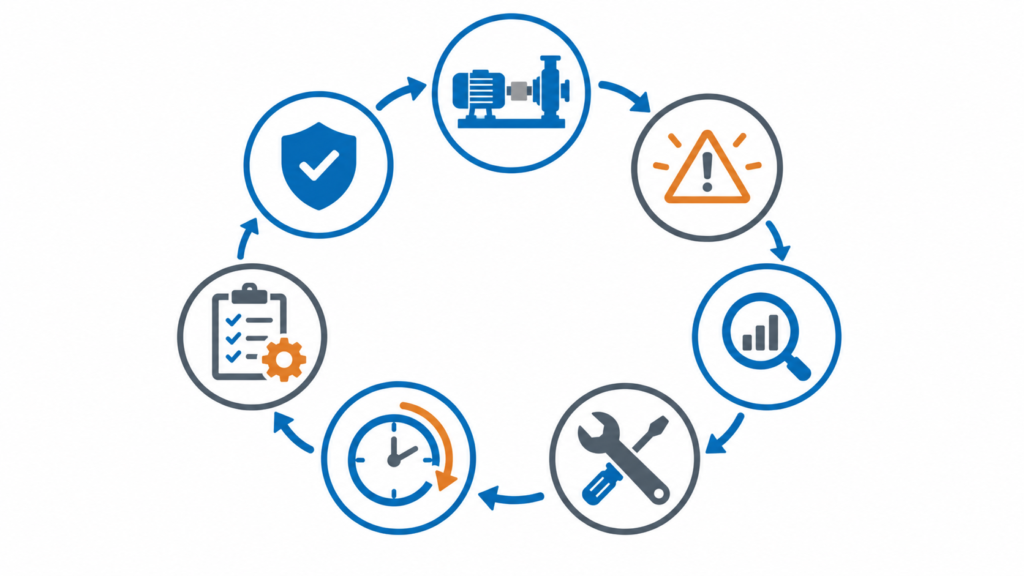
RCM is built around seven questions that must be answered for each asset.
| Question | What It Addresses |
|---|---|
| 1. What are the functions and performance standards? | What is the equipment supposed to do, and to what standard? |
| 2. What are the functional failures? | How does the equipment fail to meet its function? |
| 3. What are the failure modes? | What causes each functional failure? |
| 4. What are the failure effects? | What happens when each failure mode occurs? |
| 5. What are the failure consequences? | How serious are the effects? |
| 6. What can be done to predict or prevent the failure? | What tasks can address the failure mode? |
| 7. What if no suitable task can be found? | What is the fallback if prevention is not possible? |
Answering these questions systematically produces a maintenance program based on actual need.
Failure Consequences
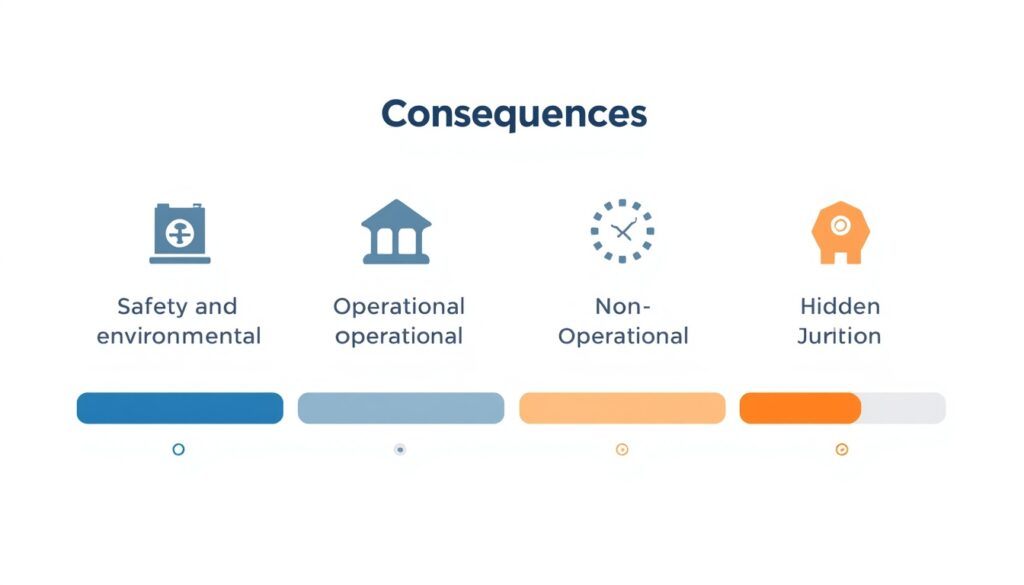
Not all failures are equal. RCM categorizes consequences into four types:
| Consequence Category | Description | Examples |
|---|---|---|
| Safety and environmental | Failure could cause injury, loss of life, or environmental damage | Pressure vessel rupture, toxic release |
| Operational | Failure affects output, quality, or cost | Pump failure stopping production |
| Non-operational | Failure affects only repair cost | Minor instrument failure |
| Hidden | Failure is not evident to operators | Standby pump failure |
The category determines how much effort is justified in preventing the failure. Safety and environmental consequences justify the most effort. Non-operational consequences justify the least.
Failure Modes and Effects Analysis (FMEA)
FMEA is the analytical tool used in RCM to identify failure modes and their effects. It is typically performed by a team that includes:
- Operations personnel (who know how equipment is used)
- Maintenance personnel (who know how equipment fails)
- Engineers (who understand design and failure mechanisms)
- Facilitator (who guides the process)
The facilitator guides the RCM analysis, ensures the team follows the process, and keeps the discussion focused. A skilled facilitator is essential for an effective RCM analysis, especially when the team includes members with different perspectives. Without strong facilitation, sessions can drift into unrelated troubleshooting discussions or get stuck debating failure probabilities instead of moving through the seven questions in sequence.
Typical FMEA steps:
- Define the equipment and its functions.
- Identify functional failures.
- Identify failure modes for each function.
- Identify failure effects for each mode.
- Assess consequences.
- Identify existing controls.
- Recommend actions.
FMEA is best performed as a team exercise. It captures knowledge from multiple perspectives and builds ownership of the resulting maintenance program.
Maintenance Task Selection
Once failure modes are identified, RCM determines what maintenance, if any, is appropriate.
Task categories:
| Task Type | Description | When to Use |
|---|---|---|
| Preventive (scheduled) | Tasks performed at fixed intervals | When failure has a clear age-related pattern |
| Predictive (condition-based) | Tasks based on condition monitoring | When failure can be detected before it occurs |
| Detection (failure-finding) | Tasks that check hidden functions | For hidden failures (e.g., standby equipment) |
| Redesign | Changing equipment or procedures | When no task is effective |
| Run-to-failure | No maintenance until failure | When consequences are acceptable |
The choice depends on the failure mode and its consequences. Not every failure mode can be prevented, and not every one needs to be.
The RCM Decision Process
The decision process can be summarized as follows:
- Is the failure mode evident to operators?
If no, use failure-finding tasks. - Does the failure mode have safety or environmental consequences?
If yes, preventive or predictive tasks must be applied, or the design must be changed. - Does the failure mode have operational consequences?
If yes, preventive or predictive tasks are justified if cost-effective. - Does the failure mode have only non-operational consequences?
If yes, run-to-failure may be acceptable. - Is there a suitable task?
If no, consider redesign or accept the risk.
This process ensures that maintenance effort is proportional to the consequences of failure.
Applying RCM in Practice
Full RCM can be time-consuming, especially for large plants with many assets. For small to medium-scale plants, a pragmatic approach is often appropriate.
Practical steps:
- Select the scope: Focus on critical equipment first. Not every asset needs full RCM analysis.
- Assemble the team: Include operations, maintenance, and engineering.
- Gather information: Equipment manuals, failure history, and operating experience.
- Perform FMEA: Identify functions, failures, modes, effects, and consequences.
- Select tasks: Determine what maintenance is appropriate for each failure mode.
- Document decisions: Record the analysis and the resulting maintenance program.
- Implement and review: Apply the program and review it periodically.
For plants new to RCM, a pilot project on one critical system is often recommended. This allows the team to learn the process, demonstrate results, and build support before applying RCM more broadly. A well-chosen pilot—typically a system with a known reliability problem or high consequence of failure—gives the team a visible win that makes it easier to justify expanding RCM to the rest of the plant.
RCM analysis can be supported by specialized software that guides the team through the seven questions, stores failure mode data, and generates maintenance tasks. Spreadsheets can also be used for smaller analyses. Software tools become more valuable as the number of assets grows, since they make it easier to track decisions, link failure modes to maintenance tasks in a CMMS, and update the analysis over time.
RCM is not a one-time exercise. It should be reviewed as equipment ages, operating conditions change, and new information becomes available.
Streamlined Approaches
Full RCM can be resource-intensive. Several streamlined approaches are available:
| Approach | Description | When to Use |
|---|---|---|
| Classical RCM | Full seven-question analysis for each asset | Critical, complex equipment |
| Streamlined RCM | Focused analysis using templates and experience | Most plant equipment |
| PM Optimization | Review and improve existing maintenance program | When a program already exists |
| Criticality-based | Apply RCM only to critical equipment | Small plants with limited resources |
For small plants, a criticality-based or streamlined approach is often the most practical.
Common Mistakes in RCM
Even experienced practitioners make mistakes. Common ones include:
- Applying RCM to everything: Wasting resources on non-critical equipment.
- Skipping the team approach: Missing knowledge from operations and maintenance.
- Ignoring consequences: Focusing on failure modes without assessing their impact.
- Over-analyzing: Getting lost in detail rather than making decisions.
- Not implementing results: Producing a report that sits on a shelf.
- Not reviewing: Failing to update the analysis as conditions change.
- Confusing RCM with a one-time project: Treating it as a task, not a practice.
These mistakes reduce the value of RCM and can lead to its abandonment.
How Japanese EPC Firms Approach RCM
Japanese engineering firms are known for their disciplined approach to maintenance and reliability. Common characteristics include:
- Thorough analysis: RCM is performed carefully, with input from all relevant disciplines.
- Focus on critical equipment: Resources are directed to equipment where failure matters most.
- Detailed documentation: Analysis, decisions, and results are carefully recorded.
- Integration with operations: RCM is connected to daily operations and maintenance planning.
- Continuous improvement: RCM is reviewed and updated as conditions change.
- Long-term focus: RCM is treated as an ongoing practice, not a one-time project.
For plant owners, this often means a maintenance program that is both effective and efficient—neither over-maintaining nor under-maintaining.
How to Evaluate RCM Readiness
When considering RCM for your plant, ask:
| Question | Why It Matters |
|---|---|
| Is critical equipment identified? | Focuses RCM effort where it matters |
| Is there a cross-functional team? | Brings together operations, maintenance, and engineering |
| Is failure history available? | Informs failure mode analysis |
| Are consequences assessed? | Determines how much effort is justified |
| Are tasks selected based on failure mode? | Ensures maintenance is appropriate |
| Is the analysis documented? | Supports implementation and review |
| Is there a plan for review? | Keeps the program current |
A plant that addresses these questions is ready to benefit from RCM.
Key Takeaways
- RCM determines maintenance requirements based on functions, failure modes, and consequences, and its requirements are formally defined in SAE JA1011.
- The seven questions provide a structured framework for analysis.
- Failure consequences (safety, operational, non-operational, hidden) determine how much effort is justified.
- FMEA, guided by a skilled facilitator, identifies failure modes and their effects.
- Maintenance tasks are selected based on failure mode and consequence.
- A pilot project on one critical system helps plants new to RCM build the process and demonstrate value before scaling up.
- Streamlined approaches and supporting software make RCM practical for small plants.
- Japanese EPC firms emphasize thorough analysis and integration with operations.
Conclusion
Reliability-Centered Maintenance is a structured approach to determining what maintenance equipment actually needs. It replaces habit and generic schedules with analysis based on functions, failure modes, and consequences.
For small to medium-scale industrial plants, RCM—applied pragmatically—can improve reliability, reduce maintenance cost, and focus limited resources where they matter most. It is not a quick fix, but it is a proven approach for plants that want to get maintenance right.