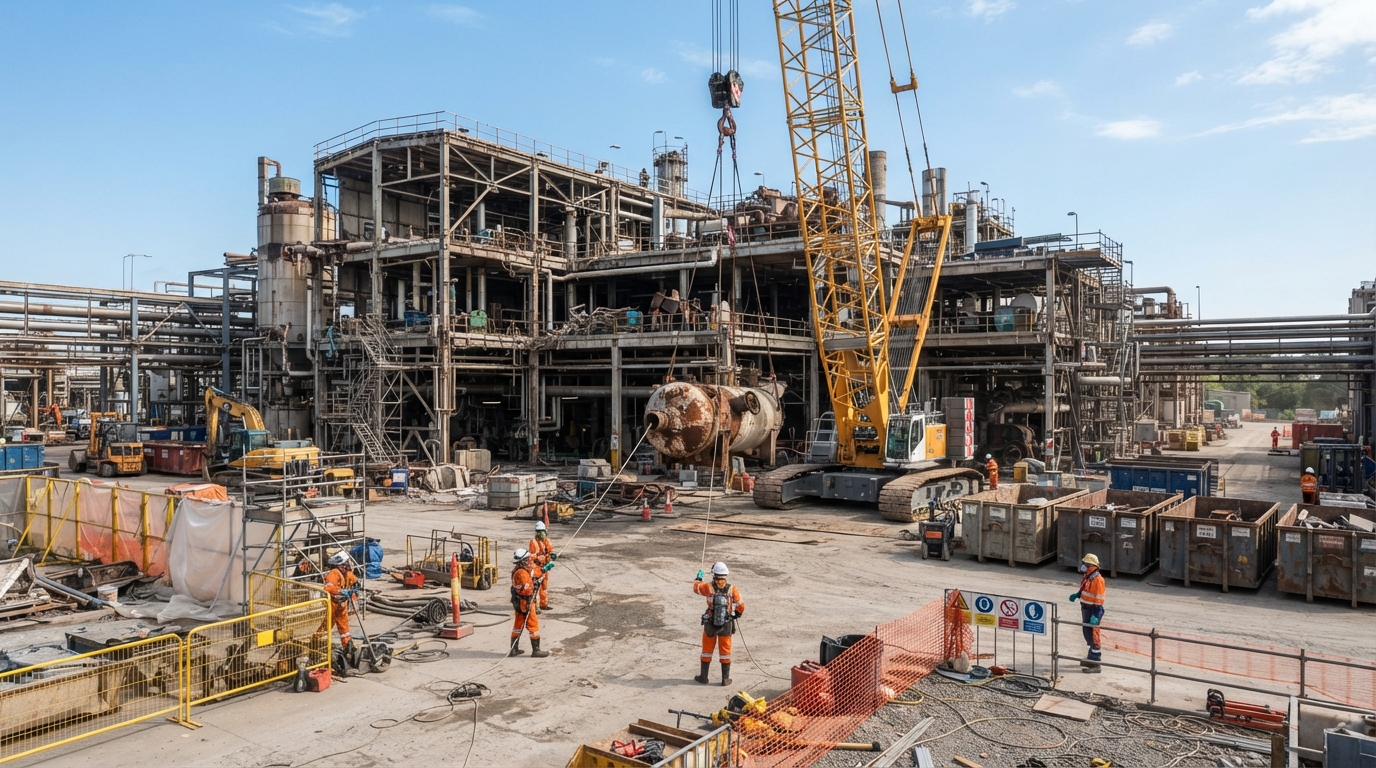
Every industrial plant eventually reaches the end of its operating life. Whether the decision is driven by economics, regulation, obsolescence, or the end of a project, decommissioning is the final phase of the plant lifecycle. It is the process of safely shutting down, dismantling, and removing the plant, and returning the site to a condition suitable for its next use.
Decommissioning is complex, expensive, and often underestimated. It involves hazardous materials, aging equipment, regulatory requirements, and the need to protect workers, the public, and the environment. Done poorly, decommissioning creates safety incidents, environmental liabilities, and legal problems. Done well, it closes out the plant’s life responsibly and prepares the site for its future.
For small to medium-scale industrial plants, decommissioning is especially important because there is less redundancy and fewer resources to absorb the consequences of a poorly planned shutdown. Owners who plan early and execute carefully avoid the traps that catch those who leave it too late.
This article covers the key considerations in plant decommissioning, from planning to final site restoration and post-closure obligations.
What Is Plant Decommissioning?
Plant decommissioning is the process of safely and permanently shutting down a plant, removing equipment and structures, and restoring the site. It includes:
- Shutdown: Ceasing operations and isolating the plant from utilities and feedstock.
- Decontamination: Removing hazardous materials and residues from equipment and systems.
- Dismantling: Removing equipment, piping, structures, and foundations.
- Waste management: Handling, treating, and disposing of hazardous and non-hazardous waste.
- Site restoration: Returning the site to a condition suitable for its next use.
- Documentation: Recording the process for regulatory and legal purposes.
- Post-closure obligations: Meeting any monitoring or maintenance requirements that continue after the work is complete.
Decommissioning is not just demolition. It is a structured process that must be planned, executed, and documented.
Why Decommissioning Matters
Decommissioning decisions have significant consequences.
| Factor | Impact of Good Decommissioning | Impact of Poor Decommissioning |
|---|---|---|
| Safety | Hazards identified and controlled | Incidents during dismantling |
| Environment | Contamination contained and removed | Soil and groundwater contamination |
| Cost | Budget managed; no surprises | Cost overruns and unexpected liabilities |
| Compliance | Regulations met; permits closed | Fines, penalties, and legal action |
| Liability | Site released for future use | Long-term liability and restrictions |
| Reputation | Responsible closure | Reputation damage |
| Asset recovery | Value recovered from equipment | Value lost |
For small plants, decommissioning is often the final major project the owner undertakes. It deserves the same planning discipline as construction.
The Case for Early Planning
Decommissioning is often planned too late. Owners focus on operations and defer decommissioning planning until the plant is already shut down. This leads to:
- Higher costs: Urgency forces expensive decisions.
- Regulatory problems: Permits and approvals take time.
- Safety risks: Hazards are not identified and controlled.
- Environmental liabilities: Contamination is discovered too late.
- Lost value: Equipment is scrapped instead of sold or reused.
- Lost knowledge: Experienced operators leave, and with them the knowledge of what is in the plant and where.
Decommissioning should be planned years in advance, ideally while the plant is still operating. Many owners keep a preliminary decommissioning plan and update it periodically throughout the plant’s life.
◆ Decommissioning Strategy Options
Before detailed planning begins, the owner must decide how to approach decommissioning. The main options are:
| Strategy | Description | Typical Use |
|---|---|---|
| Immediate dismantling | Decommissioning begins soon after shutdown | Site needed for reuse; knowledgeable staff still available |
| Deferred dismantling | Plant is secured and maintained in a safe state, then dismantled later | Awaiting funding, market conditions, or a redevelopment decision |
| Mothballing (care and maintenance) | Plant is preserved so it can potentially restart | Temporary shutdown with possible return to service |
| Entombment or partial retention | Some structures or systems left in place with controls | Where removal is impractical or unnecessary (rare, regulator-dependent) |
| Sale or transfer | Plant sold for continued operation or relocation | Plant still has operating value |
Each option has different costs, risks, and regulatory implications. Immediate dismantling retains plant knowledge and avoids long-term security costs. Deferred dismantling postpones expenditure but carries ongoing maintenance, security, and deterioration risks. The decision should be made deliberately, not by default. Before committing to decommissioning, owners should also confirm that alternatives such as life extension, repowering, or sale have been properly evaluated.
Decommissioning Phases
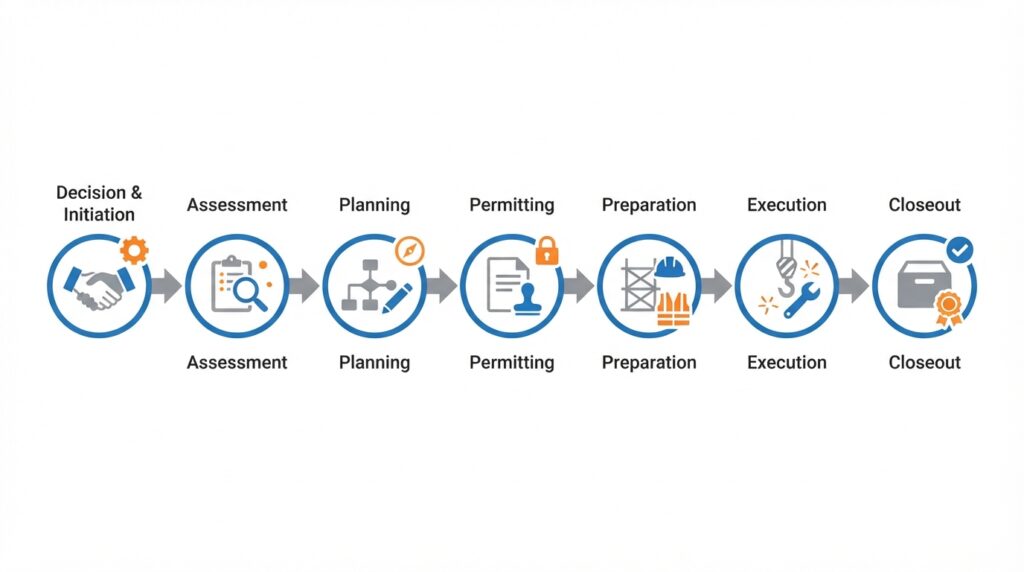
A decommissioning project typically follows several phases.
| Phase | Description |
|---|---|
| 1. Decision and initiation | Decision to decommission; strategy selection; preliminary planning |
| 2. Assessment | Site characterization, hazard identification, and regulatory review |
| 3. Planning | Detailed scope, schedule, budget, and resource plan |
| 4. Permitting | Regulatory approvals and permits |
| 5. Preparation | Shutdown, isolation, decontamination, and site setup |
| 6. Execution | Dismantling, waste management, and site restoration |
| 7. Closeout | Final documentation, regulatory closure, site release, and post-closure obligations |
Each phase builds on the previous one. Rushing planning leads to problems during execution.
Site Characterization
Site characterization is the foundation of decommissioning planning.
What site characterization covers:
- Hazardous materials: Asbestos, lead, mercury, PCBs, and other regulated materials.
- Contamination: Soil, groundwater, and building contamination.
- Equipment: Types, condition, and potential value.
- Structures: Buildings, foundations, and underground systems such as tanks, sumps, and buried piping.
- Utilities: Power, water, gas, and sewer connections.
- Regulatory status: Permits, licenses, and compliance obligations.
- Records: As-built drawings, operating history, spill and incident records, and past environmental assessments.
Characterization typically combines document review, site inspection, interviews with long-serving staff, and sampling and testing. Historical records matter because past operations, spills, and modifications often explain where contamination or hidden hazardous materials may be found. Characterization should be thorough enough to support accurate planning and budgeting.
Hazardous Materials
Industrial plants contain many hazardous materials that must be identified and managed during decommissioning.
| Material | Common Locations | Management |
|---|---|---|
| Asbestos | Insulation, gaskets, roofing, flooring | Licensed removal and disposal |
| Lead | Paints, batteries, piping | Controlled removal and disposal |
| Mercury | Instruments, switches, lamps | Controlled removal and disposal |
| PCBs | Transformers, capacitors, fluids | Regulated disposal |
| Refrigerants | Cooling systems | Recovery and recycling |
| Process chemicals | Process equipment, tanks, piping | Neutralization or disposal |
| Fuels, oils, and lubricants | Tanks, machinery, sumps | Drain, recover, and dispose or recycle |
| Radioactive materials | Instruments, gauges | Licensed disposal |
Some plants also have naturally occurring radioactive material (NORM) in scale or sludge, for example in oil and gas or geothermal facilities. This requires specific assessment and handling.
Hazardous materials must be identified before dismantling begins. Discovering them during demolition creates safety risks and cost overruns.
◆ Shutdown and Isolation
Safe decommissioning begins with a controlled shutdown and positive isolation of the plant.
Key shutdown and isolation activities:
- Controlled shutdown: Stopping operations in a planned sequence.
- Inventory removal: Draining, emptying, and removing feedstock, intermediates, products, fuels, and chemicals.
- Energy isolation: Disconnecting and locking out electrical, steam, compressed air, hydraulic, and other energy sources.
- Utility disconnection: Isolating water, gas, and sewer connections, and coordinating with the utility providers.
- Positive isolation: Using blinds, spades, or physical disconnection rather than relying on valves alone.
- Stored energy: Releasing pressure, springs, and elevated or suspended loads.
- Temporary services: Retaining only the power, water, lighting, and fire protection needed to support the decommissioning work.
Fire protection, security, and emergency response capability must be maintained throughout decommissioning. An idle or partly dismantled plant is often at higher risk, not lower.
Decontamination
Decontamination removes hazardous materials and residues from equipment and systems before dismantling.
Decontamination methods:
- Flushing: Removing liquids and residues with water or solvents.
- Steaming: Removing residues with steam.
- Chemical cleaning: Removing deposits with chemical agents.
- Mechanical cleaning: Removing residues with brushes, scrapers, or blasting.
- Ventilation: Removing gases and vapors.
Decontamination must be verified before dismantling begins. Verification typically involves sampling and testing. Wash water and cleaning fluids are themselves waste and must be collected, treated, and disposed of properly.
Dismantling
Dismantling is the physical removal of equipment, piping, structures, and foundations.
Dismantling methods:
| Method | Description | Application |
|---|---|---|
| Manual dismantling | Hand tools and small equipment | Small items, delicate equipment |
| Mechanical dismantling | Excavators, shears, and cutting equipment | Large structures, piping |
| Explosive demolition | Controlled explosives | Large structures (rare for plants) |
| Cutting | Thermal, mechanical, or abrasive cutting | Piping, steel structures |
| Lifting and removal | Cranes and heavy equipment | Large equipment, vessels |
Dismantling must be planned to protect workers, the public, and the environment. For structures, a demolition engineering plan should address sequence, temporary support, and stability at each stage. Hot work on previously contaminated or coated steel needs particular care, because cutting can release toxic fumes from lead paint, coatings, or residues.
Waste Management
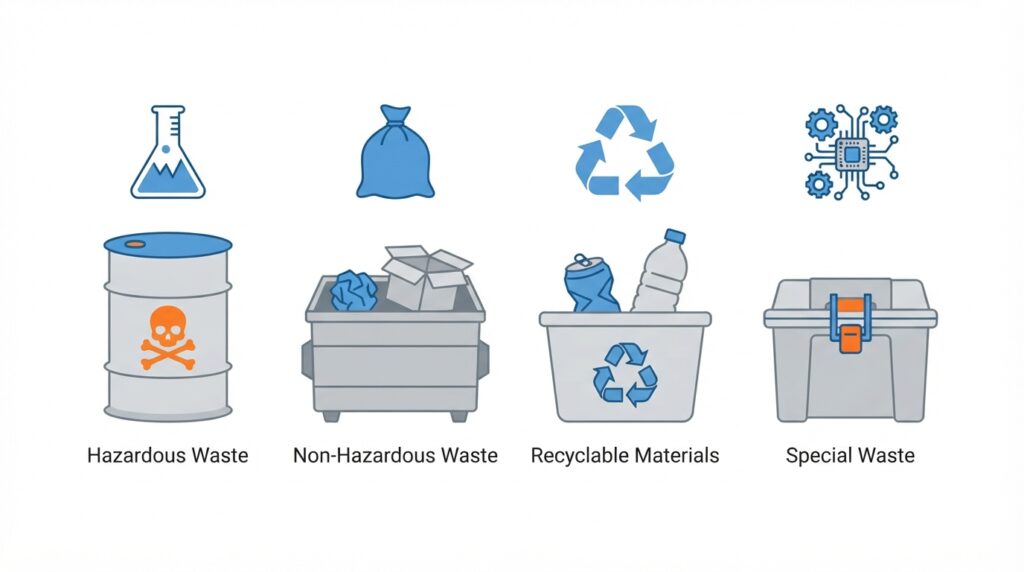
Decommissioning generates large quantities of waste.
Waste categories:
| Category | Examples | Management |
|---|---|---|
| Hazardous waste | Contaminated equipment, chemicals, fuels | Licensed disposal |
| Non-hazardous waste | Concrete, steel, packaging | Recycling or landfill |
| Recyclable materials | Steel, copper, aluminum | Recycling |
| Special waste | Asbestos, PCBs, radioactive materials, NORM | Specialized disposal |
Waste management should be planned to minimize waste, maximize recycling, and ensure regulatory compliance. Waste should be segregated at the source, because mixing hazardous and non-hazardous waste turns a small problem into a large and expensive one. Owners should also keep manifests and disposal records, since they may remain liable for waste even after it has left the site.
Asset Recovery
Decommissioning is not just about removal. It is also about recovering value.
Asset recovery options:
- Sale of equipment: Equipment in good condition may have market value.
- Sale of scrap: Steel, copper, and other metals have scrap value.
- Reuse: Equipment may be reused at other facilities.
- Spare parts: Parts may be sold or reused.
Asset recovery should be planned as part of the decommissioning project. Equipment should be removed in a sequence that preserves its value, and certain items may need decontamination or certification before sale. Revenue from asset recovery can offset decommissioning costs, though it should not be assumed to cover them. Scrap and equipment prices fluctuate, so cost estimates should treat recovery revenue conservatively.
◆ Decommissioning Cost Estimation
Decommissioning costs are often underestimated. Cost estimates should include characterization, permitting, decontamination, dismantling, waste management, site restoration, and contingency. Historical data from similar projects and industry benchmarks can improve accuracy.
Cost estimation practices:
- Estimate by phase and work package: Do not rely on a single lump sum.
- Include owner’s costs: Project management, security, insurance, utilities during the work, and regulatory fees.
- Include post-closure costs: Monitoring and maintenance obligations after the work is done.
- Apply appropriate contingency: Uncertainty is highest where characterization is incomplete, so contingency should reflect that.
- Account for asset recovery conservatively: Treat salvage and scrap revenue as an offset, not a certainty.
- Update regularly: Revise the estimate as the plant ages, regulations change, and characterization improves.
An estimate prepared years before shutdown is a planning tool, not a final budget. It should be refined as better information becomes available.
◆ Financial Assurance
Some jurisdictions require owners to provide financial assurance, such as bonds, letters of credit, or trust funds, to cover decommissioning costs. These requirements should be identified early and factored into financial planning.
Even where financial assurance is not mandatory, owners should consider how decommissioning will be funded. Common approaches include:
- Dedicated reserve or sinking fund: Set aside gradually over the plant’s operating life.
- Surety bonds or letters of credit: Provide assurance without tying up cash.
- Parent company guarantees: Where the owner’s creditworthiness supports them.
- Project financing provisions: Decommissioning costs built into the original financing structure.
Accounting and tax treatment of decommissioning obligations also vary by jurisdiction, and owners should seek appropriate professional advice.
Regulatory Requirements
Decommissioning is subject to many regulatory requirements.
Common regulatory areas:
- Environmental permits: For waste management, emissions, and discharges.
- Safety regulations: For worker protection during dismantling.
- Hazardous materials regulations: For asbestos, lead, and other regulated materials.
- Building and demolition permits: For structural work.
- Land use and zoning: For site restoration.
- Notification and closure requirements: Notices to authorities, and formal approval of closure plans.
- Financial assurance requirements: Where applicable (see above).
Regulatory requirements vary by jurisdiction. Owners should identify applicable requirements early and plan for the time needed to obtain approvals. Early engagement with regulators usually reduces surprises and delays.
Planning Decommissioning
Decommissioning should be planned as a project, with the same discipline as construction.
Planning elements:
- Scope: What will be removed, and what will remain?
- Schedule: How long will decommissioning take?
- Budget: What is the cost, and how will it be funded?
- Resources: Who will do the work, and what skills are needed?
- Risk: What are the risks, and how will they be managed?
- Regulatory: What approvals and permits are required?
- Waste: How will waste be managed?
- Site restoration: What condition will the site be left in?
- Post-closure: What obligations continue after the work is complete?
Planning should begin early, ideally while the plant is still operating.
Decommissioning Organization
A clear organization is essential for decommissioning success.
Key roles:
| Role | Responsibility |
|---|---|
| Decommissioning Manager | Overall responsibility for the project |
| Project Engineer | Technical planning and execution |
| Safety Manager | Safety oversight and compliance |
| Environmental Manager | Environmental compliance and waste management |
| Procurement Manager | Contracting and materials |
| Cost Controller | Budget tracking and cost control |
| Regulatory Liaison | Interaction with regulators |
For small plants, roles may be combined, but the functions must be covered.
◆ Contractor Selection
Decommissioning often requires specialized contractors with experience in hazardous materials removal, demolition, and waste management. Contractor prequalification should consider safety record, licensing, and relevant experience.
Additional considerations in contractor selection:
- Scope clarity: Define who is responsible for what, especially for hazardous materials discovered during the work.
- Contract structure: Lump sum, unit rate, and cost-reimbursable arrangements allocate risk differently. Where characterization is incomplete, a lump-sum contract may transfer less risk than it appears to.
- Waste responsibility: Clarify who selects disposal facilities and who retains liability for waste.
- Salvage rights: Define ownership of recovered materials and how revenue is shared.
- Insurance and financial strength: Confirm adequate coverage and capacity.
- Subcontractor control: Ensure subcontractors meet the same standards.
- Single versus multiple contractors: A single contractor simplifies coordination, while multiple specialists may offer better expertise for specific tasks.
Safety in Decommissioning
Decommissioning involves high-risk activities: hazardous materials, heavy lifting, cutting, and demolition.
Safety considerations:
- Hazard identification: What hazards are present?
- Decontamination: Have hazardous materials been removed?
- Permits: What permits are required, including hot work, confined space, and work at height?
- Training: Are personnel trained for their tasks?
- PPE: What protective equipment is required?
- Emergency response: What if something goes wrong?
- Simultaneous operations: How are conflicting activities managed?
- Contractor safety: Are contractors aligned with safety requirements?
- Structural stability: Are partly dismantled structures safe to work around?
- Health monitoring: Are workers exposed to asbestos, lead, or other hazards being monitored?
Safety must be planned into decommissioning, not added as an afterthought.
Environmental Protection
Decommissioning can create environmental liabilities if not managed properly.
Environmental considerations:
- Contamination: Have soil and groundwater been assessed?
- Waste management: Is waste being managed in compliance with regulations?
- Emissions: Are emissions from dismantling controlled?
- Discharges: Are discharges to water controlled?
- Noise and dust: Are these controlled for workers and neighbors?
- Stormwater: Is runoff from open and disturbed ground controlled?
- Site restoration: Is the site being restored to a suitable condition?
Environmental protection should be integrated into every phase of decommissioning. Where contamination is found, remediation planning should begin as soon as the extent is understood. Remediation is often the largest source of schedule and cost uncertainty.
◆ Stakeholder, Community, and Workforce Considerations
Decommissioning affects people as well as property.
- Workforce: Plan for redundancy, redeployment, or retention of key staff. Retaining a small number of experienced operators through decommissioning can be very valuable, because they know where hazards and hidden systems are.
- Knowledge retention: Capture operating and maintenance knowledge before staff leave.
- Community: Neighbors, local authorities, and community groups should be informed about the schedule, traffic, noise, and dust. Good communication builds trust and reduces complaints.
- Employees and contractors: Safety communication must continue even as the site winds down.
- Customers and suppliers: Contracts, supply agreements, and offtake arrangements must be closed out or transferred.
Site Restoration
Site restoration returns the site to a condition suitable for its next use.
Restoration options:
| Option | Description |
|---|---|
| Industrial reuse | Site prepared for new industrial use |
| Commercial reuse | Site prepared for commercial development |
| Residential reuse | Site prepared for residential development |
| Green space | Site restored as parkland or natural area |
| Agricultural use | Site restored for agricultural use |
Restoration requirements depend on the intended future use and applicable regulations. Residential and agricultural use generally require stricter cleanup standards than industrial reuse. Decisions about foundations, underground structures, and backfill should be made with the future use in mind.
◆ Post-Decommissioning Monitoring
Some sites require post-decommissioning monitoring. An example is groundwater monitoring after contamination remediation. These obligations should be identified and planned for.
Typical post-closure considerations:
- Monitoring programs: Groundwater, soil gas, or surface water sampling over a defined period.
- Land use restrictions: Deed restrictions or institutional controls limiting future use.
- Maintenance: Caps, covers, fences, or other engineered controls.
- Reporting: Periodic reports to regulators.
- Funding: Budget set aside for the duration of the obligation.
- Responsibility: Clear assignment of who is responsible, especially if the site is sold.
Post-closure obligations can last years or decades, so they should be included in cost estimates and financial planning from the beginning.
◆ Documentation and Closeout
Good records protect the owner long after the work is finished.
Closeout documentation typically includes:
- Characterization reports and sampling results
- Decontamination verification records
- Waste manifests and disposal certificates
- Permits, approvals, and regulatory correspondence
- Worker exposure and incident records
- Final site condition survey and, where required, a final environmental assessment
- Regulatory closure or release documentation
- As-left drawings showing what remains on site, such as foundations or underground structures
- Lessons learned for future projects
Records should be retained for as long as any legal or regulatory obligation continues. Where a site is sold, documentation should be transferred or made available to the new owner.
Common Mistakes in Decommissioning
Even experienced organizations make mistakes. Common ones include:
- Planning too late: Starting decommissioning planning after shutdown.
- Incomplete characterization: Missing hazardous materials or contamination.
- Underestimating cost: Decommissioning is often more expensive than expected.
- Ignoring regulations: Failing to identify and comply with requirements.
- Ignoring financial assurance: Not identifying funding obligations early.
- Poor contractor selection: Choosing on price alone, without regard to safety record and experience.
- Poor waste management: Creating environmental liabilities.
- Safety shortcuts: Leading to incidents.
- Losing plant knowledge: Releasing key staff before the work is done.
- No asset recovery: Missing opportunities to recover value.
- Inadequate documentation: Problems with regulatory closure.
- No post-decommissioning monitoring plan: Missing ongoing obligations.
These mistakes are costly to correct. They are much cheaper to avoid through early planning and disciplined execution.
How Japanese EPC Firms Approach Decommissioning
Japanese engineering firms are known for their disciplined approach to decommissioning. Common characteristics include:
- Thorough planning: Decommissioning is planned carefully, often years in advance.
- Detailed characterization: Site conditions and hazards are assessed thoroughly.
- Safety focus: Safety is prioritized throughout.
- Environmental responsibility: Environmental protection is integrated into every phase.
- Regulatory compliance: Requirements are identified and met.
- Detailed documentation: Records are complete and accurate.
- Careful community communication: Neighbors and local authorities are kept informed.
- Long-term focus: Decommissioning is treated as the final phase of responsible plant ownership.
For plant owners, this often means decommissioning that is completed safely, compliantly, and without leaving long-term liabilities.
How to Evaluate Decommissioning Readiness
When considering decommissioning for your plant, ask:
| Question | Why It Matters |
|---|---|
| Has the decommissioning strategy been chosen? | Determines timing, cost, and risk |
| Has site characterization been completed? | Identifies hazards and contamination |
| Have regulatory requirements been identified? | Ensures compliance and avoids delays |
| Is there a decommissioning plan? | Provides a roadmap for the work |
| Is there a cost estimate and budget? | Ensures realistic expectations |
| Is funding or financial assurance in place? | Ensures money is available when needed |
| Is there a contractor selection approach? | Ensures qualified, safe contractors |
| Is there a waste management plan? | Ensures waste is handled properly |
| Is there a safety plan? | Protects workers during high-risk work |
| Is there an environmental plan? | Prevents long-term liabilities |
| Is there a plan for asset recovery? | Recovers value from equipment |
| Is there a plan for site restoration? | Ensures the site is suitable for its next use |
| Are post-closure obligations identified? | Avoids unplanned long-term costs |
| Is there a plan for documentation and closure? | Ensures regulatory closure |
A plant that addresses these questions is ready to plan and execute decommissioning.
Conclusion
Plant decommissioning is the final phase of the plant lifecycle. It is complex, expensive, and often underestimated, but it can be managed successfully with early planning, thorough characterization, realistic cost estimation, and disciplined execution.
For small to medium-scale industrial plants, decommissioning is often the last major project the owner undertakes. By planning early, funding it properly, selecting qualified contractors, addressing safety and environmental risks, complying with regulations, and documenting the process, owners can close out the plant’s life responsibly and prepare the site for its future.
Key Takeaways
- Decommissioning is the final phase of the plant lifecycle
- It involves shutdown, decontamination, dismantling, waste management, and site restoration
- Decommissioning should be planned years in advance, ideally while the plant is still operating
- Site characterization identifies hazards, contamination, and regulatory requirements
- Hazardous materials must be identified and managed before dismantling
- Cost estimates should cover all phases, include contingency, and be updated regularly
- Financial assurance requirements should be identified early and built into financial planning
- Specialized contractors should be prequalified on safety record, licensing, and experience
- Waste management must comply with regulations and minimize environmental impact
- Asset recovery can offset decommissioning costs
- Safety and environmental protection must be integrated into every phase
- Post-decommissioning monitoring obligations should be identified and planned for
- Japanese EPC firms emphasize thorough planning and disciplined execution