
Commissioning ends, and operation begins. From this point forward, the plant must run reliably, efficiently, and safely for years—often decades. Operations and maintenance (O&M) is what determines whether the plant delivers on the promises made during design and construction.
For small to medium-scale industrial plants, O&M is especially critical because there is less redundancy and fewer resources to absorb unexpected failures. A well-run O&M program keeps the plant available, controls costs, and extends equipment life. A poor one leads to frequent outages, rising maintenance costs, and declining performance.
This article covers the key strategies for reliable and efficient plant operations and maintenance, from organization and planning to condition monitoring and continuous improvement.
What Is Operations and Maintenance?
Operations and maintenance covers everything required to run the plant and keep it in good condition.
Operations includes:
- Running the plant to meet production targets
- Monitoring process parameters
- Responding to alarms and disturbances
- Optimizing performance
- Managing startup, shutdown, and load changes
Maintenance includes:
- Preventive maintenance (scheduled tasks)
- Predictive maintenance (condition-based)
- Corrective maintenance (repairs after failure)
- Overhauls and inspections
- Spare parts management
O&M is not just about keeping equipment running. It is about running the plant safely, efficiently, and cost-effectively over its entire life.
Why O&M Matters
O&M determines the plant’s long-term performance.
| Factor | Impact of Good O&M | Impact of Poor O&M |
|---|---|---|
| Availability | High (fewer unplanned outages) | Low (frequent breakdowns) |
| Efficiency | Maintained or improved | Degrades over time |
| Maintenance cost | Controlled and predictable | Rising and unpredictable |
| Equipment life | Extended | Shortened |
| Safety | High | Compromised |
| Compliance | Maintained | At risk |
For plant owners, O&M is where the return on investment is realized—or lost.
O&M Organization
A clear organizational structure is essential for effective O&M.
Key roles:
- Plant manager: Overall responsibility for plant operations and maintenance.
- Operations manager/supervisor: Manages day-to-day operations and shift teams.
- Maintenance manager/supervisor: Manages maintenance planning, scheduling, and execution.
- Shift operators: Run the plant during their shifts.
- Maintenance technicians: Perform preventive, predictive, and corrective maintenance.
- Engineers: Provide technical support for troubleshooting and improvement.
Staffing considerations:
- Shift coverage: How many operators are needed per shift, and how many shifts?
- Specialist skills: Are specialist skills needed (e.g., vibration analysis, control tuning)?
- Training: How will staff be trained and kept current?
- Contract support: Which tasks are performed in-house vs. outsourced? Outsourcing maintenance can provide specialist skills without permanent staff, but it reduces direct control and may increase coordination effort. The decision depends on the criticality of the task, the availability of in-house skills, and cost.
For small plants, staff may wear multiple hats. Clarity of roles and responsibilities is still essential.
Maintenance Strategies
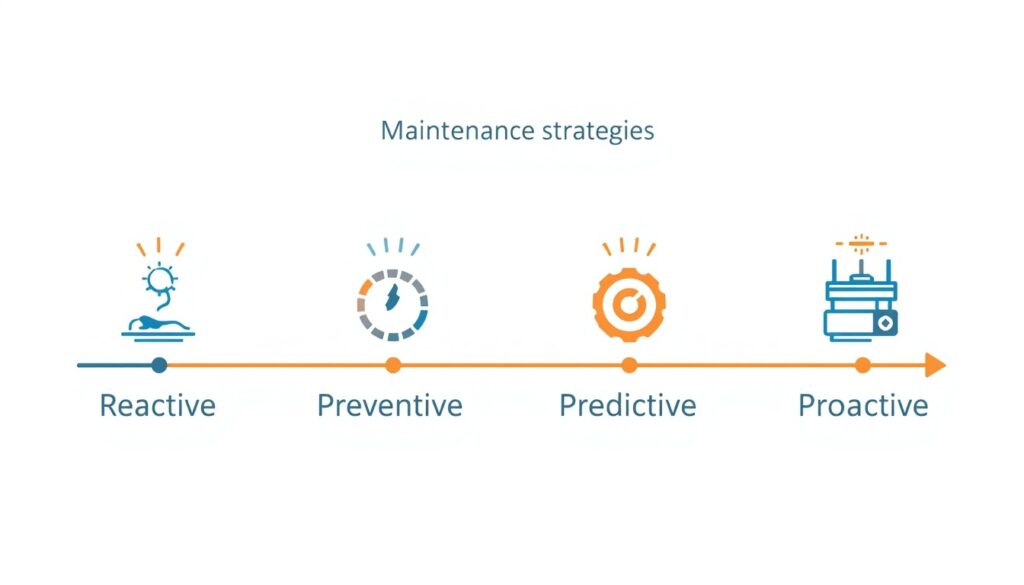
There are four main maintenance strategies. Most plants use a combination.
| Strategy | Description | Advantages | Disadvantages |
|---|---|---|---|
| Reactive (run-to-failure) | Repair after failure | Low cost for non-critical items | High risk, high cost for critical items |
| Preventive (time-based) | Scheduled maintenance at fixed intervals | Predictable, simple | May over- or under-maintain |
| Predictive (condition-based) | Maintenance based on condition monitoring | Optimized, reduces unnecessary work | Requires monitoring equipment and skills |
| Proactive (reliability-centered) | Design and maintenance to prevent failures | Long-term reliability | Requires analysis and commitment |
For small to medium-scale plants, a mix of preventive and predictive maintenance is often the most practical approach. Reactive maintenance is acceptable only for non-critical, low-cost items.
Preventive Maintenance
Preventive maintenance is scheduled maintenance performed at fixed intervals, regardless of equipment condition.
Common preventive tasks:
- Lubrication
- Filter replacement
- Inspection and cleaning
- Calibration
- Bolt tightening
- Vibration checks
Key considerations:
- Intervals: Based on manufacturer recommendations, operating experience, and criticality.
- Scheduling: Coordinated with production to minimize disruption.
- Documentation: Records of tasks performed, findings, and actions taken. Most plants use a computerized maintenance management system (CMMS) to plan, schedule, and track maintenance activities. A CMMS stores equipment records, maintenance histories, work orders, and spare parts inventory.
- Effectiveness: Intervals should be reviewed and adjusted based on experience.
Preventive maintenance is the foundation of most O&M programs, but it can be over- or under-applied if intervals are not reviewed.
Predictive Maintenance
Predictive maintenance uses condition monitoring to detect problems before they cause failure. Maintenance is performed only when needed, based on actual equipment condition.
Common predictive techniques:
| Technique | What It Detects | Typical Applications |
|---|---|---|
| Vibration analysis | Bearing wear, imbalance, misalignment | Rotating equipment |
| Thermography | Hot spots, electrical faults | Electrical panels, bearings |
| Oil analysis | Wear particles, contamination | Gearboxes, engines, turbines |
| Ultrasonic testing | Leaks, thickness loss | Piping, tanks, vessels |
| Performance monitoring | Efficiency loss, fouling | Heat exchangers, compressors |
Predictive maintenance requires:
- Monitoring equipment: Sensors, instruments, and data collection systems.
- Analysis skills: Personnel trained to interpret data.
- Baselines: Reference data to compare against.
- Action procedures: What to do when a problem is detected.
For small plants, predictive maintenance may be applied selectively to critical equipment only.
Condition Monitoring
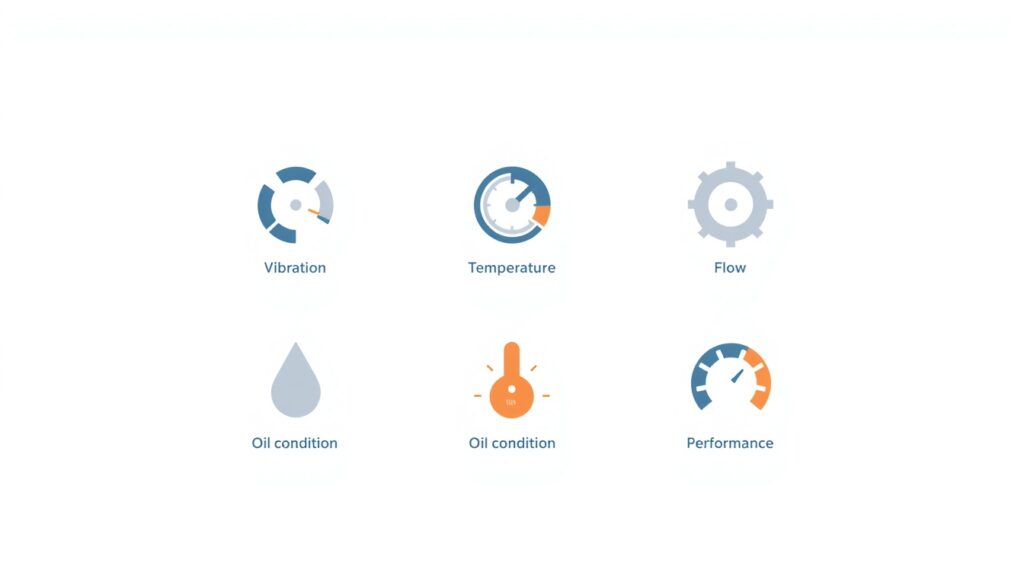
Condition monitoring is the foundation of predictive maintenance. It involves measuring equipment parameters to detect changes that indicate developing problems.
Key parameters to monitor:
- Vibration: Indicates bearing wear, imbalance, misalignment, looseness.
- Temperature: Indicates overheating, lubrication problems, electrical faults.
- Pressure: Indicates blockages, leaks, valve problems.
- Flow: Indicates fouling, blockages, pump problems.
- Oil condition: Indicates wear, contamination, degradation.
- Performance: Indicates efficiency loss, fouling, degradation.
Monitoring approaches:
- Manual: Periodic readings by operators or technicians.
- Semi-automated: Portable instruments with data logging.
- Automated: Permanently installed sensors with continuous monitoring.
For small plants, manual and semi-automated approaches are often sufficient for non-critical equipment. Critical equipment may justify automated monitoring.
Spare Parts Management
Spare parts management ensures that the right parts are available when needed, without tying up excessive capital in inventory.
Key considerations:
- Criticality: Which parts are critical to operation? Which can wait?
- Lead time: How long does it take to obtain each part?
- Cost: What is the cost of the part vs. the cost of downtime?
- Storage: Where will parts be stored, and under what conditions?
- Obsolescence: Will parts become unavailable over time?
Spare parts categories:
- Consumables: Used regularly, low cost (filters, lubricants).
- Critical spares: Essential for operation, may have long lead times.
- Insurance spares: High-cost items held in case of failure.
- Rotables: Components that are swapped out and repaired.
For small plants, a focused spare parts strategy is essential. Stocking everything is expensive; stocking nothing risks extended downtime.
Performance Monitoring and Optimization
O&M is not just about keeping equipment running. It is also about keeping the plant performing at its best.
Key performance indicators (KPIs):
- Availability: Percentage of time the plant is available for operation.
- Reliability: Frequency of forced outages.
- Heat rate: Efficiency of fuel conversion.
- Output: Actual vs. design output.
- Maintenance cost: Cost per unit of output.
- Safety: Recordable incidents, lost-time injuries.
KPIs should have targets based on design values, industry benchmarks, or historical performance. Targets should be challenging but achievable, and reviewed periodically.
Optimization opportunities:
- Operating practices: Adjusting setpoints, load allocation, startup/shutdown procedures.
- Maintenance practices: Adjusting intervals, improving procedures.
- Equipment upgrades: Replacing or modifying equipment for better performance.
- Control tuning: Optimizing control loops for stability and efficiency.
Performance monitoring helps identify where improvements are possible and whether changes are effective.
Safety in O&M
Safety is not separate from O&M. It is part of every task.
Key safety considerations:
- Permit-to-work systems: For hazardous tasks.
- Lockout/tagout: For equipment isolation.
- Personal protective equipment (PPE): Appropriate for each task.
- Training: Regular safety training for all staff.
- Incident reporting: Reporting and investigating all incidents and near-misses.
- Safety culture: Leadership commitment to safety at all levels.
Safety incidents are costly—in human terms, in downtime, and in reputation. A strong safety culture is essential for long-term O&M success.
Continuous Improvement
O&M is not static. Equipment ages, conditions change, and new techniques become available. Continuous improvement keeps the plant performing at its best.
Improvement approaches:
- Root cause analysis: Investigating failures to prevent recurrence. Root cause analysis (RCA) is a structured process for investigating failures to identify underlying causes and prevent recurrence. Common methods include 5 Whys, fishbone diagrams, and fault tree analysis.
- Reliability-centered maintenance (RCM): Analyzing equipment functions and failure modes to optimize maintenance.
- Benchmarking: Comparing performance against similar plants.
- Lessons learned: Capturing and applying lessons from projects and operations.
- Training and development: Keeping staff skills current.
Continuous improvement requires commitment from leadership and engagement from staff. It is not a one-time project but an ongoing practice.
Common Mistakes in O&M
Even experienced operators make mistakes. Common ones include:
- Neglecting preventive maintenance: Leading to premature failures.
- Over-maintaining: Performing unnecessary tasks that add cost without benefit.
- Ignoring condition monitoring data: Missing early warning signs.
- Insufficient spare parts: Leading to extended downtime.
- Poor documentation: Making troubleshooting and improvement difficult.
- Weak safety culture: Leading to incidents and injuries.
- No continuous improvement: Letting performance degrade over time.
These mistakes are costly to correct once they become habits. They are much cheaper to avoid through good planning and discipline.
How Japanese EPC Firms Approach O&M
Japanese engineering firms are known for their disciplined approach to O&M. Common characteristics include:
- Thorough planning: Maintenance plans, spare parts strategies, and training programs are developed early.
- Detailed documentation: Records of maintenance, inspections, and performance are carefully maintained.
- Discipline in execution: Procedures are followed consistently.
- Continuous improvement: Lessons are captured and applied.
- Long-term focus: O&M is treated as a long-term commitment, not a short-term cost.
For plant owners, this often means higher availability, lower maintenance costs, and longer equipment life.
How to Evaluate O&M Readiness
When reviewing O&M readiness, ask:
| Question | Why It Matters |
|---|---|
| Is there a clear O&M organization? | Ensures accountability |
| Are maintenance strategies defined? | Balances preventive, predictive, and reactive |
| Is condition monitoring in place? | Detects problems before failure |
| Is spare parts management planned? | Ensures parts are available when needed |
| Are KPIs defined and tracked? | Measures performance and identifies improvement |
| Is safety embedded in O&M? | Protects people and assets |
| Is continuous improvement practiced? | Keeps performance from degrading |
A plant that addresses these questions is likely to perform reliably and efficiently over its life.
Key Takeaways
- O&M determines long-term plant availability, efficiency, and cost
- Maintenance strategies include reactive, preventive, predictive, and proactive
- Condition monitoring detects problems before failure
- Spare parts management balances criticality, lead time, and cost
- KPIs measure performance and identify improvement opportunities
- Safety must be embedded in every O&M task
- Japanese EPC firms emphasize thorough planning and disciplined execution
Conclusion
Operations and maintenance determine whether a plant delivers on its design promise. For small to medium-scale industrial plants, O&M deserves careful planning and disciplined execution from the day the plant starts up.
By focusing on organization, maintenance strategies, condition monitoring, spare parts, performance monitoring, safety, and continuous improvement, owners and operators can ensure reliable, efficient, and safe operation for decades.