
When equipment fails, the immediate response is usually to fix it and get the plant running again. That is necessary. But if the same failure keeps happening, or if the fix addresses only the symptom and not the underlying problem, the plant is caught in a cycle of repeated failures and repeated repairs.
Root Cause Analysis (RCA) is a structured approach for finding out why a failure happened, not just what failed, and preventing it from happening again. It is one of the most valuable skills a plant team can develop, because it turns every significant failure into an opportunity to improve.
For small to medium-scale industrial plants, RCA is especially important because there is less redundancy and fewer resources to absorb repeat failures. A pump that fails every few months is more than an inconvenience; it is a drain on maintenance resources and a threat to production.
This article explains what RCA is, how it works, and how to apply it practically in an industrial plant.
What Is Root Cause Analysis?
Root Cause Analysis is a structured method for identifying the underlying causes of a problem and determining what can be done to prevent recurrence.
The key idea is that most failures have more than one cause. There is usually a chain of events and conditions that led to the failure. RCA traces that chain back to the root: the fundamental cause or causes that, if addressed, would prevent the failure from happening again.
RCA is not about assigning blame. It is about understanding what happened, why it happened, and what can be done to prevent it from happening again.
RCA vs. Troubleshooting
RCA is distinct from troubleshooting. Troubleshooting focuses on restoring operation as quickly as possible. RCA focuses on understanding why the failure occurred and preventing recurrence. Both are necessary, but they serve different purposes.
| Troubleshooting | Root Cause Analysis | |
|---|---|---|
| Goal | Restore operation | Prevent recurrence |
| Timing | During the event | After the plant is stable |
| Time scale | Minutes to hours | Days to weeks |
| Output | A repair or workaround | Corrective actions and lessons learned |
| Question asked | “What is wrong and how do we fix it?” | “Why did this happen and how do we stop it happening again?” |
The two work together. Troubleshooting should also preserve evidence for the RCA that follows (see “Gathering Data” below).
Three Types of Causes
RCA distinguishes between three layers of cause:
- Physical causes: The observable failure mechanism (a bearing seized, a seal leaked, a wire overheated).
- Human causes: The actions or omissions that allowed the physical cause to occur (lubrication was skipped, a strainer was not cleaned).
- Latent (system) causes: The weaknesses in procedures, design, training, planning, or management that made the human cause likely (no scheduled task, unclear procedure, no alarm).
Effective RCA does not stop at the physical or human cause. It reaches the latent cause, because that is what can be fixed permanently.
Why RCA Matters
Without RCA, plants tend to repeat the same failures. Common patterns include:
- Fixing symptoms, not causes: Replacing a failed bearing without addressing the misalignment that caused it to fail.
- Blaming operators: Assuming human error without examining why the error was possible.
- Skipping analysis: Restarting the plant as quickly as possible and moving on.
- Applying the wrong fix: Making changes that do not address the real cause.
RCA breaks these patterns by:
- Identifying true causes: Not just the immediate cause, but the underlying causes.
- Preventing recurrence: Addressing causes rather than symptoms.
- Improving systems: Finding weaknesses in procedures, training, design, or management.
- Capturing knowledge: Recording what was learned for future reference.
For small plants, RCA helps avoid the cycle of repeated failures that consumes maintenance resources and disrupts production. Over time, it also reduces unplanned downtime, spare parts consumption, and emergency repair costs.
When to Perform RCA
Not every failure requires full RCA. Performing RCA on every minor issue wastes resources. Performing it on none means repeating failures.
Triggers for RCA:
| Trigger | Why It Matters |
|---|---|
| Safety incident or near-miss | Protects people and prevents recurrence |
| Environmental release | Ensures compliance and prevents recurrence |
| Significant production loss | Protects revenue and customer commitments |
| Repeat failure | Indicates the true cause has not been addressed |
| High repair cost | Justifies analysis to prevent recurrence |
| Equipment criticality | Failure of critical equipment affects the whole plant |
For small plants, a threshold approach works well: perform RCA on failures that meet defined criteria (for example, downtime over a certain number of hours, cost over a certain amount, or any safety incident).
Why Near-Misses Matter
Near-misses are valuable RCA triggers because they reveal weaknesses that could cause a more serious incident. Investigating near-misses is a proactive way to prevent future incidents.
A near-miss costs nothing but attention, since no one was hurt and nothing was damaged. Yet the causal chain is often the same as in a serious accident; only the outcome differed. Plants that investigate near-misses learn from luck, rather than waiting to learn from loss.
Matching Effort to the Problem
A simple, tiered approach keeps RCA proportionate:
| Level | Typical Trigger | Approach |
|---|---|---|
| Basic | Minor repeat failure, low cost | 5 Whys by the supervisor and one or two technicians; short record |
| Standard | Significant downtime or cost | Cross-functional team; fishbone plus 5 Whys; formal report |
| Major | Serious safety, environmental, or high-consequence failure | Facilitated team; fault tree or barrier analysis; management review |
The RCA Process
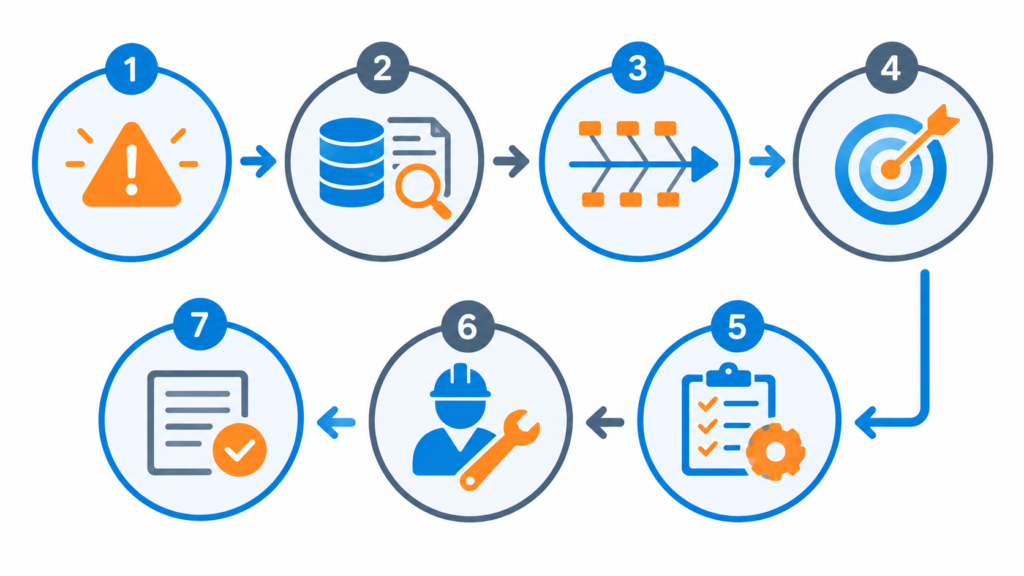
While different RCA methods exist, most follow a similar process.
| Step | Description |
|---|---|
| 1. Define the problem | What happened, when, where, and what was the impact? |
| 2. Gather data | Collect evidence: operating data, maintenance records, interviews, physical evidence. |
| 3. Identify causes | Use analytical methods to trace the chain of causes. |
| 4. Determine root cause(s) | Identify the fundamental cause(s) that, if addressed, prevent recurrence. |
| 5. Develop corrective actions | Define actions that address the root cause(s). |
| 6. Implement actions | Assign responsibility, resources, and deadlines. |
| 7. Verify effectiveness | Confirm that the actions prevented recurrence. |
RCA is not complete until the corrective actions are implemented and verified.
Defining the Problem
A well-written problem statement keeps the team focused. It should be factual and specific, and should not include assumed causes or blame. Compare:
- Weak: “Operator error damaged Pump P-101.”
- Strong: “Pump P-101 mechanical seal leaked on 14 March at 02:30, causing a 9-hour shutdown of Line 2 and an estimated production loss of X.”
Include what happened, where, when, the extent of the impact, and how it was detected.
The RCA Team
For anything beyond a basic analysis, use a small cross-functional team, typically three to six people. Useful members include:
- An operator who was on shift or familiar with the equipment
- A maintenance technician or planner
- An engineer (process, mechanical, or instrumentation as relevant)
- A facilitator who keeps the process on track and ensures no one is blamed
The facilitator should ideally not be the person responsible for the area under review. In a small plant, this may be a supervisor from another department.
RCA Methods and Tools
Several methods and tools are available. The choice depends on the complexity of the problem and the experience of the team.
| Method | Description | Best For |
|---|---|---|
| 5 Whys | Asking “why” repeatedly until the root cause is found | Simple problems |
| Fishbone (Ishikawa) diagram | Categorizing causes by type (people, method, machine, material, measurement, environment) | Problems with multiple possible causes |
| Fault tree analysis | Working backward from the failure to identify contributing events and their logical relationships | Complex systems with multiple failure paths |
| Cause-and-effect matrix | Scoring causes against defined criteria to prioritize which to investigate or address | Prioritizing among many causes |
| Barrier analysis | Examining which barriers failed and why | Safety and environmental incidents |
For most plant problems, 5 Whys and fishbone diagrams are sufficient. Fault tree analysis is used for complex or high-consequence failures.
The 5 Whys
The 5 Whys is the simplest RCA method. It involves asking “why” repeatedly until a root cause is found that can be fixed. Five is a guideline: some problems need three whys, others need seven.
Example: Pump seal failure
- Why did the pump leak? → The seal failed.
- Why did the seal fail? → The seal faces were damaged.
- Why were the seal faces damaged? → The pump was running dry.
- Why was the pump running dry? → The suction strainer was blocked.
- Why was the suction strainer blocked? → It had not been cleaned on schedule.
- Why was it not cleaned on schedule? → The cleaning task was not in the preventive maintenance plan, and there was no differential pressure indication to show the strainer was fouling.
Root causes: No scheduled strainer cleaning task, and no instrumentation to warn of a blocked strainer.
Note that the root cause is not “the seal failed” (the immediate cause), and it is not “the operator forgot” either. Both stop short of the system weakness that allowed the failure to happen.
Corrective actions might include: adding the cleaning task to the maintenance plan, reviewing and improving the procedure, installing a differential pressure alarm on the strainer, adding a low-flow trip on the pump, and training operators on the reason for the task.
Limitations of 5 Whys: It follows a single chain, so it can miss parallel causes. It depends on the knowledge of the people asking, and it can be led toward a preferred answer. For anything significant, support it with data and combine it with a fishbone diagram.
Fishbone Diagrams
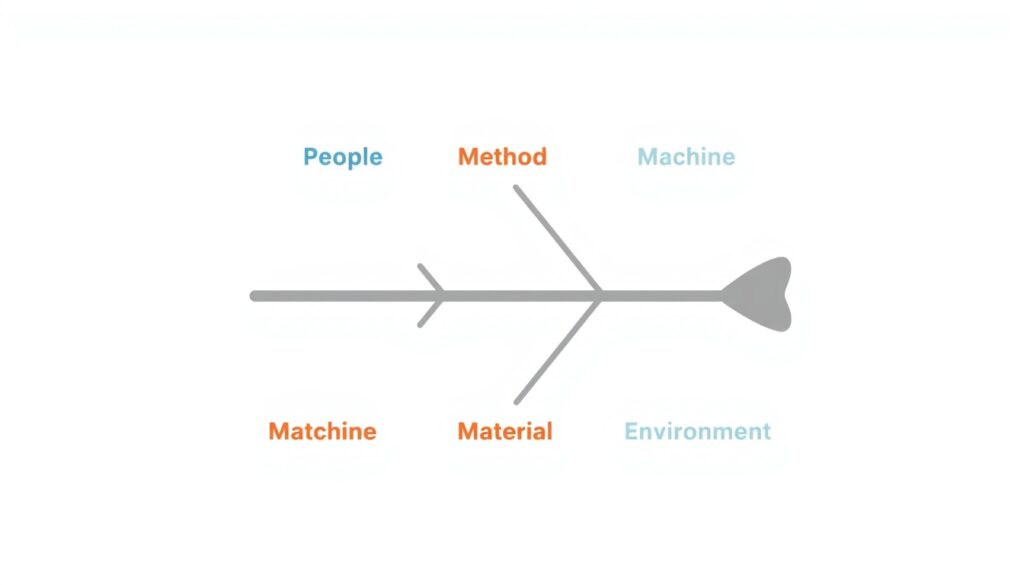
A fishbone diagram (also called an Ishikawa diagram) organizes possible causes into categories. The classic categories are:
- People: Training, staffing, communication
- Method: Procedures, work instructions, practices
- Machine: Equipment design, condition, maintenance
- Material: Raw materials, spare parts, consumables
- Measurement: Instrumentation, calibration, data
- Environment: Operating conditions, weather, contamination
The team brainstorms possible causes in each category, then narrows down to the most likely ones through data and discussion. A fishbone lists possible causes; it does not prove any of them. Each candidate cause should be confirmed or ruled out with evidence before it is treated as a root cause.
Fault Tree and Barrier Analysis
For complex or serious events, two further methods are useful:
- Fault tree analysis starts with the failure at the top and works downward, showing which combinations of events (using AND/OR logic) could have produced it. It is valuable when several independent failures had to occur together.
- Barrier analysis asks what safeguards were supposed to prevent the event (alarms, trips, relief valves, procedures, guards), and why each one failed or was absent.
Gathering Data
Good RCA depends on good data. Sources include:
- Operating data: Trends, alarms, setpoints
- Maintenance records: Work orders, inspection reports, parts replaced
- Interviews: Operators, maintenance staff, supervisors
- Physical evidence: Failed parts, photographs, samples
- Procedures and drawings: What was supposed to happen vs. what did
Collecting data early is important. Physical evidence can be lost, and memories fade.
Preserving evidence: Before repairing, photograph the failed component in place, tag and retain failed parts, and record settings, positions, and readings. Save control system trends and alarm logs before they are overwritten. Where practical, do not clean failed parts before they are inspected.
Interviewing well: Interview people separately and soon after the event. Ask open questions (“what did you see?”) rather than leading ones (“didn’t you skip the check?”). Make it clear the purpose is to understand the system, not to assign blame. People share more when they trust that the process is fair.
Building a timeline: A simple sequence of events, with times, from normal operation through the failure and response, often reveals gaps and contradictions that are not obvious otherwise.
Determining Root Cause
Determining the root cause requires distinguishing between different levels of causation.
| Level | Description | Example |
|---|---|---|
| Immediate cause | What directly caused the failure | Bearing seized |
| Contributing cause | What made the failure more likely | Lubrication was overdue |
| Root cause | The fundamental cause that, if addressed, prevents recurrence | No lubrication task was scheduled or assigned in the maintenance system |
In many cases, there are multiple root causes. For example, a failure might result from both a design weakness and a maintenance gap. Both must be addressed.
A common mistake is to stop at the immediate cause or the first plausible explanation. Good RCA keeps asking “why” until it reaches a cause that can actually be fixed.
A useful test: A cause is likely a true root cause if (1) removing it would have prevented the failure, (2) it is within the plant’s ability to control, and (3) addressing it would also prevent similar failures elsewhere.
Handling Human Error
When human error is a factor, RCA should examine why the error was possible: was the procedure unclear, the training inadequate, or the task design flawed? Human error is usually a symptom of a system weakness, not a root cause in itself.
Useful questions include:
- Was the procedure available, clear, and current?
- Was the person trained and competent for the task?
- Was the workload, time pressure, or shift arrangement a factor?
- Was the equipment or display designed in a way that invites mistakes?
- Would another competent person have made the same error in the same situation?
If the last answer is “yes,” the problem is the system, not the individual. Treating it as an individual failing will not prevent recurrence.
Corrective Actions
Corrective actions should address the root cause, not just the symptom.
Types of corrective actions:
- Engineering: Design changes, material changes, added instrumentation
- Procedural: Revised procedures, added steps, clearer instructions
- Training: Additional training, refresher courses, competency assessment
- Organizational: Staffing changes, clearer responsibilities, better communication
- Monitoring: Added condition monitoring, alarms, or inspections
Prefer stronger actions. Actions that remove or engineer out the hazard (a design change, an interlock, an alarm) are generally more reliable than actions that depend on people remembering (a reminder, a retraining session). Where a procedural or training action is used, back it up with a check or a monitoring measure.
Corrective actions should be:
- Specific: Clearly defined and actionable.
- Assigned: Someone is responsible for each action.
- Time-bound: Each action has a deadline.
- Verified: Completion is confirmed.
Actions that are vague (“improve training”) or unassigned tend not to happen.
Weigh cost against benefit. Compare the cost of an action with the cost of recurrence (repair, lost production, safety exposure). Where an ideal fix is not affordable now, adopt an interim measure and record the longer-term action.
Verification
RCA is not complete until corrective actions are verified.
Verification methods:
- Follow-up inspection: Confirming that the corrective action was implemented.
- Performance monitoring: Confirming that the failure has not recurred.
- Audit: Reviewing records and practices to confirm compliance.
- Trend analysis: Tracking failure rates over time.
Verification has two parts: confirming the action was done (implementation) and confirming it worked (effectiveness). Effectiveness may take weeks or months to demonstrate, so set a review date.
If the failure recurs, the analysis and the actions should be revisited. The root cause may have been misidentified, the actions may not have been fully implemented, or they may not have been effective enough.
Documenting RCA and Managing Knowledge
A brief written record turns one investigation into lasting plant knowledge. A simple RCA report should include:
- Problem statement and impact
- Team members and date
- Timeline and key evidence
- Causes identified and root cause(s)
- Corrective actions with owner and due date
- Verification results
RCA findings should be stored in a searchable database so that lessons can be applied to similar equipment elsewhere in the plant. Without this, the same failure may be investigated repeatedly in different areas.
In practice, a shared folder with consistent file names, or a field in the maintenance management system, is enough for a small plant. Tag each record with equipment type, failure mode, and area so it can be found later. Review past RCAs when planning maintenance, updating procedures, and training new staff. Also ask whether a finding applies to similar equipment elsewhere, such as other pumps on the same service.
Common Mistakes in RCA
Even experienced teams make mistakes. Common ones include:
- Stopping too early: Accepting the first plausible cause without digging deeper.
- Blaming individuals: Focusing on human error without examining the system that allowed it.
- Skipping data collection: Relying on memory and assumption rather than evidence.
- Not involving the right people: Missing knowledge from operators, maintenance, or engineering.
- Vague corrective actions: Actions that are not specific, assigned, or time-bound.
- Not verifying: Assuming the fix worked without confirming it.
- Not documenting: Losing the knowledge for future reference.
- Starting with a preferred answer: Using the analysis to justify a conclusion already reached.
- Analyzing too much: Applying full RCA to every minor event, which exhausts the team and discredits the process.
These mistakes reduce the value of RCA and allow failures to recur.
How Japanese EPC Firms Approach RCA
Japanese engineering firms are widely known for their disciplined approach to problem-solving. Common characteristics include:
- Thorough investigation: Time is taken to gather data and understand the problem fully.
- Team involvement: RCA is performed with input from operations, maintenance, and engineering.
- System focus: The focus is on improving systems, not blaming individuals.
- Detailed documentation: Analysis, decisions, and results are carefully recorded.
- Verification: Corrective actions are tracked and verified.
- Long-term learning: Lessons are captured and applied across the plant, and often fed back into design standards and future projects.
For plant owners, this often means fewer repeat failures and a culture of continuous improvement.
How to Evaluate RCA Readiness
When considering RCA for your plant, ask:
| Question | Why It Matters |
|---|---|
| Are triggers for RCA defined? | Ensures RCA is performed when it matters |
| Is there a standard process? | Ensures consistency and completeness |
| Are the right people involved? | Brings together operations, maintenance, and engineering |
| Is data collected and evidence preserved systematically? | Ensures analysis is based on evidence |
| Is there a no-blame culture? | Encourages honest reporting, including near-misses |
| Are corrective actions specific and assigned? | Ensures actions are implemented |
| Is verification performed? | Confirms that failures do not recur |
| Is documentation searchable and shared? | Captures knowledge for future reference |
A plant that addresses these questions is ready to benefit from RCA.
Conclusion
Root Cause Analysis is a structured approach for finding out why failures happen and preventing them from happening again. It replaces the cycle of repeated repairs with a cycle of learning and improvement.
For small to medium-scale industrial plants, RCA is especially valuable because repeat failures consume limited resources and disrupt production. Applied consistently, RCA improves reliability, reduces maintenance cost, and builds a culture of continuous improvement.
Key Takeaways
- RCA identifies the underlying causes of failures and prevents recurrence
- RCA is distinct from troubleshooting: one restores operation, the other prevents repeat failures
- Triggers include safety incidents, near-misses, production loss, repeat failures, and critical equipment
- The process includes problem definition, data gathering, cause identification, and verification
- Methods include 5 Whys, fishbone diagrams, fault tree analysis, and barrier analysis
- Corrective actions must be specific, assigned, time-bound, and verified
- Human error is usually a symptom, not a root cause
- RCA findings should be documented and stored in a searchable database
- Japanese EPC firms emphasize thorough investigation and system focus