Author: admin

  • Plant Training and Competency Development: Key Practices for EPC Projects

    Plant Training and Competency Development: Key Practices for EPC Projects

    A plant is only as good as the people who operate and maintain it. Equipment can be designed and built to the highest standards, but if the people running it do not understand how it works, how it fails, and how to respond when something goes wrong, the plant will not perform safely or reliably.

    Training and competency development is the discipline of ensuring that the owner’s team has the knowledge, skills, and confidence to operate and maintain the plant. It is not just about classroom courses. It is about building real capability through training, on-the-job experience, assessment, and continuous development.

    For small to medium-scale industrial plants, training and competency development are especially important because there is less redundancy and fewer resources to absorb the consequences of an unprepared team. A single untrained operator can cause an outage, a safety incident, or equipment damage.

    This article covers the key practices in plant training and competency development, from training needs analysis to competency assessment, effectiveness evaluation, and continuous development.

    What Is Training and Competency Development?

    Training is the process of transferring knowledge and skills to personnel. Competency development is the broader process of building the capability to perform specific tasks to a defined standard.

    Training and competency development includes:

    • Training needs analysis: What knowledge and skills are required?
    • Training design: How will training be delivered?
    • Training delivery: Delivering training to personnel.
    • On-the-job training: Building skills through practical experience.
    • Competency assessment: Verifying that personnel can perform to standard.
    • Effectiveness evaluation: Confirming that training delivers the intended outcome.
    • Continuous development: Keeping skills current over time.

    Training and competency development is not a one-time event. It is an ongoing process throughout the plant’s life.

    Management system standards such as ISO 9001 and ISO 45001 (both clause 7.2) require organizations to determine necessary competence, ensure people are competent, and retain evidence. ISO 10015 provides guidelines specifically on competence management and training.

    Why Training and Competency Development Matter

    Training and competency directly affect plant performance.

    Factor Impact of Good Training Impact of Poor Training
    Safety Personnel understand hazards and controls Incidents from lack of knowledge
    Reliability Equipment operated within limits Failures from poor operation
    Efficiency Plant operated at design performance Performance below design
    Cost Maintenance performed correctly Rework and premature failures
    Compliance Regulatory requirements met Non-compliance
    Morale Team confident and capable Team overwhelmed

    For small plants, where the team may be small and multi-skilled, training and competency development determine whether the plant can be run safely and effectively.

    Training in the EPC Contract

    In an EPC project, training is often a contractual deliverable, and it needs to be specified early rather than negotiated at the end.

    Items to define in the EPC contract:

    • Training scope: Which topics, for which roles, and how many personnel.
    • Training plan: Who delivers what, when, and where.
    • Training materials: Manuals, presentations, P&ID-based system descriptions, and operating and maintenance procedures.
    • Vendor training: Equipment-specific training for major packages such as turbines, boilers, compressors, and control systems.
    • Simulator or operator training systems: Where required for complex operations.
    • Language and format: Training delivered in a language and format the team can use.
    • Timing: Training completed before commissioning and startup, not after.
    • Acceptance criteria: How completion of training will be verified.

    Contractor and vendor training that is vaguely specified tends to be generic, late, or incomplete. Training should also be linked to operations readiness and handover, so that the owner’s team is competent by the time the plant is turned over.

    Training Needs Analysis

    Training needs analysis identifies what training is required.

    Training needs analysis activities:

    • Task analysis: What tasks must be performed?
    • Knowledge requirements: What knowledge is required for each task?
    • Skill requirements: What skills are required for each task?
    • Current competence: What competence do personnel currently have?
    • Gap analysis: What gaps exist between required and current competence?
    • Training priorities: Which gaps are most important, especially for safety-critical tasks?

    Training needs analysis should be based on the actual tasks and equipment in the plant, not on generic training programs.

    Training Plan

    The results of the needs analysis should be turned into a training plan.

    A training plan typically defines:

    • Training topics and target personnel.
    • Delivery methods and trainers.
    • Schedule, sequenced against construction, commissioning, and startup milestones.
    • Budget and resources.
    • Responsibilities for delivery and tracking.
    • Assessment and sign-off requirements.

    Sequencing matters. Operators should receive system knowledge before commissioning, so they can take part meaningfully, and procedure training before startup.

    Training Categories

    Training can be categorized by subject and audience.

    Category Description
    Operations training How to operate the plant
    Maintenance training How to maintain equipment
    Safety training How to work safely
    Emergency training How to respond to emergencies
    Vendor training Equipment-specific training from vendors
    Simulator training Practice in a simulated environment
    Soft skills training Communication, teamwork, problem-solving
    Regulatory training Statutory and permit-based competencies

    Each category requires different content, methods, and assessment.

    Regulatory and Mandatory Training

    Some competencies are required by law, by permit, or by site rules, regardless of the owner’s own training needs analysis.

    Typical examples include:

    • Electrical work and switching authorization.
    • Confined space entry.
    • Work at height.
    • Lockout/tagout and isolation.
    • Permit-to-work systems.
    • Hot work.
    • Operation of pressure equipment, boilers, and lifting equipment.
    • First aid, fire fighting, and emergency response.
    • Environmental and hazardous materials handling.

    Requirements vary by jurisdiction and site, so owners should confirm what applies locally. Certifications and their expiry dates should be tracked in the training records.

    Training Methods

    Training methods for plant personnel

    Training can be delivered through various methods.

    Method Description Best For
    Classroom training Instructor-led training in a classroom Theoretical knowledge
    On-the-job training Training while performing actual work Practical skills
    Simulator training Training in a simulated environment Complex operations
    E-learning Online training modules Flexible, self-paced learning
    Vendor training Training from equipment vendors Equipment-specific knowledge
    Mentoring Experienced staff mentor less experienced staff Knowledge transfer
    Job shadowing Junior staff observe experienced staff Practical experience

    The best training programs combine multiple methods.

    Trainers and Training Materials

    Training is only as good as the people delivering it and the materials they use.

    Considerations:

    • Trainer competence: Trainers should know the subject and know how to teach it. Being an expert operator does not automatically make someone an effective trainer.
    • Plant-specific materials: Use actual P&IDs, procedures, and equipment photos rather than generic content.
    • Up-to-date content: Materials should be updated when the plant or procedures change.
    • Accessible format: Materials should be easy to use, in the language of the team, and available after the course for reference.
    • Learning objectives: Each session should have clear objectives that link to the competency standards.

    On-the-Job Training

    On-the-job training builds practical skills through actual work.

    On-the-job training considerations:

    • Structured approach: Training should be planned, not ad hoc.
    • Qualified trainers: Trainers should be competent and trained to train.
    • Progressive responsibility: Trainees should take on increasing responsibility as they develop.
    • Documentation: Training should be documented.
    • Assessment: Competence should be assessed.

    On-the-job training is often the most effective way to build practical skills.

    Operator Involvement in Commissioning

    Commissioning is a valuable training opportunity.

    Benefits of operator involvement in commissioning:

    • Hands-on experience: Operators gain practical experience with the plant.
    • Understanding of systems: Operators learn how systems work.
    • Procedure testing: Operators can test draft procedures.
    • Early identification of issues: Operators can raise concerns while changes are still easy.
    • Confidence building: Operators build confidence before startup.

    Operators should be involved in commissioning wherever possible. This requires them to be recruited early enough to take part, which should be reflected in the staffing plan.

    Competency Assessment

    Competency assessment verifies that personnel can perform to standard.

    Competency assessment methods:
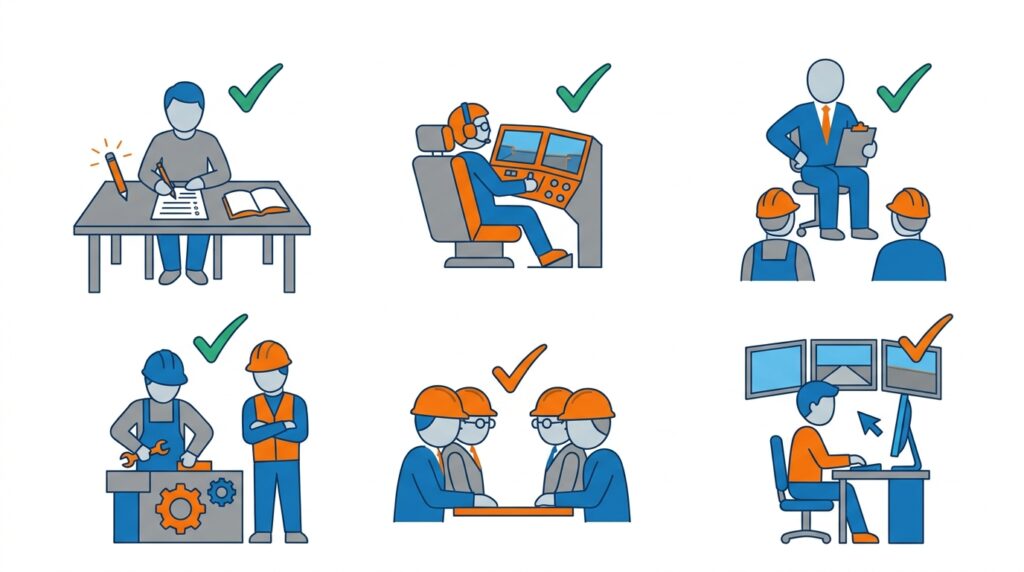
    Competency assessment methods for plant personnel

    Method Description
    Written tests Testing knowledge
    Practical tests Testing practical skills
    Observation Observing performance on the job
    Simulation Testing in a simulated environment
    Peer assessment Assessment by colleagues
    Supervisor assessment Assessment by supervisors

    Competency assessment should be based on clear standards and criteria. Assessors should be competent themselves and, where possible, independent of the trainer.

    Competency Standards

    Competency standards define what competence looks like.

    Competency standards include:

    • Task description: What task is being assessed?
    • Performance criteria: What defines competent performance?
    • Knowledge requirements: What knowledge is required?
    • Evidence requirements: What evidence is required to demonstrate competence?
    • Assessment methods: How will competence be assessed?

    Competency standards should be clear, specific, and relevant to the plant.

    Competency Matrices

    A competency matrix maps each role against the competencies required, showing who is competent, who is in training, and where gaps exist. It is a practical tool for managing workforce competence.

    A competency matrix typically helps to:

    • Show at a glance who can perform which tasks.
    • Identify single points of failure where only one person is competent.
    • Plan shift rosters so that every shift has the required competencies.
    • Prioritize training and cross-training.
    • Provide evidence for audits and regulators.

    The matrix should be kept current and linked to the training records.

    Training Records

    Training records document training and competency.

    Training record contents:

    • Personnel details: Who was trained?
    • Training details: What training was provided?
    • Dates: When was training provided?
    • Assessment results: How did the person perform?
    • Competency status: Is the person competent?
    • Expiry dates: When does refresher training need to happen?

    Training records support audits, regulatory compliance, and workforce planning.

    Evaluating Training Effectiveness

    Training should be evaluated to confirm it works. Delivering training is not the same as achieving competence.

    Training effectiveness should be evaluated using models such as Kirkpatrick’s four levels: reaction, learning, behavior, and results. This confirms that training is delivering the intended outcome, not just being delivered.

    Level Question Example Evidence
    1. Reaction Did participants find the training useful? Feedback forms
    2. Learning Did participants acquire the knowledge and skills? Tests, practical assessments
    3. Behavior Are participants applying it on the job? Observation, supervisor review
    4. Results Did plant performance improve? Fewer incidents, fewer operator errors, better efficiency

    Findings should feed back into training design. Incident investigations should also be checked for training-related causes.

    Refresher Training

    Refresher training keeps skills current.

    Refresher training considerations:

    • Frequency: How often is refresher training needed?
    • Content: What should refresher training cover?
    • Assessment: Should refresher training include assessment?
    • Triggers: What triggers refresher training (e.g., incidents, changes, long absences)?

    Refresher training ensures that skills do not degrade over time. Rarely used skills, such as emergency response and infrequent startup and shutdown tasks, are especially at risk.

    Training and Change

    Training must keep pace with changes to the plant.

    • Management of change: Changes to equipment, procedures, or control systems should trigger a check on whether training needs updating, and affected personnel should be trained before the change goes live.
    • Incident learning: Lessons from incidents and near-misses should be fed into training content.
    • Pre-startup safety review: Verifying that training is complete is a standard element of a pre-startup safety review.

    Training for Emergency Response

    Emergency response training prepares personnel to respond to emergencies.

    Emergency response training includes:

    • Emergency procedures: How to respond to emergencies.
    • Emergency equipment: How to use emergency equipment.
    • Drills: Practice responding to emergencies.
    • Coordination: How to coordinate with others, including external responders.
    • Communication: How to communicate during emergencies.

    Emergency response training should be practical and realistic.

    Training for Maintenance

    Maintenance training prepares personnel to maintain equipment.

    Maintenance training includes:

    • Equipment knowledge: How equipment works.
    • Maintenance procedures: How to maintain equipment.
    • Troubleshooting: How to diagnose problems.
    • Safety procedures: How to work safely.
    • Tools and techniques: How to use tools and techniques.

    Maintenance training should be practical and equipment-specific.

    Training for Operations

    Operations training prepares personnel to operate the plant.

    Operations training includes:

    • Plant systems: How the plant works.
    • Operating procedures: How to operate the plant.
    • Control systems: How to use control systems.
    • Abnormal situations: How to respond to abnormal situations.
    • Emergency procedures: How to respond to emergencies.

    Operations training should include both classroom and practical elements.

    Training for Contractors

    Contractors working on site require training and competency verification appropriate to their tasks. Site induction, safety training, and task-specific competency checks should be included in contractor management.

    Contractor training considerations:

    • Site induction: Site rules, hazards, emergency arrangements, and permit-to-work.
    • Task-specific competence: Evidence of qualifications and certifications for the work to be done.
    • Verification: Checks that competence has been confirmed, not just claimed.
    • Records: Contractor training and induction records maintained.
    • Ongoing oversight: Supervision and re-verification for long-duration or high-risk work.

    This applies both during construction and commissioning and later during turnarounds and maintenance campaigns.

    Knowledge Retention and Succession Planning

    Training and competency development are closely linked to knowledge retention and succession planning. Documenting critical knowledge and developing successors reduces the risk of losing expertise when experienced staff leave.

    Practical measures include:

    • Identifying critical roles and the people who hold key knowledge.
    • Documenting tacit knowledge such as troubleshooting experience and equipment quirks.
    • Pairing experienced staff with successors through mentoring and job shadowing.
    • Cross-training so that no critical skill depends on one person.
    • Capturing knowledge from the EPC contractor and vendors during commissioning and handover.

    This is particularly important in small plants, where one departure can remove a large share of the team’s expertise.

    Training in Small Plants

    Small plants face particular challenges with training and competency development.

    Challenges:

    • Fewer resources for training.
    • Smaller teams with less redundancy.
    • Less access to specialist training.
    • Competing priorities.

    Practical approaches:

    • Focus on critical skills: Prioritize training for critical tasks.
    • Use vendor training: Leverage equipment vendor training.
    • Use online training: Online training is flexible and cost-effective.
    • Learn from others: Share training resources with other plants.
    • Build internal capability: Develop internal trainers over time.
    • Use a simple competency matrix: Track competence without heavy systems.
    • Document training: Good records demonstrate competence.

    Training does not need to be expensive. It needs to be focused and practical.

    Common Mistakes in Training and Competency Development

    Even experienced organizations make mistakes. Common ones include:

    • No training needs analysis: Training not based on actual needs.
    • Generic training: Training not tailored to the plant.
    • Training not specified in the EPC contract: Scope, timing, and acceptance criteria left vague.
    • Insufficient training time: Training rushed or inadequate.
    • No competency assessment: Training without verification of competence.
    • No evaluation of effectiveness: Training delivered but never checked for results.
    • No competency matrix: No clear view of who is competent for what.
    • Poor training records: Records incomplete or missing.
    • No refresher training: Skills degrade over time.
    • No on-the-job training: Training not reinforced with practice.
    • No operator involvement: Operators not involved in commissioning.
    • Contractors overlooked: Site workers not inducted or verified.
    • No succession planning: Critical knowledge held by one or two people.
    • Training seen as a cost: Training treated as an expense rather than an investment.

    These mistakes are costly to correct. They are much cheaper to avoid through disciplined training and competency development.

    How Japanese EPC Firms Approach Training and Competency Development

    Japanese engineering firms are known for their disciplined approach to training and competency development. Common characteristics include:

    • Thorough planning: Training is planned carefully, based on actual needs.
    • Detailed content: Training content is specific and relevant.
    • Comprehensive assessment: Competence is assessed rigorously.
    • Strong records: Training records are complete and accurate.
    • Continuous development: Training is an ongoing process.
    • Operator involvement: Operators participate in commissioning and training.
    • Knowledge transfer: Experienced staff mentor successors, and know-how is passed on deliberately.
    • Long-term focus: Training is treated as an investment in the plant’s future.

    For plant owners, this often means a team that is confident, competent, and ready to operate.

    How to Evaluate Training and Competency Development Readiness

    When reviewing training and competency development, ask:

    Question Why It Matters
    Is training scope defined in the EPC contract? Ensures training is delivered on time and to standard
    Is there a training needs analysis? Ensures training is based on actual needs
    Is there a training plan with schedule and budget? Ensures training is resourced and sequenced
    Is training tailored to the plant? Ensures training is relevant
    Are training methods appropriate? Ensures training is effective
    Is on-the-job training provided? Builds practical skills
    Are operators involved in commissioning? Provides hands-on experience
    Are mandatory certifications in place? Ensures regulatory compliance
    Is competency assessed against defined standards? Verifies that personnel are competent
    Is there a competency matrix? Shows gaps and single points of failure
    Is training effectiveness evaluated? Confirms training delivers results
    Are contractors inducted and verified? Protects safety on site
    Are training records maintained? Documents training and competence
    Is refresher training planned? Keeps skills current
    Is there a succession plan for critical roles? Protects against loss of expertise
    Is training seen as an investment? Ensures ongoing commitment

    A plant that addresses these questions is ready for effective training and competency development.

    Conclusion

    Training and competency development are critical to plant success. For small to medium-scale industrial plants, they determine whether the owner’s team can operate and maintain the plant safely and effectively.

    By focusing on training needs analysis, a clear EPC training scope, training design and delivery, on-the-job training, competency assessment, competency matrices, effectiveness evaluation, records, refresher training, contractor competence, and succession planning, owners and project teams can ensure that the plant is operated by a competent and confident team.

    Key Takeaways

    • Training transfers knowledge and skills; competency development builds capability to perform to standard.
    • Training scope, timing, and acceptance criteria should be defined in the EPC contract.
    • Training needs analysis identifies what training is required based on actual tasks and equipment.
    • Training methods include classroom, on-the-job, simulator, e-learning, vendor, mentoring, and job shadowing.
    • On-the-job training and operator involvement in commissioning build practical skills.
    • Competency assessment verifies that personnel can perform to standard, and competency standards define what competence looks like.
    • Competency matrices show who is competent, who is in training, and where gaps exist.
    • Training effectiveness should be evaluated, for example with Kirkpatrick’s four levels.
    • Training records document training and competence; refresher training keeps skills current.
    • Emergency, maintenance, and operations training are all essential.
    • Contractors need site induction and competency verification.
    • Training supports knowledge retention and succession planning.
    • Small plants can focus on critical skills and use vendor and online training.
    • Japanese EPC firms emphasize thorough planning and rigorous assessment.

  • Plant Digitalization and Data Management: Key Practices for EPC Projects

    Plant Digitalization and Data Management: Key Practices for EPC Projects

    Industrial plants generate enormous amounts of data. Design models, equipment specifications, sensor readings, maintenance records, performance trends, and operational logs are all created, stored, and used across the plant’s lifecycle. But data alone is not valuable. What matters is whether the data is accurate, accessible, and useful for decision-making.

    Digitalization is the use of digital technologies to improve how plants are designed, built, and operated. Data management is the discipline of ensuring that data is accurate, complete, secure, and available to the people who need it. Together, they are transforming how industrial plants work and how EPC projects are delivered.

    For small to medium-scale industrial plants, both are especially important because there is less redundancy and fewer resources to absorb the consequences of poor data. A plant with inaccurate or inaccessible data cannot be operated efficiently, maintained effectively, or improved over time.

    This article covers the key practices in plant digitalization and data management, from digital tools to data governance, handover, and cybersecurity.

    What Is Digitalization?

    Digitalization is the use of digital technologies to improve processes, create new value, and enable better decisions.

    In an industrial plant, digitalization includes:

    • Digital design: 3D modeling, digital twins, and paperless engineering.
    • Digital procurement: E-procurement, vendor data management, and supply chain visibility.
    • Digital construction: Digital work packages, mobile data capture, and progress tracking.
    • Digital operations: Control systems, condition monitoring, and performance analytics.
    • Digital maintenance: CMMS, predictive maintenance, and mobile work execution.

    Digitalization is not just about technology. It is about using technology to work differently and better.

    What Is Data Management?

    Data management is the process of ensuring that data is accurate, complete, secure, and available.

    Data management includes:

    • Data governance: Policies and procedures for managing data.
    • Data quality: Ensuring data is accurate and complete.
    • Data security: Protecting data from unauthorized access.
    • Data integration: Combining data from different sources.
    • Data accessibility: Ensuring data is available to those who need it.
    • Data retention: Retaining data for the required period.

    Data management is the foundation of digitalization. Without good data, digital tools cannot deliver their value.

    Why Digitalization and Data Management Matter

    Factor Impact of Good Digitalization Impact of Poor Digitalization
    Efficiency Processes are faster and more accurate Manual processes are slow and error-prone
    Decisions Decisions based on accurate, timely data Decisions based on incomplete or outdated data
    Reliability Predictive maintenance and condition monitoring Reactive maintenance and unexpected failures
    Cost Lower operating and maintenance costs Higher costs from inefficiency and failures
    Safety Better visibility and faster response Blind spots and slow response
    Compliance Data available for audits and reporting Data gaps and compliance issues

    For small plants, where there is less margin for error, these factors determine whether the plant can be operated efficiently and improved over time.

    Digital Twins

    Digital twin across the plant lifecycle

    A digital twin is a digital representation of a physical asset, system, or process, connected to plant data so that it reflects the current state of the real plant. This connection is what distinguishes a digital twin from a static 3D model.

    Use Description
    Design Verify design before construction
    Construction Plan construction sequence and detect clashes
    Commissioning Support commissioning and testing
    Operations Monitor performance and optimize operations
    Maintenance Plan maintenance and predict failures
    Training Train operators in a virtual environment

    Digital twins are most valuable when they are kept up to date with the physical plant. A twin that is not maintained after handover quickly becomes a historical record rather than a working tool.

    Digital Design and Engineering

    Digital design and engineering use digital tools to design the plant.

    • 3D CAD and plant design: Three-dimensional modeling of plant and equipment.
    • BIM: Building information modeling for integrated design, particularly for buildings and structures.
    • Intelligent P&IDs: Data-rich diagrams linked to the engineering database.
    • Clash detection: Identifying conflicts between disciplines.
    • Engineering databases: Storing and managing engineering data such as equipment lists, line lists, and instrument indexes.
    • Digital workflows: Managing design reviews and approvals electronically.

    Digital design reduces errors, improves coordination, and creates a data foundation for construction and operations.

    Common Data Environment (CDE)

    A common data environment (CDE) is a shared repository where project data (drawings, models, documents, and correspondence) is stored and managed. It provides a single source of truth for the project and supports collaboration between disciplines and contractors.

    A good CDE:

    • Controls document versions and status (work in progress, shared, approved, archived).
    • Defines who can view, edit, and approve each type of information.
    • Keeps an audit trail of changes and approvals.
    • Uses agreed naming, numbering, and metadata conventions.

    Information management standards such as ISO 19650 describe CDE workflows and are a useful reference, even outside building projects.

    Digital Procurement and Vendor Data

    Digital procurement and vendor data management improve supply chain efficiency.

    • E-procurement: Online purchasing and supplier management.
    • Vendor data management: Managing vendor documentation and data.
    • Supply chain visibility: Tracking materials and equipment through the supply chain.
    • Digital inspection: Remote inspection and digital records.

    Vendor data is a critical part of the plant’s data foundation. It should be captured in a structured, accessible form, not only as scanned PDFs, so that it can flow into the engineering database and the CMMS.

    Digital Construction

    Digital construction uses digital tools to plan, execute, and track construction.

    • Digital work packages: Electronic work instructions and checklists.
    • Mobile data capture: Recording progress, inspections, and issues on mobile devices.
    • Progress tracking: Real-time tracking of construction progress.
    • Digital as-builts: Capturing as-built information digitally.
    • Drones and laser scanning: Capturing site conditions and progress.

    Digital construction improves efficiency, accuracy, and visibility.

    Digital Operations

    Digital operations use digital tools to operate and monitor the plant.

    • Control systems: DCS, PLC, SCADA.
    • Condition monitoring: Vibration, temperature, and performance monitoring.
    • Performance analytics: Analyzing plant performance and identifying improvements.
    • Digital procedures: Electronic operating procedures and checklists.
    • Operator rounds: Mobile tools for recording operator rounds.

    Digital operations improve efficiency, safety, and reliability.

    Digital Maintenance

    Digital maintenance uses digital tools to plan, execute, and track maintenance.

    • CMMS: Computerized maintenance management system.
    • Predictive maintenance: Using data to predict failures.
    • Mobile work execution: Performing maintenance with mobile devices.
    • Digital spare parts management: Managing spare parts inventory digitally.
    • Augmented reality: Using AR for maintenance guidance.

    Digital maintenance improves efficiency, reduces downtime, and extends equipment life.

    Analytics and Artificial Intelligence

    Digitalization enables advanced analytics and artificial intelligence: predictive maintenance, performance optimization, and anomaly detection. These tools depend on high-quality data and a solid digital foundation.

    In practice, this means:

    • Sensor data must be reliable, calibrated, and consistently tagged.
    • Historical data must be available and structured.
    • Equipment and maintenance records must be linked to the same asset tags.
    • Results must be validated by experienced engineers and operators before they drive decisions.

    For small plants, simple analytics, such as trend monitoring and alarm analysis, often deliver value well before advanced AI is justified.

    Data Governance

    Data governance is the framework for managing data.

    • Data ownership: Who owns each data set?
    • Data standards: What standards apply to data?
    • Data quality: How is data quality ensured?
    • Data security: How is data protected?
    • Data access: Who can access data, and under what conditions?
    • Data retention: How long is data retained?

    Data governance ensures that data is managed consistently and responsibly. For EPC projects, ownership, formats, and deliverables should be written into the contract (see “Data Requirements in the EPC Contract” below).

    Data Quality

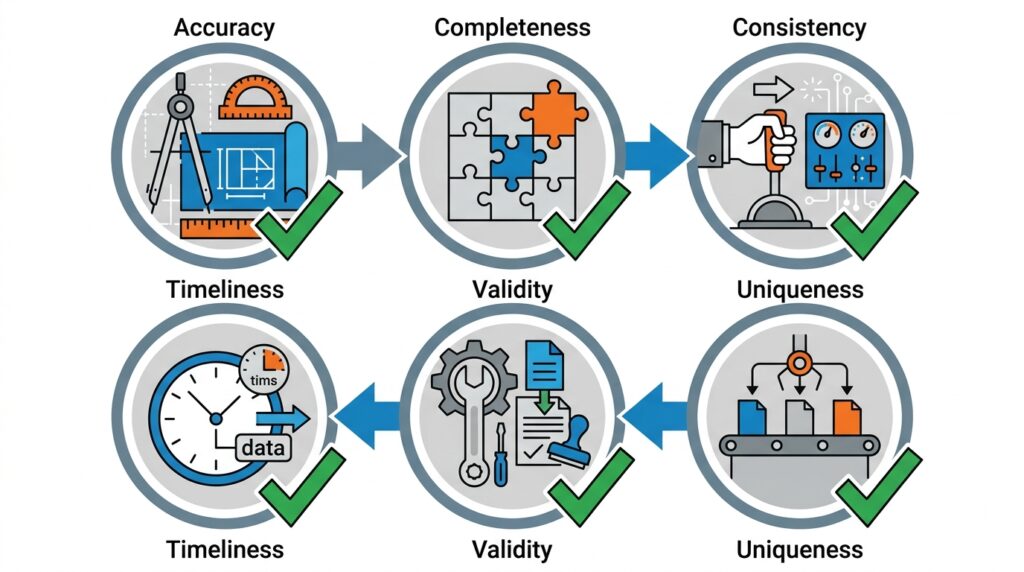
    Data quality dimensions for plant data management

    Data quality is the foundation of effective data management.

    Dimension Description
    Accuracy Data reflects reality
    Completeness All required data is present
    Consistency Data is consistent across sources
    Timeliness Data is available when needed
    Validity Data conforms to defined formats
    Uniqueness No duplicate records

    Data quality should be measured and improved continuously.

    Data Integration

    Data integration combines data from different sources.

    • Manual integration: Combining data manually.
    • Automated integration: Using software to integrate data.
    • Data warehouses: Central repositories for integrated data.
    • APIs: Application programming interfaces for data exchange.

    Data integration enables a single view of the plant. A consistent asset tagging scheme used across engineering, procurement, construction, and maintenance systems is one of the most effective integration measures.

    Legacy Systems

    Legacy systems (older control systems, standalone databases, and paper records) can be a barrier to digitalization. A gradual approach that integrates legacy systems where possible and replaces them where necessary is often the most practical path.

    Practical steps include:

    • Inventory existing systems, data sources, and paper records.
    • Use gateways, protocol converters, or data historians to bring legacy data into modern platforms.
    • Digitize critical paper records first, such as P&IDs, equipment datasheets, and maintenance histories.
    • Replace systems that are unsupported, unsafe, or impossible to integrate.

    Data Requirements in the EPC Contract

    Data deliverables should be defined in the EPC contract, not left to the end of the project.

    • Required data and document deliverables, formats, and metadata.
    • Naming, numbering, and tagging conventions.
    • Ownership of, and rights to use, models, data, and software.
    • Delivery milestones and acceptance criteria for data.
    • Cybersecurity requirements for contractor systems and remote access.

    Clear data requirements early in the project avoid expensive reconstruction of information later.

    Data Handover to Operations

    Data handover from project to operations is a critical step. As-built models, equipment data, maintenance histories, and procedures must be transferred in a structured, accessible form. This connects directly to the handover process and the plant’s long-term data foundation.

    Good practice includes:

    • Defining handover data requirements early, for example using a standard such as CFIHOS.
    • Loading equipment data directly into the CMMS and asset register.
    • Verifying that as-built models and documents match the as-built plant.
    • Confirming that operations staff can access, search, and use the data before project closeout.

    Cybersecurity

    Cybersecurity is critical for digitalized plants.

    • Network segmentation: Separating control networks from business networks.
    • Access control: Limiting access to authorized personnel, including contractors and remote vendor access.
    • Monitoring: Monitoring for unusual activity.
    • Updates: Keeping software and firmware up to date, with care for control system compatibility.
    • Training: Training personnel on cybersecurity awareness.
    • Incident response: Planning for cyber incidents.

    The convergence of operational technology (OT) and information technology (IT) increases both the value of plant data and the exposure to cyber threats. Standards such as IEC 62443 and guidance such as NIST SP 800-82 provide frameworks for industrial control system security. Cybersecurity protects the plant from threats that could disrupt operations or cause safety incidents.

    Digitalization in Small Plants

    Small plants face particular challenges:

    • Fewer resources for digitalization.
    • Less expertise in digital technologies.
    • Legacy systems that are difficult to integrate.
    • Competing priorities.

    Practical approaches:

    • Start small: Begin with high-value, low-cost digitalization.
    • Focus on data quality: Good data is the foundation of digitalization.
    • Use cloud services: Cloud services reduce infrastructure costs, with security controls suited to plant data.
    • Leverage vendor tools: Use tools provided by equipment vendors.
    • Use standard formats: Standard data formats and tagging make future integration easier.
    • Build skills gradually: Train staff on digital tools over time.
    • Learn from others: Learn from other plants’ experiences.

    Digitalization does not need to be complex. It needs to be focused and practical.

    Common Mistakes in Digitalization and Data Management

    • Technology-first approach: Focusing on technology rather than business needs.
    • Poor data quality: Data that is inaccurate or incomplete.
    • No data governance: Data managed inconsistently, with unclear ownership.
    • Siloed data: Data trapped in different systems.
    • No common data environment: Multiple versions of documents and models in circulation.
    • No handover requirements: Data delivered late, unstructured, or incomplete.
    • Inadequate cybersecurity: Data and systems not protected.
    • No integration: Systems that do not communicate.
    • Ignoring legacy systems: Assuming new tools will work without addressing existing ones.
    • No skills: Staff not trained on digital tools.
    • No change management: Digitalization resisted by staff.
    • No sustainability: Digital tools not maintained over time.

    These mistakes are costly to correct. They are much cheaper to avoid through disciplined digitalization and data management.

    How Japanese EPC Firms Approach Digitalization and Data Management

    Japanese engineering firms are often noted for a disciplined approach to digitalization and data management. Common characteristics include:

    • Business-first approach: Digitalization is driven by business needs.
    • Data quality focus: Data quality is prioritized.
    • Integrated systems: Systems are integrated to provide a single view.
    • Cybersecurity focus: Cybersecurity is built in from the start.
    • Detailed documentation: Data and processes are documented.
    • Continuous improvement: Lessons are captured and applied.
    • Long-term focus: Digitalization is treated as a long-term investment.

    For plant owners, this often means digital tools that are useful, reliable, and sustainable.

    How to Evaluate Digitalization and Data Management Readiness

    Question Why It Matters
    Is there a digitalization strategy? Provides direction for digitalization
    Are business needs defined? Ensures digitalization delivers value
    Is data quality managed? Ensures data is accurate and complete
    Is there data governance and clear ownership? Ensures data is managed consistently
    Is there a common data environment? Provides a single source of truth
    Are data handover requirements defined? Ensures operations receive usable data
    Are systems integrated, including legacy systems? Ensures a single view of the plant
    Is cybersecurity in place? Protects data and systems
    Are staff trained? Ensures digital tools are used effectively
    Is change management in place? Ensures digitalization is adopted
    Is digitalization sustainable? Ensures tools are maintained over time

    A plant that addresses these questions is ready for effective digitalization.

    Key Takeaways

    • Digitalization uses digital technologies to improve how plants are designed, built, and operated.
    • Data management ensures data is accurate, complete, secure, and available.
    • Digital twins are digital representations of physical assets, used across the lifecycle.
    • Digital tools support design, procurement, construction, operations, and maintenance.
    • A common data environment provides a single source of truth for project data.
    • Data handover from project to operations must be structured, accessible, and planned early.
    • Analytics and AI depend on high-quality data and a solid digital foundation.
    • Legacy systems should be integrated where possible and replaced where necessary.
    • Data governance provides the framework for managing data.
    • Data quality dimensions include accuracy, completeness, consistency, timeliness, validity, and uniqueness.
    • Data integration enables a single view of the plant.
    • Cybersecurity protects data and systems from cyber threats.
    • Small plants can start small and focus on data quality.
    • Japanese EPC firms emphasize a business-first approach and data quality.

    Conclusion

    Digitalization and data management are transforming how industrial plants are designed, built, and operated. For small to medium-scale industrial plants, they determine whether the plant can be operated efficiently and improved over time.

    By focusing on digital twins, a common data environment, digital tools across design, procurement, construction, operations, and maintenance, data governance, data quality, integration, handover, legacy systems, and cybersecurity, owners and project teams can ensure that digitalization delivers real value.

  • Plant Stakeholder Management: Key Practices for EPC Projects

    Plant Stakeholder Management: Key Practices for EPC Projects

    Every project has stakeholders: people and organizations who affect, or are affected by, the project. The owner, the contractors, the vendors, the regulators, the local community, the lenders, the insurers, and the plant’s future operators are all stakeholders. Each has different interests, different concerns, and different levels of influence.

    Stakeholder management is the discipline of identifying these parties, understanding their interests and influence, and engaging them effectively throughout the project. It is not about pleasing everyone, which is impossible. It is about understanding who matters, what they need, and how to work with them constructively.

    For small to medium-scale industrial plants, stakeholder management is especially important because there is less margin for error and fewer resources to absorb the consequences of stakeholder conflicts. A single unhappy regulator, community group, or lender can delay or derail a project.

    This article covers the key practices in plant stakeholder management, from identification and analysis to engagement, communication, and monitoring.

    What Is Stakeholder Management?

    Stakeholder management is the process of identifying, analyzing, and engaging stakeholders to achieve project objectives.

    It includes:

    • Stakeholder identification: Who are the stakeholders?
    • Stakeholder analysis: What are their interests, influence, and expectations?
    • Engagement planning: How will we engage each stakeholder?
    • Communication: How will we communicate with each stakeholder?
    • Monitoring: How are stakeholder relationships developing?

    Stakeholder management is not just about communication. It is about understanding and managing relationships.

    Why Stakeholder Management Matters

    Factor Good Stakeholder Management Poor Stakeholder Management
    Approvals Permits and approvals obtained smoothly Delays and rejections
    Community Community supports the project Community opposition
    Financing Lenders confident in the project Financing delayed or withdrawn
    Construction Contractors work together Contractor disputes
    Operations Operations team ready and engaged Operations unprepared
    Reputation Positive reputation Reputation damaged

    For small plants, where there is less margin for error, stakeholder management determines whether the project proceeds smoothly.

    Stakeholder Identification

    Stakeholder identification is the first step.

    Category Examples
    Internal Owner, project team, operations, maintenance
    Contractors EPC contractor, subcontractors, vendors
    Regulators Environmental agencies, safety authorities, local government
    Financial Lenders, investors, insurers
    Community Local residents, landowners, community groups, NGOs
    Workforce Construction workers, local labor, unions or worker representatives
    Media Local and industry media
    Other Utilities, emergency services, industry associations

    Identification should be comprehensive, because a missed stakeholder can cause problems later. It should also be repeated: new stakeholders appear as the project moves from design to construction to operation.

    The Stakeholder Register

    A stakeholder register lists each stakeholder, their interests, influence, engagement approach, and status. It is the central document for stakeholder management and should be reviewed regularly.

    A practical register also records the responsible owner for each stakeholder, the date and outcome of the last contact, and any open issues or commitments. For small plants, a simple spreadsheet is enough, provided it is kept current.

    Stakeholder Analysis

    Stakeholder analysis evaluates each stakeholder’s interests, influence, and expectations.

    Dimension Description
    Interest How interested is the stakeholder in the project?
    Influence How much influence does the stakeholder have?
    Impact How much will the project affect the stakeholder?
    Expectations What does the stakeholder expect?
    Concerns What are the stakeholder’s concerns?

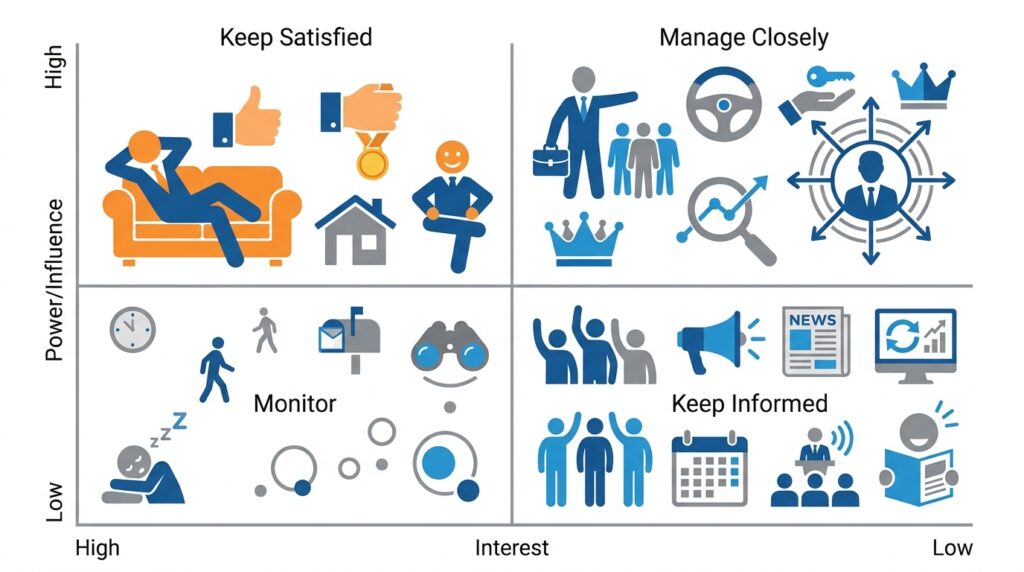
    Power-interest grid:

    Stakeholder power-interest grid for project management

    Low Influence High Influence
    High Interest Keep informed Manage closely
    Low Interest Monitor Keep satisfied

    The grid helps prioritize engagement effort. Note that influence and interest change over time. A quiet stakeholder can become highly active when the project begins to affect them directly, so the grid should be revisited as the project moves between phases.

    Managing Conflicting Stakeholder Interests

    Stakeholders often have conflicting interests: what satisfies one may concern another. Managing these conflicts requires understanding each stakeholder’s priorities, finding common ground where possible, and making transparent decisions where conflicts cannot be resolved.

    Typical conflicts on plant projects include:

    • Schedule vs. community impact: Lenders want fast completion, while residents want limited construction noise and traffic.
    • Cost vs. environmental performance: Owners want low capital cost, while regulators and lenders require stricter controls.
    • Contractor profit vs. owner scope: Each party reads the same contract differently.
    • Construction convenience vs. operability: Designs that are easy to build may be harder to operate.

    Where a conflict cannot be resolved, the decision, its rationale, and the trade-offs should be recorded and communicated openly. Stakeholders can accept an outcome they dislike more readily than one reached without explanation.

    Stakeholder Engagement in Different Project Phases

    Stakeholder engagement needs change as the project progresses.

    • Design phase: Engagement focuses on technical and regulatory stakeholders, including permitting authorities, lenders’ technical advisors, and operations.
    • Procurement phase: Engagement focuses on vendors, logistics providers, and local suppliers.
    • Construction phase: Engagement focuses on contractors and the community, covering noise, traffic, safety, and local employment.
    • Commissioning and handover: Engagement focuses on the operations team, regulators (for start-up approvals), and emergency services.
    • Operations phase: Engagement focuses on the operations team and ongoing regulatory compliance, along with continued community relations.

    The engagement plan should be updated at each phase transition.

    Stakeholder Engagement Planning

    Engagement planning determines how each stakeholder will be engaged:

    • Define objectives: What do we want to achieve with each stakeholder?
    • Define approach: How will we engage each stakeholder?
    • Define frequency: How often will we engage?
    • Define responsibilities: Who is responsible for each stakeholder?
    • Define resources: What resources are needed?
    • Define metrics: How will we measure engagement success?

    Stakeholder Engagement Plan

    Element Description
    Stakeholder list Who are the stakeholders?
    Analysis What are their interests, influence, and expectations?
    Objectives What do we want to achieve with each stakeholder?
    Engagement approach How will we engage each stakeholder?
    Communication methods How will we communicate?
    Frequency How often will we engage?
    Responsibilities Who is responsible?
    Escalation Who is involved when an issue cannot be resolved at working level?
    Metrics How will we measure success?

    The plan should be reviewed and updated regularly.

    Communication

    Stakeholder communication methods for project management

    Communication considerations:

    • Message: What do we want to communicate?
    • Audience: Who are we communicating with?
    • Method: What communication method is appropriate?
    • Timing: When should we communicate?
    • Frequency: How often should we communicate?
    • Feedback: How will we receive feedback?
    Method When to Use
    Meetings Detailed discussions and decisions
    Reports Regular status updates
    Presentations Larger audiences
    Email Routine communication
    Website and notices Public information
    Site visits Showing progress
    Public meetings Community consultation

    Communication should be tailored to the audience. A lender wants financial and schedule data; a resident wants to know about noise, traffic, and safety. Keep messages consistent across audiences, since stakeholders compare notes.

    Regulator Engagement

    Regulators are often the most important stakeholders for industrial plants. Good practice includes:

    • Early engagement: Engage regulators early in the project.
    • Clear submissions: Prepare clear, complete submissions.
    • Regular updates: Keep regulators informed of progress.
    • Compliance: Ensure compliance with all requirements.
    • Relationship building: Build constructive relationships.

    Regulator engagement should be proactive, not reactive.

    Community Engagement

    Community engagement is critical for projects that affect local residents. Good practice includes:

    • Early engagement: Engage the community early.
    • Transparent communication: Be open about project impacts.
    • Feedback mechanisms: Provide ways for the community to give feedback.
    • Community benefits: Consider local employment, local procurement, and community programs.
    • Grievance mechanisms: Provide a way to address grievances.

    Community opposition can delay or derail a project. Early, transparent engagement reduces this risk.

    Grievance Mechanisms

    A grievance mechanism provides a formal way for stakeholders to raise concerns and have them addressed. It should be accessible, transparent, and responsive, with clear timelines for resolution.

    Grievance mechanisms are especially important for community and labor stakeholders. Practical features include:

    • Multiple ways to submit a grievance (phone, email, in person, written)
    • A grievance log with an owner for each case
    • Clear response and resolution timelines
    • An escalation route if the complainant is not satisfied
    • Feedback to the complainant on the outcome
    • Periodic review of grievance trends to spot recurring problems

    Lender and Investor Engagement

    Lenders and investors have significant influence over projects. Good practice includes:

    • Regular reporting: Provide regular progress and financial reports.
    • Compliance: Ensure compliance with financing conditions, including any environmental and social requirements.
    • Transparency: Be transparent about risks and issues.
    • Relationship building: Build constructive relationships.

    Lenders and investors need confidence that the project is on track. Bad news delivered late damages that confidence far more than bad news delivered early with a recovery plan.

    Contractor and Vendor Engagement

    • Clear contracts: Define scope and responsibilities clearly.
    • Regular communication: Hold regular progress meetings.
    • Issue resolution: Address issues promptly.
    • Performance management: Monitor and manage performance.
    • Relationship building: Build constructive relationships.

    Good contractor relationships reduce disputes and improve performance.

    Workforce and Labor Engagement

    Workers are stakeholders too. Good practice includes:

    • Clear communication on site rules, safety, and working conditions
    • Fair and timely payment, including for subcontractor workers
    • A grievance channel open to all workers, including subcontractor staff
    • Respect for local labor laws and worker representation

    Media Engagement

    Media can shape public perception of the project. Designate a single spokesperson, prepare a short project statement, and provide factual updates, especially if an incident occurs. Silence leaves the story to others.

    Operations and Maintenance Engagement

    The operations and maintenance team will run the plant after handover. Their engagement during the project is critical:

    • Early involvement: Involve operations in design reviews.
    • Training: Provide training during construction and commissioning.
    • Procedure development: Involve operations in developing procedures.
    • Feedback: Seek operations feedback on design and construction.

    Operations engagement ensures that the plant is designed and built for operability.

    Monitoring Stakeholder Relationships

    Stakeholder relationships should be tracked, not assumed. Monitoring includes:

    • Updating the stakeholder register after each significant contact
    • Reviewing the power-interest grid when circumstances change
    • Tracking open issues, commitments, and grievances
    • Measuring engagement against the metrics in the plan (for example, response times, meeting attendance, number of unresolved grievances)
    • Reporting stakeholder status to project management alongside cost and schedule
    • Feeding stakeholder risks into the project risk register

    Monitoring turns stakeholder management from a one-time exercise into a continuing process.

    Stakeholder Management in Small Plants

    Small plants face particular challenges: fewer resources, less experience with complex stakeholder environments, competing priorities, and limited communication channels.

    Practical approaches:

    • Prioritize stakeholders: Focus on the most important ones.
    • Assign responsibility: Someone should be responsible for stakeholder management.
    • Use simple tools: A stakeholder register and engagement plan are sufficient.
    • Communicate regularly: Regular communication builds trust.
    • Seek advice: Get advice from experienced colleagues or consultants.

    Stakeholder management does not need to be complex. It needs to be consistent.

    Common Mistakes in Stakeholder Management

    • No stakeholder identification: Stakeholders not identified.
    • Incomplete analysis: Interests and influence not understood.
    • No engagement plan: Engagement left to chance.
    • Late engagement: Stakeholders engaged too late.
    • Poor communication: Communication not tailored or timely.
    • Ignoring concerns: Concerns not addressed.
    • No feedback or grievance mechanisms: Stakeholders cannot raise issues.
    • Reactive approach: Responding to problems instead of preventing them.
    • Static analysis: The register and grid never updated as phases change.
    • No monitoring: Relationships not tracked.

    These mistakes are costly to correct and much cheaper to avoid through disciplined stakeholder management.

    How Japanese EPC Firms Approach Stakeholder Management

    Japanese engineering firms are known for their disciplined approach. Common characteristics include:

    • Thorough identification: Stakeholders are identified systematically.
    • Detailed analysis: Interests and influence are analyzed carefully.
    • Proactive engagement: Stakeholders are engaged early and regularly, with issues discussed before formal decisions or submissions.
    • Clear communication: Communication is clear, timely, and tailored.
    • Constructive relationships: Relationships are built on trust and respect.
    • Systematic monitoring: Stakeholder relationships are tracked.
    • Continuous improvement: Lessons are captured and applied.

    For plant owners, this often means projects that proceed smoothly, with stakeholder support.

    How to Evaluate Stakeholder Management Readiness

    Question Why It Matters
    Are stakeholders identified and recorded in a register? Missing stakeholders cause problems
    Is stakeholder analysis performed? Understanding interests and influence
    Is there an engagement plan, updated for each phase? Provides a roadmap for engagement
    Is responsibility assigned? Ensures accountability
    Is communication planned? Ensures effective communication
    Are regulators engaged early? Prevents approval delays
    Is the community engaged, with a grievance mechanism? Prevents opposition
    Are lenders and investors engaged? Maintains financing confidence
    Are contractors, vendors, and workers engaged? Improves performance
    Is operations engaged? Ensures operability
    Are conflicts between stakeholders identified and managed? Prevents surprises
    Is stakeholder status monitored and reported? Keeps the plan current

    A plant that addresses these questions is ready for effective stakeholder management.

    Conclusion

    Stakeholder management is critical to project success. For small to medium-scale industrial plants, it determines whether the project proceeds smoothly, with stakeholder support.

    By focusing on stakeholder identification, the register, analysis, engagement planning, communication, grievance handling, phase-based engagement, and monitoring, owners and project teams can ensure that stakeholders support the project rather than hinder it.

    Key Takeaways

    • Stakeholder management identifies, analyzes, and engages stakeholders to achieve project objectives.
    • Stakeholders include internal, contractors, regulators, financial, community, workforce, media, and other parties.
    • A stakeholder register is the central tracking document and should be reviewed regularly.
    • Stakeholder analysis evaluates interest, influence, impact, expectations, and concerns.
    • The power-interest grid helps prioritize engagement.
    • Stakeholder interests often conflict; manage them through understanding, common ground, and transparent decisions.
    • Engagement needs change by project phase: design, construction, and operations each have different priorities.
    • A stakeholder engagement plan defines how each stakeholder will be engaged.
    • Communication should be tailored to the audience.
    • Regulator, community, lender, contractor, and operations engagement are all critical.
    • A grievance mechanism should be accessible, transparent, and responsive, with clear resolution timelines.
    • Small plants can manage stakeholders with a register, an engagement plan, and consistent communication.
    • Japanese EPC firms emphasize proactive engagement and constructive relationships.
  • Plant Contract Management: Key Practices for EPC Projects

    Plant Contract Management: Key Practices for EPC Projects

    Contracts are the foundation of every EPC project. They define what is to be built, how much it will cost, when it will be delivered, and who bears which risks. But signing a contract is only the beginning. Contract management is the discipline of administering the contract throughout the project: ensuring obligations are met, changes are managed, payments are made correctly, disputes are resolved, and the relationship between owner and contractor remains constructive.

    For small to medium-scale industrial plants, contract management is especially important because there is less margin for error and fewer resources to absorb the consequences of contractual disputes. A poorly managed contract can lead to cost overruns, schedule delays, litigation, and damaged relationships.

    This article covers the key practices in plant contract management, from contract formation to closeout.

    What Is Contract Management?

    Contract management is the process of administering a contract from award to closeout.

    It includes:

    • Contract formation: Negotiating and awarding the contract.
    • Contract administration: Managing the contract during execution.
    • Change management: Managing changes to the contract.
    • Payment management: Ensuring payments are made correctly.
    • Claims management: Managing claims and disputes.
    • Contract closeout: Closing out the contract at completion.

    Contract management is not just a legal function. It is a project management function that requires technical, commercial, and legal knowledge.

    Why Contract Management Matters

    Contract management directly affects project success.

    Factor Impact of Good Contract Management Impact of Poor Contract Management
    Cost Costs controlled; disputes avoided Cost overruns; claims
    Schedule Schedule protected; delays managed Delays; disputes over time
    Quality Quality requirements met Quality disputes
    Risk Risks allocated clearly Risks disputed
    Relationship Constructive relationship Adversarial relationship
    Closeout Smooth closeout Litigation

    For small plants, where there is less margin for error, contract management determines whether the project is delivered without disputes.

    Contract Formation

    Contract formation is the process of negotiating and awarding the contract.

    Contract formation activities:

    • Scope definition: What is included in the contract, and what is excluded?
    • Pricing: What is the contract price, and how is it structured?
    • Terms and conditions: What are the legal terms, including governing law?
    • Risk allocation: Who bears which risks?
    • Payment terms: When and how will payment be made?
    • Schedule: What are the key dates and milestones?
    • Security and insurance: What bonds, guarantees, and insurance are required?
    • Dispute resolution: How will disputes be resolved?

    Contract formation should result in a clear, complete, and fair contract.

    Many owners use a recognized standard form (for example, the FIDIC Silver Book for EPC/turnkey projects, or an industry or national model form) as the starting point. Standard forms are well understood by the market and reduce drafting risk, but they still need to be tailored through special conditions to fit the specific project.

    Handover from Negotiation to Administration

    A common weakness is that the people who negotiated the contract are not the people who administer it. Key commitments, assumptions, and negotiated clarifications can be lost. A short kickoff session that walks the project team through the contract, its key obligations, deadlines, and risk areas helps ensure that what was agreed is what gets managed.

    Contract Interpretation and Order of Precedence

    Contract documents frequently contain provisions that appear to conflict. Contracts should specify the order of precedence among documents—typically the contract agreement, then the conditions of contract, then the specification, then the drawings. This order determines which document prevails in a dispute.

    The actual order varies by contract form, so it should always be confirmed in the contract itself. Ambiguities should be raised and clarified in writing as soon as they are noticed, rather than being left to surface in a dispute.

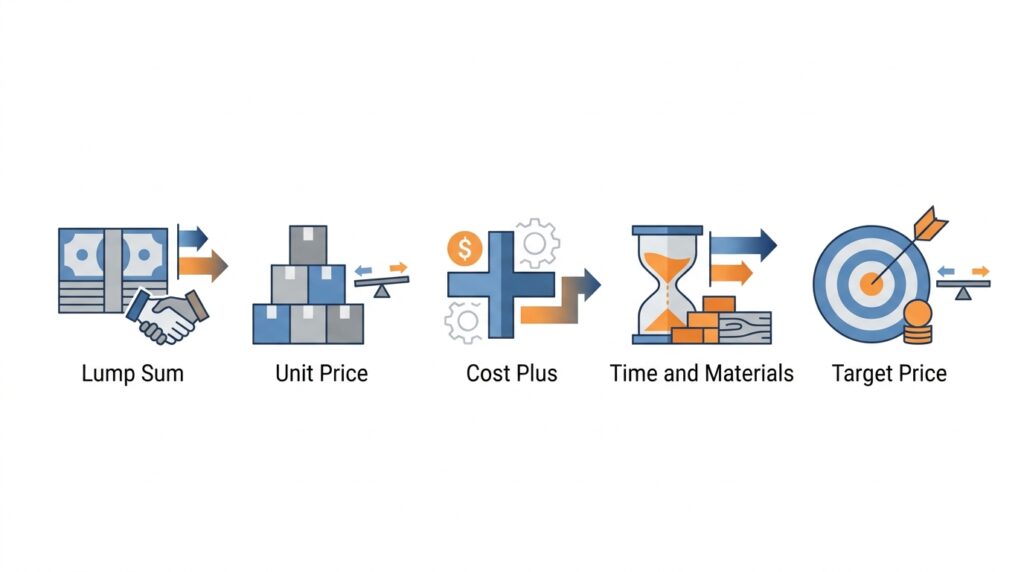
    Contract Types

    Contract types and risk allocation in EPC projects

    Different contract types allocate risk differently.

    Contract Type Description Risk Allocation
    Lump sum Fixed price for defined scope Contractor bears cost risk for defined scope; owner bears risk of scope changes
    Unit price Price per unit of work, with quantities remeasured Risk shared based on quantities
    Cost plus Actual cost plus fee Owner bears cost risk
    Time and materials Hourly rate plus materials Owner bears cost risk
    Target price Target with shared savings/overruns Risk shared

    The choice of contract type depends on how well the scope is defined and how much risk each party can bear. EPC projects are most often lump sum, which gives the owner cost certainty but only if the scope and the owner’s requirements are well defined at award.

    Key Contract Terms

    Contracts contain many terms that affect project execution.

    Term Description
    Scope What is included and excluded
    Price Contract price and pricing structure
    Payment terms When and how payment is made
    Schedule Key dates and milestones
    Performance guarantees What performance must be achieved
    Liquidated damages Pre-agreed compensation for delay or performance shortfall, usually subject to a cap
    Warranty Warranty period (defects liability) and terms
    Security Performance bonds, advance payment guarantees, parent company guarantees
    Insurance Required coverage, such as construction all-risk and third-party liability
    Indemnity Who bears liability for specific risks
    Limitation of liability Caps on each party’s total liability
    Force majeure What happens if events beyond control occur
    Suspension and termination Under what conditions the contract can be suspended or terminated
    Governing law Which law applies to the contract
    Dispute resolution How disputes are resolved

    Key terms should be clearly understood by both parties.

    Contract Administration

    Contract administration is the ongoing management of the contract during execution.

    Contract administration activities:

    • Correspondence management: Managing letters, emails, and notices.
    • Meeting management: Managing project meetings and minutes.
    • Document management: Managing contract documents and their revisions.
    • Obligation tracking: Tracking contractual obligations of both parties.
    • Compliance monitoring: Monitoring compliance with contract terms.
    • Subcontractor oversight: Confirming that the contractor’s subcontractor arrangements comply with contract requirements.
    • Reporting: Reporting contract status to management.

    Contract administration ensures that the contract is managed professionally.

    Obligations run in both directions. Owners often overlook their own duties, such as providing site access, owner-supplied information or equipment, approvals within agreed review periods, and timely payment. Failure to meet these can give the contractor grounds for a time or cost claim.

    Contract Management Software

    Contract management software can help track obligations, manage correspondence, monitor milestones, and provide alerts for upcoming deadlines. For small plants, even a structured spreadsheet can provide significant benefit.

    A simple obligations register, listing each obligation, who owns it, the due date, and its status, is often the most valuable single tool.

    Correspondence and Notices

    Correspondence and notices are the formal communication between parties.

    Correspondence considerations:

    • Formal notices: Notices required by the contract (e.g., delay notices, change notices, claim notices).
    • Time limits: Many notices have strict time limits, and some contracts bar claims that are not notified in time.
    • Format and delivery: Contracts often specify how notices must be given (in writing, to a named person or address).
    • Written record: Verbal instructions should be confirmed in writing.
    • Record keeping: Correspondence should be filed and accessible.
    • Tone: Correspondence should be professional and constructive.

    Failure to provide required notices can result in loss of rights.

    Early Warning and Risk Sharing

    Some contracts require parties to notify each other of emerging risks or problems at an early stage. Early warning allows issues to be addressed collaboratively before they escalate into claims.

    Even where the contract does not require it, raising concerns early is good practice. Regular joint risk reviews help make this routine.

    Change Management

    Changes are common in EPC projects. Managing them is critical.

    Change management activities:

    • Change identification: Recognizing when a change is required.
    • Change assessment: Evaluating the impact on scope, cost, schedule, and quality.
    • Change approval: Approving or rejecting the change before work proceeds.
    • Change implementation: Implementing the change.
    • Documentation: Recording the change and its impact, and issuing a formal change order or variation.

    Types of changes:

    Type Description
    Scope change Addition or deletion of work
    Design change Modification to design
    Schedule change Change to schedule
    Price change Change to price
    Procedure change Change to procedures

    Changes should be managed formally, with clear documentation and approval. Work carried out on verbal instruction without a formal change order is a frequent source of later disputes over entitlement and valuation.

    A change that affects price or schedule should be agreed, or at least have its basis of valuation agreed, before the work is done. Disputed changes should still be recorded so the dispute does not grow unnoticed.

    Payment Management

    Payment management ensures that payments are made correctly and on time.

    Payment management activities:

    • Payment schedule: What payments are due, and when?
    • Milestone verification: Confirming that milestones are met.
    • Invoice review: Reviewing invoices for accuracy.
    • Payment approval: Approving payments.
    • Payment processing: Processing payments.
    • Payment records: Recording payments.

    Payment considerations:

    • Retention: Some contracts include retention (a percentage held back until completion or the end of the warranty).
    • Advance payments: Some contracts include advance payments, usually secured by a bank guarantee.
    • Currency and exchange rates: What currency is used, and is there any adjustment mechanism?
    • Price adjustment: Whether the price adjusts for inflation or escalation.
    • Taxes: What taxes apply, including withholding tax.
    • Set-off: Whether the owner may deduct amounts, such as liquidated damages, from payments.

    Payment should be made according to the contract terms.

    Claims Management

    Claims are requests for additional time or money.

    Common claims:

    Claim Type Description
    Extension of time Additional time required
    Additional cost Additional cost incurred
    Disruption Disruption to planned work
    Acceleration Cost of accelerating work
    Change Cost of change

    Claims management activities:

    • Claim identification: Identifying potential claims.
    • Claim notification: Notifying the other party of claims within contract time limits.
    • Claim preparation: Preparing claim documentation.
    • Claim evaluation: Evaluating claims.
    • Claim resolution: Resolving claims.

    Claims should be managed proactively, not left to accumulate.

    Record Keeping for Claims

    Claims are usually decided on the basis of contemporaneous records: site diaries, daily reports, correspondence, and progress data. Records created at the time of the event carry far more weight than those reconstructed later.

    Useful records include updated schedules, photographs, resource and manpower records, meeting minutes, and inspection reports. Both owners and contractors benefit from keeping them consistently, because they are equally important when defending against a claim.

    Delay Analysis

    Time claims need to show not just that a delay occurred, but that it affected the critical path. Where delays by both parties overlap (concurrent delay), the contract and governing law determine how time and cost are treated. A current, agreed baseline schedule and regular schedule updates make delay analysis far more reliable.

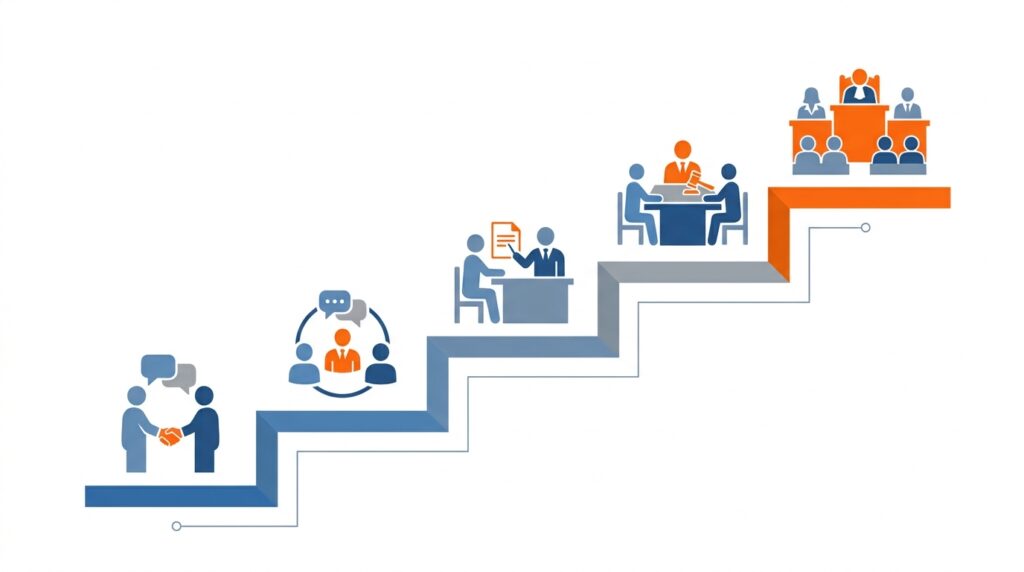
    Dispute Resolution

    Dispute resolution methods in EPC contracts

    Disputes can arise when parties disagree.

    Dispute resolution methods:

    Method Description
    Negotiation Parties negotiate directly
    Mediation Neutral third party helps the parties reach agreement; not binding unless agreed
    Adjudication / dispute board Neutral third party issues a decision, often binding in the short term but open to later challenge
    Arbitration Arbitrator issues a binding award
    Litigation Court decides

    Many contracts use a tiered approach, escalating from project-level discussion to senior management, then to mediation or a dispute board, and finally to arbitration or litigation. Dispute resolution should be planned in the contract, with clear procedures and time limits. Disputes should be raised and addressed early, while the facts are fresh and the relationship is intact.

    Contract Closeout

    Contract closeout is the final phase of contract management.

    Closeout activities:

    • Final acceptance: Confirming that all work is complete, including performance tests and handover.
    • Final payment: Making final payment.
    • Warranty documentation: Confirming warranty terms and periods.
    • Release of retention and securities: Releasing any retention and returning bonds and guarantees when due.
    • Final accounts: Agreeing final accounts, including all changes and claims.
    • Resolution of open claims: Settling or formally recording any outstanding claims.
    • Records archive: Retaining contract records for the required period.
    • Lessons learned: Capturing lessons for future projects.

    Closeout should be planned from the beginning, not left to the end.

    Contract Management in Small Plants

    Small plants face particular challenges with contract management.

    Challenges:

    • Fewer resources for contract management.
    • Less legal and commercial expertise.
    • More informal communication.
    • Competing priorities.

    Practical approaches:

    • Define clear contracts: Clear contracts reduce disputes.
    • Assign responsibility: Someone should be responsible for contract management.
    • Use templates: Standard templates for notices, change orders, and claim registers save time.
    • Keep records: Good records support claims and disputes.
    • Seek advice: Get legal or commercial advice when needed, especially before sending a notice with significant consequences.
    • Learn from others: Learn from other plants’ experiences.

    Contract management does not need to be complex. It needs to be consistent.

    Common Mistakes in Contract Management

    Even experienced organizations make mistakes. Common ones include:

    • Unclear contracts: Ambiguous terms or conflicting documents lead to disputes.
    • No contract management: Contract not actively managed.
    • Missing notices: Failing to provide required notices.
    • Poor records: Inadequate documentation.
    • Uncontrolled changes: Changes not managed formally.
    • Delayed payments: Payments not made on time.
    • Unresolved claims: Claims left to accumulate.
    • Escalating disputes: Disputes not resolved early.
    • Ignoring owner obligations: Owner-side duties not tracked.
    • Poor closeout: Closeout left to the end.

    These mistakes are costly to correct. They are much cheaper to avoid through disciplined contract management.

    How Japanese EPC Firms Approach Contract Management

    Japanese engineering firms are known for their disciplined approach to contract management. Common characteristics include:

    • Clear contracts: Contracts are clear and complete.
    • Disciplined administration: Contract obligations are tracked and managed.
    • Thorough records: Documentation is complete and accessible.
    • Proactive communication: Issues are raised early.
    • Constructive relationships: Parties work together to resolve issues.
    • Systematic closeout: Closeout is planned and executed.
    • Continuous improvement: Lessons are captured and applied.

    For plant owners, this often means projects that are delivered without disputes.

    How to Evaluate Contract Management Readiness

    When reviewing contract management, ask:

    Question Why It Matters
    Is the contract clear and complete? Reduces disputes
    Is the order of precedence defined? Resolves conflicts between documents
    Is someone responsible for contract management? Ensures accountability
    Are contract obligations tracked, for both parties? Ensures compliance
    Is correspondence managed and are notice deadlines known? Preserves rights
    Are changes managed formally? Prevents disputes
    Are payments made on time? Maintains relationship
    Are contemporaneous records kept? Supports claims and defense
    Are claims managed proactively? Prevents escalation
    Are disputes resolved early? Prevents litigation
    Is closeout planned? Ensures smooth completion

    A plant that addresses these questions is ready for effective contract management.

    Conclusion

    Contract management is critical to project success. For small to medium-scale industrial plants, it determines whether the project is delivered without disputes.

    By focusing on contract formation, administration, change management, payment, claims, dispute resolution, and closeout, owners and project teams can ensure that the contract supports the project rather than hindering it.

    Key Takeaways

    • Contract management administers the contract from award to closeout
    • Contract formation establishes clear scope, price, terms, and risk allocation
    • Contract documents should state an order of precedence to resolve conflicts
    • Contract types allocate risk differently: lump sum, unit price, cost plus, time and materials, target price
    • Key contract terms include scope, price, payment, schedule, guarantees, liquidated damages, warranty, security, indemnity, force majeure, termination, and dispute resolution
    • Correspondence and notices are formal communication with time limits
    • Early warning lets parties address emerging problems before they become claims
    • Changes must be managed formally
    • Claims should be managed proactively and supported by contemporaneous records
    • Contract management software, or even a structured spreadsheet, helps track obligations and deadlines
    • Disputes should be resolved early through negotiation, mediation, adjudication, arbitration, or litigation
    • Closeout should be planned from the beginning
    • Japanese EPC firms emphasize clear contracts and disciplined administration
  • Plant Performance Testing and Acceptance: Key Practices for EPC Projects

    Plant Performance Testing and Acceptance: Key Practices for EPC Projects

    Performance testing is the moment of truth in an EPC project. After months or years of design, construction, and commissioning, the plant is run at full load and measured against the guarantees in the contract. If it meets the guarantees, the contractor has delivered what was promised. If it falls short, the consequences (liquidated damages, corrections, or disputes) can be significant.

    For plant owners, performance testing is the final verification that the plant is worth what was paid for it. For contractors, it is the proof that their work meets the contractual requirements.

    For small to medium-scale industrial plants, performance testing and acceptance are especially important because there is less margin for error and fewer resources to absorb the consequences of a failed test. A plant that fails its performance test can be delayed for weeks or months while corrections are made.

    This article covers the key practices in performance testing and acceptance, from test planning to test execution and final acceptance.

    What Is Performance Testing?

    Performance testing is the process of measuring the plant’s actual performance against the guaranteed performance in the contract.

    Performance tests typically verify:

    • Output: Does the plant produce the guaranteed output?
    • Efficiency: Does the plant meet the guaranteed heat rate or efficiency?
    • Emissions: Do emissions meet guaranteed or regulatory limits?
    • Consumption: Does the plant consume the guaranteed amounts of fuel, water, or chemicals?
    • Availability and reliability: Does the plant demonstrate the required availability or reliability? (These are usually proven through a separate reliability run, not the short guarantee tests.)

    Performance testing is usually the final step before acceptance.

    Why Performance Testing Matters

    Performance testing determines whether the plant meets its guarantees.

    Factor Impact of Good Performance Testing Impact of Poor Performance Testing
    Acceptance Plant accepted; final payment made Acceptance delayed; disputes
    Guarantees Guarantees verified Guarantees unverified or disputed
    Liquidated damages Damages calculated fairly Damages disputed
    Warranty Warranty period starts Warranty delayed
    Owner confidence Owner confident in plant Owner uncertain
    Contractor reputation Contractor reputation enhanced Contractor reputation damaged

    For small plants, where there is less margin for error, performance testing determines whether the project closes successfully.

    Performance Guarantees

    Performance guarantees are the contractual commitments that define what the plant must achieve.

    Guarantee Description Typical Unit
    Net output Electrical output delivered at the plant boundary MW
    Heat rate Fuel input per unit of electrical output kJ/kWh
    Thermal efficiency Ratio of output to fuel input %
    Emissions NOx, SOx, particulate matter (stated at a reference O₂ level and on a dry or wet basis) mg/Nm³
    Auxiliary power Power consumed by the plant % of gross output
    Availability Percentage of time the plant is operational %
    Reliability Frequency of forced outages —

    Guarantees should be clearly defined in the contract, including reference conditions and test procedures.

    Relationship Between Performance Testing and Performance Guarantees

    Performance testing is the mechanism by which performance guarantees are verified. The guarantees define what must be achieved; the testing defines how it is measured. Both must be clearly defined and agreed in the contract. A guarantee without a defined test method invites dispute, and a test method without a clear guarantee has nothing to measure against.

    Minimum Guarantees and Full Guarantees

    Many EPC contracts use two tiers of guarantees:

    • Full (or target) guarantees: The values the contractor commits to achieve. Shortfalls against these are normally compensated through liquidated damages.
    • Minimum (or threshold) guarantees: The lowest acceptable values. If the plant falls below these, the owner may reject the plant or require correction, regardless of liquidated damages.

    Owners and contractors should be clear on which tier applies to each guarantee.

    Reference Conditions

    Reference conditions for plant performance testing

    Performance depends on ambient conditions, fuel quality, and other factors. Reference conditions define the conditions under which guarantees apply.

    Common reference conditions:

    • Ambient temperature: Typically 15°C or 25°C.
    • Ambient pressure: Sea level or site elevation.
    • Relative humidity: Typically specified as a percentage.
    • Cooling water temperature: Typically specified.
    • Fuel composition: Heating value and composition.
    • Emissions basis: Reference oxygen content and dry or wet basis.

    Test results are corrected to reference conditions using correction curves specified in the contract.

    Test Sequence

    Performance testing is normally carried out in stages rather than as a single event:

    1. Preliminary (pre-performance) tests: Run before the formal test to check instruments, plant stability, and likely performance. They allow problems to be fixed before the guarantee test, and may be used to tune the plant.
    2. Reliability run: A continuous operating period, often several days, to demonstrate stable operation and reliability.
    3. Guarantee (acceptance) tests: Formal tests for output, efficiency, emissions, and consumption, conducted and witnessed under the agreed procedures.
    4. Reporting and review: Results are corrected, analyzed, and agreed.

    The contract should state what is required at each stage and whether preliminary test results can count toward acceptance.

    Test Procedures

    Test procedures define how performance testing will be conducted.

    Test procedure elements:

    • Scope: What is being tested?
    • Reference conditions: What conditions apply?
    • Measurement points: Where are measurements taken?
    • Instrumentation: What instruments are used?
    • Test duration: How long is each test?
    • Stabilization: How long must the plant stabilize before testing?
    • Data collection: How is data collected and recorded?
    • Correction curves: How are results corrected to reference conditions?
    • Acceptance criteria: What defines a successful test?
    • Witnessing: Who witnesses the test?

    Test procedures should be agreed before testing begins, ideally as part of the contract.

    Test Standards

    Performance testing should follow recognized standards.

    Standard Application
    ASME PTC 46 Overall plant performance
    ASME PTC 4 Fired steam generators
    ASME PTC 4.4 Heat recovery steam generators
    ASME PTC 6 Steam turbines
    ASME PTC 22 Gas turbines
    ASME PTC 19.1 Test uncertainty
    ISO 2314 Gas turbines: acceptance tests
    ISO 3977 Gas turbine procurement

    Standards define measurement methods, instrumentation, and calculation procedures. The contract should state which standard and edition applies, and any agreed deviations from it.

    Instrumentation and Measurement

    Accurate measurement is essential for meaningful performance testing.

    Parameter Measurement Method
    Fuel flow Flow meters, orifice plates, Coriolis meters
    Fuel heating value Gas chromatograph, calorimeter
    Power output Power meters, current and voltage transformers
    Temperature RTDs, thermocouples
    Pressure Pressure transmitters
    Flow Flow meters, orifice plates
    Emissions Continuous emission monitoring systems (CEMS) or stack testing

    Instruments should be calibrated before testing and traceable to national standards. Fuel sampling and analysis deserve particular care, because heating value errors flow directly into heat rate results.

    Measurement Uncertainty

    All measurements have uncertainty. The contract should define how uncertainty is treated: whether it is added to the guaranteed value, subtracted from the measured value, or treated separately. This affects whether a marginal result passes or fails.

    Uncertainty is calculated using the method in the test standard (for example, ASME PTC 19.1). It is not the same as a contractual tolerance. Uncertainty reflects the quality of the measurement, while tolerance is a negotiated margin around the guarantee. Both can apply, and the contract should say how they combine.

    Test Planning

    Performance testing should be planned well in advance.

    Test planning activities:

    • Define test scope: What tests will be performed?
    • Agree test procedures: What procedures will be used?
    • Prepare instrumentation: Are instruments installed and calibrated?
    • Schedule testing: When will tests be performed?
    • Coordinate parties: Who will participate in testing?
    • Prepare documentation: What documentation is required?
    • Plan contingencies: What if testing is delayed or fails?

    Test planning should begin during commissioning, if not earlier.

    Test Execution

    Performance testing is executed after the plant is stable and operating at the required conditions.

    Test execution steps:

    1. Stabilize the plant: Operate at test conditions until stable.
    2. Verify conditions: Confirm that reference conditions are met.
    3. Start data collection: Begin recording data.
    4. Monitor throughout: Monitor conditions throughout the test.
    5. Complete the test: Run for the specified duration.
    6. Stop data collection: Stop recording data.
    7. Verify data quality: Check data for completeness and accuracy.

    Test Witnessing and Third-Party Verification

    Tests should be witnessed by representatives of both parties. For major tests, an independent third-party witness or verifier may be appointed to confirm that tests are conducted according to the agreed procedures and that results are accurately recorded. This reduces the risk of disputes.

    Test Conditions

    Tests must be conducted under conditions that satisfy the contract requirements.

    Test condition considerations:

    • Load: Tests are usually conducted at full load or specified load.
    • Stability: Conditions must be stable for the specified period.
    • Ambient conditions: Ambient conditions should be within the range specified in the contract.
    • Fuel quality: Fuel should be within the specified range.
    • Plant configuration: Plant should be in the specified configuration, with equipment such as cooling systems, auxiliaries, and any steam or power exports set as the contract requires.
    • No abnormalities: No abnormal conditions should affect the test.

    If conditions are not met, the test may be invalidated or rescheduled.

    Data Collection and Analysis

    Data collected during testing must be accurate and complete.

    Data collection considerations:

    • Data frequency: How often is data recorded?
    • Data storage: Where is data stored?
    • Data verification: How is data verified?
    • Data correction: How is data corrected to reference conditions?
    • Data analysis: How is data analyzed?

    Data should be analyzed by qualified personnel using agreed methods.

    Correction to Reference Conditions

    Test results are corrected to reference conditions using correction curves.

    Factor Effect on Performance
    Ambient temperature Higher temperature reduces output and increases heat rate
    Ambient pressure Lower pressure reduces output
    Relative humidity Affects combustion and output
    Cooling water temperature Higher temperature reduces output and efficiency
    Fuel heating value Affects fuel consumption and output

    Correction curves are typically provided by the equipment manufacturer and specified in the contract. If the plant is tested before it is fully “clean” or after some operating hours, the contract should also state whether any degradation or ageing allowance applies.

    Test Results and Acceptance

    Performance test acceptance decision process

    Test results are compared to the guarantees to determine acceptance.

    Acceptance criteria:

    • Meets guarantee: If results meet the guarantee, the test passes.
    • Within tolerance: If results are within the agreed tolerance or uncertainty treatment, the test may pass.
    • Shortfall: If results fall short of the guarantee, remedies may apply.

    Shortfalls may result in:

    • Correction: The contractor may correct the shortfall.
    • Liquidated damages: The contractor may pay damages.
    • Rejection: In extreme cases, such as a miss against the minimum guarantee, the owner may reject the plant.

    Test Report

    The test results should be documented in a formal report, typically including the test procedure followed, instrument calibration records, raw and corrected data, uncertainty analysis, comparison to guarantees, and any deviations from the agreed procedure. Both parties should review and sign off the report. It becomes a key document for acceptance and for any later dispute.

    Failed Tests and Root Cause

    When a performance test fails, root cause analysis should determine whether the shortfall is due to design, construction, commissioning, or operating conditions. This determines whether correction, retest, or a commercial settlement is appropriate.

    Liquidated Damages

    Liquidated damages are pre-agreed compensation for performance shortfalls.

    Factor Description
    Guaranteed value The contractual guarantee
    Actual value The measured performance
    Shortfall The difference
    Damage rate Pre-agreed rate per unit of shortfall
    Cap Maximum liquidated damages

    Liquidated damages should reflect the actual loss to the owner, not be punitive. Contracts often pay for shortfalls in output and heat rate separately, so the damage rate for each should be tied to the owner’s real economics, such as lost revenue or extra fuel cost over the plant’s life.

    Retesting

    If a test fails, the contractor may be entitled to retest.

    Retest considerations:

    • Correction: The contractor corrects the shortfall before retesting.
    • Time limit: Retesting must occur within a specified time.
    • Number of retests: The contract may limit the number of retests.
    • Cost: Who bears the cost of retesting?

    Retesting should be planned as part of the performance testing process.

    Final Acceptance

    Final acceptance is the formal confirmation that the plant meets requirements.

    Final acceptance activities:

    • Review test results: Confirm that results meet guarantees.
    • Resolve shortfalls: Address any shortfalls.
    • Complete documentation: Confirm documentation is complete.
    • Sign acceptance certificate: Formal acceptance of the plant.

    Final acceptance triggers payment and warranty.

    Common Mistakes in Performance Testing

    Even experienced organizations make mistakes. Common ones include:

    • No test procedures: Testing without agreed procedures.
    • Inadequate instrumentation: Instruments not installed or calibrated.
    • Poor test planning: Testing not planned in advance.
    • Invalid conditions: Testing under conditions that do not meet requirements.
    • Inadequate data collection: Data incomplete or inaccurate.
    • Poor data analysis: Data analyzed incorrectly.
    • No witnessing: Tests not witnessed by both parties.
    • Undefined uncertainty treatment: Marginal results disputed because the contract is silent on uncertainty.
    • Disputes over results: Disagreements on test validity or results.
    • No contingency: No plan for what to do if testing fails.

    These mistakes are costly to correct. They are much cheaper to avoid through good planning and disciplined execution.

    How Japanese EPC Firms Approach Performance Testing

    Japanese engineering firms are known for their disciplined approach to performance testing. Common characteristics include:

    • Thorough planning: Testing is planned carefully, with agreed procedures.
    • Detailed preparation: Instruments are installed and calibrated before testing, and preliminary tests are used to find problems early.
    • Disciplined execution: Tests are conducted under controlled conditions.
    • Comprehensive documentation: Results are documented completely and accurately.
    • Careful analysis: Data is analyzed carefully using agreed methods.
    • Continuous improvement: Lessons are captured and applied.

    For plant owners, this often means performance testing that is fair, accurate, and conclusive.

    How to Evaluate Performance Testing Readiness

    When reviewing performance testing readiness, ask:

    Question Why It Matters
    Are performance guarantees defined (full and minimum)? Defines what the plant must achieve
    Are reference conditions specified? Defines the conditions under which guarantees apply
    Are test procedures agreed? Defines how testing will be conducted
    Are standards specified? Ensures testing follows recognized methods
    Is instrumentation installed and calibrated? Ensures accurate measurement
    Is the treatment of measurement uncertainty defined? Decides whether marginal results pass or fail
    Is test planning complete, including preliminary tests? Ensures testing is well-organized
    Are both parties prepared, and is a third-party witness needed? Ensures testing is witnessed and agreed
    Is data collection and analysis planned? Ensures results are reliable
    Are retest procedures and root cause process defined? Provides for contingencies
    Is final acceptance planned? Ensures formal confirmation

    A plant that addresses these questions is ready for performance testing.

    Conclusion

    Performance testing and acceptance are the final verification that the plant meets its guarantees. For small to medium-scale industrial plants, they determine whether the project closes successfully.

    By focusing on performance guarantees, reference conditions, test procedures, standards, instrumentation, measurement uncertainty, test planning, execution, data analysis, and acceptance, owners and contractors can ensure that performance testing is fair, accurate, and conclusive.

    Key Takeaways

    • Performance testing verifies that the plant meets its contractual guarantees
    • Performance guarantees define output, efficiency, emissions, and other metrics
    • Testing is the mechanism for verifying guarantees; both must be clearly defined in the contract
    • Reference conditions define the conditions under which guarantees apply
    • Test procedures and standards define how testing is conducted
    • Accurate, calibrated instrumentation is essential for meaningful results
    • The contract should define how measurement uncertainty is treated
    • Test results are corrected to reference conditions using correction curves
    • Acceptance depends on whether results meet guarantees, fall within tolerance, or fall short
    • Independent third-party witnesses can reduce the risk of disputes
    • Failed tests need root cause analysis to decide between correction, retest, or settlement
    • Liquidated damages compensate the owner for shortfalls
    • Retesting may be permitted if a test fails
    • Japanese EPC firms emphasize thorough planning and careful data analysis
  • Plant Operations Readiness: Key Practices for EPC Projects

    Plant Operations Readiness: Key Practices for EPC Projects

    A plant can be built on time, within budget, and to specification, and still fail in its first months of operation. The equipment works. The systems are commissioned. But the owner’s team is not ready to run the plant. Procedures are missing, staff are untrained, spare parts are not in place, and the first failures catch everyone by surprise.

    Operations readiness is the discipline of ensuring that the owner’s organization is prepared to operate and maintain the plant from day one. It is not just about the plant being ready. It is about the people, procedures, systems, and support being ready too.

    For small to medium-scale industrial plants, operations readiness is especially important because there is less redundancy and fewer resources to absorb the consequences of an unprepared start. A plant that starts up without a ready operations team can suffer early failures, safety incidents, and extended teething problems.

    This article covers the key practices in operations readiness, from readiness planning to staffing, procedures, training, the transition to operations, and first-year support.

    What Is Operations Readiness?

    Operations readiness is the process of preparing the owner’s organization to operate and maintain the plant. It covers:

    • Organization: Is the right team in place, with the right skills?
    • Procedures: Are operating, maintenance, and emergency procedures ready?
    • Training: Are staff trained and competent?
    • Systems: Are maintenance, stores, information, and other support systems in place?
    • Spares and consumables: Are the parts and materials needed for operation available?
    • Support: Are vendor support and technical assistance arrangements in place?
    • Safety: Are safety systems, permits, and emergency arrangements ready?
    • Budget and contracts: Are operating funds and service contracts approved and in place?

    Operations readiness is not the same as plant readiness. A plant can be mechanically complete and commissioned while the owner’s team is still unprepared to operate it.

    Why Operations Readiness Matters

    Factor Good Readiness Poor Readiness
    Startup Smooth start; issues resolved quickly Chaotic start; issues escalate
    Safety Hazards understood and controlled Incidents during early operation
    Reliability Equipment operated within limits Early failures from poor operation
    Cost Operating costs controlled Emergency purchases; rework
    Morale Team confident and capable Team overwhelmed and demoralized
    Compliance Regulatory requirements met Non-compliance from day one

    For small plants, where the team may be small and multi-skilled, operations readiness determines whether the plant can actually be run.

    Operations Readiness Planning

    Operations readiness should be planned alongside the project, not after it. Readiness planning activities include:

    • Define readiness criteria: What must be in place before startup?
    • Define readiness scope: Which areas, systems, and functions are covered?
    • Assign responsibility: Who is responsible for each readiness element?
    • Develop a readiness plan: What must be done, by when, and by whom?
    • Track readiness: Monitor progress against the plan.
    • Conduct readiness reviews: Verify readiness before startup.

    Readiness planning should begin early, ideally during design, so that the owner’s organization has time to recruit, train, and prepare. Readiness activities should also be built into the project schedule, so that they are not squeezed when construction runs late.

    The Operations Readiness Coordinator

    Someone must own the readiness process. An operations readiness coordinator should be appointed to lead the readiness effort. This person tracks progress, coordinates between the project team and the owner’s operations team, and reports to management. Without a clear owner, readiness tasks tend to fall between the project team (focused on construction) and the operations team (not yet fully formed).

    Operations Readiness Reviews

    Operations readiness reviews should be conducted at defined milestones, such as 6 months and 3 months before startup. Each review verifies progress against the readiness plan and identifies gaps that must be closed before startup. A final review shortly before startup confirms that all readiness criteria are met and supports the decision to proceed. This review complements the pre-startup safety review (PSSR), which focuses on process safety, by covering the full scope of organizational readiness.

    Operations Readiness Criteria

    Readiness criteria define what must be in place before startup.

    Criterion Description
    Organization Team in place, roles defined, skills available
    Procedures Operating, maintenance, and emergency procedures ready
    Training Staff trained and assessed as competent
    Maintenance systems CMMS, planning, and scheduling in place
    Stores and spares Spare parts and consumables available
    Vendor support Support arrangements in place
    Safety systems Safety systems, permits, and emergency plans ready
    Documentation Operating and maintenance documentation available
    Utilities and consumables Utilities and consumables available
    Information systems Plant data, reporting, and control system access and security in place
    Budget and contracts Operating budget approved; service contracts in place
    Regulatory approvals Permits and approvals in place

    Readiness criteria should be defined in the contract and agreed by both parties.

    Organization and Staffing

    The owner’s organization must be in place before startup. Staffing considerations include:

    • Roles and responsibilities: Who does what?
    • Skills and competencies: What skills are required?
    • Staffing levels: How many people are needed?
    • Shift arrangements: How will shifts be covered?
    • Reporting lines: Who reports to whom?
    • Contractor support: What support will be provided by contractors?
    • Recruitment lead time: When must hiring start so that staff are on board in time to train?

    For small plants, staff may be multi-skilled and cover multiple roles. Clarity of roles and responsibilities is still essential.

    Procedures

    Operating, maintenance, and emergency procedures must be ready before startup.

    Procedure Type Purpose
    Operating procedures How to start up, operate, and shut down
    Emergency procedures How to respond to emergencies
    Maintenance procedures How to inspect, maintain, and repair
    Safety procedures Permit-to-work, lockout/tagout, confined space
    Alarm response procedures How to respond to specific alarms
    Laboratory procedures How to sample and test

    Procedures must be accurate, clear, and available to the people who need them. They should be reviewed by the operators who will use them and updated after commissioning to reflect how the plant actually behaves.

    Training and Competency

    The owner’s staff must be trained and competent before startup.

    Category Description
    Operations training How to operate the plant
    Maintenance training How to maintain equipment
    Safety training How to work safely
    Emergency training How to respond to emergencies
    Vendor training Equipment-specific training from vendors
    Simulator training Practice in a simulated environment

    Training considerations:

    • Timing: Training should begin well before startup.
    • Competency assessment: Training should include assessment of competency.
    • Documentation: Training records should be maintained.
    • Drills: Emergency drills should be held before startup, not after the first real event.
    • Refresher training: Refresher training should be planned.

    Training is not complete until staff can demonstrate competency.

    Operator Involvement in Commissioning

    Operators should be involved in commissioning where possible. Participating in cold and hot commissioning, and assisting with integrated testing, gives them hands-on familiarity with the plant that classroom training cannot provide. Involvement also lets operators learn the plant’s quirks, test the draft procedures, and raise concerns while changes are still easy to make. For this to work, operators must be recruited early enough to be present during commissioning.

    Maintenance Systems

    Maintenance systems should be set up and populated before startup. Key elements include:

    • CMMS: Computerized maintenance management system.
    • Equipment register: List of equipment and assets.
    • Preventive maintenance plans: Scheduled maintenance tasks.
    • Spare parts inventory: Parts and materials in stock.
    • Work order system: How work is requested and tracked.
    • Planning and scheduling: How work is planned and scheduled.

    Spares and Consumables

    Spare parts and consumables should be in place before startup, not ordered after the first failure.

    • Critical spares: Spares essential for operation.
    • Recommended spares: Spares recommended by vendors.
    • Consumables: Filters, lubricants, chemicals, and initial fills.
    • Inventory: Spare parts inventory and location.
    • Supplier information: Supplier contacts and part numbers.

    Vendor Support

    Vendor support arrangements should be in place before startup.

    • Warranty support: Who to contact for warranty claims.
    • Technical support: Who to contact for technical assistance.
    • Field service: Availability of field service support.
    • Spare parts support: Availability of spare parts.
    • Training support: Availability of vendor training.
    • Documentation support: Access to vendor documentation.

    Vendor support is especially important for specialized equipment.

    Safety Systems and Permits

    Safety readiness is not optional. It is a prerequisite for startup.

    • Safety systems: Fire and gas detection, emergency shutdown, relief systems.
    • Permits: Operating permits, environmental permits, and other approvals.
    • Emergency response: Emergency plans, equipment, and training.
    • Safety procedures: Permit-to-work, lockout/tagout, confined space.
    • PPE: Personal protective equipment available.
    • Safety training: Staff trained on safety systems and procedures.

    Regulatory Approvals

    Regulatory approvals should be obtained before startup, not after.

    • Operating permits: Permits to operate the plant.
    • Environmental permits: Permits for emissions, discharges, and waste.
    • Safety certifications: Pressure vessel, boiler, and other certifications.
    • Occupancy certificates: Certificates for buildings and structures.
    • Insurance: Insurance coverage in place.

    Operating Budget, Contracts, and Information Systems

    Two further areas are often overlooked.

    Budget and contracts. The operating budget should be approved before startup, covering staffing, consumables, utilities, spares, and service contracts. Where the owner relies on third parties for services such as specialist maintenance, laboratory testing, or waste handling, these contracts should be in place and tested before they are needed.

    Information systems. Plant data, reporting, and control system access should be ready, with clear ownership of data and appropriate cybersecurity controls. Operators and engineers need the data to run the plant and track performance from the first day.

    The Transition from Project to Operations

    The transition from project to operations is a critical handover point and should be carefully managed. This includes transferring responsibility, documentation, and knowledge from the project team to the operations team, with clear milestones and sign-offs. A good transition addresses:

    • Responsibility: When does each system pass from the project team to operations?
    • Documentation: Are as-built drawings, manuals, and records complete and accessible?
    • Knowledge: Are key project staff available to brief the operations team and answer questions?
    • Open items: Is there an agreed punch list, with owners and deadlines?
    • Sign-offs: Are handover milestones formally recorded?

    First-Year Support

    The first year of operation is critical. Support during this period helps the owner’s team through teething problems.

    • Vendor support: Ongoing support from equipment vendors.
    • Contractor support: Support from the EPC contractor during the warranty and defect liability period.
    • Technical assistance: Access to technical expertise when needed.
    • Performance monitoring: Monitoring plant performance, including performance guarantee tests, and addressing issues.
    • Training refreshers: Additional training as needed.
    • Lessons learned: Capturing and applying lessons from early operation.

    First-year support helps the owner’s team build confidence and competence.

    Common Mistakes in Operations Readiness

    • No readiness planning: Readiness left to chance.
    • No owner: No one appointed to lead the readiness effort.
    • Late staffing: Staff recruited too late.
    • Incomplete training: Staff not trained or competent.
    • Procedures missing: Procedures not ready at startup.
    • Spares missing: Spares ordered after the first failure rather than before startup.
    • No maintenance systems: CMMS and maintenance plans not in place.
    • No vendor support: Support arrangements not in place.
    • Safety gaps: Safety systems or permits not ready.
    • Rushed handover: Responsibility transferred without documentation or sign-off.
    • No first-year support: Owner left to fend for themselves after startup.

    These mistakes are costly to correct. They are much cheaper to avoid through good planning and disciplined execution.

    How Japanese EPC Firms Approach Operations Readiness

    Japanese engineering firms are known for their disciplined approach to operations readiness. Common characteristics include:

    • Early planning: Readiness is planned from the beginning of the project.
    • Detailed preparation: Procedures, training, and systems are prepared carefully.
    • Comprehensive training: Staff are trained and assessed for competency.
    • Operator participation: Owner’s operators take part in commissioning and testing.
    • Strong support: Vendor and contractor support is in place.
    • Disciplined startup: Startup is controlled and monitored.
    • Continuous improvement: Lessons are captured and applied.
    • Long-term focus: Readiness is treated as the foundation for reliable operation.

    For plant owners, this often means a plant that starts up smoothly and operates reliably from day one.

    How to Evaluate Operations Readiness

    Question Why It Matters
    Is readiness planned? Provides a roadmap for readiness
    Is a readiness coordinator appointed? Ensures someone owns the process
    Are readiness criteria defined? Defines what must be in place
    Are readiness reviews scheduled? Finds gaps while there is time to close them
    Is the organization in place? Ensures someone is available to operate
    Are procedures ready? Ensures staff know what to do
    Is training complete? Ensures staff are competent
    Are operators involved in commissioning? Builds hands-on familiarity
    Are maintenance systems in place? Ensures maintenance can be planned and tracked
    Are spares available? Ensures critical parts are on hand when failures occur
    Is vendor support in place? Ensures support is available when needed
    Are safety systems and permits ready? Ensures safe and legal operation
    Is the handover managed? Ensures responsibility, documents, and knowledge transfer cleanly
    Is first-year support in place? Ensures teething problems are addressed

    A plant that addresses these questions is ready to operate.

    Conclusion

    Operations readiness is critical to plant success. For small to medium-scale industrial plants, it determines whether the owner can operate the plant effectively from day one.

    By focusing on readiness planning, criteria, organization, procedures, training, maintenance systems, spares, vendor support, safety, a managed transition, and first-year support, owners and project teams can ensure that the plant starts up smoothly and operates reliably.

    Key Takeaways

    • Operations readiness ensures the owner’s organization is prepared to operate and maintain the plant
    • Readiness is not the same as plant readiness
    • Readiness should be planned from the beginning of the project
    • Appoint an operations readiness coordinator and hold reviews at defined milestones, such as 6 and 3 months before startup
    • Readiness criteria define what must be in place before startup
    • Organization, procedures, training, and systems must all be ready
    • Involve operators in commissioning for hands-on familiarity
    • Spares, vendor support, and safety systems are essential
    • Manage the transition from project to operations with clear milestones and sign-offs
    • First-year support helps the team through teething problems
    • Japanese EPC firms emphasize early planning and comprehensive training
  • Plant Handover and Turnover: Key Practices for EPC Projects

    Plant Handover and Turnover: Key Practices for EPC Projects

    Handover is the moment when the plant stops being a construction project and becomes an operating asset. The contractor’s job is done. The owner’s team takes over. Operations begin.

    This transition is one of the most critical, and most often rushed, phases of a project. If handover is done well, the owner receives a plant that is complete, documented, and ready to operate. If handover is done poorly, the owner inherits a plant with missing documentation, unresolved defects, and untrained staff, problems that can persist for years.

    For small to medium-scale industrial plants, handover is especially important because there is less redundancy and fewer resources to absorb the consequences of an incomplete handover. The owner’s team must be ready to operate from day one.

    This article covers the key practices in plant handover and turnover, from handover planning to documentation, control systems, permits, training, and final acceptance.

    What Is Handover and Turnover?

    Handover and turnover are the processes of transferring the plant from the contractor to the owner.

    The terms are often used interchangeably, but there is a subtle difference:

    • Turnover typically refers to the transfer of individual systems or areas from construction to commissioning.
    • Handover typically refers to the final transfer of the completed plant from the contractor to the owner.

    Both are part of the same overall process: transferring responsibility, documentation, and knowledge from the project team to the operating team.

    Why Handover Matters

    Handover determines whether the owner can operate the plant effectively.

    Factor Impact of Good Handover Impact of Poor Handover
    Readiness Owner ready to operate from day one Owner struggles to operate
    Documentation Complete, accurate, accessible Missing or incomplete
    Training Staff trained and confident Staff unprepared
    Defects Outstanding items resolved Defects persist for years
    Warranty Claims managed effectively Warranty issues unresolved
    Safety Hazards understood and controlled Hazards unknown

    For small plants, where there is less margin for error, handover determines whether operations start smoothly or struggle.

    Handover Planning

    Handover should be planned from the beginning of the project, not left to the end.

    Handover planning activities:

    • Define handover criteria: What must be complete before handover?
    • Define handover process: What are the steps in the handover?
    • Define responsibilities: Who is responsible for what?
    • Define documentation requirements: What documents must be delivered, in what format, and by when?
    • Define training requirements: What training must be provided?
    • Define acceptance criteria: What defines successful handover?
    • Schedule handover activities: When will each activity occur?

    Handover planning should be integrated into the overall project plan. It is good practice to appoint a handover coordinator on both the contractor and owner sides, and to hold regular handover readiness meetings well before mechanical completion.

    Handover Criteria

    Handover criteria define what must be complete before handover.

    Criterion Description
    Mechanical completion All systems built, installed, and tested
    Commissioning complete All systems commissioned and functional
    Performance testing Plant meets performance guarantees
    Punch list Outstanding items resolved or accepted
    Documentation Complete and accurate documentation delivered
    Control systems Software, licenses, and configuration records delivered
    Permits Regulatory approvals transferred or reissued
    Training Owner’s staff trained and competent
    Spare parts Required spare parts delivered
    Warranty Warranty terms documented and accepted

    Handover criteria should be defined in the contract and agreed by both parties.

    Mechanical Completion

    Mechanical completion is the milestone where all systems are built, installed, and ready for commissioning.

    Mechanical completion activities:

    • Construction complete: All construction work finished.
    • Inspection complete: All inspections completed and accepted.
    • Testing complete: All static tests completed (for example, pressure tests, loop checks, and insulation resistance tests).
    • Punch list: Outstanding items identified.
    • Documentation: As-built documentation prepared.

    Mechanical completion is often a contractual milestone with payment implications.

    Commissioning Completion

    Commissioning completion is the milestone where all systems are commissioned and functional.

    Commissioning completion activities:

    • System testing: All systems tested and functional.
    • Interface testing: Interfaces between systems tested.
    • Performance testing: Performance verified against guarantees.
    • Documentation: Commissioning records complete.
    • Punch list: Outstanding items resolved.

    Commissioning completion confirms that the plant is ready for operation.

    Punch List Management

    The punch list is a record of outstanding items that must be completed before handover.

    Category Description Priority
    A Must be completed before startup Highest
    B Must be completed before handover High
    C Can be completed after handover Medium
    D Minor or cosmetic items Low

    Punch list management:

    • Identification: Identify all outstanding items.
    • Categorization: Categorize by priority.
    • Assignment: Assign responsibility for each item.
    • Tracking: Track completion of each item.
    • Verification: Verify that items are completed correctly.
    • Closure: Close items when complete.

    The punch list should be managed actively, not left to the end. Category C and D items that remain open at handover should have an agreed completion date and a clear owner, and the contract should specify any payment retention tied to them. Category A items, especially those with safety implications, must never be carried past startup.

    Documentation Handover

    Types of handover documentation for plant handover

    Documentation is one of the most important, and most often incomplete, aspects of handover.

    Document Type Examples
    As-built drawings P&IDs, isometrics, electrical drawings
    Equipment manuals Vendor manuals, operating instructions
    Test records Commissioning records, test certificates
    Quality records Inspection reports, material certificates
    Operating procedures Startup, operation, shutdown procedures
    Maintenance procedures Inspection, maintenance, repair procedures
    Safety procedures Emergency procedures, safety data sheets
    Spare parts lists Recommended spares, supplier information
    Warranty documents Warranty terms, contact information
    Control system records Software backups, configuration records, control logic documentation
    Permits and approvals Operating permits, licenses, inspection certificates

    Documentation should be complete, accurate, and organized for easy access. Agree on the format (paper, electronic, or both), the indexing and naming convention, and the document register before handover begins. A handover document register, checked item by item against the contract requirements, is the most reliable way to confirm that nothing is missing.

    As-Built Documentation

    As-built documentation reflects the plant as it was actually built, not as it was designed.

    As-built documentation requirements:

    • Updated drawings: Drawings reflect actual construction.
    • Marked changes: Changes from design are clearly marked.
    • Approval: As-built documentation is approved by the contractor.
    • Verification: As-built documentation is verified against the plant, typically through a field walkdown.
    • Delivery: As-built documentation is delivered to the owner.

    As-built documentation is essential for future maintenance, modifications, and safety. Incorrect or outdated P&IDs, for example, can lead to mistakes in isolation, management of change, and hazard reviews.

    Control Systems and Software Handover

    Control systems and software are often overlooked at handover. Control system handover includes software backups, licenses, configuration records, and documentation of control logic, alarm settings, and safety system configurations. Without these, the owner cannot maintain or modify the control system independently.

    Control system handover typically includes:

    • Software backups: Complete, verified backups of DCS, PLC, SCADA, and safety system programs.
    • Licenses: Software licenses transferred to the owner, with registration details and renewal dates.
    • Configuration records: Network configuration, I/O lists, and hardware configuration records.
    • Control logic documentation: Control narratives, logic diagrams, and cause-and-effect matrices.
    • Alarm and setpoint records: Alarm settings, trip setpoints, and the alarm rationalization basis.
    • Safety system configuration: Safety instrumented system settings, bypass records, and proof test requirements.
    • Access and security: Administrator credentials, user accounts, and cybersecurity documentation transferred under a controlled process, with any contractor or vendor default passwords changed.

    The backups should be tested to confirm they can actually be restored, not just stored.

    Permits and Regulatory Approvals

    Regulatory permits, licenses, and approvals should be transferred or reissued in the owner’s name at handover. Operating permits may require inspection or certification before they are issued.

    Both parties should agree early on who is responsible for each permit. Typical items include:

    • Operating permits and licenses
    • Environmental permits and emission or discharge approvals
    • Pressure vessel and boiler certifications
    • Electrical and fire safety inspections and approvals
    • Occupancy or completion certificates

    The permit register should record the issuing authority, validity period, conditions, and renewal dates. Missing a permit can delay startup or place the owner out of compliance on the first day of operation.

    Training and Competency

    The owner’s staff must be trained to operate and maintain the plant.

    Category Description
    Operations training How to operate the plant
    Maintenance training How to maintain equipment
    Safety training How to work safely
    Emergency training How to respond to emergencies
    Vendor training Equipment-specific training from vendors

    Training considerations:

    • Timing: Training should begin before handover, and ideally before commissioning, so that operators can take part in startup.
    • Competency: Training should include competency assessment.
    • Documentation: Training records should be maintained.
    • Refresher: Refresher training should be planned.

    Training is not complete until staff can demonstrate competency.

    Training Records and Competency Assessments

    Training records, including competency assessments and qualifications, should be handed over to the owner. These records demonstrate that staff are qualified to operate and maintain the plant, and they support future audits and regulatory compliance.

    Spare Parts and Consumables

    The owner needs spare parts and consumables to operate and maintain the plant.

    Spare parts handover:

    • Recommended spares: Spares recommended by vendors.
    • Critical spares: Spares essential for operation.
    • Consumables: Filters, lubricants, chemicals, and initial fills.
    • Inventory: Spare parts inventory and location.
    • Supplier information: Supplier contacts and part numbers.

    Spare parts should be delivered, inventoried, and stored properly. Spares used by the contractor during commissioning should be replaced before handover.

    Warranty Management

    Warranty management begins at handover and continues through the warranty period.

    Warranty handover:

    • Warranty terms: What is covered, for how long, and from what date.
    • Warranty contacts: Who to contact for warranty claims.
    • Warranty procedures: How to submit and track claims.
    • Warranty register: Record of all warranties and expiry dates.

    Warranty management should be planned from the beginning of the project. Owners should also keep a clear record of defects found during the warranty period, with dates and evidence, so that claims can be made before the warranty expires. A defects inspection shortly before expiry is good practice.

    Vendor Contacts and Support Arrangements

    Vendor contact information and support arrangements should be documented at handover. This includes warranty contacts, technical support, spare parts suppliers, and service agreements.

    A vendor support register should list, for each major item of equipment, the vendor, local service representative, technical support channel, response time commitments, and any service or maintenance agreements. Ongoing vendor support is especially important for specialized equipment such as turbines, compressors, and control systems.

    Care, Custody, and Control

    Handover is also a transfer of responsibility and risk. The contract should state clearly when care, custody, and control of each system or area passes from the contractor to the owner. This affects:

    • Safety responsibility: Who authorizes work, controls isolations, and responds to incidents in each area.
    • Insurance: When the construction insurance ends and the owner’s operating insurance begins.
    • Site access and security: Who controls access to the plant.
    • Utilities and consumables: Who pays for and manages power, water, and fuel.

    A pre-startup safety review (PSSR) before introducing hazardous materials or energy is the key safety check at this point. Any gap between the contractor’s and owner’s responsibilities should be closed before startup.

    Final Acceptance

    Final acceptance is the formal confirmation that the plant meets requirements.

    Final acceptance activities:

    • Verification: Verify that all requirements are met.
    • Punch list closure: Confirm that all punch list items are closed or accepted.
    • Documentation review: Confirm that documentation is complete.
    • Training confirmation: Confirm that training is complete.
    • Sign-off: Sign the final acceptance certificate.

    Final acceptance is a contractual milestone with payment and warranty implications.

    Many contracts use two acceptance stages. Provisional acceptance (also called taking-over or preliminary acceptance) occurs when the plant has passed performance tests and the owner takes over operation, with the warranty period starting. Final acceptance occurs at the end of the warranty period, once defects have been corrected and the remaining retention is released. Owners should check which terms and milestones their contract uses so that payment, warranty, and responsibility are all clearly tied to the right event.

    Handover Ceremony and Knowledge Transfer

    Handover is not just a formal event. It is a knowledge transfer.

    Knowledge transfer activities:

    • Walkthroughs: Contractor walks the owner through the plant.
    • System explanations: Contractor explains how systems work.
    • Lessons learned: Contractor shares lessons from construction and commissioning.
    • Contacts: Contractor provides contacts for future support.
    • Documentation review: Contractor explains documentation.

    Knowledge transfer ensures that the owner understands the plant, not just owns it. Where possible, owner operations and maintenance staff should be involved during construction and commissioning, so that handover confirms knowledge they already have rather than introducing it for the first time.

    Common Mistakes in Handover and Turnover

    Even experienced organizations make mistakes. Common ones include:

    • Handover not planned: Handover left to the end.
    • Incomplete documentation: Missing or incomplete documents.
    • Control system records missing: No backups, licenses, or configuration records.
    • Permits not transferred: Regulatory approvals not in the owner’s name or not yet issued.
    • Punch list not managed: Outstanding items not tracked.
    • Training incomplete: Staff not trained or competent, or training records not handed over.
    • Spare parts missing: Spares not delivered or inventoried.
    • Warranty not documented: Warranty terms unclear.
    • Vendor support unclear: No record of who to call when equipment fails.
    • Final acceptance rushed: Sign-off without proper verification.
    • Knowledge transfer poor: Owner does not understand the plant.
    • Handover criteria unclear: What must be complete is not defined.

    These mistakes are costly to correct. They are much cheaper to avoid through good planning and disciplined execution.

    How Japanese EPC Firms Approach Handover and Turnover

    Japanese engineering firms are known for their disciplined approach to handover. Common characteristics include:

    • Thorough planning: Handover is planned from the beginning.
    • Detailed documentation: Documentation is complete and accurate.
    • Disciplined punch list management: Outstanding items are tracked and closed.
    • Comprehensive training: Staff are trained and assessed for competency.
    • Systematic knowledge transfer: Contractor ensures the owner understands the plant.
    • Formal acceptance: Final acceptance is not rushed.
    • Long-term support: Contractor provides support after handover.

    For plant owners, this often means a plant that is ready to operate from day one.

    How to Evaluate Handover Readiness

    When reviewing handover readiness, ask:

    Question Why It Matters
    Is handover planned? Provides a roadmap for handover
    Are handover criteria defined? Defines what must be complete
    Is mechanical completion achieved? Confirms construction is complete
    Is commissioning complete? Confirms systems are functional
    Is the punch list managed? Ensures outstanding items are tracked
    Is documentation complete? Ensures owner has needed information
    Are control system backups, licenses, and records delivered? Allows the owner to maintain and modify the control system
    Are permits transferred or reissued? Ensures legal operation from day one
    Is training complete and recorded? Ensures staff can operate the plant and supports audits
    Are spare parts delivered? Ensures owner can maintain the plant
    Are warranty and vendor support documented? Ensures claims and support requests can be made
    Is responsibility for care, custody, and control clear? Avoids gaps in safety and insurance
    Is final acceptance planned? Ensures formal confirmation

    A plant that addresses these questions is ready for successful handover.

    Conclusion

    Handover and turnover are the transition from construction to operation. For small to medium-scale industrial plants, they determine whether the owner can operate the plant effectively from day one.

    By focusing on handover planning, criteria, punch list management, documentation, control systems, permits, training, spare parts, warranty, vendor support, and final acceptance, owners and contractors can ensure that handover is smooth and the plant is ready for reliable operation.

    Key Takeaways

    • Handover is the transition from construction to operation
    • Handover should be planned from the beginning of the project
    • Handover criteria define what must be complete before handover
    • Punch list items should be categorized by priority and managed actively
    • Documentation handover includes as-built drawings, manuals, records, procedures, and warranties
    • Control system handover includes software backups, licenses, and configuration records
    • Permits and regulatory approvals should be transferred or reissued in the owner’s name
    • Training is not complete until staff can demonstrate competency, and training records should be handed over
    • Spare parts, warranty, and vendor support arrangements are part of handover
    • Final acceptance is a formal confirmation with contractual implications
    • Knowledge transfer ensures the owner understands the plant
    • Japanese EPC firms emphasize thorough planning and disciplined documentation
  • Plant Quality Management: Key Practices for EPC Projects

    Plant Quality Management: Key Practices for EPC Projects

    Quality is one of the three pillars of project success, alongside cost and schedule. A plant that is built quickly and cheaply but does not perform as designed, or fails prematurely, is not a success. Quality management is the discipline of ensuring that the plant is designed, built, and commissioned to meet its specifications.

    Quality is not just about inspection at the end. It is about building quality into every phase of the project, from design through procurement, construction, and commissioning. Quality problems discovered late are expensive to fix; quality problems prevented from the start cost far less.

    For small to medium-scale industrial plants, quality management is especially important because there is less redundancy and fewer resources to absorb the consequences of quality failures. A defective component or a poorly executed installation can cause outages, safety incidents, and costly rework.

    This article covers the key practices in plant quality management, from quality planning to inspection, testing, and continuous improvement.

    What Is Quality Management?

    Quality management is the process of planning, controlling, and improving quality to meet project requirements. It includes:

    • Quality planning: Defining what quality means and how it will be achieved.
    • Quality assurance: Ensuring that processes are capable of producing quality.
    • Quality control: Inspecting and testing to verify that quality is achieved.
    • Quality improvement: Continuously improving processes and outcomes.

    ▲ On EPC projects these activities are usually organized within a quality management system (QMS), often based on ISO 9001, and documented in a project quality plan (see ISO 10005 for guidance) that explains how the system applies to the specific project.

    Why Quality Management Matters

    Factor Impact of Good Quality Management Impact of Poor Quality Management
    Performance Plant meets design specifications Plant underperforms
    Reliability Equipment performs as expected Premature failures
    Safety Quality issues identified and corrected Safety incidents
    Cost Rework avoided Rework and warranty costs
    Schedule Work accepted first time Delays from rework
    Reputation Owner and contractor credibility Reputation damaged

    For small plants, where there is less margin for error, quality management determines whether the plant performs as designed.

    ▲ The Cost of Quality

    The cost of quality includes prevention costs (training, planning), appraisal costs (inspection, testing), and failure costs (rework, scrap, warranty). Failure costs can be internal (found before handover) or external (found after handover, including warranty claims and lost production). Investing in prevention and appraisal reduces failure costs. Quality is cheaper when built in than when corrected.

    Quality Planning

    Quality planning defines what quality means and how it will be achieved. Key activities:

    • Quality objectives: What level of quality is required?
    • Quality standards: What standards and specifications apply?
    • Quality responsibilities: Who is responsible for quality?
    • Quality procedures: How will quality be achieved and verified?
    • Inspection and test plans: What inspections and tests are required?
    • Acceptance criteria: What defines acceptable quality?
    • Quality records: What records will be maintained?

    Quality planning should begin early, ideally during design, so that quality requirements are built into the project.

    ▲ Quality in Design

    Design quality determines whether the plant can meet its performance requirements. Design reviews, verification, and validation ensure that the design is correct before construction begins. Typical controls include design review meetings at defined stages, independent checking of calculations and drawings, constructability and operability reviews, and formal management of design changes. Design errors found in the field are among the most expensive quality problems to correct.

    ▲ Quality Gates

    Many projects define quality gates, formal checkpoints at the end of each phase (design, procurement, construction, pre-commissioning) where quality status is reviewed before the project proceeds. A phase is not considered complete until its quality requirements are met and documented.

    Quality Standards and Specifications

    Quality standards and specifications define what quality means. Sources of quality requirements:

    • Design specifications: Technical requirements for equipment and systems.
    • Industry standards: ASME, ASTM, API, AWS, IEC, ISO, JIS, and others.
    • Regulatory requirements: Codes, permits, and regulations.
    • Contract requirements: Quality requirements in contracts.
    • Owner requirements: Specific requirements from the owner.

    Quality requirements should be clear, specific, and achievable. Ambiguous requirements lead to disputes. ▲ Where standards conflict, the order of precedence should be stated in the contract.

    Quality Assurance vs. Quality Control

    Quality assurance versus quality control in EPC projects

    Quality assurance and quality control are related but distinct.

    Aspect Quality Assurance (QA) Quality Control (QC)
    Focus Processes Products
    Approach Proactive Reactive
    Question Are we doing things right? Are the results right?
    Activities Process audits, procedure reviews Inspection, testing
    Responsibility Management Inspection and test personnel

    Quality assurance ensures that processes are capable of producing quality. Quality control verifies that quality is achieved.

    Inspection and Test Plans (ITPs)

    Inspection and test plans define what inspections and tests are required, when, and by whom.

    Element Description
    Activity What work is being inspected
    Inspection/test What inspection or test is required
    Reference What standard or specification applies
    Acceptance criteria What defines acceptable quality
    Responsibility Who performs and witnesses the inspection
    Hold points Points where work cannot proceed without inspection
    Witness points Points where inspection is witnessed but work can proceed
    Records What records are produced

    ITPs should be prepared before work begins and agreed with all parties, including the owner and, where applicable, third-party inspectors.

    Hold Points and Witness Points

    Hold points and witness points in inspection and test plans

    Hold points:

    • Definition: Points where work cannot proceed until inspection is complete and accepted.
    • Purpose: Ensure that critical quality steps are verified before work continues.
    • Examples: Pressure test acceptance, weld inspection, equipment alignment.

    Witness points:

    • Definition: Points where inspection is witnessed but work can proceed.
    • Purpose: Allow verification without stopping work.
    • Examples: Material identification, coating inspection, final assembly.

    ▲ For both, the ITP should state how much advance notice the inspector must receive. If a witness point is not attended after proper notice, work may proceed, whereas a hold point is released only by signed acceptance.

    Inspection

    Inspection verifies that work meets requirements.

    Type Description When to Use
    Receiving inspection Inspecting materials and equipment on arrival All deliveries
    In-process inspection Inspecting work during construction Critical activities
    Final inspection Inspecting completed work Before acceptance
    Surveillance Ongoing monitoring of work Throughout construction

    Inspection should be planned, documented, and performed by qualified personnel. ▲ For critical equipment, owners often appoint independent third-party inspectors to provide additional assurance.

    Testing

    Testing verifies that equipment and systems function as designed.

    Test Type Description Examples
    Factory acceptance test (FAT) Testing at vendor’s facility Equipment performance testing
    Site acceptance test (SAT) Testing at site Equipment installation verification
    Pressure test Testing pressure systems Piping and vessel pressure testing
    Functional test Testing system function Control system testing
    Performance test Testing system performance Output, efficiency, emissions

    Testing should be planned, documented, and witnessed as required.

    ▲ Statistical Quality Control

    Statistical quality control uses sampling and control charts to monitor quality and detect trends before defects occur. It is particularly useful for repetitive work such as welding, coating, and fabrication.

    Non-Conformance Management

    Non-conformances are deviations from requirements. Managing them is critical.

    1. Identify: Identify the non-conformance.
    2. Document: Record it in a non-conformance report (NCR).
    3. Assess: Assess the impact and severity.
    4. ▲ Determine root cause: Understand why it happened, not just what happened.
    5. Disposition: Determine disposition (repair, rework, replace, accept as-is).
    6. Approve: Approve the disposition. ▲ Accept-as-is and repair dispositions typically require approval from the designer and the owner.
    7. Implement: Implement the disposition.
    8. Verify: Verify that the disposition was effective.
    9. Close: Close the non-conformance.
    10. ▲ Prevent recurrence: Apply corrective and preventive action.

    Non-conformances should be tracked and analyzed to identify trends and prevent recurrence.

    Quality Records

    Quality records document that quality requirements were met. Key records:

    • Inspection reports: Results of inspections.
    • Test certificates: Results of tests.
    • Material certificates: Certification of materials.
    • Calibration records: Instrument calibration.
    • Non-conformance reports: Records of non-conformances.
    • Audit reports: Records of quality audits.
    • As-built drawings: Drawings reflecting actual construction.

    Quality records must be complete, accurate, and accessible. ▲ They are normally compiled into a handover quality dossier (often called a data book or manufacturing data record) delivered to the owner, and they remain valuable throughout the plant’s operating life.

    Quality Audits

    Quality audits verify that the quality system is working.

    Type Description When to Use
    Internal audit Audit by the organization itself Regularly
    External audit Audit by an external party As required by contract
    Supplier audit Audit of suppliers Before and during supply
    Process audit Audit of specific processes When problems occur

    Audits should be planned, performed by qualified auditors, and followed up with corrective actions.

    Supplier Quality Management

    Suppliers are a critical part of quality management. Key activities:

    • Supplier qualification: Assessing supplier quality capability.
    • Supplier audits: Auditing supplier quality systems.
    • Inspection at source: Inspecting at the supplier’s facility.
    • Supplier performance monitoring: Tracking supplier quality performance.
    • Supplier development: Helping suppliers improve quality.

    Supplier quality problems can cause significant project delays and cost overruns.

    Construction Quality

    Construction quality is where design becomes reality.

    • Workmanship standards: Defining acceptable workmanship.
    • Method statements: Defining how work will be performed.
    • Inspection and testing: Verifying construction quality.
    • Weld quality: Welding procedures, welder qualification, inspection.
    • Coating quality: Surface preparation, application, inspection.
    • Alignment and tolerance: Verifying equipment alignment.

    ▲ Weld quality deserves particular attention. It relies on qualified welding procedure specifications, qualified welders, and appropriate non-destructive examination (NDE) such as radiographic, ultrasonic, magnetic particle, or liquid penetrant testing, with the extent of NDE defined by the applicable code. Positive material identification (PMI) is also commonly used to confirm that alloy materials match the specification.

    Construction quality problems are expensive to correct after installation.

    Commissioning Quality

    Commissioning quality ensures that systems function as designed.

    • Commissioning procedures: Defining how systems will be commissioned.
    • Functional testing: Testing that systems function as designed.
    • Performance testing: Testing that systems meet performance requirements.
    • Documentation: Documenting commissioning and test results.
    • Handover: Confirming that systems meet requirements before handover.

    ▲ Pre-commissioning checks (such as loop checks, flushing, and cleaning) and a managed punch list of outstanding items support a controlled handover.

    Commissioning quality problems can delay startup or cause operational problems.

    ▲ Measuring Quality Performance

    What is not measured is hard to improve. Common quality indicators include the number and age of open NCRs, rework rate, first-time inspection pass rate, supplier delivery quality, audit findings closed on time, and punch list closure rate. Trends in these indicators give early warning of problems.

    Quality Culture

    Quality is not just a system. It is a culture.

    • Leadership commitment: Quality is a priority, not just a slogan.
    • Employee engagement: Everyone is responsible for quality.
    • Right first time: Doing it right the first time.
    • Continuous improvement: Always looking for ways to improve.
    • Open communication: Reporting problems without fear.
    • Training: Ensuring everyone has the skills to do quality work.
    • Accountability: Taking responsibility for quality.

    A quality culture is what sustains quality over the long term.

    ▲ Lessons Learned and Quality Improvement

    Lessons learned from quality problems (root causes, corrective actions, and prevention measures) should be captured and applied to future projects. A quality lessons-learned database helps prevent repeat problems. Lessons should be reviewed at project milestones, not only at closeout, so that they can benefit the current project as well.

    Common Mistakes in Quality Management

    • No quality plan: Quality not planned.
    • Inadequate specifications: Unclear or incomplete requirements.
    • Skipping inspection: Not verifying quality.
    • Poor ITPs: Inspection and test plans incomplete or not followed.
    • Ignoring non-conformances: Not addressing deviations.
    • Incomplete records: Quality records missing or incomplete.
    • No audits: Not verifying that the quality system works.
    • Poor supplier quality: Not managing supplier quality.
    • Weak quality culture: Quality not taken seriously.
    • No continuous improvement: Not learning from quality problems.
    • ▲ Weak design quality control: Errors carried from design into construction.
    • ▲ Treating quality as a cost to minimize: Cutting prevention and appraisal only increases failure costs.

    These mistakes are costly to correct. They are much cheaper to avoid through disciplined quality management.

    How Japanese EPC Firms Approach Quality Management

    Japanese engineering firms are known for their disciplined approach to quality management. Common characteristics include:

    • Thorough planning: Quality is planned carefully, with clear requirements and procedures.
    • Detailed ITPs: Inspection and test plans are comprehensive and followed.
    • Disciplined inspection: Work is inspected as it is completed.
    • Rigorous non-conformance management: Non-conformances are addressed promptly and thoroughly.
    • Detailed documentation: Records are complete and accurate.
    • Supplier quality focus: Suppliers are managed for quality.
    • Continuous improvement: Lessons are captured and applied.
    • Quality culture: Quality is embedded in how people work.
    • ▲ Process discipline: The plan-do-check-act (PDCA) cycle, kaizen, and error-proofing (poka-yoke) are part of everyday practice, and problems are investigated at the source.

    For plant owners, this often means plants that perform as designed and avoid costly rework.

    How to Evaluate Quality Management Readiness

    Question Why It Matters
    Is there a quality plan? Provides a roadmap for quality
    Are specifications clear and complete? Defines what quality means
    ▲ Are design reviews performed? Prevents design errors reaching site
    Are ITPs prepared and followed? Defines inspections and tests
    Are hold and witness points defined? Ensures critical steps are verified
    Is inspection performed? Verifies that work meets requirements
    Is testing performed? Verifies that equipment functions
    Are non-conformances managed? Addresses deviations
    Are quality records complete? Documents that quality was achieved
    Are audits performed? Verifies that the quality system works
    ▲ Are lessons learned captured? Prevents repeat problems
    Is there a quality culture? Sustains quality over time

    A plant that addresses these questions is ready for effective quality management.

    Conclusion

    Quality management is critical to project success. For small to medium-scale industrial plants, it determines whether the plant performs as designed and avoids costly rework.

    By focusing on quality planning, design quality, standards, ITPs, inspection, testing, non-conformance management, records, audits, supplier quality, and quality culture, owners and project teams can ensure that the plant is built to specification and performs reliably.

    Key Takeaways

    • Quality management ensures the plant is designed, built, and commissioned to specifications
    • Quality is built in, not inspected in
    • Quality planning defines objectives, standards, responsibilities, and procedures
    • Design quality must be verified before construction begins
    • QA focuses on processes; QC focuses on products
    • ITPs define inspections and tests, with hold and witness points
    • Non-conformances must be managed through a structured process, including root cause and corrective action
    • Quality records document that requirements were met
    • Quality audits verify that the quality system works
    • Supplier quality is a critical part of overall quality
    • Prevention and appraisal cost less than failure
    • Quality culture sustains quality over the long term
    • Japanese EPC firms emphasize thorough planning and disciplined inspection
  • Plant Interface Management: Key Practices for EPC Projects

    Plant Interface Management: Key Practices for EPC Projects

    Most project problems do not come from any single discipline doing its job badly. They come from the gaps between disciplines. Piping is designed correctly. Structural steel is designed correctly. But the pipe does not fit through the opening in the steel. The electrical cable tray clashes with the ductwork. The vendor’s equipment arrives with connections that do not match the site’s utilities.

    Interface management is the discipline of identifying, defining, and controlling the points where different scopes, disciplines, contractors, or systems meet. It is one of the most commonly underestimated aspects of EPC projects, and one of the most common sources of delay, rework, and dispute.

    For small to medium-scale industrial plants, interface management is especially important because there is less redundancy and fewer resources to absorb the consequences of interface failures. A missed interface can stop work in multiple areas at once.

    This article covers the key practices in plant interface management, from identifying interfaces to managing them through design, construction, commissioning, and closeout.

    What Is Interface Management?

    Interface management is the process of identifying, defining, and controlling the points of interaction between different parts of a project.

    An interface is any point where:

    • Two disciplines meet (e.g., mechanical and electrical).
    • Two contractors meet (e.g., civil contractor and mechanical contractor).
    • Two systems meet (e.g., process and control systems).
    • Two organizations meet (e.g., owner and EPC contractor).
    • Two phases meet (e.g., construction and commissioning).
    • New works meet existing facilities.

    Interface management ensures that these points are defined, documented, and controlled.

    Why Interface Management Matters

    Interface failures are a leading cause of project problems.

    Factor Impact of Good Interface Management Impact of Poor Interface Management
    Schedule Work proceeds without clashes Work stops at interfaces
    Cost Rework avoided Rework and added cost
    Quality Interfaces correctly designed and built Misalignment, leaks, failures
    Safety Interfaces assessed for safety Safety hazards at interfaces
    Coordination Contractors work together Contractors blame each other
    Disputes Responsibilities clear Disputes over responsibility

    For small plants, where there is less margin for error, interface management determines whether the project runs smoothly or gets bogged down in conflicts.

    Types of Interfaces

    Types of interfaces in EPC projects

    Type Description Examples
    Physical Where equipment or structures meet Pipe connections, foundation interfaces, cable entries
    Functional Where systems interact Control signals, utility supplies, process flows
    Organizational Where organizations meet Owner-contractor, contractor-contractor
    Contractual Where contracts meet Scope boundaries, responsibility splits
    Temporal Where phases meet Design-construction, construction-commissioning
    Geographic Where areas meet Site boundaries, tie-in points

    Each type requires a different approach to management.

    Interface Management Plan and Coordinator

    Interface management works best when it is organized as a defined process rather than left to individual disciplines.

    An interface management plan, prepared early in the project, typically defines:

    • Scope and objectives: Which interfaces are covered and what the process aims to achieve.
    • Roles and responsibilities: Who owns the process and who owns each interface.
    • Procedures: How interfaces are identified, documented, tracked, changed, and closed.
    • Meeting schedule: How often interface coordination meetings are held.
    • Escalation route: How unresolved issues move up the organization.
    • Reporting: What status information is reported and to whom.

    An interface coordinator (or interface manager) should be named to run the process, maintain the register, chair interface meetings, and chase open items. On small projects this may be a part-time role, but it should still have a named owner.

    Interface Identification

    Interface identification is the first step in interface management.

    Identification methods:

    • Review project scope: What scopes are involved, and where do they meet?
    • Review contracts: What are the scope boundaries and responsibilities?
    • Review drawings: Where do disciplines and systems connect?
    • Review the WBS: Where do work packages interface?
    • Workshops: Bring together disciplines and contractors to identify interfaces.
    • Interface register: Document identified interfaces.

    Identification should be comprehensive. Missing an interface is worse than identifying too many. It should also be repeated as the design develops, since new interfaces appear as scope is refined.

    The Interface Register

    The interface register is the central document for interface management.

    Field Description
    Interface ID Unique identifier
    Description What the interface is
    Parties involved Who is on each side of the interface
    Type Physical, functional, organizational, etc.
    Status Open, agreed, closed
    Responsible party Who owns the interface
    Due date When the interface must be resolved
    Documents Relevant drawings, specifications, agreements
    Issues Open issues or disagreements

    The interface register should be reviewed regularly and updated as the project progresses.

    Interface Responsibility Matrix

    An interface responsibility matrix maps each interface to the party responsible for defining, providing, or resolving it. It complements the interface register by making responsibilities explicit and reducing disputes.

    A simple matrix lists interfaces down one axis and parties (disciplines, contractors, vendors, the owner) across the other. Each cell shows the role of that party, such as defines, provides, installs, verifies, or approves. Gaps (no one responsible) and overlaps (two parties both responsible) become visible immediately and can be corrected before they become disputes.

    Interface Agreements

    An interface agreement documents how an interface will be managed.

    Interface agreement contents:

    • Scope: What is included on each side of the interface.
    • Responsibilities: Who is responsible for what.
    • Technical requirements: What each party must provide.
    • Schedule: When each party must deliver.
    • Documentation: What documents are exchanged.
    • Change process: How changes are managed.
    • Dispute resolution: How disputes are resolved.

    Interface agreements should be signed by both parties and treated as contractual documents.

    Interface Change Control

    Interfaces change as designs develop, and an uncontrolled change on one side of an interface can invalidate the other side. Changes affecting an interface should:

    • Be recorded against the interface in the register.
    • Be reviewed for impact on all parties to that interface.
    • Be approved by the parties before implementation.
    • Be communicated to affected disciplines, contractors, and vendors.
    • Update the relevant drawings, models, and agreements.

    Linking interface change control to the project’s formal change management process prevents changes from bypassing the people who are affected.

    Interface Management in Design

    Many interface issues originate in design.

    Design interface management activities:

    • Discipline coordination: Ensuring that disciplines coordinate their designs.
    • 3D modeling and clash detection: Detecting physical clashes before construction.
    • Design reviews: Reviewing designs at discipline interfaces.
    • Interface control documents: Documenting design interfaces.
    • Vendor data integration: Ensuring vendor data is integrated into the design.

    Design interface management prevents problems before they reach the field.

    3D Modeling and Clash Detection

    Clash detection process for interface management in EPC projects

    3D modeling and clash detection are key tools for interface management.

    Benefits:

    • Detect clashes: Identify physical clashes before construction.
    • Verify clearances: Confirm that equipment and piping have adequate clearance, including access for operation and maintenance.
    • Plan construction: Visualize construction sequence and access.
    • Coordinate disciplines: Allow disciplines to see each other’s designs.

    Clash detection process:

    1. Build the model: Each discipline builds its portion of the 3D model.
    2. Integrate the model: The models are combined into a single model.
    3. Run clash detection: Software identifies clashes between disciplines.
    4. Resolve clashes: Clashes are reviewed and resolved.
    5. Update the model: The model is updated as clashes are resolved.
    6. Repeat: Clash detection is repeated as the design progresses.

    Clash detection catches problems that would otherwise be found in the field, where they are far more expensive to fix. Not every clash is a real problem, so results should be filtered and prioritized, with hard clashes (physical interference) and clearance clashes (insufficient access or space) addressed first.

    Digital Tools for Interface Management

    Digital tools can support interface management beyond 3D modeling. Digital tools for interface management include BIM (building information modeling) platforms, clash detection software, and project management systems with interface tracking. These tools centralize interface data and improve coordination across disciplines and contractors.

    In practice, a shared environment where the interface register, models, drawings, and agreements are all linked allows each party to see the current status of any interface. Automated notifications for overdue items and dashboards for open interfaces further reduce reliance on manual follow-up.

    Interface Management in Procurement

    Interfaces between equipment vendors and the rest of the plant are often overlooked.

    Procurement interface activities:

    • Vendor data requirements: Defining what data vendors must provide.
    • Interface schedules: Ensuring vendor data is delivered in time for design.
    • Connection details: Confirming how vendor equipment connects to the plant.
    • Utility requirements: Confirming power, water, air, and other utilities.
    • Control interfaces: Confirming control signals and protocols.
    • Documentation: Ensuring vendor documentation is complete.

    Vendor interfaces should be defined in the purchase order and managed through the project.

    Interface Management in Construction

    Construction is where interface problems become visible.

    Construction interface activities:

    • Interface register: Maintaining the register as construction progresses.
    • Coordination meetings: Regular meetings between contractors.
    • Area-based planning: Planning work by area to manage interfaces.
    • Handover procedures: Defining how areas are handed over between contractors.
    • Inspection: Inspecting interfaces as work is completed.
    • Punch lists: Addressing interface issues before handover.

    Construction interface management prevents clashes, rework, and disputes.

    Interface Management in Commissioning

    Commissioning involves interfaces between construction and operations.

    Commissioning interface activities:

    • System handover: Defining how systems are handed over from construction to commissioning.
    • Commissioning procedures: Defining how systems are commissioned.
    • Interface testing: Testing interfaces between systems.
    • Operations involvement: Involving operations in commissioning.
    • Documentation: Documenting commissioning and handover.

    Commissioning interfaces should be planned well before commissioning begins.

    Interface Management in Brownfield Projects

    Brownfield projects, meaning modifications to existing operating plants, have unique interface challenges. Tie-ins to existing systems, as-built accuracy, and coordination with ongoing operations all require careful management. Existing documentation may be inaccurate, and interfaces with operating systems must be planned around production schedules.

    Practical measures include:

    • Field verification: Walking down and surveying (for example, by laser scanning) to confirm as-built conditions before design is finalized.
    • Tie-in planning: Identifying every tie-in early, defining its isolation requirements, and scheduling it for an available shutdown window.
    • Operations coordination: Involving plant operations in planning, permits, and work scheduling.
    • Safety at the interface: Assessing hazards where new work meets live systems, including isolation, energy control, and management of change.
    • Documentation update: Updating existing drawings and records to reflect the modified plant.

    Tie-ins missed in planning often cannot be done outside a shutdown, so they can delay the entire project.

    Organizational and Contractual Interfaces

    Organizational and contractual interfaces are often the most challenging.

    Common organizational interfaces:

    • Owner and EPC contractor: Scope, responsibilities, approvals.
    • EPC contractor and subcontractors: Scope, schedule, quality.
    • Multiple contractors: Coordination, handover, interfaces.
    • Owner and vendors: Direct contracts, warranties, support.

    Managing organizational interfaces:

    • Clear scope definition: Define what each party is responsible for.
    • Clear contract terms: Define interfaces in contracts.
    • Regular communication: Hold regular coordination meetings.
    • Escalation process: Define how issues are escalated.
    • Interface agreements: Document interface agreements.

    Organizational interfaces require active management, not assumptions.

    Interface Closeout

    Interfaces should be formally closed when both parties confirm that the interface has been defined, documented, and resolved. Closing interfaces without confirmation leaves open issues that can resurface later.

    A formal closeout typically includes:

    • Written confirmation from both parties that the interface requirements are met.
    • Supporting evidence, such as as-built drawings, test results, or inspection records.
    • Resolution or documented transfer of any open issues or punch items.
    • Updating the register status to closed, with date and sign-off.

    Closeout should be completed before area handover, system handover, and project completion, so that no interface is carried into operations unresolved.

    Interface Management Tools

    Tool Purpose
    Interface management plan Defines the process, roles, and procedures
    Interface register Central document for tracking interfaces
    Interface responsibility matrix Maps interfaces to responsible parties
    Interface agreements Document how interfaces are managed
    3D models Detect physical clashes
    Clash detection software Identify and resolve clashes
    Coordination meetings Regular communication between parties
    Interface control documents Define design interfaces
    Area-based planning Manage interfaces by area

    The right tools depend on the project’s size and complexity.

    Monitoring Interface Performance

    Interface management should be monitored like any other project process. Useful indicators include:

    • Number of interfaces open, agreed, and closed.
    • Number of overdue interfaces and how long they have been open.
    • Number of clashes detected and resolved, and how many remain open.
    • Number of interface-related changes, RFIs, and rework events.
    • Status of vendor data and interface information against schedule.

    Rising counts of overdue interfaces or late clashes are early warnings that should be raised in project reviews.

    Common Interface Problems

    Problem Description Prevention
    Physical clashes Equipment or piping clashes 3D modeling; clash detection
    Missing connections Interfaces not defined Interface register; reviews
    Utility mismatches Utilities do not match requirements Early utility definition
    Control incompatibilities Control signals do not match Control interface definition
    Scope gaps Work not assigned to any party Clear scope definition; responsibility matrix
    Scope overlaps Work assigned to multiple parties Clear scope definition; responsibility matrix
    Handover problems Areas not handed over cleanly Handover procedures; formal closeout
    Documentation gaps Interface documentation missing Interface agreements
    Inaccurate as-builts (brownfield) Existing conditions differ from records Field verification; scanning

    Prevention is far cheaper than correction.

    Common Mistakes in Interface Management

    Even experienced organizations make mistakes. Common ones include:

    • No interface management process: Interfaces not identified or managed.
    • Incomplete interface identification: Missing interfaces.
    • No interface register: Interfaces not documented.
    • No interface agreements: Responsibilities not defined.
    • No responsibility matrix: Gaps and overlaps go unnoticed.
    • Poor discipline coordination: Disciplines work in isolation.
    • Skipping clash detection: Physical clashes found in the field.
    • Ignoring vendor interfaces: Vendor connections not defined.
    • Trusting existing drawings in brownfield work: Tie-ins designed from inaccurate records.
    • Poor contractor coordination: Contractors do not communicate.
    • No escalation process: Issues not escalated when needed.
    • Closing interfaces without confirmation: Open issues resurface later.
    • Interface issues discovered late: Problems found during construction or commissioning.

    These mistakes are costly to correct. They are much cheaper to avoid through disciplined interface management.

    How Japanese EPC Firms Approach Interface Management

    Japanese engineering firms are known for their disciplined approach to interface management. Common characteristics include:

    • Thorough identification: Interfaces are identified systematically, with input from all disciplines.
    • Detailed documentation: Interface registers and agreements are complete and accurate.
    • Disciplined coordination: Regular meetings and coordination between disciplines and contractors.
    • 3D modeling: Extensive use of 3D modeling and clash detection.
    • Clear responsibilities: Scope and responsibilities are clearly defined.
    • Early resolution: Interface issues are resolved early, before they affect construction.
    • Formal confirmation: Interfaces are closed only after both sides confirm.
    • Continuous improvement: Lessons are captured and applied.

    For plant owners, this often means projects that proceed smoothly, without the clashes and disputes that plague poorly managed projects.

    Capturing Lessons Learned

    Interface problems tend to repeat across projects. At key milestones and at project closeout, record which interfaces caused delay or rework, why they were missed, and what would have prevented them. Feed these lessons into standard interface checklists, templates, and registers for future projects.

    How to Evaluate Interface Management Readiness

    Question Why It Matters
    Is there an interface management process and plan? Provides a structured approach
    Is an interface coordinator named? Gives the process an owner
    Are interfaces identified comprehensively? Missing interfaces cause problems
    Is there an interface register? Documents and tracks interfaces
    Is there an interface responsibility matrix? Removes gaps and overlaps
    Are interface agreements in place? Defines responsibilities
    Are disciplines coordinated? Prevents design clashes
    Is 3D modeling and clash detection used? Catches physical clashes before construction
    Are vendor interfaces defined? Prevents connection problems
    Are brownfield tie-ins and as-built conditions verified? Prevents surprises on operating plants
    Are contractors coordinated? Prevents construction conflicts
    Is there an escalation process? Resolves issues before they escalate
    Are interfaces formally closed? Prevents unresolved issues carrying forward
    Are interfaces managed through commissioning? Ensures smooth handover

    A plant that addresses these questions is ready for effective interface management.

    Conclusion

    Interface management is one of the most commonly underestimated aspects of EPC projects, and one of the most common sources of problems. For small to medium-scale industrial plants, it determines whether the project runs smoothly or gets bogged down in clashes, rework, and disputes.

    By focusing on interface identification, registers, responsibility matrices, agreements, discipline coordination, 3D modeling and digital tools, vendor interfaces, brownfield tie-ins, contractor coordination, and formal closeout, owners and project teams can ensure that interfaces are managed proactively rather than discovered in the field.

    Key Takeaways

    • Interface management identifies, defines, and controls the points where scopes, disciplines, contractors, or systems meet.
    • Interface failures are a leading cause of project problems.
    • Types of interfaces include physical, functional, organizational, contractual, temporal, and geographic.
    • The interface register is the central document for interface management.
    • An interface responsibility matrix makes responsibilities explicit and reduces disputes.
    • Interface agreements document how interfaces will be managed.
    • 3D modeling, clash detection, and digital tools catch physical clashes before construction and centralize interface data.
    • Vendor interfaces should be defined in the purchase order.
    • Brownfield projects need field verification, tie-in planning, and coordination with operations.
    • Organizational interfaces require active management.
    • Interfaces should be formally closed only when both parties confirm resolution.
    • Japanese EPC firms emphasize thorough identification and detailed documentation.
  • Plant Risk Management: Key Practices for EPC Projects

    Plant Risk Management: Key Practices for EPC Projects

    Every project carries risk. Equipment may arrive late. Design may take longer than expected. Weather may delay construction. Costs may rise. Contractors may underperform. The question is not whether risks will occur, but whether they are identified, assessed, and managed before they cause harm.

    Risk management is the discipline of identifying, assessing, and responding to risks that could affect project objectives. It is not about eliminating all risk, which is impossible and would be prohibitively expensive. It is about understanding which risks matter, taking action to reduce them, and being prepared for the ones that materialize.

    For small to medium-scale industrial plants, risk management is especially important because there is less redundancy and fewer resources to absorb the consequences of unmanaged risks. A single significant risk that materializes can derail the entire project.

    This article covers the key practices in plant risk management, from risk identification to monitoring and response.

    What Is Risk Management?

    Risk management is the process of identifying, assessing, and responding to risks. A risk is an uncertain event or condition that, if it occurs, has a positive or negative effect on project objectives.

    Risk management includes:

    • Risk identification: What risks could affect the project?
    • Risk assessment: How likely and how severe is each risk?
    • Risk response planning: What will be done about each risk?
    • Risk response implementation: Executing the planned responses.
    • Risk monitoring: Tracking risks and responses over time.

    Risk management is not a one-time exercise. It is an ongoing process throughout the project lifecycle. Widely used frameworks include ISO 31000 (risk management guidelines) and the Project Management Institute’s guidance on project risk management. Most owner and EPC organizations adapt these to their own procedures.

    Risk in Operations Versus Projects

    Risk management applies to operations as well as projects. Operational risks, such as equipment failure, safety incidents, and environmental releases, should be managed with the same discipline as project risks. Risks accepted or left open at handover become operational risks, so the project risk register should feed into the operations risk process.

    Why Risk Management Matters

    Factor Impact of Good Risk Management Impact of Poor Risk Management
    Objectives Project objectives achieved Objectives missed
    Cost Cost overruns avoided or reduced Cost overruns
    Schedule Delays anticipated and mitigated Delays unexpected
    Quality Quality risks managed Quality problems
    Safety Safety risks identified and controlled Incidents
    Decisions Decisions based on understanding of risk Decisions based on optimism

    For small plants, where there is less margin for error, risk management determines whether the project survives its challenges.

    Risk Appetite and Tolerance

    Risk appetite is the amount of risk an organization is willing to accept in pursuit of its objectives. Risk tolerance is the acceptable variation around a specific objective, for example a cost overrun of no more than 5% or a schedule slip of no more than four weeks. Both should be defined by management and used to guide risk responses.

    Without a defined appetite and tolerance, teams make inconsistent decisions. One manager accepts a risk that another would escalate. Clear thresholds also tell the team when a risk must be escalated to senior management.

    Risk Management Process

    Step Description
    1. Identify Identify risks that could affect the project
    2. Assess Assess likelihood and impact of each risk
    3. Prioritize Rank risks by importance
    4. Plan response Develop responses for significant risks
    5. Implement Execute the planned responses
    6. Monitor Track risks and responses
    7. Review Review and update the risk register

    The process is iterative, because risks change as the project progresses.

    Risk Identification

    Risk identification is the process of identifying risks that could affect the project.

    Method Description When to Use
    Brainstorming Team generates risks Early in the project
    Checklists Risks from similar projects When experience exists
    Interviews Experts identify risks For specialist areas
    SWOT analysis Strengths, weaknesses, opportunities, threats Strategic risks
    Assumption analysis Risks from project assumptions When assumptions are made
    Document review Risks from contracts and specifications When documents exist
    HAZOP and other process hazard studies Systematic review of process and safety hazards Design stages for process plants

    Risk identification should involve the whole project team, not just management. Workshops that bring together engineering, procurement, construction, and operations staff tend to surface risks that any one group would miss.

    Risk Categories and the Risk Breakdown Structure

    Risks can be grouped into categories to ensure comprehensive identification.

    Category Examples
    Technical Design errors, equipment performance, technology
    Schedule Delays, sequencing, resource availability
    Cost Price increases, currency, estimation errors
    Procurement Vendor performance, delivery, quality
    Construction Site conditions, productivity, safety
    Regulatory Permits, compliance, changes in regulations
    External Weather, political, economic, force majeure
    Organizational Staffing, skills, communication
    Contractual Scope disputes, claims, contract terms

    A risk breakdown structure (RBS) organizes risks hierarchically by category, similar to a WBS. It helps ensure that risks from all areas are identified and provides a framework for reporting. For example, “Procurement” might break down into vendor performance, delivery, quality, and logistics, with specific risks listed under each.

    Risk Assessment

    Risk assessment evaluates the likelihood and impact of each risk.

    Level Likelihood Impact
    Very low Rare Negligible
    Low Unlikely Minor
    Medium Possible Moderate
    High Likely Major
    Very high Almost certain Severe

    Risk score: Risk Score = Likelihood × Impact. Higher scores indicate higher-priority risks. Impact should be assessed against several objectives, such as cost, schedule, safety, quality, and environment, and the highest rating is usually used.

    Risk Matrix

    Risk matrix for project risk assessment in EPC projects

    A risk matrix displays risks by likelihood and impact. The example below is simplified to three levels. Many organizations use a five-by-five matrix that matches the scales above.

    Low Impact Medium Impact High Impact
    High Likelihood Medium High Very High
    Medium Likelihood Low Medium High
    Low Likelihood Low Low Medium

    The matrix helps prioritize risks and determine which require response. The matrix thresholds should reflect the organization’s risk appetite and tolerance.

    Qualitative vs. Quantitative Risk Assessment

    Type Description When to Use
    Qualitative Descriptive scales (low, medium, high) Most projects
    Quantitative Numerical probabilities and impacts Major or complex risks

    For most plant projects, qualitative assessment is sufficient. Quantitative assessment is used for the highest-consequence risks and for sizing contingency.

    Quantitative Risk Analysis Methods

    Quantitative risk analysis methods include Monte Carlo simulation, decision trees, and sensitivity analysis. Monte Carlo simulation is the most common for cost and schedule risk, producing probability distributions of outcomes.

    Method Purpose
    Monte Carlo simulation Runs thousands of scenarios to show the range and likelihood of cost or schedule outcomes (for example, P50 and P80 values)
    Decision trees Compare options when outcomes are uncertain, using expected monetary value
    Sensitivity analysis Identifies which risks or variables have the greatest effect on the outcome

    Monte Carlo results are commonly used to set contingency at a chosen confidence level, such as P80.

    Risk Response Strategies

    For negative risks (threats):

    Strategy Description Example
    Avoid Eliminate the risk Change scope to avoid a hazardous area
    Mitigate Reduce likelihood or impact Extra inspections to reduce quality risk
    Transfer Shift risk to another party Insurance; fixed-price contract
    Accept Acknowledge and prepare Accept small risks with contingency

    For positive risks (opportunities):

    Strategy Description Example
    Exploit Ensure the opportunity occurs Fast-track to gain schedule benefit
    Enhance Increase probability or impact Add resources to complete early
    Share Share with a partner Joint venture for a project
    Accept Acknowledge without action Accept small opportunities

    Different strategies apply to different risks. The choice depends on the nature and significance of the risk and on the organization’s risk appetite.

    Two related concepts are worth tracking:

    • Residual risk: the risk that remains after a response has been applied.
    • Secondary risk: a new risk created by the response itself. For example, an alternate vendor reduces delivery risk but may introduce quality risk.

    For significant risks, teams should also prepare a contingency (fallback) plan to be used if the primary response fails or the risk occurs.

    Risk Register

    The risk register is the central document for risk management.

    Field Description
    Risk ID Unique identifier
    Risk description What could happen (cause, event, effect)
    Category / RBS reference Technical, schedule, cost, etc.
    Likelihood Probability of occurrence
    Impact Severity if it occurs
    Risk score Likelihood × impact
    Response strategy Avoid, mitigate, transfer, accept
    Response actions What will be done
    Trigger Early warning indicator
    Residual risk Expected risk after response
    Fallback plan Action if the risk occurs
    Owner Who is responsible
    Due date When actions must be complete
    Status Open, in progress, closed

    The register should be reviewed regularly and updated as risks change.

    Risk Ownership

    Every significant risk should have an owner.

    • Understand the risk: Know what could happen and why.
    • Develop the response: Define what will be done.
    • Implement the response: Ensure actions are executed.
    • Monitor the risk: Track changes in likelihood or impact.
    • Report status: Keep management informed.

    Risk owners should have the authority and resources to manage their risks.

    Risk Monitoring and Control

    Risk monitoring tracks risks and responses over time.

    • Regular reviews: Review the risk register at project meetings.
    • Status updates: Update risk status and responses.
    • New risk identification: Identify risks that emerge as the project progresses.
    • Closed risk review: Confirm that closed risks are genuinely closed.
    • Trigger monitoring: Watch for early warning signs.
    • Trend analysis: Track risk exposure over time.
    • Reporting: Give management a concise summary of top risks, trends, and decisions needed.

    Risk Triggers and Early Warning

    Risk triggers, also called early warning signs, are indicators that a risk is about to occur or has occurred. Monitoring triggers allows proactive response rather than reactive crisis management.

    Risk Example Trigger
    Late equipment delivery Vendor misses a fabrication milestone; expediting reports show slippage
    Cost escalation Commodity price index rises above a set threshold
    Productivity problems Installed quantities fall behind plan for several weeks
    Quality problems Repeated inspection failures or open non-conformances
    Labor shortages Key trades not mobilized by the planned date

    Triggers should be defined in the risk register and tied to specific actions.

    Contingency and Risk

    Contingency is a reserve for risks that materialize.

    Type Purpose Managed By
    Contingency reserve For identified risks Project manager
    Management reserve For unidentified risks Senior management

    Contingency should be sized based on risk assessment, ideally supported by quantitative analysis such as Monte Carlo simulation, and managed carefully. It is not free money. Draw-downs should be tied to specific risks and tracked.

    Risk in EPC Contracts

    EPC contracts allocate risk between owner and contractor.

    Risk Typically Borne By
    Design errors Contractor (EPC)
    Construction cost overruns Contractor (lump-sum EPC)
    Force majeure Shared (time relief usually granted; cost often with owner or each party bears its own)
    Owner-caused delays Owner
    Regulatory changes Shared or owner (change in law)
    Site conditions Varies by contract

    Risk allocation should be explicit in the contract. Ambiguity leads to disputes. A common principle is that each risk should be borne by the party best able to control it. Pushing too much risk onto the contractor can result in inflated prices or contractor financial stress.

    Common Risks in Plant Projects

    Risk Description Typical Mitigation
    Late equipment delivery Equipment arrives late Expediting; buffer; alternate vendors
    Design changes Scope changes during design Clear scope; change management
    Cost escalation Prices increase Fixed-price contracts; contingency
    Weather delays Weather affects construction Weather contingency
    Labor shortages Skilled labor unavailable Early recruitment; training
    Quality problems Equipment or work fails to meet specs Inspection; prequalification
    Safety incidents Injuries or incidents Safety planning; training
    Regulatory changes New requirements Monitoring; compliance planning
    Currency fluctuation Exchange rates change Hedging; currency clauses

    These risks should be specifically considered in the risk register.

    Common Mistakes in Risk Management

    • No risk management: Risks not identified or managed.
    • One-time exercise: Risk management done once and forgotten.
    • Optimism bias: Underestimating likelihood or impact.
    • No risk owners: Risks without clear responsibility.
    • Vague responses: Responses that are not specific or actionable.
    • No monitoring: Risks not tracked over time.
    • Ignoring opportunities: Focusing only on threats.
    • Inadequate contingency: Not enough reserve for risks.
    • No defined appetite or tolerance: No basis for escalation or consistent decisions.
    • Weak risk culture: Team members afraid to report bad news.
    • No lessons learned: Not learning from past risks.

    These mistakes are costly to correct. They are much cheaper to avoid through disciplined risk management.

    How Japanese EPC Firms Approach Risk Management

    Japanese engineering firms are known for their disciplined approach to risk management. Common characteristics include:

    • Thorough identification: Risks are identified systematically, with input from all disciplines.
    • Conservative assessment: Risks are assessed realistically, not optimistically.
    • Detailed planning: Responses are planned carefully, with clear ownership.
    • Disciplined monitoring: Risks are tracked and reviewed regularly.
    • Adequate contingency: Contingency is sized to cover real risk.
    • Continuous improvement: Lessons are captured and applied.
    • Long-term focus: Risk management is treated as an ongoing discipline.

    For plant owners, this often means projects that are delivered without major surprises.

    How to Evaluate Risk Management Readiness

    Question Why It Matters
    Is there a risk management process? Provides a structured approach
    Are risk appetite and tolerance defined? Guides responses and escalation
    Are risks identified comprehensively? Missing risks cannot be managed
    Are risks assessed realistically? Optimistic assessment leads to surprises
    Are risks prioritized? Focuses attention on the most important risks
    Are responses planned? Provides a plan for managing risks
    Are risk owners assigned? Ensures accountability
    Is the risk register maintained? Keeps risks visible and tracked
    Are triggers defined and monitored? Enables early response
    Is risk monitoring regular? Ensures risks are not forgotten
    Is contingency adequate? Provides reserve for risks that materialize
    Are lessons learned captured? Improves future risk management

    A plant that addresses these questions is ready for effective risk management.

    Key Takeaways

    • Risk management identifies, assesses, and responds to risks that could affect project objectives
    • Risk appetite and tolerance, defined by management, guide responses and escalation
    • Risks should be identified comprehensively (an RBS helps), assessed realistically, and prioritized
    • Response strategies include avoid, mitigate, transfer, and accept (for threats)
    • Every significant risk should have an owner
    • The risk register is the central document for risk management
    • Triggers give early warning and allow proactive response
    • Quantitative methods such as Monte Carlo simulation support contingency sizing for major risks
    • Contingency covers identified risks; management reserve covers unidentified risks
    • EPC contracts allocate risk between owner and contractor
    • Risk management applies to operations as well as projects
    • Risk management is an ongoing process, not a one-time exercise
    • Japanese EPC firms emphasize thorough identification and conservative assessment

    Conclusion

    Risk management is critical to project success. For small to medium-scale industrial plants, it determines whether the project can withstand the challenges it will face.

    By defining risk appetite, identifying risks comprehensively, assessing them realistically, planning responses, assigning ownership, monitoring triggers, and sizing contingency appropriately, owners and project teams can ensure that risks are managed proactively rather than reactively.