
Every plant generates vast amounts of information: design drawings, operating procedures, maintenance records, inspection reports, safety analyses, vendor manuals, and equipment data. All of it is essential to safe, reliable, and efficient operation. Yet in many plants, this information is scattered, outdated, or inaccessible when it is needed most.
Plant documentation and knowledge management is the discipline of capturing, organizing, and maintaining the information that the plant depends on. It ensures that the right information is available to the right people at the right time, whether they are operating the plant, maintaining equipment, responding to an emergency, or planning a turnaround.
For small to medium-scale industrial plants, documentation and knowledge management are especially important because there is less redundancy and fewer people who hold critical knowledge in their heads. When an experienced operator or engineer leaves, their knowledge can leave with them, unless it has been documented and shared.
This article covers the key practices in plant documentation and knowledge management, from document control to knowledge retention.
What Is Plant Documentation and Knowledge Management?
Plant documentation is the collection of documents that describe the plant, its systems, its operation, and its history. Knowledge management is the broader discipline of capturing, organizing, and sharing the knowledge that people hold, including the knowledge that is not written down.
Together, they cover:
- Technical documents: Drawings, datasheets, specifications
- Procedures: Operating, maintenance, emergency, and safety procedures
- Records: Maintenance history, inspection reports, test results
- Analyses: Hazard analyses, risk assessments, incident investigations
- Knowledge: Experience, lessons learned, troubleshooting expertise
Documentation and knowledge management are not just administrative tasks. They are essential to safe and reliable operation.
Why Documentation and Knowledge Management Matter
Poor documentation and knowledge management lead to real problems.
| Factor | Impact of Good Documentation | Impact of Poor Documentation |
|---|---|---|
| Safety | Procedures and hazards are clear | Operators work from memory or outdated information |
| Reliability | Maintenance history supports decisions | Equipment history is lost; problems recur |
| Efficiency | Information is found quickly | Time wasted searching for documents |
| Compliance | Records demonstrate compliance | Fines and penalties for missing records |
| Continuity | Knowledge is retained when people leave | Critical knowledge is lost |
| Turnarounds | Work packages are complete and accurate | Rework and delays due to missing information |
| Incident response | Emergency information is accessible | Response is slowed by missing information |
| Modifications | Current drawings support sound engineering | Designs are based on assumptions that no longer match the plant |
For small plants, where fewer people hold critical knowledge, documentation and knowledge management are especially important.
Types of Plant Documentation
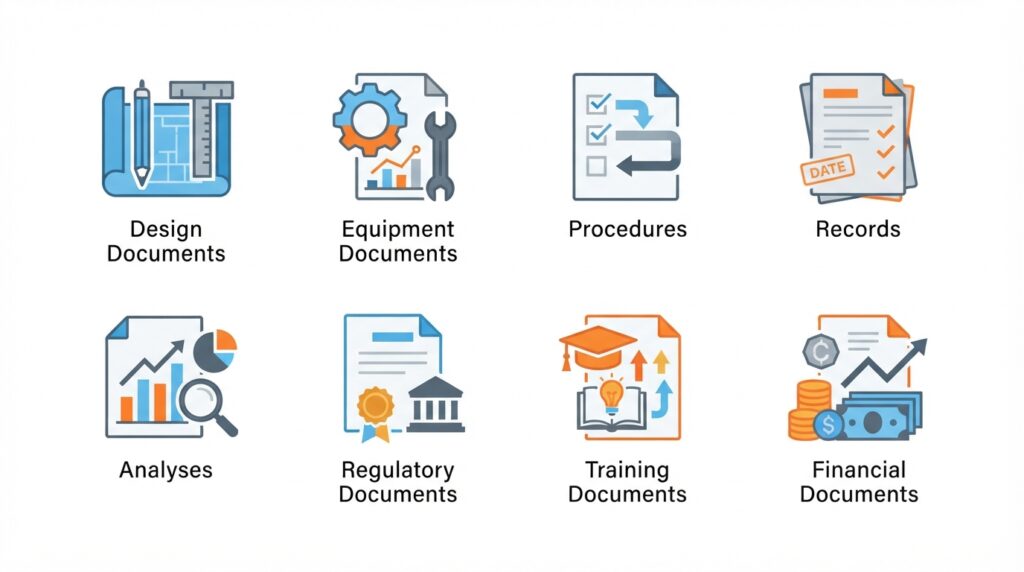
Plants generate many types of documentation.
| Category | Examples |
|---|---|
| Design documents | P&IDs, PFDs, isometrics, electrical drawings, layout drawings, cause-and-effect diagrams |
| Equipment documents | Datasheets, vendor manuals, spare parts lists, certificates, warranties |
| Procedures | Operating procedures, maintenance procedures, emergency procedures |
| Records | Maintenance history, inspection reports, test results, calibration records |
| Analyses | HAZOP studies, risk assessments, incident investigations, MOC records |
| Regulatory documents | Permits, licenses, compliance reports, inspection certificates |
| Training documents | Training materials, competency records, qualification records |
| Financial documents | Budgets, cost records, contracts, purchase orders |
Each category has its own requirements for accuracy, currency, and retention.
Documentation Begins During Design and Construction
Documentation management should begin during design and construction, not after handover. Drawings, datasheets, and procedures created during the project should be organized and handed over in a usable form.
In practice, this means the owner should:
- Specify documentation requirements in the contract: Define the document types, formats, numbering scheme, and level of detail required from the EPC contractor and vendors.
- Agree on a numbering and naming convention early: Retrofitting document numbers after handover is costly and error-prone.
- Require as-built documentation: Drawings and datasheets should reflect what was actually built, not only what was designed.
- Link documents to equipment: Tag numbers should tie drawings, datasheets, manuals, and spare parts lists together.
- Review handover packages before acceptance: Check completeness and quality before final payment or project closeout, when the owner still has leverage.
A well-organized handover package gives the plant a reliable documentation baseline from the first day of operation. A poor one forces the operating team to reconstruct information for years.
Document Control
Document control is the process of managing documents throughout their lifecycle, from creation to revision to archiving.
Key elements of document control:
- Unique identification: Every document has a unique number or identifier.
- Version control: The current version is clearly identified; superseded versions are archived.
- Approval: Documents are reviewed and approved before use.
- Distribution: Controlled distribution ensures the right people have the right documents.
- Revision management: Changes are tracked, approved, and communicated.
- Access control: Documents are accessible to those who need them and protected from unauthorized changes.
- Retention: Documents are retained for the required period.
- Archiving: Superseded documents are archived, not discarded.
Without document control, documents become outdated, inconsistent, and unreliable.
The Role of the Document Controller
In larger plants, a document controller is responsible for the document management system: issuing document numbers, tracking revisions, distributing documents, and maintaining the archive. In smaller plants, this role may be combined with other responsibilities, for example with those of a planner, administrator, or engineer.
Regardless of plant size, the responsibilities should be clearly assigned to a named person. When document control is “everyone’s job,” it often becomes no one’s job.
Document Retention
Retention requirements vary by document type and jurisdiction. Regulatory documents and safety analyses are often retained for the life of the plant. Maintenance records may be retained for a defined period, such as 5 to 10 years. Some incident records have shorter minimum periods set by regulation, but many owners choose to keep them longer because of their value for learning and investigations. Retention requirements should be documented in a retention schedule.
A retention schedule typically defines:
- Document type: For example, P&IDs, inspection reports, training records.
- Retention period: How long the document must be kept.
- Basis: The regulation, standard, contract, or company policy that sets the requirement.
- Responsible owner: Who decides when a document can be archived or disposed of.
- Disposal method: How documents are destroyed or permanently archived when the retention period ends.
Owners should confirm the requirements that apply in their jurisdiction with the relevant authorities or legal counsel.
Document Management Systems
A document management system (DMS) helps organize and control documents.
Features of a good DMS:
- Central repository: All documents in one place.
- Search: Fast and accurate search by number, title, or content.
- Version control: Automatic tracking of versions.
- Access control: Permissions by user or role.
- Workflow: Review and approval workflows.
- Audit trail: Record of who accessed or changed documents.
- Integration: Links to other systems (CMMS, ERP, etc.).
- Backup: Regular backup and disaster recovery.
For small plants, a simple DMS may be sufficient. Even a well-organized shared drive with clear naming conventions and folder structure can work, provided it is consistently maintained and access is controlled.
Digital vs. Paper Documentation
Many plants are transitioning from paper to digital documentation. Digital documentation offers advantages: searchability, accessibility, backup, and version control. However, paper documentation may still be required for field use, and critical documents should be available even during power or network outages.
Practical considerations include:
- Field access: Operators and maintenance staff need documents where the work is done. Tablets, ruggedized devices, or controlled paper copies may be needed, depending on the area.
- Hazardous areas: Electronic devices used in classified areas must be suitably certified.
- Controlled paper copies: Where paper is used, copies should be marked as controlled or uncontrolled, and a process should exist to replace them when revised.
- Emergency access: Emergency procedures, key drawings, and contact lists should be available in a form that does not depend on the network.
- Backup and cybersecurity: Digital archives need regular backups, offsite or separate copies, and protection against unauthorized access.
- Format longevity: Long-lived documents should be stored in formats that will remain readable over the plant’s life.
- Legacy documents: Scanning old paper drawings is a good start, but scanned files still need indexing and numbering to be searchable and useful.
Keeping Documentation Current
Documentation is only useful if it is current. Outdated documentation can be worse than no documentation because it creates false confidence.
Common causes of outdated documentation:
- Changes made without updating documents.
- Documents updated but not distributed.
- Multiple versions in circulation.
- Documents created but never approved.
- Documents not reviewed on schedule.
Practices to keep documentation current:
- Management of Change (MOC): Require document updates as part of MOC, and do not close out a change until the affected documents are revised.
- Regular review: Review documents on a defined schedule.
- Clear ownership: Assign responsibility for each document type.
- Change control: Update documents as part of any change, including minor modifications and temporary changes.
- Field verification: Periodically audit documents against actual plant conditions, for example by walking down P&IDs.
- Redline process: Provide a simple way for operators and technicians to mark up discrepancies they find, and a process to incorporate those markups into the master documents.
Document currency is a discipline, not a one-time effort.
Procedures: The Foundation of Safe Operation
Procedures are among the most important documents in a plant. They describe how to operate, maintain, and respond to emergencies.
| Procedure Type | Purpose |
|---|---|
| Operating procedures | How to start up, operate, and shut down the plant |
| Emergency procedures | How to respond to emergencies |
| Maintenance procedures | How to inspect, maintain, and repair equipment |
| Safety procedures | Permit-to-work, lockout/tagout, confined space, hot work |
| Alarm response procedures | How to respond to specific alarms |
Key requirements for good procedures:
- Accurate: Reflect actual plant configuration and operation.
- Clear: Written in plain language, step-by-step.
- Complete: Cover normal, abnormal, and emergency situations.
- Current: Updated when changes occur.
- Accessible: Available to those who need them.
- Usable: Written for use in the field, not just for audits.
Good procedures are usually developed with the people who perform the work. Operators and technicians should be involved in drafting and reviewing them, and procedures should be tested, for example through walk-throughs or simulator exercises, before being issued. Many regulatory frameworks for hazardous processes also expect operating procedures to be reviewed periodically, commonly at least annually, to confirm they remain current.
Procedures that are not accurate or not used are worse than no procedures.
Records and History
Records document what has happened at the plant: maintenance, inspections, tests, incidents, and changes.
Key records:
- Maintenance history: What was done, when, by whom, and what was found.
- Inspection records: Results of inspections and tests.
- Calibration records: Instrument calibration and verification.
- Incident records: What happened, why, and what was done.
- Change records: MOC documentation and approvals.
- Training records: Who was trained on what and when.
Records support:
- Decision-making: What has worked before? What failed?
- Trend analysis: Is performance improving or degrading?
- Compliance: Demonstrating compliance with regulations.
- Investigations: Understanding what happened and why.
- Planning: Scheduling maintenance and turnarounds.
Records must be accurate, complete, and accessible. A record is only as valuable as the detail it contains: “repaired pump” tells the next reader little, while the failure mode, the findings, the parts replaced, and the as-left condition can inform future decisions.
Knowledge Management
Knowledge management goes beyond documents. It captures the experience, expertise, and insights that people hold.
| Type | Description | Example |
|---|---|---|
| Explicit | Knowledge that is documented | Procedures, drawings, manuals |
| Tacit | Knowledge held by individuals | Experience, judgment, troubleshooting skills |
| Implicit | Knowledge embedded in practices | How things are actually done |
In practice, tacit and implicit knowledge overlap. Both are learned through experience and are rarely written down. Both are the most difficult to capture and the most at risk when people leave.
Capturing Tacit Knowledge
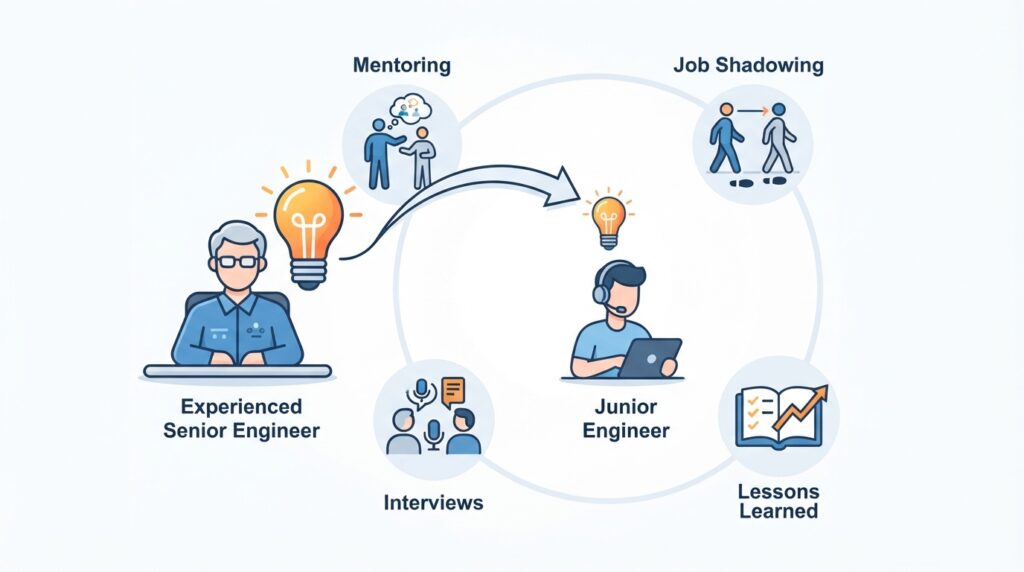
Practices for capturing tacit knowledge:
- Mentoring: Experienced staff work with less experienced staff.
- Job shadowing: Junior staff observe experienced staff.
- Interviews: Structured interviews to capture expertise.
- Lessons learned: Capturing and sharing lessons from projects and incidents.
- Communities of practice: Groups that share knowledge across the organization.
- Documentation: Writing down what experienced staff know.
- Training: Formal training that transfers knowledge.
- Exit interviews: Capturing knowledge before people leave.
Useful techniques include recording walk-through videos of complex tasks, annotating photos of equipment, and keeping troubleshooting logs that record symptoms, causes, and fixes. Short, practical formats are more likely to be created and used than long documents.
For small plants, where there may be only one or two people with critical knowledge, capturing that knowledge is especially important.
Knowledge Retention
Knowledge retention is about keeping critical knowledge in the organization when people leave, retire, or change roles.
Risks of knowledge loss:
- Retirement: Experienced staff retire, taking decades of knowledge.
- Turnover: Staff leave for other opportunities.
- Promotion: Staff move to new roles, leaving gaps.
- Reorganization: Roles change, and knowledge is not transferred.
Strategies for knowledge retention:
- Identify critical knowledge: What knowledge is essential and at risk? A simple review of critical roles and single points of failure is a good starting point.
- Document what can be documented: Procedures, lessons learned, troubleshooting guides.
- Transfer through people: Mentoring, shadowing, and training.
- Build redundancy: More than one person knows critical tasks.
- Plan for succession: Identify and prepare replacements.
- Create a learning culture: Encourage knowledge sharing and make it part of normal work, not an extra task.
- Start early: Begin transferring knowledge well before an expected departure.
Knowledge retention is a long-term investment.
Documentation and Knowledge in Turnarounds
Turnarounds are times when documentation and knowledge are especially critical.
Documentation needs during turnarounds:
- Work packages: Complete and accurate.
- Drawings: Current and accessible.
- Procedures: Updated for the work being done.
- Records: Inspection and test results documented.
- As-builts: Updated after modifications.
Knowledge needs during turnarounds:
- Experienced staff: To supervise and troubleshoot.
- Contractor knowledge: To perform specialized work.
- Lessons from previous turnarounds: To avoid repeating mistakes.
After the turnaround, findings, changes, and lessons learned should be captured and the documentation updated before the knowledge fades. Good documentation and knowledge management make turnarounds smoother and safer.
Documentation and Knowledge in Emergencies
In an emergency, documentation and knowledge must be immediately accessible.
Documentation needs during emergencies:
- Emergency procedures: Clear and accessible.
- P&IDs: Current and available.
- Safety data sheets (SDS): For hazardous materials.
- Site maps: Showing access routes and assembly points.
- Contact lists: For internal and external responders.
Knowledge needs during emergencies:
- Trained personnel: Who know what to do.
- Emergency responders: Who know the plant.
- Experience: From previous incidents and drills.
In an emergency, there is no time to search for documents or ask questions. Everything must be ready, and some of it must be available without power or network access. Contact lists and site maps should be reviewed regularly, since out-of-date phone numbers are a common failure.
Common Mistakes in Documentation and Knowledge Management
Even experienced organizations make mistakes. Common ones include:
- Outdated documents: Not updated after changes.
- Multiple versions: Different versions in circulation.
- Inaccessible documents: Hard to find when needed.
- No document control: No version control or approval.
- Incomplete records: Missing information.
- Knowledge in silos: Knowledge held by individuals, not shared.
- No succession planning: Knowledge lost when people leave.
- No lessons learned: Mistakes repeated.
- Documentation for audits only: Documents created for compliance, not for use.
- Poor handover: Project documentation accepted without review and never organized.
- No retention schedule: Documents discarded too early or kept indefinitely without a reason.
- Over-reliance on a single system or person: No backup if the system fails or the person leaves.
These mistakes lead to inefficiency, errors, and incidents.
How Japanese EPC Firms Approach Documentation and Knowledge Management
Japanese engineering firms are known for their disciplined approach to documentation. Common characteristics include:
- Thorough documentation: Everything is documented, and documentation is maintained.
- Document control: Version control and approval are strict.
- Procedures: Procedures are clear, accurate, and followed.
- Knowledge transfer: Experienced staff mentor junior staff.
- Lessons learned: Lessons are captured and applied.
- Long-term focus: Documentation and knowledge are treated as long-term assets.
- Complete handover packages: Project documentation is organized and delivered in a form the operating team can use.
For plant owners, this often means a plant where information is reliable, accessible, and useful.
How to Evaluate Documentation and Knowledge Management
When reviewing documentation and knowledge management, ask:
| Question | Why It Matters |
|---|---|
| Is there a document control system? | Ensures documents are current and approved |
| Is someone responsible for document control? | Ensures accountability |
| Were project documents handed over in a usable form? | Provides a reliable baseline |
| Are documents accessible, including in outages? | Ensures information is available when needed |
| Are documents current? | Prevents errors from outdated information |
| Is there a retention schedule? | Ensures records are kept as long as required |
| Are procedures accurate and used? | Ensures safe and consistent operation |
| Are records complete? | Supports decisions, compliance, and investigations |
| Is critical knowledge documented? | Prevents knowledge loss |
| Is knowledge shared? | Builds organizational capability |
| Is there succession planning? | Prepares for departures |
| Are lessons learned captured and applied? | Prevents repeating mistakes |
A plant that addresses these questions is likely to have effective documentation and knowledge management.
Conclusion
Plant documentation and knowledge management are not administrative overhead. They are essential to safe, reliable, and efficient operation. For small to medium-scale industrial plants, where fewer people hold critical knowledge, they are especially important.
By starting documentation management during design and construction, and by focusing on document control, procedures, records, knowledge capture, and knowledge retention, owners and operators can ensure that the plant’s information is reliable, accessible, and useful, today and in the future.
Key Takeaways
- Documentation and knowledge management ensure the right information is available when needed
- Documentation management should begin during design and construction, not after handover
- Document control manages documents through their lifecycle, and a named person should be responsible for it
- Retention requirements vary by document type and jurisdiction and should be recorded in a retention schedule
- Digital documentation improves searchability and control, but critical documents must remain available during power or network outages
- Outdated documentation can be worse than no documentation
- Procedures must be accurate, clear, complete, current, accessible, and usable
- Records support decisions, compliance, and investigations
- Knowledge management captures both explicit and tacit knowledge
- Knowledge retention prevents critical knowledge from leaving with people
- Japanese EPC firms emphasize thorough documentation and knowledge transfer