Tag: Documentation

  • Plant Handover and Turnover: Key Practices for EPC Projects

    Plant Handover and Turnover: Key Practices for EPC Projects

    Handover is the moment when the plant stops being a construction project and becomes an operating asset. The contractor’s job is done. The owner’s team takes over. Operations begin.

    This transition is one of the most critical, and most often rushed, phases of a project. If handover is done well, the owner receives a plant that is complete, documented, and ready to operate. If handover is done poorly, the owner inherits a plant with missing documentation, unresolved defects, and untrained staff, problems that can persist for years.

    For small to medium-scale industrial plants, handover is especially important because there is less redundancy and fewer resources to absorb the consequences of an incomplete handover. The owner’s team must be ready to operate from day one.

    This article covers the key practices in plant handover and turnover, from handover planning to documentation, control systems, permits, training, and final acceptance.

    What Is Handover and Turnover?

    Handover and turnover are the processes of transferring the plant from the contractor to the owner.

    The terms are often used interchangeably, but there is a subtle difference:

    • Turnover typically refers to the transfer of individual systems or areas from construction to commissioning.
    • Handover typically refers to the final transfer of the completed plant from the contractor to the owner.

    Both are part of the same overall process: transferring responsibility, documentation, and knowledge from the project team to the operating team.

    Why Handover Matters

    Handover determines whether the owner can operate the plant effectively.

    Factor Impact of Good Handover Impact of Poor Handover
    Readiness Owner ready to operate from day one Owner struggles to operate
    Documentation Complete, accurate, accessible Missing or incomplete
    Training Staff trained and confident Staff unprepared
    Defects Outstanding items resolved Defects persist for years
    Warranty Claims managed effectively Warranty issues unresolved
    Safety Hazards understood and controlled Hazards unknown

    For small plants, where there is less margin for error, handover determines whether operations start smoothly or struggle.

    Handover Planning

    Handover should be planned from the beginning of the project, not left to the end.

    Handover planning activities:

    • Define handover criteria: What must be complete before handover?
    • Define handover process: What are the steps in the handover?
    • Define responsibilities: Who is responsible for what?
    • Define documentation requirements: What documents must be delivered, in what format, and by when?
    • Define training requirements: What training must be provided?
    • Define acceptance criteria: What defines successful handover?
    • Schedule handover activities: When will each activity occur?

    Handover planning should be integrated into the overall project plan. It is good practice to appoint a handover coordinator on both the contractor and owner sides, and to hold regular handover readiness meetings well before mechanical completion.

    Handover Criteria

    Handover criteria define what must be complete before handover.

    Criterion Description
    Mechanical completion All systems built, installed, and tested
    Commissioning complete All systems commissioned and functional
    Performance testing Plant meets performance guarantees
    Punch list Outstanding items resolved or accepted
    Documentation Complete and accurate documentation delivered
    Control systems Software, licenses, and configuration records delivered
    Permits Regulatory approvals transferred or reissued
    Training Owner’s staff trained and competent
    Spare parts Required spare parts delivered
    Warranty Warranty terms documented and accepted

    Handover criteria should be defined in the contract and agreed by both parties.

    Mechanical Completion

    Mechanical completion is the milestone where all systems are built, installed, and ready for commissioning.

    Mechanical completion activities:

    • Construction complete: All construction work finished.
    • Inspection complete: All inspections completed and accepted.
    • Testing complete: All static tests completed (for example, pressure tests, loop checks, and insulation resistance tests).
    • Punch list: Outstanding items identified.
    • Documentation: As-built documentation prepared.

    Mechanical completion is often a contractual milestone with payment implications.

    Commissioning Completion

    Commissioning completion is the milestone where all systems are commissioned and functional.

    Commissioning completion activities:

    • System testing: All systems tested and functional.
    • Interface testing: Interfaces between systems tested.
    • Performance testing: Performance verified against guarantees.
    • Documentation: Commissioning records complete.
    • Punch list: Outstanding items resolved.

    Commissioning completion confirms that the plant is ready for operation.

    Punch List Management
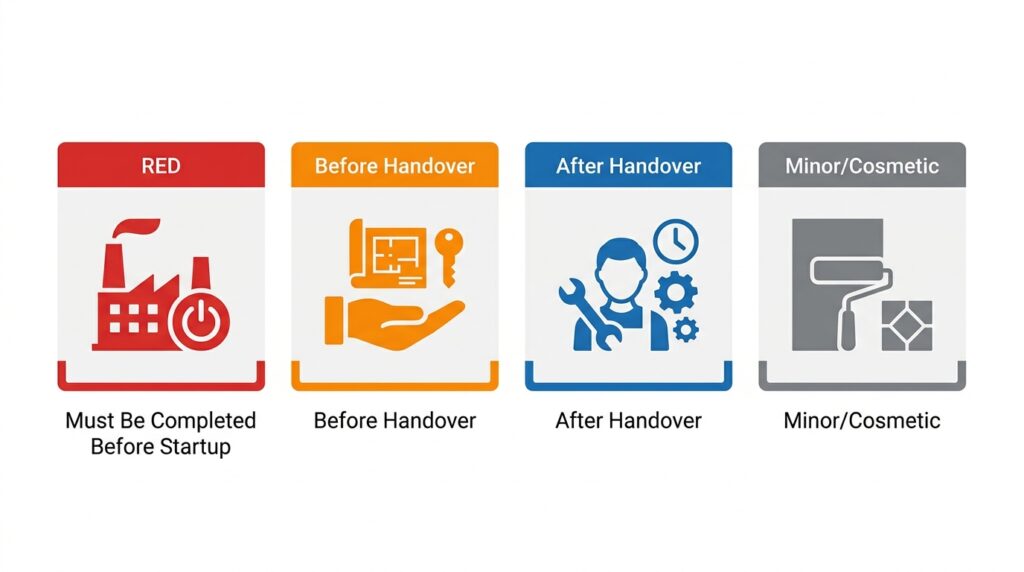
    The punch list is a record of outstanding items that must be completed before handover.

    Category Description Priority
    A Must be completed before startup Highest
    B Must be completed before handover High
    C Can be completed after handover Medium
    D Minor or cosmetic items Low

    Punch list management:

    • Identification: Identify all outstanding items.
    • Categorization: Categorize by priority.
    • Assignment: Assign responsibility for each item.
    • Tracking: Track completion of each item.
    • Verification: Verify that items are completed correctly.
    • Closure: Close items when complete.

    The punch list should be managed actively, not left to the end. Category C and D items that remain open at handover should have an agreed completion date and a clear owner, and the contract should specify any payment retention tied to them. Category A items, especially those with safety implications, must never be carried past startup.

    Documentation Handover
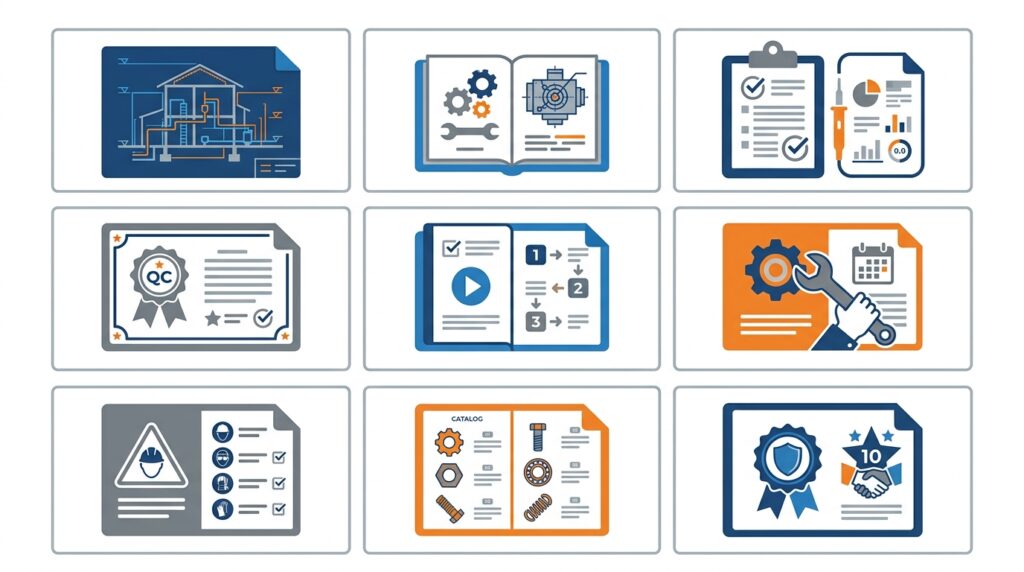
    Types of handover documentation for plant handover

    Documentation is one of the most important, and most often incomplete, aspects of handover.

    Document Type Examples
    As-built drawings P&IDs, isometrics, electrical drawings
    Equipment manuals Vendor manuals, operating instructions
    Test records Commissioning records, test certificates
    Quality records Inspection reports, material certificates
    Operating procedures Startup, operation, shutdown procedures
    Maintenance procedures Inspection, maintenance, repair procedures
    Safety procedures Emergency procedures, safety data sheets
    Spare parts lists Recommended spares, supplier information
    Warranty documents Warranty terms, contact information
    Control system records Software backups, configuration records, control logic documentation
    Permits and approvals Operating permits, licenses, inspection certificates

    Documentation should be complete, accurate, and organized for easy access. Agree on the format (paper, electronic, or both), the indexing and naming convention, and the document register before handover begins. A handover document register, checked item by item against the contract requirements, is the most reliable way to confirm that nothing is missing.

    As-Built Documentation

    As-built documentation reflects the plant as it was actually built, not as it was designed.

    As-built documentation requirements:

    • Updated drawings: Drawings reflect actual construction.
    • Marked changes: Changes from design are clearly marked.
    • Approval: As-built documentation is approved by the contractor.
    • Verification: As-built documentation is verified against the plant, typically through a field walkdown.
    • Delivery: As-built documentation is delivered to the owner.

    As-built documentation is essential for future maintenance, modifications, and safety. Incorrect or outdated P&IDs, for example, can lead to mistakes in isolation, management of change, and hazard reviews.

    Control Systems and Software Handover

    Control systems and software are often overlooked at handover. Control system handover includes software backups, licenses, configuration records, and documentation of control logic, alarm settings, and safety system configurations. Without these, the owner cannot maintain or modify the control system independently.

    Control system handover typically includes:

    • Software backups: Complete, verified backups of DCS, PLC, SCADA, and safety system programs.
    • Licenses: Software licenses transferred to the owner, with registration details and renewal dates.
    • Configuration records: Network configuration, I/O lists, and hardware configuration records.
    • Control logic documentation: Control narratives, logic diagrams, and cause-and-effect matrices.
    • Alarm and setpoint records: Alarm settings, trip setpoints, and the alarm rationalization basis.
    • Safety system configuration: Safety instrumented system settings, bypass records, and proof test requirements.
    • Access and security: Administrator credentials, user accounts, and cybersecurity documentation transferred under a controlled process, with any contractor or vendor default passwords changed.

    The backups should be tested to confirm they can actually be restored, not just stored.

    Permits and Regulatory Approvals

    Regulatory permits, licenses, and approvals should be transferred or reissued in the owner’s name at handover. Operating permits may require inspection or certification before they are issued.

    Both parties should agree early on who is responsible for each permit. Typical items include:

    • Operating permits and licenses
    • Environmental permits and emission or discharge approvals
    • Pressure vessel and boiler certifications
    • Electrical and fire safety inspections and approvals
    • Occupancy or completion certificates

    The permit register should record the issuing authority, validity period, conditions, and renewal dates. Missing a permit can delay startup or place the owner out of compliance on the first day of operation.

    Training and Competency

    The owner’s staff must be trained to operate and maintain the plant.

    Category Description
    Operations training How to operate the plant
    Maintenance training How to maintain equipment
    Safety training How to work safely
    Emergency training How to respond to emergencies
    Vendor training Equipment-specific training from vendors

    Training considerations:

    • Timing: Training should begin before handover, and ideally before commissioning, so that operators can take part in startup.
    • Competency: Training should include competency assessment.
    • Documentation: Training records should be maintained.
    • Refresher: Refresher training should be planned.

    Training is not complete until staff can demonstrate competency.

    Training Records and Competency Assessments

    Training records, including competency assessments and qualifications, should be handed over to the owner. These records demonstrate that staff are qualified to operate and maintain the plant, and they support future audits and regulatory compliance.

    Spare Parts and Consumables

    The owner needs spare parts and consumables to operate and maintain the plant.

    Spare parts handover:

    • Recommended spares: Spares recommended by vendors.
    • Critical spares: Spares essential for operation.
    • Consumables: Filters, lubricants, chemicals, and initial fills.
    • Inventory: Spare parts inventory and location.
    • Supplier information: Supplier contacts and part numbers.

    Spare parts should be delivered, inventoried, and stored properly. Spares used by the contractor during commissioning should be replaced before handover.

    Warranty Management

    Warranty management begins at handover and continues through the warranty period.

    Warranty handover:

    • Warranty terms: What is covered, for how long, and from what date.
    • Warranty contacts: Who to contact for warranty claims.
    • Warranty procedures: How to submit and track claims.
    • Warranty register: Record of all warranties and expiry dates.

    Warranty management should be planned from the beginning of the project. Owners should also keep a clear record of defects found during the warranty period, with dates and evidence, so that claims can be made before the warranty expires. A defects inspection shortly before expiry is good practice.

    Vendor Contacts and Support Arrangements

    Vendor contact information and support arrangements should be documented at handover. This includes warranty contacts, technical support, spare parts suppliers, and service agreements.

    A vendor support register should list, for each major item of equipment, the vendor, local service representative, technical support channel, response time commitments, and any service or maintenance agreements. Ongoing vendor support is especially important for specialized equipment such as turbines, compressors, and control systems.

    Care, Custody, and Control

    Handover is also a transfer of responsibility and risk. The contract should state clearly when care, custody, and control of each system or area passes from the contractor to the owner. This affects:

    • Safety responsibility: Who authorizes work, controls isolations, and responds to incidents in each area.
    • Insurance: When the construction insurance ends and the owner’s operating insurance begins.
    • Site access and security: Who controls access to the plant.
    • Utilities and consumables: Who pays for and manages power, water, and fuel.

    A pre-startup safety review (PSSR) before introducing hazardous materials or energy is the key safety check at this point. Any gap between the contractor’s and owner’s responsibilities should be closed before startup.

    Final Acceptance

    Final acceptance is the formal confirmation that the plant meets requirements.

    Final acceptance activities:

    • Verification: Verify that all requirements are met.
    • Punch list closure: Confirm that all punch list items are closed or accepted.
    • Documentation review: Confirm that documentation is complete.
    • Training confirmation: Confirm that training is complete.
    • Sign-off: Sign the final acceptance certificate.

    Final acceptance is a contractual milestone with payment and warranty implications.

    Many contracts use two acceptance stages. Provisional acceptance (also called taking-over or preliminary acceptance) occurs when the plant has passed performance tests and the owner takes over operation, with the warranty period starting. Final acceptance occurs at the end of the warranty period, once defects have been corrected and the remaining retention is released. Owners should check which terms and milestones their contract uses so that payment, warranty, and responsibility are all clearly tied to the right event.

    Handover Ceremony and Knowledge Transfer

    Handover is not just a formal event. It is a knowledge transfer.

    Knowledge transfer activities:

    • Walkthroughs: Contractor walks the owner through the plant.
    • System explanations: Contractor explains how systems work.
    • Lessons learned: Contractor shares lessons from construction and commissioning.
    • Contacts: Contractor provides contacts for future support.
    • Documentation review: Contractor explains documentation.

    Knowledge transfer ensures that the owner understands the plant, not just owns it. Where possible, owner operations and maintenance staff should be involved during construction and commissioning, so that handover confirms knowledge they already have rather than introducing it for the first time.

    Common Mistakes in Handover and Turnover

    Even experienced organizations make mistakes. Common ones include:

    • Handover not planned: Handover left to the end.
    • Incomplete documentation: Missing or incomplete documents.
    • Control system records missing: No backups, licenses, or configuration records.
    • Permits not transferred: Regulatory approvals not in the owner’s name or not yet issued.
    • Punch list not managed: Outstanding items not tracked.
    • Training incomplete: Staff not trained or competent, or training records not handed over.
    • Spare parts missing: Spares not delivered or inventoried.
    • Warranty not documented: Warranty terms unclear.
    • Vendor support unclear: No record of who to call when equipment fails.
    • Final acceptance rushed: Sign-off without proper verification.
    • Knowledge transfer poor: Owner does not understand the plant.
    • Handover criteria unclear: What must be complete is not defined.

    These mistakes are costly to correct. They are much cheaper to avoid through good planning and disciplined execution.

    How Japanese EPC Firms Approach Handover and Turnover

    Japanese engineering firms are known for their disciplined approach to handover. Common characteristics include:

    • Thorough planning: Handover is planned from the beginning.
    • Detailed documentation: Documentation is complete and accurate.
    • Disciplined punch list management: Outstanding items are tracked and closed.
    • Comprehensive training: Staff are trained and assessed for competency.
    • Systematic knowledge transfer: Contractor ensures the owner understands the plant.
    • Formal acceptance: Final acceptance is not rushed.
    • Long-term support: Contractor provides support after handover.

    For plant owners, this often means a plant that is ready to operate from day one.

    How to Evaluate Handover Readiness

    When reviewing handover readiness, ask:

    Question Why It Matters
    Is handover planned? Provides a roadmap for handover
    Are handover criteria defined? Defines what must be complete
    Is mechanical completion achieved? Confirms construction is complete
    Is commissioning complete? Confirms systems are functional
    Is the punch list managed? Ensures outstanding items are tracked
    Is documentation complete? Ensures owner has needed information
    Are control system backups, licenses, and records delivered? Allows the owner to maintain and modify the control system
    Are permits transferred or reissued? Ensures legal operation from day one
    Is training complete and recorded? Ensures staff can operate the plant and supports audits
    Are spare parts delivered? Ensures owner can maintain the plant
    Are warranty and vendor support documented? Ensures claims and support requests can be made
    Is responsibility for care, custody, and control clear? Avoids gaps in safety and insurance
    Is final acceptance planned? Ensures formal confirmation

    A plant that addresses these questions is ready for successful handover.

    Conclusion

    Handover and turnover are the transition from construction to operation. For small to medium-scale industrial plants, they determine whether the owner can operate the plant effectively from day one.

    By focusing on handover planning, criteria, punch list management, documentation, control systems, permits, training, spare parts, warranty, vendor support, and final acceptance, owners and contractors can ensure that handover is smooth and the plant is ready for reliable operation.

    Key Takeaways

    • Handover is the transition from construction to operation
    • Handover should be planned from the beginning of the project
    • Handover criteria define what must be complete before handover
    • Punch list items should be categorized by priority and managed actively
    • Documentation handover includes as-built drawings, manuals, records, procedures, and warranties
    • Control system handover includes software backups, licenses, and configuration records
    • Permits and regulatory approvals should be transferred or reissued in the owner’s name
    • Training is not complete until staff can demonstrate competency, and training records should be handed over
    • Spare parts, warranty, and vendor support arrangements are part of handover
    • Final acceptance is a formal confirmation with contractual implications
    • Knowledge transfer ensures the owner understands the plant
    • Japanese EPC firms emphasize thorough planning and disciplined documentation

  • Plant Documentation and Knowledge Management: Key Practices for Industrial Plants

    Plant Documentation and Knowledge Management: Key Practices for Industrial Plants

    Every plant generates vast amounts of information: design drawings, operating procedures, maintenance records, inspection reports, safety analyses, vendor manuals, and equipment data. All of it is essential to safe, reliable, and efficient operation. Yet in many plants, this information is scattered, outdated, or inaccessible when it is needed most.

    Plant documentation and knowledge management is the discipline of capturing, organizing, and maintaining the information that the plant depends on. It ensures that the right information is available to the right people at the right time, whether they are operating the plant, maintaining equipment, responding to an emergency, or planning a turnaround.

    For small to medium-scale industrial plants, documentation and knowledge management are especially important because there is less redundancy and fewer people who hold critical knowledge in their heads. When an experienced operator or engineer leaves, their knowledge can leave with them, unless it has been documented and shared.

    This article covers the key practices in plant documentation and knowledge management, from document control to knowledge retention.

    What Is Plant Documentation and Knowledge Management?

    Plant documentation is the collection of documents that describe the plant, its systems, its operation, and its history. Knowledge management is the broader discipline of capturing, organizing, and sharing the knowledge that people hold, including the knowledge that is not written down.

    Together, they cover:

    • Technical documents: Drawings, datasheets, specifications
    • Procedures: Operating, maintenance, emergency, and safety procedures
    • Records: Maintenance history, inspection reports, test results
    • Analyses: Hazard analyses, risk assessments, incident investigations
    • Knowledge: Experience, lessons learned, troubleshooting expertise

    Documentation and knowledge management are not just administrative tasks. They are essential to safe and reliable operation.

    Why Documentation and Knowledge Management Matter

    Poor documentation and knowledge management lead to real problems.

    Factor Impact of Good Documentation Impact of Poor Documentation
    Safety Procedures and hazards are clear Operators work from memory or outdated information
    Reliability Maintenance history supports decisions Equipment history is lost; problems recur
    Efficiency Information is found quickly Time wasted searching for documents
    Compliance Records demonstrate compliance Fines and penalties for missing records
    Continuity Knowledge is retained when people leave Critical knowledge is lost
    Turnarounds Work packages are complete and accurate Rework and delays due to missing information
    Incident response Emergency information is accessible Response is slowed by missing information
    Modifications Current drawings support sound engineering Designs are based on assumptions that no longer match the plant

    For small plants, where fewer people hold critical knowledge, documentation and knowledge management are especially important.

    Types of Plant Documentation

    Plants generate many types of documentation.

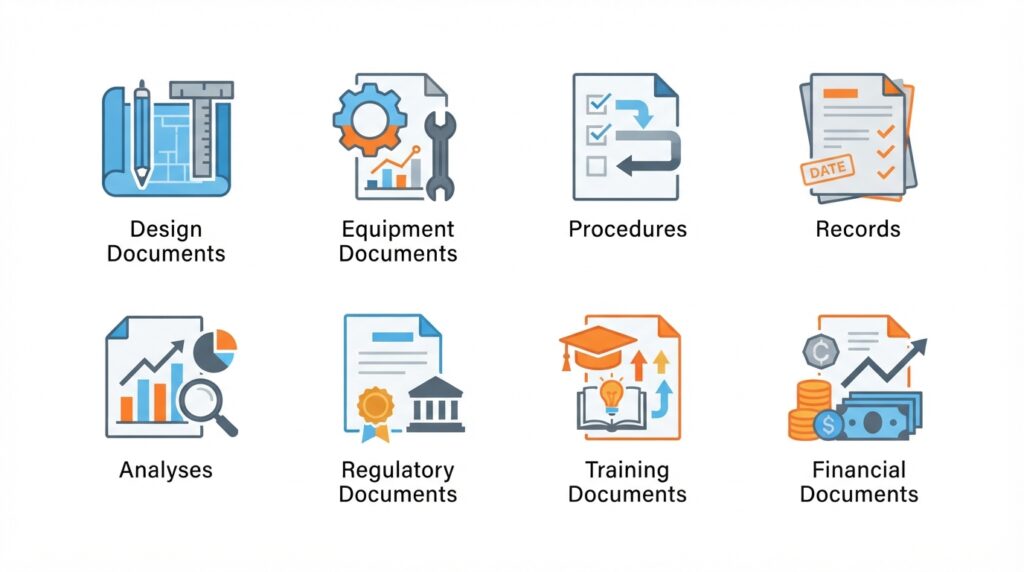
    Category Examples
    Design documents P&IDs, PFDs, isometrics, electrical drawings, layout drawings, cause-and-effect diagrams
    Equipment documents Datasheets, vendor manuals, spare parts lists, certificates, warranties
    Procedures Operating procedures, maintenance procedures, emergency procedures
    Records Maintenance history, inspection reports, test results, calibration records
    Analyses HAZOP studies, risk assessments, incident investigations, MOC records
    Regulatory documents Permits, licenses, compliance reports, inspection certificates
    Training documents Training materials, competency records, qualification records
    Financial documents Budgets, cost records, contracts, purchase orders

    Each category has its own requirements for accuracy, currency, and retention.

    Documentation Begins During Design and Construction

    Documentation management should begin during design and construction, not after handover. Drawings, datasheets, and procedures created during the project should be organized and handed over in a usable form.

    In practice, this means the owner should:

    • Specify documentation requirements in the contract: Define the document types, formats, numbering scheme, and level of detail required from the EPC contractor and vendors.
    • Agree on a numbering and naming convention early: Retrofitting document numbers after handover is costly and error-prone.
    • Require as-built documentation: Drawings and datasheets should reflect what was actually built, not only what was designed.
    • Link documents to equipment: Tag numbers should tie drawings, datasheets, manuals, and spare parts lists together.
    • Review handover packages before acceptance: Check completeness and quality before final payment or project closeout, when the owner still has leverage.

    A well-organized handover package gives the plant a reliable documentation baseline from the first day of operation. A poor one forces the operating team to reconstruct information for years.

    Document Control

    Document control is the process of managing documents throughout their lifecycle, from creation to revision to archiving.

    Key elements of document control:

    • Unique identification: Every document has a unique number or identifier.
    • Version control: The current version is clearly identified; superseded versions are archived.
    • Approval: Documents are reviewed and approved before use.
    • Distribution: Controlled distribution ensures the right people have the right documents.
    • Revision management: Changes are tracked, approved, and communicated.
    • Access control: Documents are accessible to those who need them and protected from unauthorized changes.
    • Retention: Documents are retained for the required period.
    • Archiving: Superseded documents are archived, not discarded.

    Without document control, documents become outdated, inconsistent, and unreliable.

    The Role of the Document Controller

    In larger plants, a document controller is responsible for the document management system: issuing document numbers, tracking revisions, distributing documents, and maintaining the archive. In smaller plants, this role may be combined with other responsibilities, for example with those of a planner, administrator, or engineer.

    Regardless of plant size, the responsibilities should be clearly assigned to a named person. When document control is “everyone’s job,” it often becomes no one’s job.

    Document Retention

    Retention requirements vary by document type and jurisdiction. Regulatory documents and safety analyses are often retained for the life of the plant. Maintenance records may be retained for a defined period, such as 5 to 10 years. Some incident records have shorter minimum periods set by regulation, but many owners choose to keep them longer because of their value for learning and investigations. Retention requirements should be documented in a retention schedule.

    A retention schedule typically defines:

    • Document type: For example, P&IDs, inspection reports, training records.
    • Retention period: How long the document must be kept.
    • Basis: The regulation, standard, contract, or company policy that sets the requirement.
    • Responsible owner: Who decides when a document can be archived or disposed of.
    • Disposal method: How documents are destroyed or permanently archived when the retention period ends.

    Owners should confirm the requirements that apply in their jurisdiction with the relevant authorities or legal counsel.

    Document Management Systems

    A document management system (DMS) helps organize and control documents.

    Features of a good DMS:

    • Central repository: All documents in one place.
    • Search: Fast and accurate search by number, title, or content.
    • Version control: Automatic tracking of versions.
    • Access control: Permissions by user or role.
    • Workflow: Review and approval workflows.
    • Audit trail: Record of who accessed or changed documents.
    • Integration: Links to other systems (CMMS, ERP, etc.).
    • Backup: Regular backup and disaster recovery.

    For small plants, a simple DMS may be sufficient. Even a well-organized shared drive with clear naming conventions and folder structure can work, provided it is consistently maintained and access is controlled.

    Digital vs. Paper Documentation

    Many plants are transitioning from paper to digital documentation. Digital documentation offers advantages: searchability, accessibility, backup, and version control. However, paper documentation may still be required for field use, and critical documents should be available even during power or network outages.

    Practical considerations include:

    • Field access: Operators and maintenance staff need documents where the work is done. Tablets, ruggedized devices, or controlled paper copies may be needed, depending on the area.
    • Hazardous areas: Electronic devices used in classified areas must be suitably certified.
    • Controlled paper copies: Where paper is used, copies should be marked as controlled or uncontrolled, and a process should exist to replace them when revised.
    • Emergency access: Emergency procedures, key drawings, and contact lists should be available in a form that does not depend on the network.
    • Backup and cybersecurity: Digital archives need regular backups, offsite or separate copies, and protection against unauthorized access.
    • Format longevity: Long-lived documents should be stored in formats that will remain readable over the plant’s life.
    • Legacy documents: Scanning old paper drawings is a good start, but scanned files still need indexing and numbering to be searchable and useful.

    Keeping Documentation Current

    Documentation is only useful if it is current. Outdated documentation can be worse than no documentation because it creates false confidence.

    Common causes of outdated documentation:

    • Changes made without updating documents.
    • Documents updated but not distributed.
    • Multiple versions in circulation.
    • Documents created but never approved.
    • Documents not reviewed on schedule.

    Practices to keep documentation current:

    • Management of Change (MOC): Require document updates as part of MOC, and do not close out a change until the affected documents are revised.
    • Regular review: Review documents on a defined schedule.
    • Clear ownership: Assign responsibility for each document type.
    • Change control: Update documents as part of any change, including minor modifications and temporary changes.
    • Field verification: Periodically audit documents against actual plant conditions, for example by walking down P&IDs.
    • Redline process: Provide a simple way for operators and technicians to mark up discrepancies they find, and a process to incorporate those markups into the master documents.

    Document currency is a discipline, not a one-time effort.

    Procedures: The Foundation of Safe Operation

    Procedures are among the most important documents in a plant. They describe how to operate, maintain, and respond to emergencies.

    Procedure Type Purpose
    Operating procedures How to start up, operate, and shut down the plant
    Emergency procedures How to respond to emergencies
    Maintenance procedures How to inspect, maintain, and repair equipment
    Safety procedures Permit-to-work, lockout/tagout, confined space, hot work
    Alarm response procedures How to respond to specific alarms

    Key requirements for good procedures:

    • Accurate: Reflect actual plant configuration and operation.
    • Clear: Written in plain language, step-by-step.
    • Complete: Cover normal, abnormal, and emergency situations.
    • Current: Updated when changes occur.
    • Accessible: Available to those who need them.
    • Usable: Written for use in the field, not just for audits.

    Good procedures are usually developed with the people who perform the work. Operators and technicians should be involved in drafting and reviewing them, and procedures should be tested, for example through walk-throughs or simulator exercises, before being issued. Many regulatory frameworks for hazardous processes also expect operating procedures to be reviewed periodically, commonly at least annually, to confirm they remain current.

    Procedures that are not accurate or not used are worse than no procedures.

    Records and History

    Records document what has happened at the plant: maintenance, inspections, tests, incidents, and changes.

    Key records:

    • Maintenance history: What was done, when, by whom, and what was found.
    • Inspection records: Results of inspections and tests.
    • Calibration records: Instrument calibration and verification.
    • Incident records: What happened, why, and what was done.
    • Change records: MOC documentation and approvals.
    • Training records: Who was trained on what and when.

    Records support:

    • Decision-making: What has worked before? What failed?
    • Trend analysis: Is performance improving or degrading?
    • Compliance: Demonstrating compliance with regulations.
    • Investigations: Understanding what happened and why.
    • Planning: Scheduling maintenance and turnarounds.

    Records must be accurate, complete, and accessible. A record is only as valuable as the detail it contains: “repaired pump” tells the next reader little, while the failure mode, the findings, the parts replaced, and the as-left condition can inform future decisions.

    Knowledge Management

    Knowledge management goes beyond documents. It captures the experience, expertise, and insights that people hold.

    Type Description Example
    Explicit Knowledge that is documented Procedures, drawings, manuals
    Tacit Knowledge held by individuals Experience, judgment, troubleshooting skills
    Implicit Knowledge embedded in practices How things are actually done

    In practice, tacit and implicit knowledge overlap. Both are learned through experience and are rarely written down. Both are the most difficult to capture and the most at risk when people leave.

    Capturing Tacit Knowledge

    Capturing tacit knowledge in industrial plants

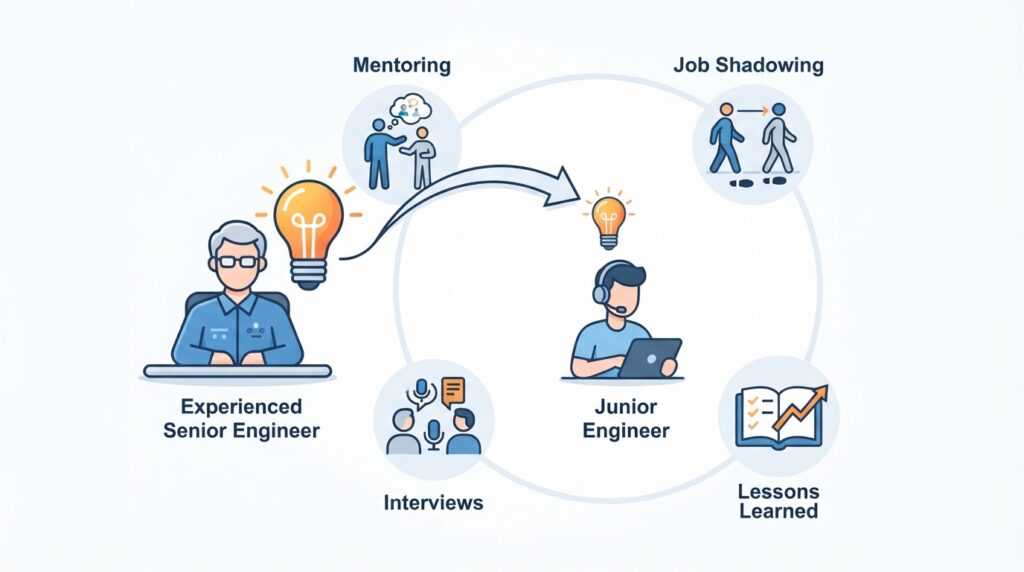
    Practices for capturing tacit knowledge:

    • Mentoring: Experienced staff work with less experienced staff.
    • Job shadowing: Junior staff observe experienced staff.
    • Interviews: Structured interviews to capture expertise.
    • Lessons learned: Capturing and sharing lessons from projects and incidents.
    • Communities of practice: Groups that share knowledge across the organization.
    • Documentation: Writing down what experienced staff know.
    • Training: Formal training that transfers knowledge.
    • Exit interviews: Capturing knowledge before people leave.

    Useful techniques include recording walk-through videos of complex tasks, annotating photos of equipment, and keeping troubleshooting logs that record symptoms, causes, and fixes. Short, practical formats are more likely to be created and used than long documents.

    For small plants, where there may be only one or two people with critical knowledge, capturing that knowledge is especially important.

    Knowledge Retention

    Knowledge retention is about keeping critical knowledge in the organization when people leave, retire, or change roles.

    Risks of knowledge loss:

    • Retirement: Experienced staff retire, taking decades of knowledge.
    • Turnover: Staff leave for other opportunities.
    • Promotion: Staff move to new roles, leaving gaps.
    • Reorganization: Roles change, and knowledge is not transferred.

    Strategies for knowledge retention:

    • Identify critical knowledge: What knowledge is essential and at risk? A simple review of critical roles and single points of failure is a good starting point.
    • Document what can be documented: Procedures, lessons learned, troubleshooting guides.
    • Transfer through people: Mentoring, shadowing, and training.
    • Build redundancy: More than one person knows critical tasks.
    • Plan for succession: Identify and prepare replacements.
    • Create a learning culture: Encourage knowledge sharing and make it part of normal work, not an extra task.
    • Start early: Begin transferring knowledge well before an expected departure.

    Knowledge retention is a long-term investment.

    Documentation and Knowledge in Turnarounds

    Turnarounds are times when documentation and knowledge are especially critical.

    Documentation needs during turnarounds:

    • Work packages: Complete and accurate.
    • Drawings: Current and accessible.
    • Procedures: Updated for the work being done.
    • Records: Inspection and test results documented.
    • As-builts: Updated after modifications.

    Knowledge needs during turnarounds:

    • Experienced staff: To supervise and troubleshoot.
    • Contractor knowledge: To perform specialized work.
    • Lessons from previous turnarounds: To avoid repeating mistakes.

    After the turnaround, findings, changes, and lessons learned should be captured and the documentation updated before the knowledge fades. Good documentation and knowledge management make turnarounds smoother and safer.

    Documentation and Knowledge in Emergencies

    In an emergency, documentation and knowledge must be immediately accessible.

    Documentation needs during emergencies:

    • Emergency procedures: Clear and accessible.
    • P&IDs: Current and available.
    • Safety data sheets (SDS): For hazardous materials.
    • Site maps: Showing access routes and assembly points.
    • Contact lists: For internal and external responders.

    Knowledge needs during emergencies:

    • Trained personnel: Who know what to do.
    • Emergency responders: Who know the plant.
    • Experience: From previous incidents and drills.

    In an emergency, there is no time to search for documents or ask questions. Everything must be ready, and some of it must be available without power or network access. Contact lists and site maps should be reviewed regularly, since out-of-date phone numbers are a common failure.

    Common Mistakes in Documentation and Knowledge Management

    Even experienced organizations make mistakes. Common ones include:

    • Outdated documents: Not updated after changes.
    • Multiple versions: Different versions in circulation.
    • Inaccessible documents: Hard to find when needed.
    • No document control: No version control or approval.
    • Incomplete records: Missing information.
    • Knowledge in silos: Knowledge held by individuals, not shared.
    • No succession planning: Knowledge lost when people leave.
    • No lessons learned: Mistakes repeated.
    • Documentation for audits only: Documents created for compliance, not for use.
    • Poor handover: Project documentation accepted without review and never organized.
    • No retention schedule: Documents discarded too early or kept indefinitely without a reason.
    • Over-reliance on a single system or person: No backup if the system fails or the person leaves.

    These mistakes lead to inefficiency, errors, and incidents.

    How Japanese EPC Firms Approach Documentation and Knowledge Management

    Japanese engineering firms are known for their disciplined approach to documentation. Common characteristics include:

    • Thorough documentation: Everything is documented, and documentation is maintained.
    • Document control: Version control and approval are strict.
    • Procedures: Procedures are clear, accurate, and followed.
    • Knowledge transfer: Experienced staff mentor junior staff.
    • Lessons learned: Lessons are captured and applied.
    • Long-term focus: Documentation and knowledge are treated as long-term assets.
    • Complete handover packages: Project documentation is organized and delivered in a form the operating team can use.

    For plant owners, this often means a plant where information is reliable, accessible, and useful.

    How to Evaluate Documentation and Knowledge Management

    When reviewing documentation and knowledge management, ask:

    Question Why It Matters
    Is there a document control system? Ensures documents are current and approved
    Is someone responsible for document control? Ensures accountability
    Were project documents handed over in a usable form? Provides a reliable baseline
    Are documents accessible, including in outages? Ensures information is available when needed
    Are documents current? Prevents errors from outdated information
    Is there a retention schedule? Ensures records are kept as long as required
    Are procedures accurate and used? Ensures safe and consistent operation
    Are records complete? Supports decisions, compliance, and investigations
    Is critical knowledge documented? Prevents knowledge loss
    Is knowledge shared? Builds organizational capability
    Is there succession planning? Prepares for departures
    Are lessons learned captured and applied? Prevents repeating mistakes

    A plant that addresses these questions is likely to have effective documentation and knowledge management.

    Conclusion

    Plant documentation and knowledge management are not administrative overhead. They are essential to safe, reliable, and efficient operation. For small to medium-scale industrial plants, where fewer people hold critical knowledge, they are especially important.

    By starting documentation management during design and construction, and by focusing on document control, procedures, records, knowledge capture, and knowledge retention, owners and operators can ensure that the plant’s information is reliable, accessible, and useful, today and in the future.

    Key Takeaways

    • Documentation and knowledge management ensure the right information is available when needed
    • Documentation management should begin during design and construction, not after handover
    • Document control manages documents through their lifecycle, and a named person should be responsible for it
    • Retention requirements vary by document type and jurisdiction and should be recorded in a retention schedule
    • Digital documentation improves searchability and control, but critical documents must remain available during power or network outages
    • Outdated documentation can be worse than no documentation
    • Procedures must be accurate, clear, complete, current, accessible, and usable
    • Records support decisions, compliance, and investigations
    • Knowledge management captures both explicit and tacit knowledge
    • Knowledge retention prevents critical knowledge from leaving with people
    • Japanese EPC firms emphasize thorough documentation and knowledge transfer