
Every project carries risk. Equipment may arrive late. Design may take longer than expected. Weather may delay construction. Costs may rise. Contractors may underperform. The question is not whether risks will occur, but whether they are identified, assessed, and managed before they cause harm.
Risk management is the discipline of identifying, assessing, and responding to risks that could affect project objectives. It is not about eliminating all risk, which is impossible and would be prohibitively expensive. It is about understanding which risks matter, taking action to reduce them, and being prepared for the ones that materialize.
For small to medium-scale industrial plants, risk management is especially important because there is less redundancy and fewer resources to absorb the consequences of unmanaged risks. A single significant risk that materializes can derail the entire project.
This article covers the key practices in plant risk management, from risk identification to monitoring and response.
What Is Risk Management?
Risk management is the process of identifying, assessing, and responding to risks. A risk is an uncertain event or condition that, if it occurs, has a positive or negative effect on project objectives.
Risk management includes:
- Risk identification: What risks could affect the project?
- Risk assessment: How likely and how severe is each risk?
- Risk response planning: What will be done about each risk?
- Risk response implementation: Executing the planned responses.
- Risk monitoring: Tracking risks and responses over time.
Risk management is not a one-time exercise. It is an ongoing process throughout the project lifecycle. Widely used frameworks include ISO 31000 (risk management guidelines) and the Project Management Institute’s guidance on project risk management. Most owner and EPC organizations adapt these to their own procedures.
Risk in Operations Versus Projects
Risk management applies to operations as well as projects. Operational risks, such as equipment failure, safety incidents, and environmental releases, should be managed with the same discipline as project risks. Risks accepted or left open at handover become operational risks, so the project risk register should feed into the operations risk process.
Why Risk Management Matters
| Factor | Impact of Good Risk Management | Impact of Poor Risk Management |
|---|---|---|
| Objectives | Project objectives achieved | Objectives missed |
| Cost | Cost overruns avoided or reduced | Cost overruns |
| Schedule | Delays anticipated and mitigated | Delays unexpected |
| Quality | Quality risks managed | Quality problems |
| Safety | Safety risks identified and controlled | Incidents |
| Decisions | Decisions based on understanding of risk | Decisions based on optimism |
For small plants, where there is less margin for error, risk management determines whether the project survives its challenges.
Risk Appetite and Tolerance
Risk appetite is the amount of risk an organization is willing to accept in pursuit of its objectives. Risk tolerance is the acceptable variation around a specific objective, for example a cost overrun of no more than 5% or a schedule slip of no more than four weeks. Both should be defined by management and used to guide risk responses.
Without a defined appetite and tolerance, teams make inconsistent decisions. One manager accepts a risk that another would escalate. Clear thresholds also tell the team when a risk must be escalated to senior management.
Risk Management Process
| Step | Description |
|---|---|
| 1. Identify | Identify risks that could affect the project |
| 2. Assess | Assess likelihood and impact of each risk |
| 3. Prioritize | Rank risks by importance |
| 4. Plan response | Develop responses for significant risks |
| 5. Implement | Execute the planned responses |
| 6. Monitor | Track risks and responses |
| 7. Review | Review and update the risk register |
The process is iterative, because risks change as the project progresses.
Risk Identification
Risk identification is the process of identifying risks that could affect the project.
| Method | Description | When to Use |
|---|---|---|
| Brainstorming | Team generates risks | Early in the project |
| Checklists | Risks from similar projects | When experience exists |
| Interviews | Experts identify risks | For specialist areas |
| SWOT analysis | Strengths, weaknesses, opportunities, threats | Strategic risks |
| Assumption analysis | Risks from project assumptions | When assumptions are made |
| Document review | Risks from contracts and specifications | When documents exist |
| HAZOP and other process hazard studies | Systematic review of process and safety hazards | Design stages for process plants |
Risk identification should involve the whole project team, not just management. Workshops that bring together engineering, procurement, construction, and operations staff tend to surface risks that any one group would miss.
Risk Categories and the Risk Breakdown Structure
Risks can be grouped into categories to ensure comprehensive identification.
| Category | Examples |
|---|---|
| Technical | Design errors, equipment performance, technology |
| Schedule | Delays, sequencing, resource availability |
| Cost | Price increases, currency, estimation errors |
| Procurement | Vendor performance, delivery, quality |
| Construction | Site conditions, productivity, safety |
| Regulatory | Permits, compliance, changes in regulations |
| External | Weather, political, economic, force majeure |
| Organizational | Staffing, skills, communication |
| Contractual | Scope disputes, claims, contract terms |
A risk breakdown structure (RBS) organizes risks hierarchically by category, similar to a WBS. It helps ensure that risks from all areas are identified and provides a framework for reporting. For example, “Procurement” might break down into vendor performance, delivery, quality, and logistics, with specific risks listed under each.
Risk Assessment
Risk assessment evaluates the likelihood and impact of each risk.
| Level | Likelihood | Impact |
|---|---|---|
| Very low | Rare | Negligible |
| Low | Unlikely | Minor |
| Medium | Possible | Moderate |
| High | Likely | Major |
| Very high | Almost certain | Severe |
Risk score: Risk Score = Likelihood × Impact. Higher scores indicate higher-priority risks. Impact should be assessed against several objectives, such as cost, schedule, safety, quality, and environment, and the highest rating is usually used.
Risk Matrix

A risk matrix displays risks by likelihood and impact. The example below is simplified to three levels. Many organizations use a five-by-five matrix that matches the scales above.
| Low Impact | Medium Impact | High Impact | |
|---|---|---|---|
| High Likelihood | Medium | High | Very High |
| Medium Likelihood | Low | Medium | High |
| Low Likelihood | Low | Low | Medium |
The matrix helps prioritize risks and determine which require response. The matrix thresholds should reflect the organization’s risk appetite and tolerance.
Qualitative vs. Quantitative Risk Assessment
| Type | Description | When to Use |
|---|---|---|
| Qualitative | Descriptive scales (low, medium, high) | Most projects |
| Quantitative | Numerical probabilities and impacts | Major or complex risks |
For most plant projects, qualitative assessment is sufficient. Quantitative assessment is used for the highest-consequence risks and for sizing contingency.
Quantitative Risk Analysis Methods
Quantitative risk analysis methods include Monte Carlo simulation, decision trees, and sensitivity analysis. Monte Carlo simulation is the most common for cost and schedule risk, producing probability distributions of outcomes.
| Method | Purpose |
|---|---|
| Monte Carlo simulation | Runs thousands of scenarios to show the range and likelihood of cost or schedule outcomes (for example, P50 and P80 values) |
| Decision trees | Compare options when outcomes are uncertain, using expected monetary value |
| Sensitivity analysis | Identifies which risks or variables have the greatest effect on the outcome |
Monte Carlo results are commonly used to set contingency at a chosen confidence level, such as P80.
Risk Response Strategies
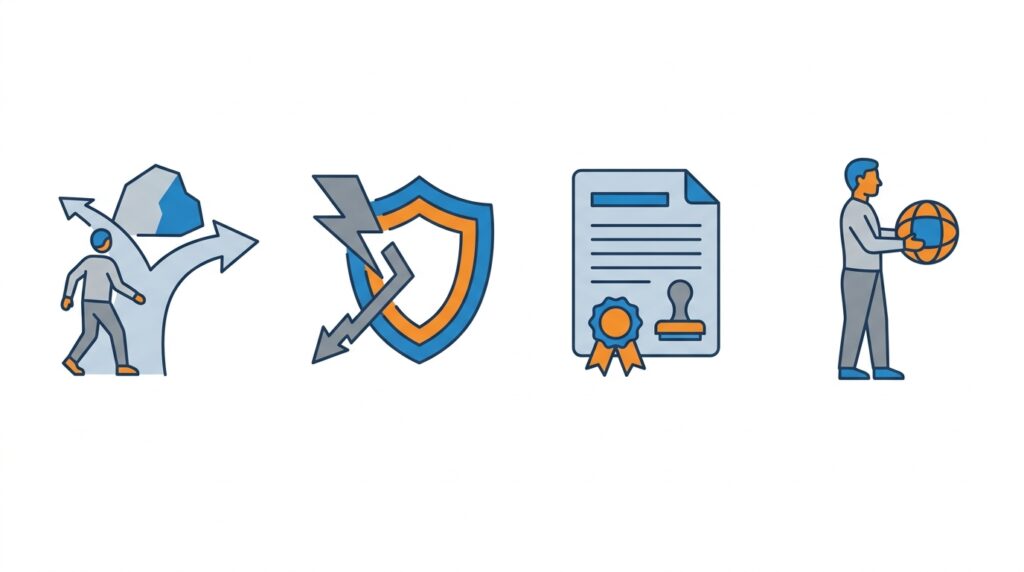
For negative risks (threats):
| Strategy | Description | Example |
|---|---|---|
| Avoid | Eliminate the risk | Change scope to avoid a hazardous area |
| Mitigate | Reduce likelihood or impact | Extra inspections to reduce quality risk |
| Transfer | Shift risk to another party | Insurance; fixed-price contract |
| Accept | Acknowledge and prepare | Accept small risks with contingency |
For positive risks (opportunities):
| Strategy | Description | Example |
|---|---|---|
| Exploit | Ensure the opportunity occurs | Fast-track to gain schedule benefit |
| Enhance | Increase probability or impact | Add resources to complete early |
| Share | Share with a partner | Joint venture for a project |
| Accept | Acknowledge without action | Accept small opportunities |
Different strategies apply to different risks. The choice depends on the nature and significance of the risk and on the organization’s risk appetite.
Two related concepts are worth tracking:
- Residual risk: the risk that remains after a response has been applied.
- Secondary risk: a new risk created by the response itself. For example, an alternate vendor reduces delivery risk but may introduce quality risk.
For significant risks, teams should also prepare a contingency (fallback) plan to be used if the primary response fails or the risk occurs.
Risk Register
The risk register is the central document for risk management.
| Field | Description |
|---|---|
| Risk ID | Unique identifier |
| Risk description | What could happen (cause, event, effect) |
| Category / RBS reference | Technical, schedule, cost, etc. |
| Likelihood | Probability of occurrence |
| Impact | Severity if it occurs |
| Risk score | Likelihood × impact |
| Response strategy | Avoid, mitigate, transfer, accept |
| Response actions | What will be done |
| Trigger | Early warning indicator |
| Residual risk | Expected risk after response |
| Fallback plan | Action if the risk occurs |
| Owner | Who is responsible |
| Due date | When actions must be complete |
| Status | Open, in progress, closed |
The register should be reviewed regularly and updated as risks change.
Risk Ownership
Every significant risk should have an owner.
- Understand the risk: Know what could happen and why.
- Develop the response: Define what will be done.
- Implement the response: Ensure actions are executed.
- Monitor the risk: Track changes in likelihood or impact.
- Report status: Keep management informed.
Risk owners should have the authority and resources to manage their risks.
Risk Monitoring and Control
Risk monitoring tracks risks and responses over time.
- Regular reviews: Review the risk register at project meetings.
- Status updates: Update risk status and responses.
- New risk identification: Identify risks that emerge as the project progresses.
- Closed risk review: Confirm that closed risks are genuinely closed.
- Trigger monitoring: Watch for early warning signs.
- Trend analysis: Track risk exposure over time.
- Reporting: Give management a concise summary of top risks, trends, and decisions needed.
Risk Triggers and Early Warning
Risk triggers, also called early warning signs, are indicators that a risk is about to occur or has occurred. Monitoring triggers allows proactive response rather than reactive crisis management.
| Risk | Example Trigger |
|---|---|
| Late equipment delivery | Vendor misses a fabrication milestone; expediting reports show slippage |
| Cost escalation | Commodity price index rises above a set threshold |
| Productivity problems | Installed quantities fall behind plan for several weeks |
| Quality problems | Repeated inspection failures or open non-conformances |
| Labor shortages | Key trades not mobilized by the planned date |
Triggers should be defined in the risk register and tied to specific actions.
Contingency and Risk
Contingency is a reserve for risks that materialize.
| Type | Purpose | Managed By |
|---|---|---|
| Contingency reserve | For identified risks | Project manager |
| Management reserve | For unidentified risks | Senior management |
Contingency should be sized based on risk assessment, ideally supported by quantitative analysis such as Monte Carlo simulation, and managed carefully. It is not free money. Draw-downs should be tied to specific risks and tracked.
Risk in EPC Contracts
EPC contracts allocate risk between owner and contractor.
| Risk | Typically Borne By |
|---|---|
| Design errors | Contractor (EPC) |
| Construction cost overruns | Contractor (lump-sum EPC) |
| Force majeure | Shared (time relief usually granted; cost often with owner or each party bears its own) |
| Owner-caused delays | Owner |
| Regulatory changes | Shared or owner (change in law) |
| Site conditions | Varies by contract |
Risk allocation should be explicit in the contract. Ambiguity leads to disputes. A common principle is that each risk should be borne by the party best able to control it. Pushing too much risk onto the contractor can result in inflated prices or contractor financial stress.
Common Risks in Plant Projects
| Risk | Description | Typical Mitigation |
|---|---|---|
| Late equipment delivery | Equipment arrives late | Expediting; buffer; alternate vendors |
| Design changes | Scope changes during design | Clear scope; change management |
| Cost escalation | Prices increase | Fixed-price contracts; contingency |
| Weather delays | Weather affects construction | Weather contingency |
| Labor shortages | Skilled labor unavailable | Early recruitment; training |
| Quality problems | Equipment or work fails to meet specs | Inspection; prequalification |
| Safety incidents | Injuries or incidents | Safety planning; training |
| Regulatory changes | New requirements | Monitoring; compliance planning |
| Currency fluctuation | Exchange rates change | Hedging; currency clauses |
These risks should be specifically considered in the risk register.
Common Mistakes in Risk Management
- No risk management: Risks not identified or managed.
- One-time exercise: Risk management done once and forgotten.
- Optimism bias: Underestimating likelihood or impact.
- No risk owners: Risks without clear responsibility.
- Vague responses: Responses that are not specific or actionable.
- No monitoring: Risks not tracked over time.
- Ignoring opportunities: Focusing only on threats.
- Inadequate contingency: Not enough reserve for risks.
- No defined appetite or tolerance: No basis for escalation or consistent decisions.
- Weak risk culture: Team members afraid to report bad news.
- No lessons learned: Not learning from past risks.
These mistakes are costly to correct. They are much cheaper to avoid through disciplined risk management.
How Japanese EPC Firms Approach Risk Management
Japanese engineering firms are known for their disciplined approach to risk management. Common characteristics include:
- Thorough identification: Risks are identified systematically, with input from all disciplines.
- Conservative assessment: Risks are assessed realistically, not optimistically.
- Detailed planning: Responses are planned carefully, with clear ownership.
- Disciplined monitoring: Risks are tracked and reviewed regularly.
- Adequate contingency: Contingency is sized to cover real risk.
- Continuous improvement: Lessons are captured and applied.
- Long-term focus: Risk management is treated as an ongoing discipline.
For plant owners, this often means projects that are delivered without major surprises.
How to Evaluate Risk Management Readiness
| Question | Why It Matters |
|---|---|
| Is there a risk management process? | Provides a structured approach |
| Are risk appetite and tolerance defined? | Guides responses and escalation |
| Are risks identified comprehensively? | Missing risks cannot be managed |
| Are risks assessed realistically? | Optimistic assessment leads to surprises |
| Are risks prioritized? | Focuses attention on the most important risks |
| Are responses planned? | Provides a plan for managing risks |
| Are risk owners assigned? | Ensures accountability |
| Is the risk register maintained? | Keeps risks visible and tracked |
| Are triggers defined and monitored? | Enables early response |
| Is risk monitoring regular? | Ensures risks are not forgotten |
| Is contingency adequate? | Provides reserve for risks that materialize |
| Are lessons learned captured? | Improves future risk management |
A plant that addresses these questions is ready for effective risk management.
Key Takeaways
- Risk management identifies, assesses, and responds to risks that could affect project objectives
- Risk appetite and tolerance, defined by management, guide responses and escalation
- Risks should be identified comprehensively (an RBS helps), assessed realistically, and prioritized
- Response strategies include avoid, mitigate, transfer, and accept (for threats)
- Every significant risk should have an owner
- The risk register is the central document for risk management
- Triggers give early warning and allow proactive response
- Quantitative methods such as Monte Carlo simulation support contingency sizing for major risks
- Contingency covers identified risks; management reserve covers unidentified risks
- EPC contracts allocate risk between owner and contractor
- Risk management applies to operations as well as projects
- Risk management is an ongoing process, not a one-time exercise
- Japanese EPC firms emphasize thorough identification and conservative assessment
Conclusion
Risk management is critical to project success. For small to medium-scale industrial plants, it determines whether the project can withstand the challenges it will face.
By defining risk appetite, identifying risks comprehensively, assessing them realistically, planning responses, assigning ownership, monitoring triggers, and sizing contingency appropriately, owners and project teams can ensure that risks are managed proactively rather than reactively.