By EPC Partners Inc. Engineering Team
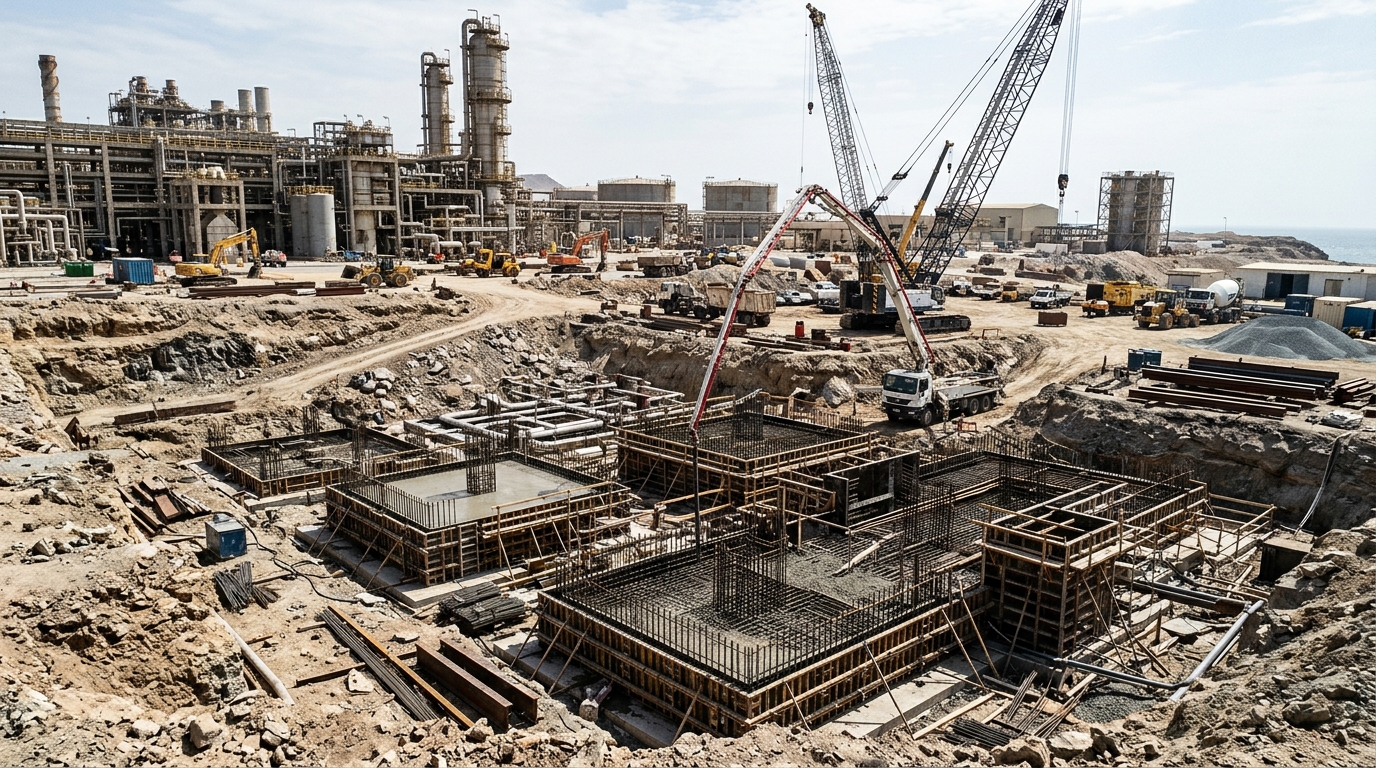
Civil engineering is the foundation of every industrial plant, literally. Foundations support the equipment. Structures house the process. Roads provide access. Drainage protects the site. All of it must be designed and built to withstand the site conditions, the plant loads, and the test of time.
At EPC Partners Inc., civil engineering has been a core part of our work across a wide range of plant projects, from geothermal fields in the East African Rift Valley to coastal desalination sites in the Arabian Gulf, and from seismic zones in Iceland to constrained industrial sites in Japan. Our civil work has ranged from turbine-generator foundations for 300 MW thermal units to marine intakes and outfalls for some of the world’s largest desalination plants. Each project has presented different challenges, and each has reinforced the same lesson: civil engineering is not a secondary discipline. It is fundamental to project success.
This article covers the key practices in plant civil engineering, drawing on our experience supporting projects across Asia, the Middle East, Africa, and Europe.
What Is Plant Civil Engineering?
Plant civil engineering is the discipline of designing and constructing the civil works required for an industrial plant. It includes:
- Site preparation: Earthworks, grading, and compaction.
- Foundations: Supporting equipment, structures, and buildings.
- Structures: Buildings, shelters, and support structures.
- Roads and access: Site roads, access roads, and hardstanding.
- Drainage: Surface water, stormwater, and process drainage.
- Underground services: Pits, trenches, culverts, and buried piping and cable routes.
- Retaining structures: Walls, slopes, and embankments.
- Marine works: Intakes, outfalls, and coastal structures (where applicable).
Civil engineering provides the platform on which all other disciplines depend.
Why Civil Engineering Matters
| Factor | Impact of Good Civil Engineering | Impact of Poor Civil Engineering |
|---|---|---|
| Safety | Stable foundations and structures | Structural failures, safety incidents |
| Cost | Optimized earthworks and foundations | Cost overruns from rework |
| Schedule | Civil works completed on time | Delays cascade to other disciplines |
| Performance | Equipment operates as designed | Vibration, settlement, alignment issues |
| Durability | Structures last for decades | Premature deterioration |
| Compliance | Meets building codes and regulations | Non-compliance, legal issues |
For small to medium-scale industrial plants, civil engineering determines whether the plant can be built safely and operated reliably.
Design Basis, Codes, and Standards
Civil design starts with a clear design basis, agreed early with the owner and the other disciplines. It should define:
- Applicable codes: National and local building codes, plus international standards where the project requires them (for example ACI, ASCE, or Eurocode families, and local codes such as those in Japan, Indonesia, or the Gulf states).
- Design loads: Dead, live, equipment, wind, seismic, thermal, and construction loads.
- Environmental conditions: Temperature, rainfall, groundwater, aggressive soil or seawater, and seismic and wind data.
- Equipment data: Vendor loads, anchor bolt layouts, and tolerances, which are often the last information to arrive and the most expensive to get wrong.
- Design life and durability requirements.
Where several codes apply, such as owner standards, local regulations, and vendor requirements, the design basis should state which governs.
Site Preparation
Site preparation is the first step in civil construction.
- Clearing and grubbing: Removing vegetation, debris, and obstructions.
- Earthworks: Cut and fill to achieve design levels.
- Grading: Shaping the site to design contours.
- Compaction: Compacting fill to achieve design density, verified by testing.
- Dewatering: Managing groundwater during excavation where the water table is high.
- Erosion and sediment control: Preventing erosion during construction.
Site preparation should be based on accurate topographic survey data and geotechnical investigation.
Geotechnical Investigation
Geotechnical investigation is the basis of civil design.
- Boreholes: Drilling to investigate soil and rock conditions.
- Test pits: Excavating to investigate shallow conditions.
- In-situ testing: Standard penetration tests and cone penetration tests.
- Laboratory testing: Soil classification, strength, and consolidation, plus chemical testing (sulfates, chlorides, pH) to assess concrete and steel durability.
- Geophysical testing: Seismic refraction and resistivity.
- Groundwater monitoring: Water levels and variations over time.
The investigation should cover the whole plant footprint, with denser coverage under heavy or sensitive equipment such as turbine-generators, stacks, and large tanks.
Lessons from the field. At our geothermal projects in Kenya (Olkaria I Unit 6, 83 MW) and Indonesia (Muara Laboh, 85.2 MW), the volcanic terrain required careful geotechnical assessment for foundations, access roads, and pipeline routing. In Iceland (Theistareykir, 2×45 MW), seismic conditions shaped the structural design. Each site’s unique conditions shaped the engineering approach, and in every case the quality of the early geotechnical work determined how smoothly construction went.
Seismic and Geohazard Considerations
Many of the plant sites we support lie in seismically active or geologically complex regions. Designers should consider:
- Seismic loading: Ground motion for foundations, structures, and equipment anchorage.
- Liquefaction and settlement: Particularly at coastal and reclaimed sites.
- Slope stability: Natural slopes and engineered cuts and fills.
- Volcanic and geothermal ground conditions: Hot ground, steam, and altered soils at geothermal sites.
- Flood and tsunami exposure: For coastal and low-lying sites.
These hazards should be identified early, because they affect foundation type, structural system, and site layout.
Foundations
Foundations support equipment, structures, and buildings. The foundation type depends on soil conditions, loads, and equipment requirements.
| Foundation Type | Description | When to Use |
|---|---|---|
| Shallow foundations | Spread footings, strip footings | Good soil conditions, moderate loads |
| Raft (mat) foundations | Large concrete slabs spreading load over a wide area | Uniform loads, weaker soil |
| Deep foundations | Piles, drilled shafts | Poor soil conditions, heavy loads, liquefaction risk |
| Machine foundations | Dynamic foundations for rotating equipment | Turbines, compressors, pumps |
| Tank foundations | Ringwalls, slabs, or piled bases | Storage tanks, where settlement is critical |
Machine Foundations
Machine foundations require special attention.
- Dynamic loads: Rotating equipment generates dynamic loads that the foundation must accommodate, including a check that the foundation’s natural frequencies stay clear of the machine’s operating frequencies.
- Vibration isolation: Foundations should limit vibration transmitted to surrounding structures. A common approach is to separate the machine foundation from building floors and slabs.
- Alignment: Foundations must maintain equipment alignment over time.
- Settlement: Differential settlement can cause misalignment and failure.
- Temperature effects: Thermal expansion must be accommodated, and large concrete placements need thermal control to limit cracking.
- Grouting and anchor bolts: Placement tolerances, grout selection, and curing must follow the equipment vendor’s requirements.
At thermal power projects in Vietnam (Thai Binh 1, 2×300 MW) and Bangladesh (Bibiyana-III, 400 MW CCGT), turbine-generator foundations required careful design to accommodate dynamic loads and maintain alignment.
Structures
Structures house the process and support the plant.
- Buildings: Control rooms, offices, workshops, warehouses.
- Process structures: Equipment support structures, pipe racks, platforms.
- Shelters: Equipment shelters and weather protection.
- Special structures: Stacks, cooling towers, silos.
Structure design must consider loads, environmental conditions, fire protection requirements, and regulatory requirements. Structural steel and concrete choices should also take into account local construction capability, material availability, and corrosion exposure.
Roads and Access
Roads and access are essential for construction and operation.
- Site roads: Roads within the plant site.
- Access roads: Roads connecting the site to public roads.
- Heavy haul routes: Routes for transporting large equipment, including checks of bridges, culverts, turning radii, and overhead clearances.
- Hardstanding: Paved areas for laydown, maintenance, and vehicle parking.
- Drainage: Road drainage to prevent flooding and pavement damage.
For remote sites in Ethiopia (Aluto Langano, 5 MW) and Indonesia, access roads and logistics planning were critical to construction success.
Drainage
Drainage protects the site from water damage.
- Surface water: Stormwater runoff and drainage.
- Process drainage: Drainage from process areas.
- Contaminated drainage: Drainage that may contain oil or chemicals, with containment and treatment before discharge.
- Flood protection: Protection against flooding, including consideration of extreme events.
- Erosion control: Prevention of erosion from runoff.
Drainage design must consider rainfall intensity, site topography, and environmental requirements.
Underground Services
Underground pits, trenches, culverts, and buried pipes and cables are easy to overlook in planning and difficult to change once built. They should be coordinated early with piping, electrical, and instrumentation teams so that routes, crossings, and depths are resolved before foundations and roads are constructed.
Retaining Structures
Retaining structures support slopes and prevent erosion.
- Gravity walls: Concrete or masonry walls that resist soil pressure by their weight.
- Cantilever walls: Reinforced concrete walls that resist soil pressure by cantilever action.
- Sheet pile walls: Steel or concrete piles driven into the ground.
- Gabion walls: Stone-filled wire baskets.
- Soil nailing: A slope stabilization technique using reinforcing bars installed in the soil.
Retaining structures are often required on sites with significant level changes.
Marine Works
Marine works are required for coastal sites.
- Intakes: Structures for drawing cooling water or process water from the sea.
- Outfalls: Structures for discharging water to the sea.
- Breakwaters: Structures to protect the site from wave action.
- Jetties: Structures for loading and unloading materials.
Marine works demand additional data (bathymetry, tides, waves, currents, and sediment transport) and must be designed for the aggressive marine environment. For desalination projects in the Gulf (Taweelah, 909,200 m³/day; Jubail 3A, 600,000 m³/day), marine works were a significant part of the civil scope.
Concrete, Materials, and Quality Control
Good design can be undone by poor construction quality. Key practices include:
- Concrete mix design: Matched to exposure, such as sulfate-bearing soils, seawater, or high temperatures.
- Testing: Concrete cube or cylinder testing, reinforcement testing, and compaction testing.
- Inspection and hold points: Formwork, reinforcement, and embedments inspected before every pour.
- Curing and temperature control: Particularly in hot climates and for mass concrete.
- Survey control: As-built surveys of foundations and anchor bolts before equipment installation.
Interfaces and Construction Sequencing
Civil works come first, so delays and errors spread to every other discipline. Practical measures include:
- Early equipment data: Securing vendor loads and anchor details before foundation design is finalized.
- Discipline coordination: Resolving clashes between foundations, underground services, and piping routes in the design stage.
- Sequencing plan: Planning excavations, pours, and backfill so that civil works do not block equipment delivery and mechanical erection.
- Handover of foundations: Clear acceptance criteria for turning over completed foundations to the mechanical contractor.
Civil Engineering in Small Plants
Small plants face particular challenges:
- Fewer resources for civil engineering.
- Less geotechnical data available.
- Less in-house expertise.
- Competing priorities.
Practical approaches:
- Invest in geotechnical investigation: Good geotechnical data prevents costly surprises.
- Use standard designs: Standard foundation and structure designs can save time and cost.
- Seek expert advice: Get advice from geotechnical and structural engineers.
- Plan for construction: Plan civil works around the construction sequence.
- Document decisions: Record the basis for design decisions.
- Consider lifecycle: Design for durability and low maintenance.
Civil engineering does not need to be complex. It needs to be thorough and practical.
Common Mistakes in Civil Engineering
- Insufficient geotechnical investigation: Discovering soil problems after construction begins.
- Inadequate site preparation: Poor compaction leading to settlement.
- Underestimating drainage requirements: Flooding during construction or operation.
- Ignoring seismic conditions: Structural failure during earthquakes.
- Poor machine foundation design: Vibration and alignment problems.
- Late equipment data: Redesign and rework when vendor loads change.
- Inadequate access roads: Difficulty delivering equipment.
- Ignoring environmental requirements: Erosion and sedimentation problems.
- Weak quality control on concrete: Defects that surface only after commissioning.
- No construction sequencing plan: Civil works blocking other disciplines.
These mistakes are costly to correct. They are much cheaper to avoid through disciplined civil engineering.
How EPC Partners Inc. Approaches Civil Engineering
At EPC Partners Inc., we bring practical experience from projects across Asia, the Middle East, Africa, and Europe to civil engineering. Our approach includes:
- Thorough geotechnical investigation: We ensure that civil design is based on accurate site data.
- Practical design: We design civil works that are constructible, durable, and cost-effective.
- Local knowledge: We work with local experts to understand site conditions and regulatory requirements.
- Construction support: We provide civil construction management and supervision.
- Risk assessment: We identify and assess civil-related risks.
- Detailed documentation: We document the civil design and construction process.
Our experience includes supporting geothermal projects in Kenya, Ethiopia, Indonesia, Iceland, and Japan; desalination projects in the UAE, Saudi Arabia, Oman, and Qatar; thermal power projects in Vietnam, Bangladesh, and Japan; and water treatment projects in Vietnam, Kuwait, and Qatar. We have also supported clients including Marubeni Corporation, Fuji Electric Co., Ltd., and Toyota Tsusho Corporation on civil engineering aspects of their projects.
How to Evaluate Civil Engineering Readiness
| Question | Why It Matters |
|---|---|
| Is the design basis (codes, loads, environment) agreed? | Gives all disciplines a common reference |
| Has geotechnical investigation been performed? | Provides the basis for design |
| Have seismic and geohazard risks been assessed? | Prevents structural and stability failures |
| Is site preparation planned? | Ensures proper site conditions |
| Are foundations designed for loads? | Ensures equipment and structures are supported |
| Are machine foundations designed for dynamic loads? | Ensures equipment alignment and reliability |
| Are structures designed for environmental conditions? | Ensures durability and safety |
| Are roads and access adequate? | Ensures construction and operation can proceed |
| Is drainage designed? | Prevents flooding and erosion |
| Are underground services coordinated? | Avoids clashes and rework |
| Are retaining structures designed? | Prevents slope failure |
| Are marine works designed? | Ensures coastal structures perform |
| Is a quality control and testing plan in place? | Ensures the as-built matches the design |
| Is the design documented? | Ensures transparency |
A project that can answer these questions is ready for sound civil engineering.
Conclusion
Civil engineering is the foundation of every industrial plant. For small to medium-scale industrial plants, it determines whether the plant can be built safely, operated reliably, and maintained economically.
By focusing on the design basis, geotechnical investigation, site preparation, foundations, structures, roads, drainage, retaining structures, marine works, and quality control, owners and project teams can ensure that the civil works support the plant throughout its life.
If you are planning a plant project and need support with civil engineering or EPC project delivery, contact us to discuss how we can help.
EPC Partners Inc. is a Japanese EPC support firm with experience supporting power, water, and industrial plant projects across Asia, the Middle East, Africa, and Europe. For more information, visit our project list.