Tag: EPC

  • Plant Cost Estimation and Budget Control: Key Practices for EPC Projects

    Plant Cost Estimation and Budget Control: Key Practices for EPC Projects

    Cost is one of the three pillars of project success, alongside schedule and quality. A project that is delivered on time and to specification but costs far more than planned is not a success. Cost estimation and budget control are the disciplines that ensure a project is affordable, funded, and delivered within the money available.

    Cost estimation is the process of predicting what a project will cost. Budget control is the process of ensuring that actual costs stay within the approved budget. Together, they determine whether the project is financially viable—and whether the owner gets what they paid for.

    For small to medium-scale industrial plants, cost estimation and budget control are especially important because there is less margin for error and fewer resources to absorb cost overruns. An accurate estimate supports good decisions; a poor one leads to underfunding, delays, and disputes.

    This article covers the key practices in plant cost estimation and budget control, from estimating methods to change management and cost reporting.

    What Is Cost Estimation and Budget Control?

    Cost estimation is the process of predicting the cost of a project or a component of a project. Budget control is the process of managing actual costs against the approved budget.

    Together, they cover:

    • Estimating: Predicting costs for each element of the project.

    • Budgeting: Allocating the approved budget to work packages.

    • Commitment tracking: Tracking contracts and purchase orders.

    • Cost tracking: Tracking actual costs against budget.

    • Forecasting: Predicting final costs based on current trends.

    • Change management: Managing changes and their cost impact.

    • Reporting: Reporting cost performance to management.

    Cost estimation and budget control are not just financial functions. They are project management functions that require technical knowledge as well as financial discipline.

    Why Cost Estimation and Budget Control Matter

    Cost performance has significant consequences.

    Factor Impact of Good Cost Management Impact of Poor Cost Management
    Viability Project remains financially viable Project becomes unaffordable
    Funding Funding secured and sufficient Funding shortfalls and delays
    Decisions Decisions based on accurate data Decisions based on guesswork
    Disputes Fewer disputes with contractors More disputes and claims
    Reputation Owner and contractor credibility Reputation damaged
    Completion Project completed as planned Project delayed or abandoned

    For small plants, where there is less margin for error, cost management determines whether the project can be completed.

    Cost Estimation Methods
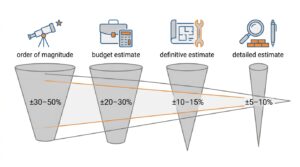
    Cost estimation accuracy over project stages

    Different estimating methods are used at different stages of a project.

    Method Description Accuracy When to Use
    Order of magnitude Based on capacity or similar projects ±30% to ±50% Concept stage
    Budget estimate Based on preliminary design ±20% to ±30% Feasibility stage
    Definitive estimate Based on detailed design ±10% to ±15% Basic engineering stage
    Detailed estimate Based on completed design and quotes ±5% to ±10% Detailed design stage

    Estimate accuracy improves as design progresses. Early estimates are used for feasibility decisions; later estimates support budget approval and contract awards.

    Cost Categories

    Project costs are typically divided into categories.

    Category Description Examples
    Equipment Major equipment items Turbines, boilers, compressors
    Bulk materials Commodity materials Pipe, fittings, valves, cable
    Construction Construction labor and services Civil, mechanical, electrical
    Engineering Design and engineering services Process, mechanical, electrical
    Project management Project management and administration Salaries, offices, travel
    Owner’s costs Costs borne by the owner Land, permits, insurance, financing
    Contingency Reserve for unknowns Scope, price, schedule

    Each category should be estimated separately and tracked separately.

    Work Breakdown Structure (WBS)

    A work breakdown structure (WBS) divides the project into manageable components.

    WBS principles:

    • Hierarchical: Each level breaks the level above into smaller components.

    • Complete: All project scope is included.

    • Unique: Each component has a unique identifier.

    • Manageable: Components are small enough to plan, estimate, and control.

    Typical WBS levels:

    Level Description Example
    1 Project Power plant
    2 Major systems Boiler, turbine, electrical
    3 Subsystems Feedwater, fuel, control
    4 Work packages Pumps, valves, instruments
    5 Activities Installation tasks

    The WBS provides the framework for estimating, budgeting, and cost control.

    Estimating Techniques

    Several techniques are used to estimate costs.

    Technique Description When to Use
    Parametric Based on historical relationships (e.g., cost per MW) Early stages
    Analogous Based on similar past projects When data is limited
    Bottom-up Built from detailed quantities and rates Detailed stages
    Vendor quotes Based on actual vendor pricing For equipment and services
    Expert judgment Based on experience For unusual items

    Most estimates use a combination of techniques. Equipment is often priced by vendor quotes; construction is often priced bottom-up from quantities.

    Contingency

    Contingency is a reserve for unknowns. It covers costs that are likely to occur but cannot be specifically identified at the time of estimating.

    Types of contingency:

    Type Description Examples
    Scope contingency For scope changes Additional work identified during design
    Price contingency For price changes Material price increases
    Schedule contingency For schedule changes Delays due to weather or labor
    Management reserve For unidentified risks Reserved by management

    Contingency sizing:

    • Early stages: Higher contingency (e.g., 15–25%) due to uncertainty.

    • Later stages: Lower contingency (e.g., 5–10%) as uncertainty reduces.

    • Risk-based: Contingency based on quantitative risk analysis.

    Contingency should be managed, not treated as free money. Drawing it down should be controlled.

    Budget Development

    The budget is the approved spending plan for the project.

    Budget development steps:

    1. Estimate: Estimate the cost of each WBS element.

    2. Review: Review the estimate for completeness and accuracy.

    3. Approve: Obtain approval from management or the owner.

    4. Allocate: Allocate the budget to work packages and cost accounts.

    5. Baseline: Establish the baseline budget for control.

    The baseline budget is the reference against which actual costs are compared.

    Budget Control

    Budget control ensures that actual costs stay within budget.

    Budget control activities:

    Activity Description
    Commitment tracking Tracking contracts, purchase orders, and commitments
    Cost tracking Tracking actual costs against budget
    Accruals Recording costs incurred but not yet invoiced
    Forecasting Predicting final costs based on current trends
    Variance analysis Comparing actual and forecast costs against budget
    Corrective action Taking action when variances are significant

    Budget control requires accurate data and timely reporting.

    Earned Value Management
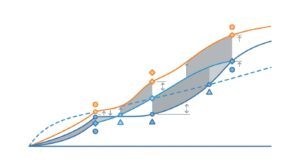
    Earned value management curves for project cost and schedule control

    Earned value management (EVM) integrates cost, schedule, and scope to measure project performance.

    Key EVM metrics:

    Metric Description Formula
    Planned Value (PV) Budgeted cost of work scheduled —
    Earned Value (EV) Budgeted cost of work performed —
    Actual Cost (AC) Actual cost of work performed —
    Cost Variance (CV) EV − AC Positive = under budget
    Schedule Variance (SV) EV − PV Positive = ahead of schedule
    Cost Performance Index (CPI) EV ÷ AC >1 = efficient
    Schedule Performance Index (SPI) EV ÷ PV >1 = ahead

    EVM provides early warning of cost and schedule problems, allowing corrective action before it is too late.

    Forecasting

    Forecasting predicts the final cost of the project based on current performance.

    Forecasting methods:

    Method Description When to Use
    Budget-based Remaining budget for remaining work When performance is on track
    CPI-based Remaining budget adjusted by CPI When performance is off track
    Bottom-up Re-estimate remaining work For significant variances
    Management judgment Based on experience For unusual situations

    Forecasting should be updated regularly as the project progresses.

    Change Management

    Changes during a project affect cost. Managing them is critical.

    Change management activities:

    • Change identification: Recognizing when a change is required.

    • Change assessment: Evaluating the impact on cost, schedule, and scope.

    • Change approval: Approving or rejecting the change.

    • Change implementation: Implementing the change.

    • Documentation: Recording the change and its cost impact.

    Uncontrolled changes lead to cost overruns and disputes.

    Cost Reporting

    Cost reporting keeps management informed of cost performance.

    Cost report contents:

    • Budget: The approved budget.

    • Commitments: Contracts and purchase orders.

    • Actual costs: Costs incurred to date.

    • Accruals: Costs incurred but not invoiced.

    • Forecast: Predicted final cost.

    • Variance: Actual and forecast vs. budget.

    • Trends: Cost performance over time.

    Reports should be accurate, timely, and clear.

    Cost Control in EPC Projects

    EPC projects have specific cost control challenges.

    EPC cost control considerations:

    • Lump-sum contracts: The contractor bears cost risk, but changes may still affect the owner.

    • Shared risk: Some contracts share cost risk between owner and contractor.

    • Owner’s costs: The owner bears costs not included in the EPC contract.

    • Interface costs: Costs at the interface between EPC and owner scope.

    Cost control in EPC projects requires clear contract terms and disciplined change management.

    Common Mistakes in Cost Estimation and Budget Control

    Even experienced organizations make mistakes. Common ones include:

    • Optimistic estimates: Underestimating costs.

    • Incomplete scope: Missing elements that later add cost.

    • Inadequate contingency: Not enough reserve for unknowns.

    • Poor change control: Changes not tracked or approved.

    • Delayed reporting: Discovering cost overruns too late.

    • Inaccurate data: Costs not recorded accurately.

    • No forecasting: Not predicting final costs.

    • Ignoring trends: Missing early warning signs.

    • Weak commitment tracking: Not tracking contracts and purchase orders.

    These mistakes are costly to correct. They are much cheaper to avoid through disciplined estimating and control.

    How Japanese EPC Firms Approach Cost Estimation and Budget Control

    Japanese engineering firms are known for their disciplined approach to cost management. Common characteristics include:

    • Thorough estimating: Estimates are prepared carefully, with detailed quantities and rates.

    • Conservative assumptions: Estimates are based on realistic, not optimistic, assumptions.

    • Adequate contingency: Contingency is sized to cover real uncertainty.

    • Disciplined control: Costs are tracked and reported regularly.

    • Early warning: Variances are identified and addressed early.

    • Detailed documentation: Records are complete and accurate.

    • Continuous improvement: Lessons are captured and applied.

    For plant owners, this often means projects that are delivered within budget and without surprises.

    How to Evaluate Cost Estimation and Budget Control Readiness

    When reviewing cost estimation and budget control, ask:

    Question Why It Matters
    Is there a cost estimate? Provides the basis for budgeting
    Is the estimate based on adequate design information? Determines estimate accuracy
    Is contingency adequate? Covers unknowns
    Is there a baseline budget? Provides the reference for control
    Are commitments tracked? Ensures all costs are captured
    Is cost tracked against budget? Identifies variances
    Is forecasting performed? Predicts final costs
    Is change management disciplined? Prevents uncontrolled cost growth
    Is reporting timely? Enables early corrective action

    A plant that addresses these questions is ready for effective cost management.

    Conclusion

    Cost estimation and budget control are critical to project success. For small to medium-scale industrial plants, they determine whether the project is affordable, funded, and delivered within the money available.

    By focusing on estimating methods, WBS, contingency, budget development, budget control, earned value, forecasting, and change management, owners and project teams can ensure that costs are managed effectively and the project is delivered within budget.
  • Plant Procurement and Vendor Management: Key Practices for EPC Projects

    Plant Procurement and Vendor Management: Key Practices for EPC Projects

    Procurement is where design becomes physical. Drawings and specifications are translated into purchase orders, equipment is manufactured, and materials are delivered to site. For an EPC project, procurement is often among the largest cost elements and one of the most common sources of delay.

    Procurement and vendor management is the discipline of sourcing, purchasing, and managing the equipment, materials, and services required for a project. It includes selecting vendors, negotiating contracts, expediting deliveries, inspecting equipment, and managing vendor performance through to the end of warranty.

    For small to medium-scale industrial plants, procurement and vendor management are especially important because there is less redundancy and fewer resources to absorb the consequences of poor procurement decisions. A late delivery or defective item can delay the entire project.

    This article covers the key practices in plant procurement and vendor management, from procurement planning to vendor performance management and warranty follow-up.

    What Is Procurement and Vendor Management?

    Procurement is the process of acquiring the equipment, materials, and services needed for a project. Vendor management is the ongoing management of the suppliers who provide those goods and services.

    Together, they cover:

    • Procurement planning: Defining what to buy, when, and how.
    • Sourcing: Identifying and evaluating potential vendors.
    • Contracting: Negotiating and awarding contracts.
    • Expediting: Monitoring vendor progress and ensuring on-time delivery.
    • Inspection and surveillance: Verifying that equipment and materials meet specifications.
    • Logistics: Managing shipping, customs, and delivery to site.
    • Vendor performance management: Evaluating and managing vendor performance.
    • Warranty management: Tracking and resolving claims after delivery and installation.

    Procurement and vendor management are not just administrative functions. They directly affect project cost, schedule, quality, and risk.

    Why Procurement and Vendor Management Matter

    Factor Impact of Good Procurement Impact of Poor Procurement
    Cost Competitive pricing; no surprises Higher costs; disputes
    Schedule On-time delivery; project on track Late deliveries; project delayed
    Quality Equipment meets specifications Defective equipment; rework
    Risk Risks identified and managed Risks materialize; problems escalate
    Compliance Regulatory requirements met Non-compliance; fines
    Warranty Claims resolved quickly Warranty issues unresolved

    For small plants, where there is less margin for error, procurement and vendor management determine whether the project is delivered successfully.

    Procurement Planning

    Procurement planning defines what to buy, when, and how.

    Procurement planning activities:

    • Scope definition: What equipment, materials, and services are required?
    • Specification review: Are specifications complete and clear?
    • Make-or-buy analysis: What should be purchased vs. fabricated?
    • Packaging: How should procurement be divided into packages?
    • Scheduling: When must each item be delivered, working back from the construction schedule?
    • Budgeting: What is the budget for each item?
    • Sourcing strategy: How will vendors be identified and selected, locally or globally?
    • Contracting strategy: What contract types will be used?
    • Risk assessment: What are the procurement risks?

    Procurement planning should begin early, ideally during design, so that long-lead items are identified and ordered in time. Long-lead items (large turbines, transformers, boilers, specialty valves) often need to be ordered before detailed design is complete. Their delivery dates then drive the project schedule.

    Procurement Packages

    Procurement package types for EPC projects

    Large projects are typically divided into procurement packages.

    Package Type Description Examples
    Equipment packages Major equipment items Turbines, boilers, compressors
    Bulk materials Commodity materials Pipe, fittings, valves, cable
    Services Specialized services Inspection, NDT, machining
    Construction Construction contracts Civil, mechanical, electrical
    Systems Integrated systems Control systems, safety systems

    Packaging affects competition, coordination, and risk. Smaller packages increase competition but require more coordination. Larger packages reduce coordination but may limit competition and concentrate risk in fewer vendors.

    Procurement Documents

    Each package is defined by a set of documents sent to vendors, typically:

    • Material or purchase requisition: The technical definition of what is required.
    • Technical specifications and datasheets: Performance, design codes, materials, and testing requirements.
    • Commercial terms: Price basis, payment, delivery, warranty, and liability terms.
    • Vendor data requirements: The drawings, calculations, procedures, and manuals the vendor must submit, and when.
    • Inspection and test requirements: The quality plan or inspection and test plan (ITP) expectations.

    Incomplete or ambiguous requisitions are a leading cause of disputes and change orders, so they are worth reviewing carefully before issue.

    Vendor Identification and Prequalification

    Identifying and prequalifying vendors is critical to procurement success.

    Vendor identification sources:

    • Approved vendor lists: Vendors previously used and approved.
    • Industry directories: Trade associations, directories, and databases.
    • References: Recommendations from other plants or contractors.
    • Internet searches: Company websites and industry platforms.
    • Trade shows: Industry exhibitions and conferences.

    Vendor prequalification criteria:

    Criterion What to Assess
    Technical capability Can the vendor meet the technical requirements?
    Experience Has the vendor supplied similar equipment?
    Financial strength Is the vendor financially stable?
    Quality systems Does the vendor have a quality management system (e.g., ISO 9001)?
    Capacity Can the vendor meet the schedule given its current workload?
    References What do previous customers say?
    Compliance Does the vendor meet regulatory, safety, and ethical requirements?

    Prequalification reduces the risk of selecting an unsuitable vendor.

    Prequalification vs. Qualification

    The two terms are often used interchangeably, but they are different. Prequalification is the initial assessment of a vendor’s capability. Qualification is the ongoing process of keeping vendors on an approved list, updated as performance is evaluated and as vendors’ capabilities change. A vendor that was suitable five years ago may no longer be, so approved vendor lists should be reviewed periodically rather than treated as permanent.

    Sourcing: Global vs. Local

    Sourcing decisions involve trade-offs between global and local vendors. Global sourcing may offer lower prices and access to specialized equipment, but introduces longer lead times, customs risk, and currency exposure. Local sourcing offers shorter lead times and easier communication, but may limit competition. The right balance depends on the item and the project.

    Other factors include local content requirements, import duties and taxes, availability of local after-sales service and spare parts, and the cost of travel for inspection and expediting.

    Vendor Selection

    Vendor selection is the process of choosing the vendor for each package.

    Selection methods:

    • Competitive bidding: Multiple vendors submit proposals; the best is selected.
    • Negotiated selection: The owner negotiates with a single vendor.
    • Sole source: Only one vendor can supply the item.
    • Framework agreements: Pre-agreed terms with selected vendors.

    Evaluation criteria:

    Criterion What to Assess Indicative Weight*
    Technical compliance Does the proposal meet specifications? Pass/fail, then scored
    Price Is the price competitive, on a like-for-like basis? 30–40%
    Schedule Can the vendor meet the delivery date? 10–20%
    Experience Has the vendor done similar work? 10–15%
    Quality Does the vendor have a quality system? 10–15%
    Service Does the vendor provide support and spares? 5–10%
    Financial strength Is the vendor financially stable? 5–10%

    *Weights vary by project and package. They are shown only as an illustration.

    Evaluation is usually done in two stages. A technical evaluation checks compliance with specifications, and only technically acceptable bids go through to the commercial evaluation. This prevents a low price from outweighing a non-compliant proposal. Evaluation criteria and weights should be defined before proposals are received and applied consistently. Bid clarifications and exceptions should be documented, and prices compared on the same basis, including delivery terms, spares, and taxes.

    Contracting

    Contracting is the process of negotiating and awarding contracts.

    Contract Type Description When to Use
    Lump sum Fixed price for defined scope Well-defined scope
    Unit price Price per unit of work Quantities uncertain
    Cost plus Actual cost plus fee Scope uncertain
    Time and materials Hourly rate plus materials Small or undefined work

    Key contract terms:

    • Scope: What is included in the contract?
    • Price: How much will be paid, and when?
    • Delivery terms: Which Incoterms apply, and who bears risk and cost at each stage of transport?
    • Schedule: When must the work be completed?
    • Quality: What quality standards, inspection rights, and testing apply?
    • Warranty: What warranty is provided, for how long, and from what start date?
    • Liquidated damages: What pre-agreed compensation applies for delay or performance shortfall?
    • Performance security: Are advance payment guarantees, performance bonds, or retention required?
    • Payment terms: When and how will payment be made, and against which milestones?
    • Change management: How are changes priced and approved?
    • Termination: Under what conditions can the contract be terminated?

    Contract terms should be clear and complete to avoid disputes. Where equipment performance is guaranteed (efficiency, output, emissions), the guarantee terms and test procedures should be defined in the contract (see the article on performance guarantees in EPC contracts).

    Vendor Document Review

    After award, vendors submit drawings, calculations, and procedures for review. This step is easy to underestimate. Review turnaround times should be agreed in advance, since slow approvals delay manufacturing as surely as slow vendors do. Reviews should confirm that the design matches the specification and that interfaces (nozzle loads, foundations, electrical and instrument connections) are coordinated with the rest of the plant.

    Expediting

    Vendor expediting process for EPC projects

    Expediting is the process of monitoring vendor progress and ensuring on-time delivery.

    Expediting activities:

    • Progress monitoring: Tracking vendor progress against schedule.
    • Milestone verification: Confirming that milestones such as material receipt, machining, assembly, and testing are met.
    • Issue resolution: Identifying and resolving problems.
    • Reporting: Reporting progress and issues to project management.
    • Escalation: Escalating issues that cannot be resolved at the working level.

    Expediting is especially important for long-lead items, where delays have the greatest impact. A kick-off meeting with each major vendor sets expectations on schedule, reporting, and document submittals from the start. Expediters should also look at the vendor’s sub-suppliers, since delays often originate there.

    Inspection, Testing, and Surveillance

    Inspection and testing verify that equipment and materials meet specifications.

    Inspection activities:

    • Pre-inspection meeting: Reviewing inspection requirements and the ITP with the vendor.
    • In-process inspection: Inspecting during manufacturing.
    • Final inspection: Inspecting before shipment.
    • Witness testing: Witnessing tests specified in the contract, such as factory acceptance tests (FAT).
    • Documentation review: Reviewing test certificates, material certificates, and quality records.

    Inspection levels:

    Level Description
    Full inspection Every item inspected
    Sampling inspection A sample of items inspected
    Witness testing Specific tests witnessed
    Documentation review Records reviewed without physical inspection

    Inspection levels should be based on criticality and risk.

    Vendor Surveillance

    For critical equipment, vendor surveillance goes beyond inspection. It may include resident inspectors at the vendor’s facility, who monitor progress and quality throughout manufacturing. This provides earlier detection of problems than final inspection alone.

    Non-Conformance Handling

    When an inspection finds a deviation, it should be recorded in a non-conformance report. The vendor proposes a disposition (repair, rework, replace, or accept as is), and the owner or its representative approves it. Releasing equipment for shipment should depend on closing, or formally accepting, all open non-conformances.

    Logistics

    Logistics is the process of managing shipping, customs, and delivery to site.

    Logistics activities:

    • Shipping: Arranging transport from vendor to site, including special handling for oversized or heavy loads.
    • Customs: Managing import/export procedures and documentation.
    • Insurance: Insuring goods during transport.
    • Tracking: Monitoring shipment progress.
    • Receiving: Inspecting and accepting deliveries at site, and checking for shipping damage and shortages.
    • Storage and preservation: Storing materials properly and maintaining preservation measures until installation.

    Logistics is especially important for international procurement, where customs and shipping can cause significant delays. Site readiness (access roads, laydown areas, cranes, and storage) should be confirmed before deliveries arrive.

    Vendor Performance Management

    Vendor performance management is the ongoing evaluation and management of vendor performance.

    Metric What It Measures
    On-time delivery Percentage of deliveries on time
    Quality Defect rate; non-conformance rate
    Responsiveness Speed of response to issues
    Documentation Completeness and accuracy of documentation
    Warranty support Speed of warranty claims resolution
    Cost performance Adherence to contract price and control of change orders

    Performance should be reviewed regularly and used to inform future vendor selection and the qualification status of each vendor.

    Warranty Management

    Warranty management continues after equipment is delivered and installed. Warranty claims should be tracked, resolved promptly, and used to evaluate vendor performance. Warranties should be documented and their expiry dates tracked.

    Practical points include:

    • Confirm when each warranty period starts (delivery, installation, or commissioning) and when it ends.
    • Keep a register of warranties, covering equipment, vendor, terms, and expiry dates.
    • Schedule a warranty review before expiry, so latent defects are identified and claimed in time.
    • Keep operating and maintenance records, since vendors may dispute claims if equipment was operated or maintained outside their requirements.

    Managing Vendor Issues

    Vendor issues are common in procurement. Managing them effectively is critical.

    Common vendor issues:

    • Late delivery: Vendor fails to meet delivery date.
    • Quality problems: Equipment does not meet specifications.
    • Documentation gaps: Missing or incomplete documentation.
    • Communication problems: Vendor is unresponsive.
    • Financial problems: Vendor faces financial difficulty.
    • Scope disputes: Disagreement over what is included.

    Issue management approaches:

    • Early detection: Identify issues as early as possible.
    • Root cause analysis: Understand why the issue occurred.
    • Corrective action: Require the vendor to take corrective action.
    • Escalation: Escalate to higher management if needed.
    • Contract remedies: Apply contract remedies (e.g., liquidated damages).
    • Alternative sourcing: Identify alternative sources if needed.

    Issue management should be proactive, not reactive.

    Procurement and Risk Management

    Procurement is a major source of project risk.

    Risk Description Mitigation
    Late delivery Vendor fails to meet schedule Expediting; buffer; alternate vendors
    Quality problems Equipment does not meet specs Inspection; prequalification
    Cost overrun Prices increase Fixed-price contracts; contingency
    Vendor failure Vendor becomes insolvent Financial prequalification; guarantees
    Currency fluctuation Exchange rates change Hedging; currency clauses
    Logistics delays Shipping or customs delays Early ordering; tracking
    Transport damage Equipment damaged in transit or storage Insurance; packaging and handling requirements
    Force majeure Events beyond control Contract clauses; insurance

    Risk management should identify risks early and develop mitigation plans.

    Procurement Documentation

    Procurement generates significant documentation.

    Key documents:

    • Purchase orders: Formal orders for goods and services.
    • Contracts: Legal agreements with vendors.
    • Specifications and datasheets: Technical requirements.
    • Drawings: Equipment and material drawings.
    • Inspection reports: Results of inspections and tests.
    • Test certificates: Documentation of tests performed.
    • Shipping documents: Bills of lading, packing lists, certificates of origin.
    • Warranty documents: Warranty terms and conditions.
    • Vendor manuals: Operating and maintenance manuals.
    • Spare parts lists: Recommended spares for commissioning and operation.

    Documentation must be complete and accurate for handover to operations.

    Common Mistakes in Procurement and Vendor Management

    Even experienced organizations make mistakes. Common ones include:

    • Incomplete specifications: Leading to disputes and changes.
    • Inadequate prequalification: Selecting unsuitable vendors.
    • Choosing on price alone: Ignoring quality, schedule, and service.
    • Poor contract terms: Leading to disputes.
    • Slow document review: Delaying manufacturing.
    • Inadequate expediting: Discovering delays too late.
    • Skipping inspection: Accepting defective equipment.
    • Poor logistics planning: Delays in shipping or customs.
    • No performance management: Not tracking vendor performance.
    • Neglecting warranty follow-up: Letting warranty periods expire with defects unclaimed.
    • Reactive issue management: Waiting for problems to escalate.
    • Incomplete documentation: Problems during handover.

    These mistakes are costly to correct. They are much cheaper to avoid through good planning and disciplined execution.

    How Japanese EPC Firms Approach Procurement and Vendor Management

    Japanese engineering firms are known for their disciplined approach to procurement and vendor management. Common characteristics include:

    • Thorough planning: Procurement is planned carefully, with detailed specifications and schedules.
    • Careful vendor selection: Vendors are prequalified and selected based on capability, not just price.
    • Disciplined contracting: Contracts are clear and complete.
    • Active expediting: Vendor progress is monitored closely.
    • Thorough inspection: Equipment is inspected before shipment, and critical items are followed during manufacturing.
    • Detailed documentation: Records are complete and accurate.
    • Long-term relationships: Vendors are treated as partners, not just suppliers.
    • Continuous improvement: Lessons are captured and applied.

    For plant owners, this often means equipment that arrives on time, meets specifications, and performs reliably.

    How to Evaluate Procurement and Vendor Management Readiness

    When reviewing procurement and vendor management, ask:

    Question Why It Matters
    Is there a procurement plan? Provides a roadmap for procurement
    Are long-lead items identified and ordered early? Protects the project schedule
    Are specifications complete and clear? Prevents disputes and changes
    Are vendors prequalified, and is the approved list kept current? Ensures capable vendors
    Is vendor selection based on multiple criteria? Ensures the best vendor is selected
    Are contracts clear and complete? Prevents disputes
    Is expediting in place? Ensures on-time delivery
    Is inspection and surveillance planned according to criticality? Ensures equipment meets specifications
    Is logistics planned? Ensures materials arrive on time
    Is vendor performance managed? Ensures issues are addressed
    Are warranties tracked? Ensures claims are made in time
    Is documentation complete? Supports handover and operations

    A plant that addresses these questions is ready for successful procurement.

    Key Takeaways

    • Procurement and vendor management determine whether equipment arrives on time, meets specifications, and performs reliably.
    • Procurement planning should begin during design to identify long-lead items.
    • Vendor prequalification reduces the risk of selecting unsuitable vendors, and qualification keeps the approved list current.
    • Vendor selection should consider multiple criteria, not just price.
    • Clear contracts prevent disputes.
    • Expediting, inspection, and logistics ensure equipment arrives on time and in good condition. Critical equipment may justify vendor surveillance.
    • Vendor performance should be tracked and used to inform future selection.
    • Warranties should be documented, tracked, and claimed before they expire.
    • Procurement is a major source of project risk and should be managed proactively.
    • Japanese EPC firms emphasize thorough planning and long-term vendor relationships.

    Conclusion

    Procurement and vendor management are critical to EPC project success. For small to medium-scale industrial plants, they determine whether equipment and materials arrive on time, meet specifications, and perform reliably.

    By focusing on procurement planning, vendor selection, contracting, expediting, inspection, logistics, vendor performance management, and warranty follow-up, owners and project teams can ensure that procurement supports the project rather than hindering it.

  • Plant Construction Management: Key Practices for Successful Project Execution

    Plant Construction Management: Key Practices for Successful Project Execution

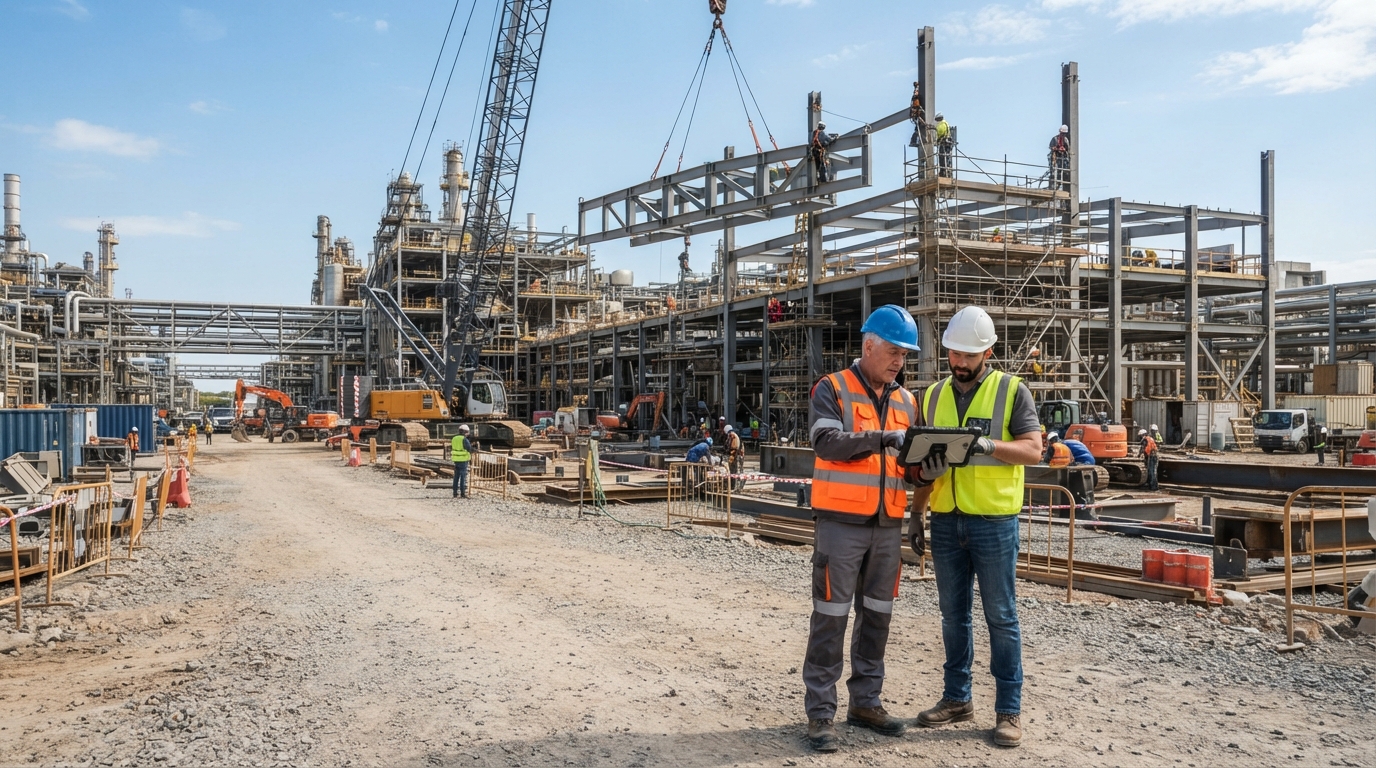
    Construction is where a plant moves from drawings to reality. It is the phase where steel is erected, equipment is installed, piping is connected, and systems are tested. It is also the phase where the most visible risks—safety, schedule, cost, and quality—come together.

    Construction management is the discipline of planning, coordinating, and controlling construction activities to deliver the plant safely, on schedule, within budget, and to the required quality. For small to medium-scale industrial plants, effective construction management is especially important because there is less redundancy and fewer resources to absorb the consequences of poor planning or execution.

    This article covers the key practices in plant construction management, from pre-construction planning to closeout.

    What Is Construction Management?

    Construction management is the process of managing the construction phase of a project. It includes:

    • Planning: Defining scope, schedule, budget, and resources.
    • Coordination: Managing contractors, vendors, and interfaces.
    • Control: Monitoring progress, cost, quality, and safety.
    • Communication: Keeping all parties informed.
    • Closeout: Completing punch lists and handing over to commissioning.

    Construction management is distinct from design and commissioning. It focuses on the physical execution of the work, although it must work closely with both: design provides the information to build from, and commissioning receives the finished plant.

    Why Construction Management Matters

    Construction is where projects succeed or fail.

    Factor Impact of Good Construction Management Impact of Poor Construction Management
    Safety Incidents prevented; workers protected Incidents, injuries, and regulatory action
    Schedule Milestones met; startup on time Delays cascade; startup postponed
    Cost Budget controlled; no surprises Cost overruns; disputes
    Quality Work meets specifications Rework; premature failures
    Coordination Contractors work together Conflicts; interface problems
    Documentation Records complete for handover Incomplete records; operational problems

    For small plants, where there is less margin for error, construction management determines whether the project is delivered successfully.

    The Role of the Construction Manager

    The construction manager is responsible for the construction phase of the project.

    Key responsibilities:

    • Planning and scheduling construction activities.
    • Coordinating contractors, vendors, and suppliers.
    • Monitoring progress, cost, quality, and safety.
    • Managing changes and resolving issues.
    • Reporting to the project manager and owner.
    • Ensuring documentation is complete.

    The construction manager must have both technical knowledge and management skills.

    Pre-Construction Planning

    Pre-construction planning sets the foundation for successful construction.

    Pre-construction activities:

    • Scope definition: What work is included in the construction contract?
    • Constructability review: Is the design buildable? Are there conflicts or issues?
    • Schedule development: What is the construction sequence and timeline?
    • Budget development: What is the cost of construction?
    • Contractor selection: Who will perform the work?
    • Regulatory approvals: Have building permits, environmental approvals, and other statutory requirements been obtained?
    • Site preparation: Is the site ready for construction?
    • Logistics planning: How will materials and equipment be delivered?
    • Safety planning: What are the construction hazards, and how will they be controlled?
    • Risk assessment: What could go wrong (weather, ground conditions, late deliveries, labor availability), and what is the response?

    Pre-construction planning should begin early—ideally during design—to identify and resolve issues before construction starts.

    Constructability Review

    A constructability review examines the design to identify construction issues before they become problems.

    Constructability review questions:

    • Can the design be built safely and efficiently?
    • Are there conflicts between disciplines (e.g., piping and structural)?
    • Is there adequate access for construction equipment, including cranes?
    • Are there adequate laydown areas?
    • Are materials and equipment available within the required lead times?
    • Are there sequencing issues?
    • Is there space and access to maintain the equipment once installed?
    • Are there constructability issues that will increase cost or schedule?

    Constructability reviews are most valuable when conducted during design, when changes are still inexpensive.

    Construction Sequencing

    Construction sequencing determines the order in which work is performed. Good sequencing minimizes rework, avoids blocking access, and allows work to proceed in parallel where possible. Sequencing should be planned during pre-construction and adjusted as work progresses.

    Typical sequencing considerations for an industrial plant include:

    • Installing underground utilities and foundations before structures and equipment are placed above them.
    • Setting heavy equipment (turbines, boilers, large vessels) before surrounding structures and piping close off crane access.
    • Completing large-bore piping and structural steel before small-bore piping, cable trays, and instrumentation.
    • Prioritizing work by system, so that areas and systems can be completed and turned over to commissioning in the order commissioning needs them.

    Sequencing should be aligned with equipment delivery dates, so that work is not delayed waiting for materials and equipment is not stored longer than necessary.

    Construction Organization

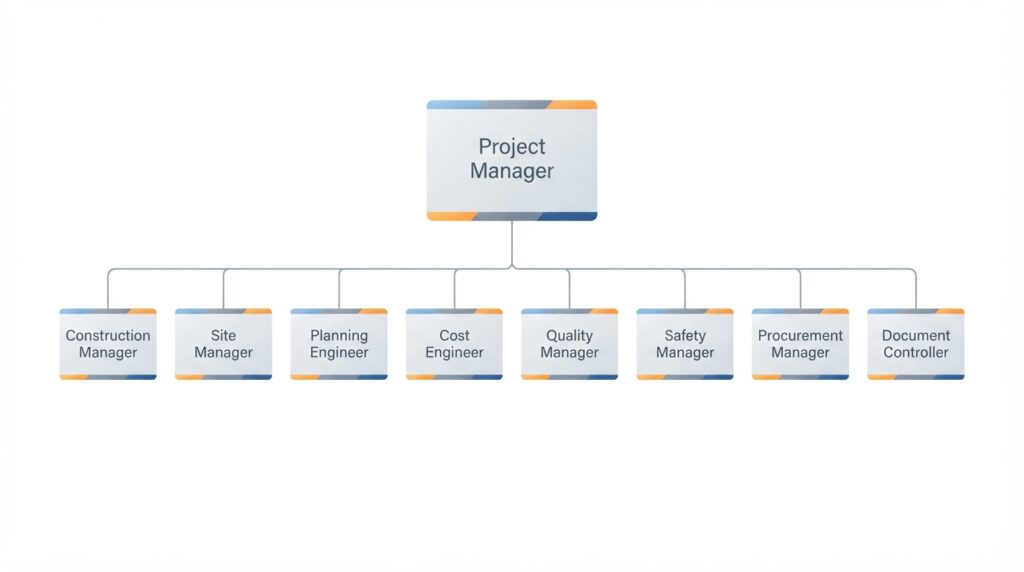
    Construction management organization structure for industrial plants

    A clear organization is essential for construction management.

    Key roles:

    Role Responsibility
    Project Manager Overall responsibility for the project
    Construction Manager Construction planning, coordination, and control
    Site Manager Day-to-day management of the site
    Planning Engineer Schedule development and progress tracking
    Cost Engineer Budget tracking and cost control
    Quality Manager Quality control and inspection
    Safety Manager Safety oversight and compliance
    Procurement Manager Materials and equipment
    Document Controller Document management

    For small plants, roles may be combined, but the functions must be covered. Clear lines of authority and reporting should be established before mobilization, so that everyone on site knows who makes decisions.

    Temporary Facilities

    Construction sites require temporary facilities. Temporary facilities—site offices, warehouses, rest areas, first aid stations, and utilities—must be planned and provided. These facilities support the construction workforce and are demobilized during closeout.

    Other temporary facilities to plan for include:

    • Laydown and fabrication yards.
    • Temporary power, water, and sanitation.
    • Site access roads, gates, and security.
    • Waste collection and storage.
    • Parking, worker transport, and, for remote sites, accommodation.

    These facilities should be located so that they do not interfere with permanent works, and their cost and schedule impact should be included in the construction plan.

    Contractor Management

    Construction is typically performed by contractors. Managing them effectively is critical.

    Contractor management activities:

    • Pre-qualification: Assessing contractor capability, safety record, and financial strength.
    • Contracting: Defining scope, schedule, quality, and safety requirements.
    • Mobilization: Ensuring contractors are ready to start work, with qualified personnel, equipment, and approved procedures.
    • Supervision: Monitoring contractor performance.
    • Coordination: Managing interfaces between contractors.
    • Performance evaluation: Assessing contractor performance against requirements.

    Good contractor management requires clear expectations, consistent enforcement, and open communication. Contractors should also be required to submit method statements for critical or high-risk activities, such as heavy lifts, so that the approach is reviewed before work begins.

    Interface Management

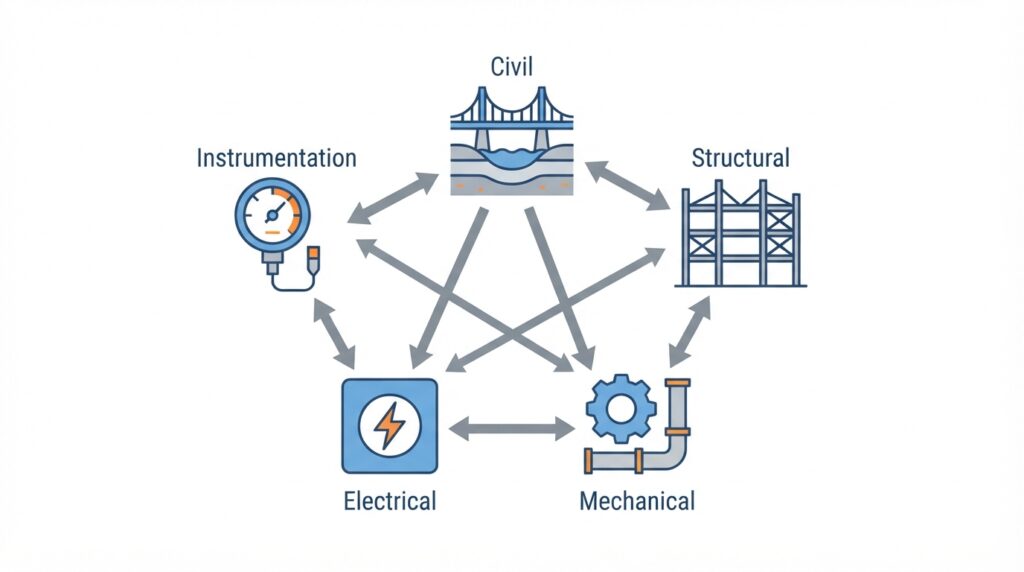
    Construction interface management between disciplines

    Construction involves many interfaces—between disciplines, contractors, and systems.

    Common interfaces:

    • Between civil and structural works.
    • Between structural and mechanical works.
    • Between mechanical and electrical works.
    • Between electrical and instrumentation works.
    • Between contractors working in the same area.
    • Between construction and commissioning.
    • Between new construction and existing operating facilities, where applicable.

    Interface management ensures that work is coordinated and conflicts are resolved. Practical tools include an interface register, regular coordination meetings, and area-based work planning.

    Schedule Management

    Schedule management ensures that construction is completed on time.

    Schedule management activities:

    • Baseline schedule: The approved schedule for the project.
    • Progress tracking: Measuring actual progress against the baseline, using agreed progress measurement rules (for example, weighted quantities installed rather than subjective estimates).
    • Critical path analysis: Identifying activities that determine the project duration.
    • Schedule updates: Updating the schedule as work progresses.
    • Look-ahead planning: Short-term (for example, three-week) schedules that translate the baseline into detailed work plans.
    • Delay analysis: Identifying causes of delay and corrective actions.
    • Recovery planning: Developing plans to recover schedule slippage.

    Schedule management requires accurate progress data and timely decision-making.

    Cost Management

    Cost management ensures that construction is completed within budget.

    Cost management activities:

    • Budget development: The approved budget for construction.
    • Commitment tracking: Tracking contracts and purchase orders.
    • Cost tracking: Tracking actual costs against budget.
    • Forecasting: Predicting final costs based on current trends.
    • Change management: Managing scope changes and their cost impact.
    • Contingency management: Managing contingency for unknowns.

    Cost management requires accurate cost data and disciplined change control. Cost and schedule performance are best evaluated together—for example, by comparing the value of work completed with both planned progress and actual spending—so that problems are visible early.

    Quality Management

    Quality management ensures that construction meets specifications.

    Quality management activities:

    • Quality plan: Defining quality requirements and responsibilities.
    • Inspection and test plans: Defining which activities are inspected, by whom, and at which hold or witness points.
    • Inspection and testing: Verifying that work meets specifications.
    • Documentation: Recording inspections and test results.
    • Non-conformance management: Identifying and resolving quality issues.
    • Final acceptance: Confirming that work meets requirements.

    Quality issues discovered during construction are cheaper to fix than those discovered during commissioning or operation. Inspecting work as it is completed, rather than at the end, prevents defects from being buried by later work.

    Safety Management

    Safety is the highest priority in construction.

    Safety management activities:

    • Hazard identification: Identifying construction hazards.
    • Risk assessment: Assessing and prioritizing risks.
    • Safety procedures: Permit-to-work, lockout/tagout, confined space, hot work, work at height, excavation, and lifting operations.
    • Training: Ensuring workers are trained for their tasks and receive a site induction.
    • PPE: Providing and enforcing use of protective equipment.
    • Inspections: Regular site inspections to identify hazards.
    • Incident reporting: Reporting and investigating incidents and near-misses.
    • Emergency response: Planning for emergencies.

    Safety must be integrated into every construction activity, not added as an afterthought.

    Permit-to-Work Systems

    Permit-to-work is a key safety control during construction. A permit-to-work system controls high-risk activities such as hot work, confined space entry, and work at height. Permits define the precautions required and must be issued by authorized personnel before work begins.

    An effective permit-to-work system also:

    • Specifies the location, scope, duration, and the people covered by each permit.
    • Requires the area to be checked and isolated as needed before work starts.
    • Coordinates simultaneous operations, so that one activity does not endanger another.
    • Requires permits to be closed out when work is complete or suspended.

    Environmental Management

    Construction can affect the environment through dust, noise, spills, waste, and runoff. An environmental plan should address permit conditions, waste management, spill prevention, and erosion and sediment control. Environmental requirements should be communicated to contractors and monitored like any other contract requirement.

    Materials and Equipment Management

    Construction requires timely delivery of materials and equipment.

    Materials management activities:

    • Procurement: Ordering materials and equipment.
    • Expediting: Monitoring supplier progress.
    • Inspection: Verifying materials meet specifications.
    • Logistics: Managing shipping, customs, and delivery.
    • Receiving: Inspecting and accepting deliveries.
    • Storage: Storing and preserving materials.
    • Issue: Delivering materials to the work site.

    Materials management ensures that materials are available when needed and in good condition. Rotating equipment, electrical gear, and instruments often require special preservation (for example, climate-controlled storage or periodic rotation), and failing to maintain it can invalidate warranties.

    Construction Documentation

    Construction generates vast amounts of documentation.

    Key documents:

    • Drawings: As-built drawings reflecting actual construction.
    • Specifications: Technical requirements.
    • Inspection records: Results of inspections and tests.
    • Test records: Results of system tests.
    • Non-conformance reports: Records of quality issues.
    • Change orders: Documentation of scope changes.
    • Progress reports: Records of progress and issues.
    • Safety records: Incident reports and safety inspections.
    • Vendor documents: Manuals, certificates, and warranty information.

    Documentation must be complete and accurate for handover to commissioning and operations. It is far easier to collect records as the work is completed than to reconstruct them afterward.

    Communication and Reporting

    Regular communication keeps everyone aligned. Typical practices include daily toolbox or coordination meetings, weekly progress meetings with contractors, and monthly reports to the owner covering progress, cost, quality, safety statistics, risks, and upcoming milestones. Decisions and actions should be recorded and followed up.

    Managing Changes During Construction

    Changes during construction are common. Managing them is critical.

    Change management activities:

    • Change identification: Recognizing when a change is required.
    • Change assessment: Evaluating the impact on scope, schedule, cost, quality, and safety.
    • Change approval: Approving or rejecting the change.
    • Change implementation: Implementing the change.
    • Documentation: Recording the change and its impact, including updates to drawings.

    Uncontrolled changes lead to scope creep, schedule delays, and cost overruns.

    Construction Closeout

    Closeout is the phase where construction is completed and handed over to commissioning.

    Closeout activities:

    • Punch list: Outstanding items to be completed, typically categorized by whether they must be finished before commissioning or can be completed afterward.
    • Inspection: Verification that work meets requirements.
    • Mechanical completion: Confirmation that systems are built, inspected, and ready for pre-commissioning and commissioning.
    • Documentation: Completion of as-built drawings and records.
    • Handover: Formal transfer to commissioning, typically system by system.
    • Demobilization: Removal of contractors, equipment, and temporary facilities.
    • Housekeeping: Cleaning the site.

    Closeout should be planned as part of construction, not left to the end. Handing over completed systems progressively allows commissioning to start earlier and reduces the end-of-project crunch.

    Lessons Learned

    Lessons learned during construction should be captured and applied. Regular reviews and a lessons-learned database help ensure that problems are not repeated on future projects.

    Lessons should be captured throughout the project, not only at the end—for example, at milestone reviews and after significant incidents or non-conformances—and shared with the people who will plan the next project.

    Common Mistakes in Construction Management

    Even experienced organizations make mistakes. Common ones include:

    • Inadequate pre-construction planning: Starting construction before planning is complete.
    • Poor constructability review: Missing design issues that cause problems during construction.
    • Unclear scope: Leading to disputes and changes.
    • Poor contractor selection: Choosing on price alone.
    • Inadequate interface management: Conflicts between disciplines and contractors.
    • Poor sequencing: Work performed in an order that causes rework or blocks access.
    • Poor schedule management: Delays not identified or addressed.
    • Weak cost control: Cost overruns not detected until too late.
    • Quality issues: Rework and premature failures.
    • Safety shortcuts: Leading to incidents.
    • Incomplete documentation: Problems during handover.
    • Failing to capture lessons: Repeating the same mistakes on later projects.

    These mistakes are costly to correct. They are much cheaper to avoid through good planning and disciplined execution.

    How Japanese EPC Firms Approach Construction Management

    Japanese engineering firms are known for their disciplined approach to construction management. Common characteristics include:

    • Thorough planning: Construction is planned carefully, with detailed schedules and work packages.
    • Disciplined execution: Work is performed as planned, with tight control.
    • Safety focus: Safety is prioritized throughout, with daily toolbox meetings and hazard prediction activities.
    • Quality control: Work is inspected as it is completed.
    • Detailed documentation: Records are complete and accurate.
    • Interface management: Interfaces between disciplines and contractors are carefully managed.
    • Continuous improvement: Lessons are captured and applied.
    • Long-term focus: Construction is treated as the foundation for reliable operation.

    For plant owners, this often means construction that is completed safely, on schedule, within budget, and to the required quality.

    How to Evaluate Construction Management Readiness

    When reviewing construction management, ask:

    Question Why It Matters
    Is pre-construction planning complete? Sets the foundation for success
    Has a constructability review been performed? Identifies issues before construction
    Is the scope clearly defined? Prevents disputes and changes
    Are contractors pre-qualified? Ensures capable contractors
    Is the construction sequence defined? Minimizes rework and access conflicts
    Is the schedule realistic? Ensures work can be completed
    Is the budget adequate? Ensures funding is available
    Are temporary facilities planned? Supports the workforce and logistics
    Is there a quality plan? Ensures work meets specifications
    Is there a safety plan and permit-to-work system? Protects workers
    Are interfaces managed? Prevents conflicts
    Is documentation complete? Supports handover and operations
    Is there a process for capturing lessons learned? Improves future projects

    A plant that addresses these questions is ready for successful construction.

    Conclusion

    Construction management is the discipline of delivering the plant safely, on schedule, within budget, and to the required quality. For small to medium-scale industrial plants, it is especially important because there is less margin for error.

    By focusing on pre-construction planning, constructability review, sequencing, contractor management, interface management, schedule, cost, quality, and safety, owners and construction managers can ensure that construction is completed successfully and the plant is ready for commissioning and operation.

    Key Takeaways

    • Construction management delivers the plant safely, on schedule, within budget, and to quality.
    • Pre-construction planning sets the foundation for success.
    • Constructability reviews identify issues before construction begins.
    • Good sequencing minimizes rework and avoids blocking access.
    • Contractor, interface, schedule, cost, quality, and safety management are all essential.
    • Permit-to-work systems control high-risk activities.
    • Materials management ensures materials are available when needed.
    • Documentation must be complete and accurate for handover.
    • Change management prevents scope creep and cost overruns.
    • Closeout should be planned as part of construction.
    • Lessons learned should be captured and applied to future projects.
    • Japanese EPC firms emphasize thorough planning and disciplined execution.