
Performance testing is the moment of truth in an EPC project. After months or years of design, construction, and commissioning, the plant is run at full load and measured against the guarantees in the contract. If it meets the guarantees, the contractor has delivered what was promised. If it falls short, the consequences (liquidated damages, corrections, or disputes) can be significant.
For plant owners, performance testing is the final verification that the plant is worth what was paid for it. For contractors, it is the proof that their work meets the contractual requirements.
For small to medium-scale industrial plants, performance testing and acceptance are especially important because there is less margin for error and fewer resources to absorb the consequences of a failed test. A plant that fails its performance test can be delayed for weeks or months while corrections are made.
This article covers the key practices in performance testing and acceptance, from test planning to test execution and final acceptance.
What Is Performance Testing?
Performance testing is the process of measuring the plant’s actual performance against the guaranteed performance in the contract.
Performance tests typically verify:
- Output: Does the plant produce the guaranteed output?
- Efficiency: Does the plant meet the guaranteed heat rate or efficiency?
- Emissions: Do emissions meet guaranteed or regulatory limits?
- Consumption: Does the plant consume the guaranteed amounts of fuel, water, or chemicals?
- Availability and reliability: Does the plant demonstrate the required availability or reliability? (These are usually proven through a separate reliability run, not the short guarantee tests.)
Performance testing is usually the final step before acceptance.
Why Performance Testing Matters
Performance testing determines whether the plant meets its guarantees.
| Factor | Impact of Good Performance Testing | Impact of Poor Performance Testing |
|---|---|---|
| Acceptance | Plant accepted; final payment made | Acceptance delayed; disputes |
| Guarantees | Guarantees verified | Guarantees unverified or disputed |
| Liquidated damages | Damages calculated fairly | Damages disputed |
| Warranty | Warranty period starts | Warranty delayed |
| Owner confidence | Owner confident in plant | Owner uncertain |
| Contractor reputation | Contractor reputation enhanced | Contractor reputation damaged |
For small plants, where there is less margin for error, performance testing determines whether the project closes successfully.
Performance Guarantees
Performance guarantees are the contractual commitments that define what the plant must achieve.
| Guarantee | Description | Typical Unit |
|---|---|---|
| Net output | Electrical output delivered at the plant boundary | MW |
| Heat rate | Fuel input per unit of electrical output | kJ/kWh |
| Thermal efficiency | Ratio of output to fuel input | % |
| Emissions | NOx, SOx, particulate matter (stated at a reference O₂ level and on a dry or wet basis) | mg/Nm³ |
| Auxiliary power | Power consumed by the plant | % of gross output |
| Availability | Percentage of time the plant is operational | % |
| Reliability | Frequency of forced outages | — |
Guarantees should be clearly defined in the contract, including reference conditions and test procedures.
Relationship Between Performance Testing and Performance Guarantees
Performance testing is the mechanism by which performance guarantees are verified. The guarantees define what must be achieved; the testing defines how it is measured. Both must be clearly defined and agreed in the contract. A guarantee without a defined test method invites dispute, and a test method without a clear guarantee has nothing to measure against.
Minimum Guarantees and Full Guarantees
Many EPC contracts use two tiers of guarantees:
- Full (or target) guarantees: The values the contractor commits to achieve. Shortfalls against these are normally compensated through liquidated damages.
- Minimum (or threshold) guarantees: The lowest acceptable values. If the plant falls below these, the owner may reject the plant or require correction, regardless of liquidated damages.
Owners and contractors should be clear on which tier applies to each guarantee.
Reference Conditions
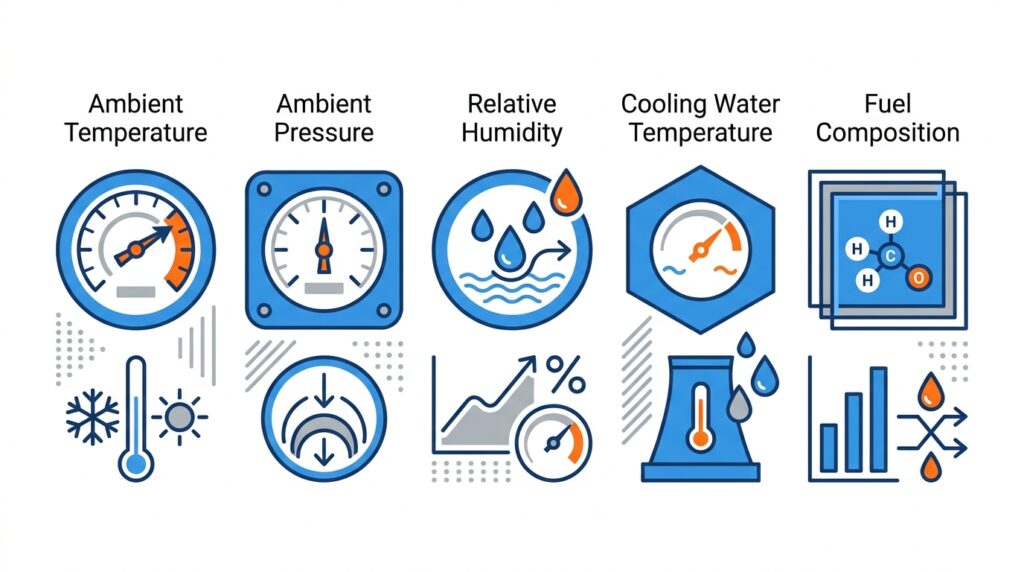
Performance depends on ambient conditions, fuel quality, and other factors. Reference conditions define the conditions under which guarantees apply.
Common reference conditions:
- Ambient temperature: Typically 15°C or 25°C.
- Ambient pressure: Sea level or site elevation.
- Relative humidity: Typically specified as a percentage.
- Cooling water temperature: Typically specified.
- Fuel composition: Heating value and composition.
- Emissions basis: Reference oxygen content and dry or wet basis.
Test results are corrected to reference conditions using correction curves specified in the contract.
Test Sequence
Performance testing is normally carried out in stages rather than as a single event:
- Preliminary (pre-performance) tests: Run before the formal test to check instruments, plant stability, and likely performance. They allow problems to be fixed before the guarantee test, and may be used to tune the plant.
- Reliability run: A continuous operating period, often several days, to demonstrate stable operation and reliability.
- Guarantee (acceptance) tests: Formal tests for output, efficiency, emissions, and consumption, conducted and witnessed under the agreed procedures.
- Reporting and review: Results are corrected, analyzed, and agreed.
The contract should state what is required at each stage and whether preliminary test results can count toward acceptance.
Test Procedures
Test procedures define how performance testing will be conducted.
Test procedure elements:
- Scope: What is being tested?
- Reference conditions: What conditions apply?
- Measurement points: Where are measurements taken?
- Instrumentation: What instruments are used?
- Test duration: How long is each test?
- Stabilization: How long must the plant stabilize before testing?
- Data collection: How is data collected and recorded?
- Correction curves: How are results corrected to reference conditions?
- Acceptance criteria: What defines a successful test?
- Witnessing: Who witnesses the test?
Test procedures should be agreed before testing begins, ideally as part of the contract.
Test Standards
Performance testing should follow recognized standards.
| Standard | Application |
|---|---|
| ASME PTC 46 | Overall plant performance |
| ASME PTC 4 | Fired steam generators |
| ASME PTC 4.4 | Heat recovery steam generators |
| ASME PTC 6 | Steam turbines |
| ASME PTC 22 | Gas turbines |
| ASME PTC 19.1 | Test uncertainty |
| ISO 2314 | Gas turbines: acceptance tests |
| ISO 3977 | Gas turbine procurement |
Standards define measurement methods, instrumentation, and calculation procedures. The contract should state which standard and edition applies, and any agreed deviations from it.
Instrumentation and Measurement
Accurate measurement is essential for meaningful performance testing.
| Parameter | Measurement Method |
|---|---|
| Fuel flow | Flow meters, orifice plates, Coriolis meters |
| Fuel heating value | Gas chromatograph, calorimeter |
| Power output | Power meters, current and voltage transformers |
| Temperature | RTDs, thermocouples |
| Pressure | Pressure transmitters |
| Flow | Flow meters, orifice plates |
| Emissions | Continuous emission monitoring systems (CEMS) or stack testing |
Instruments should be calibrated before testing and traceable to national standards. Fuel sampling and analysis deserve particular care, because heating value errors flow directly into heat rate results.
Measurement Uncertainty
All measurements have uncertainty. The contract should define how uncertainty is treated: whether it is added to the guaranteed value, subtracted from the measured value, or treated separately. This affects whether a marginal result passes or fails.
Uncertainty is calculated using the method in the test standard (for example, ASME PTC 19.1). It is not the same as a contractual tolerance. Uncertainty reflects the quality of the measurement, while tolerance is a negotiated margin around the guarantee. Both can apply, and the contract should say how they combine.
Test Planning
Performance testing should be planned well in advance.
Test planning activities:
- Define test scope: What tests will be performed?
- Agree test procedures: What procedures will be used?
- Prepare instrumentation: Are instruments installed and calibrated?
- Schedule testing: When will tests be performed?
- Coordinate parties: Who will participate in testing?
- Prepare documentation: What documentation is required?
- Plan contingencies: What if testing is delayed or fails?
Test planning should begin during commissioning, if not earlier.
Test Execution
Performance testing is executed after the plant is stable and operating at the required conditions.
Test execution steps:
- Stabilize the plant: Operate at test conditions until stable.
- Verify conditions: Confirm that reference conditions are met.
- Start data collection: Begin recording data.
- Monitor throughout: Monitor conditions throughout the test.
- Complete the test: Run for the specified duration.
- Stop data collection: Stop recording data.
- Verify data quality: Check data for completeness and accuracy.
Test Witnessing and Third-Party Verification
Tests should be witnessed by representatives of both parties. For major tests, an independent third-party witness or verifier may be appointed to confirm that tests are conducted according to the agreed procedures and that results are accurately recorded. This reduces the risk of disputes.
Test Conditions
Tests must be conducted under conditions that satisfy the contract requirements.
Test condition considerations:
- Load: Tests are usually conducted at full load or specified load.
- Stability: Conditions must be stable for the specified period.
- Ambient conditions: Ambient conditions should be within the range specified in the contract.
- Fuel quality: Fuel should be within the specified range.
- Plant configuration: Plant should be in the specified configuration, with equipment such as cooling systems, auxiliaries, and any steam or power exports set as the contract requires.
- No abnormalities: No abnormal conditions should affect the test.
If conditions are not met, the test may be invalidated or rescheduled.
Data Collection and Analysis
Data collected during testing must be accurate and complete.
Data collection considerations:
- Data frequency: How often is data recorded?
- Data storage: Where is data stored?
- Data verification: How is data verified?
- Data correction: How is data corrected to reference conditions?
- Data analysis: How is data analyzed?
Data should be analyzed by qualified personnel using agreed methods.
Correction to Reference Conditions
Test results are corrected to reference conditions using correction curves.
| Factor | Effect on Performance |
|---|---|
| Ambient temperature | Higher temperature reduces output and increases heat rate |
| Ambient pressure | Lower pressure reduces output |
| Relative humidity | Affects combustion and output |
| Cooling water temperature | Higher temperature reduces output and efficiency |
| Fuel heating value | Affects fuel consumption and output |
Correction curves are typically provided by the equipment manufacturer and specified in the contract. If the plant is tested before it is fully “clean” or after some operating hours, the contract should also state whether any degradation or ageing allowance applies.
Test Results and Acceptance
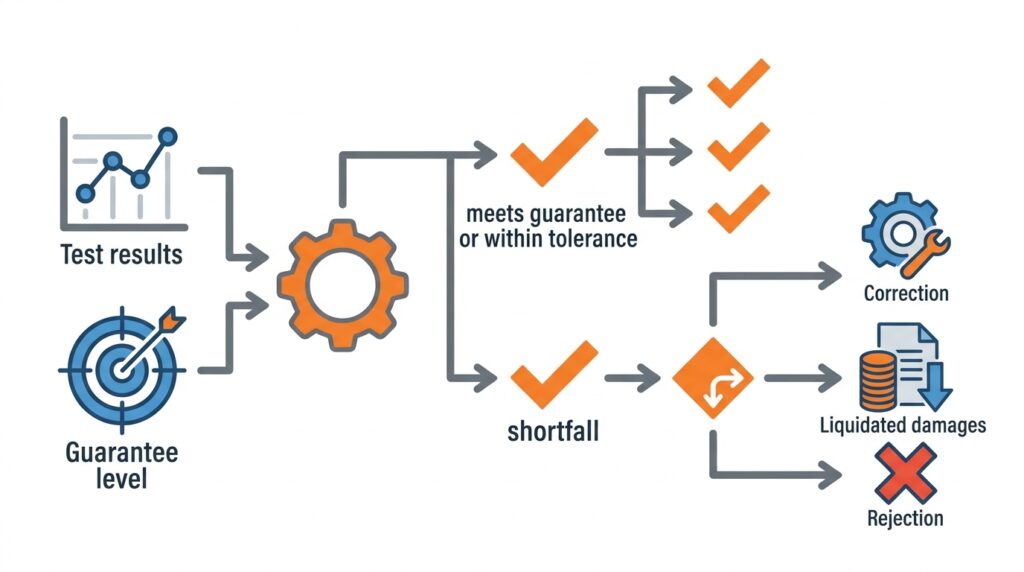
Test results are compared to the guarantees to determine acceptance.
Acceptance criteria:
- Meets guarantee: If results meet the guarantee, the test passes.
- Within tolerance: If results are within the agreed tolerance or uncertainty treatment, the test may pass.
- Shortfall: If results fall short of the guarantee, remedies may apply.
Shortfalls may result in:
- Correction: The contractor may correct the shortfall.
- Liquidated damages: The contractor may pay damages.
- Rejection: In extreme cases, such as a miss against the minimum guarantee, the owner may reject the plant.
Test Report
The test results should be documented in a formal report, typically including the test procedure followed, instrument calibration records, raw and corrected data, uncertainty analysis, comparison to guarantees, and any deviations from the agreed procedure. Both parties should review and sign off the report. It becomes a key document for acceptance and for any later dispute.
Failed Tests and Root Cause
When a performance test fails, root cause analysis should determine whether the shortfall is due to design, construction, commissioning, or operating conditions. This determines whether correction, retest, or a commercial settlement is appropriate.
Liquidated Damages
Liquidated damages are pre-agreed compensation for performance shortfalls.
| Factor | Description |
|---|---|
| Guaranteed value | The contractual guarantee |
| Actual value | The measured performance |
| Shortfall | The difference |
| Damage rate | Pre-agreed rate per unit of shortfall |
| Cap | Maximum liquidated damages |
Liquidated damages should reflect the actual loss to the owner, not be punitive. Contracts often pay for shortfalls in output and heat rate separately, so the damage rate for each should be tied to the owner’s real economics, such as lost revenue or extra fuel cost over the plant’s life.
Retesting
If a test fails, the contractor may be entitled to retest.
Retest considerations:
- Correction: The contractor corrects the shortfall before retesting.
- Time limit: Retesting must occur within a specified time.
- Number of retests: The contract may limit the number of retests.
- Cost: Who bears the cost of retesting?
Retesting should be planned as part of the performance testing process.
Final Acceptance
Final acceptance is the formal confirmation that the plant meets requirements.
Final acceptance activities:
- Review test results: Confirm that results meet guarantees.
- Resolve shortfalls: Address any shortfalls.
- Complete documentation: Confirm documentation is complete.
- Sign acceptance certificate: Formal acceptance of the plant.
Final acceptance triggers payment and warranty.
Common Mistakes in Performance Testing
Even experienced organizations make mistakes. Common ones include:
- No test procedures: Testing without agreed procedures.
- Inadequate instrumentation: Instruments not installed or calibrated.
- Poor test planning: Testing not planned in advance.
- Invalid conditions: Testing under conditions that do not meet requirements.
- Inadequate data collection: Data incomplete or inaccurate.
- Poor data analysis: Data analyzed incorrectly.
- No witnessing: Tests not witnessed by both parties.
- Undefined uncertainty treatment: Marginal results disputed because the contract is silent on uncertainty.
- Disputes over results: Disagreements on test validity or results.
- No contingency: No plan for what to do if testing fails.
These mistakes are costly to correct. They are much cheaper to avoid through good planning and disciplined execution.
How Japanese EPC Firms Approach Performance Testing
Japanese engineering firms are known for their disciplined approach to performance testing. Common characteristics include:
- Thorough planning: Testing is planned carefully, with agreed procedures.
- Detailed preparation: Instruments are installed and calibrated before testing, and preliminary tests are used to find problems early.
- Disciplined execution: Tests are conducted under controlled conditions.
- Comprehensive documentation: Results are documented completely and accurately.
- Careful analysis: Data is analyzed carefully using agreed methods.
- Continuous improvement: Lessons are captured and applied.
For plant owners, this often means performance testing that is fair, accurate, and conclusive.
How to Evaluate Performance Testing Readiness
When reviewing performance testing readiness, ask:
| Question | Why It Matters |
|---|---|
| Are performance guarantees defined (full and minimum)? | Defines what the plant must achieve |
| Are reference conditions specified? | Defines the conditions under which guarantees apply |
| Are test procedures agreed? | Defines how testing will be conducted |
| Are standards specified? | Ensures testing follows recognized methods |
| Is instrumentation installed and calibrated? | Ensures accurate measurement |
| Is the treatment of measurement uncertainty defined? | Decides whether marginal results pass or fail |
| Is test planning complete, including preliminary tests? | Ensures testing is well-organized |
| Are both parties prepared, and is a third-party witness needed? | Ensures testing is witnessed and agreed |
| Is data collection and analysis planned? | Ensures results are reliable |
| Are retest procedures and root cause process defined? | Provides for contingencies |
| Is final acceptance planned? | Ensures formal confirmation |
A plant that addresses these questions is ready for performance testing.
Conclusion
Performance testing and acceptance are the final verification that the plant meets its guarantees. For small to medium-scale industrial plants, they determine whether the project closes successfully.
By focusing on performance guarantees, reference conditions, test procedures, standards, instrumentation, measurement uncertainty, test planning, execution, data analysis, and acceptance, owners and contractors can ensure that performance testing is fair, accurate, and conclusive.
Key Takeaways
- Performance testing verifies that the plant meets its contractual guarantees
- Performance guarantees define output, efficiency, emissions, and other metrics
- Testing is the mechanism for verifying guarantees; both must be clearly defined in the contract
- Reference conditions define the conditions under which guarantees apply
- Test procedures and standards define how testing is conducted
- Accurate, calibrated instrumentation is essential for meaningful results
- The contract should define how measurement uncertainty is treated
- Test results are corrected to reference conditions using correction curves
- Acceptance depends on whether results meet guarantees, fall within tolerance, or fall short
- Independent third-party witnesses can reduce the risk of disputes
- Failed tests need root cause analysis to decide between correction, retest, or settlement
- Liquidated damages compensate the owner for shortfalls
- Retesting may be permitted if a test fails
- Japanese EPC firms emphasize thorough planning and careful data analysis