
Commissioning is the bridge between construction and operation. It is the process of verifying that every system in the plant works as designed, that safety systems function correctly, and that the plant can operate reliably at its specified performance. A successful commissioning phase means the plant starts up smoothly, meets its performance guarantees, and is ready for handover to the owner’s operations team.
For small to medium-scale industrial plants, commissioning is especially critical because there is less redundancy and fewer resources to manage unexpected problems. A poorly executed commissioning phase leads to delays, cost overruns, and operational problems that persist long after startup.
This article covers the key steps and considerations in plant commissioning, from pre-commissioning checks to performance testing and handover.
What Is Commissioning?
Commissioning is the systematic process of testing and verifying that plant systems and equipment function according to design intent and contract requirements. It includes:
- Pre-commissioning: Static checks, cleaning, and preparation before energization or startup.
- Commissioning: Functional testing of individual systems and equipment.
- Integrated testing: Testing of interconnected systems under operating conditions.
- Performance testing: Verifying that the plant meets its contractual performance guarantees.
- Handover: Transferring the plant to the owner’s operations team.
Commissioning is not just a technical exercise. It is also a contractual milestone, often tied to payment and acceptance.
Why Commissioning Matters
Commissioning determines whether the plant:
- Operates safely: Safety systems are tested and verified.
- Meets design performance: Output, efficiency, and emissions are confirmed.
- Is reliable: Equipment and systems function as intended.
- Is ready for operation: The owner’s team is trained and documentation is complete.
- Meets contractual requirements: Performance guarantees are verified.
A successful commissioning phase reduces the risk of operational problems after handover. A poor one creates problems that may take months or years to resolve.
The Commissioning Process
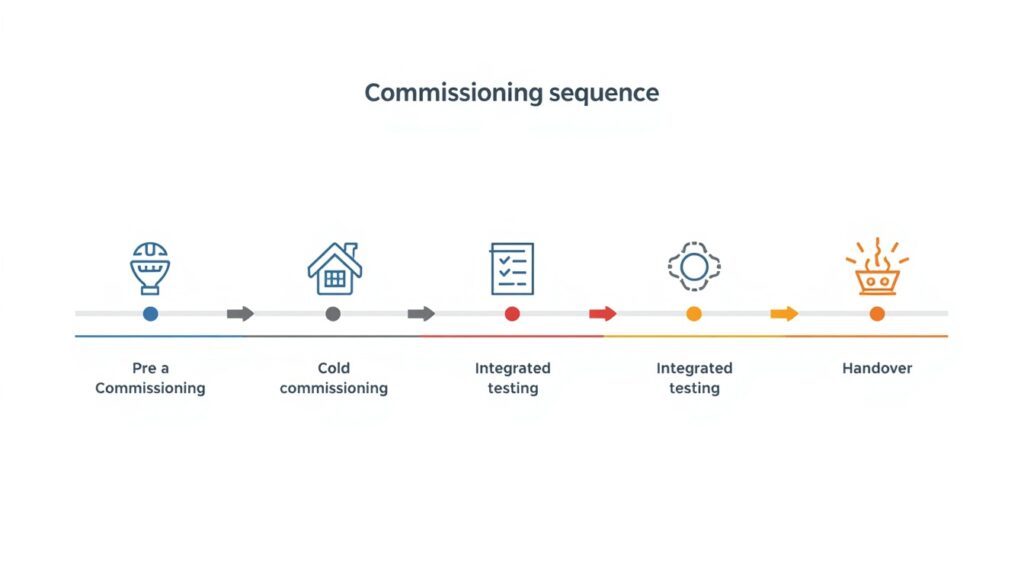
Commissioning typically follows a structured sequence, though the exact steps depend on the plant type and contract.
| Phase | Activities |
|---|---|
| Pre-commissioning | Static checks, cleaning, flushing, pressure testing, instrument calibration |
| Cold commissioning | Testing without process fluids or at ambient conditions |
| Hot commissioning | Testing with process fluids at operating conditions |
| Integrated testing | Testing interconnected systems under load |
| Performance testing | Verifying contractual performance guarantees |
| Handover | Documentation, training, and formal acceptance |
Each phase builds on the previous one. Skipping or rushing a phase creates problems that surface later.
In larger projects, systems are turned over from construction to commissioning in stages, system by system, rather than all at once. This allows commissioning to begin on completed systems — such as a fuel gas system or a cooling water system — while construction continues elsewhere on the site. Staged turnover requires a clear handoff process: each system is inspected, documented, and formally accepted by the commissioning team before work on it begins, so that responsibility and accountability for that system are never ambiguous.
Pre-Commissioning
Pre-commissioning is the preparation phase. It includes:
Static checks:
- Verifying that equipment is installed correctly.
- Checking that instruments are installed and connected.
- Verifying that electrical connections are correct.
- Checking that valves are in the correct position.
Cleaning and flushing:
- Removing debris, scale, and contaminants from piping and equipment.
- Flushing oil systems, water systems, and process lines.
- Cleaning tanks and vessels.
Pressure testing:
- Hydrostatic or pneumatic testing of piping and vessels.
- Verifying that systems can withstand design pressure without leaking.
Instrument calibration:
- Calibrating instruments to ensure accurate measurement.
- Verifying signal transmission and control system response.
Safety system checks:
- Verifying that safety interlocks and shutdown systems function correctly.
- Testing alarms and trips.
Pre-commissioning is often the most time-consuming phase. Rushing it leads to problems during commissioning.
Equipment that is installed but not yet commissioned must be preserved according to vendor requirements during this period. This includes protection from moisture, corrosion, and mechanical damage — for example, maintaining nitrogen purges on idle piping, running space heaters in motors and switchgear, and keeping rotating equipment on periodic turning or lubrication cycles. Preservation gaps are easy to overlook on a busy site, but they can cause damage that only shows up once a system is finally started, well after the responsible party has moved on to other work.
Cold Commissioning
Cold commissioning tests systems without process fluids or at ambient conditions. It includes:
- Motor rotation checks: Verifying that motors rotate in the correct direction.
- Pump and fan testing: Verifying that equipment operates without load.
- Control loop testing: Verifying that control loops respond correctly.
- Valve operation: Verifying that valves open, close, and modulate correctly.
- Interlock testing: Verifying that safety interlocks function correctly.
Cold commissioning verifies that systems work mechanically and electrically before introducing process fluids.
Hot Commissioning
Hot commissioning tests systems with process fluids at operating conditions. It includes:
- System startup: Starting up individual systems and verifying operation.
- Process parameter verification: Confirming that temperature, pressure, flow, and other parameters meet design values.
- Control loop tuning: Tuning controllers for stable, responsive control.
- Equipment performance: Verifying that equipment operates within design parameters.
- Emissions testing: Initial checks that emissions are within expected ranges under real operating conditions.
Hot commissioning is where many problems surface. It requires close coordination between the contractor, owner, and equipment vendors.
Integrated Testing
Integrated testing verifies that interconnected systems work together under operating conditions. It includes:
- Full plant operation: Operating the plant as a whole, not just individual systems.
- Load testing: Operating at various loads to verify performance across the operating range.
- Transient testing: Testing response to load changes, trips, and other disturbances.
- Safety system verification: Verifying that safety systems function correctly under realistic conditions.
Integrated testing is where the plant is proven as a complete system, not just a collection of components.
Performance Testing

Performance testing verifies that the plant meets its contractual performance guarantees. It includes:
- Output testing: Verifying that the plant produces the guaranteed output.
- Heat rate testing: Verifying that the plant meets its guaranteed efficiency.
- Emissions testing: Verifying that emissions meet guaranteed or regulatory limits, under the formal test conditions specified in the contract.
- Availability and reliability: Some contracts require demonstration of availability or reliability over a defined period.
Performance testing must follow the procedures specified in the contract, including reference conditions, test methods, and measurement uncertainty.
Handover
Handover is the formal transfer of the plant from the contractor to the owner. It includes:
- Documentation: As-built drawings, equipment manuals, operating procedures, and maintenance schedules.
- Training: Training the owner’s operations and maintenance team.
- Spare parts: Delivering spare parts and consumables.
- Warranty documentation: Confirming warranty terms and procedures.
- Formal acceptance: Signing off that the plant meets contractual requirements.
Incomplete handover documentation is a common source of problems during the first years of operation.
Operator training often begins during commissioning, not just at handover. Operators who participate in commissioning — observing cold and hot commissioning, and ideally assisting with integrated testing — gain valuable familiarity with the plant’s actual behavior before they take over operation. This hands-on exposure is generally far more effective than classroom training alone, since it lets operators see how the plant actually responds rather than only how it is supposed to respond on paper.
A punch list is a record of outstanding items that must be completed before handover. Items are typically categorized by priority, with safety-critical items addressed first, followed by performance-affecting items, and finally minor or cosmetic items. The punch list is developed collaboratively by the contractor, owner, and commissioning team throughout the commissioning process, not just compiled at the end, and it is cleared — or formally accepted with an agreed completion plan for any remaining items — before formal acceptance.
Key Considerations for Successful Commissioning
1. Planning
Commissioning must be planned from the earliest stages of the project. The commissioning plan defines sequence, responsibilities, resources, and milestones.
2. Roles and Responsibilities
Clear roles and responsibilities are essential. The contractor, owner, equipment vendors, and commissioning specialists must all know what they are responsible for.
A commissioning manager is typically appointed to lead the commissioning effort. This person coordinates between the contractor, owner, vendors, and commissioning specialists, and is responsible for the commissioning plan, schedule, and documentation. On smaller projects this role may be combined with other project responsibilities, but the function itself — a single point of accountability for commissioning progress and decisions — should not be skipped, since fragmented ownership of commissioning is a common cause of delay.
3. Safety
Commissioning involves energizing equipment, introducing process fluids, and operating at high temperatures and pressures. Safety procedures must be in place and followed.
4. Documentation
Commissioning records must be complete and accurate. These records support performance testing, handover, and future maintenance.
5. Coordination
Commissioning requires coordination between multiple parties. Regular meetings and clear communication help avoid delays and misunderstandings.
6. Contingency Planning
Problems arise during commissioning. Contingency plans help address them without derailing the schedule.
Common Problems During Commissioning
Even well-planned commissioning encounters problems. Common ones include:
- Incomplete pre-commissioning: Leading to problems during hot commissioning.
- Instrument calibration errors: Causing inaccurate readings and poor control.
- Control loop tuning problems: Causing instability or poor response.
- Equipment failures: Leading to delays and rework.
- Safety system issues: Requiring redesign or modification.
- Documentation gaps: Making handover difficult.
- Schedule pressure: Leading to rushed testing and missed problems.
These problems are costly to resolve after startup. They are much cheaper to avoid through careful planning and execution.
How Japanese EPC Firms Approach Commissioning
Japanese engineering firms are known for their disciplined approach to commissioning. Common characteristics include:
- Thorough pre-commissioning: Static checks, cleaning, and calibration are completed carefully before startup.
- Detailed planning: Commissioning sequences, responsibilities, and contingencies are planned in advance.
- Comprehensive documentation: Commissioning records, test results, and as-built documentation are carefully maintained.
- Integrated teams: Contractor, owner, and vendor personnel work closely together.
- Long-term focus: Commissioning is treated as the foundation for reliable long-term operation, not just a milestone to pass.
For plant owners, this often means a smoother startup, fewer surprises, and a plant that is ready for reliable operation from day one.
How to Evaluate Commissioning Planning
When reviewing commissioning planning, ask:
| Question | Why It Matters |
|---|---|
| Is there a detailed commissioning plan? | Defines sequence, responsibilities, and milestones |
| Are roles and responsibilities clear? | Avoids confusion and delays |
| Is pre-commissioning thorough? | Prevents problems during hot commissioning |
| Are safety procedures in place? | Protects personnel and equipment |
| Is documentation complete? | Supports performance testing and handover |
| Are contingencies planned? | Helps address problems without derailing schedule |
| Is the owner involved early? | Ensures smooth handover and operation |
A commissioning plan that addresses these questions is likely to deliver a successful startup.
Key Takeaways
- Commissioning verifies that systems work as designed before handover.
- The process includes pre-commissioning, cold, hot, integrated, and performance testing.
- Pre-commissioning is often the most time-consuming phase, and equipment awaiting commissioning must be properly preserved.
- In larger projects, systems are turned over from construction to commissioning in stages.
- A commissioning manager provides a single point of accountability for the commissioning effort.
- Operator training often begins during commissioning, not just at handover.
- Punch lists track outstanding items by priority and are cleared before formal acceptance.
- Performance testing verifies contractual guarantees.
- Handover includes documentation, training, and formal acceptance.
- Japanese EPC firms emphasize thorough pre-commissioning and detailed planning.
Conclusion
Commissioning is the bridge between construction and operation. It determines whether the plant starts up smoothly, meets its performance guarantees, and is ready for reliable operation. For small to medium-scale industrial plants, commissioning deserves careful planning and execution from the earliest stages of the project.
By focusing on pre-commissioning, phased testing, documentation, and coordination, owners and contractors can ensure a successful startup and a smooth transition to operation.