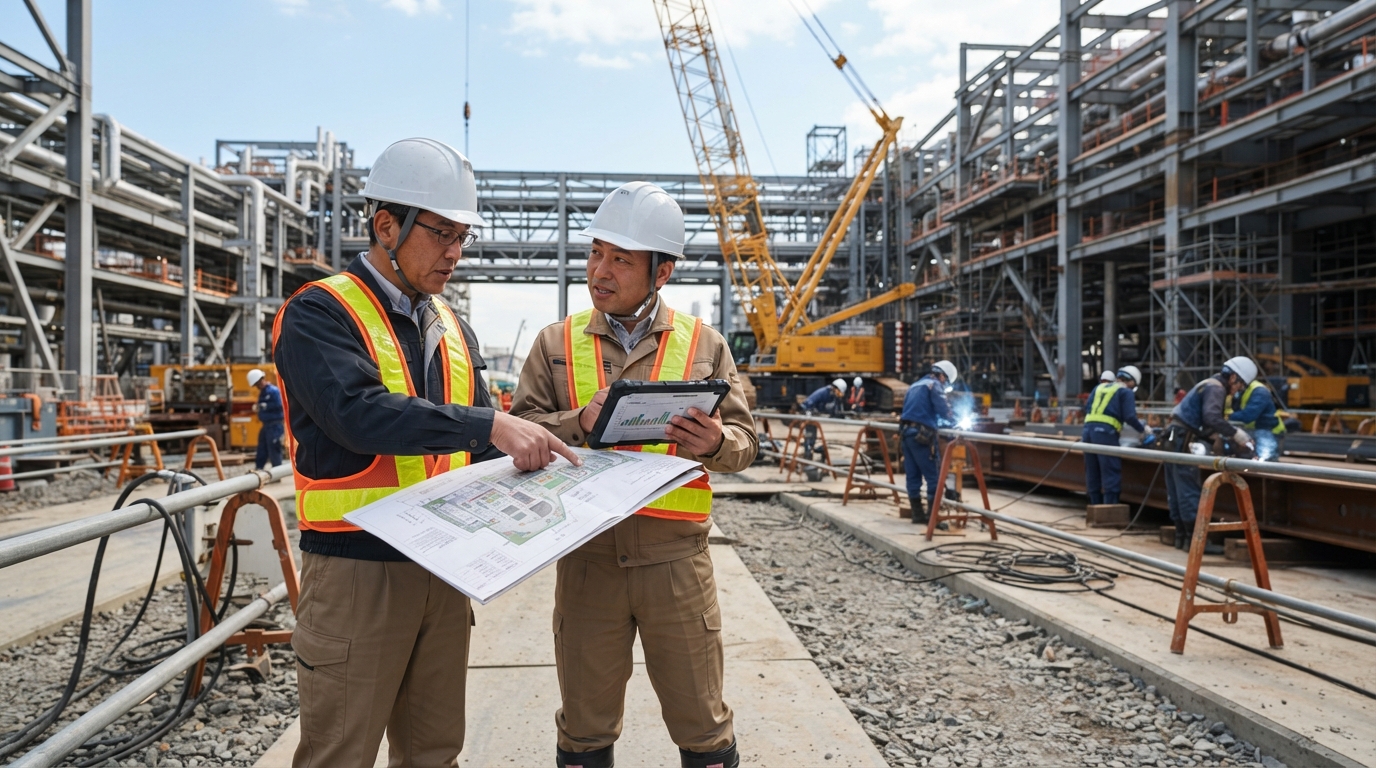
A construction site is a complex, dynamic environment. Hundreds of workers, heavy equipment, materials, and multiple contractors occupy the same space, often in remote locations with limited infrastructure. Site management is the discipline of organizing, coordinating, and controlling everything that happens on site, ensuring that work proceeds safely, efficiently, and in accordance with the project plan.
At EPC Partners Inc., site management has been a core part of our work across a wide range of plant projects: geothermal power plants in Kenya, Indonesia, and Iceland; large-scale desalination facilities in the UAE and Saudi Arabia; thermal power plants in Vietnam and Bangladesh; and water treatment plants in Vietnam and Kuwait. Each project has presented different site management challenges, and each has reinforced the same lesson: good site management is not just about giving instructions. It is about creating the conditions for work to proceed safely and efficiently, and resolving problems before they escalate.
This article covers the key practices in plant site management, drawing on our experience supporting projects across Asia, the Middle East, Africa, and Europe.
What Is Site Management?
Site management is the discipline of organizing, coordinating, and controlling activities on a construction site. It includes:
- Site organization: Setting up the site, including offices, laydown areas, and access.
- Safety management: Ensuring that work is performed safely.
- Quality management: Ensuring that work meets specifications.
- Progress management: Tracking and controlling progress.
- Coordination: Coordinating disciplines, contractors, and activities.
- Resource management: Managing labor, equipment, and materials.
- Environmental management: Controlling the impact of construction on air, water, soil, noise, and ecology.
- Stakeholder management: Managing relationships with the local community, regulators, and other stakeholders.
Site management ensures that construction proceeds safely, efficiently, and in accordance with the project plan.
Why Site Management Matters
Site management directly affects project success.
| Factor | Impact of Good Site Management | Impact of Poor Site Management |
|---|---|---|
| Safety | Incidents prevented | Incidents and injuries |
| Quality | Work meets specifications | Rework and defects |
| Schedule | Work completed on time | Delays and inefficiency |
| Cost | Costs controlled | Cost overruns |
| Coordination | Disciplines work together | Conflicts and confusion |
| Environment | Impacts controlled and permit conditions met | Violations, fines, and stop-work orders |
| Community | Community supports the project | Community opposition |
For small to medium-scale industrial plants, site management determines whether construction proceeds smoothly.
The Site Management Team
Site management works only when roles are clear. A typical site organization includes:
- Site manager / construction manager: Overall responsibility for site activities, safety, progress, and coordination.
- Construction supervisors and discipline leads: Direct supervision of civil, mechanical, piping, electrical, and instrumentation work.
- HSE manager and officers: Safety, health, and environmental management, including inspections and training.
- QA/QC engineer or inspectors: Inspection, testing, and non-conformance management.
- Planner / progress engineer: Progress measurement, reporting, and look-ahead schedules.
- Document controller: Drawings, transmittals, and site records.
- Materials and logistics coordinator: Receiving, storage, and issue of materials and equipment.
- Community liaison officer: Day-to-day contact with local communities and authorities.
On small projects, one person may cover several roles. What matters is that every responsibility has a named owner.
Site Organization

Site organization is the process of setting up the site for construction.
Site organization activities:
- Site layout: Planning the layout of offices, laydown areas, access roads, and utilities.
- Site facilities: Providing offices, warehouses, workshops, and welfare facilities.
- Site access: Establishing access roads, gates, and traffic routes, with separation of vehicles and pedestrians.
- Site security: Providing security to protect people and assets.
- Site utilities: Providing power, water, sanitation, and communications.
- Drainage and ground conditions: Managing stormwater and ground conditions so that the site remains workable in bad weather.
Site organization should be planned before construction begins, and the layout should be reviewed as the project moves from civil works to mechanical erection and then to commissioning, because space needs change at each phase.
At our geothermal projects in Kenya (Olkaria I Unit 6, 83 MW) and Indonesia (Muara Laboh, 85.2 MW), site organization included careful planning of laydown areas and access roads in remote, difficult terrain. In Iceland (Theistareykir, 2×45 MW), site organization considered the short construction season and the need for efficient site logistics.
Project experience: At one geothermal project in Kenya, the remote site location required careful planning of laydown areas and access roads, with materials stockpiled before the rainy season to avoid delays. At another project in Indonesia, the difficult terrain required specialized access roads and crane pads to enable construction in steep, volcanic conditions.
Mobilization and Site Establishment
The first weeks on site set the pattern for the whole project. Effective mobilization includes:
- Confirming site access, land rights, and permits before mobilizing.
- Establishing temporary offices, welfare facilities, and first-aid and emergency arrangements before large work crews arrive.
- Setting up site induction so that every worker and visitor is briefed before entering the work area.
- Agreeing on reporting formats, meeting schedules, and communication channels with all contractors.
- Surveying and recording the pre-construction condition of the site and surrounding roads and structures, which protects the project in later disputes.
Safety Management
Safety is the highest priority in site management.
Safety management activities:
- Hazard identification: Identifying site hazards.
- Risk assessment: Assessing the risks of site activities.
- Safety procedures: Developing and implementing safety procedures.
- Safety training and induction: Training workers on safety requirements before they start work.
- Safety inspections: Regular inspections to identify hazards.
- Incident reporting: Reporting and investigating incidents, including near misses.
- Emergency response: Planning for emergencies, including medical evacuation from remote locations.
Safety management should be proactive: identifying and addressing hazards before they cause incidents.
High-risk activities
Some activities need particular control on every plant project:
- Permit-to-work system: Hot work, confined space entry, excavation, energized work, and work at height should require a permit, issued only after the hazards and controls have been checked on site.
- Lifting operations: Lifting plans, certified equipment and operators, exclusion zones, and wind limits for heavy lifts.
- Work at height: Scaffolding inspection, fall protection, and control of falling objects.
- Excavation and ground work: Identification of underground services, shoring, and edge protection.
- Electrical safety: Lock-out/tag-out and control of temporary power.
- Traffic and equipment movement: Defined routes, banksmen, and speed limits.
- Simultaneous operations: Control of overlapping work in the same area, especially during commissioning when parts of the plant become live.
For thermal power projects in Vietnam (Thai Binh 1, 2×300 MW) and Bangladesh (Bibiyana-III, 400 MW CCGT), safety management included daily safety briefings, regular safety inspections, and a strong safety culture that emphasized personal responsibility and hazard reporting.
Japanese practices
Japanese EPC practice brings a number of habits to site safety that translate well to international projects: morning assemblies with toolbox meetings, hazard prediction activities (known in Japan as KY, kiken yochi) before each task, and disciplined housekeeping through 5S (sort, set in order, shine, standardize, sustain). These are simple, low-cost practices, but they keep hazard awareness visible every day.
Quality Management
Quality management ensures that work meets specifications.
Quality management activities:
- Quality planning: Defining quality requirements and how they will be achieved.
- Inspection and testing: Inspecting and testing work as it is completed.
- Non-conformance management: Identifying and resolving non-conformances.
- Documentation: Recording inspections, tests, and non-conformances.
Quality management should be based on inspection and test plans (ITPs) and should be integrated with construction activities. Hold points and witness points should be agreed in advance, so that critical work (such as concrete pours, welding, pressure tests, and cable terminations) is not covered up before it is inspected. Quality records should be built progressively during construction, not assembled at the end.
Progress Management
Progress management tracks and controls progress against the schedule.
Progress management activities:
- Progress measurement: Measuring actual progress against the plan, using agreed methods such as quantities installed or weighted milestones.
- Progress reporting: Reporting progress to project management through daily, weekly, and monthly reports.
- Look-ahead planning: Preparing short-term (typically two to four week) look-ahead schedules that identify what is needed for upcoming work: drawings, materials, equipment, labor, and permits.
- Variance analysis: Identifying and analyzing variances.
- Corrective action: Taking corrective action to recover slippage.
Progress management should be based on accurate data and regular reporting. Progress that is over-reported early in the project often becomes a serious problem later, so measurement rules should be agreed and applied consistently.
Coordination
Coordination ensures that disciplines, contractors, and activities work together.
Coordination activities:
- Interface management: Managing interfaces between disciplines and contractors.
- Coordination meetings: Regular meetings to coordinate work, with actions recorded and followed up.
- Area-based planning: Planning work by area to manage interfaces.
- Handover procedures: Defining how areas are handed over between contractors.
Coordination is especially important in complex projects with multiple contractors.
For desalination projects in the Gulf (Taweelah, 909,200 m³/day; Jubail 3A, 600,000 m³/day), coordination included the interface between the marine works contractor, the process plant contractor, and the electrical and instrumentation contractor, with careful planning of tie-ins and handovers.
Subcontractor Management
Most of the work on a plant site is performed by subcontractors, so the main contractor’s site management is only as strong as its control of them. Key practices:
- Require subcontractors to comply with the project safety, quality, and environmental procedures, and verify compliance on site.
- Check competence and certification of key personnel, welders, riggers, and equipment operators before work starts.
- Agree clear scopes and interfaces, so that gaps and overlaps between subcontractors are identified early.
- Hold subcontractors to the same reporting and meeting discipline as the main contractor’s own teams.
- Address performance problems early, before they affect the critical path.
Resource Management
Resource management ensures that labor, equipment, and materials are available when needed.
Resource management activities:
- Labor management: Ensuring that adequate, qualified labor is available, including accommodation, transport, and welfare where needed.
- Equipment management: Ensuring that equipment is available, inspected, and maintained.
- Materials management: Ensuring that materials are received, inspected, stored correctly, and issued when needed.
Resource management should be planned to avoid shortages and delays. On remote sites, storage conditions, protection of sensitive equipment (such as electrical gear, instruments, and rotating machinery), and buffer stocks of critical materials deserve particular attention.
Environmental Management
Construction can affect air quality, water, soil, noise, and local ecology. Site environmental management should follow the project’s environmental permits and management plan, and typically includes:
- Dust, noise, and vibration control.
- Stormwater and erosion control, and protection of nearby watercourses.
- Waste segregation, storage, and disposal through approved routes.
- Storage and handling of fuels and chemicals, with spill prevention and response equipment.
- Protection of sensitive habitats and cultural heritage, where applicable.
- Regular monitoring and records, so that compliance can be demonstrated to regulators and lenders.
Stakeholder Management
Stakeholder management manages relationships with the local community, regulators, and other stakeholders.
Stakeholder management activities:
- Community engagement: Engaging with the local community, including local employment and procurement where possible.
- Regulator engagement: Engaging with regulators and arranging inspections and approvals in good time.
- Grievance mechanisms: Providing a way for stakeholders to raise concerns.
- Communication: Keeping stakeholders informed, including advance notice of heavy traffic, blasting, or other disruptive work.
Stakeholder management should be proactive and transparent.
Site Security and Records
Security. Site security protects people, materials, and equipment. Practices include controlled access with worker and visitor registration, perimeter fencing, secure storage for high-value items, and coordination with local authorities where appropriate.
Site records. Good records support coordination, claims, and handover. Core site records include:
- Daily site diaries and daily progress reports.
- Inspection and test records, and non-conformance reports.
- Safety records: inductions, toolbox talks, inspections, permits, and incident reports.
- Material receiving and inspection records.
- Instructions, variations, and correspondence with the client and subcontractors.
- Photographs of key activities and of work that will be covered up.
- As-built information, marked up progressively as work is completed.
Completion, Commissioning Interface, and Demobilization
Site management does not end when construction is mechanically complete. In the final phase:
- Construction and commissioning teams should agree on system-by-system turnover, so that completed systems are handed over in a defined, documented way.
- Safety control becomes even more important as systems are energized and pressurized, with clear isolation and permit procedures between construction and commissioning work.
- Punch lists should be managed actively, with categories, owners, and deadlines.
- Final documentation, including as-built drawings and quality records, should be completed and handed over.
- Temporary facilities should be removed and the site restored in accordance with contract and permit requirements.
- Lessons learned should be recorded for use on future projects.
Site Management in Small Plants
Small plants face particular challenges with site management.
Challenges:
- Fewer resources for site management.
- Less expertise.
- Less access to specialist support.
- Competing priorities.
Practical approaches:
- Focus on critical activities: Prioritize management of critical activities.
- Use simple tools: Simple checklists and logs can be sufficient.
- Use third-party support: Leverage third-party support for specialized work.
- Document everything: Good records support coordination and disputes.
- Train staff: Ensure staff understand site management requirements.
- Learn from others: Apply lessons from other projects.
Site management does not need to be complex. It needs to be thorough and consistent.
Common Mistakes in Site Management
Even experienced organizations make mistakes. Common ones include:
- Inadequate site planning: Site not properly organized.
- Poor safety management: Incidents and injuries.
- Weak quality management: Rework and defects.
- Poor progress management: Delays not identified.
- Ineffective coordination: Conflicts between disciplines and contractors.
- Weak subcontractor control: Subcontractors working outside agreed procedures.
- Resource shortages: Labor, equipment, or materials not available.
- Neglected environmental controls: Permit breaches and stop-work orders.
- Poor stakeholder management: Community or regulator opposition.
- Incomplete documentation: Records missing or incomplete.
These mistakes are costly to correct. They are much cheaper to avoid through disciplined site management.
How EPC Partners Inc. Approaches Site Management
At EPC Partners Inc., we bring practical experience from projects across Asia, the Middle East, Africa, and Europe to site management.
Our approach includes:
- Safety focus: Safety is prioritized throughout construction.
- Quality focus: Work is inspected as it is completed.
- Progress monitoring: Progress is tracked and reported regularly.
- Coordination: Disciplines and contractors are coordinated carefully.
- Resource management: Resources are planned and managed effectively.
- Environmental and stakeholder management: Environmental impacts are controlled and stakeholders are engaged constructively.
- Detailed documentation: Records are complete and accurate.
- Continuous improvement: Lessons are captured and applied.
Our experience includes supporting geothermal projects in Kenya, Ethiopia, Indonesia, Iceland, and Japan; desalination projects in the UAE, Saudi Arabia, Oman, and Qatar; thermal power projects in Vietnam, Bangladesh, and Japan; and water treatment projects in Vietnam, Kuwait, and Qatar.
We have also supported clients including Marubeni Corporation, Fuji Electric Co., Ltd., and Toyota Tsusho Corporation on site management aspects of their projects.
How to Evaluate Site Management Readiness
When reviewing site management, ask:
| Question | Why It Matters |
|---|---|
| Is the site organized? | Provides the foundation for construction |
| Are roles and responsibilities clear? | Ensures every task has an owner |
| Is safety management in place, including permit-to-work? | Protects workers |
| Is quality management in place? | Ensures work meets specifications |
| Is progress monitored? | Identifies delays early |
| Is coordination effective, including subcontractors? | Prevents conflicts |
| Are resources managed? | Ensures resources are available |
| Are environmental controls in place? | Prevents violations and stop-work orders |
| Are stakeholders engaged? | Prevents opposition |
| Is documentation complete? | Supports handover and operations |
A project that addresses these questions is ready for effective site management.
Key Takeaways
- Plan the site before construction begins, and revisit the layout as the project phases change.
- Make safety the first priority, with permit-to-work and daily hazard awareness.
- Inspect work as it is completed, based on agreed ITPs.
- Measure progress consistently and plan short-term look-aheads.
- Control subcontractors and interfaces actively.
- Keep complete, accurate records from the first day.
Conclusion
Site management is critical to plant success. For small to medium-scale industrial plants, it determines whether construction proceeds safely, efficiently, and in accordance with the project plan.
By focusing on site organization, safety management, quality management, progress management, coordination, resource management, environmental management, and stakeholder management, owners and project teams can ensure that construction proceeds smoothly and the plant is built safely and to the required quality.
If you are planning a plant project and need support with site management or EPC project delivery, contact us to discuss how we can help.
EPC Partners Inc. is a Japanese EPC support firm with experience supporting power, water, and industrial plant projects across Asia, the Middle East, Africa, and Europe. For more information, visit our project list.