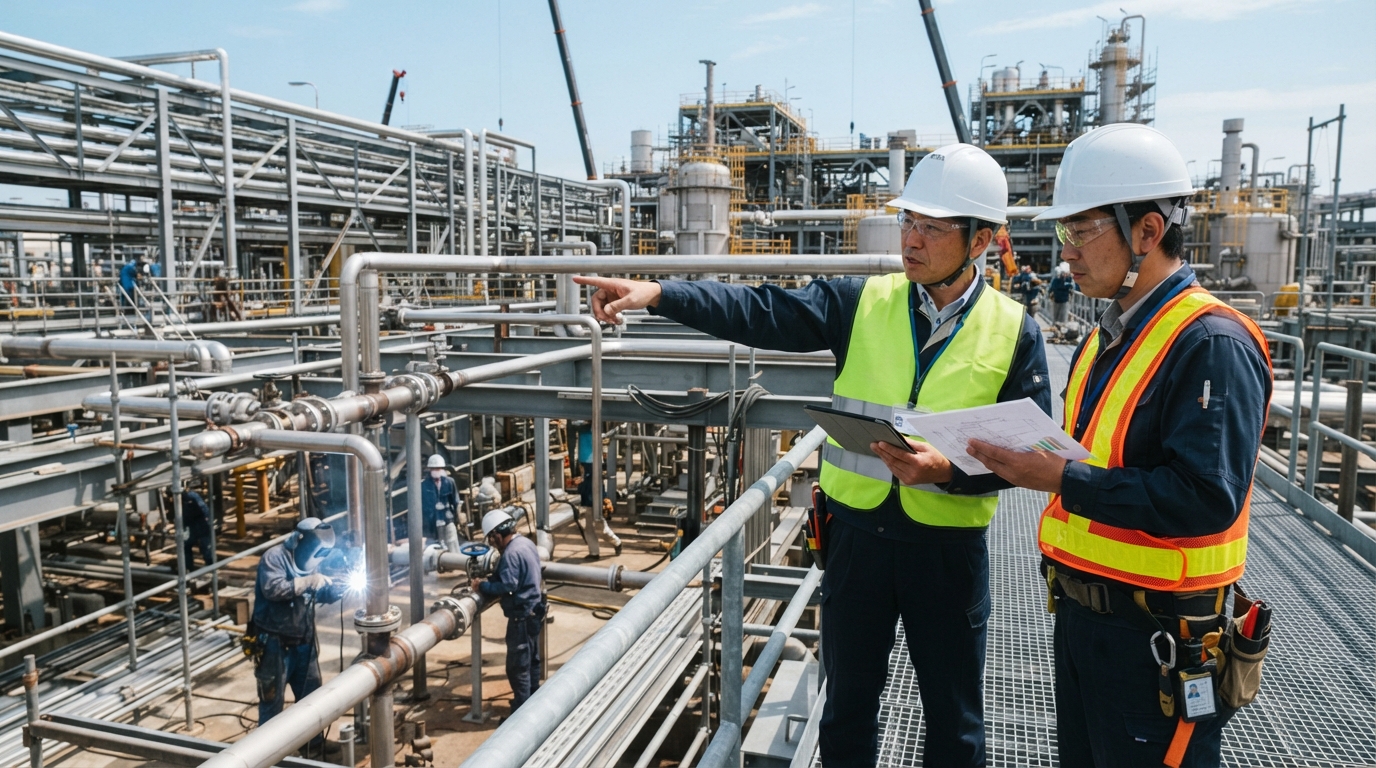
Most EPC projects rely on subcontractors. Civil works, mechanical erection, electrical installation, piping fabrication, insulation, painting, and marine works are often performed by specialist subcontractors rather than the main contractor’s own workforce. Subcontractor management is the discipline of selecting, contracting, coordinating, and supervising these subcontractors so that their work meets the project’s requirements for safety, quality, schedule, and cost.
At EPC Partners Inc., subcontractor management has been a core part of our work across a wide range of plant projects: geothermal power plants in Kenya, Indonesia, and Iceland; large-scale desalination facilities in the UAE and Saudi Arabia; thermal power plants in Vietnam and Bangladesh; and water treatment plants in Vietnam and Kuwait. Our work has ranged from remote geothermal sites, where capable local subcontractors and careful mobilization were essential, to large-scale desalination projects in the Gulf, where coordination between multiple specialist subcontractors was critical. Each project has presented different challenges, and each has reinforced the same lesson: subcontractors are not just suppliers of labor. They are partners in delivering the project, and their performance largely determines its success.
This article covers the key practices in plant subcontractor management, drawing on our experience supporting projects across Asia, the Middle East, Africa, and Europe.
What Is Subcontractor Management?
Subcontractor management covers the full life of a subcontract, from the decision to subcontract through to closeout. It includes:
- Subcontractor selection: Identifying, prequalifying, and selecting qualified subcontractors.
- Subcontractor contracting: Negotiating and awarding subcontracts.
- Subcontractor mobilization: Ensuring subcontractors are ready to start work.
- Subcontractor supervision: Monitoring subcontractor performance on site.
- Subcontractor coordination: Managing interfaces between subcontractors and with the main contractor’s own work.
- Subcontractor performance management: Evaluating performance and taking action.
- Subcontractor payment and closeout: Paying correctly, closing out scope, and handing over records.
Together, these ensure that subcontractors deliver their work safely, on time, and to the required quality.
Why Subcontractor Management Matters
Subcontractor management directly affects project success. Because the main contractor remains responsible to the owner for subcontracted work, a subcontractor’s failure becomes the project’s failure.
| Factor | Impact of Good Subcontractor Management | Impact of Poor Subcontractor Management |
|---|---|---|
| Safety | Subcontractors work safely | Incidents and injuries |
| Quality | Work meets specifications | Rework and defects |
| Schedule | Work completed on time | Delays and inefficiency |
| Cost | Costs controlled | Cost overruns and claims |
| Coordination | Subcontractors work together | Conflicts and interface problems |
| Compliance | Legal, labor, and permit requirements met | Penalties, stoppages, and liability |
| Reputation | Positive reputation | Reputation damaged |
For small to medium-scale industrial plants, subcontractor management often determines whether construction proceeds smoothly.
Aligning Subcontracts with the Main Contract
A subcontract should never be written in isolation. The main contract imposes obligations on the contractor (schedule, performance guarantees, liquidated damages, quality and safety standards, documentation, warranties), and these need to flow down to subcontractors in a way that matches what the subcontractor can actually control.
Key points:
- Flow-down of requirements: Technical specifications, HSE rules, quality requirements, and reporting duties should carry through to the subcontract.
- Back-to-back terms: Delay damages, warranty periods, and change procedures should be aligned so the contractor is not exposed to risks it cannot pass on.
- Scope boundaries: Define precisely what is included and excluded, who supplies materials, equipment, and temporary works, and who is responsible for each interface.
- Owner approvals: Confirm whether the owner has approval rights over subcontractors, and obtain approvals early.
Subcontractor Selection
Subcontractor selection is the first step in subcontractor management, and the cheapest point at which to prevent problems.
Selection criteria:
| Criterion | Description |
|---|---|
| Technical capability | Can the subcontractor perform the work? |
| Experience | Has the subcontractor done similar work, in similar conditions? |
| Safety record | What is the subcontractor’s safety performance? |
| Quality record | What is the subcontractor’s quality performance? |
| Financial strength | Is the subcontractor financially stable enough to complete the work and carry its payroll and materials? |
| Capacity | Can the subcontractor provide the manpower, supervision, and equipment to meet the schedule? |
| Local knowledge | Does the subcontractor understand local regulations, labor practices, and logistics? |
| References | What do previous clients say? |
A sound process includes:
- Prequalification: Screening candidates before issuing the tender.
- Clear tender documents: Scope, specifications, schedule, and commercial terms.
- Bid evaluation: Comparing technical and commercial offers on the same basis, including clarifications and exclusions.
- Capability checks: Reviewing key personnel, equipment, and, where practical, visiting a current project or the fabrication shop.
Selection should be based on objective criteria, not preference, and should look beyond the lowest price. An unrealistically low bid is often a warning sign of misunderstood scope.
At our geothermal projects in Kenya (Olkaria I Unit 6, 83 MW) and Indonesia (Muara Laboh, 85.2 MW), subcontractor selection for civil works and mechanical erection considered experience in remote, difficult terrain and familiarity with geothermal construction. In Iceland (Theistareykir, 2×45 MW), selection considered experience with seismic design and cold-weather construction.
Subcontractor Contracting
Subcontractor contracting is the process of negotiating and awarding subcontracts.
Subcontract contents:
- Scope: What work is included, and what is not?
- Price: What is the price, and how is it structured (lump sum, unit rate, reimbursable)?
- Schedule: Start, key milestones, and completion dates.
- Quality: Applicable standards, inspection and test plans, and hold points.
- Safety and environment: Site rules, permit-to-work requirements, and reporting duties.
- Insurance and security: Required insurances, performance bonds, advance payment guarantees, and retention.
- Payment terms: When and how payment is made, and what documents support it.
- Change process: How variations are requested, priced, approved, and instructed.
- Delay and default: Remedies, liquidated damages, and notice requirements.
- Warranty and defects: Warranty period and obligations for correcting defects.
- Termination: Conditions and consequences, including step-in rights.
- Records and documentation: Required reports, as-built information, and turnover documents.
- Compliance: Applicable laws, labor and immigration requirements, and ethics and anti-corruption obligations.
Subcontracts should be clear and complete to avoid disputes. Where subcontractors are expected to use sub-tier subcontractors, the subcontract should state whether approval is required and that the subcontractor remains responsible for their work.
Subcontractor Mobilization
Subcontractor mobilization ensures that subcontractors are ready to start work.
Mobilization activities:
- Site induction: Inducting subcontractor personnel on site rules and safety.
- Training and competency: Confirming that personnel hold required skills, certifications, and medical clearances (for example, welders, riggers, crane operators, and electricians).
- Permits and access: Securing work permits, visas, site passes, and area access.
- Equipment: Ensuring that equipment is available, inspected, and suitable.
- Materials: Ensuring that materials are available, and that laydown areas and storage are allocated.
- Procedures and plans: Reviewing and approving method statements, safety plans, quality plans, and schedules before work begins.
- Welfare and logistics: Arranging accommodation, transport, and site facilities where needed, especially at remote sites.
Mobilization should be planned to avoid delays at the start of work. Releasing a work front before approved procedures, permits, and competent personnel are in place is a common source of early problems.
Subcontractor Supervision
Subcontractor supervision monitors subcontractor performance.
Supervision activities:
- Daily supervision: Supervising work on a daily basis.
- Safety supervision: Ensuring work is performed safely, including permit-to-work compliance and toolbox talks.
- Quality supervision: Ensuring work meets specifications, including witnessing inspections and tests at hold points.
- Progress monitoring: Tracking progress against schedule using agreed measures.
- Issue resolution: Resolving problems as they arise, with clear escalation routes.
Supervision should be proactive: identifying and addressing problems before they escalate. It should also be proportionate, since over-supervision can slow work and blur responsibility, while under-supervision lets small problems grow.
On thermal power projects in Vietnam (Thai Binh 1, 2×300 MW) and Bangladesh (Bibiyana-III, 400 MW CCGT), subcontractor supervision included daily progress meetings, safety inspections, and quality checks, with clear channels for raising and resolving issues.
Project Experience: Supervision in Practice
At one thermal power project in Vietnam, supervision of the mechanical erection and electrical subcontractors relied on daily progress meetings, with safety inspections and quality checks completed before each work front was released. The discipline of checking readiness before release reduced rework and kept the two subcontractors from working in each other’s way.
At another project in Bangladesh, coordination between the civil, mechanical, and electrical subcontractors required careful sequencing of area handovers, so that each trade received a ready, safe, and accessible work front.
Subcontractor Coordination
Subcontractor coordination ensures that subcontractors work together and with the main contractor’s own activities.
Coordination activities:
- Interface management: Identifying and managing interfaces between subcontractors.
- Coordination meetings: Regular meetings to coordinate work, with actions tracked to closure.
- Area-based planning: Planning work by area to manage interfaces, access, and shared resources such as cranes and laydown.
- Handover procedures: Defining how areas and systems are handed over between subcontractors.
- Integrated schedule: Maintaining a master schedule that incorporates subcontractor schedules and reflects their dependencies.
Coordination is especially important in complex projects with multiple subcontractors.
For desalination projects in the Gulf (Taweelah, 909,200 m³/day; Jubail 3A, 600,000 m³/day), coordination covered the interfaces between the marine works subcontractor, the process plant subcontractor, and the electrical and instrumentation subcontractor, with careful planning of tie-ins and handovers.
Subcontractor Performance Management
Subcontractor performance management evaluates and manages subcontractor performance.
Performance management activities:
- Performance metrics: Defining metrics for safety, quality, schedule, and cost (for example, incident rates, non-conformance closure, progress against plan, and variation levels).
- Performance monitoring: Monitoring performance against metrics.
- Performance reviews: Regular reviews with the subcontractor’s management.
- Corrective action: Taking action when performance falls short, from formal notices to recovery plans and, where necessary, additional resources or replacement.
- Recognition: Recognizing good performance.
Performance management should be fair, consistent, and based on objective data.
Managing Changes and Claims
Changes and claims are among the most common sources of subcontractor disputes.
- Written instructions: Changes should be instructed in writing before work proceeds.
- Prompt pricing: Variations should be priced and agreed promptly, using rates set out in the subcontract where possible.
- Notice discipline: Both sides should respect notice periods for delay, variation, and claim events.
- Contemporaneous records: Daily reports, photographs, manpower and equipment records, and correspondence support fair assessment.
- Pass-through: Owner-driven changes and delays should be assessed so that valid entitlements are passed to the owner, and subcontractor entitlements are managed consistently with the main contract.
Health, Safety, and Environment
Subcontractor personnel often make up the majority of the site workforce, so subcontractor safety performance largely determines site safety performance.
- Apply the same HSE rules to subcontractors as to the main contractor’s own staff.
- Review subcontractor safety plans and risk assessments before work starts.
- Verify competency for high-risk activities such as lifting, work at height, confined space, hot work, and energized work.
- Include subcontractors in incident reporting, investigation, and lessons learned.
- Address environmental and community obligations, including waste, noise, and local labor relations.
Subcontractor Payment
Subcontractor payment ensures that subcontractors are paid correctly and on time.
Payment activities:
- Payment schedule: What payments are due, and when?
- Milestone and progress verification: Confirming that work has actually been completed and, where required, inspected and accepted.
- Invoice review: Reviewing invoices for accuracy, supporting documents, and consistency with the subcontract.
- Deductions and retention: Applying retention, backcharges, and advance payment recovery as the subcontract provides.
- Payment approval and processing: Approving and processing payments within the agreed period.
Payment should be made according to the subcontract terms. Late or disputed payments can lead to reduced manpower, slowed progress, and strained relationships, so payment certification should be fast, transparent, and based on verified progress.
Subcontract Closeout
Subcontract closeout is often neglected, yet it protects both parties.
- Completion and punch list: Confirm completion, and close out punch list items and non-conformances.
- Demobilization: Remove equipment, temporary works, and surplus materials, and restore areas.
- Documentation: Collect as-built drawings, test records, certificates, and manuals for the turnover package.
- Final account: Agree final measurement, variations, and outstanding claims, and release retention and bonds according to the subcontract.
- Warranty: Confirm warranty obligations and contacts.
- Lessons learned: Record the performance review and lessons for future projects.
Subcontractor Management in Small Plants
Small plants face particular challenges with subcontractor management.
Challenges:
- Fewer resources for subcontractor management.
- Less expertise.
- Less access to specialist subcontractors.
- Competing priorities.
Practical approaches:
- Focus on critical subcontractors: Prioritize management of subcontractors whose work is on the critical path or carries high safety or quality risk.
- Use simple tools: Simple checklists, logs, and weekly reports can be sufficient.
- Use local subcontractors where suitable: Local subcontractors can reduce logistics and coordination complexity and bring local knowledge, provided competence and safety standards are verified.
- Limit the number of interfaces: Bundle compatible scopes into fewer subcontracts where sensible.
- Document everything: Good records support coordination and resolve disputes.
- Train staff: Ensure staff understand subcontractor management requirements.
- Learn from others: Apply lessons from other projects.
Subcontractor management does not need to be complex. It needs to be thorough and consistent.
Common Mistakes in Subcontractor Management
Even experienced organizations make mistakes. Common ones include:
- Poor subcontractor selection: Selecting subcontractors who cannot perform the work, or choosing on price alone.
- Unclear subcontracts: Ambiguous scope or terms that lead to disputes.
- Mismatch with the main contract: Obligations that are not flowed down, leaving the contractor exposed.
- Inadequate mobilization: Subcontractors not ready to start work.
- Poor supervision: Problems not identified and addressed.
- Ineffective coordination: Conflicts between subcontractors over access, sequence, or shared resources.
- Neglecting subcontractor safety: Treating subcontractor personnel as outside the project’s safety culture.
- No performance management: Performance not monitored or managed.
- Slow change and claim handling: Variations left unresolved until the end of the project.
- Delayed payments: Subcontractors not paid on time.
- Incomplete documentation: Records missing or incomplete.
These mistakes are costly to correct. They are much cheaper to avoid through disciplined subcontractor management.
How EPC Partners Inc. Approaches Subcontractor Management
At EPC Partners Inc., we bring practical experience from projects across Asia, the Middle East, Africa, and Europe to subcontractor management. As a Japanese EPC support firm, we emphasize preparation, clear communication, and steady, detailed follow-through on site.
Our approach includes:
- Thorough selection: Subcontractors are prequalified and selected based on objective criteria.
- Clear contracts: Subcontracts are clear, complete, and aligned with the main contract.
- Careful mobilization: Procedures, personnel, and permits are checked before work fronts are released.
- Disciplined supervision: Subcontractor work is supervised daily, with safety and quality checks.
- Effective coordination: Interfaces, area handovers, and tie-ins are planned carefully.
- Performance management: Subcontractor performance is monitored and managed.
- Timely payment: Subcontractors are paid according to the subcontract terms on the basis of verified progress.
- Detailed documentation: Records are complete and accurate.
- Continuous improvement: Lessons are captured and applied.
Our experience includes supporting geothermal projects in Kenya, Ethiopia, Indonesia, Iceland, and Japan; desalination projects in the UAE, Saudi Arabia, Oman, and Qatar; thermal power projects in Vietnam, Bangladesh, and Japan; and water treatment projects in Vietnam, Kuwait, and Qatar.
We have also supported clients including Marubeni Corporation, Fuji Electric Co., Ltd., and Toyota Tsusho Corporation on subcontractor management aspects of their projects.
How to Evaluate Subcontractor Management Readiness
When reviewing subcontractor management, ask:
| Question | Why It Matters |
|---|---|
| Are subcontractors prequalified and selected on objective criteria? | Ensures capable subcontractors |
| Are subcontracts clear, complete, and aligned with the main contract? | Prevents disputes and unmanaged risk |
| Are subcontractors mobilized effectively? | Ensures work starts on time and safely |
| Are subcontractors supervised? | Ensures work meets requirements |
| Are subcontractors coordinated? | Prevents conflicts |
| Is subcontractor safety managed? | Protects people and the project |
| Is subcontractor performance managed? | Ensures performance meets requirements |
| Are changes and claims handled promptly? | Avoids end-of-project disputes |
| Are subcontractors paid on time? | Maintains relationships and manpower |
| Is closeout planned and documentation complete? | Supports handover, warranty, and disputes |
A project that addresses these questions is ready for effective subcontractor management.
Conclusion
Subcontractor management is critical to plant success. For small to medium-scale industrial plants, it determines whether construction proceeds safely, on time, and to the required quality.
By focusing on subcontractor selection, contracting, mobilization, supervision, coordination, performance management, payment, and closeout, owners and project teams can ensure that subcontractors deliver their work successfully.
If you are planning a plant project and need support with subcontractor management or EPC project delivery, contact us to discuss how we can help.
EPC Partners Inc. is a Japanese EPC support firm with experience supporting power, water, and industrial plant projects across Asia, the Middle East, Africa, and Europe. For more information, visit our project list.