By EPC Partners Inc. Engineering Team | Plant Design & Engineering
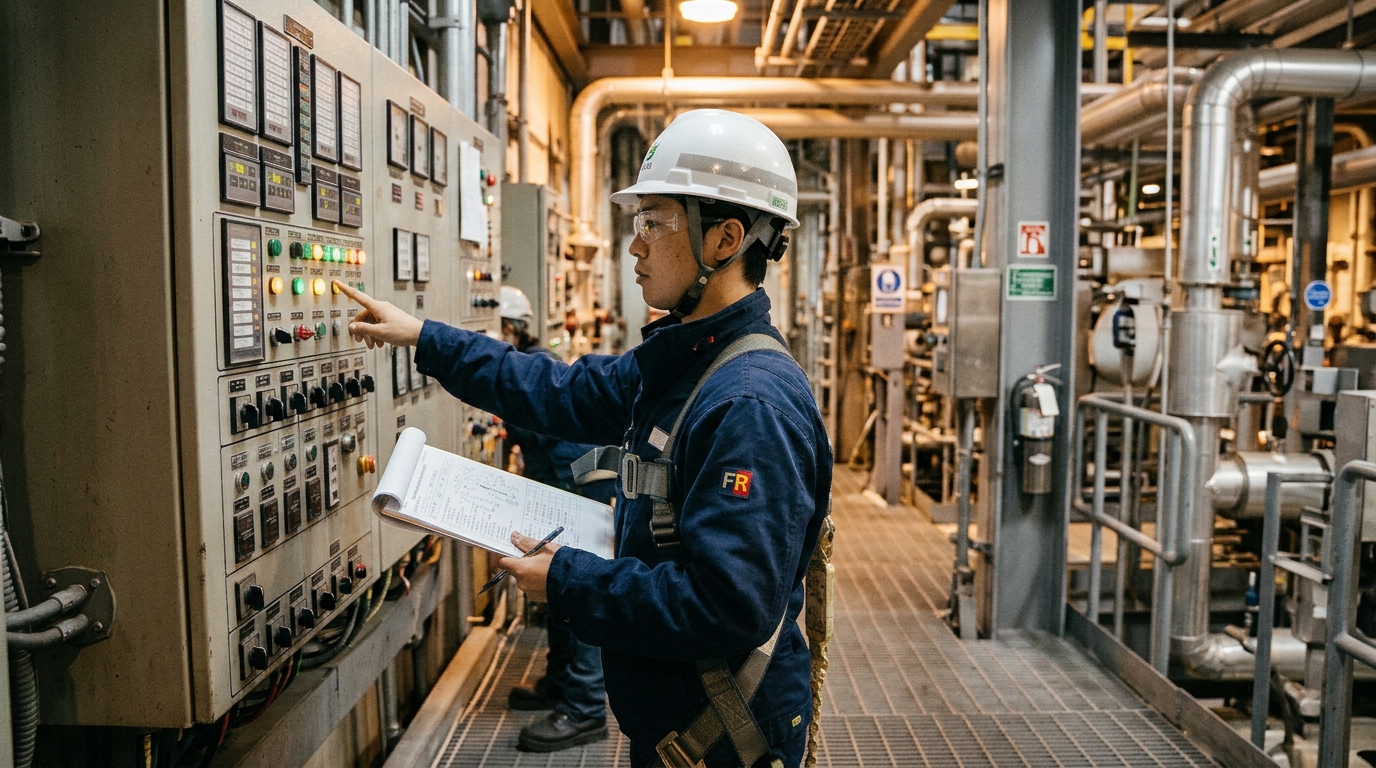
Safety engineering is not an add-on to plant design. It is a discipline that runs through every phase of a project, from concept and design to construction, commissioning, and operation. It identifies hazards, assesses risks, and designs systems and procedures to prevent incidents and protect people, the environment, and the plant itself.
At EPC Partners Inc., safety engineering has been a core part of our work across a wide range of plant projects: geothermal power plants in Kenya, Indonesia, and Iceland; large-scale desalination facilities in the UAE and Saudi Arabia; thermal power plants in Vietnam and Bangladesh; and water treatment plants in Vietnam and Kuwait. Each project has presented different safety challenges, and each has reinforced the same lesson: safety is not a cost to be minimized. It is a fundamental requirement that shapes every decision.
This article covers the key practices in plant safety engineering, drawing on our experience supporting projects across Asia, the Middle East, Africa, and Europe.
What Is Safety Engineering?
Safety engineering is the discipline of identifying hazards, assessing risks, and designing systems and procedures to prevent incidents and protect people, the environment, and the plant.
It includes:
- Hazard identification: Identifying hazards that could cause harm.
- Risk assessment: Assessing the likelihood and consequence of hazards.
- Inherent safety: Designing out hazards where possible.
- Safety systems: Designing systems to prevent, detect, and mitigate incidents.
- Safety procedures: Developing procedures for safe operation and maintenance.
- Safety training: Training personnel on safety requirements.
- Emergency response: Planning for emergencies.
Safety engineering provides the foundation for safe plant design, construction, and operation.
Why Safety Engineering Matters
Safety engineering directly affects plant performance.
| Factor | Impact of Good Safety Engineering | Impact of Poor Safety Engineering |
|---|---|---|
| People | Hazards identified and controlled | Injuries and fatalities |
| Environment | Environmental hazards controlled | Environmental releases |
| Assets | Plant protected from incidents | Equipment damage and destruction |
| Compliance | Regulatory requirements met | Fines, penalties, shutdowns |
| Reputation | Trust maintained | Reputation damaged |
| Cost | Incidents avoided | Cost of incidents and recovery |
For small to medium-scale industrial plants, safety engineering determines whether the plant can operate without harming people, the environment, or the plant itself.
Safety Engineering Across the Project Lifecycle
Safety engineering is most effective, and least costly, when it starts early. Decisions made at the concept stage, such as site, layout, and technology, fix most of the hazards a plant will carry for its whole life.
| Phase | Key Safety Activities |
|---|---|
| Concept and feasibility | Early hazard identification (HAZID), site and layout screening, inherent safety review |
| Basic and detailed design | HAZOP, risk assessment, SIL determination, safety system design, relief and fire protection design |
| Procurement | Safety requirements in specifications, vendor documentation, factory acceptance testing of safety systems |
| Construction | Construction safety planning, permit-to-work, simultaneous operations control |
| Commissioning | Pre-startup safety review, functional testing of safety systems, operator training |
| Operation | Proof testing, management of change, incident learning, periodic review |
Safety requirements should be written into the project from the start. Adding them late is expensive and often incomplete.
Hazard Identification
Hazard identification is the first step in safety engineering.
| Method | Description | When to Use |
|---|---|---|
| HAZOP | Systematic review of process deviations | Process systems |
| HAZID | Structured identification of hazards | Concept and layout stages |
| What-if analysis | Brainstorming “what if” scenarios | Any system |
| Checklist | Review against known hazards | Routine operations |
| FMEA | Identifying failure modes and effects | Equipment and systems |
Hazard identification should be comprehensive and involve the whole project team: process, mechanical, electrical, instrumentation, civil, and operations personnel all see different hazards.
At our geothermal projects in Kenya (Olkaria I Unit 6, 83 MW) and Indonesia (Muara Laboh, 85.2 MW), hazard identification focused on the specific risks of geothermal steam: high temperature, hydrogen sulfide, and non-condensable gases. In Iceland (Theistareykir, 2×45 MW), hazard identification considered the seismic and environmental conditions of the site.
From the field: At one geothermal project in Indonesia, the hazard identification identified hydrogen sulfide as a key risk, leading to the design of gas detection systems and emergency response procedures specific to the geothermal environment. At another project in Kenya, the hazard identification considered the high temperature of the geothermal steam and the potential for burns, leading to the design of insulation and personnel protection measures.
Risk Assessment
Risk assessment evaluates the likelihood and consequence of hazards.
Risk assessment considerations:
- Likelihood: How likely is the hazard to cause harm?
- Consequence: How severe would the harm be?
- Risk ranking: How does the risk compare to others?
- Risk tolerance: What risk is acceptable?
A risk matrix is the most common tool for ranking risks. For higher-consequence scenarios, a more detailed method such as layer of protection analysis (LOPA) can show whether existing safeguards are enough, and how much additional risk reduction is needed.
Risk assessment should be based on credible data and consistent methods. It should also be revisited whenever the design changes.
Layers of Protection
No single safeguard should be relied on to prevent a serious incident. Good plant design uses several independent layers of protection, so that if one fails, another still acts.
Typical layers, from the inside out:
- Process design: Inherently safer design and operating conditions.
- Basic process control and operator response: Normal control and alarms.
- Safety instrumented systems: Independent automatic shutdown.
- Physical protection: Relief devices, dikes, and barriers.
- Emergency response: Plant and external response to a release or fire.
The independence of these layers is what makes them effective. A layer that shares a sensor, power supply, or logic with another layer may fail at the same time.
Inherent Safety
Inherent safety is the practice of designing out hazards rather than controlling them.
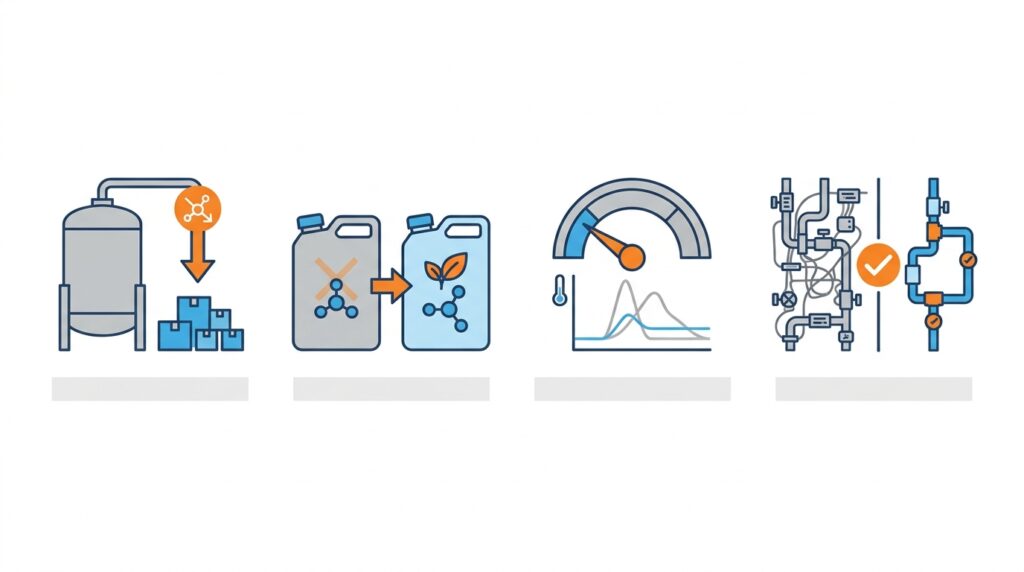
Inherent safety principles:
- Minimize: Reduce the quantity of hazardous materials.
- Substitute: Replace hazardous materials with less hazardous ones.
- Moderate: Use less hazardous conditions (lower temperature, pressure).
- Simplify: Design simple systems that are less prone to failure.
Inherent safety is the most effective way to manage risk, because it eliminates hazards rather than controlling them. It is also most practical early in design, when changes are still cheap.
Safety Systems
Safety systems are designed to prevent, detect, and mitigate incidents.
| System | Description | Examples |
|---|---|---|
| Prevention | Prevent hazardous conditions | Control systems, interlocks |
| Detection | Detect hazardous conditions | Gas detectors, fire detectors |
| Mitigation | Reduce consequences of incidents | Relief valves, fire suppression |
| Emergency response | Respond to incidents | Emergency shutdown, evacuation |
Safety systems should be designed to be independent, reliable, and testable.
Safety Instrumented Systems (SIS)
Safety instrumented systems are independent systems that bring the plant to a safe state when abnormal conditions occur.
SIS components:
- Sensors: Detect abnormal conditions.
- Logic solver: Evaluates sensor signals and decides when to act.
- Final elements: Carry out the safety action (valves, trips).
Key considerations:
- Safety integrity level (SIL): What SIL is required? The target is set by risk assessment, and the design must then be verified against it.
- Independence: Is the SIS independent of the basic control system?
- Proof testing: How often is the SIS tested, and can it be tested without shutting the plant down?
- Documentation: Is the SIS documented, including its safety requirements specification?
SIS design is generally guided by functional safety standards such as IEC 61508 and IEC 61511, which cover the full safety lifecycle from specification through operation and modification.
For desalination projects in the Gulf (Taweelah, 909,200 m³/day; Jubail 3A, 600,000 m³/day), safety instrumented systems were designed to protect high-pressure equipment and to bring the plant to a safe state during abnormal conditions.
Fire and Gas Detection
Fire and gas detection systems detect fires and hazardous gas releases.
Fire detection:
- Smoke detectors: Detect smoke from combustion.
- Heat detectors: Detect temperature rise.
- Flame detectors: Detect radiation from flames.
- Manual call points: Allow people to raise the alarm.
Gas detection:
- Flammable gas detectors: Detect combustible gas.
- Toxic gas detectors: Detect toxic gases such as hydrogen sulfide.
Fire and gas detection systems should be designed for full coverage, with redundancy for critical areas. Detector placement should consider gas density, ventilation, and likely leak points, and detector alarms should be linked to defined executive actions such as ventilation control, shutdown, and evacuation alarms.
Fire Protection
Fire protection includes both passive and active systems.
Passive fire protection:
- Fire-resistant construction: Materials that resist fire spread.
- Fire walls and barriers: Physical barriers that contain fire.
- Fire doors: Doors that resist fire spread.
Active fire protection:
- Sprinkler systems: Automatic water-based suppression.
- Foam systems: For flammable liquid fires.
- Gas suppression systems: For electrical or control rooms.
- Fire hydrants and monitors: For manual fire fighting.
Fire protection should be based on the fire hazards present, the value of the assets, and local regulations. A reliable fire water supply, with adequate storage and redundant pumps, underpins all water-based systems.
Pressure Relief
Pressure relief systems protect equipment from overpressure.
Pressure relief devices:
- Pressure relief valves: Open when pressure exceeds a set point.
- Rupture discs: Burst at a set pressure.
- Pilot-operated relief valves: Use a pilot valve to control the main valve.
Key considerations:
- Sizing: Relief devices must be sized for the maximum relief case, which requires identifying all credible overpressure scenarios (blocked outlet, fire, control failure, and others).
- Set pressure: Set at or below the equipment design pressure.
- Discharge location: Relief discharge must be routed to a safe location.
- Testing: Relief devices must be tested periodically.
For thermal power projects in Vietnam (Thai Binh 1, 2×300 MW) and Bangladesh (Bibiyana-III, 400 MW CCGT), pressure relief systems were designed for the main steam, reheat, and boiler systems, with careful attention to sizing and discharge location.
Safety Procedures
Safety procedures define how to work safely.
- Permit-to-work: For hazardous tasks.
- Lockout/tagout: For equipment isolation.
- Confined space entry: For entry into confined spaces.
- Hot work: For welding, cutting, and other hot work.
- Work at height: For work above ground level.
Safety procedures should be clear, practical, and available to the people who need them.
Safety During Construction and Commissioning
Some of the highest-risk periods in a plant’s life are construction and commissioning, when many contractors work close together and systems are being energized and filled for the first time.
Key practices:
- Construction safety plan: Defined roles, rules, and reporting for all contractors.
- Simultaneous operations control: Coordinating activities that could endanger each other, such as lifting over live areas or hot work near commissioned systems.
- Pre-startup safety review: A formal check that safety systems, procedures, and training are in place before hazardous materials or energy are introduced.
- Functional testing of safety systems: Confirming that detectors, trips, and shutdown valves work as designed before startup.
Construction and commissioning safety should be planned during design, not improvised on site.
Management of Change
Safety does not end at handover. Over the plant’s life, equipment is modified, set points are adjusted, and operating practices drift. A formal management of change process makes sure that every modification is reviewed for safety impact before it is made, and that drawings, procedures, and training are updated afterward. Untracked changes are one of the most common ways a well-designed plant becomes an unsafe one.
Human Factors
Safety systems are used by people. Poorly designed alarms, unclear displays, or hard-to-reach valves can lead to errors even in a well-engineered plant.
Human factors considerations:
- Alarm management: Alarms should be meaningful, prioritized, and manageable in number.
- Control room design: Displays and controls should support clear decisions under stress.
- Accessibility: Valves, instruments, and exits should be reachable and clearly labeled.
- Procedures: Written for the people who use them, not just to satisfy a requirement.
Safety Training
Safety training ensures that personnel understand safety requirements.
- General safety: Basic safety awareness.
- Task-specific safety: Safety for specific tasks.
- Emergency response: How to respond to emergencies.
- Contractor safety: Safety for contractors.
Safety training should be practical and relevant to the work being performed.
Emergency Response
Emergency response planning prepares the plant for emergencies.
- Emergency plan: Defined roles, communication, and decision authority.
- Scenarios: Plans based on credible incidents.
- Alarms and communication: Ways to alert everyone on site.
- Evacuation and muster: Clear routes, assembly points, and headcount.
- Training and drills: Regular exercises.
Emergency response should be planned, practiced, and updated.
Safety Documentation
Safety engineering produces records that must stay accurate for the life of the plant. These typically include hazard identification and risk assessment reports, HAZOP records and action closure, SIL determination and verification reports, safety requirements specifications, cause-and-effect charts, relief sizing calculations, fire and gas detector layouts, and proof test procedures. Good documentation makes safety systems easier to maintain, test, audit, and modify safely.
Safety Engineering in Small Plants
Small plants face particular challenges with safety engineering.
Challenges:
- Fewer resources for safety engineering.
- Less expertise.
- Less access to specialist support.
- Competing priorities.
Practical approaches:
- Focus on high-consequence hazards: Prioritize hazards with the most serious consequences.
- Use proven safety systems: Reduce risk by using proven systems.
- Use available guidance: Leverage industry standards and guidance.
- Seek expert advice: Get advice from safety consultants where needed.
- Train staff: Ensure staff understand safety requirements.
- Learn from others: Apply lessons from other plants.
Safety engineering does not need to be complex. It needs to be thorough and practical.
Common Mistakes in Safety Engineering
Even experienced organizations make mistakes. Common ones include:
- Incomplete hazard identification: Missing hazards that later cause incidents.
- Underestimating risk: Assuming hazards are less likely or less severe than they are.
- Inadequate independence: Safety systems not truly independent of the control system.
- Poor proof testing: Safety systems not tested, or tested incorrectly.
- Ignoring human factors: Designing systems that operators cannot use effectively.
- Weak safety culture: Systems in place but not respected or followed.
- Insufficient documentation: Making it difficult to maintain and verify safety systems.
- Uncontrolled changes: Modifications made without safety review.
- No emergency planning: Unprepared for emergencies.
These mistakes are costly to correct. They are much cheaper to avoid through disciplined safety engineering.
How EPC Partners Inc. Approaches Safety Engineering
At EPC Partners Inc., we bring practical experience from projects across Asia, the Middle East, Africa, and Europe to safety engineering.
Our approach includes:
- Thorough hazard identification: Hazards are identified systematically, with input from all disciplines.
- Conservative risk assessment: Risks are assessed realistically, not optimistically.
- Independent safety systems: Safety systems are designed to be independent and reliable.
- Detailed documentation: Safety analyses, designs, and test records are carefully maintained.
- Comprehensive training: Personnel are trained on safety requirements.
- Emergency planning: Emergency response is planned, practiced, and updated.
- Long-term focus: Safety is treated as an ongoing commitment, not a one-time project.
Our experience includes supporting geothermal projects in Kenya, Ethiopia, Indonesia, Iceland, and Japan; desalination projects in the UAE, Saudi Arabia, Oman, and Qatar; thermal power projects in Vietnam, Bangladesh, and Japan; and water treatment projects in Vietnam, Kuwait, and Qatar.
We have also supported clients including Marubeni Corporation, Fuji Electric Co., Ltd., and Toyota Tsusho Corporation on safety engineering aspects of their projects.
How to Evaluate Safety Engineering Readiness
When reviewing safety engineering, ask:
| Question | Why It Matters |
|---|---|
| Have all hazards been identified? | You cannot protect against unknown hazards |
| Has risk been assessed consistently? | Determines how much protection is needed |
| Are there independent layers of protection? | Prevents a single failure from becoming an incident |
| Are safety systems independent? | Ensures reliable protection |
| Are safety systems tested? | Verifies that safety systems work |
| Are safety procedures in place? | Ensures safe operation |
| Is a change management process in place? | Keeps the plant safe after modifications |
| Is safety training provided? | Ensures personnel understand safety requirements |
| Is emergency response planned? | Prepares for emergencies |
| Is there a safety culture? | Ensures systems are respected and followed |
A plant that addresses these questions is ready for safe operation.
Conclusion
Safety engineering is critical to plant success. For small to medium-scale industrial plants, it determines whether the plant can operate without harming people, the environment, or the plant itself.
By focusing on hazard identification, risk assessment, layers of protection, inherent safety, safety systems, fire and gas detection, fire protection, pressure relief, safety procedures, training, and emergency response, owners and project teams can ensure that the plant is safe throughout its life.
If you are planning a plant project and need support with safety engineering or EPC project delivery, contact us to discuss how we can help.
EPC Partners Inc. is a Japanese EPC support firm with experience supporting power, water, and industrial plant projects across Asia, the Middle East, Africa, and Europe. For more information, visit our project list.