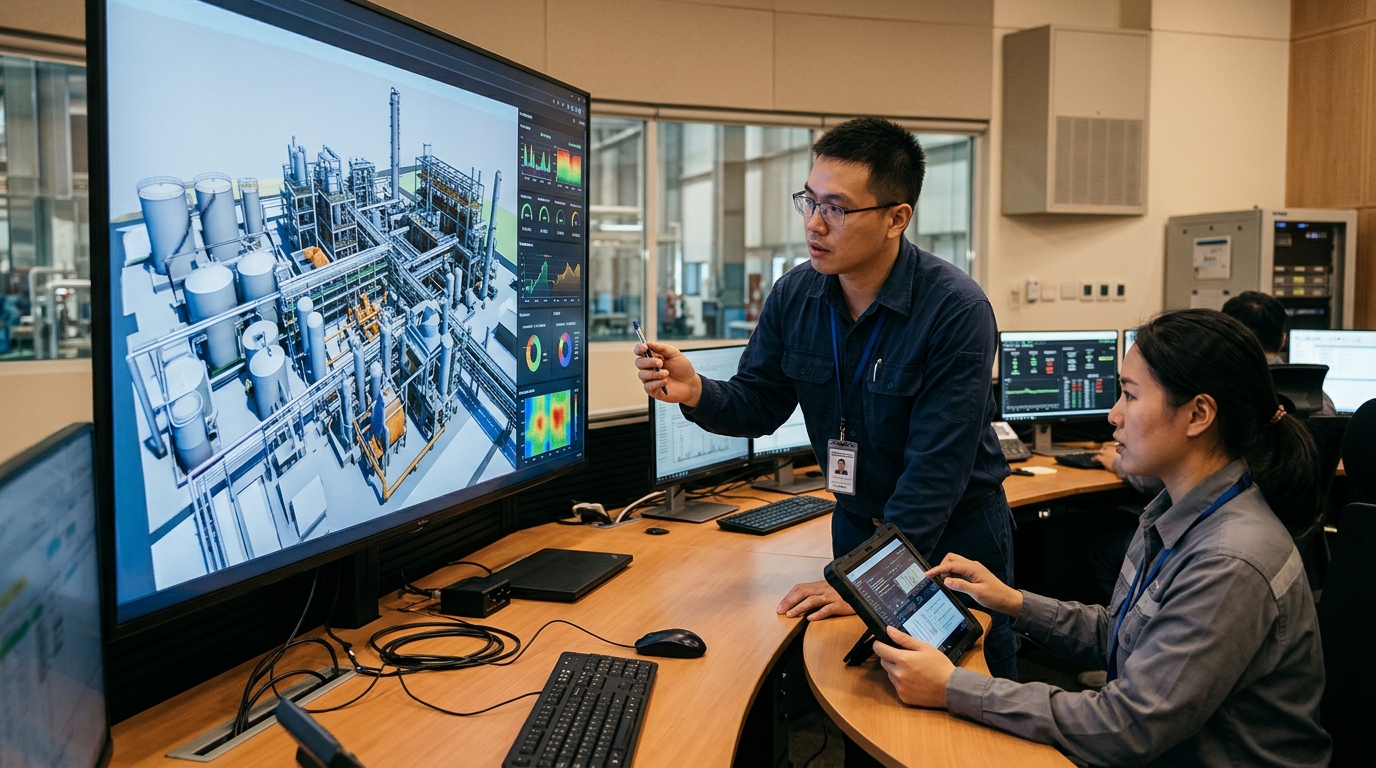
Industrial plants generate enormous amounts of data. Design models, equipment specifications, sensor readings, maintenance records, performance trends, and operational logs are all created, stored, and used across the plant’s lifecycle. But data alone is not valuable. What matters is whether the data is accurate, accessible, and useful for decision-making.
Digitalization is the use of digital technologies to improve how plants are designed, built, and operated. Data management is the discipline of ensuring that data is accurate, complete, secure, and available to the people who need it. Together, they are transforming how industrial plants work and how EPC projects are delivered.
For small to medium-scale industrial plants, both are especially important because there is less redundancy and fewer resources to absorb the consequences of poor data. A plant with inaccurate or inaccessible data cannot be operated efficiently, maintained effectively, or improved over time.
This article covers the key practices in plant digitalization and data management, from digital tools to data governance, handover, and cybersecurity.
What Is Digitalization?
Digitalization is the use of digital technologies to improve processes, create new value, and enable better decisions.
In an industrial plant, digitalization includes:
- Digital design: 3D modeling, digital twins, and paperless engineering.
- Digital procurement: E-procurement, vendor data management, and supply chain visibility.
- Digital construction: Digital work packages, mobile data capture, and progress tracking.
- Digital operations: Control systems, condition monitoring, and performance analytics.
- Digital maintenance: CMMS, predictive maintenance, and mobile work execution.
Digitalization is not just about technology. It is about using technology to work differently and better.
What Is Data Management?
Data management is the process of ensuring that data is accurate, complete, secure, and available.
Data management includes:
- Data governance: Policies and procedures for managing data.
- Data quality: Ensuring data is accurate and complete.
- Data security: Protecting data from unauthorized access.
- Data integration: Combining data from different sources.
- Data accessibility: Ensuring data is available to those who need it.
- Data retention: Retaining data for the required period.
Data management is the foundation of digitalization. Without good data, digital tools cannot deliver their value.
Why Digitalization and Data Management Matter
| Factor | Impact of Good Digitalization | Impact of Poor Digitalization |
|---|---|---|
| Efficiency | Processes are faster and more accurate | Manual processes are slow and error-prone |
| Decisions | Decisions based on accurate, timely data | Decisions based on incomplete or outdated data |
| Reliability | Predictive maintenance and condition monitoring | Reactive maintenance and unexpected failures |
| Cost | Lower operating and maintenance costs | Higher costs from inefficiency and failures |
| Safety | Better visibility and faster response | Blind spots and slow response |
| Compliance | Data available for audits and reporting | Data gaps and compliance issues |
For small plants, where there is less margin for error, these factors determine whether the plant can be operated efficiently and improved over time.
Digital Twins
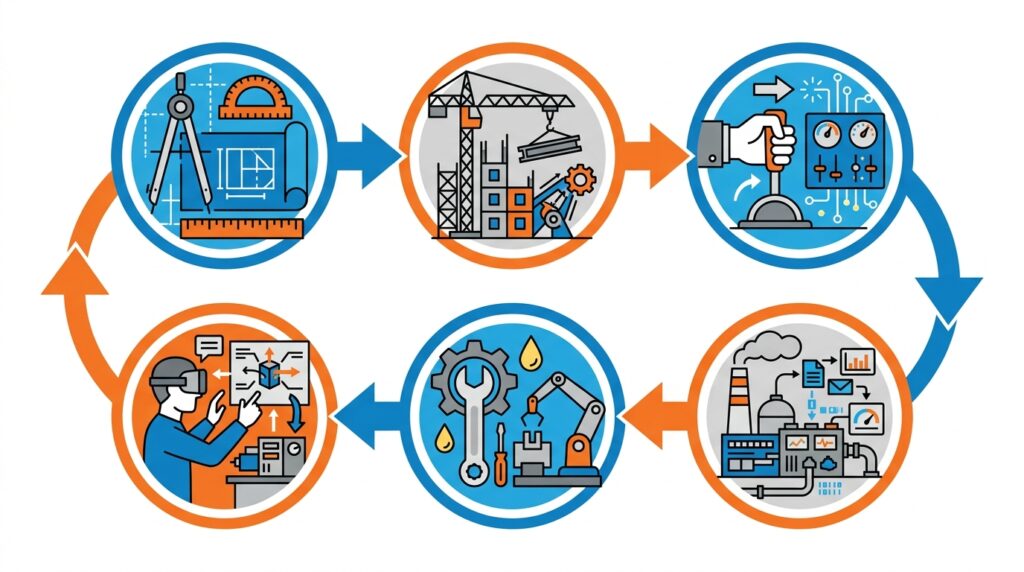
A digital twin is a digital representation of a physical asset, system, or process, connected to plant data so that it reflects the current state of the real plant. This connection is what distinguishes a digital twin from a static 3D model.
| Use | Description |
|---|---|
| Design | Verify design before construction |
| Construction | Plan construction sequence and detect clashes |
| Commissioning | Support commissioning and testing |
| Operations | Monitor performance and optimize operations |
| Maintenance | Plan maintenance and predict failures |
| Training | Train operators in a virtual environment |
Digital twins are most valuable when they are kept up to date with the physical plant. A twin that is not maintained after handover quickly becomes a historical record rather than a working tool.
Digital Design and Engineering
Digital design and engineering use digital tools to design the plant.
- 3D CAD and plant design: Three-dimensional modeling of plant and equipment.
- BIM: Building information modeling for integrated design, particularly for buildings and structures.
- Intelligent P&IDs: Data-rich diagrams linked to the engineering database.
- Clash detection: Identifying conflicts between disciplines.
- Engineering databases: Storing and managing engineering data such as equipment lists, line lists, and instrument indexes.
- Digital workflows: Managing design reviews and approvals electronically.
Digital design reduces errors, improves coordination, and creates a data foundation for construction and operations.
Common Data Environment (CDE)
A common data environment (CDE) is a shared repository where project data (drawings, models, documents, and correspondence) is stored and managed. It provides a single source of truth for the project and supports collaboration between disciplines and contractors.
A good CDE:
- Controls document versions and status (work in progress, shared, approved, archived).
- Defines who can view, edit, and approve each type of information.
- Keeps an audit trail of changes and approvals.
- Uses agreed naming, numbering, and metadata conventions.
Information management standards such as ISO 19650 describe CDE workflows and are a useful reference, even outside building projects.
Digital Procurement and Vendor Data
Digital procurement and vendor data management improve supply chain efficiency.
- E-procurement: Online purchasing and supplier management.
- Vendor data management: Managing vendor documentation and data.
- Supply chain visibility: Tracking materials and equipment through the supply chain.
- Digital inspection: Remote inspection and digital records.
Vendor data is a critical part of the plant’s data foundation. It should be captured in a structured, accessible form, not only as scanned PDFs, so that it can flow into the engineering database and the CMMS.
Digital Construction
Digital construction uses digital tools to plan, execute, and track construction.
- Digital work packages: Electronic work instructions and checklists.
- Mobile data capture: Recording progress, inspections, and issues on mobile devices.
- Progress tracking: Real-time tracking of construction progress.
- Digital as-builts: Capturing as-built information digitally.
- Drones and laser scanning: Capturing site conditions and progress.
Digital construction improves efficiency, accuracy, and visibility.
Digital Operations
Digital operations use digital tools to operate and monitor the plant.
- Control systems: DCS, PLC, SCADA.
- Condition monitoring: Vibration, temperature, and performance monitoring.
- Performance analytics: Analyzing plant performance and identifying improvements.
- Digital procedures: Electronic operating procedures and checklists.
- Operator rounds: Mobile tools for recording operator rounds.
Digital operations improve efficiency, safety, and reliability.
Digital Maintenance
Digital maintenance uses digital tools to plan, execute, and track maintenance.
- CMMS: Computerized maintenance management system.
- Predictive maintenance: Using data to predict failures.
- Mobile work execution: Performing maintenance with mobile devices.
- Digital spare parts management: Managing spare parts inventory digitally.
- Augmented reality: Using AR for maintenance guidance.
Digital maintenance improves efficiency, reduces downtime, and extends equipment life.
Analytics and Artificial Intelligence
Digitalization enables advanced analytics and artificial intelligence: predictive maintenance, performance optimization, and anomaly detection. These tools depend on high-quality data and a solid digital foundation.
In practice, this means:
- Sensor data must be reliable, calibrated, and consistently tagged.
- Historical data must be available and structured.
- Equipment and maintenance records must be linked to the same asset tags.
- Results must be validated by experienced engineers and operators before they drive decisions.
For small plants, simple analytics, such as trend monitoring and alarm analysis, often deliver value well before advanced AI is justified.
Data Governance
Data governance is the framework for managing data.
- Data ownership: Who owns each data set?
- Data standards: What standards apply to data?
- Data quality: How is data quality ensured?
- Data security: How is data protected?
- Data access: Who can access data, and under what conditions?
- Data retention: How long is data retained?
Data governance ensures that data is managed consistently and responsibly. For EPC projects, ownership, formats, and deliverables should be written into the contract (see “Data Requirements in the EPC Contract” below).
Data Quality
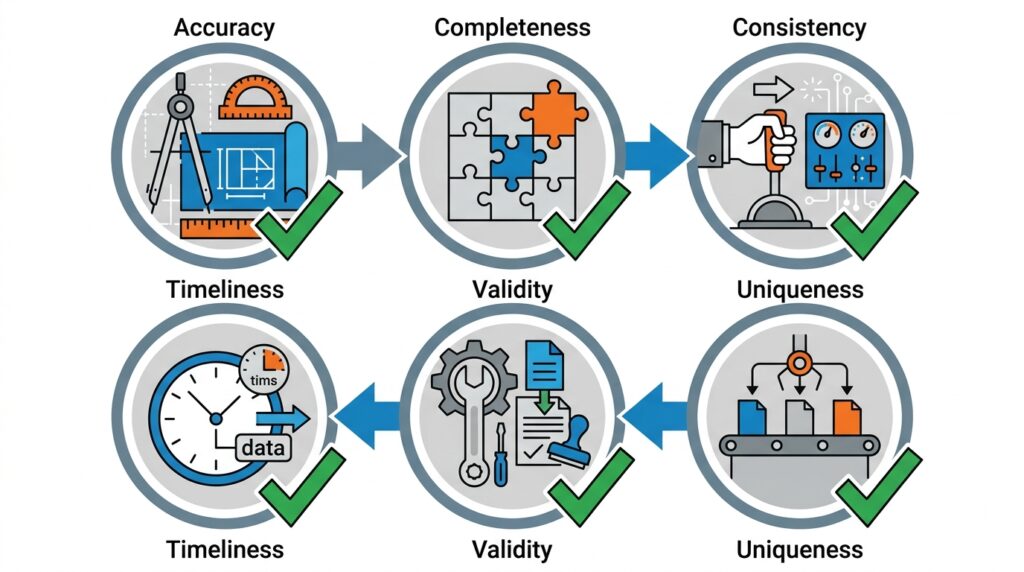
Data quality is the foundation of effective data management.
| Dimension | Description |
|---|---|
| Accuracy | Data reflects reality |
| Completeness | All required data is present |
| Consistency | Data is consistent across sources |
| Timeliness | Data is available when needed |
| Validity | Data conforms to defined formats |
| Uniqueness | No duplicate records |
Data quality should be measured and improved continuously.
Data Integration
Data integration combines data from different sources.
- Manual integration: Combining data manually.
- Automated integration: Using software to integrate data.
- Data warehouses: Central repositories for integrated data.
- APIs: Application programming interfaces for data exchange.
Data integration enables a single view of the plant. A consistent asset tagging scheme used across engineering, procurement, construction, and maintenance systems is one of the most effective integration measures.
Legacy Systems
Legacy systems (older control systems, standalone databases, and paper records) can be a barrier to digitalization. A gradual approach that integrates legacy systems where possible and replaces them where necessary is often the most practical path.
Practical steps include:
- Inventory existing systems, data sources, and paper records.
- Use gateways, protocol converters, or data historians to bring legacy data into modern platforms.
- Digitize critical paper records first, such as P&IDs, equipment datasheets, and maintenance histories.
- Replace systems that are unsupported, unsafe, or impossible to integrate.
Data Requirements in the EPC Contract
Data deliverables should be defined in the EPC contract, not left to the end of the project.
- Required data and document deliverables, formats, and metadata.
- Naming, numbering, and tagging conventions.
- Ownership of, and rights to use, models, data, and software.
- Delivery milestones and acceptance criteria for data.
- Cybersecurity requirements for contractor systems and remote access.
Clear data requirements early in the project avoid expensive reconstruction of information later.
Data Handover to Operations
Data handover from project to operations is a critical step. As-built models, equipment data, maintenance histories, and procedures must be transferred in a structured, accessible form. This connects directly to the handover process and the plant’s long-term data foundation.
Good practice includes:
- Defining handover data requirements early, for example using a standard such as CFIHOS.
- Loading equipment data directly into the CMMS and asset register.
- Verifying that as-built models and documents match the as-built plant.
- Confirming that operations staff can access, search, and use the data before project closeout.
Cybersecurity
Cybersecurity is critical for digitalized plants.
- Network segmentation: Separating control networks from business networks.
- Access control: Limiting access to authorized personnel, including contractors and remote vendor access.
- Monitoring: Monitoring for unusual activity.
- Updates: Keeping software and firmware up to date, with care for control system compatibility.
- Training: Training personnel on cybersecurity awareness.
- Incident response: Planning for cyber incidents.
The convergence of operational technology (OT) and information technology (IT) increases both the value of plant data and the exposure to cyber threats. Standards such as IEC 62443 and guidance such as NIST SP 800-82 provide frameworks for industrial control system security. Cybersecurity protects the plant from threats that could disrupt operations or cause safety incidents.
Digitalization in Small Plants
Small plants face particular challenges:
- Fewer resources for digitalization.
- Less expertise in digital technologies.
- Legacy systems that are difficult to integrate.
- Competing priorities.
Practical approaches:
- Start small: Begin with high-value, low-cost digitalization.
- Focus on data quality: Good data is the foundation of digitalization.
- Use cloud services: Cloud services reduce infrastructure costs, with security controls suited to plant data.
- Leverage vendor tools: Use tools provided by equipment vendors.
- Use standard formats: Standard data formats and tagging make future integration easier.
- Build skills gradually: Train staff on digital tools over time.
- Learn from others: Learn from other plants’ experiences.
Digitalization does not need to be complex. It needs to be focused and practical.
Common Mistakes in Digitalization and Data Management
- Technology-first approach: Focusing on technology rather than business needs.
- Poor data quality: Data that is inaccurate or incomplete.
- No data governance: Data managed inconsistently, with unclear ownership.
- Siloed data: Data trapped in different systems.
- No common data environment: Multiple versions of documents and models in circulation.
- No handover requirements: Data delivered late, unstructured, or incomplete.
- Inadequate cybersecurity: Data and systems not protected.
- No integration: Systems that do not communicate.
- Ignoring legacy systems: Assuming new tools will work without addressing existing ones.
- No skills: Staff not trained on digital tools.
- No change management: Digitalization resisted by staff.
- No sustainability: Digital tools not maintained over time.
These mistakes are costly to correct. They are much cheaper to avoid through disciplined digitalization and data management.
How Japanese EPC Firms Approach Digitalization and Data Management
Japanese engineering firms are often noted for a disciplined approach to digitalization and data management. Common characteristics include:
- Business-first approach: Digitalization is driven by business needs.
- Data quality focus: Data quality is prioritized.
- Integrated systems: Systems are integrated to provide a single view.
- Cybersecurity focus: Cybersecurity is built in from the start.
- Detailed documentation: Data and processes are documented.
- Continuous improvement: Lessons are captured and applied.
- Long-term focus: Digitalization is treated as a long-term investment.
For plant owners, this often means digital tools that are useful, reliable, and sustainable.
How to Evaluate Digitalization and Data Management Readiness
| Question | Why It Matters |
|---|---|
| Is there a digitalization strategy? | Provides direction for digitalization |
| Are business needs defined? | Ensures digitalization delivers value |
| Is data quality managed? | Ensures data is accurate and complete |
| Is there data governance and clear ownership? | Ensures data is managed consistently |
| Is there a common data environment? | Provides a single source of truth |
| Are data handover requirements defined? | Ensures operations receive usable data |
| Are systems integrated, including legacy systems? | Ensures a single view of the plant |
| Is cybersecurity in place? | Protects data and systems |
| Are staff trained? | Ensures digital tools are used effectively |
| Is change management in place? | Ensures digitalization is adopted |
| Is digitalization sustainable? | Ensures tools are maintained over time |
A plant that addresses these questions is ready for effective digitalization.
Key Takeaways
- Digitalization uses digital technologies to improve how plants are designed, built, and operated.
- Data management ensures data is accurate, complete, secure, and available.
- Digital twins are digital representations of physical assets, used across the lifecycle.
- Digital tools support design, procurement, construction, operations, and maintenance.
- A common data environment provides a single source of truth for project data.
- Data handover from project to operations must be structured, accessible, and planned early.
- Analytics and AI depend on high-quality data and a solid digital foundation.
- Legacy systems should be integrated where possible and replaced where necessary.
- Data governance provides the framework for managing data.
- Data quality dimensions include accuracy, completeness, consistency, timeliness, validity, and uniqueness.
- Data integration enables a single view of the plant.
- Cybersecurity protects data and systems from cyber threats.
- Small plants can start small and focus on data quality.
- Japanese EPC firms emphasize a business-first approach and data quality.
Conclusion
Digitalization and data management are transforming how industrial plants are designed, built, and operated. For small to medium-scale industrial plants, they determine whether the plant can be operated efficiently and improved over time.
By focusing on digital twins, a common data environment, digital tools across design, procurement, construction, operations, and maintenance, data governance, data quality, integration, handover, legacy systems, and cybersecurity, owners and project teams can ensure that digitalization delivers real value.