Tag: EPC

  • Plant Performance Testing and Acceptance: Key Practices for EPC Projects

    Plant Performance Testing and Acceptance: Key Practices for EPC Projects

    Performance testing is the moment of truth in an EPC project. After months or years of design, construction, and commissioning, the plant is run at full load and measured against the guarantees in the contract. If it meets the guarantees, the contractor has delivered what was promised. If it falls short, the consequences (liquidated damages, corrections, or disputes) can be significant.

    For plant owners, performance testing is the final verification that the plant is worth what was paid for it. For contractors, it is the proof that their work meets the contractual requirements.

    For small to medium-scale industrial plants, performance testing and acceptance are especially important because there is less margin for error and fewer resources to absorb the consequences of a failed test. A plant that fails its performance test can be delayed for weeks or months while corrections are made.

    This article covers the key practices in performance testing and acceptance, from test planning to test execution and final acceptance.

    What Is Performance Testing?

    Performance testing is the process of measuring the plant’s actual performance against the guaranteed performance in the contract.

    Performance tests typically verify:

    • Output: Does the plant produce the guaranteed output?
    • Efficiency: Does the plant meet the guaranteed heat rate or efficiency?
    • Emissions: Do emissions meet guaranteed or regulatory limits?
    • Consumption: Does the plant consume the guaranteed amounts of fuel, water, or chemicals?
    • Availability and reliability: Does the plant demonstrate the required availability or reliability? (These are usually proven through a separate reliability run, not the short guarantee tests.)

    Performance testing is usually the final step before acceptance.

    Why Performance Testing Matters

    Performance testing determines whether the plant meets its guarantees.

    Factor Impact of Good Performance Testing Impact of Poor Performance Testing
    Acceptance Plant accepted; final payment made Acceptance delayed; disputes
    Guarantees Guarantees verified Guarantees unverified or disputed
    Liquidated damages Damages calculated fairly Damages disputed
    Warranty Warranty period starts Warranty delayed
    Owner confidence Owner confident in plant Owner uncertain
    Contractor reputation Contractor reputation enhanced Contractor reputation damaged

    For small plants, where there is less margin for error, performance testing determines whether the project closes successfully.

    Performance Guarantees

    Performance guarantees are the contractual commitments that define what the plant must achieve.

    Guarantee Description Typical Unit
    Net output Electrical output delivered at the plant boundary MW
    Heat rate Fuel input per unit of electrical output kJ/kWh
    Thermal efficiency Ratio of output to fuel input %
    Emissions NOx, SOx, particulate matter (stated at a reference O₂ level and on a dry or wet basis) mg/Nm³
    Auxiliary power Power consumed by the plant % of gross output
    Availability Percentage of time the plant is operational %
    Reliability Frequency of forced outages —

    Guarantees should be clearly defined in the contract, including reference conditions and test procedures.

    Relationship Between Performance Testing and Performance Guarantees

    Performance testing is the mechanism by which performance guarantees are verified. The guarantees define what must be achieved; the testing defines how it is measured. Both must be clearly defined and agreed in the contract. A guarantee without a defined test method invites dispute, and a test method without a clear guarantee has nothing to measure against.

    Minimum Guarantees and Full Guarantees

    Many EPC contracts use two tiers of guarantees:

    • Full (or target) guarantees: The values the contractor commits to achieve. Shortfalls against these are normally compensated through liquidated damages.
    • Minimum (or threshold) guarantees: The lowest acceptable values. If the plant falls below these, the owner may reject the plant or require correction, regardless of liquidated damages.

    Owners and contractors should be clear on which tier applies to each guarantee.

    Reference Conditions
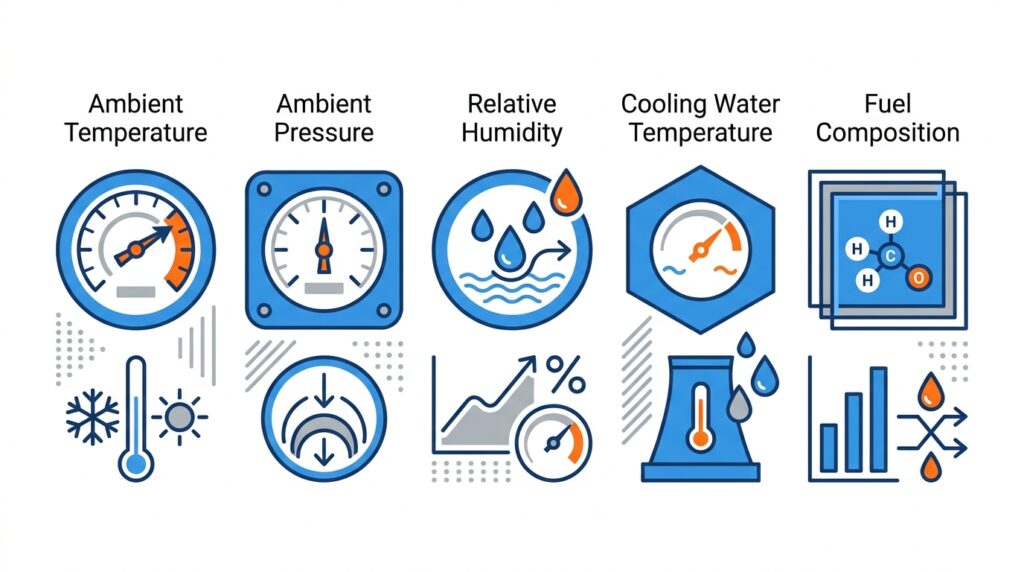
    Reference conditions for plant performance testing

    Performance depends on ambient conditions, fuel quality, and other factors. Reference conditions define the conditions under which guarantees apply.

    Common reference conditions:

    • Ambient temperature: Typically 15°C or 25°C.
    • Ambient pressure: Sea level or site elevation.
    • Relative humidity: Typically specified as a percentage.
    • Cooling water temperature: Typically specified.
    • Fuel composition: Heating value and composition.
    • Emissions basis: Reference oxygen content and dry or wet basis.

    Test results are corrected to reference conditions using correction curves specified in the contract.

    Test Sequence

    Performance testing is normally carried out in stages rather than as a single event:

    1. Preliminary (pre-performance) tests: Run before the formal test to check instruments, plant stability, and likely performance. They allow problems to be fixed before the guarantee test, and may be used to tune the plant.
    2. Reliability run: A continuous operating period, often several days, to demonstrate stable operation and reliability.
    3. Guarantee (acceptance) tests: Formal tests for output, efficiency, emissions, and consumption, conducted and witnessed under the agreed procedures.
    4. Reporting and review: Results are corrected, analyzed, and agreed.

    The contract should state what is required at each stage and whether preliminary test results can count toward acceptance.

    Test Procedures

    Test procedures define how performance testing will be conducted.

    Test procedure elements:

    • Scope: What is being tested?
    • Reference conditions: What conditions apply?
    • Measurement points: Where are measurements taken?
    • Instrumentation: What instruments are used?
    • Test duration: How long is each test?
    • Stabilization: How long must the plant stabilize before testing?
    • Data collection: How is data collected and recorded?
    • Correction curves: How are results corrected to reference conditions?
    • Acceptance criteria: What defines a successful test?
    • Witnessing: Who witnesses the test?

    Test procedures should be agreed before testing begins, ideally as part of the contract.

    Test Standards

    Performance testing should follow recognized standards.

    Standard Application
    ASME PTC 46 Overall plant performance
    ASME PTC 4 Fired steam generators
    ASME PTC 4.4 Heat recovery steam generators
    ASME PTC 6 Steam turbines
    ASME PTC 22 Gas turbines
    ASME PTC 19.1 Test uncertainty
    ISO 2314 Gas turbines: acceptance tests
    ISO 3977 Gas turbine procurement

    Standards define measurement methods, instrumentation, and calculation procedures. The contract should state which standard and edition applies, and any agreed deviations from it.

    Instrumentation and Measurement

    Accurate measurement is essential for meaningful performance testing.

    Parameter Measurement Method
    Fuel flow Flow meters, orifice plates, Coriolis meters
    Fuel heating value Gas chromatograph, calorimeter
    Power output Power meters, current and voltage transformers
    Temperature RTDs, thermocouples
    Pressure Pressure transmitters
    Flow Flow meters, orifice plates
    Emissions Continuous emission monitoring systems (CEMS) or stack testing

    Instruments should be calibrated before testing and traceable to national standards. Fuel sampling and analysis deserve particular care, because heating value errors flow directly into heat rate results.

    Measurement Uncertainty

    All measurements have uncertainty. The contract should define how uncertainty is treated: whether it is added to the guaranteed value, subtracted from the measured value, or treated separately. This affects whether a marginal result passes or fails.

    Uncertainty is calculated using the method in the test standard (for example, ASME PTC 19.1). It is not the same as a contractual tolerance. Uncertainty reflects the quality of the measurement, while tolerance is a negotiated margin around the guarantee. Both can apply, and the contract should say how they combine.

    Test Planning

    Performance testing should be planned well in advance.

    Test planning activities:

    • Define test scope: What tests will be performed?
    • Agree test procedures: What procedures will be used?
    • Prepare instrumentation: Are instruments installed and calibrated?
    • Schedule testing: When will tests be performed?
    • Coordinate parties: Who will participate in testing?
    • Prepare documentation: What documentation is required?
    • Plan contingencies: What if testing is delayed or fails?

    Test planning should begin during commissioning, if not earlier.

    Test Execution

    Performance testing is executed after the plant is stable and operating at the required conditions.

    Test execution steps:

    1. Stabilize the plant: Operate at test conditions until stable.
    2. Verify conditions: Confirm that reference conditions are met.
    3. Start data collection: Begin recording data.
    4. Monitor throughout: Monitor conditions throughout the test.
    5. Complete the test: Run for the specified duration.
    6. Stop data collection: Stop recording data.
    7. Verify data quality: Check data for completeness and accuracy.

    Test Witnessing and Third-Party Verification

    Tests should be witnessed by representatives of both parties. For major tests, an independent third-party witness or verifier may be appointed to confirm that tests are conducted according to the agreed procedures and that results are accurately recorded. This reduces the risk of disputes.

    Test Conditions

    Tests must be conducted under conditions that satisfy the contract requirements.

    Test condition considerations:

    • Load: Tests are usually conducted at full load or specified load.
    • Stability: Conditions must be stable for the specified period.
    • Ambient conditions: Ambient conditions should be within the range specified in the contract.
    • Fuel quality: Fuel should be within the specified range.
    • Plant configuration: Plant should be in the specified configuration, with equipment such as cooling systems, auxiliaries, and any steam or power exports set as the contract requires.
    • No abnormalities: No abnormal conditions should affect the test.

    If conditions are not met, the test may be invalidated or rescheduled.

    Data Collection and Analysis

    Data collected during testing must be accurate and complete.

    Data collection considerations:

    • Data frequency: How often is data recorded?
    • Data storage: Where is data stored?
    • Data verification: How is data verified?
    • Data correction: How is data corrected to reference conditions?
    • Data analysis: How is data analyzed?

    Data should be analyzed by qualified personnel using agreed methods.

    Correction to Reference Conditions

    Test results are corrected to reference conditions using correction curves.

    Factor Effect on Performance
    Ambient temperature Higher temperature reduces output and increases heat rate
    Ambient pressure Lower pressure reduces output
    Relative humidity Affects combustion and output
    Cooling water temperature Higher temperature reduces output and efficiency
    Fuel heating value Affects fuel consumption and output

    Correction curves are typically provided by the equipment manufacturer and specified in the contract. If the plant is tested before it is fully “clean” or after some operating hours, the contract should also state whether any degradation or ageing allowance applies.

    Test Results and Acceptance
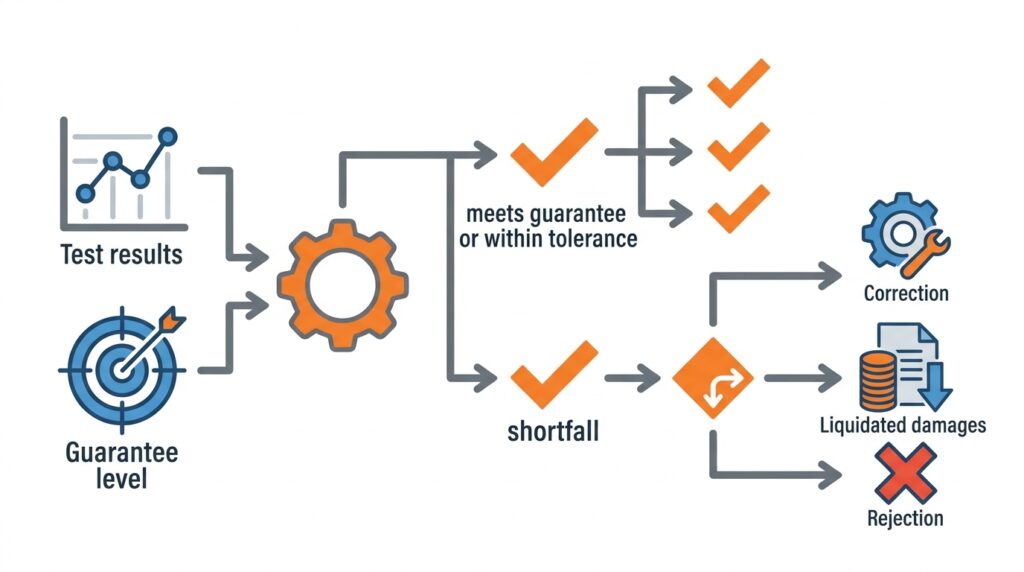
    Performance test acceptance decision process

    Test results are compared to the guarantees to determine acceptance.

    Acceptance criteria:

    • Meets guarantee: If results meet the guarantee, the test passes.
    • Within tolerance: If results are within the agreed tolerance or uncertainty treatment, the test may pass.
    • Shortfall: If results fall short of the guarantee, remedies may apply.

    Shortfalls may result in:

    • Correction: The contractor may correct the shortfall.
    • Liquidated damages: The contractor may pay damages.
    • Rejection: In extreme cases, such as a miss against the minimum guarantee, the owner may reject the plant.

    Test Report

    The test results should be documented in a formal report, typically including the test procedure followed, instrument calibration records, raw and corrected data, uncertainty analysis, comparison to guarantees, and any deviations from the agreed procedure. Both parties should review and sign off the report. It becomes a key document for acceptance and for any later dispute.

    Failed Tests and Root Cause

    When a performance test fails, root cause analysis should determine whether the shortfall is due to design, construction, commissioning, or operating conditions. This determines whether correction, retest, or a commercial settlement is appropriate.

    Liquidated Damages

    Liquidated damages are pre-agreed compensation for performance shortfalls.

    Factor Description
    Guaranteed value The contractual guarantee
    Actual value The measured performance
    Shortfall The difference
    Damage rate Pre-agreed rate per unit of shortfall
    Cap Maximum liquidated damages

    Liquidated damages should reflect the actual loss to the owner, not be punitive. Contracts often pay for shortfalls in output and heat rate separately, so the damage rate for each should be tied to the owner’s real economics, such as lost revenue or extra fuel cost over the plant’s life.

    Retesting

    If a test fails, the contractor may be entitled to retest.

    Retest considerations:

    • Correction: The contractor corrects the shortfall before retesting.
    • Time limit: Retesting must occur within a specified time.
    • Number of retests: The contract may limit the number of retests.
    • Cost: Who bears the cost of retesting?

    Retesting should be planned as part of the performance testing process.

    Final Acceptance

    Final acceptance is the formal confirmation that the plant meets requirements.

    Final acceptance activities:

    • Review test results: Confirm that results meet guarantees.
    • Resolve shortfalls: Address any shortfalls.
    • Complete documentation: Confirm documentation is complete.
    • Sign acceptance certificate: Formal acceptance of the plant.

    Final acceptance triggers payment and warranty.

    Common Mistakes in Performance Testing

    Even experienced organizations make mistakes. Common ones include:

    • No test procedures: Testing without agreed procedures.
    • Inadequate instrumentation: Instruments not installed or calibrated.
    • Poor test planning: Testing not planned in advance.
    • Invalid conditions: Testing under conditions that do not meet requirements.
    • Inadequate data collection: Data incomplete or inaccurate.
    • Poor data analysis: Data analyzed incorrectly.
    • No witnessing: Tests not witnessed by both parties.
    • Undefined uncertainty treatment: Marginal results disputed because the contract is silent on uncertainty.
    • Disputes over results: Disagreements on test validity or results.
    • No contingency: No plan for what to do if testing fails.

    These mistakes are costly to correct. They are much cheaper to avoid through good planning and disciplined execution.

    How Japanese EPC Firms Approach Performance Testing

    Japanese engineering firms are known for their disciplined approach to performance testing. Common characteristics include:

    • Thorough planning: Testing is planned carefully, with agreed procedures.
    • Detailed preparation: Instruments are installed and calibrated before testing, and preliminary tests are used to find problems early.
    • Disciplined execution: Tests are conducted under controlled conditions.
    • Comprehensive documentation: Results are documented completely and accurately.
    • Careful analysis: Data is analyzed carefully using agreed methods.
    • Continuous improvement: Lessons are captured and applied.

    For plant owners, this often means performance testing that is fair, accurate, and conclusive.

    How to Evaluate Performance Testing Readiness

    When reviewing performance testing readiness, ask:

    Question Why It Matters
    Are performance guarantees defined (full and minimum)? Defines what the plant must achieve
    Are reference conditions specified? Defines the conditions under which guarantees apply
    Are test procedures agreed? Defines how testing will be conducted
    Are standards specified? Ensures testing follows recognized methods
    Is instrumentation installed and calibrated? Ensures accurate measurement
    Is the treatment of measurement uncertainty defined? Decides whether marginal results pass or fail
    Is test planning complete, including preliminary tests? Ensures testing is well-organized
    Are both parties prepared, and is a third-party witness needed? Ensures testing is witnessed and agreed
    Is data collection and analysis planned? Ensures results are reliable
    Are retest procedures and root cause process defined? Provides for contingencies
    Is final acceptance planned? Ensures formal confirmation

    A plant that addresses these questions is ready for performance testing.

    Conclusion

    Performance testing and acceptance are the final verification that the plant meets its guarantees. For small to medium-scale industrial plants, they determine whether the project closes successfully.

    By focusing on performance guarantees, reference conditions, test procedures, standards, instrumentation, measurement uncertainty, test planning, execution, data analysis, and acceptance, owners and contractors can ensure that performance testing is fair, accurate, and conclusive.

    Key Takeaways

    • Performance testing verifies that the plant meets its contractual guarantees
    • Performance guarantees define output, efficiency, emissions, and other metrics
    • Testing is the mechanism for verifying guarantees; both must be clearly defined in the contract
    • Reference conditions define the conditions under which guarantees apply
    • Test procedures and standards define how testing is conducted
    • Accurate, calibrated instrumentation is essential for meaningful results
    • The contract should define how measurement uncertainty is treated
    • Test results are corrected to reference conditions using correction curves
    • Acceptance depends on whether results meet guarantees, fall within tolerance, or fall short
    • Independent third-party witnesses can reduce the risk of disputes
    • Failed tests need root cause analysis to decide between correction, retest, or settlement
    • Liquidated damages compensate the owner for shortfalls
    • Retesting may be permitted if a test fails
    • Japanese EPC firms emphasize thorough planning and careful data analysis

  • Plant Operations Readiness: Key Practices for EPC Projects

    Plant Operations Readiness: Key Practices for EPC Projects

    A plant can be built on time, within budget, and to specification, and still fail in its first months of operation. The equipment works. The systems are commissioned. But the owner’s team is not ready to run the plant. Procedures are missing, staff are untrained, spare parts are not in place, and the first failures catch everyone by surprise.

    Operations readiness is the discipline of ensuring that the owner’s organization is prepared to operate and maintain the plant from day one. It is not just about the plant being ready. It is about the people, procedures, systems, and support being ready too.

    For small to medium-scale industrial plants, operations readiness is especially important because there is less redundancy and fewer resources to absorb the consequences of an unprepared start. A plant that starts up without a ready operations team can suffer early failures, safety incidents, and extended teething problems.

    This article covers the key practices in operations readiness, from readiness planning to staffing, procedures, training, the transition to operations, and first-year support.

    What Is Operations Readiness?

    Operations readiness is the process of preparing the owner’s organization to operate and maintain the plant. It covers:

    • Organization: Is the right team in place, with the right skills?
    • Procedures: Are operating, maintenance, and emergency procedures ready?
    • Training: Are staff trained and competent?
    • Systems: Are maintenance, stores, information, and other support systems in place?
    • Spares and consumables: Are the parts and materials needed for operation available?
    • Support: Are vendor support and technical assistance arrangements in place?
    • Safety: Are safety systems, permits, and emergency arrangements ready?
    • Budget and contracts: Are operating funds and service contracts approved and in place?

    Operations readiness is not the same as plant readiness. A plant can be mechanically complete and commissioned while the owner’s team is still unprepared to operate it.

    Why Operations Readiness Matters

    Factor Good Readiness Poor Readiness
    Startup Smooth start; issues resolved quickly Chaotic start; issues escalate
    Safety Hazards understood and controlled Incidents during early operation
    Reliability Equipment operated within limits Early failures from poor operation
    Cost Operating costs controlled Emergency purchases; rework
    Morale Team confident and capable Team overwhelmed and demoralized
    Compliance Regulatory requirements met Non-compliance from day one

    For small plants, where the team may be small and multi-skilled, operations readiness determines whether the plant can actually be run.

    Operations Readiness Planning

    Operations readiness should be planned alongside the project, not after it. Readiness planning activities include:

    • Define readiness criteria: What must be in place before startup?
    • Define readiness scope: Which areas, systems, and functions are covered?
    • Assign responsibility: Who is responsible for each readiness element?
    • Develop a readiness plan: What must be done, by when, and by whom?
    • Track readiness: Monitor progress against the plan.
    • Conduct readiness reviews: Verify readiness before startup.

    Readiness planning should begin early, ideally during design, so that the owner’s organization has time to recruit, train, and prepare. Readiness activities should also be built into the project schedule, so that they are not squeezed when construction runs late.

    The Operations Readiness Coordinator

    Someone must own the readiness process. An operations readiness coordinator should be appointed to lead the readiness effort. This person tracks progress, coordinates between the project team and the owner’s operations team, and reports to management. Without a clear owner, readiness tasks tend to fall between the project team (focused on construction) and the operations team (not yet fully formed).

    Operations Readiness Reviews

    Operations readiness reviews should be conducted at defined milestones, such as 6 months and 3 months before startup. Each review verifies progress against the readiness plan and identifies gaps that must be closed before startup. A final review shortly before startup confirms that all readiness criteria are met and supports the decision to proceed. This review complements the pre-startup safety review (PSSR), which focuses on process safety, by covering the full scope of organizational readiness.

    Operations Readiness Criteria

    Readiness criteria define what must be in place before startup.

    Criterion Description
    Organization Team in place, roles defined, skills available
    Procedures Operating, maintenance, and emergency procedures ready
    Training Staff trained and assessed as competent
    Maintenance systems CMMS, planning, and scheduling in place
    Stores and spares Spare parts and consumables available
    Vendor support Support arrangements in place
    Safety systems Safety systems, permits, and emergency plans ready
    Documentation Operating and maintenance documentation available
    Utilities and consumables Utilities and consumables available
    Information systems Plant data, reporting, and control system access and security in place
    Budget and contracts Operating budget approved; service contracts in place
    Regulatory approvals Permits and approvals in place

    Readiness criteria should be defined in the contract and agreed by both parties.

    Organization and Staffing

    The owner’s organization must be in place before startup. Staffing considerations include:

    • Roles and responsibilities: Who does what?
    • Skills and competencies: What skills are required?
    • Staffing levels: How many people are needed?
    • Shift arrangements: How will shifts be covered?
    • Reporting lines: Who reports to whom?
    • Contractor support: What support will be provided by contractors?
    • Recruitment lead time: When must hiring start so that staff are on board in time to train?

    For small plants, staff may be multi-skilled and cover multiple roles. Clarity of roles and responsibilities is still essential.

    Procedures

    Operating, maintenance, and emergency procedures must be ready before startup.

    Procedure Type Purpose
    Operating procedures How to start up, operate, and shut down
    Emergency procedures How to respond to emergencies
    Maintenance procedures How to inspect, maintain, and repair
    Safety procedures Permit-to-work, lockout/tagout, confined space
    Alarm response procedures How to respond to specific alarms
    Laboratory procedures How to sample and test

    Procedures must be accurate, clear, and available to the people who need them. They should be reviewed by the operators who will use them and updated after commissioning to reflect how the plant actually behaves.

    Training and Competency

    The owner’s staff must be trained and competent before startup.

    Category Description
    Operations training How to operate the plant
    Maintenance training How to maintain equipment
    Safety training How to work safely
    Emergency training How to respond to emergencies
    Vendor training Equipment-specific training from vendors
    Simulator training Practice in a simulated environment

    Training considerations:

    • Timing: Training should begin well before startup.
    • Competency assessment: Training should include assessment of competency.
    • Documentation: Training records should be maintained.
    • Drills: Emergency drills should be held before startup, not after the first real event.
    • Refresher training: Refresher training should be planned.

    Training is not complete until staff can demonstrate competency.

    Operator Involvement in Commissioning

    Operators should be involved in commissioning where possible. Participating in cold and hot commissioning, and assisting with integrated testing, gives them hands-on familiarity with the plant that classroom training cannot provide. Involvement also lets operators learn the plant’s quirks, test the draft procedures, and raise concerns while changes are still easy to make. For this to work, operators must be recruited early enough to be present during commissioning.

    Maintenance Systems

    Maintenance systems should be set up and populated before startup. Key elements include:

    • CMMS: Computerized maintenance management system.
    • Equipment register: List of equipment and assets.
    • Preventive maintenance plans: Scheduled maintenance tasks.
    • Spare parts inventory: Parts and materials in stock.
    • Work order system: How work is requested and tracked.
    • Planning and scheduling: How work is planned and scheduled.

    Spares and Consumables

    Spare parts and consumables should be in place before startup, not ordered after the first failure.

    • Critical spares: Spares essential for operation.
    • Recommended spares: Spares recommended by vendors.
    • Consumables: Filters, lubricants, chemicals, and initial fills.
    • Inventory: Spare parts inventory and location.
    • Supplier information: Supplier contacts and part numbers.

    Vendor Support

    Vendor support arrangements should be in place before startup.

    • Warranty support: Who to contact for warranty claims.
    • Technical support: Who to contact for technical assistance.
    • Field service: Availability of field service support.
    • Spare parts support: Availability of spare parts.
    • Training support: Availability of vendor training.
    • Documentation support: Access to vendor documentation.

    Vendor support is especially important for specialized equipment.

    Safety Systems and Permits

    Safety readiness is not optional. It is a prerequisite for startup.

    • Safety systems: Fire and gas detection, emergency shutdown, relief systems.
    • Permits: Operating permits, environmental permits, and other approvals.
    • Emergency response: Emergency plans, equipment, and training.
    • Safety procedures: Permit-to-work, lockout/tagout, confined space.
    • PPE: Personal protective equipment available.
    • Safety training: Staff trained on safety systems and procedures.

    Regulatory Approvals

    Regulatory approvals should be obtained before startup, not after.

    • Operating permits: Permits to operate the plant.
    • Environmental permits: Permits for emissions, discharges, and waste.
    • Safety certifications: Pressure vessel, boiler, and other certifications.
    • Occupancy certificates: Certificates for buildings and structures.
    • Insurance: Insurance coverage in place.

    Operating Budget, Contracts, and Information Systems

    Two further areas are often overlooked.

    Budget and contracts. The operating budget should be approved before startup, covering staffing, consumables, utilities, spares, and service contracts. Where the owner relies on third parties for services such as specialist maintenance, laboratory testing, or waste handling, these contracts should be in place and tested before they are needed.

    Information systems. Plant data, reporting, and control system access should be ready, with clear ownership of data and appropriate cybersecurity controls. Operators and engineers need the data to run the plant and track performance from the first day.

    The Transition from Project to Operations

    The transition from project to operations is a critical handover point and should be carefully managed. This includes transferring responsibility, documentation, and knowledge from the project team to the operations team, with clear milestones and sign-offs. A good transition addresses:

    • Responsibility: When does each system pass from the project team to operations?
    • Documentation: Are as-built drawings, manuals, and records complete and accessible?
    • Knowledge: Are key project staff available to brief the operations team and answer questions?
    • Open items: Is there an agreed punch list, with owners and deadlines?
    • Sign-offs: Are handover milestones formally recorded?

    First-Year Support

    The first year of operation is critical. Support during this period helps the owner’s team through teething problems.

    • Vendor support: Ongoing support from equipment vendors.
    • Contractor support: Support from the EPC contractor during the warranty and defect liability period.
    • Technical assistance: Access to technical expertise when needed.
    • Performance monitoring: Monitoring plant performance, including performance guarantee tests, and addressing issues.
    • Training refreshers: Additional training as needed.
    • Lessons learned: Capturing and applying lessons from early operation.

    First-year support helps the owner’s team build confidence and competence.

    Common Mistakes in Operations Readiness

    • No readiness planning: Readiness left to chance.
    • No owner: No one appointed to lead the readiness effort.
    • Late staffing: Staff recruited too late.
    • Incomplete training: Staff not trained or competent.
    • Procedures missing: Procedures not ready at startup.
    • Spares missing: Spares ordered after the first failure rather than before startup.
    • No maintenance systems: CMMS and maintenance plans not in place.
    • No vendor support: Support arrangements not in place.
    • Safety gaps: Safety systems or permits not ready.
    • Rushed handover: Responsibility transferred without documentation or sign-off.
    • No first-year support: Owner left to fend for themselves after startup.

    These mistakes are costly to correct. They are much cheaper to avoid through good planning and disciplined execution.

    How Japanese EPC Firms Approach Operations Readiness

    Japanese engineering firms are known for their disciplined approach to operations readiness. Common characteristics include:

    • Early planning: Readiness is planned from the beginning of the project.
    • Detailed preparation: Procedures, training, and systems are prepared carefully.
    • Comprehensive training: Staff are trained and assessed for competency.
    • Operator participation: Owner’s operators take part in commissioning and testing.
    • Strong support: Vendor and contractor support is in place.
    • Disciplined startup: Startup is controlled and monitored.
    • Continuous improvement: Lessons are captured and applied.
    • Long-term focus: Readiness is treated as the foundation for reliable operation.

    For plant owners, this often means a plant that starts up smoothly and operates reliably from day one.

    How to Evaluate Operations Readiness

    Question Why It Matters
    Is readiness planned? Provides a roadmap for readiness
    Is a readiness coordinator appointed? Ensures someone owns the process
    Are readiness criteria defined? Defines what must be in place
    Are readiness reviews scheduled? Finds gaps while there is time to close them
    Is the organization in place? Ensures someone is available to operate
    Are procedures ready? Ensures staff know what to do
    Is training complete? Ensures staff are competent
    Are operators involved in commissioning? Builds hands-on familiarity
    Are maintenance systems in place? Ensures maintenance can be planned and tracked
    Are spares available? Ensures critical parts are on hand when failures occur
    Is vendor support in place? Ensures support is available when needed
    Are safety systems and permits ready? Ensures safe and legal operation
    Is the handover managed? Ensures responsibility, documents, and knowledge transfer cleanly
    Is first-year support in place? Ensures teething problems are addressed

    A plant that addresses these questions is ready to operate.

    Conclusion

    Operations readiness is critical to plant success. For small to medium-scale industrial plants, it determines whether the owner can operate the plant effectively from day one.

    By focusing on readiness planning, criteria, organization, procedures, training, maintenance systems, spares, vendor support, safety, a managed transition, and first-year support, owners and project teams can ensure that the plant starts up smoothly and operates reliably.

    Key Takeaways

    • Operations readiness ensures the owner’s organization is prepared to operate and maintain the plant
    • Readiness is not the same as plant readiness
    • Readiness should be planned from the beginning of the project
    • Appoint an operations readiness coordinator and hold reviews at defined milestones, such as 6 and 3 months before startup
    • Readiness criteria define what must be in place before startup
    • Organization, procedures, training, and systems must all be ready
    • Involve operators in commissioning for hands-on familiarity
    • Spares, vendor support, and safety systems are essential
    • Manage the transition from project to operations with clear milestones and sign-offs
    • First-year support helps the team through teething problems
    • Japanese EPC firms emphasize early planning and comprehensive training
  • Plant Handover and Turnover: Key Practices for EPC Projects

    Plant Handover and Turnover: Key Practices for EPC Projects

    Handover is the moment when the plant stops being a construction project and becomes an operating asset. The contractor’s job is done. The owner’s team takes over. Operations begin.

    This transition is one of the most critical, and most often rushed, phases of a project. If handover is done well, the owner receives a plant that is complete, documented, and ready to operate. If handover is done poorly, the owner inherits a plant with missing documentation, unresolved defects, and untrained staff, problems that can persist for years.

    For small to medium-scale industrial plants, handover is especially important because there is less redundancy and fewer resources to absorb the consequences of an incomplete handover. The owner’s team must be ready to operate from day one.

    This article covers the key practices in plant handover and turnover, from handover planning to documentation, control systems, permits, training, and final acceptance.

    What Is Handover and Turnover?

    Handover and turnover are the processes of transferring the plant from the contractor to the owner.

    The terms are often used interchangeably, but there is a subtle difference:

    • Turnover typically refers to the transfer of individual systems or areas from construction to commissioning.
    • Handover typically refers to the final transfer of the completed plant from the contractor to the owner.

    Both are part of the same overall process: transferring responsibility, documentation, and knowledge from the project team to the operating team.

    Why Handover Matters

    Handover determines whether the owner can operate the plant effectively.

    Factor Impact of Good Handover Impact of Poor Handover
    Readiness Owner ready to operate from day one Owner struggles to operate
    Documentation Complete, accurate, accessible Missing or incomplete
    Training Staff trained and confident Staff unprepared
    Defects Outstanding items resolved Defects persist for years
    Warranty Claims managed effectively Warranty issues unresolved
    Safety Hazards understood and controlled Hazards unknown

    For small plants, where there is less margin for error, handover determines whether operations start smoothly or struggle.

    Handover Planning

    Handover should be planned from the beginning of the project, not left to the end.

    Handover planning activities:

    • Define handover criteria: What must be complete before handover?
    • Define handover process: What are the steps in the handover?
    • Define responsibilities: Who is responsible for what?
    • Define documentation requirements: What documents must be delivered, in what format, and by when?
    • Define training requirements: What training must be provided?
    • Define acceptance criteria: What defines successful handover?
    • Schedule handover activities: When will each activity occur?

    Handover planning should be integrated into the overall project plan. It is good practice to appoint a handover coordinator on both the contractor and owner sides, and to hold regular handover readiness meetings well before mechanical completion.

    Handover Criteria

    Handover criteria define what must be complete before handover.

    Criterion Description
    Mechanical completion All systems built, installed, and tested
    Commissioning complete All systems commissioned and functional
    Performance testing Plant meets performance guarantees
    Punch list Outstanding items resolved or accepted
    Documentation Complete and accurate documentation delivered
    Control systems Software, licenses, and configuration records delivered
    Permits Regulatory approvals transferred or reissued
    Training Owner’s staff trained and competent
    Spare parts Required spare parts delivered
    Warranty Warranty terms documented and accepted

    Handover criteria should be defined in the contract and agreed by both parties.

    Mechanical Completion

    Mechanical completion is the milestone where all systems are built, installed, and ready for commissioning.

    Mechanical completion activities:

    • Construction complete: All construction work finished.
    • Inspection complete: All inspections completed and accepted.
    • Testing complete: All static tests completed (for example, pressure tests, loop checks, and insulation resistance tests).
    • Punch list: Outstanding items identified.
    • Documentation: As-built documentation prepared.

    Mechanical completion is often a contractual milestone with payment implications.

    Commissioning Completion

    Commissioning completion is the milestone where all systems are commissioned and functional.

    Commissioning completion activities:

    • System testing: All systems tested and functional.
    • Interface testing: Interfaces between systems tested.
    • Performance testing: Performance verified against guarantees.
    • Documentation: Commissioning records complete.
    • Punch list: Outstanding items resolved.

    Commissioning completion confirms that the plant is ready for operation.

    Punch List Management

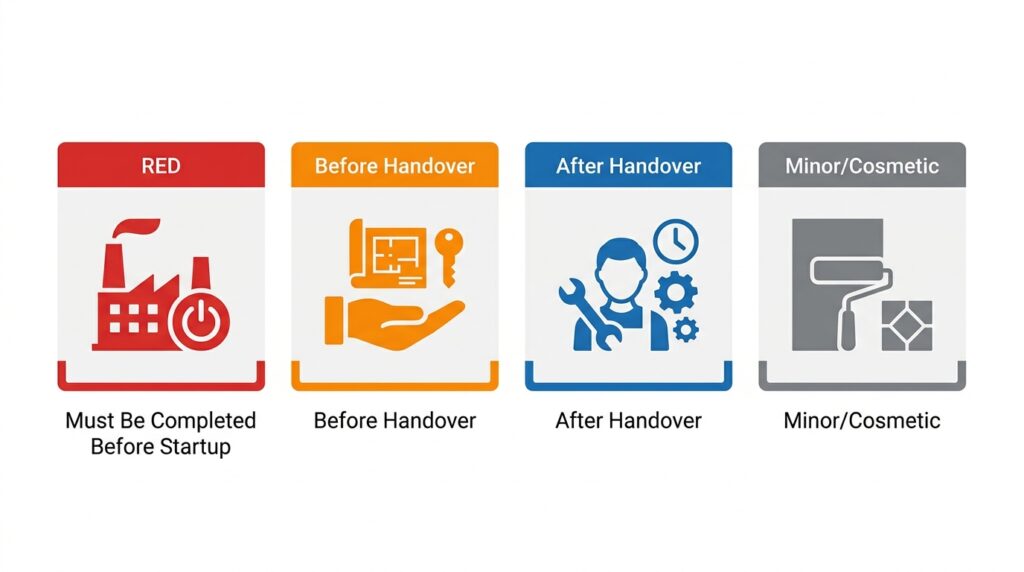
    The punch list is a record of outstanding items that must be completed before handover.

    Category Description Priority
    A Must be completed before startup Highest
    B Must be completed before handover High
    C Can be completed after handover Medium
    D Minor or cosmetic items Low

    Punch list management:

    • Identification: Identify all outstanding items.
    • Categorization: Categorize by priority.
    • Assignment: Assign responsibility for each item.
    • Tracking: Track completion of each item.
    • Verification: Verify that items are completed correctly.
    • Closure: Close items when complete.

    The punch list should be managed actively, not left to the end. Category C and D items that remain open at handover should have an agreed completion date and a clear owner, and the contract should specify any payment retention tied to them. Category A items, especially those with safety implications, must never be carried past startup.

    Documentation Handover

    Types of handover documentation for plant handover

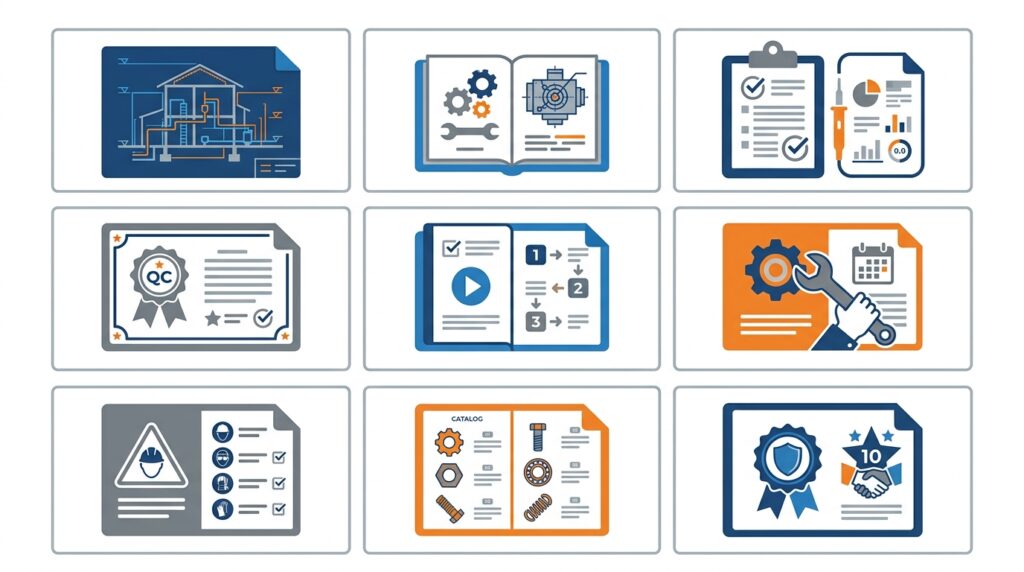
    Documentation is one of the most important, and most often incomplete, aspects of handover.

    Document Type Examples
    As-built drawings P&IDs, isometrics, electrical drawings
    Equipment manuals Vendor manuals, operating instructions
    Test records Commissioning records, test certificates
    Quality records Inspection reports, material certificates
    Operating procedures Startup, operation, shutdown procedures
    Maintenance procedures Inspection, maintenance, repair procedures
    Safety procedures Emergency procedures, safety data sheets
    Spare parts lists Recommended spares, supplier information
    Warranty documents Warranty terms, contact information
    Control system records Software backups, configuration records, control logic documentation
    Permits and approvals Operating permits, licenses, inspection certificates

    Documentation should be complete, accurate, and organized for easy access. Agree on the format (paper, electronic, or both), the indexing and naming convention, and the document register before handover begins. A handover document register, checked item by item against the contract requirements, is the most reliable way to confirm that nothing is missing.

    As-Built Documentation

    As-built documentation reflects the plant as it was actually built, not as it was designed.

    As-built documentation requirements:

    • Updated drawings: Drawings reflect actual construction.
    • Marked changes: Changes from design are clearly marked.
    • Approval: As-built documentation is approved by the contractor.
    • Verification: As-built documentation is verified against the plant, typically through a field walkdown.
    • Delivery: As-built documentation is delivered to the owner.

    As-built documentation is essential for future maintenance, modifications, and safety. Incorrect or outdated P&IDs, for example, can lead to mistakes in isolation, management of change, and hazard reviews.

    Control Systems and Software Handover

    Control systems and software are often overlooked at handover. Control system handover includes software backups, licenses, configuration records, and documentation of control logic, alarm settings, and safety system configurations. Without these, the owner cannot maintain or modify the control system independently.

    Control system handover typically includes:

    • Software backups: Complete, verified backups of DCS, PLC, SCADA, and safety system programs.
    • Licenses: Software licenses transferred to the owner, with registration details and renewal dates.
    • Configuration records: Network configuration, I/O lists, and hardware configuration records.
    • Control logic documentation: Control narratives, logic diagrams, and cause-and-effect matrices.
    • Alarm and setpoint records: Alarm settings, trip setpoints, and the alarm rationalization basis.
    • Safety system configuration: Safety instrumented system settings, bypass records, and proof test requirements.
    • Access and security: Administrator credentials, user accounts, and cybersecurity documentation transferred under a controlled process, with any contractor or vendor default passwords changed.

    The backups should be tested to confirm they can actually be restored, not just stored.

    Permits and Regulatory Approvals

    Regulatory permits, licenses, and approvals should be transferred or reissued in the owner’s name at handover. Operating permits may require inspection or certification before they are issued.

    Both parties should agree early on who is responsible for each permit. Typical items include:

    • Operating permits and licenses
    • Environmental permits and emission or discharge approvals
    • Pressure vessel and boiler certifications
    • Electrical and fire safety inspections and approvals
    • Occupancy or completion certificates

    The permit register should record the issuing authority, validity period, conditions, and renewal dates. Missing a permit can delay startup or place the owner out of compliance on the first day of operation.

    Training and Competency

    The owner’s staff must be trained to operate and maintain the plant.

    Category Description
    Operations training How to operate the plant
    Maintenance training How to maintain equipment
    Safety training How to work safely
    Emergency training How to respond to emergencies
    Vendor training Equipment-specific training from vendors

    Training considerations:

    • Timing: Training should begin before handover, and ideally before commissioning, so that operators can take part in startup.
    • Competency: Training should include competency assessment.
    • Documentation: Training records should be maintained.
    • Refresher: Refresher training should be planned.

    Training is not complete until staff can demonstrate competency.

    Training Records and Competency Assessments

    Training records, including competency assessments and qualifications, should be handed over to the owner. These records demonstrate that staff are qualified to operate and maintain the plant, and they support future audits and regulatory compliance.

    Spare Parts and Consumables

    The owner needs spare parts and consumables to operate and maintain the plant.

    Spare parts handover:

    • Recommended spares: Spares recommended by vendors.
    • Critical spares: Spares essential for operation.
    • Consumables: Filters, lubricants, chemicals, and initial fills.
    • Inventory: Spare parts inventory and location.
    • Supplier information: Supplier contacts and part numbers.

    Spare parts should be delivered, inventoried, and stored properly. Spares used by the contractor during commissioning should be replaced before handover.

    Warranty Management

    Warranty management begins at handover and continues through the warranty period.

    Warranty handover:

    • Warranty terms: What is covered, for how long, and from what date.
    • Warranty contacts: Who to contact for warranty claims.
    • Warranty procedures: How to submit and track claims.
    • Warranty register: Record of all warranties and expiry dates.

    Warranty management should be planned from the beginning of the project. Owners should also keep a clear record of defects found during the warranty period, with dates and evidence, so that claims can be made before the warranty expires. A defects inspection shortly before expiry is good practice.

    Vendor Contacts and Support Arrangements

    Vendor contact information and support arrangements should be documented at handover. This includes warranty contacts, technical support, spare parts suppliers, and service agreements.

    A vendor support register should list, for each major item of equipment, the vendor, local service representative, technical support channel, response time commitments, and any service or maintenance agreements. Ongoing vendor support is especially important for specialized equipment such as turbines, compressors, and control systems.

    Care, Custody, and Control

    Handover is also a transfer of responsibility and risk. The contract should state clearly when care, custody, and control of each system or area passes from the contractor to the owner. This affects:

    • Safety responsibility: Who authorizes work, controls isolations, and responds to incidents in each area.
    • Insurance: When the construction insurance ends and the owner’s operating insurance begins.
    • Site access and security: Who controls access to the plant.
    • Utilities and consumables: Who pays for and manages power, water, and fuel.

    A pre-startup safety review (PSSR) before introducing hazardous materials or energy is the key safety check at this point. Any gap between the contractor’s and owner’s responsibilities should be closed before startup.

    Final Acceptance

    Final acceptance is the formal confirmation that the plant meets requirements.

    Final acceptance activities:

    • Verification: Verify that all requirements are met.
    • Punch list closure: Confirm that all punch list items are closed or accepted.
    • Documentation review: Confirm that documentation is complete.
    • Training confirmation: Confirm that training is complete.
    • Sign-off: Sign the final acceptance certificate.

    Final acceptance is a contractual milestone with payment and warranty implications.

    Many contracts use two acceptance stages. Provisional acceptance (also called taking-over or preliminary acceptance) occurs when the plant has passed performance tests and the owner takes over operation, with the warranty period starting. Final acceptance occurs at the end of the warranty period, once defects have been corrected and the remaining retention is released. Owners should check which terms and milestones their contract uses so that payment, warranty, and responsibility are all clearly tied to the right event.

    Handover Ceremony and Knowledge Transfer

    Handover is not just a formal event. It is a knowledge transfer.

    Knowledge transfer activities:

    • Walkthroughs: Contractor walks the owner through the plant.
    • System explanations: Contractor explains how systems work.
    • Lessons learned: Contractor shares lessons from construction and commissioning.
    • Contacts: Contractor provides contacts for future support.
    • Documentation review: Contractor explains documentation.

    Knowledge transfer ensures that the owner understands the plant, not just owns it. Where possible, owner operations and maintenance staff should be involved during construction and commissioning, so that handover confirms knowledge they already have rather than introducing it for the first time.

    Common Mistakes in Handover and Turnover

    Even experienced organizations make mistakes. Common ones include:

    • Handover not planned: Handover left to the end.
    • Incomplete documentation: Missing or incomplete documents.
    • Control system records missing: No backups, licenses, or configuration records.
    • Permits not transferred: Regulatory approvals not in the owner’s name or not yet issued.
    • Punch list not managed: Outstanding items not tracked.
    • Training incomplete: Staff not trained or competent, or training records not handed over.
    • Spare parts missing: Spares not delivered or inventoried.
    • Warranty not documented: Warranty terms unclear.
    • Vendor support unclear: No record of who to call when equipment fails.
    • Final acceptance rushed: Sign-off without proper verification.
    • Knowledge transfer poor: Owner does not understand the plant.
    • Handover criteria unclear: What must be complete is not defined.

    These mistakes are costly to correct. They are much cheaper to avoid through good planning and disciplined execution.

    How Japanese EPC Firms Approach Handover and Turnover

    Japanese engineering firms are known for their disciplined approach to handover. Common characteristics include:

    • Thorough planning: Handover is planned from the beginning.
    • Detailed documentation: Documentation is complete and accurate.
    • Disciplined punch list management: Outstanding items are tracked and closed.
    • Comprehensive training: Staff are trained and assessed for competency.
    • Systematic knowledge transfer: Contractor ensures the owner understands the plant.
    • Formal acceptance: Final acceptance is not rushed.
    • Long-term support: Contractor provides support after handover.

    For plant owners, this often means a plant that is ready to operate from day one.

    How to Evaluate Handover Readiness

    When reviewing handover readiness, ask:

    Question Why It Matters
    Is handover planned? Provides a roadmap for handover
    Are handover criteria defined? Defines what must be complete
    Is mechanical completion achieved? Confirms construction is complete
    Is commissioning complete? Confirms systems are functional
    Is the punch list managed? Ensures outstanding items are tracked
    Is documentation complete? Ensures owner has needed information
    Are control system backups, licenses, and records delivered? Allows the owner to maintain and modify the control system
    Are permits transferred or reissued? Ensures legal operation from day one
    Is training complete and recorded? Ensures staff can operate the plant and supports audits
    Are spare parts delivered? Ensures owner can maintain the plant
    Are warranty and vendor support documented? Ensures claims and support requests can be made
    Is responsibility for care, custody, and control clear? Avoids gaps in safety and insurance
    Is final acceptance planned? Ensures formal confirmation

    A plant that addresses these questions is ready for successful handover.

    Conclusion

    Handover and turnover are the transition from construction to operation. For small to medium-scale industrial plants, they determine whether the owner can operate the plant effectively from day one.

    By focusing on handover planning, criteria, punch list management, documentation, control systems, permits, training, spare parts, warranty, vendor support, and final acceptance, owners and contractors can ensure that handover is smooth and the plant is ready for reliable operation.

    Key Takeaways

    • Handover is the transition from construction to operation
    • Handover should be planned from the beginning of the project
    • Handover criteria define what must be complete before handover
    • Punch list items should be categorized by priority and managed actively
    • Documentation handover includes as-built drawings, manuals, records, procedures, and warranties
    • Control system handover includes software backups, licenses, and configuration records
    • Permits and regulatory approvals should be transferred or reissued in the owner’s name
    • Training is not complete until staff can demonstrate competency, and training records should be handed over
    • Spare parts, warranty, and vendor support arrangements are part of handover
    • Final acceptance is a formal confirmation with contractual implications
    • Knowledge transfer ensures the owner understands the plant
    • Japanese EPC firms emphasize thorough planning and disciplined documentation
  • Plant Quality Management: Key Practices for EPC Projects

    Plant Quality Management: Key Practices for EPC Projects

    Quality is one of the three pillars of project success, alongside cost and schedule. A plant that is built quickly and cheaply but does not perform as designed, or fails prematurely, is not a success. Quality management is the discipline of ensuring that the plant is designed, built, and commissioned to meet its specifications.

    Quality is not just about inspection at the end. It is about building quality into every phase of the project, from design through procurement, construction, and commissioning. Quality problems discovered late are expensive to fix; quality problems prevented from the start cost far less.

    For small to medium-scale industrial plants, quality management is especially important because there is less redundancy and fewer resources to absorb the consequences of quality failures. A defective component or a poorly executed installation can cause outages, safety incidents, and costly rework.

    This article covers the key practices in plant quality management, from quality planning to inspection, testing, and continuous improvement.

    What Is Quality Management?

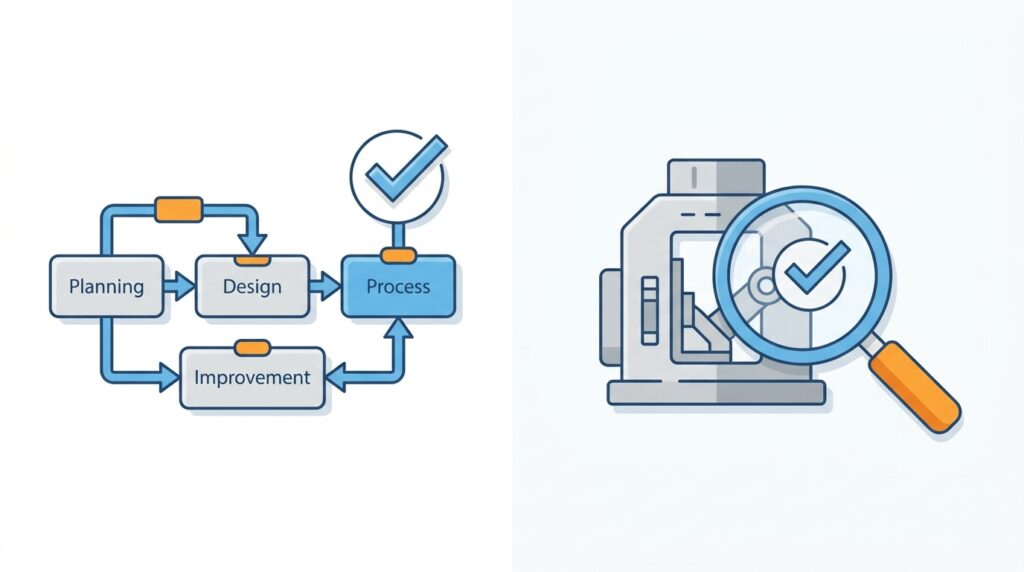
    Quality management is the process of planning, controlling, and improving quality to meet project requirements. It includes:

    • Quality planning: Defining what quality means and how it will be achieved.
    • Quality assurance: Ensuring that processes are capable of producing quality.
    • Quality control: Inspecting and testing to verify that quality is achieved.
    • Quality improvement: Continuously improving processes and outcomes.

    ▲ On EPC projects these activities are usually organized within a quality management system (QMS), often based on ISO 9001, and documented in a project quality plan (see ISO 10005 for guidance) that explains how the system applies to the specific project.

    Why Quality Management Matters

    Factor Impact of Good Quality Management Impact of Poor Quality Management
    Performance Plant meets design specifications Plant underperforms
    Reliability Equipment performs as expected Premature failures
    Safety Quality issues identified and corrected Safety incidents
    Cost Rework avoided Rework and warranty costs
    Schedule Work accepted first time Delays from rework
    Reputation Owner and contractor credibility Reputation damaged

    For small plants, where there is less margin for error, quality management determines whether the plant performs as designed.

    ▲ The Cost of Quality

    The cost of quality includes prevention costs (training, planning), appraisal costs (inspection, testing), and failure costs (rework, scrap, warranty). Failure costs can be internal (found before handover) or external (found after handover, including warranty claims and lost production). Investing in prevention and appraisal reduces failure costs. Quality is cheaper when built in than when corrected.

    Quality Planning

    Quality planning defines what quality means and how it will be achieved. Key activities:

    • Quality objectives: What level of quality is required?
    • Quality standards: What standards and specifications apply?
    • Quality responsibilities: Who is responsible for quality?
    • Quality procedures: How will quality be achieved and verified?
    • Inspection and test plans: What inspections and tests are required?
    • Acceptance criteria: What defines acceptable quality?
    • Quality records: What records will be maintained?

    Quality planning should begin early, ideally during design, so that quality requirements are built into the project.

    ▲ Quality in Design

    Design quality determines whether the plant can meet its performance requirements. Design reviews, verification, and validation ensure that the design is correct before construction begins. Typical controls include design review meetings at defined stages, independent checking of calculations and drawings, constructability and operability reviews, and formal management of design changes. Design errors found in the field are among the most expensive quality problems to correct.

    ▲ Quality Gates

    Many projects define quality gates, formal checkpoints at the end of each phase (design, procurement, construction, pre-commissioning) where quality status is reviewed before the project proceeds. A phase is not considered complete until its quality requirements are met and documented.

    Quality Standards and Specifications

    Quality standards and specifications define what quality means. Sources of quality requirements:

    • Design specifications: Technical requirements for equipment and systems.
    • Industry standards: ASME, ASTM, API, AWS, IEC, ISO, JIS, and others.
    • Regulatory requirements: Codes, permits, and regulations.
    • Contract requirements: Quality requirements in contracts.
    • Owner requirements: Specific requirements from the owner.

    Quality requirements should be clear, specific, and achievable. Ambiguous requirements lead to disputes. ▲ Where standards conflict, the order of precedence should be stated in the contract.

    Quality Assurance vs. Quality Control

    Quality assurance versus quality control in EPC projects

    Quality assurance and quality control are related but distinct.

    Aspect Quality Assurance (QA) Quality Control (QC)
    Focus Processes Products
    Approach Proactive Reactive
    Question Are we doing things right? Are the results right?
    Activities Process audits, procedure reviews Inspection, testing
    Responsibility Management Inspection and test personnel

    Quality assurance ensures that processes are capable of producing quality. Quality control verifies that quality is achieved.

    Inspection and Test Plans (ITPs)

    Inspection and test plans define what inspections and tests are required, when, and by whom.

    Element Description
    Activity What work is being inspected
    Inspection/test What inspection or test is required
    Reference What standard or specification applies
    Acceptance criteria What defines acceptable quality
    Responsibility Who performs and witnesses the inspection
    Hold points Points where work cannot proceed without inspection
    Witness points Points where inspection is witnessed but work can proceed
    Records What records are produced

    ITPs should be prepared before work begins and agreed with all parties, including the owner and, where applicable, third-party inspectors.

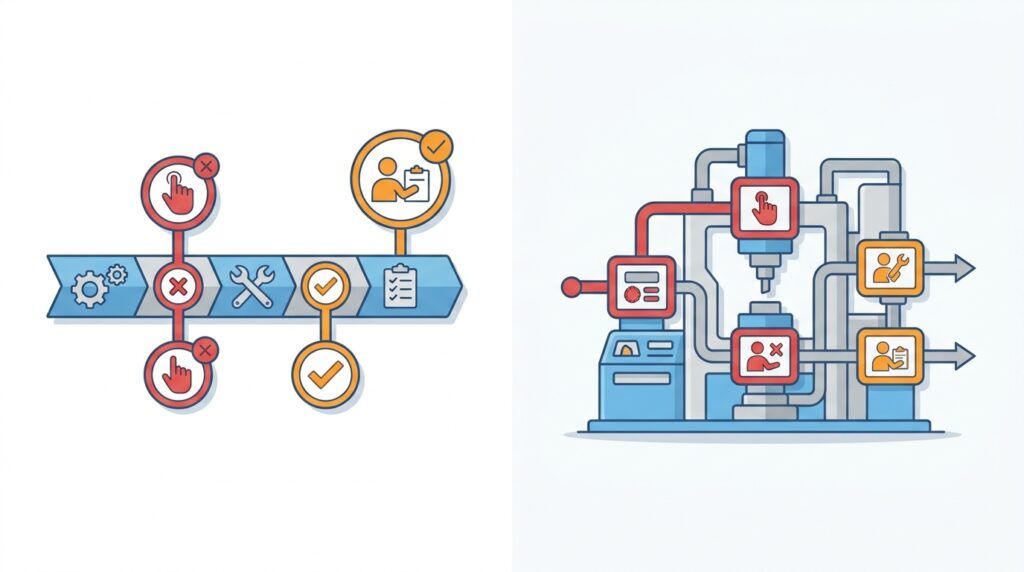
    Hold Points and Witness Points

    Hold points and witness points in inspection and test plans

    Hold points:

    • Definition: Points where work cannot proceed until inspection is complete and accepted.
    • Purpose: Ensure that critical quality steps are verified before work continues.
    • Examples: Pressure test acceptance, weld inspection, equipment alignment.

    Witness points:

    • Definition: Points where inspection is witnessed but work can proceed.
    • Purpose: Allow verification without stopping work.
    • Examples: Material identification, coating inspection, final assembly.

    ▲ For both, the ITP should state how much advance notice the inspector must receive. If a witness point is not attended after proper notice, work may proceed, whereas a hold point is released only by signed acceptance.

    Inspection

    Inspection verifies that work meets requirements.

    Type Description When to Use
    Receiving inspection Inspecting materials and equipment on arrival All deliveries
    In-process inspection Inspecting work during construction Critical activities
    Final inspection Inspecting completed work Before acceptance
    Surveillance Ongoing monitoring of work Throughout construction

    Inspection should be planned, documented, and performed by qualified personnel. ▲ For critical equipment, owners often appoint independent third-party inspectors to provide additional assurance.

    Testing

    Testing verifies that equipment and systems function as designed.

    Test Type Description Examples
    Factory acceptance test (FAT) Testing at vendor’s facility Equipment performance testing
    Site acceptance test (SAT) Testing at site Equipment installation verification
    Pressure test Testing pressure systems Piping and vessel pressure testing
    Functional test Testing system function Control system testing
    Performance test Testing system performance Output, efficiency, emissions

    Testing should be planned, documented, and witnessed as required.

    ▲ Statistical Quality Control

    Statistical quality control uses sampling and control charts to monitor quality and detect trends before defects occur. It is particularly useful for repetitive work such as welding, coating, and fabrication.

    Non-Conformance Management

    Non-conformances are deviations from requirements. Managing them is critical.

    1. Identify: Identify the non-conformance.
    2. Document: Record it in a non-conformance report (NCR).
    3. Assess: Assess the impact and severity.
    4. ▲ Determine root cause: Understand why it happened, not just what happened.
    5. Disposition: Determine disposition (repair, rework, replace, accept as-is).
    6. Approve: Approve the disposition. ▲ Accept-as-is and repair dispositions typically require approval from the designer and the owner.
    7. Implement: Implement the disposition.
    8. Verify: Verify that the disposition was effective.
    9. Close: Close the non-conformance.
    10. ▲ Prevent recurrence: Apply corrective and preventive action.

    Non-conformances should be tracked and analyzed to identify trends and prevent recurrence.

    Quality Records

    Quality records document that quality requirements were met. Key records:

    • Inspection reports: Results of inspections.
    • Test certificates: Results of tests.
    • Material certificates: Certification of materials.
    • Calibration records: Instrument calibration.
    • Non-conformance reports: Records of non-conformances.
    • Audit reports: Records of quality audits.
    • As-built drawings: Drawings reflecting actual construction.

    Quality records must be complete, accurate, and accessible. ▲ They are normally compiled into a handover quality dossier (often called a data book or manufacturing data record) delivered to the owner, and they remain valuable throughout the plant’s operating life.

    Quality Audits

    Quality audits verify that the quality system is working.

    Type Description When to Use
    Internal audit Audit by the organization itself Regularly
    External audit Audit by an external party As required by contract
    Supplier audit Audit of suppliers Before and during supply
    Process audit Audit of specific processes When problems occur

    Audits should be planned, performed by qualified auditors, and followed up with corrective actions.

    Supplier Quality Management

    Suppliers are a critical part of quality management. Key activities:

    • Supplier qualification: Assessing supplier quality capability.
    • Supplier audits: Auditing supplier quality systems.
    • Inspection at source: Inspecting at the supplier’s facility.
    • Supplier performance monitoring: Tracking supplier quality performance.
    • Supplier development: Helping suppliers improve quality.

    Supplier quality problems can cause significant project delays and cost overruns.

    Construction Quality

    Construction quality is where design becomes reality.

    • Workmanship standards: Defining acceptable workmanship.
    • Method statements: Defining how work will be performed.
    • Inspection and testing: Verifying construction quality.
    • Weld quality: Welding procedures, welder qualification, inspection.
    • Coating quality: Surface preparation, application, inspection.
    • Alignment and tolerance: Verifying equipment alignment.

    ▲ Weld quality deserves particular attention. It relies on qualified welding procedure specifications, qualified welders, and appropriate non-destructive examination (NDE) such as radiographic, ultrasonic, magnetic particle, or liquid penetrant testing, with the extent of NDE defined by the applicable code. Positive material identification (PMI) is also commonly used to confirm that alloy materials match the specification.

    Construction quality problems are expensive to correct after installation.

    Commissioning Quality

    Commissioning quality ensures that systems function as designed.

    • Commissioning procedures: Defining how systems will be commissioned.
    • Functional testing: Testing that systems function as designed.
    • Performance testing: Testing that systems meet performance requirements.
    • Documentation: Documenting commissioning and test results.
    • Handover: Confirming that systems meet requirements before handover.

    ▲ Pre-commissioning checks (such as loop checks, flushing, and cleaning) and a managed punch list of outstanding items support a controlled handover.

    Commissioning quality problems can delay startup or cause operational problems.

    ▲ Measuring Quality Performance

    What is not measured is hard to improve. Common quality indicators include the number and age of open NCRs, rework rate, first-time inspection pass rate, supplier delivery quality, audit findings closed on time, and punch list closure rate. Trends in these indicators give early warning of problems.

    Quality Culture

    Quality is not just a system. It is a culture.

    • Leadership commitment: Quality is a priority, not just a slogan.
    • Employee engagement: Everyone is responsible for quality.
    • Right first time: Doing it right the first time.
    • Continuous improvement: Always looking for ways to improve.
    • Open communication: Reporting problems without fear.
    • Training: Ensuring everyone has the skills to do quality work.
    • Accountability: Taking responsibility for quality.

    A quality culture is what sustains quality over the long term.

    ▲ Lessons Learned and Quality Improvement

    Lessons learned from quality problems (root causes, corrective actions, and prevention measures) should be captured and applied to future projects. A quality lessons-learned database helps prevent repeat problems. Lessons should be reviewed at project milestones, not only at closeout, so that they can benefit the current project as well.

    Common Mistakes in Quality Management

    • No quality plan: Quality not planned.
    • Inadequate specifications: Unclear or incomplete requirements.
    • Skipping inspection: Not verifying quality.
    • Poor ITPs: Inspection and test plans incomplete or not followed.
    • Ignoring non-conformances: Not addressing deviations.
    • Incomplete records: Quality records missing or incomplete.
    • No audits: Not verifying that the quality system works.
    • Poor supplier quality: Not managing supplier quality.
    • Weak quality culture: Quality not taken seriously.
    • No continuous improvement: Not learning from quality problems.
    • ▲ Weak design quality control: Errors carried from design into construction.
    • ▲ Treating quality as a cost to minimize: Cutting prevention and appraisal only increases failure costs.

    These mistakes are costly to correct. They are much cheaper to avoid through disciplined quality management.

    How Japanese EPC Firms Approach Quality Management

    Japanese engineering firms are known for their disciplined approach to quality management. Common characteristics include:

    • Thorough planning: Quality is planned carefully, with clear requirements and procedures.
    • Detailed ITPs: Inspection and test plans are comprehensive and followed.
    • Disciplined inspection: Work is inspected as it is completed.
    • Rigorous non-conformance management: Non-conformances are addressed promptly and thoroughly.
    • Detailed documentation: Records are complete and accurate.
    • Supplier quality focus: Suppliers are managed for quality.
    • Continuous improvement: Lessons are captured and applied.
    • Quality culture: Quality is embedded in how people work.
    • ▲ Process discipline: The plan-do-check-act (PDCA) cycle, kaizen, and error-proofing (poka-yoke) are part of everyday practice, and problems are investigated at the source.

    For plant owners, this often means plants that perform as designed and avoid costly rework.

    How to Evaluate Quality Management Readiness

    Question Why It Matters
    Is there a quality plan? Provides a roadmap for quality
    Are specifications clear and complete? Defines what quality means
    ▲ Are design reviews performed? Prevents design errors reaching site
    Are ITPs prepared and followed? Defines inspections and tests
    Are hold and witness points defined? Ensures critical steps are verified
    Is inspection performed? Verifies that work meets requirements
    Is testing performed? Verifies that equipment functions
    Are non-conformances managed? Addresses deviations
    Are quality records complete? Documents that quality was achieved
    Are audits performed? Verifies that the quality system works
    ▲ Are lessons learned captured? Prevents repeat problems
    Is there a quality culture? Sustains quality over time

    A plant that addresses these questions is ready for effective quality management.

    Conclusion

    Quality management is critical to project success. For small to medium-scale industrial plants, it determines whether the plant performs as designed and avoids costly rework.

    By focusing on quality planning, design quality, standards, ITPs, inspection, testing, non-conformance management, records, audits, supplier quality, and quality culture, owners and project teams can ensure that the plant is built to specification and performs reliably.

    Key Takeaways

    • Quality management ensures the plant is designed, built, and commissioned to specifications
    • Quality is built in, not inspected in
    • Quality planning defines objectives, standards, responsibilities, and procedures
    • Design quality must be verified before construction begins
    • QA focuses on processes; QC focuses on products
    • ITPs define inspections and tests, with hold and witness points
    • Non-conformances must be managed through a structured process, including root cause and corrective action
    • Quality records document that requirements were met
    • Quality audits verify that the quality system works
    • Supplier quality is a critical part of overall quality
    • Prevention and appraisal cost less than failure
    • Quality culture sustains quality over the long term
    • Japanese EPC firms emphasize thorough planning and disciplined inspection
  • Plant Interface Management: Key Practices for EPC Projects

    Plant Interface Management: Key Practices for EPC Projects

    Most project problems do not come from any single discipline doing its job badly. They come from the gaps between disciplines. Piping is designed correctly. Structural steel is designed correctly. But the pipe does not fit through the opening in the steel. The electrical cable tray clashes with the ductwork. The vendor’s equipment arrives with connections that do not match the site’s utilities.

    Interface management is the discipline of identifying, defining, and controlling the points where different scopes, disciplines, contractors, or systems meet. It is one of the most commonly underestimated aspects of EPC projects, and one of the most common sources of delay, rework, and dispute.

    For small to medium-scale industrial plants, interface management is especially important because there is less redundancy and fewer resources to absorb the consequences of interface failures. A missed interface can stop work in multiple areas at once.

    This article covers the key practices in plant interface management, from identifying interfaces to managing them through design, construction, commissioning, and closeout.

    What Is Interface Management?

    Interface management is the process of identifying, defining, and controlling the points of interaction between different parts of a project.

    An interface is any point where:

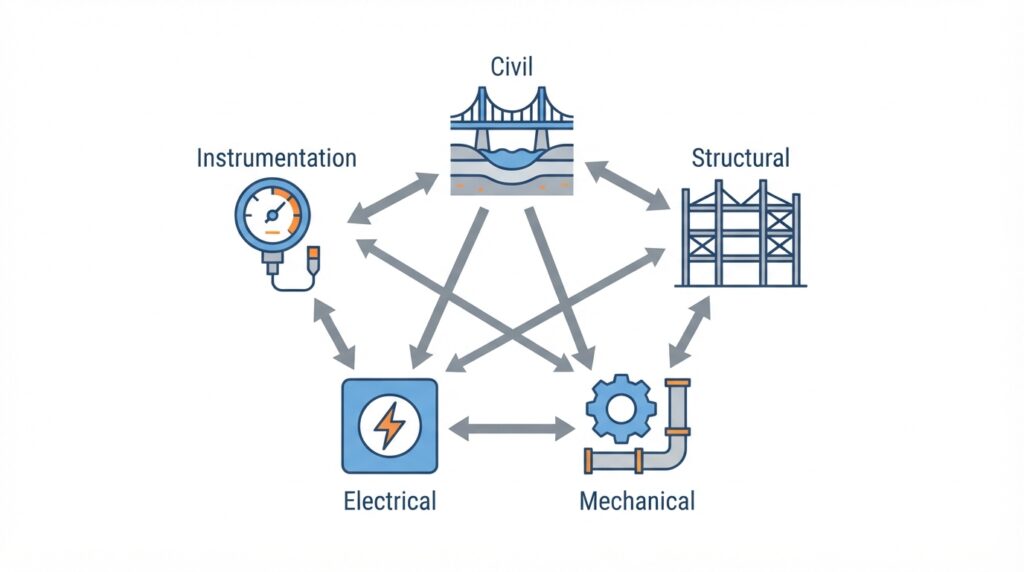
    • Two disciplines meet (e.g., mechanical and electrical).
    • Two contractors meet (e.g., civil contractor and mechanical contractor).
    • Two systems meet (e.g., process and control systems).
    • Two organizations meet (e.g., owner and EPC contractor).
    • Two phases meet (e.g., construction and commissioning).
    • New works meet existing facilities.

    Interface management ensures that these points are defined, documented, and controlled.

    Why Interface Management Matters

    Interface failures are a leading cause of project problems.

    Factor Impact of Good Interface Management Impact of Poor Interface Management
    Schedule Work proceeds without clashes Work stops at interfaces
    Cost Rework avoided Rework and added cost
    Quality Interfaces correctly designed and built Misalignment, leaks, failures
    Safety Interfaces assessed for safety Safety hazards at interfaces
    Coordination Contractors work together Contractors blame each other
    Disputes Responsibilities clear Disputes over responsibility

    For small plants, where there is less margin for error, interface management determines whether the project runs smoothly or gets bogged down in conflicts.

    Types of Interfaces

    Types of interfaces in EPC projects

    Type Description Examples
    Physical Where equipment or structures meet Pipe connections, foundation interfaces, cable entries
    Functional Where systems interact Control signals, utility supplies, process flows
    Organizational Where organizations meet Owner-contractor, contractor-contractor
    Contractual Where contracts meet Scope boundaries, responsibility splits
    Temporal Where phases meet Design-construction, construction-commissioning
    Geographic Where areas meet Site boundaries, tie-in points

    Each type requires a different approach to management.

    Interface Management Plan and Coordinator

    Interface management works best when it is organized as a defined process rather than left to individual disciplines.

    An interface management plan, prepared early in the project, typically defines:

    • Scope and objectives: Which interfaces are covered and what the process aims to achieve.
    • Roles and responsibilities: Who owns the process and who owns each interface.
    • Procedures: How interfaces are identified, documented, tracked, changed, and closed.
    • Meeting schedule: How often interface coordination meetings are held.
    • Escalation route: How unresolved issues move up the organization.
    • Reporting: What status information is reported and to whom.

    An interface coordinator (or interface manager) should be named to run the process, maintain the register, chair interface meetings, and chase open items. On small projects this may be a part-time role, but it should still have a named owner.

    Interface Identification

    Interface identification is the first step in interface management.

    Identification methods:

    • Review project scope: What scopes are involved, and where do they meet?
    • Review contracts: What are the scope boundaries and responsibilities?
    • Review drawings: Where do disciplines and systems connect?
    • Review the WBS: Where do work packages interface?
    • Workshops: Bring together disciplines and contractors to identify interfaces.
    • Interface register: Document identified interfaces.

    Identification should be comprehensive. Missing an interface is worse than identifying too many. It should also be repeated as the design develops, since new interfaces appear as scope is refined.

    The Interface Register

    The interface register is the central document for interface management.

    Field Description
    Interface ID Unique identifier
    Description What the interface is
    Parties involved Who is on each side of the interface
    Type Physical, functional, organizational, etc.
    Status Open, agreed, closed
    Responsible party Who owns the interface
    Due date When the interface must be resolved
    Documents Relevant drawings, specifications, agreements
    Issues Open issues or disagreements

    The interface register should be reviewed regularly and updated as the project progresses.

    Interface Responsibility Matrix

    An interface responsibility matrix maps each interface to the party responsible for defining, providing, or resolving it. It complements the interface register by making responsibilities explicit and reducing disputes.

    A simple matrix lists interfaces down one axis and parties (disciplines, contractors, vendors, the owner) across the other. Each cell shows the role of that party, such as defines, provides, installs, verifies, or approves. Gaps (no one responsible) and overlaps (two parties both responsible) become visible immediately and can be corrected before they become disputes.

    Interface Agreements

    An interface agreement documents how an interface will be managed.

    Interface agreement contents:

    • Scope: What is included on each side of the interface.
    • Responsibilities: Who is responsible for what.
    • Technical requirements: What each party must provide.
    • Schedule: When each party must deliver.
    • Documentation: What documents are exchanged.
    • Change process: How changes are managed.
    • Dispute resolution: How disputes are resolved.

    Interface agreements should be signed by both parties and treated as contractual documents.

    Interface Change Control

    Interfaces change as designs develop, and an uncontrolled change on one side of an interface can invalidate the other side. Changes affecting an interface should:

    • Be recorded against the interface in the register.
    • Be reviewed for impact on all parties to that interface.
    • Be approved by the parties before implementation.
    • Be communicated to affected disciplines, contractors, and vendors.
    • Update the relevant drawings, models, and agreements.

    Linking interface change control to the project’s formal change management process prevents changes from bypassing the people who are affected.

    Interface Management in Design

    Many interface issues originate in design.

    Design interface management activities:

    • Discipline coordination: Ensuring that disciplines coordinate their designs.
    • 3D modeling and clash detection: Detecting physical clashes before construction.
    • Design reviews: Reviewing designs at discipline interfaces.
    • Interface control documents: Documenting design interfaces.
    • Vendor data integration: Ensuring vendor data is integrated into the design.

    Design interface management prevents problems before they reach the field.

    3D Modeling and Clash Detection

    Clash detection process for interface management in EPC projects

    3D modeling and clash detection are key tools for interface management.

    Benefits:

    • Detect clashes: Identify physical clashes before construction.
    • Verify clearances: Confirm that equipment and piping have adequate clearance, including access for operation and maintenance.
    • Plan construction: Visualize construction sequence and access.
    • Coordinate disciplines: Allow disciplines to see each other’s designs.

    Clash detection process:

    1. Build the model: Each discipline builds its portion of the 3D model.
    2. Integrate the model: The models are combined into a single model.
    3. Run clash detection: Software identifies clashes between disciplines.
    4. Resolve clashes: Clashes are reviewed and resolved.
    5. Update the model: The model is updated as clashes are resolved.
    6. Repeat: Clash detection is repeated as the design progresses.

    Clash detection catches problems that would otherwise be found in the field, where they are far more expensive to fix. Not every clash is a real problem, so results should be filtered and prioritized, with hard clashes (physical interference) and clearance clashes (insufficient access or space) addressed first.

    Digital Tools for Interface Management

    Digital tools can support interface management beyond 3D modeling. Digital tools for interface management include BIM (building information modeling) platforms, clash detection software, and project management systems with interface tracking. These tools centralize interface data and improve coordination across disciplines and contractors.

    In practice, a shared environment where the interface register, models, drawings, and agreements are all linked allows each party to see the current status of any interface. Automated notifications for overdue items and dashboards for open interfaces further reduce reliance on manual follow-up.

    Interface Management in Procurement

    Interfaces between equipment vendors and the rest of the plant are often overlooked.

    Procurement interface activities:

    • Vendor data requirements: Defining what data vendors must provide.
    • Interface schedules: Ensuring vendor data is delivered in time for design.
    • Connection details: Confirming how vendor equipment connects to the plant.
    • Utility requirements: Confirming power, water, air, and other utilities.
    • Control interfaces: Confirming control signals and protocols.
    • Documentation: Ensuring vendor documentation is complete.

    Vendor interfaces should be defined in the purchase order and managed through the project.

    Interface Management in Construction

    Construction is where interface problems become visible.

    Construction interface activities:

    • Interface register: Maintaining the register as construction progresses.
    • Coordination meetings: Regular meetings between contractors.
    • Area-based planning: Planning work by area to manage interfaces.
    • Handover procedures: Defining how areas are handed over between contractors.
    • Inspection: Inspecting interfaces as work is completed.
    • Punch lists: Addressing interface issues before handover.

    Construction interface management prevents clashes, rework, and disputes.

    Interface Management in Commissioning

    Commissioning involves interfaces between construction and operations.

    Commissioning interface activities:

    • System handover: Defining how systems are handed over from construction to commissioning.
    • Commissioning procedures: Defining how systems are commissioned.
    • Interface testing: Testing interfaces between systems.
    • Operations involvement: Involving operations in commissioning.
    • Documentation: Documenting commissioning and handover.

    Commissioning interfaces should be planned well before commissioning begins.

    Interface Management in Brownfield Projects

    Brownfield projects, meaning modifications to existing operating plants, have unique interface challenges. Tie-ins to existing systems, as-built accuracy, and coordination with ongoing operations all require careful management. Existing documentation may be inaccurate, and interfaces with operating systems must be planned around production schedules.

    Practical measures include:

    • Field verification: Walking down and surveying (for example, by laser scanning) to confirm as-built conditions before design is finalized.
    • Tie-in planning: Identifying every tie-in early, defining its isolation requirements, and scheduling it for an available shutdown window.
    • Operations coordination: Involving plant operations in planning, permits, and work scheduling.
    • Safety at the interface: Assessing hazards where new work meets live systems, including isolation, energy control, and management of change.
    • Documentation update: Updating existing drawings and records to reflect the modified plant.

    Tie-ins missed in planning often cannot be done outside a shutdown, so they can delay the entire project.

    Organizational and Contractual Interfaces

    Organizational and contractual interfaces are often the most challenging.

    Common organizational interfaces:

    • Owner and EPC contractor: Scope, responsibilities, approvals.
    • EPC contractor and subcontractors: Scope, schedule, quality.
    • Multiple contractors: Coordination, handover, interfaces.
    • Owner and vendors: Direct contracts, warranties, support.

    Managing organizational interfaces:

    • Clear scope definition: Define what each party is responsible for.
    • Clear contract terms: Define interfaces in contracts.
    • Regular communication: Hold regular coordination meetings.
    • Escalation process: Define how issues are escalated.
    • Interface agreements: Document interface agreements.

    Organizational interfaces require active management, not assumptions.

    Interface Closeout

    Interfaces should be formally closed when both parties confirm that the interface has been defined, documented, and resolved. Closing interfaces without confirmation leaves open issues that can resurface later.

    A formal closeout typically includes:

    • Written confirmation from both parties that the interface requirements are met.
    • Supporting evidence, such as as-built drawings, test results, or inspection records.
    • Resolution or documented transfer of any open issues or punch items.
    • Updating the register status to closed, with date and sign-off.

    Closeout should be completed before area handover, system handover, and project completion, so that no interface is carried into operations unresolved.

    Interface Management Tools

    Tool Purpose
    Interface management plan Defines the process, roles, and procedures
    Interface register Central document for tracking interfaces
    Interface responsibility matrix Maps interfaces to responsible parties
    Interface agreements Document how interfaces are managed
    3D models Detect physical clashes
    Clash detection software Identify and resolve clashes
    Coordination meetings Regular communication between parties
    Interface control documents Define design interfaces
    Area-based planning Manage interfaces by area

    The right tools depend on the project’s size and complexity.

    Monitoring Interface Performance

    Interface management should be monitored like any other project process. Useful indicators include:

    • Number of interfaces open, agreed, and closed.
    • Number of overdue interfaces and how long they have been open.
    • Number of clashes detected and resolved, and how many remain open.
    • Number of interface-related changes, RFIs, and rework events.
    • Status of vendor data and interface information against schedule.

    Rising counts of overdue interfaces or late clashes are early warnings that should be raised in project reviews.

    Common Interface Problems

    Problem Description Prevention
    Physical clashes Equipment or piping clashes 3D modeling; clash detection
    Missing connections Interfaces not defined Interface register; reviews
    Utility mismatches Utilities do not match requirements Early utility definition
    Control incompatibilities Control signals do not match Control interface definition
    Scope gaps Work not assigned to any party Clear scope definition; responsibility matrix
    Scope overlaps Work assigned to multiple parties Clear scope definition; responsibility matrix
    Handover problems Areas not handed over cleanly Handover procedures; formal closeout
    Documentation gaps Interface documentation missing Interface agreements
    Inaccurate as-builts (brownfield) Existing conditions differ from records Field verification; scanning

    Prevention is far cheaper than correction.

    Common Mistakes in Interface Management

    Even experienced organizations make mistakes. Common ones include:

    • No interface management process: Interfaces not identified or managed.
    • Incomplete interface identification: Missing interfaces.
    • No interface register: Interfaces not documented.
    • No interface agreements: Responsibilities not defined.
    • No responsibility matrix: Gaps and overlaps go unnoticed.
    • Poor discipline coordination: Disciplines work in isolation.
    • Skipping clash detection: Physical clashes found in the field.
    • Ignoring vendor interfaces: Vendor connections not defined.
    • Trusting existing drawings in brownfield work: Tie-ins designed from inaccurate records.
    • Poor contractor coordination: Contractors do not communicate.
    • No escalation process: Issues not escalated when needed.
    • Closing interfaces without confirmation: Open issues resurface later.
    • Interface issues discovered late: Problems found during construction or commissioning.

    These mistakes are costly to correct. They are much cheaper to avoid through disciplined interface management.

    How Japanese EPC Firms Approach Interface Management

    Japanese engineering firms are known for their disciplined approach to interface management. Common characteristics include:

    • Thorough identification: Interfaces are identified systematically, with input from all disciplines.
    • Detailed documentation: Interface registers and agreements are complete and accurate.
    • Disciplined coordination: Regular meetings and coordination between disciplines and contractors.
    • 3D modeling: Extensive use of 3D modeling and clash detection.
    • Clear responsibilities: Scope and responsibilities are clearly defined.
    • Early resolution: Interface issues are resolved early, before they affect construction.
    • Formal confirmation: Interfaces are closed only after both sides confirm.
    • Continuous improvement: Lessons are captured and applied.

    For plant owners, this often means projects that proceed smoothly, without the clashes and disputes that plague poorly managed projects.

    Capturing Lessons Learned

    Interface problems tend to repeat across projects. At key milestones and at project closeout, record which interfaces caused delay or rework, why they were missed, and what would have prevented them. Feed these lessons into standard interface checklists, templates, and registers for future projects.

    How to Evaluate Interface Management Readiness

    Question Why It Matters
    Is there an interface management process and plan? Provides a structured approach
    Is an interface coordinator named? Gives the process an owner
    Are interfaces identified comprehensively? Missing interfaces cause problems
    Is there an interface register? Documents and tracks interfaces
    Is there an interface responsibility matrix? Removes gaps and overlaps
    Are interface agreements in place? Defines responsibilities
    Are disciplines coordinated? Prevents design clashes
    Is 3D modeling and clash detection used? Catches physical clashes before construction
    Are vendor interfaces defined? Prevents connection problems
    Are brownfield tie-ins and as-built conditions verified? Prevents surprises on operating plants
    Are contractors coordinated? Prevents construction conflicts
    Is there an escalation process? Resolves issues before they escalate
    Are interfaces formally closed? Prevents unresolved issues carrying forward
    Are interfaces managed through commissioning? Ensures smooth handover

    A plant that addresses these questions is ready for effective interface management.

    Conclusion

    Interface management is one of the most commonly underestimated aspects of EPC projects, and one of the most common sources of problems. For small to medium-scale industrial plants, it determines whether the project runs smoothly or gets bogged down in clashes, rework, and disputes.

    By focusing on interface identification, registers, responsibility matrices, agreements, discipline coordination, 3D modeling and digital tools, vendor interfaces, brownfield tie-ins, contractor coordination, and formal closeout, owners and project teams can ensure that interfaces are managed proactively rather than discovered in the field.

    Key Takeaways

    • Interface management identifies, defines, and controls the points where scopes, disciplines, contractors, or systems meet.
    • Interface failures are a leading cause of project problems.
    • Types of interfaces include physical, functional, organizational, contractual, temporal, and geographic.
    • The interface register is the central document for interface management.
    • An interface responsibility matrix makes responsibilities explicit and reduces disputes.
    • Interface agreements document how interfaces will be managed.
    • 3D modeling, clash detection, and digital tools catch physical clashes before construction and centralize interface data.
    • Vendor interfaces should be defined in the purchase order.
    • Brownfield projects need field verification, tie-in planning, and coordination with operations.
    • Organizational interfaces require active management.
    • Interfaces should be formally closed only when both parties confirm resolution.
    • Japanese EPC firms emphasize thorough identification and detailed documentation.
  • Plant Risk Management: Key Practices for EPC Projects

    Plant Risk Management: Key Practices for EPC Projects

    Every project carries risk. Equipment may arrive late. Design may take longer than expected. Weather may delay construction. Costs may rise. Contractors may underperform. The question is not whether risks will occur, but whether they are identified, assessed, and managed before they cause harm.

    Risk management is the discipline of identifying, assessing, and responding to risks that could affect project objectives. It is not about eliminating all risk, which is impossible and would be prohibitively expensive. It is about understanding which risks matter, taking action to reduce them, and being prepared for the ones that materialize.

    For small to medium-scale industrial plants, risk management is especially important because there is less redundancy and fewer resources to absorb the consequences of unmanaged risks. A single significant risk that materializes can derail the entire project.

    This article covers the key practices in plant risk management, from risk identification to monitoring and response.

    What Is Risk Management?

    Risk management is the process of identifying, assessing, and responding to risks. A risk is an uncertain event or condition that, if it occurs, has a positive or negative effect on project objectives.

    Risk management includes:

    • Risk identification: What risks could affect the project?
    • Risk assessment: How likely and how severe is each risk?
    • Risk response planning: What will be done about each risk?
    • Risk response implementation: Executing the planned responses.
    • Risk monitoring: Tracking risks and responses over time.

    Risk management is not a one-time exercise. It is an ongoing process throughout the project lifecycle. Widely used frameworks include ISO 31000 (risk management guidelines) and the Project Management Institute’s guidance on project risk management. Most owner and EPC organizations adapt these to their own procedures.

    Risk in Operations Versus Projects

    Risk management applies to operations as well as projects. Operational risks, such as equipment failure, safety incidents, and environmental releases, should be managed with the same discipline as project risks. Risks accepted or left open at handover become operational risks, so the project risk register should feed into the operations risk process.

    Why Risk Management Matters

    Factor Impact of Good Risk Management Impact of Poor Risk Management
    Objectives Project objectives achieved Objectives missed
    Cost Cost overruns avoided or reduced Cost overruns
    Schedule Delays anticipated and mitigated Delays unexpected
    Quality Quality risks managed Quality problems
    Safety Safety risks identified and controlled Incidents
    Decisions Decisions based on understanding of risk Decisions based on optimism

    For small plants, where there is less margin for error, risk management determines whether the project survives its challenges.

    Risk Appetite and Tolerance

    Risk appetite is the amount of risk an organization is willing to accept in pursuit of its objectives. Risk tolerance is the acceptable variation around a specific objective, for example a cost overrun of no more than 5% or a schedule slip of no more than four weeks. Both should be defined by management and used to guide risk responses.

    Without a defined appetite and tolerance, teams make inconsistent decisions. One manager accepts a risk that another would escalate. Clear thresholds also tell the team when a risk must be escalated to senior management.

    Risk Management Process

    Step Description
    1. Identify Identify risks that could affect the project
    2. Assess Assess likelihood and impact of each risk
    3. Prioritize Rank risks by importance
    4. Plan response Develop responses for significant risks
    5. Implement Execute the planned responses
    6. Monitor Track risks and responses
    7. Review Review and update the risk register

    The process is iterative, because risks change as the project progresses.

    Risk Identification

    Risk identification is the process of identifying risks that could affect the project.

    Method Description When to Use
    Brainstorming Team generates risks Early in the project
    Checklists Risks from similar projects When experience exists
    Interviews Experts identify risks For specialist areas
    SWOT analysis Strengths, weaknesses, opportunities, threats Strategic risks
    Assumption analysis Risks from project assumptions When assumptions are made
    Document review Risks from contracts and specifications When documents exist
    HAZOP and other process hazard studies Systematic review of process and safety hazards Design stages for process plants

    Risk identification should involve the whole project team, not just management. Workshops that bring together engineering, procurement, construction, and operations staff tend to surface risks that any one group would miss.

    Risk Categories and the Risk Breakdown Structure

    Risks can be grouped into categories to ensure comprehensive identification.

    Category Examples
    Technical Design errors, equipment performance, technology
    Schedule Delays, sequencing, resource availability
    Cost Price increases, currency, estimation errors
    Procurement Vendor performance, delivery, quality
    Construction Site conditions, productivity, safety
    Regulatory Permits, compliance, changes in regulations
    External Weather, political, economic, force majeure
    Organizational Staffing, skills, communication
    Contractual Scope disputes, claims, contract terms

    A risk breakdown structure (RBS) organizes risks hierarchically by category, similar to a WBS. It helps ensure that risks from all areas are identified and provides a framework for reporting. For example, “Procurement” might break down into vendor performance, delivery, quality, and logistics, with specific risks listed under each.

    Risk Assessment

    Risk assessment evaluates the likelihood and impact of each risk.

    Level Likelihood Impact
    Very low Rare Negligible
    Low Unlikely Minor
    Medium Possible Moderate
    High Likely Major
    Very high Almost certain Severe

    Risk score: Risk Score = Likelihood × Impact. Higher scores indicate higher-priority risks. Impact should be assessed against several objectives, such as cost, schedule, safety, quality, and environment, and the highest rating is usually used.

    Risk Matrix

    Risk matrix for project risk assessment in EPC projects

    A risk matrix displays risks by likelihood and impact. The example below is simplified to three levels. Many organizations use a five-by-five matrix that matches the scales above.

    Low Impact Medium Impact High Impact
    High Likelihood Medium High Very High
    Medium Likelihood Low Medium High
    Low Likelihood Low Low Medium

    The matrix helps prioritize risks and determine which require response. The matrix thresholds should reflect the organization’s risk appetite and tolerance.

    Qualitative vs. Quantitative Risk Assessment

    Type Description When to Use
    Qualitative Descriptive scales (low, medium, high) Most projects
    Quantitative Numerical probabilities and impacts Major or complex risks

    For most plant projects, qualitative assessment is sufficient. Quantitative assessment is used for the highest-consequence risks and for sizing contingency.

    Quantitative Risk Analysis Methods

    Quantitative risk analysis methods include Monte Carlo simulation, decision trees, and sensitivity analysis. Monte Carlo simulation is the most common for cost and schedule risk, producing probability distributions of outcomes.

    Method Purpose
    Monte Carlo simulation Runs thousands of scenarios to show the range and likelihood of cost or schedule outcomes (for example, P50 and P80 values)
    Decision trees Compare options when outcomes are uncertain, using expected monetary value
    Sensitivity analysis Identifies which risks or variables have the greatest effect on the outcome

    Monte Carlo results are commonly used to set contingency at a chosen confidence level, such as P80.

    Risk Response Strategies

    For negative risks (threats):

    Strategy Description Example
    Avoid Eliminate the risk Change scope to avoid a hazardous area
    Mitigate Reduce likelihood or impact Extra inspections to reduce quality risk
    Transfer Shift risk to another party Insurance; fixed-price contract
    Accept Acknowledge and prepare Accept small risks with contingency

    For positive risks (opportunities):

    Strategy Description Example
    Exploit Ensure the opportunity occurs Fast-track to gain schedule benefit
    Enhance Increase probability or impact Add resources to complete early
    Share Share with a partner Joint venture for a project
    Accept Acknowledge without action Accept small opportunities

    Different strategies apply to different risks. The choice depends on the nature and significance of the risk and on the organization’s risk appetite.

    Two related concepts are worth tracking:

    • Residual risk: the risk that remains after a response has been applied.
    • Secondary risk: a new risk created by the response itself. For example, an alternate vendor reduces delivery risk but may introduce quality risk.

    For significant risks, teams should also prepare a contingency (fallback) plan to be used if the primary response fails or the risk occurs.

    Risk Register

    The risk register is the central document for risk management.

    Field Description
    Risk ID Unique identifier
    Risk description What could happen (cause, event, effect)
    Category / RBS reference Technical, schedule, cost, etc.
    Likelihood Probability of occurrence
    Impact Severity if it occurs
    Risk score Likelihood × impact
    Response strategy Avoid, mitigate, transfer, accept
    Response actions What will be done
    Trigger Early warning indicator
    Residual risk Expected risk after response
    Fallback plan Action if the risk occurs
    Owner Who is responsible
    Due date When actions must be complete
    Status Open, in progress, closed

    The register should be reviewed regularly and updated as risks change.

    Risk Ownership

    Every significant risk should have an owner.

    • Understand the risk: Know what could happen and why.
    • Develop the response: Define what will be done.
    • Implement the response: Ensure actions are executed.
    • Monitor the risk: Track changes in likelihood or impact.
    • Report status: Keep management informed.

    Risk owners should have the authority and resources to manage their risks.

    Risk Monitoring and Control

    Risk monitoring tracks risks and responses over time.

    • Regular reviews: Review the risk register at project meetings.
    • Status updates: Update risk status and responses.
    • New risk identification: Identify risks that emerge as the project progresses.
    • Closed risk review: Confirm that closed risks are genuinely closed.
    • Trigger monitoring: Watch for early warning signs.
    • Trend analysis: Track risk exposure over time.
    • Reporting: Give management a concise summary of top risks, trends, and decisions needed.

    Risk Triggers and Early Warning

    Risk triggers, also called early warning signs, are indicators that a risk is about to occur or has occurred. Monitoring triggers allows proactive response rather than reactive crisis management.

    Risk Example Trigger
    Late equipment delivery Vendor misses a fabrication milestone; expediting reports show slippage
    Cost escalation Commodity price index rises above a set threshold
    Productivity problems Installed quantities fall behind plan for several weeks
    Quality problems Repeated inspection failures or open non-conformances
    Labor shortages Key trades not mobilized by the planned date

    Triggers should be defined in the risk register and tied to specific actions.

    Contingency and Risk

    Contingency is a reserve for risks that materialize.

    Type Purpose Managed By
    Contingency reserve For identified risks Project manager
    Management reserve For unidentified risks Senior management

    Contingency should be sized based on risk assessment, ideally supported by quantitative analysis such as Monte Carlo simulation, and managed carefully. It is not free money. Draw-downs should be tied to specific risks and tracked.

    Risk in EPC Contracts

    EPC contracts allocate risk between owner and contractor.

    Risk Typically Borne By
    Design errors Contractor (EPC)
    Construction cost overruns Contractor (lump-sum EPC)
    Force majeure Shared (time relief usually granted; cost often with owner or each party bears its own)
    Owner-caused delays Owner
    Regulatory changes Shared or owner (change in law)
    Site conditions Varies by contract

    Risk allocation should be explicit in the contract. Ambiguity leads to disputes. A common principle is that each risk should be borne by the party best able to control it. Pushing too much risk onto the contractor can result in inflated prices or contractor financial stress.

    Common Risks in Plant Projects

    Risk Description Typical Mitigation
    Late equipment delivery Equipment arrives late Expediting; buffer; alternate vendors
    Design changes Scope changes during design Clear scope; change management
    Cost escalation Prices increase Fixed-price contracts; contingency
    Weather delays Weather affects construction Weather contingency
    Labor shortages Skilled labor unavailable Early recruitment; training
    Quality problems Equipment or work fails to meet specs Inspection; prequalification
    Safety incidents Injuries or incidents Safety planning; training
    Regulatory changes New requirements Monitoring; compliance planning
    Currency fluctuation Exchange rates change Hedging; currency clauses

    These risks should be specifically considered in the risk register.

    Common Mistakes in Risk Management

    • No risk management: Risks not identified or managed.
    • One-time exercise: Risk management done once and forgotten.
    • Optimism bias: Underestimating likelihood or impact.
    • No risk owners: Risks without clear responsibility.
    • Vague responses: Responses that are not specific or actionable.
    • No monitoring: Risks not tracked over time.
    • Ignoring opportunities: Focusing only on threats.
    • Inadequate contingency: Not enough reserve for risks.
    • No defined appetite or tolerance: No basis for escalation or consistent decisions.
    • Weak risk culture: Team members afraid to report bad news.
    • No lessons learned: Not learning from past risks.

    These mistakes are costly to correct. They are much cheaper to avoid through disciplined risk management.

    How Japanese EPC Firms Approach Risk Management

    Japanese engineering firms are known for their disciplined approach to risk management. Common characteristics include:

    • Thorough identification: Risks are identified systematically, with input from all disciplines.
    • Conservative assessment: Risks are assessed realistically, not optimistically.
    • Detailed planning: Responses are planned carefully, with clear ownership.
    • Disciplined monitoring: Risks are tracked and reviewed regularly.
    • Adequate contingency: Contingency is sized to cover real risk.
    • Continuous improvement: Lessons are captured and applied.
    • Long-term focus: Risk management is treated as an ongoing discipline.

    For plant owners, this often means projects that are delivered without major surprises.

    How to Evaluate Risk Management Readiness

    Question Why It Matters
    Is there a risk management process? Provides a structured approach
    Are risk appetite and tolerance defined? Guides responses and escalation
    Are risks identified comprehensively? Missing risks cannot be managed
    Are risks assessed realistically? Optimistic assessment leads to surprises
    Are risks prioritized? Focuses attention on the most important risks
    Are responses planned? Provides a plan for managing risks
    Are risk owners assigned? Ensures accountability
    Is the risk register maintained? Keeps risks visible and tracked
    Are triggers defined and monitored? Enables early response
    Is risk monitoring regular? Ensures risks are not forgotten
    Is contingency adequate? Provides reserve for risks that materialize
    Are lessons learned captured? Improves future risk management

    A plant that addresses these questions is ready for effective risk management.

    Key Takeaways

    • Risk management identifies, assesses, and responds to risks that could affect project objectives
    • Risk appetite and tolerance, defined by management, guide responses and escalation
    • Risks should be identified comprehensively (an RBS helps), assessed realistically, and prioritized
    • Response strategies include avoid, mitigate, transfer, and accept (for threats)
    • Every significant risk should have an owner
    • The risk register is the central document for risk management
    • Triggers give early warning and allow proactive response
    • Quantitative methods such as Monte Carlo simulation support contingency sizing for major risks
    • Contingency covers identified risks; management reserve covers unidentified risks
    • EPC contracts allocate risk between owner and contractor
    • Risk management applies to operations as well as projects
    • Risk management is an ongoing process, not a one-time exercise
    • Japanese EPC firms emphasize thorough identification and conservative assessment

    Conclusion

    Risk management is critical to project success. For small to medium-scale industrial plants, it determines whether the project can withstand the challenges it will face.

    By defining risk appetite, identifying risks comprehensively, assessing them realistically, planning responses, assigning ownership, monitoring triggers, and sizing contingency appropriately, owners and project teams can ensure that risks are managed proactively rather than reactively.

  • Plant Schedule Management: Key Practices for EPC Projects

    Plant Schedule Management: Key Practices for EPC Projects

    Schedule is one of the three pillars of project success, alongside cost and quality. A project completed within budget and to specification, but a year late, has still failed to meet its objectives. Schedule management is the discipline of planning, monitoring, and controlling project timelines so that the plant is delivered when it is needed.

    Schedule management is closely linked to cost management. Delays cost money through extended overheads, idle resources, lost production, and contractual penalties. Conversely, rushing to recover schedule can increase costs and compromise quality and safety.

    For small to medium-scale industrial plants, schedule management is especially important because there is less redundancy and fewer resources to absorb delays. A late delivery or a slipped milestone can delay the entire project.

    This article covers the key practices in plant schedule management, from schedule development to progress measurement, risk analysis, and recovery.

    What Is Schedule Management?

    Schedule management is the process of planning, developing, monitoring, and controlling the project schedule. It includes:

    • Planning: Defining the activities, sequence, and durations.
    • Development: Building the schedule model and identifying the critical path.
    • Monitoring: Tracking actual progress against the plan.
    • Control: Taking corrective action when the schedule slips.
    • Reporting: Communicating schedule performance to management.

    Schedule management is not just about dates. It is about understanding what needs to happen, in what order, and by when, and ensuring that it does.

    Why Schedule Management Matters

    Factor Impact of Good Schedule Management Impact of Poor Schedule Management
    Delivery Project completed on time Project delayed
    Cost Delays avoided; costs controlled Delay costs; extended overheads
    Revenue Production starts on time Lost revenue from delayed startup
    Reputation Owner and contractor credibility Reputation damaged
    Contracts Liquidated damages avoided Liquidated damages incurred
    Morale Team meets commitments Team demoralized by slippage

    For small plants, where there is less margin for error, schedule management determines whether the project meets its objectives.

    Schedule Development

    Schedule development is the process of building the project schedule.

    1. Activity definition: What activities must be performed?
    2. Sequencing: In what order must activities be performed?
    3. Resource estimating: What resources are needed for each activity?
    4. Duration estimating: How long will each activity take, given those resources?
    5. Schedule calculation: When will each activity start and finish?
    6. Critical path analysis: Which activities determine the project duration?
    7. Baseline approval: The approved schedule becomes the reference for control.

    The schedule should be developed with input from the people who will perform the work, including engineering, procurement, construction, and commissioning leads.

    Work Breakdown Structure (WBS)

    The work breakdown structure provides the framework for schedule development.

    • Hierarchical: Each level breaks the level above into smaller components.
    • Complete: All project scope is included.
    • Unique: Each component has a unique identifier.
    • Manageable: Components are small enough to plan and control.
    Level Description Example
    1 Project Power plant
    2 Major systems Boiler, turbine, electrical
    3 Subsystems Feedwater, fuel, control
    4 Work packages Pumps, valves, instruments
    5 Activities Installation tasks

    The WBS links the schedule to scope and cost, so that the same structure supports planning, budgeting, and progress reporting.

    Activity Sequencing

    Activity sequencing determines the order in which activities are performed.

    Relationship Description
    Finish-to-Start (FS) Activity B starts after Activity A finishes
    Start-to-Start (SS) Activity B starts after Activity A starts
    Finish-to-Finish (FF) Activity B finishes after Activity A finishes
    Start-to-Finish (SF) Activity B finishes after Activity A starts (rarely used)

    Most construction activities use finish-to-start relationships. Other relationships are used where work can overlap. Lags (required waiting time, such as concrete curing) and leads (allowed overlap) refine these relationships, but should be used sparingly and documented, because hidden lags make schedules hard to audit.

    Duration Estimating

    Method Description When to Use
    Analogous Based on similar past activities When data is limited
    Parametric Based on productivity rates When quantities are known
    Bottom-up Built from detailed task analysis For critical activities
    Expert judgment Based on experience For unusual activities
    Three-point Optimistic, most likely, pessimistic For uncertain activities

    Durations should be realistic, not optimistic. Optimistic durations lead to schedule slippage.

    Productivity assumptions. Duration estimates depend on productivity assumptions: how much work is done per unit of time. Productivity varies with crew size, skill, weather, site conditions, and learning curve. Assumptions should be documented and validated with historical data.

    The Critical Path

    Critical path in a project network diagram for EPC projects

    The critical path is the sequence of activities that determines the project duration.

    • Critical path: The longest path through the network.
    • Critical activities: Activities on the critical path.
    • Float (slack): The amount of time an activity can be delayed without causing a problem.
    • Total float: The time an activity can be delayed without delaying project completion.
    • Free float: The time an activity can be delayed without delaying the earliest start of any successor.
    • Near-critical paths: Paths with very little float that can become critical after a small delay.

    Activities on the critical path have zero (or negative) total float. Delays on the critical path delay the project. Near-critical paths should be monitored too, since the critical path can shift as work progresses.

    Schedule Levels

    Level Description Purpose
    Level 1 Executive summary schedule Management overview
    Level 2 Summary schedule Project management
    Level 3 Project schedule Detailed planning and control
    Level 4 Work package schedule Detailed execution
    Level 5 Activity schedule Day-to-day management

    Different levels serve different audiences, and the level of detail increases with the level number. Lower-level schedules must roll up consistently into higher-level ones.

    Long-Lead Items and Interfaces

    In EPC projects, many delays originate not in construction but in procurement and interfaces. Key practices include:

    • Long-lead equipment: Identify items such as turbines, boilers, large transformers, and special valves early, and schedule their ordering, engineering data, and delivery as critical activities.
    • Engineering–procurement–construction interfaces: Link vendor data submission, approval, fabrication, delivery, and installation in the logic.
    • Contractor interfaces: Define handover dates between contractors and make them contractual milestones.
    • Commissioning and startup: Include commissioning, testing, and performance tests in the schedule from the start, not as an afterthought.

    Schedule Baselines

    The schedule baseline is the approved schedule against which progress is measured.

    • Approval: The baseline is approved by management.
    • Control: Changes to the baseline are formally controlled.
    • Updates: The baseline is revised only for approved changes, such as scope changes or owner-caused delays.
    • Reporting: Progress is reported against the baseline.

    Progress Measurement

    Method Description When to Use
    Milestone tracking Tracking completion of milestones High-level progress
    Percent complete Estimating percent complete for activities Subjective but simple
    Units installed Counting units installed Quantifiable work
    Earned value Comparing earned value to planned value Integrated cost-schedule
    Weighted milestones Assigning weights to milestones Construction progress

    Progress measurement should be objective and consistent. Subjective estimates should be avoided where possible.

    Progress measurement rules. Progress measurement rules should be agreed in advance, particularly for contracts. Weighted milestones, units installed, or agreed rules of credit provide objective, auditable progress data and reduce disputes.

    Schedule Monitoring

    • Progress updates: Regular updates to the schedule at a consistent data date.
    • Variance analysis: Comparing actual progress to planned.
    • Critical path monitoring: Tracking critical and near-critical activities.
    • Float monitoring: Tracking available float and its consumption.
    • Trend analysis: Identifying trends, for example through the Schedule Performance Index (SPI) where earned value is used.
    • Forecasting: Predicting the final completion date.

    Monitoring should be regular and timely.

    Schedule Control

    • Variance identification: Identifying where the schedule has slipped.
    • Root cause analysis: Understanding why it slipped.
    • Corrective action: Taking action to recover.
    • Recovery planning: Developing plans to recover slippage.
    • Change management: Managing changes that affect the schedule.

    Corrective action may include adding resources, working overtime, resequencing activities, or reducing scope.

    Schedule Recovery

    Schedule recovery strategies for EPC projects

    Strategy Description Considerations
    Add resources (crashing) More people or equipment May not be possible; productivity loss
    Overtime Longer working hours Fatigue; cost increase; safety
    Resequencing Changing the sequence May affect other activities
    Parallel working (fast-tracking) Performing activities in parallel Risk of interference, rework, and safety
    Reduce scope Removing scope May not be acceptable
    Extend schedule Accepting a later completion May affect revenue

    Recovery should be planned carefully. Rushing can increase cost, reduce quality, and create safety risks. Recovery that does not address root causes usually fails.

    Schedule Buffers

    Schedule buffers, which are deliberate time allowances distinct from the float that arises naturally from network logic, should be built into the schedule to absorb uncertainty. Buffers should be sized based on risk and monitored, not consumed informally. Many projects place buffers ahead of key milestones or before completion rather than padding individual activities.

    Schedule Risk Management

    Risk Description Mitigation
    Late deliveries Equipment or materials arrive late Expediting; buffer; alternate vendors
    Design delays Design takes longer than planned Early design; resourcing
    Weather Weather delays outdoor work Weather contingency
    Labor shortages Resources not available Early recruitment; alternate sources
    Productivity Work takes longer than planned Realistic rates; monitoring
    Rework Work must be redone Quality control
    Scope changes Changes affect schedule Change management

    Risk management should identify risks early and develop mitigation plans.

    Schedule risk analysis. Schedule risk analysis, often using Monte Carlo simulation, quantifies the probability of meeting the schedule. It produces a range of possible completion dates with associated confidence levels, such as P50 or P80. Owners often set commitments at P80 rather than P50 to improve the chance of success.

    Resource Leveling

    • Peak demand: Avoid peaks that exceed available resources.
    • Resource smoothing: Adjust activities within their float to reduce peaks without extending the schedule.
    • Resource constraints: Some resources, such as specialist crews or cranes, may be limited.
    • Cost impact: Leveling may extend the schedule or increase cost.

    The Schedule in Contracts

    The schedule is also a contractual document. Good practice includes:

    • Contractor schedule submission: Require a baseline schedule, with logic and resources, for approval, and regular updates in native format.
    • Milestones and liquidated damages: Tie delay damages to clearly defined milestones.
    • Extension of time: Define the process for claiming time, and keep contemporaneous records, since delay claims are usually analyzed using the updated schedules.
    • Scheduling tools: Use recognized software, such as Primavera P6 or Microsoft Project, with agreed settings and a scheduling specification.

    Schedule Reporting

    • Baseline schedule: The approved schedule.
    • Actual progress: Progress to date.
    • Variance: Actual vs. planned.
    • Forecast: Predicted completion date.
    • Critical path: Status of critical activities.
    • Risks: Schedule risks and mitigation.
    • Trends: Schedule performance over time.

    Reports should be accurate, timely, and clear.

    Common Mistakes in Schedule Management

    • Optimistic durations: Underestimating how long work takes.
    • Incomplete scope: Missing activities that later add time.
    • Inadequate sequencing: Activities sequenced incorrectly.
    • Ignoring the critical path: Focusing on non-critical activities.
    • Poor progress measurement: Subjective or inconsistent data.
    • Delayed reporting: Discovering slippage too late.
    • No recovery planning: Not planning to recover slippage.
    • Unrealistic recovery: Rushing without addressing root causes.
    • No risk management: Not identifying and mitigating schedule risks.
    • Informal buffer use: Consuming float and contingency without tracking.

    These mistakes are costly to correct and much cheaper to avoid through disciplined planning and control.

    How Japanese EPC Firms Approach Schedule Management

    • Thorough planning: Schedules are developed carefully, with realistic durations and sequencing.
    • Detailed control: Progress is tracked and reported regularly.
    • Early warning: Variances are identified and addressed early.
    • Disciplined recovery: Recovery plans are developed and executed carefully.
    • Detailed documentation: Records are complete and accurate.
    • Continuous improvement: Lessons are captured and applied.

    For plant owners, this often means projects that are delivered on schedule and without surprises.

    How to Evaluate Schedule Management Readiness

    Question Why It Matters
    Is there a detailed schedule? Provides the basis for planning and control
    Is the schedule based on a WBS? Links schedule to scope and cost
    Are durations and productivity assumptions realistic and documented? Prevents optimistic schedules
    Are long-lead items and interfaces in the logic? Captures the most common sources of delay
    Is the critical path identified? Focuses attention where it matters
    Is there a schedule baseline? Provides the reference for control
    Are progress measurement rules agreed? Ensures objective, auditable progress data
    Is the schedule monitored regularly? Identifies variances early
    Is corrective action taken? Recovers slippage
    Is schedule risk analyzed and are buffers managed? Prepares for potential delays
    Is reporting timely? Enables early corrective action

    Conclusion

    Schedule management is critical to project success. For small to medium-scale industrial plants, it determines whether the project is delivered on time and meets its objectives.

    By focusing on schedule development, WBS, sequencing, duration estimating, critical path analysis, progress measurement, monitoring, control, recovery, and risk analysis, owners and project teams can ensure that the project is delivered on schedule.

    Key Takeaways

    • Schedule management determines whether the project is delivered on time
    • Schedule development includes activity definition, sequencing, resource and duration estimating, and critical path analysis
    • Duration estimates depend on documented, validated productivity assumptions
    • The critical path is the sequence of activities that determines the project duration
    • Progress measurement should be objective and consistent, with rules agreed in advance
    • Schedule monitoring tracks progress and identifies variances
    • Schedule control takes corrective action when the schedule slips
    • Recovery should be planned carefully; rushing increases cost and risk
    • Buffers should be sized based on risk and monitored, not consumed informally
    • Schedule risk analysis (for example Monte Carlo, P50/P80) quantifies the probability of meeting the schedule
    • Japanese EPC firms emphasize thorough planning and detailed control
  • Plant Cost Estimation and Budget Control: Key Practices for EPC Projects

    Plant Cost Estimation and Budget Control: Key Practices for EPC Projects

    Cost is one of the three pillars of project success, alongside schedule and quality. A project that is delivered on time and to specification but costs far more than planned is not a success. Cost estimation and budget control are the disciplines that ensure a project is affordable, funded, and delivered within the money available.

    Cost estimation is the process of predicting what a project will cost. Budget control is the process of ensuring that actual costs stay within the approved budget. Together, they determine whether the project is financially viable, and whether the owner gets what they paid for.

    For small to medium-scale industrial plants, cost estimation and budget control are especially important because there is less margin for error and fewer resources to absorb cost overruns. An accurate estimate supports good decisions; a poor one leads to underfunding, delays, and disputes.

    This article covers the key practices in plant cost estimation and budget control, from estimating methods to change management and cost reporting.

    What Is Cost Estimation and Budget Control?

    Cost estimation is the process of predicting the cost of a project or a component of a project. Budget control is the process of managing actual costs against the approved budget.

    Together, they cover:

    • Estimating: Predicting costs for each element of the project.
    • Budgeting: Allocating the approved budget to work packages.
    • Commitment tracking: Tracking contracts and purchase orders.
    • Cost tracking: Tracking actual costs against budget.
    • Forecasting: Predicting final costs based on current trends.
    • Change management: Managing changes and their cost impact.
    • Reporting: Reporting cost performance to management.

    Cost estimation and budget control are not just financial functions. They are project management functions that require technical knowledge as well as financial discipline.

    Why Cost Estimation and Budget Control Matter

    Cost performance has significant consequences.

    Factor Impact of Good Cost Management Impact of Poor Cost Management
    Viability Project remains financially viable Project becomes unaffordable
    Funding Funding secured and sufficient Funding shortfalls and delays
    Decisions Decisions based on accurate data Decisions based on guesswork
    Disputes Fewer disputes with contractors More disputes and claims
    Reputation Owner and contractor credibility Reputation damaged
    Completion Project completed as planned Project delayed or abandoned

    For small plants, where there is less margin for error, cost management determines whether the project can be completed.

    Cost Estimation Methods

    Cost estimation accuracy over project stages

    Different estimating methods are used at different stages of a project. Estimate accuracy improves as the design matures.

    Method Description Typical Accuracy When to Use
    Order of magnitude Based on capacity or similar projects ±30% to ±50% Concept stage
    Budget estimate Based on preliminary design ±20% to ±30% Feasibility stage
    Definitive estimate Based on detailed design ±10% to ±15% Basic engineering stage
    Detailed estimate Based on completed design and quotes ±5% to ±10% Detailed design stage

    Early estimates are used for feasibility decisions; later estimates support budget approval and contract awards.

    A note on accuracy ranges: The ranges above are simplified, typical values. Industry practice, such as the AACE International estimate classification system, defines five estimate classes (Class 5 for concept screening through Class 1 for check estimates) and recognizes that early estimates are skewed toward overruns, so the range is usually wider on the high side than on the low side. Accuracy also depends on project complexity, the quality of the scope definition, and the estimator’s experience. Every estimate should state its class and expected accuracy range.

    Cost Categories

    Project costs are typically divided into categories.

    Category Description Examples
    Equipment Major equipment items Turbines, boilers, compressors
    Bulk materials Commodity materials Pipe, fittings, valves, cable
    Construction Construction labor and services Civil, mechanical, electrical
    Engineering Design and engineering services Process, mechanical, electrical
    Project management Project management and administration Salaries, offices, travel
    Owner’s costs Costs borne by the owner Land, permits, insurance, financing
    Contingency Reserve for unknowns Scope, price, schedule

    Each category should be estimated separately and tracked separately.

    Work Breakdown Structure (WBS)

    A work breakdown structure (WBS) divides the project into manageable components.

    WBS principles:

    • Hierarchical: Each level breaks the level above into smaller components.
    • Complete: All project scope is included.
    • Unique: Each component has a unique identifier.
    • Manageable: Components are small enough to plan, estimate, and control.

    Typical WBS levels:

    Level Description Example
    1 Project Power plant
    2 Major systems Boiler, turbine, electrical
    3 Subsystems Feedwater, fuel, control
    4 Work packages Pumps, valves, instruments
    5 Activities Installation tasks

    The WBS provides the framework for estimating, budgeting, and cost control. It is usually linked to a cost code structure, so that estimates, commitments, and actual costs are all recorded against the same codes and can be compared directly.

    Estimating Techniques

    Several techniques are used to estimate costs.

    Technique Description When to Use
    Parametric Based on historical relationships (e.g., cost per MW) Early stages
    Analogous Based on similar past projects When data is limited
    Bottom-up Built from detailed quantities and rates Detailed stages
    Vendor quotes Based on actual vendor pricing For equipment and services
    Expert judgment Based on experience For unusual items

    Most estimates use a combination of techniques. Equipment is often priced by vendor quotes; construction is often priced bottom-up from quantities.

    Basis of Estimate

    Every estimate should be accompanied by a basis of estimate (BOE): a document that records the scope included and excluded, the design information used, the estimating methods, key assumptions, pricing date, productivity assumptions, allowances, exclusions, and the expected accuracy. A clear BOE allows the estimate to be reviewed, defended, and updated, and it prevents disputes later about what the estimate was meant to cover.

    Cost Escalation

    Costs can escalate over the life of a project. Cost escalation, the increase in costs over time due to inflation, market conditions, and other factors, should be considered in estimates, especially for projects with long durations. Escalation can be applied as a percentage per year or based on specific indices.

    Escalation should be estimated separately from contingency. Escalation covers expected price changes between the pricing date and the date when the item will be bought or the work performed; contingency covers uncertainty in scope and quantities. For long-lead equipment and commodity-driven items such as steel, copper, and pipe, the timing of purchase has a significant effect on escalation exposure.

    Currency and Exchange Rate Risk

    International projects face currency risk. For international projects, costs may be incurred in multiple currencies. Exchange rate fluctuations can significantly affect the final cost. Currency risk should be identified and managed through hedging, currency clauses in contracts, or by matching costs and revenue in the same currency.

    For example, a plant owner funded in local currency may buy major equipment in US dollars, euros, or yen. A weakening local currency increases the local-currency cost of that equipment even though the contract price has not changed. The estimate should show the currency of each major cost item, so that exposure can be quantified and managed.

    Contingency

    Contingency is a reserve for unknowns. It covers costs that are likely to occur but cannot be specifically identified at the time of estimating.

    Types of contingency and reserves:

    Type Description Examples
    Scope contingency For scope growth and definition gaps Additional work identified during design
    Price contingency For price variation not covered by escalation Material price increases above allowance
    Schedule contingency For cost impact of delays Delays due to weather or labor
    Management reserve For unidentified risks, held by management outside the baseline Major unforeseen events

    Contingency sizing:

    • Early stages: Higher contingency (e.g., 15–25%) due to uncertainty.
    • Later stages: Lower contingency (e.g., 5–10%) as uncertainty reduces.
    • Risk-based: Contingency based on quantitative risk analysis, such as Monte Carlo simulation, which gives a confidence level (for example P50 or P80) for the estimate.

    Contingency should be managed, not treated as free money. Drawing it down should be controlled, with each use approved, recorded, and reported. The percentages above are typical examples; actual values depend on project type, scope definition, and risk.

    Budget Development

    The budget is the approved spending plan for the project.

    Budget development steps:

    1. Estimate: Estimate the cost of each WBS element.
    2. Review: Review the estimate for completeness and accuracy.
    3. Approve: Obtain approval from management or the owner.
    4. Allocate: Allocate the budget to work packages and cost accounts.
    5. Baseline: Establish the baseline budget for control.

    The baseline budget is the reference against which actual costs are compared. It should also be time-phased into a cash flow forecast (often shown as an S-curve), so that funding, financing, and payments can be planned in line with the schedule.

    Budget Control

    Budget control ensures that actual costs stay within budget.

    Budget control activities:

    Activity Description
    Commitment tracking Tracking contracts, purchase orders, and commitments
    Cost tracking Tracking actual costs against budget
    Accruals Recording costs incurred but not yet invoiced
    Forecasting Predicting final costs based on current trends
    Variance analysis Comparing actual and forecast costs against budget
    Corrective action Taking action when variances are significant

    Budget control requires accurate data and timely reporting. Tracking commitments, not just invoices, is essential: by the time an invoice arrives, the money has already been committed, and the opportunity to act has often passed.

    Earned Value Management

    Earned value management curves for project cost and schedule control

    Earned value management (EVM) integrates cost, schedule, and scope to measure project performance.

    Key EVM metrics:

    Metric Description Formula
    Planned Value (PV) Budgeted cost of work scheduled —
    Earned Value (EV) Budgeted cost of work performed —
    Actual Cost (AC) Actual cost of work performed —
    Cost Variance (CV) Cost performance EV − AC (positive = under budget)
    Schedule Variance (SV) Schedule performance EV − PV (positive = ahead of schedule)
    Cost Performance Index (CPI) Cost efficiency EV ÷ AC (>1 = efficient)
    Schedule Performance Index (SPI) Schedule efficiency EV ÷ PV (>1 = ahead)
    Budget at Completion (BAC) Total approved budget —
    Estimate at Completion (EAC) Forecast final cost AC + (BAC − EV) ÷ CPI, if current cost performance continues
    Estimate to Complete (ETC) Forecast cost of remaining work EAC − AC

    EVM provides early warning of cost and schedule problems, allowing corrective action before it is too late. Its reliability depends on a well-defined WBS and objective measurement of progress, since earned value is only as good as the progress data behind it.

    Forecasting

    Forecasting predicts the final cost of the project based on current performance.

    Forecasting methods:

    Method Description When to Use
    Budget-based Actual cost plus remaining budget for remaining work When performance is on track
    CPI-based Remaining budget adjusted by CPI When performance is off track
    Bottom-up Re-estimate remaining work For significant variances
    Management judgment Based on experience For unusual situations

    Forecasting should be updated regularly as the project progresses. A good forecast also includes known risks and pending changes, not only the work already measured.

    Change Management

    Changes during a project affect cost. Managing them is critical.

    Change management activities:

    • Change identification: Recognizing when a change is required.
    • Change assessment: Evaluating the impact on cost, schedule, and scope.
    • Change approval: Approving or rejecting the change.
    • Change implementation: Implementing the change.
    • Documentation: Recording the change and its cost impact.

    Uncontrolled changes lead to cost overruns and disputes. Approved changes should update the budget and forecast, with any contingency draw-down clearly recorded. Pending and unapproved changes should be tracked so that their potential cost impact is visible to management.

    Cost Reporting

    Cost reporting keeps management informed of cost performance.

    Cost report contents:

    • Budget: The approved budget.
    • Commitments: Contracts and purchase orders.
    • Actual costs: Costs incurred to date.
    • Accruals: Costs incurred but not invoiced.
    • Forecast: Predicted final cost.
    • Variance: Actual and forecast vs. budget.
    • Trends: Cost performance over time.
    • Contingency status: Contingency used and remaining.

    Reports should be accurate, timely, and clear.

    Cost Control in EPC Projects

    EPC projects have specific cost control challenges.

    EPC cost control considerations:

    • Lump-sum contracts: The contractor bears cost risk, but changes may still affect the owner.
    • Shared risk: Some contracts share cost risk between owner and contractor, for example target-price or cost-plus arrangements.
    • Owner’s costs: The owner bears costs not included in the EPC contract.
    • Interface costs: Costs at the interface between EPC and owner scope.
    • Payment milestones: Payments linked to measurable progress help align contractor cash flow with actual work.
    • Liquidated damages and guarantees: These protect the owner but do not remove the need for owner-side cost control.

    Cost control in EPC projects requires clear contract terms and disciplined change management.

    The Role of the Cost Engineer

    A cost engineer, or cost controller, is responsible for estimating, budgeting, and controlling project costs. In smaller projects, this role may be combined with other project management functions, but the discipline of cost control should not be neglected.

    Typical responsibilities include preparing and updating estimates, setting up the cost code structure, tracking commitments and actuals, preparing forecasts and reports, and evaluating the cost impact of changes. Independence matters: the person reporting cost performance should be able to report bad news without pressure.

    Lessons Learned and Benchmarking

    Historical data from previous projects, including actual costs, productivity rates, and lessons learned, improves estimating accuracy. Maintaining a cost database and benchmarking against completed projects helps calibrate estimates and identify trends.

    Benchmarks such as cost per installed MW, cost per tonne of equipment, or labor hours per unit of quantity can be used to test whether a new estimate is reasonable. Capturing lessons learned at project closeout, including where the estimate was wrong and why, is one of the most valuable inputs for the next project.

    Common Mistakes in Cost Estimation and Budget Control

    Even experienced organizations make mistakes. Common ones include:

    • Optimistic estimates: Underestimating costs.
    • Incomplete scope: Missing elements that later add cost.
    • Inadequate contingency: Not enough reserve for unknowns.
    • Ignoring escalation and currency effects: Pricing as if costs will not change.
    • Poor change control: Changes not tracked or approved.
    • Delayed reporting: Discovering cost overruns too late.
    • Inaccurate data: Costs not recorded accurately.
    • No forecasting: Not predicting final costs.
    • Ignoring trends: Missing early warning signs.
    • Weak commitment tracking: Not tracking contracts and purchase orders.
    • No historical data: Not learning from previous projects.

    These mistakes are costly to correct. They are much cheaper to avoid through disciplined estimating and control.

    How Japanese EPC Firms Approach Cost Estimation and Budget Control

    Japanese engineering firms are known for their disciplined approach to cost management. Common characteristics include:

    • Thorough estimating: Estimates are prepared carefully, with detailed quantities and rates.
    • Conservative assumptions: Estimates are based on realistic, not optimistic, assumptions.
    • Adequate contingency: Contingency is sized to cover real uncertainty.
    • Disciplined control: Costs are tracked and reported regularly.
    • Early warning: Variances are identified and addressed early.
    • Detailed documentation: Records are complete and accurate.
    • Continuous improvement: Lessons are captured and applied.

    For plant owners, this often means projects that are delivered within budget and without surprises.

    How to Evaluate Cost Estimation and Budget Control Readiness

    When reviewing cost estimation and budget control, ask:

    Question Why It Matters
    Is there a cost estimate with a documented basis? Provides the basis for budgeting
    Is the estimate based on adequate design information? Determines estimate accuracy
    Are escalation and currency risk addressed? Prevents hidden price exposure
    Is contingency adequate? Covers unknowns
    Is there a baseline budget and cash flow forecast? Provides the reference for control and funding
    Are commitments tracked? Ensures all costs are captured
    Is cost tracked against budget? Identifies variances
    Is forecasting performed? Predicts final costs
    Is change management disciplined? Prevents uncontrolled cost growth
    Is someone responsible for cost control? Ensures accountability
    Is reporting timely? Enables early corrective action

    A plant that addresses these questions is ready for effective cost management.

    Conclusion

    Cost estimation and budget control are critical to project success. For small to medium-scale industrial plants, they determine whether the project is affordable, funded, and delivered within the money available.

    By focusing on estimating methods, WBS, escalation and currency risk, contingency, budget development, budget control, earned value, forecasting, and change management, owners and project teams can ensure that costs are managed effectively and the project is delivered within budget.

    Key Takeaways

    • Cost estimation and budget control determine whether the project is affordable, funded, and delivered within budget
    • Estimate accuracy improves as design progresses
    • Cost categories should be estimated and tracked separately
    • The WBS provides the framework for estimating, budgeting, and cost control
    • Escalation and currency risk should be estimated and managed explicitly
    • Contingency covers unknowns and should be sized to match uncertainty
    • Earned value management integrates cost, schedule, and scope
    • Forecasting predicts final costs based on current performance
    • Change management prevents uncontrolled cost growth
    • Cost reporting keeps management informed and enables early corrective action
    • Historical data and benchmarking improve future estimates
    • Japanese EPC firms emphasize thorough estimating and disciplined control
  • Plant Procurement and Vendor Management: Key Practices for EPC Projects

    Plant Procurement and Vendor Management: Key Practices for EPC Projects

    Procurement is where design becomes physical. Drawings and specifications are translated into purchase orders, equipment is manufactured, and materials are delivered to site. For an EPC project, procurement is often among the largest cost elements and one of the most common sources of delay.

    Procurement and vendor management is the discipline of sourcing, purchasing, and managing the equipment, materials, and services required for a project. It includes selecting vendors, negotiating contracts, expediting deliveries, inspecting equipment, and managing vendor performance through to the end of warranty.

    For small to medium-scale industrial plants, procurement and vendor management are especially important because there is less redundancy and fewer resources to absorb the consequences of poor procurement decisions. A late delivery or defective item can delay the entire project.

    This article covers the key practices in plant procurement and vendor management, from procurement planning to vendor performance management and warranty follow-up.

    What Is Procurement and Vendor Management?

    Procurement is the process of acquiring the equipment, materials, and services needed for a project. Vendor management is the ongoing management of the suppliers who provide those goods and services.

    Together, they cover:

    • Procurement planning: Defining what to buy, when, and how.
    • Sourcing: Identifying and evaluating potential vendors.
    • Contracting: Negotiating and awarding contracts.
    • Expediting: Monitoring vendor progress and ensuring on-time delivery.
    • Inspection and surveillance: Verifying that equipment and materials meet specifications.
    • Logistics: Managing shipping, customs, and delivery to site.
    • Vendor performance management: Evaluating and managing vendor performance.
    • Warranty management: Tracking and resolving claims after delivery and installation.

    Procurement and vendor management are not just administrative functions. They directly affect project cost, schedule, quality, and risk.

    Why Procurement and Vendor Management Matter

    Factor Impact of Good Procurement Impact of Poor Procurement
    Cost Competitive pricing; no surprises Higher costs; disputes
    Schedule On-time delivery; project on track Late deliveries; project delayed
    Quality Equipment meets specifications Defective equipment; rework
    Risk Risks identified and managed Risks materialize; problems escalate
    Compliance Regulatory requirements met Non-compliance; fines
    Warranty Claims resolved quickly Warranty issues unresolved

    For small plants, where there is less margin for error, procurement and vendor management determine whether the project is delivered successfully.

    Procurement Planning

    Procurement planning defines what to buy, when, and how.

    Procurement planning activities:

    • Scope definition: What equipment, materials, and services are required?
    • Specification review: Are specifications complete and clear?
    • Make-or-buy analysis: What should be purchased vs. fabricated?
    • Packaging: How should procurement be divided into packages?
    • Scheduling: When must each item be delivered, working back from the construction schedule?
    • Budgeting: What is the budget for each item?
    • Sourcing strategy: How will vendors be identified and selected, locally or globally?
    • Contracting strategy: What contract types will be used?
    • Risk assessment: What are the procurement risks?

    Procurement planning should begin early, ideally during design, so that long-lead items are identified and ordered in time. Long-lead items (large turbines, transformers, boilers, specialty valves) often need to be ordered before detailed design is complete. Their delivery dates then drive the project schedule.

    Procurement Packages

    Procurement package types for EPC projects

    Large projects are typically divided into procurement packages.

    Package Type Description Examples
    Equipment packages Major equipment items Turbines, boilers, compressors
    Bulk materials Commodity materials Pipe, fittings, valves, cable
    Services Specialized services Inspection, NDT, machining
    Construction Construction contracts Civil, mechanical, electrical
    Systems Integrated systems Control systems, safety systems

    Packaging affects competition, coordination, and risk. Smaller packages increase competition but require more coordination. Larger packages reduce coordination but may limit competition and concentrate risk in fewer vendors.

    Procurement Documents

    Each package is defined by a set of documents sent to vendors, typically:

    • Material or purchase requisition: The technical definition of what is required.
    • Technical specifications and datasheets: Performance, design codes, materials, and testing requirements.
    • Commercial terms: Price basis, payment, delivery, warranty, and liability terms.
    • Vendor data requirements: The drawings, calculations, procedures, and manuals the vendor must submit, and when.
    • Inspection and test requirements: The quality plan or inspection and test plan (ITP) expectations.

    Incomplete or ambiguous requisitions are a leading cause of disputes and change orders, so they are worth reviewing carefully before issue.

    Vendor Identification and Prequalification

    Identifying and prequalifying vendors is critical to procurement success.

    Vendor identification sources:

    • Approved vendor lists: Vendors previously used and approved.
    • Industry directories: Trade associations, directories, and databases.
    • References: Recommendations from other plants or contractors.
    • Internet searches: Company websites and industry platforms.
    • Trade shows: Industry exhibitions and conferences.

    Vendor prequalification criteria:

    Criterion What to Assess
    Technical capability Can the vendor meet the technical requirements?
    Experience Has the vendor supplied similar equipment?
    Financial strength Is the vendor financially stable?
    Quality systems Does the vendor have a quality management system (e.g., ISO 9001)?
    Capacity Can the vendor meet the schedule given its current workload?
    References What do previous customers say?
    Compliance Does the vendor meet regulatory, safety, and ethical requirements?

    Prequalification reduces the risk of selecting an unsuitable vendor.

    Prequalification vs. Qualification

    The two terms are often used interchangeably, but they are different. Prequalification is the initial assessment of a vendor’s capability. Qualification is the ongoing process of keeping vendors on an approved list, updated as performance is evaluated and as vendors’ capabilities change. A vendor that was suitable five years ago may no longer be, so approved vendor lists should be reviewed periodically rather than treated as permanent.

    Sourcing: Global vs. Local

    Sourcing decisions involve trade-offs between global and local vendors. Global sourcing may offer lower prices and access to specialized equipment, but introduces longer lead times, customs risk, and currency exposure. Local sourcing offers shorter lead times and easier communication, but may limit competition. The right balance depends on the item and the project.

    Other factors include local content requirements, import duties and taxes, availability of local after-sales service and spare parts, and the cost of travel for inspection and expediting.

    Vendor Selection

    Vendor selection is the process of choosing the vendor for each package.

    Selection methods:

    • Competitive bidding: Multiple vendors submit proposals; the best is selected.
    • Negotiated selection: The owner negotiates with a single vendor.
    • Sole source: Only one vendor can supply the item.
    • Framework agreements: Pre-agreed terms with selected vendors.

    Evaluation criteria:

    Criterion What to Assess Indicative Weight*
    Technical compliance Does the proposal meet specifications? Pass/fail, then scored
    Price Is the price competitive, on a like-for-like basis? 30–40%
    Schedule Can the vendor meet the delivery date? 10–20%
    Experience Has the vendor done similar work? 10–15%
    Quality Does the vendor have a quality system? 10–15%
    Service Does the vendor provide support and spares? 5–10%
    Financial strength Is the vendor financially stable? 5–10%

    *Weights vary by project and package. They are shown only as an illustration.

    Evaluation is usually done in two stages. A technical evaluation checks compliance with specifications, and only technically acceptable bids go through to the commercial evaluation. This prevents a low price from outweighing a non-compliant proposal. Evaluation criteria and weights should be defined before proposals are received and applied consistently. Bid clarifications and exceptions should be documented, and prices compared on the same basis, including delivery terms, spares, and taxes.

    Contracting

    Contracting is the process of negotiating and awarding contracts.

    Contract Type Description When to Use
    Lump sum Fixed price for defined scope Well-defined scope
    Unit price Price per unit of work Quantities uncertain
    Cost plus Actual cost plus fee Scope uncertain
    Time and materials Hourly rate plus materials Small or undefined work

    Key contract terms:

    • Scope: What is included in the contract?
    • Price: How much will be paid, and when?
    • Delivery terms: Which Incoterms apply, and who bears risk and cost at each stage of transport?
    • Schedule: When must the work be completed?
    • Quality: What quality standards, inspection rights, and testing apply?
    • Warranty: What warranty is provided, for how long, and from what start date?
    • Liquidated damages: What pre-agreed compensation applies for delay or performance shortfall?
    • Performance security: Are advance payment guarantees, performance bonds, or retention required?
    • Payment terms: When and how will payment be made, and against which milestones?
    • Change management: How are changes priced and approved?
    • Termination: Under what conditions can the contract be terminated?

    Contract terms should be clear and complete to avoid disputes. Where equipment performance is guaranteed (efficiency, output, emissions), the guarantee terms and test procedures should be defined in the contract (see the article on performance guarantees in EPC contracts).

    Vendor Document Review

    After award, vendors submit drawings, calculations, and procedures for review. This step is easy to underestimate. Review turnaround times should be agreed in advance, since slow approvals delay manufacturing as surely as slow vendors do. Reviews should confirm that the design matches the specification and that interfaces (nozzle loads, foundations, electrical and instrument connections) are coordinated with the rest of the plant.

    Expediting

    Vendor expediting process for EPC projects

    Expediting is the process of monitoring vendor progress and ensuring on-time delivery.

    Expediting activities:

    • Progress monitoring: Tracking vendor progress against schedule.
    • Milestone verification: Confirming that milestones such as material receipt, machining, assembly, and testing are met.
    • Issue resolution: Identifying and resolving problems.
    • Reporting: Reporting progress and issues to project management.
    • Escalation: Escalating issues that cannot be resolved at the working level.

    Expediting is especially important for long-lead items, where delays have the greatest impact. A kick-off meeting with each major vendor sets expectations on schedule, reporting, and document submittals from the start. Expediters should also look at the vendor’s sub-suppliers, since delays often originate there.

    Inspection, Testing, and Surveillance

    Inspection and testing verify that equipment and materials meet specifications.

    Inspection activities:

    • Pre-inspection meeting: Reviewing inspection requirements and the ITP with the vendor.
    • In-process inspection: Inspecting during manufacturing.
    • Final inspection: Inspecting before shipment.
    • Witness testing: Witnessing tests specified in the contract, such as factory acceptance tests (FAT).
    • Documentation review: Reviewing test certificates, material certificates, and quality records.

    Inspection levels:

    Level Description
    Full inspection Every item inspected
    Sampling inspection A sample of items inspected
    Witness testing Specific tests witnessed
    Documentation review Records reviewed without physical inspection

    Inspection levels should be based on criticality and risk.

    Vendor Surveillance

    For critical equipment, vendor surveillance goes beyond inspection. It may include resident inspectors at the vendor’s facility, who monitor progress and quality throughout manufacturing. This provides earlier detection of problems than final inspection alone.

    Non-Conformance Handling

    When an inspection finds a deviation, it should be recorded in a non-conformance report. The vendor proposes a disposition (repair, rework, replace, or accept as is), and the owner or its representative approves it. Releasing equipment for shipment should depend on closing, or formally accepting, all open non-conformances.

    Logistics

    Logistics is the process of managing shipping, customs, and delivery to site.

    Logistics activities:

    • Shipping: Arranging transport from vendor to site, including special handling for oversized or heavy loads.
    • Customs: Managing import/export procedures and documentation.
    • Insurance: Insuring goods during transport.
    • Tracking: Monitoring shipment progress.
    • Receiving: Inspecting and accepting deliveries at site, and checking for shipping damage and shortages.
    • Storage and preservation: Storing materials properly and maintaining preservation measures until installation.

    Logistics is especially important for international procurement, where customs and shipping can cause significant delays. Site readiness (access roads, laydown areas, cranes, and storage) should be confirmed before deliveries arrive.

    Vendor Performance Management

    Vendor performance management is the ongoing evaluation and management of vendor performance.

    Metric What It Measures
    On-time delivery Percentage of deliveries on time
    Quality Defect rate; non-conformance rate
    Responsiveness Speed of response to issues
    Documentation Completeness and accuracy of documentation
    Warranty support Speed of warranty claims resolution
    Cost performance Adherence to contract price and control of change orders

    Performance should be reviewed regularly and used to inform future vendor selection and the qualification status of each vendor.

    Warranty Management

    Warranty management continues after equipment is delivered and installed. Warranty claims should be tracked, resolved promptly, and used to evaluate vendor performance. Warranties should be documented and their expiry dates tracked.

    Practical points include:

    • Confirm when each warranty period starts (delivery, installation, or commissioning) and when it ends.
    • Keep a register of warranties, covering equipment, vendor, terms, and expiry dates.
    • Schedule a warranty review before expiry, so latent defects are identified and claimed in time.
    • Keep operating and maintenance records, since vendors may dispute claims if equipment was operated or maintained outside their requirements.

    Managing Vendor Issues

    Vendor issues are common in procurement. Managing them effectively is critical.

    Common vendor issues:

    • Late delivery: Vendor fails to meet delivery date.
    • Quality problems: Equipment does not meet specifications.
    • Documentation gaps: Missing or incomplete documentation.
    • Communication problems: Vendor is unresponsive.
    • Financial problems: Vendor faces financial difficulty.
    • Scope disputes: Disagreement over what is included.

    Issue management approaches:

    • Early detection: Identify issues as early as possible.
    • Root cause analysis: Understand why the issue occurred.
    • Corrective action: Require the vendor to take corrective action.
    • Escalation: Escalate to higher management if needed.
    • Contract remedies: Apply contract remedies (e.g., liquidated damages).
    • Alternative sourcing: Identify alternative sources if needed.

    Issue management should be proactive, not reactive.

    Procurement and Risk Management

    Procurement is a major source of project risk.

    Risk Description Mitigation
    Late delivery Vendor fails to meet schedule Expediting; buffer; alternate vendors
    Quality problems Equipment does not meet specs Inspection; prequalification
    Cost overrun Prices increase Fixed-price contracts; contingency
    Vendor failure Vendor becomes insolvent Financial prequalification; guarantees
    Currency fluctuation Exchange rates change Hedging; currency clauses
    Logistics delays Shipping or customs delays Early ordering; tracking
    Transport damage Equipment damaged in transit or storage Insurance; packaging and handling requirements
    Force majeure Events beyond control Contract clauses; insurance

    Risk management should identify risks early and develop mitigation plans.

    Procurement Documentation

    Procurement generates significant documentation.

    Key documents:

    • Purchase orders: Formal orders for goods and services.
    • Contracts: Legal agreements with vendors.
    • Specifications and datasheets: Technical requirements.
    • Drawings: Equipment and material drawings.
    • Inspection reports: Results of inspections and tests.
    • Test certificates: Documentation of tests performed.
    • Shipping documents: Bills of lading, packing lists, certificates of origin.
    • Warranty documents: Warranty terms and conditions.
    • Vendor manuals: Operating and maintenance manuals.
    • Spare parts lists: Recommended spares for commissioning and operation.

    Documentation must be complete and accurate for handover to operations.

    Common Mistakes in Procurement and Vendor Management

    Even experienced organizations make mistakes. Common ones include:

    • Incomplete specifications: Leading to disputes and changes.
    • Inadequate prequalification: Selecting unsuitable vendors.
    • Choosing on price alone: Ignoring quality, schedule, and service.
    • Poor contract terms: Leading to disputes.
    • Slow document review: Delaying manufacturing.
    • Inadequate expediting: Discovering delays too late.
    • Skipping inspection: Accepting defective equipment.
    • Poor logistics planning: Delays in shipping or customs.
    • No performance management: Not tracking vendor performance.
    • Neglecting warranty follow-up: Letting warranty periods expire with defects unclaimed.
    • Reactive issue management: Waiting for problems to escalate.
    • Incomplete documentation: Problems during handover.

    These mistakes are costly to correct. They are much cheaper to avoid through good planning and disciplined execution.

    How Japanese EPC Firms Approach Procurement and Vendor Management

    Japanese engineering firms are known for their disciplined approach to procurement and vendor management. Common characteristics include:

    • Thorough planning: Procurement is planned carefully, with detailed specifications and schedules.
    • Careful vendor selection: Vendors are prequalified and selected based on capability, not just price.
    • Disciplined contracting: Contracts are clear and complete.
    • Active expediting: Vendor progress is monitored closely.
    • Thorough inspection: Equipment is inspected before shipment, and critical items are followed during manufacturing.
    • Detailed documentation: Records are complete and accurate.
    • Long-term relationships: Vendors are treated as partners, not just suppliers.
    • Continuous improvement: Lessons are captured and applied.

    For plant owners, this often means equipment that arrives on time, meets specifications, and performs reliably.

    How to Evaluate Procurement and Vendor Management Readiness

    When reviewing procurement and vendor management, ask:

    Question Why It Matters
    Is there a procurement plan? Provides a roadmap for procurement
    Are long-lead items identified and ordered early? Protects the project schedule
    Are specifications complete and clear? Prevents disputes and changes
    Are vendors prequalified, and is the approved list kept current? Ensures capable vendors
    Is vendor selection based on multiple criteria? Ensures the best vendor is selected
    Are contracts clear and complete? Prevents disputes
    Is expediting in place? Ensures on-time delivery
    Is inspection and surveillance planned according to criticality? Ensures equipment meets specifications
    Is logistics planned? Ensures materials arrive on time
    Is vendor performance managed? Ensures issues are addressed
    Are warranties tracked? Ensures claims are made in time
    Is documentation complete? Supports handover and operations

    A plant that addresses these questions is ready for successful procurement.

    Key Takeaways

    • Procurement and vendor management determine whether equipment arrives on time, meets specifications, and performs reliably.
    • Procurement planning should begin during design to identify long-lead items.
    • Vendor prequalification reduces the risk of selecting unsuitable vendors, and qualification keeps the approved list current.
    • Vendor selection should consider multiple criteria, not just price.
    • Clear contracts prevent disputes.
    • Expediting, inspection, and logistics ensure equipment arrives on time and in good condition. Critical equipment may justify vendor surveillance.
    • Vendor performance should be tracked and used to inform future selection.
    • Warranties should be documented, tracked, and claimed before they expire.
    • Procurement is a major source of project risk and should be managed proactively.
    • Japanese EPC firms emphasize thorough planning and long-term vendor relationships.

    Conclusion

    Procurement and vendor management are critical to EPC project success. For small to medium-scale industrial plants, they determine whether equipment and materials arrive on time, meet specifications, and perform reliably.

    By focusing on procurement planning, vendor selection, contracting, expediting, inspection, logistics, vendor performance management, and warranty follow-up, owners and project teams can ensure that procurement supports the project rather than hindering it.

  • Plant Construction Management: Key Practices for Successful Project Execution

    Plant Construction Management: Key Practices for Successful Project Execution

    Construction is where a plant moves from drawings to reality. It is the phase where steel is erected, equipment is installed, piping is connected, and systems are tested. It is also the phase where the most visible risks—safety, schedule, cost, and quality—come together.

    Construction management is the discipline of planning, coordinating, and controlling construction activities to deliver the plant safely, on schedule, within budget, and to the required quality. For small to medium-scale industrial plants, effective construction management is especially important because there is less redundancy and fewer resources to absorb the consequences of poor planning or execution.

    This article covers the key practices in plant construction management, from pre-construction planning to closeout.

    What Is Construction Management?

    Construction management is the process of managing the construction phase of a project. It includes:

    • Planning: Defining scope, schedule, budget, and resources.
    • Coordination: Managing contractors, vendors, and interfaces.
    • Control: Monitoring progress, cost, quality, and safety.
    • Communication: Keeping all parties informed.
    • Closeout: Completing punch lists and handing over to commissioning.

    Construction management is distinct from design and commissioning. It focuses on the physical execution of the work, although it must work closely with both: design provides the information to build from, and commissioning receives the finished plant.

    Why Construction Management Matters

    Construction is where projects succeed or fail.

    Factor Impact of Good Construction Management Impact of Poor Construction Management
    Safety Incidents prevented; workers protected Incidents, injuries, and regulatory action
    Schedule Milestones met; startup on time Delays cascade; startup postponed
    Cost Budget controlled; no surprises Cost overruns; disputes
    Quality Work meets specifications Rework; premature failures
    Coordination Contractors work together Conflicts; interface problems
    Documentation Records complete for handover Incomplete records; operational problems

    For small plants, where there is less margin for error, construction management determines whether the project is delivered successfully.

    The Role of the Construction Manager

    The construction manager is responsible for the construction phase of the project.

    Key responsibilities:

    • Planning and scheduling construction activities.
    • Coordinating contractors, vendors, and suppliers.
    • Monitoring progress, cost, quality, and safety.
    • Managing changes and resolving issues.
    • Reporting to the project manager and owner.
    • Ensuring documentation is complete.

    The construction manager must have both technical knowledge and management skills.

    Pre-Construction Planning

    Pre-construction planning sets the foundation for successful construction.

    Pre-construction activities:

    • Scope definition: What work is included in the construction contract?
    • Constructability review: Is the design buildable? Are there conflicts or issues?
    • Schedule development: What is the construction sequence and timeline?
    • Budget development: What is the cost of construction?
    • Contractor selection: Who will perform the work?
    • Regulatory approvals: Have building permits, environmental approvals, and other statutory requirements been obtained?
    • Site preparation: Is the site ready for construction?
    • Logistics planning: How will materials and equipment be delivered?
    • Safety planning: What are the construction hazards, and how will they be controlled?
    • Risk assessment: What could go wrong (weather, ground conditions, late deliveries, labor availability), and what is the response?

    Pre-construction planning should begin early—ideally during design—to identify and resolve issues before construction starts.

    Constructability Review

    A constructability review examines the design to identify construction issues before they become problems.

    Constructability review questions:

    • Can the design be built safely and efficiently?
    • Are there conflicts between disciplines (e.g., piping and structural)?
    • Is there adequate access for construction equipment, including cranes?
    • Are there adequate laydown areas?
    • Are materials and equipment available within the required lead times?
    • Are there sequencing issues?
    • Is there space and access to maintain the equipment once installed?
    • Are there constructability issues that will increase cost or schedule?

    Constructability reviews are most valuable when conducted during design, when changes are still inexpensive.

    Construction Sequencing

    Construction sequencing determines the order in which work is performed. Good sequencing minimizes rework, avoids blocking access, and allows work to proceed in parallel where possible. Sequencing should be planned during pre-construction and adjusted as work progresses.

    Typical sequencing considerations for an industrial plant include:

    • Installing underground utilities and foundations before structures and equipment are placed above them.
    • Setting heavy equipment (turbines, boilers, large vessels) before surrounding structures and piping close off crane access.
    • Completing large-bore piping and structural steel before small-bore piping, cable trays, and instrumentation.
    • Prioritizing work by system, so that areas and systems can be completed and turned over to commissioning in the order commissioning needs them.

    Sequencing should be aligned with equipment delivery dates, so that work is not delayed waiting for materials and equipment is not stored longer than necessary.

    Construction Organization

    Construction management organization structure for industrial plants

    A clear organization is essential for construction management.

    Key roles:

    Role Responsibility
    Project Manager Overall responsibility for the project
    Construction Manager Construction planning, coordination, and control
    Site Manager Day-to-day management of the site
    Planning Engineer Schedule development and progress tracking
    Cost Engineer Budget tracking and cost control
    Quality Manager Quality control and inspection
    Safety Manager Safety oversight and compliance
    Procurement Manager Materials and equipment
    Document Controller Document management

    For small plants, roles may be combined, but the functions must be covered. Clear lines of authority and reporting should be established before mobilization, so that everyone on site knows who makes decisions.

    Temporary Facilities

    Construction sites require temporary facilities. Temporary facilities—site offices, warehouses, rest areas, first aid stations, and utilities—must be planned and provided. These facilities support the construction workforce and are demobilized during closeout.

    Other temporary facilities to plan for include:

    • Laydown and fabrication yards.
    • Temporary power, water, and sanitation.
    • Site access roads, gates, and security.
    • Waste collection and storage.
    • Parking, worker transport, and, for remote sites, accommodation.

    These facilities should be located so that they do not interfere with permanent works, and their cost and schedule impact should be included in the construction plan.

    Contractor Management

    Construction is typically performed by contractors. Managing them effectively is critical.

    Contractor management activities:

    • Pre-qualification: Assessing contractor capability, safety record, and financial strength.
    • Contracting: Defining scope, schedule, quality, and safety requirements.
    • Mobilization: Ensuring contractors are ready to start work, with qualified personnel, equipment, and approved procedures.
    • Supervision: Monitoring contractor performance.
    • Coordination: Managing interfaces between contractors.
    • Performance evaluation: Assessing contractor performance against requirements.

    Good contractor management requires clear expectations, consistent enforcement, and open communication. Contractors should also be required to submit method statements for critical or high-risk activities, such as heavy lifts, so that the approach is reviewed before work begins.

    Interface Management

    Construction interface management between disciplines

    Construction involves many interfaces—between disciplines, contractors, and systems.

    Common interfaces:

    • Between civil and structural works.
    • Between structural and mechanical works.
    • Between mechanical and electrical works.
    • Between electrical and instrumentation works.
    • Between contractors working in the same area.
    • Between construction and commissioning.
    • Between new construction and existing operating facilities, where applicable.

    Interface management ensures that work is coordinated and conflicts are resolved. Practical tools include an interface register, regular coordination meetings, and area-based work planning.

    Schedule Management

    Schedule management ensures that construction is completed on time.

    Schedule management activities:

    • Baseline schedule: The approved schedule for the project.
    • Progress tracking: Measuring actual progress against the baseline, using agreed progress measurement rules (for example, weighted quantities installed rather than subjective estimates).
    • Critical path analysis: Identifying activities that determine the project duration.
    • Schedule updates: Updating the schedule as work progresses.
    • Look-ahead planning: Short-term (for example, three-week) schedules that translate the baseline into detailed work plans.
    • Delay analysis: Identifying causes of delay and corrective actions.
    • Recovery planning: Developing plans to recover schedule slippage.

    Schedule management requires accurate progress data and timely decision-making.

    Cost Management

    Cost management ensures that construction is completed within budget.

    Cost management activities:

    • Budget development: The approved budget for construction.
    • Commitment tracking: Tracking contracts and purchase orders.
    • Cost tracking: Tracking actual costs against budget.
    • Forecasting: Predicting final costs based on current trends.
    • Change management: Managing scope changes and their cost impact.
    • Contingency management: Managing contingency for unknowns.

    Cost management requires accurate cost data and disciplined change control. Cost and schedule performance are best evaluated together—for example, by comparing the value of work completed with both planned progress and actual spending—so that problems are visible early.

    Quality Management

    Quality management ensures that construction meets specifications.

    Quality management activities:

    • Quality plan: Defining quality requirements and responsibilities.
    • Inspection and test plans: Defining which activities are inspected, by whom, and at which hold or witness points.
    • Inspection and testing: Verifying that work meets specifications.
    • Documentation: Recording inspections and test results.
    • Non-conformance management: Identifying and resolving quality issues.
    • Final acceptance: Confirming that work meets requirements.

    Quality issues discovered during construction are cheaper to fix than those discovered during commissioning or operation. Inspecting work as it is completed, rather than at the end, prevents defects from being buried by later work.

    Safety Management

    Safety is the highest priority in construction.

    Safety management activities:

    • Hazard identification: Identifying construction hazards.
    • Risk assessment: Assessing and prioritizing risks.
    • Safety procedures: Permit-to-work, lockout/tagout, confined space, hot work, work at height, excavation, and lifting operations.
    • Training: Ensuring workers are trained for their tasks and receive a site induction.
    • PPE: Providing and enforcing use of protective equipment.
    • Inspections: Regular site inspections to identify hazards.
    • Incident reporting: Reporting and investigating incidents and near-misses.
    • Emergency response: Planning for emergencies.

    Safety must be integrated into every construction activity, not added as an afterthought.

    Permit-to-Work Systems

    Permit-to-work is a key safety control during construction. A permit-to-work system controls high-risk activities such as hot work, confined space entry, and work at height. Permits define the precautions required and must be issued by authorized personnel before work begins.

    An effective permit-to-work system also:

    • Specifies the location, scope, duration, and the people covered by each permit.
    • Requires the area to be checked and isolated as needed before work starts.
    • Coordinates simultaneous operations, so that one activity does not endanger another.
    • Requires permits to be closed out when work is complete or suspended.

    Environmental Management

    Construction can affect the environment through dust, noise, spills, waste, and runoff. An environmental plan should address permit conditions, waste management, spill prevention, and erosion and sediment control. Environmental requirements should be communicated to contractors and monitored like any other contract requirement.

    Materials and Equipment Management

    Construction requires timely delivery of materials and equipment.

    Materials management activities:

    • Procurement: Ordering materials and equipment.
    • Expediting: Monitoring supplier progress.
    • Inspection: Verifying materials meet specifications.
    • Logistics: Managing shipping, customs, and delivery.
    • Receiving: Inspecting and accepting deliveries.
    • Storage: Storing and preserving materials.
    • Issue: Delivering materials to the work site.

    Materials management ensures that materials are available when needed and in good condition. Rotating equipment, electrical gear, and instruments often require special preservation (for example, climate-controlled storage or periodic rotation), and failing to maintain it can invalidate warranties.

    Construction Documentation

    Construction generates vast amounts of documentation.

    Key documents:

    • Drawings: As-built drawings reflecting actual construction.
    • Specifications: Technical requirements.
    • Inspection records: Results of inspections and tests.
    • Test records: Results of system tests.
    • Non-conformance reports: Records of quality issues.
    • Change orders: Documentation of scope changes.
    • Progress reports: Records of progress and issues.
    • Safety records: Incident reports and safety inspections.
    • Vendor documents: Manuals, certificates, and warranty information.

    Documentation must be complete and accurate for handover to commissioning and operations. It is far easier to collect records as the work is completed than to reconstruct them afterward.

    Communication and Reporting

    Regular communication keeps everyone aligned. Typical practices include daily toolbox or coordination meetings, weekly progress meetings with contractors, and monthly reports to the owner covering progress, cost, quality, safety statistics, risks, and upcoming milestones. Decisions and actions should be recorded and followed up.

    Managing Changes During Construction

    Changes during construction are common. Managing them is critical.

    Change management activities:

    • Change identification: Recognizing when a change is required.
    • Change assessment: Evaluating the impact on scope, schedule, cost, quality, and safety.
    • Change approval: Approving or rejecting the change.
    • Change implementation: Implementing the change.
    • Documentation: Recording the change and its impact, including updates to drawings.

    Uncontrolled changes lead to scope creep, schedule delays, and cost overruns.

    Construction Closeout

    Closeout is the phase where construction is completed and handed over to commissioning.

    Closeout activities:

    • Punch list: Outstanding items to be completed, typically categorized by whether they must be finished before commissioning or can be completed afterward.
    • Inspection: Verification that work meets requirements.
    • Mechanical completion: Confirmation that systems are built, inspected, and ready for pre-commissioning and commissioning.
    • Documentation: Completion of as-built drawings and records.
    • Handover: Formal transfer to commissioning, typically system by system.
    • Demobilization: Removal of contractors, equipment, and temporary facilities.
    • Housekeeping: Cleaning the site.

    Closeout should be planned as part of construction, not left to the end. Handing over completed systems progressively allows commissioning to start earlier and reduces the end-of-project crunch.

    Lessons Learned

    Lessons learned during construction should be captured and applied. Regular reviews and a lessons-learned database help ensure that problems are not repeated on future projects.

    Lessons should be captured throughout the project, not only at the end—for example, at milestone reviews and after significant incidents or non-conformances—and shared with the people who will plan the next project.

    Common Mistakes in Construction Management

    Even experienced organizations make mistakes. Common ones include:

    • Inadequate pre-construction planning: Starting construction before planning is complete.
    • Poor constructability review: Missing design issues that cause problems during construction.
    • Unclear scope: Leading to disputes and changes.
    • Poor contractor selection: Choosing on price alone.
    • Inadequate interface management: Conflicts between disciplines and contractors.
    • Poor sequencing: Work performed in an order that causes rework or blocks access.
    • Poor schedule management: Delays not identified or addressed.
    • Weak cost control: Cost overruns not detected until too late.
    • Quality issues: Rework and premature failures.
    • Safety shortcuts: Leading to incidents.
    • Incomplete documentation: Problems during handover.
    • Failing to capture lessons: Repeating the same mistakes on later projects.

    These mistakes are costly to correct. They are much cheaper to avoid through good planning and disciplined execution.

    How Japanese EPC Firms Approach Construction Management

    Japanese engineering firms are known for their disciplined approach to construction management. Common characteristics include:

    • Thorough planning: Construction is planned carefully, with detailed schedules and work packages.
    • Disciplined execution: Work is performed as planned, with tight control.
    • Safety focus: Safety is prioritized throughout, with daily toolbox meetings and hazard prediction activities.
    • Quality control: Work is inspected as it is completed.
    • Detailed documentation: Records are complete and accurate.
    • Interface management: Interfaces between disciplines and contractors are carefully managed.
    • Continuous improvement: Lessons are captured and applied.
    • Long-term focus: Construction is treated as the foundation for reliable operation.

    For plant owners, this often means construction that is completed safely, on schedule, within budget, and to the required quality.

    How to Evaluate Construction Management Readiness

    When reviewing construction management, ask:

    Question Why It Matters
    Is pre-construction planning complete? Sets the foundation for success
    Has a constructability review been performed? Identifies issues before construction
    Is the scope clearly defined? Prevents disputes and changes
    Are contractors pre-qualified? Ensures capable contractors
    Is the construction sequence defined? Minimizes rework and access conflicts
    Is the schedule realistic? Ensures work can be completed
    Is the budget adequate? Ensures funding is available
    Are temporary facilities planned? Supports the workforce and logistics
    Is there a quality plan? Ensures work meets specifications
    Is there a safety plan and permit-to-work system? Protects workers
    Are interfaces managed? Prevents conflicts
    Is documentation complete? Supports handover and operations
    Is there a process for capturing lessons learned? Improves future projects

    A plant that addresses these questions is ready for successful construction.

    Conclusion

    Construction management is the discipline of delivering the plant safely, on schedule, within budget, and to the required quality. For small to medium-scale industrial plants, it is especially important because there is less margin for error.

    By focusing on pre-construction planning, constructability review, sequencing, contractor management, interface management, schedule, cost, quality, and safety, owners and construction managers can ensure that construction is completed successfully and the plant is ready for commissioning and operation.

    Key Takeaways

    • Construction management delivers the plant safely, on schedule, within budget, and to quality.
    • Pre-construction planning sets the foundation for success.
    • Constructability reviews identify issues before construction begins.
    • Good sequencing minimizes rework and avoids blocking access.
    • Contractor, interface, schedule, cost, quality, and safety management are all essential.
    • Permit-to-work systems control high-risk activities.
    • Materials management ensures materials are available when needed.
    • Documentation must be complete and accurate for handover.
    • Change management prevents scope creep and cost overruns.
    • Closeout should be planned as part of construction.
    • Lessons learned should be captured and applied to future projects.
    • Japanese EPC firms emphasize thorough planning and disciplined execution.