
Every industrial plant must eventually shut down for major maintenance, inspection, repair, or modification. These planned outages, called turnarounds, shutdowns, or outages, are among the most complex and costly activities in a plant’s life. A turnaround can involve thousands of tasks, hundreds of workers, and, at large facilities, tens of millions of dollars in direct cost and lost production.
For small to medium-scale industrial plants, turnarounds are especially challenging because there is less redundancy, fewer resources, and less margin for error. A turnaround that overruns schedule or budget can seriously affect the plant’s finances. A turnaround that misses critical work can lead to unplanned outages later.
This article covers the key considerations in turnaround planning and execution, from scope definition to post-turnaround review.
What Is a Turnaround?
A turnaround is a planned, temporary shutdown of a plant or unit for maintenance, inspection, repair, or modification. It differs from an unplanned outage because it is scheduled in advance, which allows work, materials, and people to be prepared beforehand.
The same activity goes by several names, depending on the industry and region:
- Shutdown (SD)
- Outage (common in power generation)
- Turnaround (TAR) (common in refining and petrochemicals)
- Planned maintenance outage
- Major overhaul (for rotating equipment and boilers)
A turnaround can range from a few days of minor maintenance to several weeks or months of major overhaul and modification.
Why Turnarounds Matter
Turnarounds are critical for plant reliability and safety.
| Factor | Impact of Good Turnaround | Impact of Poor Turnaround |
|---|---|---|
| Reliability | Equipment restored to design condition | Equipment failures continue or worsen |
| Safety | Safety systems inspected, tested, and restored | Safety systems missed or left degraded |
| Cost | Budget and schedule met | Cost overruns and extended lost production |
| Compliance | Regulatory and insurance inspections completed | Fines, penalties, or forced shutdowns |
| Production | Plant returns to full capacity | Plant operates at reduced capacity or trips after restart |
| Morale | Team feels accomplishment | Team exhausted and demoralized |
For small plants, a turnaround is a major event that requires careful planning and execution.
Types of Turnarounds
Turnarounds vary in scope and duration.
| Type | Description | Typical Duration |
|---|---|---|
| Minor shutdown | Small scope, limited to specific equipment | Days |
| Major turnaround | Broad scope, involving multiple systems | Weeks |
| Turnaround with modification | Includes capital projects or modifications | Weeks to months |
| Inspection shutdown | Regulatory or insurance inspections | Days to weeks |
The type determines the planning effort, resources, and management approach. Durations are indicative and vary widely by industry and plant size.
Turnaround Phases
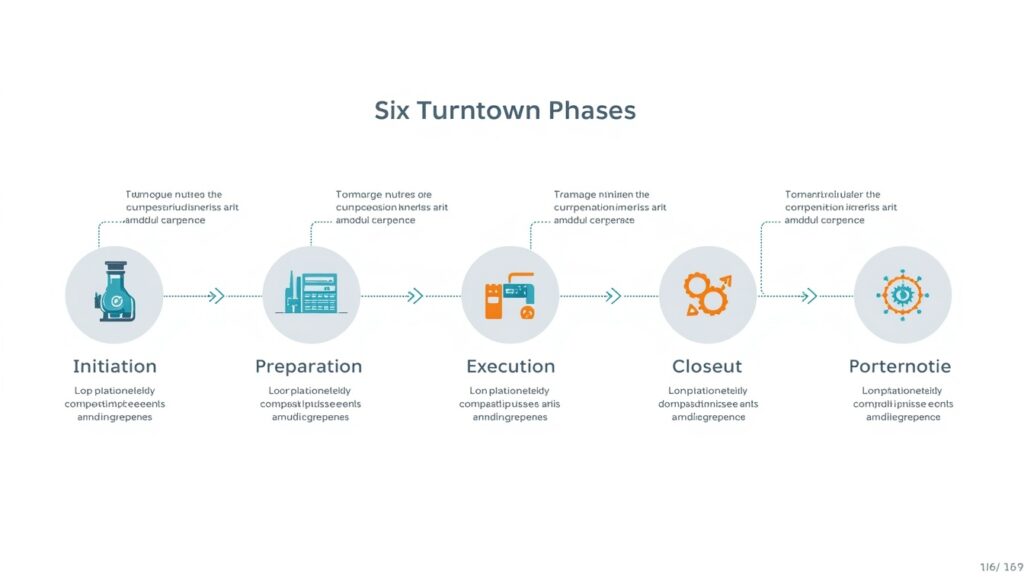
A turnaround typically follows these phases.
| Phase | Description |
|---|---|
| 1. Initiation | Decision to conduct the turnaround; preliminary scope, objectives, and budget |
| 2. Planning | Detailed scope, schedule, budget, and resource plan |
| 3. Preparation | Procurement, contracting, logistics, training, and readiness review |
| 4. Execution | Shutdown, work, and restart |
| 5. Closeout | Documentation, punch list, handover, and demobilization |
| 6. Post-turnaround review | Lessons learned and performance evaluation |
Each phase builds on the previous one. Rushing planning leads to problems during execution. Many owners also use stage gates, formal reviews at the end of key phases, to confirm that the work is ready to move forward.
Turnaround Objectives and Benchmarking
Every turnaround should start with clear objectives, such as target duration, cost, safety performance, scope completion, and post-restart reliability. Objectives should be measurable and agreed with plant management before detailed planning begins.
Benchmarking against similar plants can help set realistic targets for duration, cost, and scope. Industry associations and peer networks often provide benchmarking data. Because plants differ in age, technology, and condition, benchmarks should be used as a reference point, not as a rigid target.
Scope Definition
Scope definition is the foundation of turnaround success.
Scope categories:
- Mandatory: Work that must be done for safety, regulatory, or reliability reasons.
- Essential: Work that should be done to prevent near-term problems.
- Discretionary: Work that could be deferred if resources or time are limited.
Scope sources:
- Inspection findings: From previous inspections or condition monitoring.
- Maintenance history: Recurring problems or deferred work.
- Regulatory requirements: Inspections, tests, or certifications, such as pressure vessel, boiler, and safety valve requirements.
- Capital projects: Modifications or upgrades that can only be done while the plant is down.
- Reliability improvements: Changes to improve performance.
- Operations input: Problems operators have observed but could not fix online.
Scope freeze. Scope should be finalized early, with a defined freeze date. For major turnarounds, this is typically several months before the shutdown, so that materials with long lead times can be ordered and work packages completed. Changes after the freeze date should be minimized and approved through a formal change process, with their cost and schedule impact assessed.
Emergent work. Some work cannot be known until equipment is opened and inspected. This is often called emergent or discovery work. Experienced planners estimate an allowance for it, based on past turnarounds, and hold contingency and spare materials for the most likely findings.
Modifications. Capital projects and changes performed during the turnaround should go through the plant’s management of change (MOC) process before execution, and their documentation should be updated as part of closeout.
Turnaround Planning
Planning is the most important phase of a turnaround. The quality of planning largely determines the quality of execution.
Planning activities:
- Scope development: Detailed definition of work packages.
- Scheduling: Sequencing of tasks, resources, and dependencies.
- Budgeting: Cost estimates for labor, materials, services, and contingency.
- Resource planning: People, equipment, and contractor requirements.
- Procurement: Ordering materials and services with adequate lead time.
- Logistics: Site access, laydown areas, temporary facilities, and utilities.
- Safety planning: Hazard identification, permits, and emergency response.
- Risk management: Identifying risks and developing mitigation plans.
Planning should begin months before the turnaround. For major turnarounds, it may begin a year or more ahead. The earlier planning begins, the more time there is to resolve problems, order long-lead items, and secure contractors.
Learning from previous turnarounds. Reviewing lessons from previous turnarounds should be part of the planning process. Many organizations maintain a lessons-learned database that is consulted before each new turnaround. Typical items include actual versus planned durations for common tasks, recurring emergent work, and procurement or contractor problems.
Work Packages
Work is organized into work packages that can be planned, scheduled, and tracked.
A work package typically includes:
- Scope description: What work is to be done.
- Drawings and specifications: Technical details, including P&IDs and isolation points.
- Materials and tools: What is needed, with part numbers and quantities.
- Labor requirements: Skills and number of workers.
- Duration estimate: How long the work will take.
- Dependencies: What must be done before and after.
- Safety requirements: Permits, isolation and lockout/tagout (LOTO), PPE, and precautions.
- Quality requirements: Inspection, testing, and acceptance criteria.
Work packages should be detailed enough that the work can be executed without further clarification. They should be complete well before the shutdown so that they can be reviewed by operations, maintenance, and safety.
Scheduling
Scheduling sequences work to minimize turnaround duration while keeping it safe.
Scheduling considerations:
- Critical path: The sequence of tasks that determines the turnaround duration. Any delay on the critical path delays the whole turnaround.
- Parallel work: Tasks that can be done simultaneously, subject to safety and space constraints.
- Resource leveling: Balancing resources to avoid peaks and bottlenecks.
- Dependencies: Tasks that must follow others.
- Shutdown and startup sequences: Shutdown, cooldown, purging, gas freeing, and isolation at the start, and leak testing, purging, and restart at the end, take real time and must be in the schedule.
- Milestones: Key dates, such as shutdown start, mechanical completion, handover, and startup.
The schedule should be realistic, with contingency for delays. Aggressive schedules often lead to rework, safety issues, and schedule overruns. Schedules are typically prepared with project scheduling software and reviewed with the people who will do the work.
Resource Planning
Turnarounds require significant resources.
Resource categories:
- Internal staff: Operators, maintenance technicians, engineers.
- Contractors: Specialized labor for specific tasks.
- Specialty services: Inspection, NDT, machining, heat treatment, and similar services.
- Equipment: Cranes, scaffolding, tools, and similar equipment.
- Temporary facilities: Offices, warehouses, rest areas, and similar facilities.
Resource planning must consider:
- Availability: Are resources available when needed? Several plants in the same region may be shutting down at once.
- Competency: Do they have the required skills and certifications?
- Cost: What is the rate, and is it within budget?
- Productivity: What is the expected output per hour?
Resource constraints often determine the turnaround schedule.
Contractor Management
Contractors often make up the majority of the turnaround workforce. Contractor management is critical during turnarounds. Contractors must be aligned with safety requirements, trained on site procedures, and integrated into the turnaround organization.
Good contractor management typically includes:
- Prequalification: Reviewing safety record, competence, and capacity before award.
- Clear scope and responsibilities: Written scope, interfaces, and performance expectations.
- Site induction and training: Site rules, permit system, emergency procedures, and hazards.
- Supervision: Adequate contractor supervision and a clear plant counterpart for each contractor.
- Coordination: Inclusion in daily meetings and progress reporting.
- Performance review: Evaluation during and after the turnaround, feeding into future selection.
Procurement and Contracting
Procurement must be completed before the turnaround starts.
Procurement considerations:
- Lead time: Materials and services must be ordered early. Long-lead items such as large valves, heat exchanger bundles, rotating equipment spares, and special alloys can take many months.
- Specifications: Clear and complete specifications reduce errors.
- Quality: Materials must meet requirements and be verified on receipt.
- Delivery: Delivery must be coordinated with the schedule.
- Storage: Materials must be stored, preserved, and identified so they can be found when needed.
Contracting should be completed with clear scope, schedule, and performance requirements. The commercial basis (lump sum, unit rate, or reimbursable) should be chosen to match how well the scope is defined: the less defined the scope, the more risk the owner retains.
Safety Planning
Turnarounds involve high-risk activities: confined space entry, hot work, working at height, heavy lifting, line breaking, and simultaneous operations. The workforce is large, many workers are unfamiliar with the site, and schedule pressure is high.
Safety planning considerations:
- Hazard identification: What hazards are present, including residual hazardous materials and stored energy?
- Permits: What permits are required (hot work, confined space, line breaking, excavation, lifting)?
- Isolation: Are energy sources and process lines positively isolated, and is LOTO applied?
- Training: Are personnel trained for their tasks?
- PPE: What protective equipment is required?
- Emergency response: What if something goes wrong? Are rescue arrangements, such as confined space rescue, in place?
- Simultaneous operations (SIMOPS): How are conflicting activities managed (for example, hot work above personnel in a vessel)?
- Contractor safety: Are contractors aligned with safety requirements?
- Fatigue management: Long shifts and extended schedules increase the risk of errors.
Safety must be planned into the turnaround, not added as an afterthought.
Risk Management
Turnarounds have significant risks.
Common turnaround risks:
| Risk | Description | Mitigation |
|---|---|---|
| Scope growth | Additional work identified during execution | Freeze scope early; manage changes formally; allow for emergent work |
| Schedule delay | Work takes longer than planned | Realistic schedule; contingency; monitor the critical path |
| Cost overrun | Costs exceed budget | Contingency; cost tracking |
| Safety incident | Injury or incident during turnaround | Safety planning; supervision; SIMOPS control |
| Quality issues | Work does not meet requirements | Inspection; quality control |
| Resource shortage | Resources unavailable | Early contracting; backup plans |
| Long-lead material delays | Parts arrive late or are wrong | Early ordering; expediting; receipt inspection |
| Weather | Weather delays outdoor work | Weather contingency |
| Startup problems | Plant fails to restart or trips after restart | Thorough checks; pre-startup review; staged restart |
Risk management should identify risks early, assign owners, and develop mitigation plans. The risk register should be reviewed throughout planning and execution.
Pre-Turnaround Readiness Review
A pre-turnaround readiness review should be conducted before the shutdown starts. It confirms that scope is frozen, materials are available, resources are committed, and safety plans are in place.
The review typically also confirms that:
- Work packages are complete and approved.
- The schedule has been reviewed and accepted.
- Permits, isolations, and procedures are ready.
- Contractors are mobilized, inducted, and trained.
- Shutdown procedures and the operations team are ready.
- Temporary facilities, utilities, and logistics are in place.
If the review finds gaps, they should be closed before the shutdown starts, or a conscious decision should be made to accept the risk. A start date should not be held simply because it has been announced.
Execution
Execution is the phase where the work is actually performed. It starts with the controlled shutdown, decontamination, and isolation of the equipment, and ends with restart.
Execution considerations:
- Daily coordination: Meetings to review progress, issues, and changes.
- Progress tracking: Measuring actual vs. planned progress, usually by work package, and updating the critical path.
- Change management: Managing scope changes formally, with cost and schedule impact.
- Quality control: Inspecting work as it is completed, with hold points where needed.
- Safety oversight: Monitoring safety throughout, with active field supervision.
- Communication: Keeping all parties informed.
- Cost control: Tracking commitments and forecast cost against budget.
Execution is where planning is tested. Good planning makes execution smoother; poor planning creates chaos.
Turnaround Organization
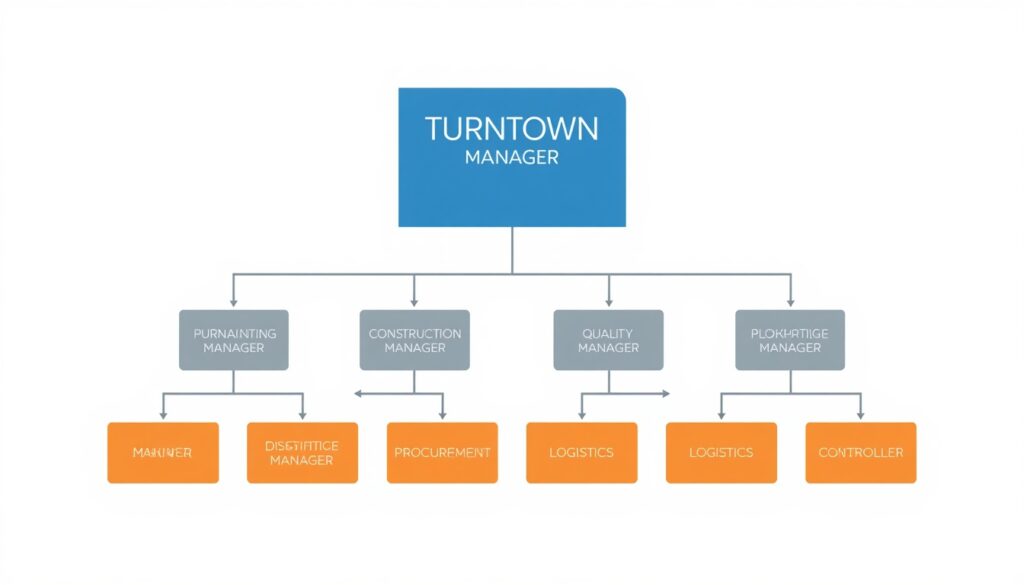
A clear organization is essential for turnaround success.
Key roles:
| Role | Responsibility |
|---|---|
| Turnaround Manager | Overall responsibility for the turnaround |
| Planning Manager | Scope, schedule, and work packages |
| Construction/Execution Manager | Execution of work in the field |
| Safety Manager | Safety oversight and compliance |
| Quality Manager | Quality control and inspection |
| Procurement Manager | Materials and services |
| Logistics Manager | Site access, facilities, and support |
| Cost Controller | Budget tracking and cost control |
| Operations Coordinator | Shutdown, isolation, handback, and restart |
For small plants, roles may be combined, but the functions must be covered. A dedicated turnaround manager who is not also responsible for daily plant operations is strongly recommended wherever possible.
Closeout and Handover
Closeout is the phase where the turnaround is completed and the plant is returned to operation.
Closeout activities:
- Punch list: Outstanding items to be completed, classified by whether they must be done before startup.
- Mechanical completion and inspection: Verification that work is finished, tested, and accepted, with safety devices reinstated.
- Documentation: Updated drawings, procedures, and records, including as-built information for modifications.
- Inspection records: Completed inspections and test results, including those required by regulators or insurers.
- Handover: Formal transfer back to operations.
- Startup preparation: Pre-startup safety review (PSSR) where required, especially after modifications, with startup procedures and the operating team ready.
- Demobilization: Removal of contractors, equipment, scaffolding, and temporary facilities.
- Housekeeping: Removal of waste, tools, and materials from the plant.
Closeout should be planned as part of the turnaround, not left to the end. Restart should be controlled and staged, with close monitoring in the first days of operation to catch problems early.
Post-Turnaround Review
After the turnaround, a review should be conducted to capture lessons learned, ideally within weeks, while memories are fresh.
Review topics:
- Scope performance: Was the scope completed as planned? How much emergent work arose?
- Schedule performance: Was the schedule met? What were the main delays?
- Cost performance: Was the budget met? Where were the variances?
- Safety performance: Were there any incidents or near misses?
- Quality performance: Were there any quality issues or rework?
- Startup and early operation: Did the plant restart smoothly and perform as expected?
- Lessons learned: What went well? What could be improved?
Lessons learned should be documented, entered in a lessons-learned database, and applied to future turnarounds. Results should also be compared with the objectives and benchmarks set at the start.
Turnarounds in Small Plants
Small plants face particular challenges with turnarounds.
Challenges:
- Fewer internal resources.
- Less turnaround experience.
- Smaller budgets.
- Limited contractor availability.
Practical approaches:
- Start planning early: Even small turnarounds benefit from early planning.
- Use templates: Standard work packages and checklists save time.
- Contract strategically: Use contractors for specialized work.
- Focus on critical work: Prioritize mandatory and essential scope.
- Learn from others: Talk to other plants about their turnarounds.
- Document lessons: Capture what worked and what didn’t.
Small turnarounds can be managed with simple tools, but the discipline of planning and execution remains essential.
Common Mistakes in Turnarounds
Even experienced organizations make mistakes. Common ones include:
- Insufficient planning: Rushing planning leads to execution problems.
- Scope creep: Adding work after the freeze date.
- Unrealistic schedule: Leading to rework and safety issues.
- Inadequate resources: Not enough people or equipment.
- Poor contractor management: Contractors not aligned with safety rules or the turnaround organization.
- Poor communication: Confusion and delays.
- Safety shortcuts: Leading to incidents.
- No contingency: No buffer for delays or emergent work.
- Skipping the readiness review: Starting the shutdown with gaps still open.
- Weak closeout: Outstanding items forgotten.
- No post-turnaround review: Lessons not captured.
These mistakes are costly to correct. They are much cheaper to avoid through good planning and disciplined execution.
How Japanese EPC Firms Approach Turnarounds
Japanese engineering firms are known for their disciplined approach to turnarounds. Common characteristics include:
- Thorough planning: Detailed scope, schedule, and work packages.
- Disciplined execution: Work is performed as planned, with tight control.
- Safety focus: Safety is prioritized throughout, often through daily toolbox meetings and hazard prediction activities.
- Quality control: Work is inspected as it is completed.
- Detailed documentation: Records are complete and accurate.
- Continuous improvement: Lessons are captured and applied.
- Long-term focus: Turnarounds are treated as investments in future reliability.
For plant owners, this often means turnarounds that are completed on schedule, within budget, and with the plant ready for reliable operation.
How to Evaluate Turnaround Readiness
When reviewing turnaround readiness, ask:
| Question | Why It Matters |
|---|---|
| Are objectives and targets defined and benchmarked? | Sets realistic and measurable goals |
| Is the scope defined and frozen? | Prevents scope creep during execution |
| Have lessons from previous turnarounds been reviewed? | Avoids repeating past mistakes |
| Is the schedule realistic? | Ensures work can be completed safely |
| Are resources planned and available? | Ensures work can be performed |
| Are contractors selected, inducted, and integrated? | Ensures safe and coordinated work |
| Is procurement complete? | Ensures materials are available |
| Is safety planning adequate? | Protects people during high-risk work |
| Is risk management in place? | Prepares for problems |
| Is the organization clear? | Ensures accountability |
| Has the readiness review been completed? | Confirms everything is in place before shutdown |
| Is closeout planned? | Ensures completion and handover |
| Is a post-turnaround review planned? | Captures lessons for future turnarounds |
A plant that addresses these questions is likely to have a successful turnaround.
Conclusion
Turnarounds are among the most complex and costly activities in a plant’s life. For small to medium-scale industrial plants, they require careful planning and disciplined execution.
By focusing on scope definition, planning, scheduling, resource and contractor management, safety, readiness review, and closeout, owners and turnaround teams can ensure that turnarounds are completed safely, on schedule, and within budget, and that the plant is ready for reliable operation afterward.
Key Takeaways
- Turnarounds are among the most complex and costly activities in a plant’s life
- Benchmarking against similar plants helps set realistic targets for duration, cost, and scope
- Scope definition and freeze are the foundation of turnaround success
- Planning determines the quality of execution, and lessons from previous turnarounds should feed into it
- Work packages organize the work for planning, scheduling, and tracking
- Contractors must be aligned with safety requirements, trained, and integrated into the turnaround organization
- Safety must be planned into the turnaround, not added as an afterthought
- Risk management identifies problems before they occur
- A pre-turnaround readiness review confirms that everything is in place before the shutdown starts
- Closeout and post-turnaround review capture lessons for future turnarounds
- Japanese EPC firms emphasize thorough planning, disciplined execution, and continuous improvement