By EPC Partners Inc. Engineering Team
Quality is not an inspection at the end of a project. It is a discipline that runs through every phase, from design and procurement to construction and commissioning. Quality assurance (QA) and quality control (QC) are the two complementary processes that ensure the plant is built to specification, operates safely, and performs reliably over its life.
At EPC Partners Inc., quality assurance and quality control have been a core part of our work across a wide range of plant projects, from geothermal power plants in Kenya, Indonesia, and Iceland to large-scale desalination facilities in the UAE and Saudi Arabia, and from thermal power plants in Vietnam and Bangladesh to water treatment plants in Vietnam and Kuwait. Our QA/QC work has ranged from welding inspection of geothermal steam piping to pressure testing of main steam lines for 300 MW thermal units, and supplier quality surveillance for high-pressure desalination equipment. Each project has presented different quality challenges, and each has reinforced the same lesson: quality is not a cost to be minimized. It is an investment in the plant’s long-term reliability.
This article covers the key practices in plant quality assurance and quality control, drawing on our experience supporting projects across Asia, the Middle East, Africa, and Europe.
What Is Quality Assurance and Quality Control?
Quality assurance (QA) and quality control (QC) are related but distinct.
Quality assurance is the process of ensuring that the systems and procedures used to build the plant are capable of producing the required quality. It is proactive: it focuses on preventing defects before they occur.
Quality control is the process of inspecting and testing the work to verify that it meets the specified requirements. It is detection-focused: it identifies defects so they can be corrected before they reach the owner.
Together, QA and QC ensure that the plant is built right the first time, and that any defects are found and corrected before they cause problems.
Why QA and QC Matter
Quality directly affects plant performance.
| Factor | Impact of Good QA/QC | Impact of Poor QA/QC |
|---|---|---|
| Safety | Defects detected and corrected | Safety incidents from defective work |
| Reliability | Equipment and systems perform as designed | Premature failures and downtime |
| Cost | Rework avoided | Rework and warranty costs |
| Schedule | Work accepted first time | Delays from rework |
| Compliance | Regulatory requirements met | Non-compliance and legal issues |
| Reputation | Owner and contractor credibility | Reputation damaged |
For small to medium-scale industrial plants, QA/QC determines whether the plant performs as designed and avoids costly rework. The cost of preventing a defect is almost always far lower than the cost of finding it after the plant is in service.
QA/QC Across the Project Phases
Quality must be managed from the first day of a project, not only during construction.
| Phase | Typical QA/QC Focus |
|---|---|
| Design | Design review and verification, code and specification compliance, checking of vendor drawings |
| Procurement | Supplier qualification, purchase order quality requirements, inspection at source, factory acceptance tests (FAT) |
| Construction | ITPs, welding control, NDE, material verification, civil and structural testing, pressure testing |
| Commissioning | Loop and function checks, system testing, performance verification, punch list control |
| Handover | Quality records (data books), as-built documentation, closure of non-conformances |
Quality Planning and the Quality Management System
QA starts with a project quality plan. The quality plan defines the quality objectives, organization and responsibilities, applicable codes and specifications, procedures, inspection and testing requirements, and how records will be controlled.
Most EPC contractors and suppliers work within a quality management system aligned with ISO 9001. The project quality plan applies that system to the specific project and should be agreed with the owner before work begins.
Codes and standards that commonly drive plant quality requirements include:
- ASME B31.1 (power piping) and ASME B31.3 (process piping)
- ASME Boiler and Pressure Vessel Code, including Section IX for welding qualification
- ISO 3834 and ISO 15614 for welding quality and procedure qualification
- AWS D1.1 for structural welding
- Project-specific owner specifications and local regulations
The applicable codes should be identified in the quality plan so that every party works to the same requirements.
Quality Assurance
Quality assurance focuses on the systems and procedures used to build the plant.
QA activities:
- Quality planning: Defining quality requirements and how they will be achieved.
- Procedure development: Developing procedures for work activities.
- Supplier qualification: Assessing suppliers’ quality capability.
- Audits: Auditing quality systems and processes.
- Training: Ensuring personnel are trained on quality requirements.
- Documentation: Maintaining quality records.
QA ensures that the systems are in place to produce quality, before work begins.
Quality Control
Quality control focuses on inspecting and testing the work to verify quality.
QC activities:
- Inspection: Visual and dimensional inspection of work.
- Testing: Testing materials, equipment, and systems.
- Non-destructive examination (NDE): Testing without damaging the item.
- Documentation review: Reviewing test certificates and quality records.
- Non-conformance management: Identifying and resolving defects.
- Calibration control: Ensuring that inspection, measuring, and test equipment is calibrated and its certificates are valid.
QC verifies that the work meets requirements as it is performed and before it is accepted.
Inspection and Test Plans (ITPs)
Inspection and test plans (ITPs) define what inspections and tests are required, when, and by whom.
ITP contents:
| Element | Description |
|---|---|
| Activity | What work is being inspected |
| Inspection/test | What inspection or test is required |
| Reference | What standard or specification applies |
| Acceptance criteria | What defines acceptable quality |
| Responsibility | Who performs and witnesses the inspection |
| Hold points | Points where work cannot proceed without inspection |
| Witness points | Points where inspection is witnessed but work can proceed |
| Records | What records are produced |
ITPs should be prepared before work begins and agreed with all parties, including the owner and any third-party inspector.
Hold Points and Witness Points
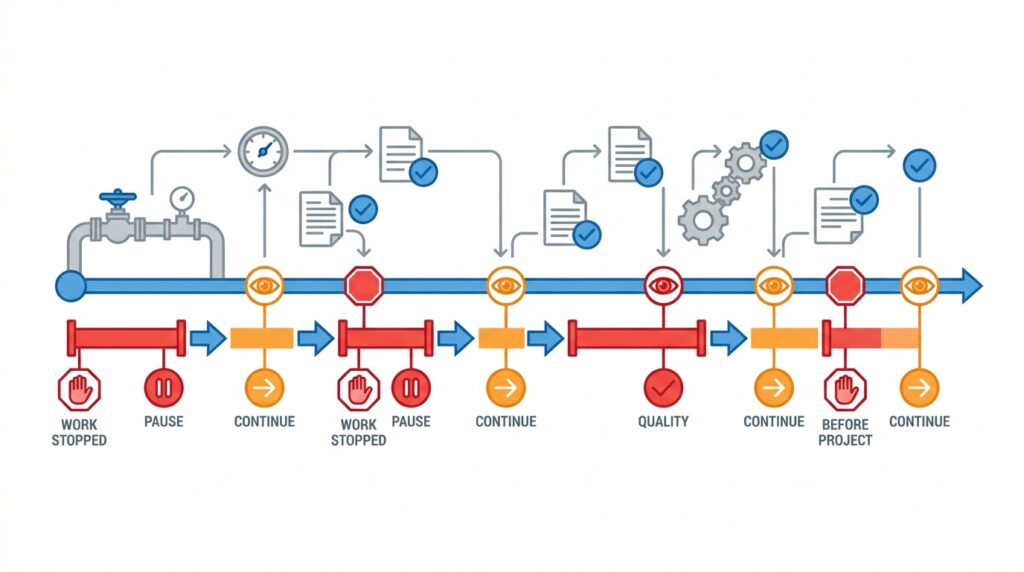
Hold points and witness points are key controls in ITPs.
Hold points:
- Definition: Points where work cannot proceed until inspection is complete and accepted.
- Purpose: Ensure that critical quality steps are verified before work continues.
- Examples: Pressure test acceptance, weld inspection, equipment alignment, concrete pour release.
Witness points:
- Definition: Points where inspection is witnessed by the owner or third party but work can proceed if they do not attend after proper notice.
- Purpose: Allow verification without stopping work.
- Examples: Material identification, coating inspection, final assembly.
Hold points and witness points should be clearly defined in the ITP, with agreed notice periods so that inspections do not delay the schedule.
Non-Destructive Examination (NDE)
Non-destructive examination (NDE) is used to inspect materials and welds without damaging them.
Common NDE methods:
| Method | Description | Application |
|---|---|---|
| Radiographic testing (RT) | Uses X-rays or gamma rays | Weld inspection |
| Ultrasonic testing (UT) | Uses high-frequency sound waves | Weld inspection, thickness measurement |
| Magnetic particle testing (MT) | Uses magnetic fields and particles | Surface and near-surface defects |
| Liquid penetrant testing (PT) | Uses liquid dye and developer | Surface defects |
| Visual inspection (VT) | Visual examination | Surface defects |
NDE methods should be selected based on the material, weld type, and criticality. The extent of NDE (for example, 100% or a sampling percentage) is set by the applicable code and project specification. NDE personnel should be qualified and certified, for example to ISO 9712 or ASNT SNT-TC-1A.
Welding Quality
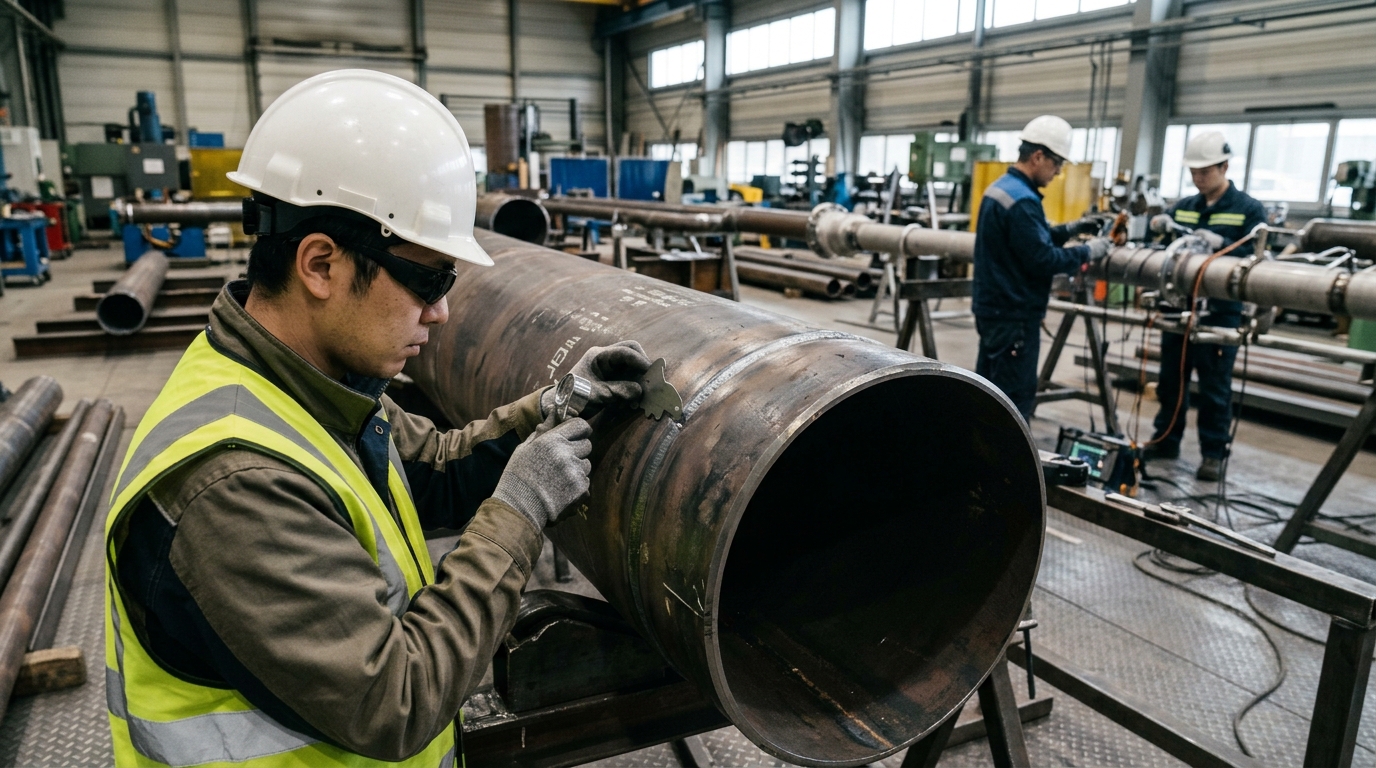
Welding is a critical quality area in many industrial plants.
Welding quality considerations:
- Welding procedure specifications (WPS): Documented procedures for each weld type.
- Procedure qualification records (PQR): Evidence that the WPS produces acceptable welds.
- Welder qualification: Evidence that welders are qualified for the work.
- Welding consumables control: Storage, baking, and issue of electrodes and filler materials.
- Preheat and post-weld heat treatment (PWHT): Controlled and recorded where required by material and thickness.
- Weld inspection: Visual inspection and NDE of welds.
- Weld documentation: Weld maps, welder identification, and records of welding, inspection, and testing.
At our geothermal projects in Kenya (Olkaria I Unit 6, 83 MW) and Indonesia (Muara Laboh, 85.2 MW), welding of geothermal steam piping required special procedures and materials to handle the corrosive nature of the steam. In Iceland (Theistareykir, 2×45 MW), welding was performed to the specific requirements of the geothermal environment.
Project experience: At one geothermal project in Indonesia, the steam piping required special welding procedures and materials to handle the corrosive effects of hydrogen sulfide. At another project in Kenya, the welding of high-pressure steam lines was subject to rigorous NDE, with radiographic testing of every butt weld.
Material Verification
Material verification ensures that the materials used match the specifications.
Material verification activities:
- Material certificates: Certificates confirming material composition and properties (for example, EN 10204 type 3.1 certificates).
- Positive material identification (PMI): Testing to confirm material composition.
- Material traceability: Tracking materials from receipt to installation.
- Storage and preservation: Storing materials to prevent damage or contamination.
Material verification is especially important for critical materials such as alloy steels and stainless steels, where a wrong grade may look identical to the correct one but fail in service.
Coating, Civil, and Electrical QC
QA/QC is not limited to piping and mechanical work. Other disciplines have their own key controls:
- Coatings and painting: Surface preparation, environmental conditions, dry film thickness, and holiday testing.
- Civil and structural: Concrete mix approval, slump and cube strength tests, reinforcement inspection, survey and tolerance checks, and grouting.
- Electrical: Insulation resistance testing, cable testing, protection relay testing, and earthing verification.
- Instrumentation and control: Calibration, loop checks, and function tests.
Pressure Testing
Pressure testing verifies that pressure systems can withstand design pressure.
Pressure testing types:
- Hydrostatic test: Fills the system with water and pressurizes to test strength and leak tightness.
- Pneumatic test: Uses air or inert gas instead of water.
Pressure testing considerations:
- Test pressure: Set by the governing code. Hydrostatic test pressure is typically 1.5 times design pressure, with pneumatic tests at a lower multiple.
- Hold time: Defined by the code and test procedure, with enough time at pressure for a thorough inspection of all joints.
- Test medium: Water is preferred; air or inert gas is used where water is not suitable.
- Water quality: For stainless steel systems, water chloride content must be controlled, and systems must be drained and dried after testing.
- Safety: Pressure testing involves stored energy, especially in pneumatic tests, and must be performed under a controlled procedure with exclusion zones.
For thermal power projects in Vietnam (Thai Binh 1, 2×300 MW) and Bangladesh (Bibiyana-III, 400 MW CCGT), pressure testing of main steam and high-pressure piping was a critical quality milestone, witnessed by the owner and third-party inspectors.
Non-Conformance Management
Non-conformances are deviations from requirements. Managing them is critical.
Non-conformance process:
- Identify: Identify the non-conformance.
- Document: Record the non-conformance in a non-conformance report (NCR).
- Assess: Assess the impact and severity.
- Disposition: Determine disposition (repair, rework, replace, accept as-is).
- Approve: Approve the disposition.
- Implement: Implement the disposition.
- Verify: Verify that the disposition was effective.
- Close: Close the non-conformance.
Non-conformances should be tracked and analyzed to identify trends. Where a problem recurs, corrective action should address the root cause, not just the individual defect.
Quality Records
Quality records document that quality requirements were met.
Key quality records:
- Inspection reports: Results of inspections.
- Test certificates: Results of tests.
- Material certificates: Certification of materials.
- NDE reports: Results of non-destructive examination.
- Non-conformance reports: Records of non-conformances.
- As-built drawings: Drawings reflecting actual construction.
Quality records are usually compiled into a final quality data book (also called a manufacturing data book or dossier) at handover. Records must be complete, accurate, and accessible. Gaps found at handover are expensive and sometimes impossible to fix.
Supplier Quality
Suppliers are a critical part of quality management.
Supplier quality activities:
- Supplier qualification: Assessing supplier quality capability.
- Supplier audits: Auditing supplier quality systems.
- Inspection at source: Inspecting at the supplier’s facility, including witnessing FAT.
- Supplier performance monitoring: Tracking supplier quality performance.
Supplier quality problems can cause significant project delays and cost overruns, particularly for long-lead equipment where there is no time to remanufacture.
For desalination projects in the Gulf (Taweelah, 909,200 m³/day; Jubail 3A, 600,000 m³/day), supplier quality was critical for high-pressure pumps, membranes, and corrosion-resistant materials, with inspection at source and material verification as key controls.
QA/QC in Small Plants
Small plants face particular challenges with QA/QC.
Challenges:
- Fewer resources for QA/QC.
- Less expertise.
- Less access to testing facilities.
- Competing priorities.
Practical approaches:
- Focus on critical items: Prioritize QA/QC for critical equipment and systems.
- Use third-party inspection: Leverage third-party inspectors for specialized work.
- Use standard procedures: Standard ITPs and procedures can save time.
- Document everything: Good records demonstrate quality.
- Train staff: Ensure staff understand quality requirements.
- Learn from others: Apply lessons from other plants.
QA/QC does not need to be complex. It needs to be thorough and consistent.
Common Mistakes in QA/QC
Even experienced organizations make mistakes. Common ones include:
- No quality plan: Quality not planned.
- Inadequate ITPs: Inspection and test plans incomplete or not followed.
- Skipping inspection: Not verifying quality.
- Poor documentation: Quality records missing or incomplete.
- Ignoring non-conformances: Not addressing deviations.
- Inadequate NDE: Insufficient non-destructive examination.
- Poor supplier quality: Not managing supplier quality.
- Uncalibrated equipment: Using inspection and test instruments with expired calibration.
- No audits: Not verifying that the quality system works.
- Rushing QA/QC: Insufficient time for thorough inspection and testing.
These mistakes are costly to correct. They are much cheaper to avoid through disciplined QA/QC.
How EPC Partners Inc. Approaches QA/QC
At EPC Partners Inc., we bring practical experience from projects across Asia, the Middle East, Africa, and Europe to QA/QC.
Our approach includes:
- Thorough planning: Quality is planned from the beginning.
- Detailed ITPs: Inspection and test plans are comprehensive and followed.
- Disciplined inspection: Work is inspected as it is completed.
- Rigorous non-conformance management: Non-conformances are addressed promptly.
- Detailed documentation: Records are complete and accurate.
- Supplier quality focus: Suppliers are managed for quality.
- Continuous improvement: Lessons are captured and applied.
Our experience includes supporting geothermal projects in Kenya, Ethiopia, Indonesia, Iceland, and Japan; desalination projects in the UAE, Saudi Arabia, Oman, and Qatar; thermal power projects in Vietnam, Bangladesh, and Japan; and water treatment projects in Vietnam, Kuwait, and Qatar.
We have also supported clients including Marubeni Corporation, Fuji Electric Co., Ltd., and Toyota Tsusho Corporation on QA/QC aspects of their projects.
How to Evaluate QA/QC Readiness
When reviewing QA/QC, ask:
| Question | Why It Matters |
|---|---|
| Is there a quality plan? | Provides a roadmap for quality |
| Are ITPs prepared and followed? | Defines inspections and tests |
| Are hold and witness points defined? | Ensures critical steps are verified |
| Are welders, procedures, and NDE personnel qualified? | Ensures critical work is done by competent people |
| Is inspection performed? | Verifies that work meets requirements |
| Is testing performed? | Verifies that equipment functions |
| Are non-conformances managed? | Addresses deviations |
| Are quality records complete? | Documents that quality was achieved |
| Are suppliers managed for quality? | Ensures supplier quality |
| Are audits performed? | Verifies that the quality system works |
A plant that addresses these questions is ready for effective QA/QC.
Key Takeaways
- Quality runs through every phase of the project, from design to handover, not just construction.
- QA prevents defects through planning, procedures, and audits; QC detects them through inspection and testing.
- ITPs with clear hold and witness points are the backbone of quality control.
- Welding, material verification, and pressure testing deserve the most attention on piping-intensive plants.
- Non-conformances should be tracked to root cause, and records must be complete at handover.
- Supplier quality is a project risk that must be managed actively.
Conclusion
Quality assurance and quality control are critical to plant success. For small to medium-scale industrial plants, they determine whether the plant performs as designed and avoids costly rework.
By focusing on quality planning, ITPs, hold and witness points, NDE, welding quality, material verification, pressure testing, non-conformance management, quality records, and supplier quality, owners and project teams can ensure that the plant is built to specification and performs reliably.
If you are planning a plant project and need support with QA/QC or EPC project delivery, contact us to discuss how we can help.
EPC Partners Inc. is a Japanese EPC support firm with experience supporting power, water, and industrial plant projects across Asia, the Middle East, Africa, and Europe. For more information, visit our project list.