
Schedule is one of the three pillars of project success, alongside cost and quality. A project that is completed within budget and to specification but finishes a year late has still failed to meet its objectives. Scheduling and progress control are the disciplines of planning, monitoring, and controlling project timelines so that the plant is delivered when it is needed.
At EPC Partners Inc., scheduling has been a core part of our work across a wide range of plant projects—from geothermal power plants in Kenya, Indonesia, and Iceland to large-scale desalination facilities in the UAE and Saudi Arabia, and from thermal power plants in Vietnam and Bangladesh to water treatment plants in Vietnam and Kuwait. Our scheduling work has ranged from geothermal projects in Kenya and Indonesia, where long-lead turbine delivery and drilling schedules were critical, to desalination projects in the Gulf, where high-pressure pump and membrane delivery drove the schedule. Each project has reinforced the same lesson: schedule management is not just about dates. It is about understanding what needs to happen, in what order, and by when—and ensuring that it does.
This article covers the key practices in plant project scheduling and progress control, drawing on our experience supporting projects across Asia, the Middle East, Africa, and Europe.
What Is Project Scheduling and Progress Control?
Project scheduling is the process of planning, developing, monitoring, and controlling the project schedule. Progress control is the process of measuring actual progress against the plan and taking corrective action when the schedule slips.
Together, they include:
- Planning: Defining the activities, sequence, and durations.
- Development: Building the schedule model and identifying the critical path.
- Monitoring: Tracking actual progress against the plan.
- Control: Taking corrective action when the schedule slips.
- Reporting: Communicating schedule performance to management.
Why Scheduling and Progress Control Matter
Schedule performance has significant consequences.
| Factor | Impact of Good Schedule Management | Impact of Poor Schedule Management |
|---|---|---|
| Delivery | Project completed on time | Project delayed |
| Cost | Delays avoided; costs controlled | Delay costs; extended overheads |
| Revenue | Production starts on time | Lost revenue from delayed startup |
| Reputation | Owner and contractor credibility | Reputation damaged |
| Contracts | Liquidated damages avoided | Liquidated damages incurred |
| Morale | Team meets commitments | Team demoralized by slippage |
For small to medium-scale industrial plants, schedule management determines whether the project meets its objectives.
Schedule Development
Schedule development is the process of building the project schedule.
- Activity definition: What activities must be performed?
- Sequencing: In what order must activities be performed?
- Resource estimating: What resources are needed for each activity?
- Duration estimating: How long will each activity take, given those resources?
- Schedule calculation: When will each activity start and finish?
- Critical path analysis: Which activities determine the project duration?
- Baseline approval: The approved schedule becomes the reference for control.
The schedule should be developed with input from the people who will perform the work, including engineering, procurement, construction, and commissioning leads.
At our geothermal projects in Kenya (Olkaria I Unit 6, 83 MW) and Indonesia (Muara Laboh, 85.2 MW), schedule development was driven by the long-lead delivery of steam turbines and the need to coordinate drilling, steam gathering, and power plant construction. In Iceland (Theistareykir, 2×45 MW), the schedule was shaped by the short construction season and the need to complete critical works before winter.
Work Breakdown Structure (WBS)
The work breakdown structure (WBS) provides the framework for schedule development.
- Hierarchical: Each level breaks the level above into smaller components.
- Complete: All project scope is included.
- Unique: Each component has a unique identifier.
- Manageable: Components are small enough to plan and control.
| Level | Description | Example |
|---|---|---|
| 1 | Project | Power plant |
| 2 | Major systems | Boiler, turbine, electrical |
| 3 | Subsystems | Feedwater, fuel, control |
| 4 | Work packages | Pumps, valves, instruments |
| 5 | Activities | Installation tasks |
The WBS links the schedule to scope and cost.
Activity Sequencing
Activity sequencing determines the order in which activities are performed.
| Relationship | Description |
|---|---|
| Finish-to-Start (FS) | Activity B starts after Activity A finishes |
| Start-to-Start (SS) | Activity B starts after Activity A starts |
| Finish-to-Finish (FF) | Activity B finishes after Activity A finishes |
| Start-to-Finish (SF) | Activity B finishes after Activity A starts (rarely used) |
Most construction activities use finish-to-start relationships. Other relationships are used where work can overlap.
Duration Estimating
Duration estimating determines how long each activity will take.
| Method | Description | When to Use |
|---|---|---|
| Analogous | Based on similar past activities | When data is limited |
| Parametric | Based on productivity rates | When quantities are known |
| Bottom-up | Built from detailed task analysis | For critical activities |
| Expert judgment | Based on experience | For unusual activities |
| Three-point | Optimistic, most likely, pessimistic | For uncertain activities |
Durations should be realistic, not optimistic. Optimistic durations lead to schedule slippage.
Resource Loading and Calendars
Durations only hold if resources are available. Resource-load the schedule to find peaks in manpower, cranes, and equipment, and level them where possible. Use realistic calendars covering working days, shifts, holidays, religious observances such as Ramadan, and weather seasons. In Iceland, the short construction season drove which works had to be finished before winter. In the Gulf, summer heat limits outdoor working hours.
The Critical Path
The critical path is the sequence of activities that determines the project duration.
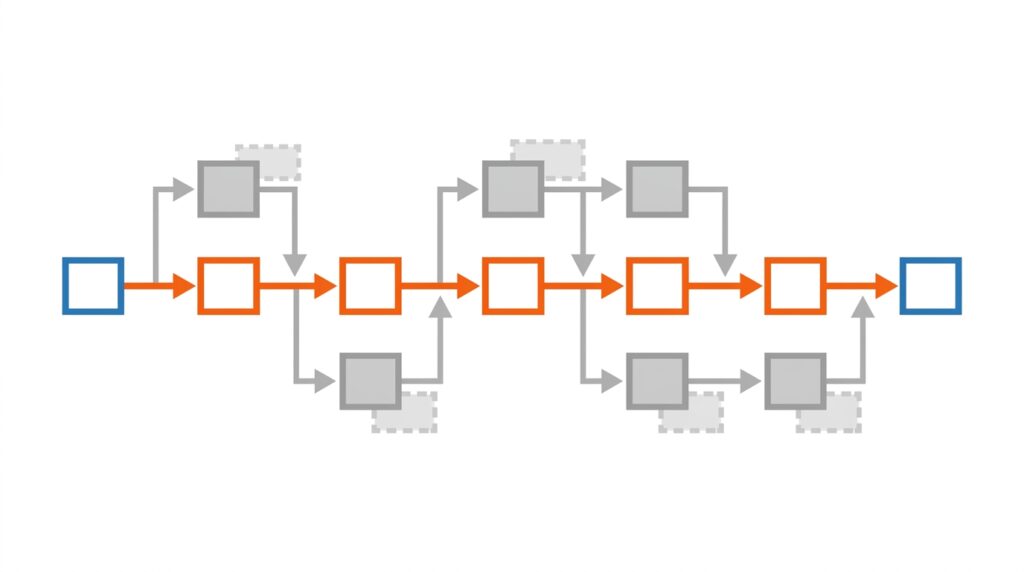
- Critical path: The longest path through the network.
- Critical activities: Activities on the critical path.
- Float (slack): The amount of time an activity can be delayed without causing a problem.
- Total float: The time an activity can be delayed without delaying project completion.
- Free float: The time an activity can be delayed without delaying the earliest start of any successor.
- Near-critical paths: Paths with very little float that can become critical after a small delay.
Activities on the critical path have zero (or negative) total float. Delays on the critical path delay the project. Near-critical paths should be monitored too, since the critical path can shift as work progresses.
At one thermal power project in Vietnam (Thai Binh 1, 2×300 MW), the critical path ran through the steam turbine and generator delivery and installation, with the boiler and balance of plant following in sequence. At another project in Bangladesh (Bibiyana-III, 400 MW CCGT), the schedule was built around the delivery of the gas turbine and the heat recovery steam generator, with careful coordination of the construction sequence to avoid delay. In both cases, close monitoring of the critical path and near-critical paths was essential.
Schedule Levels
Schedules are developed at different levels for different purposes.
| Level | Description | Purpose |
|---|---|---|
| Level 1 | Executive summary schedule | Management overview |
| Level 2 | Summary schedule | Project management |
| Level 3 | Project schedule | Detailed planning and control |
| Level 4 | Work package schedule | Detailed execution |
| Level 5 | Activity schedule | Day-to-day management |
Different levels serve different audiences, and the level of detail increases with the level number. Lower-level schedules must roll up consistently into higher-level ones.
Long-Lead Items and Interfaces
In EPC projects, many delays originate not in construction but in procurement and interfaces.
- Long-lead equipment: Identify items such as turbines, boilers, large transformers, and special valves early, and schedule their ordering, engineering data, and delivery as critical activities.
- Engineering–procurement–construction interfaces: Link vendor data submission, approval, fabrication, delivery, and installation in the logic.
- Contractor interfaces: Define handover dates between contractors and make them contractual milestones.
- Commissioning and startup: Include commissioning, testing, and performance tests in the schedule from the start, not as an afterthought.
For desalination projects in the Gulf (Taweelah, 909,200 m³/day; Jubail 3A, 600,000 m³/day), the long-lead delivery of high-pressure pumps and membrane skids was a critical path item, and the schedule was built around their delivery dates.
Schedule Baselines
The schedule baseline is the approved schedule against which progress is measured.
- Approval: The baseline is approved by management.
- Control: Changes to the baseline are formally controlled.
- Updates: The baseline is revised only for approved changes, such as scope changes or owner-caused delays.
- Reporting: Progress is reported against the baseline.
Schedule Quality Checks
Before approving a baseline, check its quality. Look for activities with missing predecessors or successors, excessive constraints, very long durations, unrealistic lags, negative float, and open-ended activities. Recognized checklists, such as the DCMA 14-point assessment, can help. A schedule that fails these checks cannot be relied on for forecasting or claims.
Progress Measurement
Progress measurement tracks actual progress against the plan.
| Method | Description | When to Use |
|---|---|---|
| Milestone tracking | Tracking completion of milestones | High-level progress |
| Percent complete | Estimating percent complete for activities | Subjective but simple |
| Units installed | Counting units installed | Quantifiable work |
| Earned value | Comparing earned value to planned value | Integrated cost-schedule |
| Weighted milestones | Assigning weights to milestones | Construction progress |
Progress measurement should be objective and consistent. Subjective estimates should be avoided where possible.
Schedule Monitoring
Schedule monitoring tracks progress and identifies variances.
- Progress updates: Regular updates to the schedule at a consistent data date.
- Variance analysis: Comparing actual progress to planned.
- Critical path monitoring: Tracking critical and near-critical activities.
- Float monitoring: Tracking available float and its consumption.
- Trend analysis: Identifying trends, for example through the Schedule Performance Index (SPI) where earned value is used.
- Forecasting: Predicting the final completion date.
Monitoring should be regular and timely.
Look-Ahead Schedules and S-Curves
Short-term look-ahead schedules, typically three to six weeks, turn the master schedule into actionable work plans. Weekly coordination meetings should check constraints such as materials, drawings, permits, access, and manpower before work starts. Cumulative progress (S-curves) comparing planned, actual, and forecast progress shows trends at a glance. A flattening actual curve is an early warning.
Schedule Control
Schedule control takes corrective action when the schedule slips.
- Variance identification: Identifying where the schedule has slipped.
- Root cause analysis: Understanding why it slipped.
- Corrective action: Taking action to recover.
- Recovery planning: Developing plans to recover slippage.
- Change management: Managing changes that affect the schedule.
Corrective action may include adding resources, working overtime, resequencing activities, or reducing scope.
Schedule Recovery
Schedule recovery is the process of recovering lost time.
| Strategy | Description | Considerations |
|---|---|---|
| Add resources (crashing) | More people or equipment | May not be possible; productivity loss |
| Overtime | Longer working hours | Fatigue; cost increase; safety |
| Resequencing | Changing the sequence | May affect other activities |
| Parallel working (fast-tracking) | Performing activities in parallel | Risk of interference, rework, and safety |
| Reduce scope | Removing scope | May not be acceptable |
| Extend schedule | Accepting a later completion | May affect revenue |
Recovery should be planned carefully. Rushing can increase cost, reduce quality, and create safety risks. Recovery that does not address root causes usually fails.
Schedule Buffers
Schedule buffers, which are deliberate time allowances distinct from the float that arises naturally from network logic, should be built into the schedule to absorb uncertainty. Buffers should be sized based on risk and monitored, not consumed informally. Many projects place buffers ahead of key milestones or before completion rather than padding individual activities.
Schedule Risk Management
Schedule risk is the risk that the project will not meet its schedule.
| Risk | Description | Mitigation |
|---|---|---|
| Late deliveries | Equipment or materials arrive late | Expediting; buffer; alternate vendors |
| Design delays | Design takes longer than planned | Early design; resourcing |
| Weather | Weather delays outdoor work | Weather contingency |
| Labor shortages | Resources not available | Early recruitment; alternate sources |
| Productivity | Work takes longer than planned | Realistic rates; monitoring |
| Rework | Work must be redone | Quality control |
| Scope changes | Changes affect schedule | Change management |
Risk management should identify risks early and develop mitigation plans.
Schedule Risk Analysis
Schedule risk analysis, often using Monte Carlo simulation, quantifies the probability of meeting the schedule. It produces a range of possible completion dates with associated confidence levels, such as P50 or P80. Owners often set commitments at P80 rather than P50 to improve the chance of success.
The Schedule in Contracts
The schedule is also a contractual document.
- Contractor schedule submission: Require a baseline schedule, with logic and resources, for approval, and regular updates in native format.
- Milestones and liquidated damages: Tie delay damages to clearly defined milestones.
- Extension of time: Define the process for claiming time, and keep contemporaneous records, since delay claims are usually analyzed using the updated schedules.
- Scheduling tools: Use recognized software, such as Primavera P6 or Microsoft Project, with agreed settings and a scheduling specification.
Delay Analysis
When delays occur, responsibility must be established. Common methods include as-planned versus as-built comparison, time impact analysis, and windows analysis. Each depends on a reliable baseline and regularly updated schedules, which is why the practices above matter. Concurrent delays (owner-caused and contractor-caused at the same time) need particular care, and the contract should state how they are treated.
Schedule Reporting
Schedule reporting keeps management informed of schedule performance.
- Baseline schedule: The approved schedule.
- Actual progress: Progress to date.
- Variance: Actual vs. planned.
- Forecast: Predicted completion date.
- Critical path: Status of critical activities.
- Risks: Schedule risks and mitigation.
- Trends: Schedule performance over time.
Reports should be accurate, timely, and clear.
Scheduling in Small Plants
Small plants face particular challenges with scheduling: fewer resources, less expertise, less access to scheduling tools, and competing priorities.
Practical approaches:
- Focus on critical activities: Prioritize scheduling of critical activities.
- Use simple tools: Spreadsheets or simple scheduling software can be sufficient.
- Use vendor information: Leverage vendor delivery schedules.
- Seek expert advice: Get advice from experienced planners.
- Document assumptions: Record the basis for the schedule.
- Learn from others: Apply lessons from other plants.
Scheduling does not need to be complex. It needs to be realistic and well-maintained.
Common Mistakes in Scheduling
Even experienced organizations make mistakes. Common ones include:
- Optimistic durations: Underestimating how long work takes.
- Incomplete scope: Missing activities that later add time.
- Inadequate sequencing: Activities sequenced incorrectly.
- Ignoring the critical path: Focusing on non-critical activities.
- Poor progress measurement: Subjective or inconsistent data.
- Delayed reporting: Discovering slippage too late.
- No recovery planning: Not planning to recover slippage.
- Unrealistic recovery: Rushing without addressing root causes.
- No risk management: Not identifying and mitigating schedule risks.
- Informal buffer use: Consuming float and contingency without tracking.
These mistakes are costly to correct. They are much cheaper to avoid through disciplined scheduling and progress control.
The Japanese EPC Approach
Japanese EPC practice emphasizes detailed advance planning, disciplined weekly coordination, early identification of constraints, and thorough documentation. Problems are raised early and handled at the source, not carried forward.
How EPC Partners Inc. Approaches Scheduling and Progress Control
At EPC Partners Inc., we bring practical experience from projects across Asia, the Middle East, Africa, and Europe to scheduling and progress control.
- Thorough planning: Schedules are developed carefully, with realistic durations and sequencing.
- Detailed control: Progress is tracked and reported regularly.
- Early warning: Variances are identified and addressed early.
- Disciplined recovery: Recovery plans are developed and executed carefully.
- Detailed documentation: Records are complete and accurate.
- Continuous improvement: Lessons are captured and applied.
Our experience includes supporting geothermal projects in Kenya, Ethiopia, Indonesia, Iceland, and Japan; desalination projects in the UAE, Saudi Arabia, Oman, and Qatar; thermal power projects in Vietnam, Bangladesh, and Japan; and water treatment projects in Vietnam, Kuwait, and Qatar.
We have also supported clients including Marubeni Corporation, Fuji Electric Co., Ltd., and Toyota Tsusho Corporation on scheduling and progress control aspects of their projects.
How to Evaluate Scheduling Readiness
When reviewing scheduling, ask:
| Question | Why It Matters |
|---|---|
| Is there a detailed schedule? | Provides the basis for planning and control |
| Is the schedule based on a WBS? | Links schedule to scope and cost |
| Are durations and productivity assumptions realistic and documented? | Prevents optimistic schedules |
| Are resources and calendars loaded realistically? | Prevents unachievable durations |
| Are long-lead items and interfaces in the logic? | Captures the most common sources of delay |
| Is the critical path identified? | Focuses attention where it matters |
| Is there a schedule baseline? | Provides the reference for control |
| Is the baseline checked for quality before approval? | Ensures a reliable forecasting and claims basis |
| Are progress measurement rules agreed? | Ensures objective, auditable progress data |
| Is the schedule monitored regularly? | Identifies variances early |
| Is corrective action taken? | Recovers slippage |
| Is schedule risk analyzed and are buffers managed? | Prepares for potential delays |
| Is reporting timely? | Enables early corrective action |
A project that addresses these questions is ready for effective schedule management.
Conclusion
Scheduling and progress control are critical to plant success. For small to medium-scale industrial plants, they determine whether the project is delivered on time and meets its objectives.
By focusing on schedule development, WBS, sequencing, duration estimating, critical path analysis, progress measurement, monitoring, control, recovery, and risk analysis, owners and project teams can ensure that the project is delivered on schedule. Scheduling is not a one-time exercise. It is a discipline that must be maintained throughout the project, from baseline approval to handover.
If you are planning a plant project and need support with scheduling or EPC project delivery, contact us to discuss how we can help.
EPC Partners Inc. is a Japanese EPC support firm with experience supporting power, water, and industrial plant projects across Asia, the Middle East, Africa, and Europe. For more information, visit our project list.