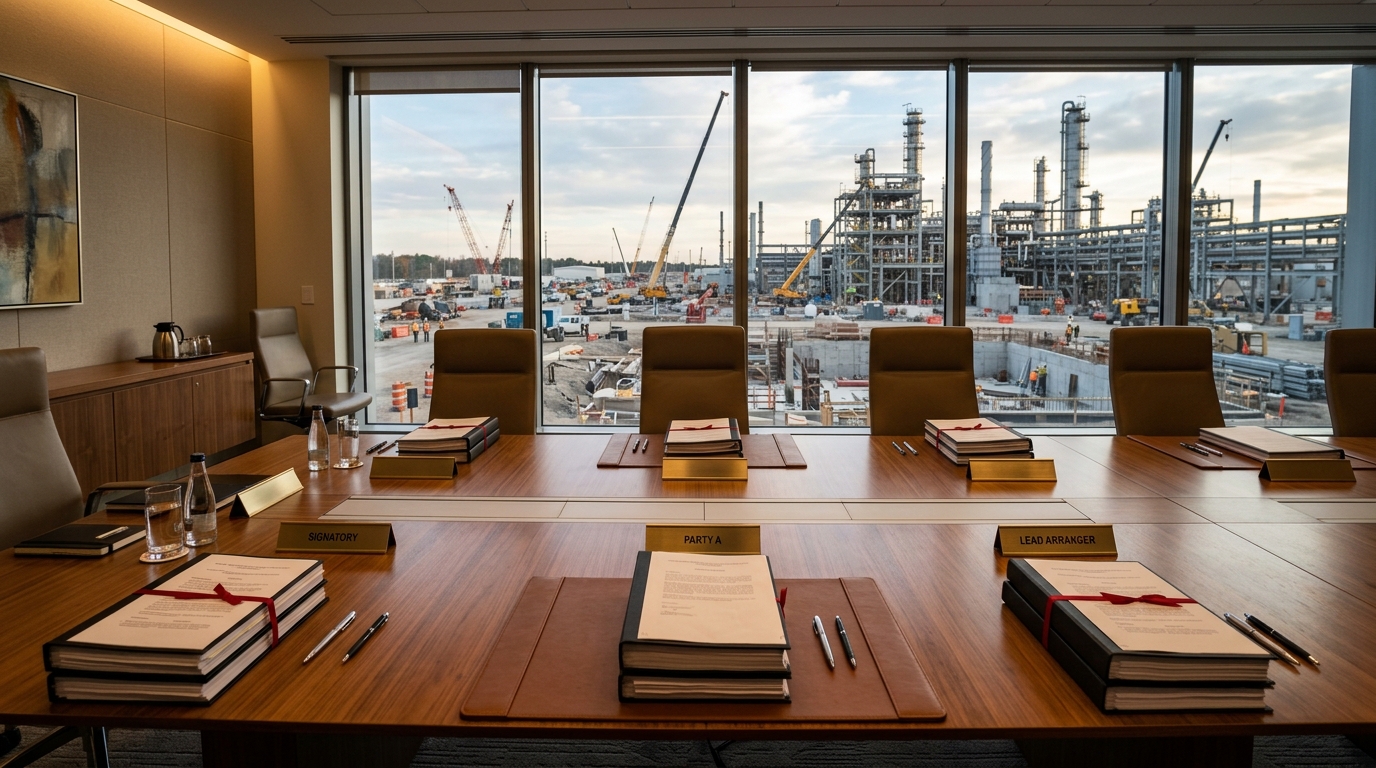
Every industrial plant project needs money. Before major equipment is ordered or construction begins, the project must be financed, and the financing must be secured through a process called financial close. Financial close is the point at which all financing agreements are signed, all conditions to effectiveness are met, and funds can be drawn for construction.
At EPC Partners Inc., we have supported projects across a wide range of plant types, from geothermal power plants in Kenya and Indonesia to large-scale desalination facilities in the UAE and Saudi Arabia, and from thermal power projects in Vietnam and Bangladesh to water treatment plants in Vietnam and Kuwait. Our financing support has ranged from technical due diligence for geothermal projects in Kenya and Indonesia, to commercial due diligence for large-scale desalination projects in the Gulf, and contract support for thermal power projects in Vietnam and Bangladesh. Each project has reinforced the same lesson: financial close is not just a financial milestone. It is a critical project milestone that depends on technical, commercial, and contractual readiness as much as on financial arrangements.
This article covers the key practices in plant project financing and financial close, drawing on our experience supporting projects across Asia, the Middle East, Africa, and Europe.
What Is Project Financing?
Project financing is the process of raising funds for a project, typically through a combination of debt and equity, where repayment depends mainly on the cash flow the project itself generates.
Key features of project financing:
- Non-recourse or limited recourse: Lenders rely primarily on the project’s cash flow for repayment, not on the sponsor’s balance sheet.
- Special purpose vehicle (SPV): A separate legal entity is created to own and operate the project.
- Security: Lenders take security over project assets, contracts, accounts, and cash flows.
- Contract-based risk allocation: Risks are allocated among the parties through the project contracts (EPC, O&M, offtake, supply).
- Due diligence: Lenders conduct technical, commercial, legal, environmental, and insurance due diligence before committing funds.
Project financing is common for large industrial plants, especially in the power, water, and infrastructure sectors. It is different from corporate financing, where the lender looks mainly at the borrower’s overall balance sheet.
Why Financing Matters
Financing directly affects project viability.
| Factor | Impact of Good Financing | Impact of Poor Financing |
|---|---|---|
| Viability | Project can proceed | Project delayed or abandoned |
| Cost | Competitive financing costs | Higher financing costs and tariffs |
| Risk | Risks allocated fairly | Risks concentrated on one party |
| Schedule | Financial close on time | Delays in financial close |
| Construction | Funds available for construction | Construction delayed or stalled |
For small to medium-scale industrial plants, financing often determines whether the project can proceed at all.
Sources of Project Finance
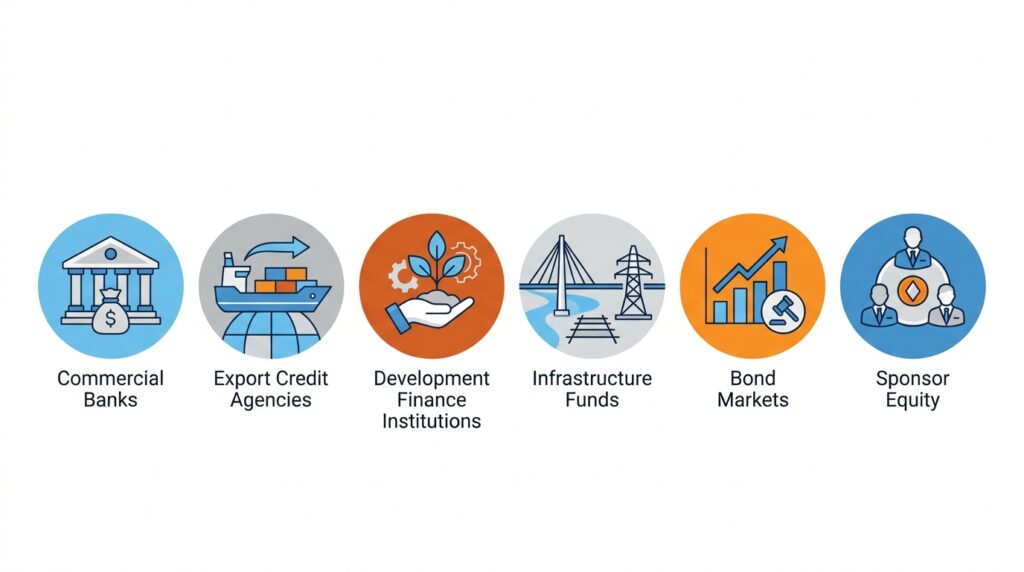
Project financing comes from several sources.
| Source | Description | Typical Use |
|---|---|---|
| Commercial banks | Traditional bank loans, often in syndicates | Most projects |
| Export credit agencies (ECAs) | Government-backed financing and insurance for exports | Equipment from specific countries |
| Development finance institutions (DFIs) and multilateral lenders | Financing for development projects, often with environmental and social conditions | Projects in developing countries |
| Infrastructure funds | Private equity and debt funds for infrastructure | Long-term infrastructure projects |
| Bond markets | Debt securities | Large projects and refinancing |
| Mezzanine or subordinated debt | Debt ranking behind senior lenders | Bridging the gap between senior debt and equity |
| Sponsor equity | Equity from project sponsors | All projects |
The mix of sources depends on project size, location, and risk profile. Where equipment or services come from a particular country, that country’s ECA may offer attractive terms. For projects with Japanese equipment or contractors, Japanese public financing and trade insurance institutions can be relevant. Political risk insurance may also be used to support lenders in higher-risk jurisdictions.
The Financing Process
Project financing follows a structured process.
| Step | Description |
|---|---|
| 1. Feasibility | Assessing project viability and financing needs |
| 2. Structuring | Designing the financing structure |
| 3. Mandate | Appointing financial advisors and lenders |
| 4. Due diligence | Lenders assess the project |
| 5. Documentation | Preparing financing agreements |
| 6. Financial close | Signing agreements and meeting conditions |
| 7. Drawdown | Funds are drawn for construction |
Financial close is the culmination of the financing process. From mandate to financial close often takes many months, and for large projects it can take a year or more. The timeline is usually driven by the slowest workstream, which is often permits, land, or contract negotiations rather than the loan documents themselves.
Feasibility and Financing Needs
The feasibility study (see Article #51) provides the foundation for financing.
Feasibility outputs relevant to financing:
- Capital cost estimate: How much will the project cost?
- Operating cost estimate: What will it cost to operate?
- Revenue forecast: What revenue will the project generate?
- Financial model: What are the projected cash flows?
- Risk assessment: What risks could affect the project?
Lenders rely on the feasibility study to assess the project’s viability. A study that is thin, optimistic, or out of date is one of the quickest ways to lose lender confidence.
Financing Structure
The financing structure defines how the project will be funded.
Financing structure components:
- Debt-to-equity ratio: How much debt versus equity? This varies widely with sector, risk, and lender appetite.
- Debt terms: Interest rate, tenor, repayment schedule, covenants.
- Equity terms: Sponsor contributions, timing, return expectations.
- Security package: What security is provided to lenders?
- Reserve accounts: Debt service reserve, maintenance reserve, and similar accounts.
- Hedging: Interest rate and, where relevant, currency hedging.
The financing structure should balance lender requirements with sponsor objectives. It should also be consistent with the project contracts. For example, the repayment profile should match the revenue profile, and the construction period should include a realistic allowance for delay and interest during construction.
The Financial Model
The financial model is the central tool of project financing. It projects cash flows over the life of the loan and tests whether the project can service its debt.
Key outputs lenders look at:
- Debt service cover ratio (DSCR): Cash available for debt service divided by debt service due. Minimum levels are set according to project risk.
- Loan life cover ratio (LLCR): The present value of cash flow over the loan life compared with outstanding debt.
- Equity returns: Whether returns are adequate for sponsors.
- Sensitivity cases: How results change with delay, cost overrun, lower output, higher operating costs, or changes in interest rates and exchange rates.
The model should be built on assumptions that are consistent with the technical and commercial documents. Technical inputs such as capacity, availability, degradation, fuel or steam consumption, and operating costs should come from the engineering team and the EPC and O&M contracts, not from generic assumptions. Lenders commonly appoint an independent model auditor to review the model before financial close.
Debt Terms
Debt terms define the conditions of the loan.
| Term | Description |
|---|---|
| Interest rate | Fixed or floating; based on market rates and risk |
| Tenor | Loan duration; commonly 10 to 20 years or more for infrastructure, depending on the sector and the contracts |
| Repayment schedule | How and when the loan is repaid, often sculpted to project cash flow |
| Covenants | Financial and operational conditions lenders require |
| Security | What lenders can claim if the project fails |
| Conditions precedent | Conditions that must be met before funds are available |
Debt terms should be negotiated carefully to balance cost and flexibility. Tight covenants may be cheaper on paper but can leave little room if construction or operation does not go to plan.
Risk Allocation and Bankability
Lenders will only fund a project whose major risks are understood, allocated, and mitigated. The project contracts are the main tools for doing this.
| Risk | Typical Mitigation |
|---|---|
| Construction cost and delay | Fixed-price, date-certain EPC contract; liquidated damages; contingency; performance security |
| Performance shortfall | Performance guarantees and liquidated damages in the EPC contract; performance testing |
| Operation and maintenance | Experienced O&M contractor; availability guarantees; maintenance reserve |
| Market or offtake | Long-term offtake or purchase agreement; take-or-pay provisions |
| Fuel, steam, or feedstock supply | Supply agreement or resource assessment; independent verification |
| Interest rate and currency | Hedging; matching currency of revenue and debt |
| Permits and regulation | Permits in place before close; stable legal framework; change-in-law provisions |
| Political | Government support agreements; political risk insurance |
| Force majeure and insurance | Adequate insurance package; clear force majeure terms |
A bankable EPC contract typically provides a clear scope, a fixed price, a firm completion date, meaningful liquidated damages that are linked to the debt service, and a credible contractor with the financial strength to stand behind its obligations. Lenders also commonly require direct agreements that allow them to step in if the project company defaults. Contracts that leave key risks with the project company, such as ground conditions, interfaces between contractors, or performance shortfalls, are difficult to finance.
Conditions Precedent
Conditions precedent (CPs) are conditions that must be met before funds are available.
Common conditions precedent:
- Project agreements: EPC contract, O&M contract, offtake agreement, supply agreement, and direct agreements.
- Permits: Environmental permits, construction permits, operating permits.
- Land: Land acquisition and rights, including leases and access.
- Grid or utility connections: Interconnection and utility agreements where applicable.
- Insurance: Insurance policies in place, as reviewed by the lenders’ insurance adviser.
- Equity: Sponsor equity contributed, or committed with acceptable support.
- Financial model: Agreed and audited financial model.
- Security documents: Security over assets, accounts, and contracts, together with hedging arrangements.
- Due diligence: Satisfactory completion of due diligence and delivery of reports from lenders’ advisers.
- Legal opinions: Opinions confirming enforceability and the capacity and authority of the parties.
- Other items: Know-your-customer checks, corporate approvals, and notice to proceed under the EPC contract.
Meeting conditions precedent is a key part of achieving financial close. A practical tool is a CP tracker that lists every condition, its owner, its status, and its due date, reviewed weekly as financial close approaches. Many delays come from a few outstanding items, such as a permit, a land document, or a consent from a counterparty, that were not tracked early enough.
Due Diligence
Lenders conduct due diligence before committing funds.
| Area | Description |
|---|---|
| Technical | Is the technology proven? Is the design sound? |
| Commercial | Is the market viable? Are the contracts bankable? |
| Legal | Are the contracts enforceable? Are the permits valid? |
| Environmental and social | Are environmental and social requirements met? |
| Financial | Is the financial model sound? |
| Insurance | Is adequate insurance in place? |
Due diligence is often conducted by independent consultants appointed by the lenders, including a lenders’ technical adviser or independent engineer, legal counsel, a model auditor, an insurance adviser, and an environmental and social consultant. The sponsor and the EPC contractor should plan for the time and information these reviews require.
Technical Due Diligence
Technical due diligence assesses the technical viability of the project.
Technical due diligence considerations:
- Technology: Is the technology proven and appropriate?
- Design: Is the design sound and complete?
- Construction: Is the construction plan and schedule realistic?
- O&M: Is the O&M plan adequate?
- Performance: Are the performance guarantees realistic?
- Risks: What technical risks exist, and how are they mitigated?
Technical due diligence is especially important for projects using new or unproven technology or relying on a natural resource.
At our geothermal projects in Kenya (Olkaria I Unit 6, 83 MW) and Indonesia (Muara Laboh, 85.2 MW), technical due diligence included assessment of the geothermal resource, the steam turbine technology, and the performance guarantees. At one geothermal project in Kenya, the technical due diligence included a detailed review of the steam resource assessment and the performance guarantees, with lenders requiring independent verification of the resource before committing funds. At another project in Indonesia, the due diligence considered the seismic conditions of the site and the design of the turbine foundations. In Iceland (Theistareykir, 2×45 MW), due diligence considered the specific environmental and seismic conditions of the site.
The common lesson is that lenders want evidence, not assurances. Resource data, design basis documents, and test results that are well organized and independently verifiable shorten the due diligence process considerably.
Commercial Due Diligence
Commercial due diligence assesses the commercial viability of the project.
Commercial due diligence considerations:
- Market: Is there a market for the output?
- Price: Is the price realistic?
- Contracts: Are the offtake and supply contracts bankable?
- Counterparty: Is the offtaker creditworthy?
- Demand: Is demand likely to grow or decline?
For desalination projects in the Gulf (Taweelah, 909,200 m³/day; Jubail 3A, 600,000 m³/day), commercial due diligence included assessment of the water purchase agreements and the regulatory framework for water pricing.
Legal Due Diligence
Legal due diligence assesses the legal framework of the project.
Legal due diligence considerations:
- Contracts: Are the contracts enforceable?
- Permits: Are the permits valid and sufficient?
- Land: Are land rights secure?
- Regulatory: Is the regulatory framework stable?
- Dispute resolution: How will disputes be resolved, and are awards enforceable?
Legal due diligence is essential for ensuring that lenders’ rights are protected.
Environmental and Social Due Diligence
Environmental and social due diligence assesses the environmental and social aspects of the project.
Considerations:
- Environmental and social impact assessment: Has an ESIA been completed?
- Permits: Are environmental permits in place?
- Compliance: Does the project comply with environmental regulations?
- Standards: Does the project meet international standards, such as the IFC Performance Standards and, where lenders have adopted them, the Equator Principles?
- Community: Has the community been consulted, and are land acquisition and resettlement issues handled properly?
- Action plan: Is there an environmental and social action plan with clear responsibilities and monitoring?
Environmental and social due diligence is increasingly important for project financing, and international lenders often make compliance a covenant that continues through construction and operation.
Financial Close
Financial close is the point at which all financing agreements are signed and conditions precedent to effectiveness are met.
Financial close activities:
- Signing: Signing all financing and project agreements.
- Conditions precedent: Confirming that all conditions precedent are met and delivering evidence to the lenders.
- Effectiveness: Declaring the financing agreements effective.
- Equity and first drawdown: Contributing equity and, once the conditions to first drawdown are met, making the first draw.
- Notice to proceed: Issuing notice to proceed to the EPC contractor.
- Announcement: Announcing financial close.
Financial close is a major project milestone and often triggers construction start. Some conditions for the first drawdown may be satisfied slightly after signing, so it is worth being clear about which items are required at which stage.
Post-Financial Close
After financial close, the project moves into construction and drawdown.
Post-financial close activities:
- Drawdown: Drawing down funds as needed for construction, usually against certified progress and with approval from the lenders’ independent engineer.
- Reporting: Reporting to lenders on progress, cost, schedule, and compliance.
- Covenant compliance: Ensuring compliance with financial and operational covenants.
- Insurance: Maintaining insurance as required.
- Changes: Managing changes with lender consent where required. Variation orders, schedule changes, and claims can all require lender approval.
- Completion: Demonstrating completion, including performance testing, before the loan converts from construction to operation.
Lenders remain involved throughout construction and operation. Good reporting and early warning of problems keep that relationship constructive.
Financing in Small Plants
Small plants face particular challenges with financing.
Challenges:
- Smaller projects may not attract large lenders, because transaction costs are high relative to loan size.
- Sponsors may have less track record.
- Perceived risk is higher.
- Access to specialist advisors is more limited.
Practical approaches:
- Consider smaller lenders: Regional banks and development finance institutions may be more flexible.
- Use sponsor equity: More equity may reduce lender concerns.
- Use ECA financing: Export credit agencies can support equipment purchases.
- Seek expert advice: Get advice from financial advisors with project finance experience.
- Prepare thoroughly: A well-prepared feasibility study and documentation reduces lender concerns.
- Consider alternative structures: Leasing, vendor financing, or other structures may be appropriate.
- Keep the contract package simple: A single, well-drafted EPC contract is often easier to finance than many small contracts with interface risk.
Financing does not need to be complex. It needs to be thorough and well-prepared.
Common Mistakes in Project Financing
Even experienced organizations make mistakes. Common ones include:
- Inadequate feasibility study: Lenders lack confidence in the project.
- Unrealistic financial model: Projections are not credible.
- Poor contract structure: Contracts are not bankable.
- Incomplete permits: Permits are not in place.
- Inadequate environmental and social assessment: Issues are not addressed.
- Weak sponsor: Sponsor lacks track record or financial strength.
- Unrealistic schedule: Financial close is delayed.
- Inconsistent documents: Technical, commercial, and financial documents contradict each other, so lenders lose confidence.
- Poor communication: Lenders lose confidence.
- Late engagement of advisers: Technical, legal, and financial advisers are appointed too late to shape the project.
These mistakes are costly to correct. They are much cheaper to avoid through disciplined preparation.
How EPC Partners Inc. Approaches Project Financing
At EPC Partners Inc., we bring practical experience from projects across Asia, the Middle East, Africa, and Europe to project financing.
Our approach includes:
- Technical support: We support technical due diligence and provide the technical information lenders need.
- Contract support: We support the development of bankable EPC and O&M contracts.
- Performance guarantees: We help ensure that performance guarantees are realistic and bankable.
- Documentation: We provide the technical documentation lenders require.
- Risk assessment: We help identify and mitigate technical and commercial risks.
- Conditions precedent: We help track and close out technical and contractual conditions precedent.
- Long-term focus: We support projects through financial close and beyond.
Our experience includes supporting geothermal projects in Kenya, Ethiopia, Indonesia, Iceland, and Japan; desalination projects in the UAE, Saudi Arabia, Oman, and Qatar; thermal power projects in Vietnam, Bangladesh, and Japan; and water treatment projects in Vietnam, Kuwait, and Qatar.
We have also supported clients including Marubeni Corporation, Fuji Electric Co., Ltd., and Toyota Tsusho Corporation on financing-related aspects of their projects.
How to Evaluate Project Financing Readiness
When reviewing project financing, ask:
| Question | Why It Matters |
|---|---|
| Is the feasibility study adequate? | Provides the basis for financing |
| Is the financial model credible and consistent with the technical documents? | Lenders rely on the model |
| Are the contracts bankable? | Lenders require bankable contracts |
| Are permits and land rights in place? | Conditions precedent for financial close |
| Is environmental and social compliance addressed? | Increasingly required by lenders |
| Are risks allocated and mitigated? | Lenders will not carry unmitigated risk |
| Is the sponsor credible? | Lenders assess sponsor capability |
| Is the schedule realistic? | Ensures financial close on time |
| Is there a CP tracker with clear owners? | Prevents last-minute delays |
| Is communication with lenders effective? | Builds lender confidence |
A project that addresses these questions is ready for financial close.
Key Takeaways
- Financial close is a project milestone, not only a financial one. It depends on technical, commercial, and contractual readiness.
- Lenders rely on the feasibility study, the financial model, and independent due diligence. Make them credible and consistent.
- Bankable contracts allocate risk clearly and are backed by creditworthy counterparties.
- Track conditions precedent from the start, with named owners and dates.
- Lenders stay involved through construction and operation, so plan for reporting and consent processes.
Conclusion
Project financing and financial close are critical to plant success. For small to medium-scale industrial plants, they often determine whether the project can proceed at all.
By focusing on feasibility, financing structure, due diligence, conditions precedent, and financial close, owners and project teams can ensure that the project is financed and ready for construction.
If you are planning a plant project and need support with project financing or EPC project delivery, contact us to discuss how we can help.
EPC Partners Inc. is a Japanese EPC support firm with experience supporting power, water, and industrial plant projects across Asia, the Middle East, Africa, and Europe. For more information, visit our project list.