
Procurement is where engineering meets the market. The drawings, specifications, and datasheets produced by the engineering team become the basis for purchase orders, vendor selection, and equipment delivery. Procurement engineering is the discipline of ensuring that technical requirements are correctly translated into procurement documents, that vendors are technically qualified, and that the equipment delivered meets the design intent.
At EPC Partners Inc., procurement engineering has been a core part of our work across a wide range of plant projects, from geothermal power plants in Kenya, Indonesia, and Iceland to large-scale desalination facilities in the UAE and Saudi Arabia, and from thermal power plants in Vietnam and Bangladesh to water treatment plants in Vietnam and Kuwait. Our work has ranged from geothermal projects in Kenya and Indonesia, where steam turbine specifications had to account for corrosive geothermal steam, to desalination projects in the Gulf, where high-pressure pump efficiency and materials were critical to plant performance. Each project has presented different procurement challenges, and each has reinforced the same lesson: procurement engineering is not just about buying equipment. It is about ensuring that the equipment meets the technical requirements, is delivered on time, and integrates seamlessly with the rest of the plant.
This article covers the key practices in plant procurement engineering, drawing on our experience supporting projects across Asia, the Middle East, Africa, and Europe.
What Is Procurement Engineering?
Procurement engineering ensures that technical requirements are correctly translated into procurement documents and that vendors and equipment meet the design intent. It includes:
- Requisition preparation: preparing technical requisitions for procurement.
- Vendor technical evaluation: evaluating vendors’ technical capability.
- Technical bid evaluation: comparing technical proposals from vendors.
- Vendor document review: reviewing vendor documents for compliance with specifications.
- Inspection and testing: witnessing tests and inspections at vendor facilities.
- Technical support during delivery: resolving technical issues during delivery and installation.
Procurement engineering provides the technical foundation for procurement. The commercial side (pricing, terms, contract award) is typically led by the procurement or contracts team, so the two must work from the same documents and the same schedule.
Why Procurement Engineering Matters
| Factor | Impact of Good Procurement Engineering | Impact of Poor Procurement Engineering |
|---|---|---|
| Quality | Equipment meets specifications | Defective or non-compliant equipment |
| Cost | Competitive pricing from qualified vendors | Higher costs from rework and disputes |
| Schedule | Equipment delivered on time | Delays from technical issues |
| Integration | Equipment integrates with the plant | Interface problems |
| Compliance | Equipment meets codes and standards | Non-compliance |
| Warranty | Clear warranty terms and responsibilities | Disputes over warranty coverage |
For industrial plants of any scale, procurement engineering determines whether the plant is built with the right equipment.
Requisition Preparation
Requisition preparation is the first step.
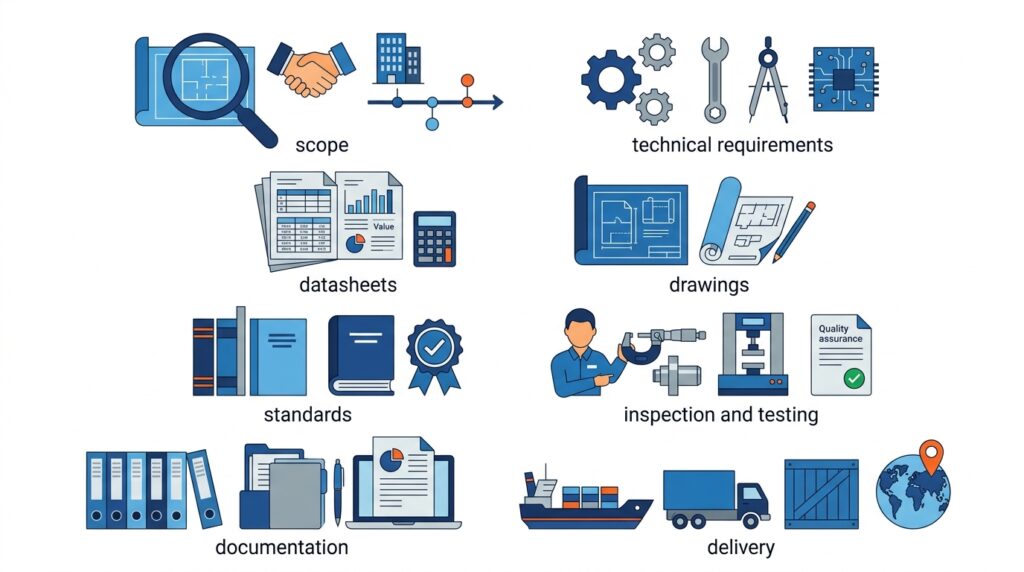
| Element | Description |
|---|---|
| Scope | What is being procured, including battery limits |
| Technical requirements | Performance, design, materials, testing |
| Datasheets | Detailed technical data |
| Drawings | Reference drawings and layouts |
| Standards | Applicable codes and standards |
| Inspection and testing | Required inspections and tests |
| Documentation | Required vendor documentation (see Vendor Data Requirements) |
| Delivery | Required delivery date, location, and Incoterms |
Requisitions should be clear, complete, and consistent with the design. At our geothermal projects in Kenya (Olkaria I Unit 6, 83 MW) and Indonesia (Muara Laboh, 85.2 MW), requisitions for steam turbines included the specific steam conditions, performance guarantees, and materials requirements for the geothermal environment. In Iceland (Theistareykir, 2×45 MW), requisitions also considered the seismic and environmental conditions of the site.
Vendor Technical Evaluation
Vendor technical evaluation assesses whether vendors can meet the technical requirements. Typical criteria:
- Technical capability: can the vendor meet the requirements?
- Experience: has the vendor supplied similar equipment in similar conditions?
- References: what do previous customers say?
- Quality systems: does the vendor operate a quality management system and manage its sub-suppliers?
- Capacity: can the vendor meet the delivery schedule, including workshop load and key sub-supplier lead times?
- Support: does the vendor provide technical support, service, and spare parts?
Evaluation should be based on objective criteria, not preference, and should feed into the approved vendor list for the project.
Technical Bid Evaluation
Technical bid evaluation compares technical proposals from vendors:
- Compliance review: does the proposal comply with the requisition?
- Technical comparison: how do the proposals compare on a like-for-like basis?
- Clarification: resolve open technical points with vendors.
- Deviation review: assess every deviation from the specification and its impact.
- Recommendation: recommend the technically preferred vendor, with a clear basis.
The evaluation should be documented and consistent, with the same criteria applied to every bidder. For desalination projects in the Gulf (Taweelah, 909,200 m³/day; Jubail 3A, 600,000 m³/day), evaluation of high-pressure pumps and energy recovery devices compared efficiency, reliability, and materials of construction, with careful review of each vendor’s experience in Gulf seawater conditions.
Technical Queries and Deviations
Questions and deviations arise throughout procurement, before and after award. A simple discipline helps:
- Log every technical query and its response, with dates and owners.
- Treat vendor deviations as formal requests, approved or rejected in writing.
- Assess the knock-on effect on other disciplines (civil, electrical, piping, I&C) before accepting.
- Reflect approved changes in the purchase order, datasheets, and design documents so that nothing lives only in email.
Vendor Data Requirements
A vendor data requirements list (VDRL or VDDR) states which documents the vendor must submit, in what format, and by when. Tying document submission dates to payment milestones gives vendors a clear incentive to deliver on time. The list should identify which documents are for approval, which are for information, and which are needed early because other disciplines depend on them, such as foundation loads, nozzle loads, and utility requirements.
Vendor Document Review
Vendor document review ensures vendor documents comply with specifications. Documents to review include:
- Drawings: equipment and interface drawings.
- Datasheets: equipment datasheets and performance data.
- Calculations: design calculations and stress analysis.
- Test procedures: inspection and test plans.
- Manuals: operating and maintenance manuals.
Review should be timely, because delays in review can delay manufacturing and delivery. For thermal power projects in Vietnam (Thai Binh 1, 2×300 MW) and Bangladesh (Bibiyana-III, 400 MW CCGT), review covered turbine and generator drawings, datasheets, and test procedures, with comments resolved before manufacturing began.
From the field: At one thermal power project in Vietnam, the vendor document review identified a mismatch between the turbine foundation drawing and the civil foundation design, which was resolved before manufacturing began. At another project in Bangladesh, the review of generator datasheets identified a cooling requirement that had not been captured in the original specification, allowing the vendor to adjust the design before delivery. In both cases, catching the issue on paper cost far less than finding it on site.
Inspection and Testing
Inspection and testing verify that equipment meets specifications:
- Pre-inspection meeting: agree inspection requirements and hold points with the vendor.
- In-process inspection: inspect during manufacturing, especially for critical components.
- Final inspection: inspect before shipment, including packing and preservation.
- Witness testing: witness the tests specified in the contract.
- Documentation review: review test certificates, material certificates, and quality records.
Inspection and testing should be planned in advance, risk-based, and documented, with non-conformances tracked to closure.
Expediting and Delivery Support
Procurement engineering supports expediting by resolving the technical questions that hold up manufacturing and shipment. Useful practices include monitoring the status of vendor drawings and approvals against the delivery schedule, flagging long-lead items early, and checking that packing, marking, and shipping documents match the site receiving requirements. Technical support continues through installation and commissioning, when the vendor’s service engineers are often needed.
Spare Parts and Special Tools
Spare parts should be specified at the requisition stage, not left until handover. Typical categories are commissioning spares, start-up spares, and recommended operating spares, plus any special tools. Asking vendors to price these with their bids allows fair comparison and avoids surprises later.
Interface Management
Interface management ensures that equipment fits with the rest of the plant:
- Physical interfaces: dimensions, connections, and foundations.
- Functional interfaces: control signals, utilities, and process connections.
- Documentation interfaces: vendor documents and plant documentation.
- Responsibility interfaces: who is responsible for each interface, and where the battery limit lies.
Managing interfaces prevents problems during installation and commissioning.
Smaller Projects and Owner Teams
Smaller projects, and owner teams without a large engineering group, face particular challenges: fewer resources, less specialist expertise, less access to vendor information, and competing priorities. Practical approaches include:
- Focus on critical equipment: put the most effort into items that drive safety, performance, or schedule.
- Use vendor information: use vendor data and references, but verify them.
- Seek expert advice: bring in experienced engineers for key packages.
- Use standard specifications: they save time and reduce errors.
- Document decisions: record the basis for decisions.
- Learn from others: apply lessons from similar projects.
Procurement engineering does not need to be complex. It needs to be thorough and consistent.
Common Mistakes in Procurement Engineering
- Incomplete requisitions: missing information that causes delays or errors.
- Unclear specifications: ambiguous requirements that lead to disputes.
- Inadequate vendor evaluation: selecting vendors who cannot meet requirements.
- Poor document review: vendor documents not reviewed in time.
- Uncontrolled deviations: changes accepted informally and not reflected in the design.
- Skipping inspection: accepting defective equipment.
- Ignoring interfaces: equipment that does not integrate with the plant.
- No documentation: records missing or incomplete.
These mistakes are costly to correct and much cheaper to avoid through disciplined procurement engineering.
How EPC Partners Inc. Approaches Procurement Engineering
At EPC Partners Inc., we bring practical experience from projects across Asia, the Middle East, Africa, and Europe. As a Japanese EPC support firm, we apply a careful, document-driven approach: clear requirements up front, early resolution of technical questions, and attention to detail at every stage. Our approach includes:
- Thorough requisition preparation: clear, complete, and consistent with the design.
- Objective vendor evaluation: vendors assessed against clear technical criteria.
- Disciplined document review: vendor documents reviewed on time, with comments tracked to closure.
- Thorough inspection: equipment inspected before shipment.
- Interface focus: interfaces identified and managed.
- Detailed documentation: complete and accurate records.
- Continuous improvement: lessons captured and applied.
Our experience includes geothermal projects in Kenya, Ethiopia, Indonesia, Iceland, and Japan; desalination projects in the UAE, Saudi Arabia, Oman, and Qatar; thermal power projects in Vietnam, Bangladesh, and Japan; and water treatment projects in Vietnam, Kuwait, and Qatar. We have also supported clients including Marubeni Corporation, Fuji Electric Co., Ltd., and Toyota Tsusho Corporation on procurement engineering aspects of their projects.
How to Evaluate Procurement Engineering Readiness
| Question | Why It Matters |
|---|---|
| Are requisitions complete and clear? | Prevents delays and errors |
| Are specifications unambiguous? | Prevents disputes |
| Are vendors technically evaluated? | Ensures capable vendors |
| Are technical bids evaluated consistently? | Ensures fair comparison |
| Are vendor data requirements defined? | Ensures the right documents arrive on time |
| Are vendor documents reviewed in time? | Prevents delivery delays |
| Are deviations and queries controlled? | Keeps design and purchase orders aligned |
| Is inspection and testing planned? | Ensures equipment meets specifications |
| Are interfaces managed? | Prevents integration problems |
| Is documentation complete? | Supports handover and operations |
A project that can answer yes to these questions is ready for effective procurement engineering.
Conclusion
Procurement engineering is critical to plant success. It determines whether the plant is built with the right equipment, on time, and within budget. By focusing on requisition preparation, vendor technical evaluation, technical bid evaluation, vendor document review, inspection and testing, and interface management, owners and project teams can ensure that procurement engineering supports the project from design through operation.
If you are planning a plant project and need support with procurement engineering or EPC project delivery, contact us to discuss how we can help.
EPC Partners Inc. is a Japanese EPC support firm with experience supporting power, water, and industrial plant projects across Asia, the Middle East, Africa, and Europe. For more information, visit our project list.