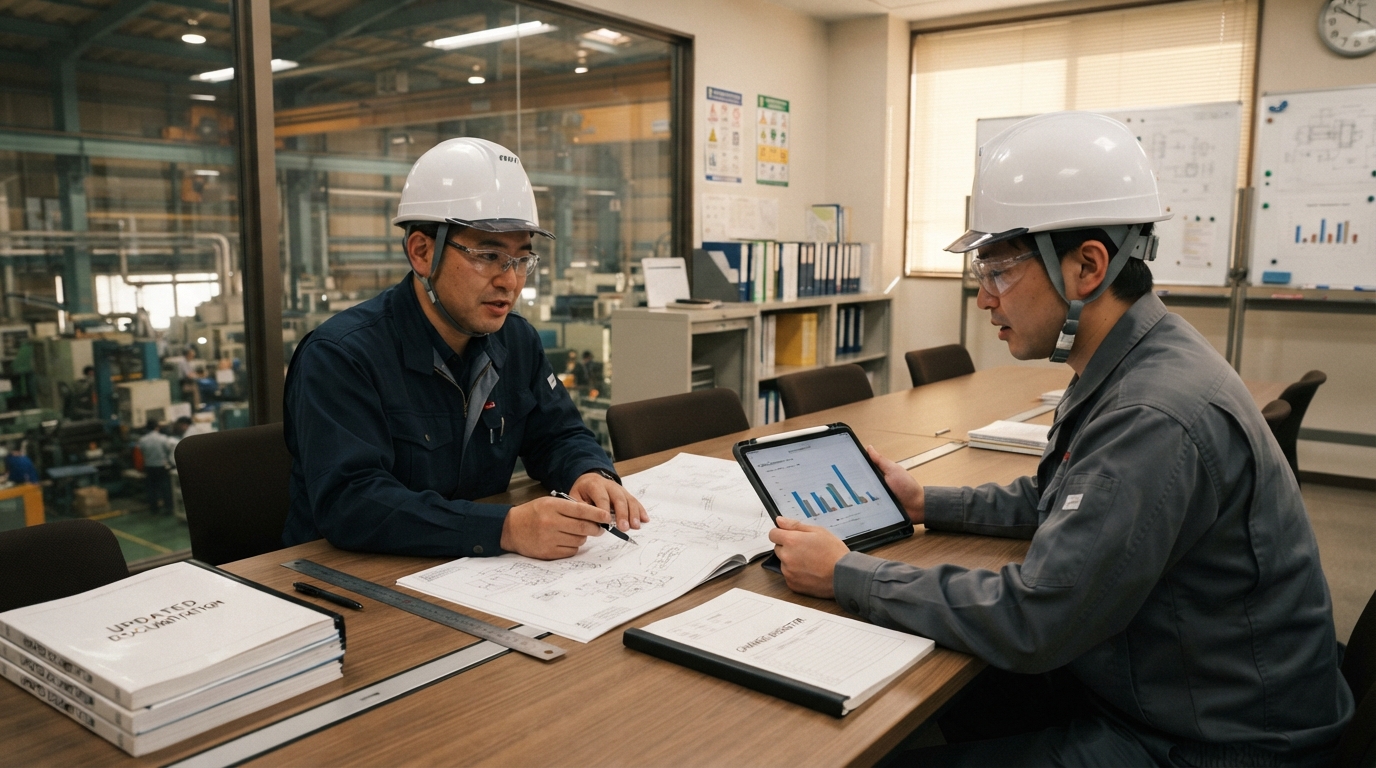
Change is inevitable in EPC projects. Designs evolve, site conditions differ from expectations, vendors propose alternatives, and clients request modifications. Engineering change management is the discipline of controlling these changes—ensuring that they are properly evaluated, approved, documented, and implemented—so that the project stays on track and within budget.
At EPC Partners Inc., engineering change management has been a core part of our work across a wide range of plant projects—from geothermal power plants in Kenya, Indonesia, and Iceland to large-scale desalination facilities in the UAE and Saudi Arabia, and from thermal power plants in Vietnam and Bangladesh to water treatment plants in Vietnam and Kuwait. Our change management work has ranged from geothermal projects in Kenya and Indonesia, where actual resource conditions required design changes, to thermal power projects in Vietnam and Bangladesh, where vendor-proposed changes were evaluated for performance and cost impact. Each project has presented different challenges, and each has reinforced the same lesson: change is not the enemy. Uncontrolled change is.
This article covers the key practices in plant engineering change management, drawing on our experience supporting projects across Asia, the Middle East, Africa, and Europe.
What Is Engineering Change Management?
Engineering change management is the discipline of controlling changes to engineering deliverables, designs, and specifications after they have been baselined or issued.
It includes:
- Change identification: Recognizing when a change is required.
- Change assessment: Evaluating the impact on scope, cost, schedule, quality, and risk.
- Change approval: Approving or rejecting the change.
- Change implementation: Implementing the approved change in all affected deliverables.
- Change documentation: Recording the change and its impact.
- Change communication: Communicating the change to affected parties.
- Change verification and closure: Confirming the change has been implemented and closing it out.
Why Engineering Change Management Matters
| Factor | Impact of Good Change Management | Impact of Poor Change Management |
|---|---|---|
| Cost | Changes controlled; costs managed | Cost overruns from uncontrolled changes |
| Schedule | Changes evaluated for schedule impact | Delays from unplanned changes |
| Quality | Changes reviewed for quality impact | Quality problems from poorly implemented changes |
| Safety | Changes reviewed for safety and regulatory impact | Hazards introduced without review |
| Scope | Scope changes controlled | Scope creep |
| Documentation | Changes documented | Outdated documentation |
| Disputes | Changes formally approved | Disputes over changes |
For small to medium-scale industrial plants, engineering change management often determines whether the project stays within budget and on schedule.
The Cost of Change Rises Over Time
A change during early design may require only a revised drawing. The same change after equipment is ordered may require a vendor change order and rework. After construction, it may mean demolition and reinstallation, and after commissioning, shutdown and re-testing. Changes should therefore be identified early, and late changes deserve the most careful assessment.
Types of Engineering Changes
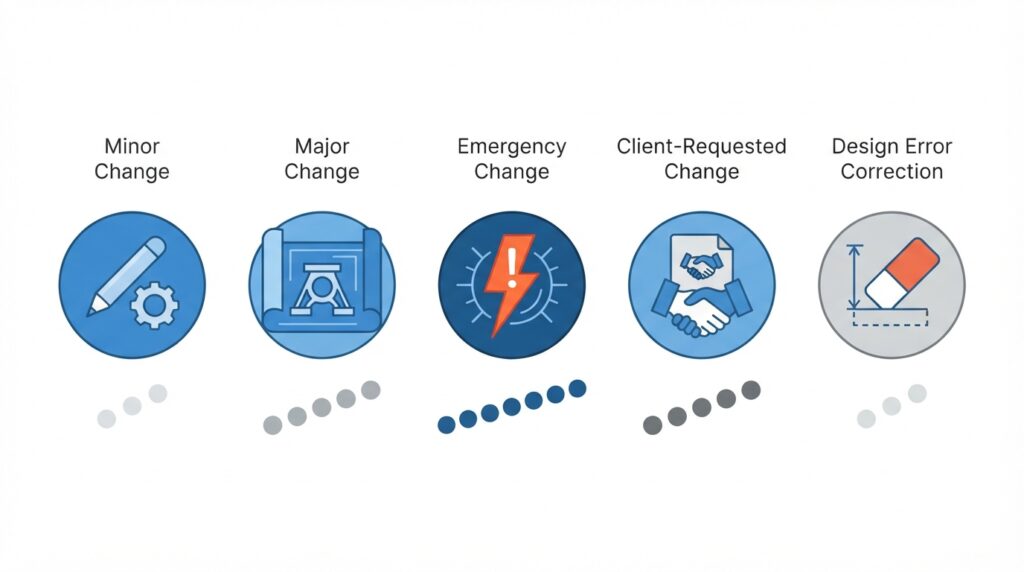
| Change Type | Description | Typical Control Level |
|---|---|---|
| Minor change | Small change with minimal impact | Simple review and approval |
| Major change | Significant cost or schedule impact | Full change management process |
| Emergency change | Needed to address an immediate safety or operational issue | Fast-track approval with follow-up documentation |
| Client-requested change | Requested by the owner | Formal change order process |
| Vendor-proposed change | Alternative proposed to improve performance or reduce cost | Technical and commercial evaluation before approval |
| Design error correction | Correction of a design error | Design review and approval |
At our geothermal projects in Kenya (Olkaria I Unit 6, 83 MW) and Indonesia (Muara Laboh, 85.2 MW), change management focused on design changes required by the actual geothermal resource conditions—steam quality, pressure, and non-condensable gas content—which differed from the initial assumptions. In Iceland (Theistareykir, 2×45 MW), change management considered the seismic and environmental conditions of the site.
Change Baselines and Configuration Control
A change can only be controlled if there is something to change from.
- Design basis and scope baseline: The agreed design basis, process requirements, and scope of work.
- Document baseline: Issued-for-design, issued-for-procurement, and issued-for-construction revisions of drawings, specifications, and datasheets.
- Cost and schedule baselines: The approved budget and schedule against which change impact is measured.
Changes to a baselined item should always go through the change process, and each document’s revision history should show which approved change it reflects. Design freeze points—for example, before issuing key equipment for purchase or starting construction of an area—concentrate change activity early, when it is least costly.
Change Identification
Sources of change:
- Design and safety reviews: Including HAZOP and constructability reviews.
- Site conditions: Conditions that differ from expectations.
- Vendor proposals and vendor data: Alternatives, or final vendor data that differs from design assumptions.
- Client requests.
- Construction issues.
- Commissioning issues.
- Regulatory or permit changes.
Identification should be systematic and timely. Every change should be raised through a formal change request so that nothing is implemented informally.
Change Assessment
Assessment activities:
- Technical impact: Effect on design and performance.
- Cost impact: Engineering, procurement, construction, and commissioning effects.
- Schedule impact: Including long-lead items and the critical path.
- Quality impact.
- Safety and regulatory impact: Effect on safety studies, permits, and compliance.
- Risk impact.
- Interface impact: Effect on other disciplines or systems.
- Operability and maintainability impact.
Assessment should be thorough and documented.
For thermal power projects in Vietnam (Thai Binh 1, 2×300 MW) and Bangladesh (Bibiyana-III, 400 MW CCGT), change assessment included the evaluation of design changes proposed by vendors to improve performance or reduce cost, with careful analysis of the impact on plant performance, schedule, and interfaces.
Project Examples
At one geothermal project in Indonesia, the actual steam conditions required a change to the turbine design before manufacturing began, with the change assessed for impact on performance, cost, and schedule. At one thermal power project in Vietnam, a vendor-proposed change to the boiler design was assessed for its impact on efficiency and emissions before approval.
In both cases, the decision was made on documented evidence of impact rather than assumption.
Change Approval
| Change Type | Approval Authority |
|---|---|
| Minor change | Discipline lead or project engineer |
| Major change | Project manager and client representative |
| Emergency change | Designated authority, with follow-up documentation |
| Client-requested change | Client representative and project manager |
Approval should be documented with the approver’s name, date, and any conditions. Approval limits should be defined at project start so everyone knows who can approve what.
Change Implementation
- Design update: Drawings, specifications, and datasheets.
- Procurement update: Purchase orders and vendor documents, including vendor change orders.
- Construction update: Construction plans and work packages, and treatment of work already completed.
- Documentation update: All affected documents, including P&IDs, 3D models, and as-built records.
- Communication: Informing affected parties.
An approved change that is only partially reflected in the documents is one of the most common sources of site problems.
Change Documentation
Contents:
- Change description: What is changing and why?
- Change assessment: Impact on scope, cost, schedule, and quality.
- Change approval: Who approved it and when.
- Change implementation: How it was implemented.
- Affected documents: Which were updated, and to which revision.
- Communication: Who was informed.
This provides an audit trail and supports claims, handover, and lessons learned.
The Change Register
A central change register should track every change from raising to closure. Typical fields: change number and title, originator and date, type and priority, estimated cost and schedule impact, status (raised, under assessment, approved, rejected, implemented, closed), approver and date, and affected documents and purchase orders.
Change Communication
- Notification of affected parties.
- Distribution of updated documents through document control.
- Training where required.
- Follow-up to ensure the change is understood and implemented.
Communication should be timely and clear, and should reach site teams and vendors as well as the design office.
Contractual Aspects of Change
Engineering changes often have contractual consequences. A change that alters scope, price, or schedule typically needs to be handled under the contract’s variation or change order provisions.
- Know the notice requirements: Contracts often require notice within a defined period; missing it can weaken a party’s position.
- Separate technical approval from commercial agreement: A change may be approved technically while its cost and time effects are still being negotiated. Track both.
- Record the basis of the change: Client instruction, differing site conditions, or contractor preference affects who bears the cost.
- Keep records contemporaneous: Records made at the time are far more useful than reconstruction later.
Change Control Board
Responsibilities:
- Review change requests and assessments.
- Approve or reject changes.
- Prioritize by impact and urgency.
- Monitor implementation of approved changes.
The CCB should include representatives from engineering, procurement, construction, and the client. It should meet regularly, with a faster route for urgent changes.
Monitoring Change Performance
- Number of changes raised, approved, rejected, and open
- Average time to assess and approve a change
- Cumulative cost and schedule impact of approved changes
- Proportion of changes raised after design freeze or after equipment is ordered
- Number of changes implemented without prior approval (ideally zero)
A rising number of late changes is an early warning that earlier phases, such as basic design or requirements definition, need attention.
Engineering Change Management in Small Plants
Challenges: fewer resources, less expertise, less access to change management systems, and competing priorities.
Practical approaches:
- Focus on major changes.
- Use simple tools: Simple registers and forms can be sufficient.
- Use clear procedures.
- Document everything.
- Train staff.
- Learn from others: Apply lessons from other projects.
Change management does not need to be complex. It needs to be thorough and consistent.
Common Mistakes in Engineering Change Management
- No change management process: Changes made without formal process.
- Inadequate change assessment.
- Poor change documentation.
- No change communication.
- Uncontrolled changes: Including informal site changes.
- Scope creep.
- Outdated documentation.
- Ignoring interface effects: A change in one discipline not checked against others.
- No follow-up: Changes not verified as implemented.
These mistakes are costly to correct and much cheaper to avoid through disciplined change management.
How EPC Partners Inc. Approaches Engineering Change Management
At EPC Partners Inc., we bring practical experience from projects across Asia, the Middle East, Africa, and Europe. As a Japanese EPC support firm, we place particular emphasis on careful assessment before decisions are made, clear documentation, and consistent follow-through.
Our approach includes:
- Formal process
- Thorough assessment of technical, cost, schedule, and quality impact
- Clear approval by authorized personnel
- Documentation and tracking
- Communication to affected parties
- Follow-up to verify implementation
- Continuous improvement: Lessons are captured and applied.
Our experience includes supporting geothermal projects in Kenya, Ethiopia, Indonesia, Iceland, and Japan; desalination projects in the UAE, Saudi Arabia, Oman, and Qatar; thermal power projects in Vietnam, Bangladesh, and Japan; and water treatment projects in Vietnam, Kuwait, and Qatar.
We have also supported clients including Marubeni Corporation, Fuji Electric Co., Ltd., and Toyota Tsusho Corporation on engineering change management aspects of their projects.
How to Evaluate Engineering Change Management Readiness
| Question | Why It Matters |
|---|---|
| Is there a formal change management process? | Ensures changes are controlled |
| Are baselines and design freeze points defined? | Gives a reference for measuring change |
| Are changes assessed for impact? | Ensures impact is understood |
| Are changes approved by authorized personnel? | Ensures accountability |
| Are changes documented in a change register? | Provides an audit trail |
| Are affected parties informed? | Ensures changes are understood |
| Are contractual notice requirements tracked? | Protects commercial position |
| Are documents updated? | Ensures everyone works from current information |
| Are changes verified as implemented? | Ensures changes are effective |
A project that addresses these questions is ready for effective engineering change management.
Key Takeaways
- Change is inevitable; uncontrolled change is what damages projects.
- Define baselines and design freeze points so change has a reference.
- Assess every change for technical, cost, schedule, quality, safety, and interface impact.
- Match the level of approval to the type and impact of the change.
- Keep a change register, update all affected documents, and verify implementation.
- Treat the contractual side of change as seriously as the technical side.
Conclusion
Engineering change management is critical to plant success. For small to medium-scale industrial plants, it often determines whether the project stays within budget and on schedule.
By focusing on change identification, assessment, approval, implementation, documentation, and communication, owners and project teams can ensure that changes are controlled and that their impact is understood and managed.
If you are planning a plant project and need support with engineering change management or EPC project delivery, contact us to discuss how we can help.
EPC Partners Inc. is a Japanese EPC support firm with experience supporting power, water, and industrial plant projects across Asia, the Middle East, Africa, and Europe. For more information, visit our project list.