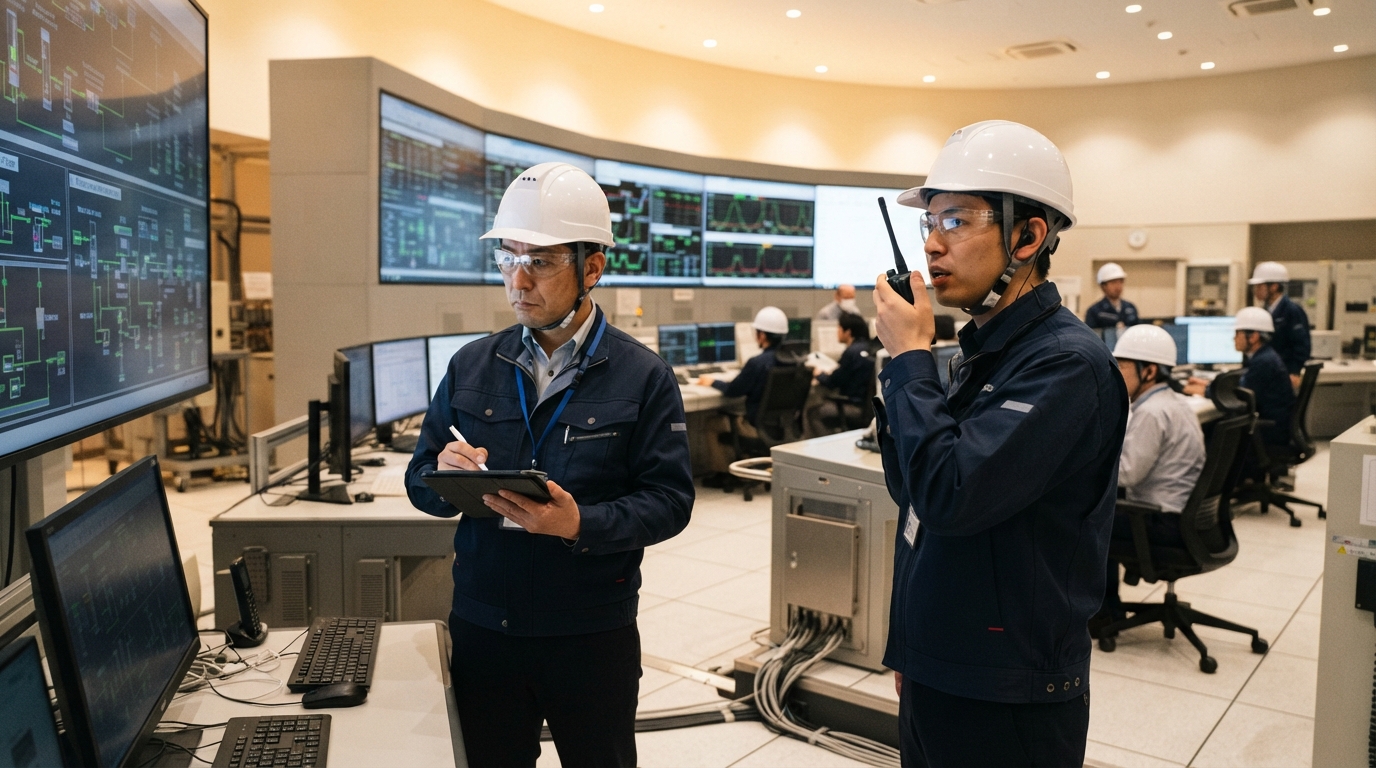
Commissioning and startup are where everything the project team has designed and built is proven in practice. After months or years of engineering, procurement, and construction, the plant is energized, filled with process fluids, and brought up to operating conditions. Every system is tested, every safety device is verified, and operators learn how the plant actually behaves. A successful commissioning and startup means the plant enters commercial operation smoothly. A poor one means delays, cost overruns, and problems that persist for years.
At EPC Partners Inc., commissioning and startup have been a core part of our work across a wide range of plant projects: geothermal power plants in Kenya, Indonesia, and Iceland; large-scale desalination facilities in the UAE and Saudi Arabia; thermal power plants in Vietnam and Bangladesh; and water treatment plants in Vietnam and Kuwait. Our commissioning work has ranged from geothermal projects in Kenya and Indonesia, where steam blow and turbine roll were critical milestones, to desalination projects in the Gulf, where membrane system startup and water quality testing were essential. Each project has presented different challenges, and each has reinforced the same lesson: commissioning is not only a technical exercise. It is a planning, organization, and communication exercise as well.
This article covers the key practices in plant commissioning and startup, drawing on our experience supporting projects across Asia, the Middle East, Africa, and Europe.
What Is Commissioning and Startup?
Commissioning is the process of verifying that every system in the plant works as designed. Startup is the process of bringing the plant into operation. Commercial operation follows once performance has been demonstrated and the owner accepts the plant.
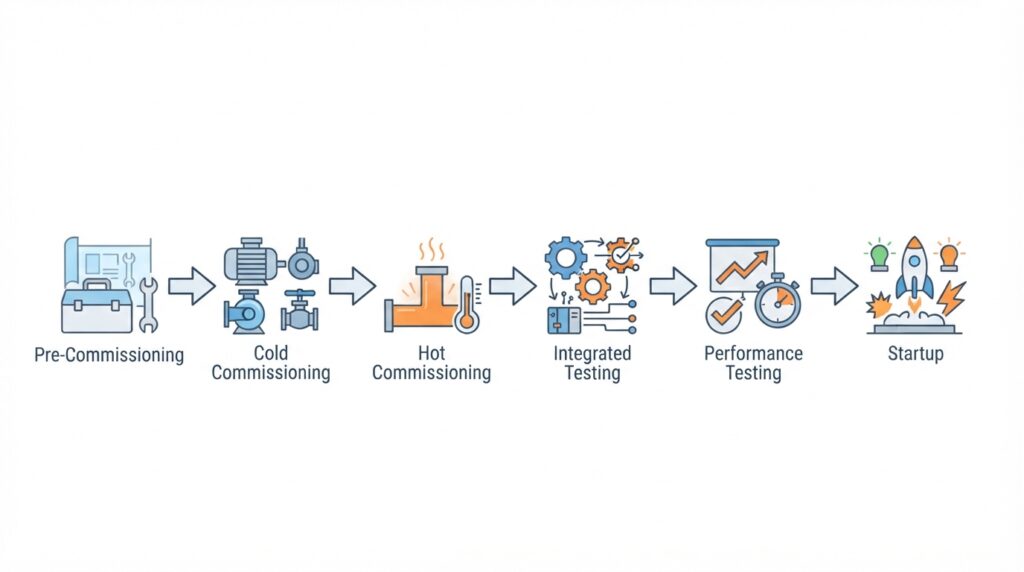
The main phases are:
- Mechanical completion and turnover: Construction hands completed systems over to the commissioning team.
- Pre-commissioning: Static checks, cleaning, and preparation before energization or startup.
- Cold commissioning: Testing without process fluids, or at ambient conditions.
- Hot commissioning: Testing with process fluids at operating conditions.
- Integrated testing: Testing interconnected systems together under operating conditions.
- Performance testing: Verifying that the plant meets its contractual performance guarantees.
- Startup and trial operation: Bringing the plant into stable, continuous operation and, where required, demonstrating reliability before acceptance.
Together, these ensure the plant is ready for safe and reliable operation.
Why Commissioning and Startup Matter
| Factor | Impact of Good Commissioning | Impact of Poor Commissioning |
|---|---|---|
| Safety | Systems verified safe before startup | Safety incidents during startup |
| Performance | Plant meets performance guarantees | Plant underperforms |
| Reliability | Systems function as designed | Early failures and downtime |
| Schedule | Startup on time | Delays from commissioning problems |
| Cost | Rework avoided | Rework and extended commissioning |
| Handover | Smooth transition to operations | Difficult handover |
For small to medium-scale industrial plants, commissioning and startup determine whether the plant starts up smoothly and meets its performance targets.
Commissioning Planning
Commissioning planning is the foundation of successful commissioning.
Key planning activities:
- Define scope: Which systems will be commissioned?
- Define sequence: In what order? Utilities and power distribution usually come first, then the systems that depend on them.
- Define organization: Who is responsible for what?
- Define schedule: When will each activity occur, and how does it fit with remaining construction?
- Define resources: What people, tools, temporary equipment, consumables, and utilities are needed?
- Define procedures: How will each system be commissioned?
- Define acceptance criteria: What counts as successful commissioning?
- Define the safety approach: How will permits, isolation, and simultaneous construction and commissioning activities be controlled?
Commissioning planning should begin during construction, and ideally during engineering, so that the design supports commissioning (test connections, temporary strainers, vents and drains, and access for calibration).
At our geothermal projects in Kenya (Olkaria I Unit 6, 83 MW) and Indonesia (Muara Laboh, 85.2 MW), commissioning planning covered the sequence for steam blow, turbine roll, and grid synchronization, with careful coordination of drilling, steam gathering, and power plant systems. In Iceland (Theistareykir, 2×45 MW), planning took into account the short construction season and the need to complete commissioning before winter.
Commissioning Organization
A clear organization is essential.
| Role | Responsibility |
|---|---|
| Commissioning Manager | Overall responsibility for commissioning |
| Commissioning Engineers | System-specific commissioning |
| Operations Representative | Operations input and readiness |
| Safety Representative | Safety oversight during commissioning |
| Vendor Representatives | Equipment-specific commissioning support |
| Contractor Representatives | Construction support and punch list completion |
For small plants, roles may be combined, but every function must still be covered. Reporting lines and decision authority, especially for stopping work on safety grounds, should be clear before commissioning begins.
Mechanical Completion and System Turnover
Commissioning is easier when work is handed over system by system, not all at once at the end of construction.
- Define systems and subsystems early, with clear boundaries, so each can be completed, turned over, and commissioned on its own.
- Verify mechanical completion: installation checks, torque and alignment records, and inspection sign-offs.
- Classify the punch list: items that must be closed before commissioning, items that must be closed before startup, and items that can wait until after startup.
- Agree on formal turnover certificates so responsibility for each system is unambiguous.
- Control access: once a system is turned over or energized, changes and entry should be managed through permits.
Pre-Commissioning
Pre-commissioning is the preparation phase before energization or startup.
- Static checks: verifying that equipment is installed correctly.
- Cleaning and flushing: removing debris and contaminants.
- Pressure testing: testing piping and vessels for strength and leak tightness.
- Instrument calibration and loop checks: verifying signals from field device to control system.
- Electrical checks: insulation, protection relay settings, and verification before energization.
- Safety system checks: verifying that safety systems function correctly.
Pre-commissioning is often the most time-consuming phase, and rushing it leads to problems later. For our thermal power projects in Vietnam (Thai Binh 1, 2×300 MW) and Bangladesh (Bibiyana-III, 400 MW CCGT), pre-commissioning included thorough cleaning of steam piping to remove construction debris, calibration of instrumentation, and verification of safety interlocks before first fire.
Cold Commissioning
Cold commissioning tests systems without process fluids or at ambient conditions.
- Motor rotation checks: correct direction before coupling.
- Pump and fan testing: operation without process load.
- Control loop testing: confirming loops respond correctly.
- Valve operation: open, close, modulate, and fail-safe position.
- Interlock and alarm testing: confirming safety interlocks and alarms function.
- Utilities: power, instrument air, cooling water, and other utilities proven before process systems depend on them.
Cold commissioning verifies that systems work mechanically and electrically before process fluids are introduced.
Hot Commissioning
Hot commissioning tests systems with process fluids at operating conditions.
- System startup: starting individual systems and verifying operation.
- Process parameter verification: confirming temperature, pressure, flow, and other parameters meet design values.
- Control loop tuning: tuning for stable, responsive control.
- Equipment performance: confirming equipment operates within design parameters, including vibration and temperature monitoring.
- Emissions and discharge checks: verifying regulatory limits are met.
Hot commissioning is where many problems surface, and it requires close coordination between contractor, owner, and equipment vendors.
For desalination projects in the Gulf (Taweelah, 909,200 m³/day; Jubail 3A, 600,000 m³/day), hot commissioning included the startup of high-pressure pumps, membrane systems, and energy recovery devices, with careful attention to water quality and energy consumption.
Project experience: At one thermal power project in Vietnam, hot commissioning included steam blow and turbine roll, with careful monitoring of steam chemistry and turbine protection systems before synchronization to the grid. At one geothermal project in Kenya, hot commissioning included the startup of the steam turbine and generator, with close coordination between the drilling, steam gathering, and power plant teams.
Integrated Testing
Integrated testing verifies that interconnected systems work together.
- Full plant operation: running the plant as a whole, not only individual systems.
- Load testing: operating across the load range.
- Transient testing: response to load changes, trips, and other disturbances.
- Safety system verification: confirming protective functions work under realistic conditions, using agreed procedures that do not put the plant at unnecessary risk.
This is where the plant is proven as a complete system, not just a collection of components.
Performance Testing
Performance testing verifies that the plant meets its contractual guarantees.
- Output testing: capacity or production rate (MW, m³/day, throughput).
- Efficiency testing: heat rate for power plants; specific energy consumption and recovery for desalination and water treatment plants.
- Product quality: for example, product water quality.
- Emissions testing: compliance with guaranteed or regulatory limits.
- Availability and reliability: some contracts require a demonstration run over a defined period.
Performance testing must follow the procedures specified in the contract, including reference conditions, test methods, instrument accuracy, and measurement uncertainty. Test procedures should be agreed with all parties well before the tests begin.
Startup and Trial Operation
Startup is the process of bringing the plant into stable, continuous operation.
- System readiness: confirming all required systems, permits, and utilities are ready.
- Operator readiness: confirming operators are trained and procedures are available.
- Startup sequence: following the planned sequence for each system.
- Monitoring: tracking performance, vibration, temperatures, and alarms closely.
- Issue resolution: resolving problems quickly, with a clear process for decisions.
- Trial operation: where required, running the plant continuously to demonstrate reliability before acceptance.
Startup should be planned and controlled. A pre-startup safety review, with sign-off from operations, safety, and the commissioning team, helps confirm the plant is ready.
Commissioning Safety
Commissioning is one of the highest-risk phases of a project. Systems are being energized and pressurized for the first time, while construction work may still be in progress.
- Permit-to-work and isolation (lockout/tagout) for all work on commissioned systems.
- Clear segregation between energized or live systems and ongoing construction areas.
- Hazard reviews for first-time operations such as steam blow, chemical cleaning, and high-pressure testing.
- Emergency response arrangements and drills that cover the commissioning period.
- Authority to stop work for anyone who sees an unsafe condition.
Commissioning Documentation
- Commissioning procedures: one for each system.
- Commissioning records: tests and results.
- Test certificates: for equipment and systems.
- Punch lists: outstanding items, classified by priority.
- As-built drawings: reflecting actual construction and any changes made during commissioning.
- Operating and maintenance procedures: for the operations team.
- Lessons learned records: captured as the work progresses.
Documentation must be complete, accurate, and accessible.
Handover and Post-Startup Support
Commissioning does not end when the plant starts up.
- Formal acceptance based on completed performance tests and agreed acceptance criteria.
- Closure of remaining punch list items with owners and dates.
- Transfer of documentation, spare parts, and special tools to the owner.
- Warranty or defects liability period: a clear process for reporting and resolving defects.
- Post-startup support: a period where commissioning engineers and vendors remain available to the operations team.
Commissioning and Startup in Small Plants
Small plants face particular challenges: fewer resources, less in-house expertise, limited vendor support, and competing priorities.
Practical approaches:
- Plan early: begin during engineering or construction.
- Use vendor support: engage vendors for equipment commissioning.
- Involve operations: operators should take part in commissioning, not just receive the plant afterwards.
- Document everything: good records support handover and operations.
- Focus on critical systems: prioritize safety-critical systems.
- Apply lessons from other projects: use checklists and procedures from similar plants.
Commissioning does not need to be complex. It needs to be thorough and well planned.
Common Mistakes in Commissioning and Startup
- Insufficient pre-commissioning: leading to problems during hot commissioning.
- Instrument calibration errors: causing inaccurate readings and poor control.
- Control loop tuning problems: causing instability.
- Equipment failures: leading to delays and rework.
- Safety system issues: requiring redesign or modification.
- Documentation gaps: making handover difficult.
- Schedule pressure: leading to rushed testing and missed problems.
- Unclear turnover: systems commissioned while construction work is still unfinished.
- No operator involvement: operators unprepared for startup.
- Poorly agreed performance test procedures: leading to disputes over results.
These mistakes are costly to correct and much cheaper to avoid through disciplined commissioning.
How EPC Partners Inc. Approaches Commissioning and Startup
At EPC Partners Inc., we bring practical experience from projects across Asia, the Middle East, Africa, and Europe.
- Thorough planning: clear procedures and acceptance criteria.
- Detailed preparation: pre-commissioning completed before startup.
- Disciplined execution: a controlled sequence with defined hold points.
- Comprehensive documentation: complete and accurate records.
- Operator involvement: operations staff take part throughout.
- Safety focus: safety is prioritized at every stage.
- Continuous improvement: lessons are captured and applied to later projects.
Our experience includes supporting geothermal projects in Kenya, Ethiopia, Indonesia, Iceland, and Japan; desalination projects in the UAE, Saudi Arabia, Oman, and Qatar; thermal power projects in Vietnam, Bangladesh, and Japan; and water treatment projects in Vietnam, Kuwait, and Qatar. We have also supported clients including Marubeni Corporation, Fuji Electric Co., Ltd., and Toyota Tsusho Corporation on commissioning and startup aspects of their projects.
How to Evaluate Commissioning and Startup Readiness
| Question | Why It Matters |
|---|---|
| Is there a commissioning plan? | Provides a roadmap |
| Is the turnover process defined? | Prevents overlap between construction and commissioning |
| Is pre-commissioning thorough? | Prevents problems during hot commissioning |
| Are procedures prepared? | Defines how systems will be commissioned |
| Is the organization in place? | Ensures clear responsibilities |
| Are operators involved and trained? | Builds familiarity and readiness |
| Are safety systems and permits in place? | Ensures safe operation |
| Is documentation complete? | Supports handover and operations |
| Is performance testing planned and agreed? | Verifies contractual guarantees |
| Is startup and post-startup support planned? | Ensures a smooth transition to operation |
A project that can answer yes to these questions is well prepared for commissioning and startup.
Conclusion
Commissioning and startup are the final proof of everything the project team has designed and built. For small to medium-scale industrial plants, they determine whether the plant starts up smoothly, meets its performance guarantees, and is ready for reliable operation.
By focusing on commissioning planning, organization, turnover, pre-commissioning, cold and hot commissioning, integrated and performance testing, safe startup, and a structured handover, owners and project teams can enter commercial operation with confidence.
If you are planning a plant project and need support with commissioning and startup or EPC project delivery, contact us to discuss how we can help.
EPC Partners Inc. is a Japanese EPC support firm with experience supporting power, water, and industrial plant projects across Asia, the Middle East, Africa, and Europe. For more information, visit our project list.