
Engineering deliverables are the tangible outputs of the engineering phase: drawings, specifications, datasheets, calculations, and reports that define what the plant will be, how it will be built, and how it will operate. They are the bridge between design intent and physical construction. If deliverables are incomplete, inaccurate, or late, the consequences ripple through procurement, construction, and commissioning.
At EPC Partners Inc., engineering deliverables management has been a core part of our work across a wide range of plant projects, including geothermal power plants in Kenya, Indonesia, and Iceland; large-scale desalination facilities in the UAE and Saudi Arabia; thermal power plants in Vietnam and Bangladesh; and water treatment plants in Vietnam and Kuwait. Our work has ranged from geothermal projects in Kenya and Indonesia, where long-lead equipment datasheets were critical to early procurement, to desalination projects in the Gulf, where coordination between process, mechanical, electrical, and instrumentation deliverables was essential to avoid clashes. Each project has presented different challenges, and each has reinforced the same lesson: engineering deliverables are not just documents. They are the foundation on which the entire project is built.
This article covers the key practices in plant engineering deliverables management, drawing on our experience supporting projects across Asia, the Middle East, Africa, and Europe.
What Are Engineering Deliverables?
Engineering deliverables are the documents, drawings, and data produced by the engineering team. They include:
- Design drawings: P&IDs, PFDs, isometrics, electrical drawings, layout drawings.
- Specifications: Equipment, material, and technical specifications.
- Datasheets: Equipment, instrument, and valve datasheets.
- Calculations: Process, mechanical, structural, and electrical calculations.
- Reports: Design reports, studies, and analyses.
- Manuals: Operating and maintenance manuals.
- Lists: Equipment lists, cable schedules, instrument indexes, line lists.
- Models: 3D plant models and data extracted from them, where used.
Engineering deliverables define the plant and provide the information needed to procure, construct, and operate it.
Why Engineering Deliverables Matter
| Factor | Impact of Good Deliverables | Impact of Poor Deliverables |
|---|---|---|
| Procurement | Equipment ordered correctly and on time | Wrong equipment ordered; delays |
| Construction | Construction proceeds smoothly | Rework and delays |
| Commissioning | Systems commissioned correctly | Commissioning problems |
| Operations | Plant operated and maintained effectively | Operational problems |
| Cost | Rework avoided | Cost overruns |
| Schedule | Deliverables on time | Delays cascade |
For small to medium-scale industrial plants, engineering deliverables determine whether the plant is built correctly and on schedule.
Deliverable Planning
Deliverable planning defines what deliverables are required, when, and by whom.
- Define the deliverable list: What deliverables are required?
- Define the schedule: When is each deliverable required, and by which downstream activity?
- Define the format: What file formats, templates, and numbering conventions apply?
- Define quality standards: What standards and checks apply?
- Define responsibilities: Who is responsible for each deliverable?
- Define review and approval: How will deliverables be reviewed and approved, and within what turnaround time?
Deliverable planning should be integrated into the overall project schedule, and the schedule should be driven by need dates from procurement and construction rather than by what is convenient for engineering.
At our geothermal projects in Kenya (Olkaria I Unit 6, 83 MW) and Indonesia (Muara Laboh, 85.2 MW), deliverable planning focused on the long-lead equipment datasheets and specifications needed for early procurement of steam turbines and generators. In Iceland (Theistareykir, 2×45 MW), deliverable planning also took into account the specific regulatory and environmental requirements of the project.
Deliverable Register
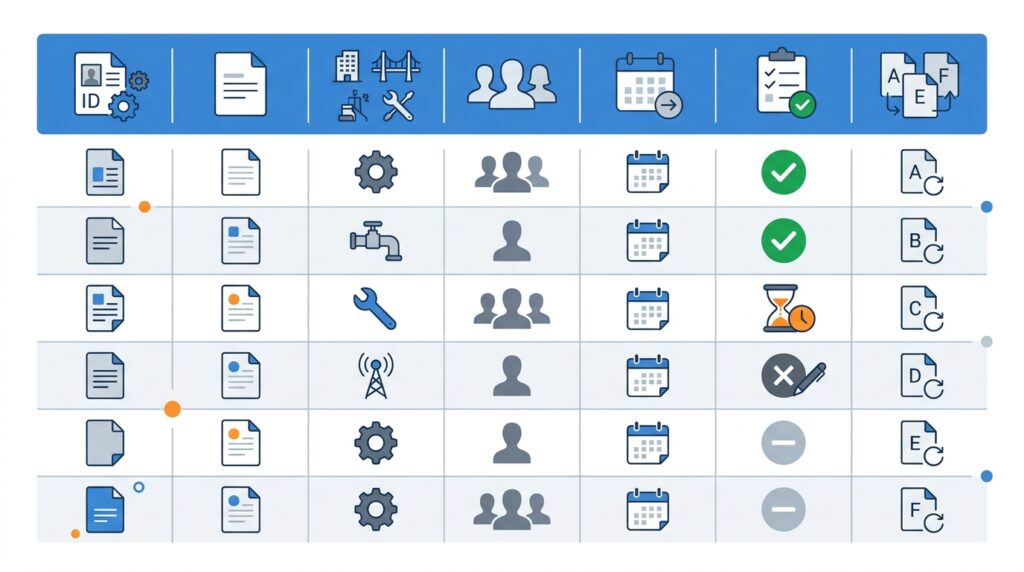
The deliverable register (often called a master document register) is the central document for tracking deliverables.
| Field | Description |
|---|---|
| Deliverable ID | Unique identifier |
| Description | What the deliverable is |
| Discipline | Process, mechanical, electrical, etc. |
| Responsible party | Who is responsible |
| Due date | When the deliverable is required |
| Status | Not started, in progress, submitted, approved |
| Revision | Current revision |
| Transmittal | How and when it was transmitted |
The register should be reviewed regularly and updated as deliverables progress. A consistent numbering scheme, agreed at the start of the project, makes the register far easier to maintain and search.
Key Engineering Deliverables
| Discipline | Key Deliverables |
|---|---|
| Process | PFDs, heat and mass balances, P&IDs, process datasheets |
| Mechanical | Equipment datasheets, mechanical drawings, stress analysis |
| Piping | Piping layouts, isometrics, support drawings, material take-offs |
| Electrical | Single-line diagrams, cable schedules, electrical layouts |
| Instrumentation | Instrument indexes, loop diagrams, cause-and-effect diagrams |
| Civil/Structural | Foundation drawings, structural drawings, site layouts |
| Control | Control philosophy, control system architecture, I/O lists |
Each discipline must coordinate with the others to ensure consistency.
Issue Purposes and Status Codes
Not every issue of a deliverable has the same standing. A drawing issued for review is not the same as one issued for construction, and mixing them up is a common source of rework.
Define a small set of status codes and use them consistently. Typical examples:
- Issued for Review (IFR): For internal or client comment.
- Issued for Approval (IFA): For formal approval.
- Issued for Procurement (IFP): For purchasing and bidding.
- Issued for Construction (IFC): Released for site use.
- As-Built: Reflects the plant as actually constructed.
Only documents marked for construction should be used on site, and the status must be clearly shown on the document and in the register.
Deliverable Quality
Poor-quality deliverables cause problems downstream. Quality considerations:
- Accuracy: Does the deliverable reflect the actual design?
- Completeness: Does it include all required information?
- Consistency: Is it consistent with other deliverables?
- Clarity: Is it clear and easy to understand?
- Compliance: Does it comply with applicable standards, codes, and regulations?
Quality should be checked before deliverables are issued, using checklists suited to each deliverable type.
Deliverable Review and Approval
Deliverables should be reviewed and approved before they are issued.
- Internal review: By the originating discipline and other affected disciplines.
- Client review: By the owner or their representative.
- Approval: Formal approval by authorized personnel.
- Comment resolution: Resolution and documentation of comments from reviewers.
- Issue: Issue of the approved deliverable.
Agree review turnaround times in advance. Slow client review is one of the most common causes of deliverable delay, and it is much easier to manage if expectations are set at the start.
Vendor Documents
On EPC projects, a large share of deliverables comes from equipment suppliers rather than the engineering team: datasheets, general arrangement drawings, foundation loads, performance data, test procedures, and manuals.
- Specify requirements in the purchase order: List the documents required, their timing, and the review process.
- Track vendor documents in the register: Treat them like any other deliverable.
- Review promptly: Late review of vendor drawings delays fabrication and can affect foundations and piping design.
- Feed back into engineering: Vendor data must be reflected in the plant design, for example in civil foundation design and piping layouts.
Deliverable Transmittals
Transmittals are the formal record of deliverable issue.
- Transmittal number: Unique identifier.
- Date: Date of issue.
- Recipient: Who the deliverable is sent to.
- Deliverables: What is included, with revision numbers.
- Purpose: Why they are being issued (for review, for approval, for construction).
- Response required: What response is needed and by when.
Transmittals provide an audit trail of issue and receipt.
At one thermal power project in Vietnam (Thai Binh 1, 2×300 MW), transmittals were used to formally issue the P&IDs and equipment datasheets to the construction contractor, with each transmittal recording the purpose (for construction) and the required response date. At another project in Bangladesh (Bibiyana-III, 400 MW CCGT), the transmittal log was used to track the issue of revised drawings as the design developed, giving a clear record of what was issued, when, and to whom.
Deliverable Revisions
Deliverables are often revised as the design develops.
- Revision numbering: Each revision is numbered sequentially.
- Revision description: Each revision records what changed and why.
- Superseded documents: Previous revisions are clearly marked as superseded.
- Distribution: Revised deliverables go to all holders of previous revisions.
Revision control ensures that everyone is working from the current version.
Deliverable Coordination
Deliverables from different disciplines must be coordinated.
- Interface checks: Checking that deliverables from different disciplines are consistent.
- Clash detection: Checking that physical designs do not clash.
- Design reviews: Reviewing designs across disciplines.
- Change management: Managing changes that affect multiple disciplines.
For desalination projects in the Gulf (Taweelah, 909,200 m³/day; Jubail 3A, 600,000 m³/day), coordination included interface checks between the process, mechanical, electrical, and instrumentation disciplines, with clash detection used to identify and resolve physical conflicts before construction.
As-Built and Handover Documentation
Deliverables do not end when construction starts. The operating plant needs an accurate record of what was built.
- As-built drawings: Updated to reflect field changes and redlines.
- Final data books: Compiled equipment documentation, certificates, and test records.
- Operating and maintenance manuals: Complete and aligned with the as-built plant.
- Spare parts lists and maintenance data: Provided in the format the owner needs.
- Handover package: Delivered in an organized, searchable form.
Plan for this from the start. As-built documentation is much harder to reconstruct at the end of the project than to maintain throughout.
Tracking Progress and Performance
Deliverables are easier to manage when progress is measured.
- Planned vs. actual issue: Compare the planned issue date with the actual date for each deliverable.
- Overdue deliverables: Track overdue items, prioritizing those on the critical path.
- Review cycle times: Monitor how long reviews and comment resolution take.
- Revision counts: A high number of revisions can signal unclear requirements or design instability.
- Open comments: Track unresolved comments and who owns them.
Regular reporting to project management keeps problems visible while they can still be fixed.
Deliverables in Small Plants
Small plants face particular challenges with engineering deliverables:
- Fewer resources for deliverables management.
- Less expertise.
- Less access to specialist support.
- Competing priorities.
Practical approaches:
- Focus on critical deliverables: Prioritize those on the critical path.
- Use simple tools: Simple registers and transmittal logs can be sufficient.
- Use templates: Standard templates save time and improve consistency.
- Seek expert advice: Get advice from experienced engineers.
- Document everything: Good records support coordination and resolve disputes.
- Learn from others: Apply lessons from other projects.
Deliverables management does not need to be complex. It needs to be thorough and consistent.
Common Mistakes in Engineering Deliverables
Even experienced organizations make mistakes. Common ones include:
- Incomplete deliverables: Missing information that causes problems downstream.
- Late deliverables: Delays that cascade to procurement and construction.
- Poor quality: Errors that cause rework.
- Poor coordination: Inconsistencies and clashes between disciplines.
- No revision control: Multiple versions in circulation.
- No transmittals: No record of what was issued and when.
- Unclear status: Review documents used as if they were approved for construction.
- Vendor documents neglected: Supplier data not tracked, reviewed, or reflected in the design.
- No review and approval: Deliverables issued without proper checking.
- Weak as-built control: Field changes not captured in final documentation.
These mistakes are costly to correct and much cheaper to avoid through disciplined deliverables management.
How EPC Partners Inc. Approaches Engineering Deliverables
At EPC Partners Inc., we bring practical experience from projects across Asia, the Middle East, Africa, and Europe to engineering deliverables management. Our approach includes:
- Thorough planning: Deliverables are planned from the beginning, with clear schedules and responsibilities.
- Disciplined tracking: Deliverables are tracked through a deliverable register.
- Quality focus: Deliverables are reviewed and checked before issue.
- Formal transmittals: Deliverables are issued through formal transmittals.
- Revision control: Revisions are controlled and distributed.
- Coordination: Deliverables from different disciplines are coordinated.
- Continuous improvement: Lessons are captured and applied.
Our experience includes supporting geothermal projects in Kenya, Ethiopia, Indonesia, Iceland, and Japan; desalination projects in the UAE, Saudi Arabia, Oman, and Qatar; thermal power projects in Vietnam, Bangladesh, and Japan; and water treatment projects in Vietnam, Kuwait, and Qatar. We have also supported clients including Marubeni Corporation, Fuji Electric Co., Ltd., and Toyota Tsusho Corporation on engineering deliverables aspects of their projects.
How to Evaluate Engineering Deliverables Readiness
| Question | Why It Matters |
|---|---|
| Is there a deliverable register? | Provides a central record of deliverables |
| Is the deliverable schedule realistic and tied to need dates? | Ensures deliverables are available when needed |
| Are status codes defined and used consistently? | Prevents unapproved documents being used for construction |
| Are deliverables reviewed and approved? | Ensures quality |
| Are vendor documents tracked and reviewed? | Keeps supplier data in step with the design |
| Are transmittals used? | Provides an audit trail |
| Is revision control in place? | Ensures everyone works from the current version |
| Are deliverables coordinated across disciplines? | Prevents conflicts |
| Are deliverables complete and accurate? | Prevents downstream problems |
| Is there a process for managing changes? | Ensures changes are reflected in deliverables |
| Is there a plan for as-built and handover documents? | Ensures the owner receives accurate final records |
A project that addresses these questions is ready for effective engineering deliverables management.
Conclusion
Engineering deliverables are the foundation on which the plant is built. For small to medium-scale industrial plants, they determine whether the plant is procured, constructed, and operated correctly.
By focusing on deliverable planning, the register, status control, quality, review and approval, vendor documents, transmittals, revision control, coordination, and as-built records, owners and project teams can ensure that engineering deliverables support the project throughout its life.
If you are planning a plant project and need support with engineering deliverables management or EPC project delivery, contact us to discuss how we can help.
EPC Partners Inc. is a Japanese EPC support firm with experience supporting power, water, and industrial plant projects across Asia, the Middle East, Africa, and Europe. For more information, visit our project list.