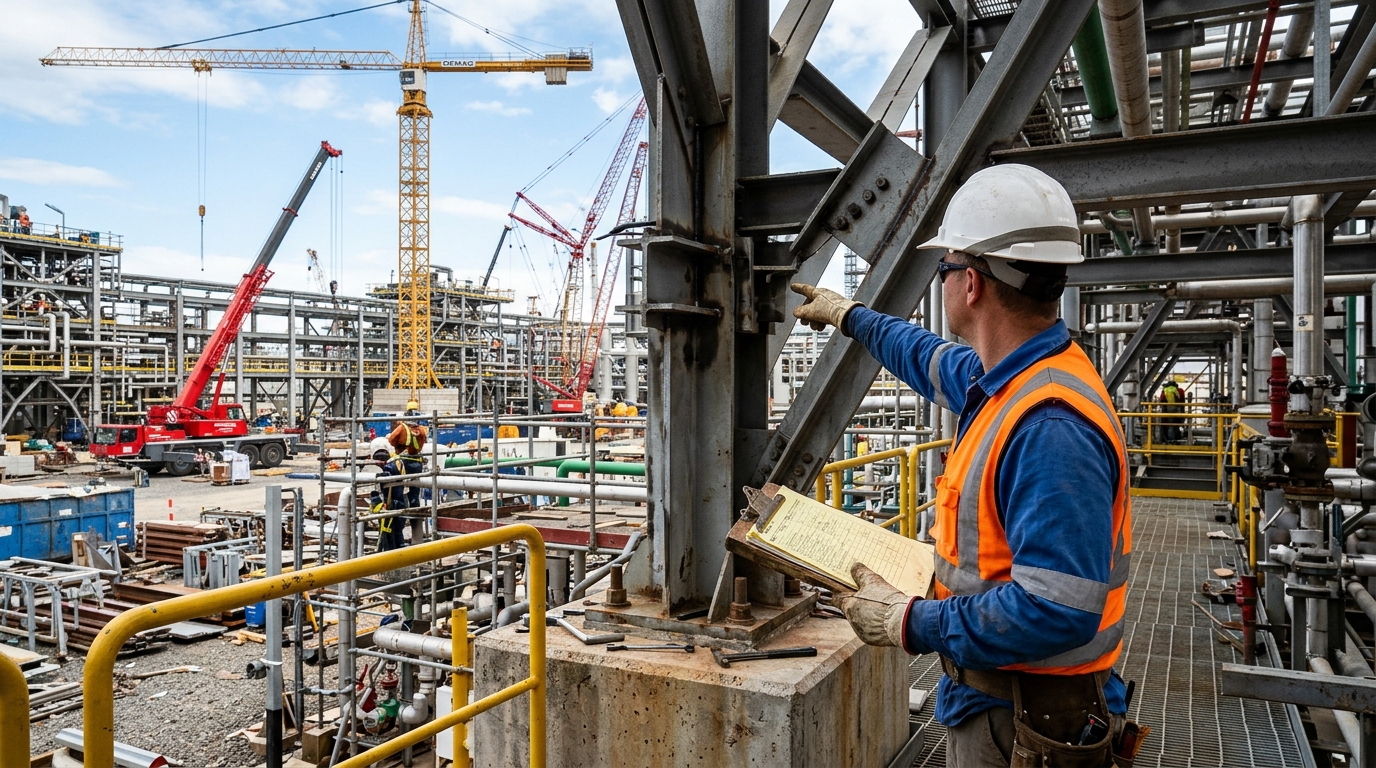
Construction supervision is the discipline of overseeing construction activities so that work is performed safely, on schedule, within budget, and to the required quality. It is the bridge between the design office and the construction site. It is where drawings become physical reality, and where problems are found and resolved before they become costly.
At EPC Partners Inc., construction supervision has been a core part of our work across geothermal, desalination, thermal power, and water treatment projects. Our supervision work has ranged from geothermal projects in Kenya and Indonesia, where high-temperature steam and hydrogen sulfide required special safety measures, to desalination projects in the Gulf, where coordination between marine, process, and electrical contractors was critical. Each project has presented different challenges, and each has reinforced the same lesson: good construction supervision is not just about watching the work. It is about anticipating problems, coordinating disciplines, and maintaining the standards that determine the plant’s long-term reliability.
This article covers the key practices in plant construction supervision, drawing on our experience across Asia, the Middle East, Africa, and Europe.
What Construction Supervision Covers
Construction supervision includes:
- Safety supervision: ensuring construction work is performed safely.
- Quality supervision: ensuring work meets specifications.
- Schedule supervision: ensuring work is completed on time.
- Cost supervision: ensuring work is completed within budget.
- Coordination: ensuring disciplines and contractors work together.
- Documentation: ensuring construction records are complete.
Together, these ensure the plant is built as designed, safely, and to the required quality.
Why Construction Supervision Matters
| Factor | Impact of Good Supervision | Impact of Poor Supervision |
|---|---|---|
| Safety | Incidents prevented | Incidents and injuries |
| Quality | Work meets specifications | Rework and premature failures |
| Schedule | Work completed on time | Delays from rework and coordination problems |
| Cost | Rework avoided | Cost overruns from rework |
| Coordination | Disciplines work together | Conflicts and interface problems |
| Documentation | Records complete for handover | Incomplete records |
For small to medium-scale industrial plants, construction supervision determines whether the plant is built correctly and safely.
The Role of the Construction Supervisor
The construction supervisor oversees construction activities on behalf of the owner or the project.
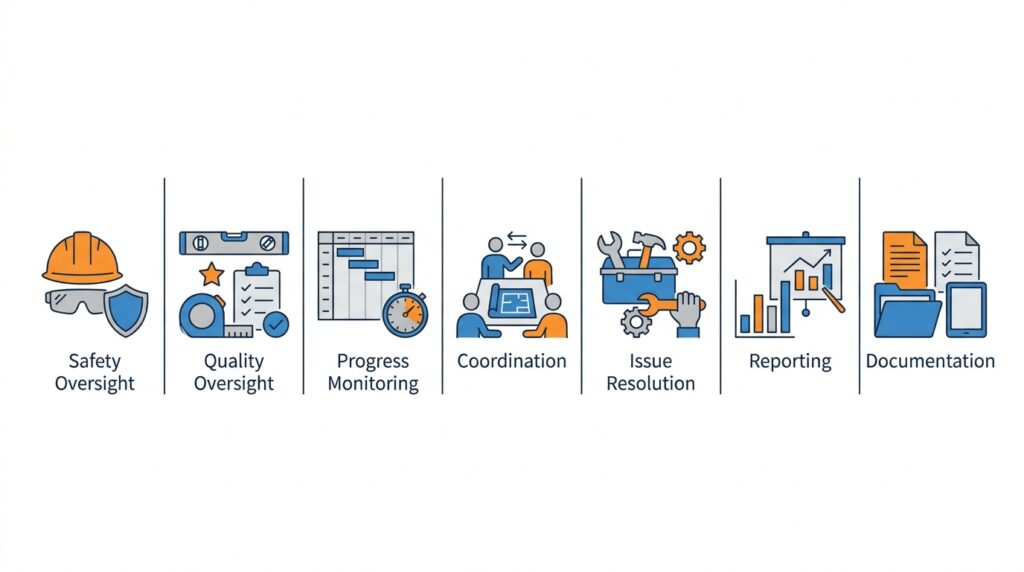
Key responsibilities:
- Safety oversight: ensuring safety procedures are followed.
- Quality oversight: ensuring work meets specifications and approved drawings.
- Progress monitoring: tracking progress against the schedule.
- Coordination: coordinating disciplines and contractors.
- Issue resolution: resolving problems as they arise.
- Reporting: reporting progress and issues to management.
- Documentation: ensuring records are complete.
The supervisor must combine technical knowledge with management skills. Just as important, the supervisor needs clear authority, including the authority to stop unsafe or non-conforming work.
Setting Up Supervision: The Supervision Plan
Effective supervision starts before construction begins. A supervision plan should define:
- Organization, roles, responsibilities, and reporting lines
- Supervision staffing by discipline and by phase
- Inspection and test requirements (ITPs)
- Safety requirements and the permit-to-work system
- Progress measurement and reporting methods
- Coordination and interface procedures
- Document control and records requirements
- Communication with the owner, designer, and contractors
Safety Supervision
Safety is the highest priority in construction supervision.
Safety supervision activities:
- Hazard identification: identifying construction hazards, including those of the specific site and process.
- Permit-to-work: ensuring permits are in place for hazardous work.
- Safety inspections: regular inspections to identify hazards.
- Toolbox talks: daily safety briefings.
- Incident reporting: reporting and investigating incidents and near misses.
- Emergency response: ensuring emergency procedures are in place and understood.
Permit-to-work deserves particular attention. It is effective only when permits are issued for a defined scope, hazards and isolations are verified in the field, and permits are closed out properly at the end of the work. Typical permit-controlled activities include hot work, confined space entry, work at height, excavation, lifting operations, energized electrical work, and line breaking.
Safety supervision should be proactive: identifying and addressing hazards before they cause incidents.
Project examples. At one geothermal project in Indonesia, safety supervision required careful management of hydrogen sulfide exposure, with continuous gas monitoring and respiratory protection for workers in confined spaces. At another project in Kenya, the high-temperature steam systems required strict isolation and permit-to-work procedures during construction. At a geothermal project in Iceland, supervision also had to account for the seismic and environmental conditions of the site.
Quality Supervision
Quality supervision ensures that construction work meets specifications.
Quality supervision activities:
- Inspection: inspecting work as it is completed, before it is covered or closed.
- Testing: witnessing tests and reviewing test records.
- Material verification: verifying that materials meet specifications, including certificates and traceability.
- Non-conformance management: identifying, recording, and resolving non-conformances.
- Documentation: ensuring quality records are complete.
Quality supervision should be based on inspection and test plans (ITPs) that define the required inspections and tests. ITPs typically designate:
- Hold points: work must stop until the inspection is passed (for example, before concrete is poured or before piping is closed up).
- Witness points: the supervisor is notified and may attend, but work can proceed if they do not.
- Review points: records are reviewed after the activity.
Typical focus areas include foundations and civil works, structural steel, equipment installation and alignment, welding and NDT, pressure testing, piping cleaning and flushing, and electrical and instrument installation.
Schedule Supervision
Schedule supervision ensures that construction work is completed on time.
Schedule supervision activities:
- Progress monitoring: tracking progress against the schedule.
- Look-ahead planning: planning work for the next two to four weeks.
- Critical path monitoring: tracking critical activities.
- Delay identification: identifying delays and their causes.
- Recovery planning: developing plans to recover delays.
Schedule supervision should be based on a realistic schedule and accurate, measured progress data rather than estimated percentages.
For the thermal power projects in Vietnam (Thai Binh 1, 2×300 MW) and Bangladesh (Bibiyana-III, 400 MW CCGT), schedule supervision included daily progress meetings, weekly look-ahead planning, and careful monitoring of the critical path through turbine and generator installation.
Cost Supervision
Cost supervision ensures that construction work is completed within budget.
Cost supervision activities:
- Commitment tracking: tracking contracts and purchase orders.
- Cost tracking: tracking actual costs against budget.
- Change management: managing changes and their cost and schedule impact.
- Forecasting: predicting final costs.
- Reporting: reporting cost status to management.
Cost supervision should be based on accurate cost data and disciplined change control. Verbal instructions on site that have cost implications should be documented and approved before work proceeds.
Coordination and Contractor Management
Coordination ensures that disciplines and contractors work together.
Coordination activities:
- Interface management: managing interfaces between disciplines and contractors.
- Coordination meetings: regular meetings to coordinate work.
- Area-based planning: planning work by area to manage interfaces and avoid congestion.
- Handover procedures: defining how areas and systems are handed over between contractors.
- Contractor oversight: monitoring subcontractor performance, manpower, equipment, and compliance with safety and quality requirements.
Coordination is especially important on complex projects with multiple contractors. For the desalination projects in the Gulf (Taweelah, 909,200 m³/day; Jubail 3A, 600,000 m³/day), coordination covered the interfaces between the marine works contractor, the process plant contractor, and the electrical and instrumentation contractor, with careful planning of tie-ins and handovers.
Issue Resolution
Issue resolution is the process of resolving problems as they arise.
- Issue identification: recognizing problems early.
- Root cause analysis: understanding why the problem occurred.
- Solution development: developing practical solutions, with designer input where needed.
- Implementation: implementing the solution.
- Verification: confirming the solution is effective.
Resolution should be timely and practical. An unresolved site issue usually gets more expensive every day.
Documentation
Documentation ensures that construction records are complete.
- Daily reports: recording activities, manpower, equipment, weather, progress, and issues.
- Inspection records: recording inspections and test results.
- Non-conformance reports: recording non-conformances and their closure.
- As-built drawings: recording what was actually built.
- Photographs: recording progress and issues.
Documentation should be complete, accurate, and accessible. Records that are not captured during construction are very hard to reconstruct later.
From Construction to Commissioning
Construction supervision does not end when installation looks finished. Supervisors play a key role in the transition to commissioning:
- Verifying mechanical completion against defined criteria
- Managing the punch list, with items categorized by priority
- Confirming completion of pressure tests, flushing, and cleaning
- Organizing system-by-system turnover
- Ensuring documentation is ready for handover
A well-managed transition reduces delays during commissioning and startup.
Construction Supervision in Small Plants
Small plants face particular challenges: fewer resources for supervision, less in-house expertise, limited access to specialist support, and competing priorities.
Practical approaches:
- Focus on critical activities: prioritize supervision where failure would be most costly or dangerous.
- Use checklists: simple checklists can be sufficient.
- Use third-party inspection: engage inspectors for specialized work.
- Document everything: good records support handover and operations.
- Train staff: make sure staff understand supervision requirements.
- Learn from others: apply lessons from other plants.
Construction supervision does not need to be complex. It needs to be thorough and consistent.
Common Mistakes in Construction Supervision
- Inadequate safety oversight: leading to incidents.
- Skipping inspections: allowing defective work to proceed.
- Poor progress monitoring: discovering delays too late.
- Weak cost control: missing overruns until it is too late.
- Poor coordination: conflicts between disciplines and contractors.
- Delayed issue resolution: problems escalating.
- Incomplete documentation: problems at handover.
- No lessons learned: repeating mistakes.
These mistakes are costly to correct and much cheaper to avoid.
How EPC Partners Inc. Approaches Construction Supervision
We bring practical experience from projects across Asia, the Middle East, Africa, and Europe. Our approach includes:
- Safety focus: safety is prioritized throughout construction.
- Quality focus: work is inspected as it is completed.
- Progress monitoring: progress is tracked and reported regularly.
- Coordination: disciplines and contractors are coordinated carefully.
- Issue resolution: problems are resolved promptly.
- Detailed documentation: records are complete and accurate.
- Continuous improvement: lessons are captured and applied.
As a Japanese EPC support firm, we bring the Japanese emphasis on discipline, preparation, and attention to detail: thorough pre-construction planning, daily site meetings, careful inspection before each work stage is closed, and consistent record keeping.
Our experience includes geothermal projects in Kenya, Ethiopia, Indonesia, Iceland, and Japan; desalination projects in the UAE, Saudi Arabia, Oman, and Qatar; thermal power projects in Vietnam, Bangladesh, and Japan; and water treatment projects in Vietnam, Kuwait, and Qatar. We have supported clients including Marubeni Corporation, Fuji Electric Co., Ltd., and Toyota Tsusho Corporation on construction supervision aspects of their projects.
How to Evaluate Construction Supervision Readiness
| Question | Why It Matters |
|---|---|
| Is there a supervision plan? | Provides a roadmap for supervision |
| Is safety supervision in place, including permit-to-work? | Protects workers |
| Are ITPs defined, with hold and witness points? | Ensures work meets specifications |
| Is progress monitored with measured data? | Identifies delays early |
| Is cost monitored and change control enforced? | Identifies overruns early |
| Is coordination effective? | Prevents conflicts |
| Are issues resolved promptly? | Prevents escalation |
| Is documentation complete? | Supports handover and operations |
| Is the transition to commissioning planned? | Reduces startup delays |
Key Takeaways
- Safety comes first, and permit-to-work must be enforced, not just issued.
- Base quality supervision on ITPs with clear hold and witness points.
- Measure progress with real data and look ahead every week.
- Control changes and costs through documented approvals.
- Coordinate by area, and manage contractor interfaces actively.
- Keep records as you go, and plan the transition to commissioning early.
Conclusion
Construction supervision is critical to plant success. For small to medium-scale industrial plants, it determines whether the plant is built correctly and safely. By focusing on safety, quality, schedule, cost, coordination, issue resolution, and documentation, owners and project teams can ensure the plant is built as designed and to the required quality.
If you are planning a plant project and need support with construction supervision or EPC project delivery, contact us to discuss how we can help.
EPC Partners Inc. is a Japanese EPC support firm with experience supporting power, water, and industrial plant projects across Asia, the Middle East, Africa, and Europe. For more information, visit our project list.