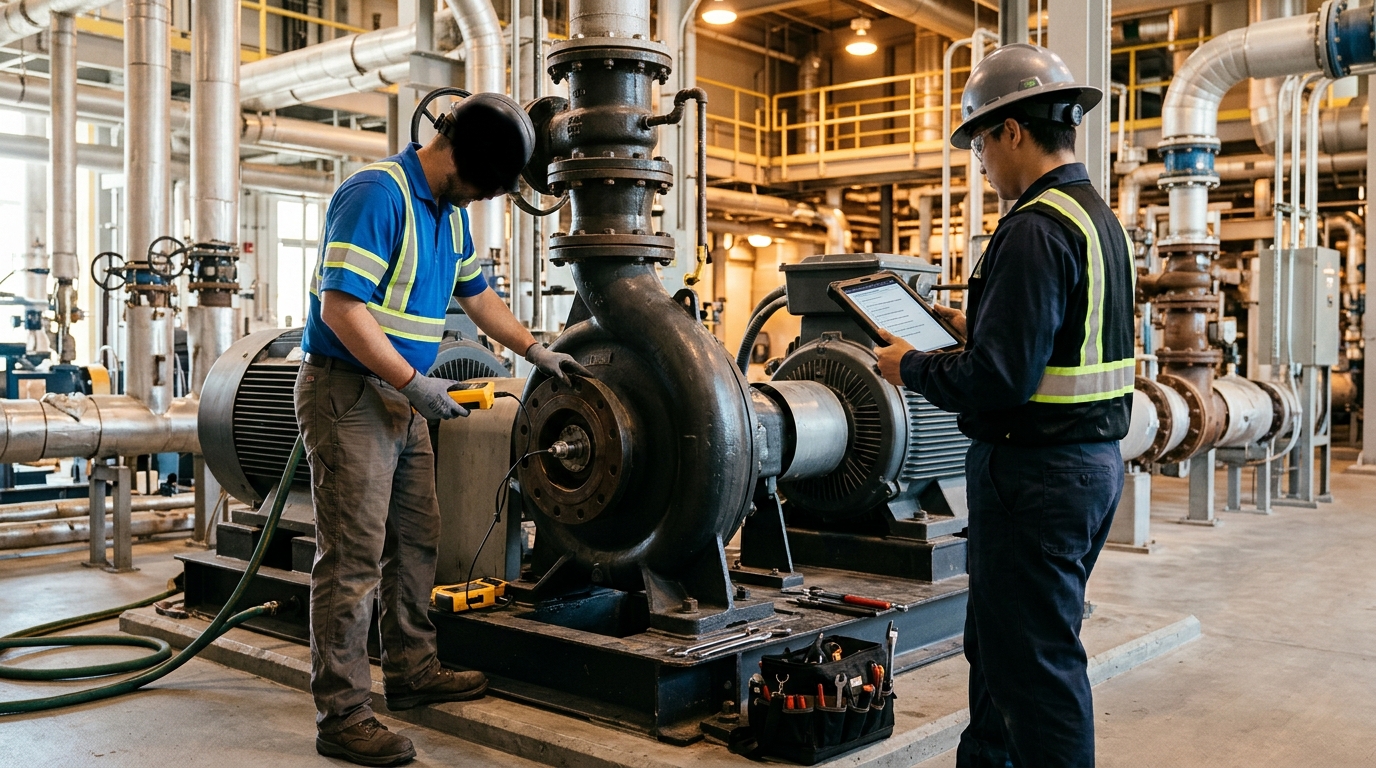
A plant is built once, but it is operated and maintained for decades. The quality of operations and maintenance (O&M) determines whether the plant delivers its intended value over its life, or becomes a source of rising costs, repeated failures, and safety incidents.
O&M engineering is the discipline of designing, planning, and supporting the systems and practices that keep the plant running reliably, efficiently, and safely. It begins during design, when equipment and systems are selected and configured for operability and maintainability. It continues through construction, commissioning, and handover, when the owner’s team takes over.
At EPC Partners Inc., O&M engineering has been a core part of our work across a wide range of plant projects: geothermal power plants in Kenya, Indonesia, and Iceland; large-scale desalination facilities in the UAE and Saudi Arabia; thermal power plants in Vietnam and Bangladesh; and water treatment plants in Vietnam and Kuwait. Each project has presented different O&M challenges, and each has reinforced the same lesson: operability and maintainability must be designed in, not added later.
This article covers the key practices in plant O&M engineering, drawing on our experience supporting projects across Asia, the Middle East, Africa, and Europe.
What Is Operations and Maintenance Engineering?
O&M engineering is the discipline of ensuring that the plant can be operated and maintained safely, reliably, and efficiently over its life. It includes:
- Operability: Designing the plant so it can be operated safely and efficiently.
- Maintainability: Designing the plant so it can be maintained safely and efficiently.
- Reliability: Designing the plant so it performs as required over its life.
- Maintenance strategy: Defining how the plant will be maintained.
- Spare parts: Ensuring that spare parts are available when needed.
- Training: Ensuring that operations and maintenance staff are competent.
- Documentation and asset data: Ensuring that procedures, records, and equipment data are available.
- Safety: Ensuring that O&M work is carried out under controlled conditions.
O&M engineering provides the foundation for reliable and efficient plant operation.
Why O&M Engineering Matters
| Factor | Impact of Good O&M Engineering | Impact of Poor O&M Engineering |
|---|---|---|
| Reliability | Equipment performs as required | Failures and downtime |
| Cost | Lowest lifecycle cost | Higher maintenance and operating costs |
| Safety | Hazards identified and controlled | Safety incidents |
| Efficiency | Plant operates at design efficiency | Performance below design |
| Availability | Plant available when needed | Unplanned outages |
| Morale | Team confident and capable | Team overwhelmed and demoralized |
For small to medium-scale industrial plants, O&M engineering determines whether the plant delivers value over its life. Operating and maintenance costs typically exceed the original capital cost over a plant’s life, so early design decisions that affect O&M have an outsized effect on lifecycle cost.
Operability
Operability is the ease with which the plant can be operated safely and efficiently. Key considerations:
- Control system design: Are controls intuitive and well-organized?
- Operator interfaces: Are displays clear and informative?
- Alarm management: Are alarms prioritized and actionable, so operators are not flooded during upsets?
- Access: Can operators reach equipment and instruments safely?
- Procedures: Are operating procedures clear and practical?
- Startup, shutdown, and upset conditions: Has the design been checked for abnormal operation, not just normal duty?
- Training: Are operators trained on the specific plant?
Operability should be considered during design, not after construction. Operations staff should review P&IDs, control philosophy, and layout before they are frozen.
At our geothermal projects in Kenya (Olkaria I Unit 6, 83 MW) and Indonesia (Muara Laboh, 85.2 MW), operability was considered in the design of the control systems and the layout of the steam and cooling water systems. In Iceland (Theistareykir, 2×45 MW), the control system was designed to handle the specific operating conditions of the geothermal resource.
Maintainability
Maintainability is the ease with which the plant can be maintained safely and efficiently. Key considerations:
- Access: Can equipment be reached for inspection and repair?
- Lifting: Is there adequate lifting access for heavy components?
- Space: Is there room to remove and replace components?
- Isolation: Can equipment be isolated and maintained without shutting down adjacent systems?
- Standardization: Are parts standardized to reduce spares?
- Documentation: Are manuals and drawings available?
- Training: Are maintenance staff trained on the specific equipment?
Maintainability should be considered during design, not after construction. Maintenance staff should review 3D models and layouts to identify access and removal problems while they can still be fixed cheaply.
At our desalination projects in the Gulf (Taweelah, 909,200 m³/day; Jubail 3A, 600,000 m³/day), maintainability was considered in the layout of high-pressure pumps, membrane racks, and energy recovery devices, with adequate access for maintenance and replacement.
From our projects: At one desalination project in the Gulf, the membrane racks were designed with adequate space for membrane replacement, and the high-pressure pumps were positioned for easy removal and maintenance. At another project in Kenya, the geothermal steam system was laid out to allow access for valve maintenance and instrument calibration without shutting down adjacent systems.
Reliability
Reliability is the probability that equipment will perform its function without failure over a given period. Key considerations:
- Equipment selection: Is equipment proven in similar applications and operating conditions?
- Redundancy: Is redundancy justified for critical equipment?
- Criticality analysis: Have critical equipment and failure modes been identified (for example, through FMEA)?
- Condition monitoring: Are monitoring systems in place?
- Maintenance strategy: Is the strategy appropriate to the equipment?
- Spare parts: Are spare parts available when needed?
Reliability should be considered during design and maintained through operation.
Maintenance Strategy
Maintenance strategy defines how the plant will be maintained. The right strategy depends on the equipment, its criticality, and the consequences of failure.
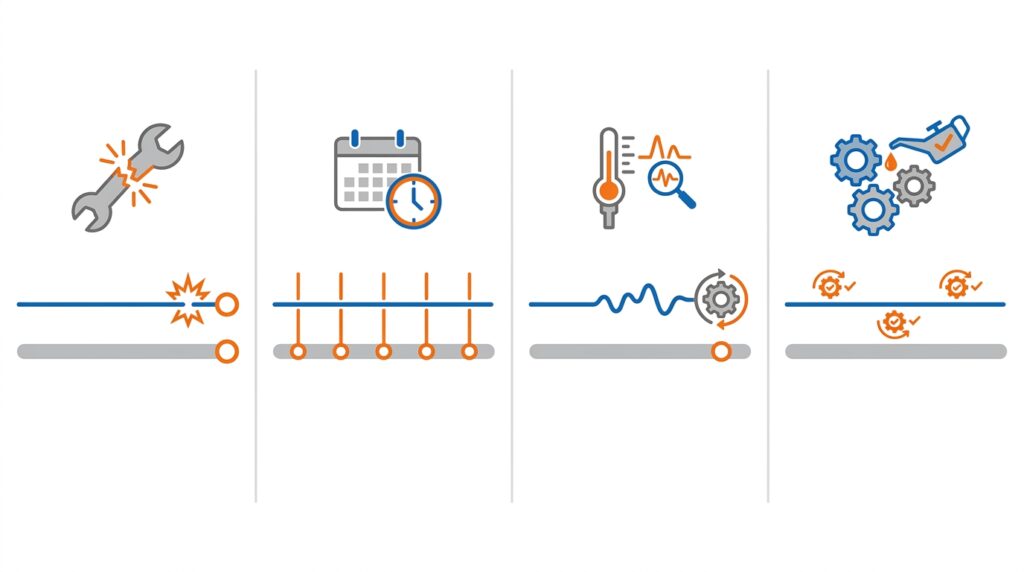
| Strategy | Description | When to Use |
|---|---|---|
| Reactive (run-to-failure) | Repair after failure | Non-critical, low-cost items with no safety or production consequence |
| Preventive | Scheduled maintenance at fixed intervals | Equipment with predictable, age-related wear |
| Predictive | Maintenance triggered by measured condition | Critical equipment where degradation can be detected before failure |
| Proactive | Root cause elimination, design improvements, and failure analysis | Recurring failures and chronic problem equipment |
In practice, a plant uses a mix of all four. Reliability-centered maintenance (RCM) is a structured way to choose the right approach for each asset, based on its functions, failure modes, and consequences.
Condition Monitoring
Condition monitoring is a key part of predictive maintenance.
| Technique | Detects | Application |
|---|---|---|
| Vibration analysis | Bearing wear, imbalance, misalignment | Rotating equipment |
| Thermography | Hot spots, electrical faults | Electrical panels, bearings |
| Oil analysis | Wear particles, contamination | Gearboxes, engines, turbines |
| Ultrasonic testing | Leaks, thickness loss | Piping, tanks, vessels |
| Performance monitoring | Efficiency loss, fouling | Heat exchangers, compressors |
Condition monitoring allows maintenance to be performed when needed, not on a fixed schedule. Baseline readings should be taken during commissioning so later trends have a reference.
For thermal power projects in Vietnam (Thai Binh 1, 2×300 MW) and Bangladesh (Bibiyana-III, 400 MW CCGT), condition monitoring was planned for critical equipment such as turbines, generators, and boiler feed pumps, with vibration and performance monitoring as key techniques.
Maintenance Management Systems and Asset Data
A maintenance strategy only works if it is managed. A computerized maintenance management system (CMMS) provides:
- Asset register: A structured list of equipment with tags, specifications, and criticality.
- Work management: Planned and corrective work orders, with history.
- Preventive maintenance schedules: Task lists and intervals tied to the asset register.
- Spare parts linkage: Parts linked to the equipment that uses them.
- Reporting: Maintenance cost, backlog, and failure history.
The best time to build the asset register is during the EPC phase, using engineering data, so the owner starts operation with a populated system instead of an empty one. Poor data quality at handover is one of the most common reasons CMMS implementations fail.
Spare Parts Management
Spare parts management ensures that parts are available when needed. Spares are usually grouped as:
- Commissioning and startup spares: Parts needed during commissioning and initial operation.
- Critical (insurance) spares: Parts that are expensive or have long lead times but would stop the plant if they failed.
- Operating spares: Parts expected to be used regularly, such as filters, seals, and belts.
- Consumables: Lubricants, chemicals, and filter media.
Other considerations include inventory levels and storage location, supplier contacts and part numbers, and standardization across equipment to reduce the range of spares held. Spares should be selected based on criticality, lead time, and failure consequence, not simply on vendor recommendations.
Spare parts should be in place before startup, not ordered after the first failure.
Safety in Operations and Maintenance
Most plant incidents occur during non-routine work, such as maintenance, startup, and shutdown. O&M engineering should therefore address safety directly:
- Permit to work: A controlled system for authorizing hazardous work.
- Isolation and lockout/tagout: Designed-in isolation points, with clear procedures for energy isolation.
- Confined space and work at height: Safe access provisions and procedures.
- Management of change: Controls on modifications so safety is not eroded over time.
- Emergency response: Procedures, drills, and equipment suited to the plant’s specific hazards.
Isolation points, drains, vents, and access platforms should be designed into the plant, because they are hard to add after construction.
Training
Training ensures that operations and maintenance staff are competent.
- Operations training: How to operate the plant, including startup, shutdown, and upsets.
- Maintenance training: How to maintain equipment.
- Safety training: How to work safely.
- Emergency training: How to respond to emergencies.
- Vendor training: Equipment-specific training from vendors.
Training should happen early enough that staff can take part in commissioning, which is the best hands-on learning opportunity available. Training is not complete until staff can demonstrate competency.
Documentation
Documentation provides the information needed to operate and maintain the plant.
- Operating procedures: How to operate the plant.
- Maintenance procedures: How to maintain equipment.
- Safety procedures: How to work safely.
- Equipment manuals: Vendor manuals and instructions.
- As-built drawings: Drawings reflecting actual construction.
- Spare parts lists: Recommended spares and supplier information.
Documentation must be complete, accurate, and accessible, and it needs a process for keeping it up to date after handover.
Operations Readiness and Handover
The transition from construction to operation is where many O&M problems begin. Operations readiness means that, before handover, the owner has:
- Trained and organized O&M staff in place.
- Procedures approved and available.
- Spare parts, tools, and consumables on site.
- The CMMS populated and ready to use.
- Safety systems and emergency procedures tested.
- A clear plan for post-handover support from the EPC contractor and vendors during warranty and initial operation.
Involving the O&M team during design, construction, and commissioning, not just at handover, gives the best results.
Performance Monitoring and Continuous Improvement
An O&M program should be measured and improved over time. Common indicators include:
- Availability and reliability: Percentage of time the plant or equipment is available.
- Planned vs. unplanned maintenance ratio: A high planned share indicates a healthy program.
- Maintenance backlog: Overdue work.
- Mean time between failures (MTBF) and mean time to repair (MTTR).
- Maintenance cost per unit of output.
- Safety indicators: Incidents and near misses.
Failures should be analyzed for root cause, and lessons fed back into procedures, spares, and strategy. Without this feedback loop, performance gradually degrades.
O&M Engineering in Small Plants
Small plants face particular challenges with O&M engineering:
- Fewer resources for O&M engineering.
- Less expertise.
- Less access to vendor support.
- Competing priorities.
Practical approaches:
- Focus on critical equipment: Prioritize O&M effort where failure matters most.
- Use vendor support: Leverage vendor support, including service agreements for specialized equipment.
- Build internal capability: Develop internal O&M skills over time.
- Use simple tools: Simple condition monitoring and maintenance planning are sufficient.
- Document decisions: Record the basis for O&M decisions.
- Learn from others: Apply lessons from other plants.
O&M engineering does not need to be complex. It needs to be thorough and practical.
Common Mistakes in O&M Engineering
Even experienced organizations make mistakes. Common ones include:
- Neglecting operability: Designing plants that are difficult to operate.
- Neglecting maintainability: Designing plants that are difficult to maintain.
- No maintenance strategy: Maintaining without a clear strategy.
- Ignoring condition monitoring: Missing early warning signs.
- Insufficient spare parts: Leading to extended downtime.
- Inadequate training: Staff unprepared for O&M.
- Poor documentation and asset data: Making O&M difficult.
- Involving O&M too late: Bringing operations staff in only at handover.
- No continuous improvement: Letting performance degrade over time.
These mistakes are costly to correct. They are much cheaper to avoid through disciplined O&M engineering.
How EPC Partners Inc. Approaches O&M Engineering
At EPC Partners Inc., we bring practical experience from projects across Asia, the Middle East, Africa, and Europe to O&M engineering. Our approach includes:
- Operability and maintainability focus: Both are considered during design, with input from operations and maintenance staff.
- Reliability focus: Equipment is selected for reliability in similar applications.
- Maintenance strategy: Strategies are defined for each equipment type.
- Condition monitoring: Monitoring is planned for critical equipment.
- Asset data and CMMS readiness: Engineering data is structured to support the owner’s maintenance system.
- Spare parts planning: Spare parts are planned before startup.
- Training and readiness: Training is provided for operations and maintenance staff, aligned with commissioning.
- Documentation: Documentation is complete and accessible.
Our experience includes supporting geothermal projects in Kenya, Ethiopia, Indonesia, Iceland, and Japan; desalination projects in the UAE, Saudi Arabia, Oman, and Qatar; thermal power projects in Vietnam, Bangladesh, and Japan; and water treatment projects in Vietnam, Kuwait, and Qatar.
We have also supported clients including Marubeni Corporation, Fuji Electric Co., Ltd., and Toyota Tsusho Corporation on O&M aspects of their projects.
How to Evaluate O&M Engineering Readiness
When reviewing O&M engineering, ask:
| Question | Why It Matters |
|---|---|
| Is operability considered during design? | Ensures plant can be operated safely and efficiently |
| Is maintainability considered during design? | Ensures plant can be maintained safely and efficiently |
| Is equipment selected for reliability? | Ensures equipment performs as required |
| Is a maintenance strategy defined? | Provides a roadmap for maintenance |
| Is condition monitoring planned? | Detects problems before failures |
| Is the asset register ready for the CMMS? | Lets maintenance start on day one |
| Are spare parts planned? | Ensures parts are available when needed |
| Are safe isolation and access provisions designed in? | Reduces risk during maintenance |
| Is training provided? | Ensures staff are competent |
| Is documentation complete? | Supports O&M |
| Are KPIs defined? | Allows performance to be tracked and improved |
A plant that addresses these questions is ready for reliable and efficient operation.
Conclusion
Operations and maintenance engineering is critical to plant success. For small to medium-scale industrial plants, it determines whether the plant delivers value over its life.
By focusing on operability, maintainability, reliability, maintenance strategy, condition monitoring, asset data, spare parts, safety, training, and documentation, owners and project teams can ensure that the plant can be operated and maintained safely, reliably, and efficiently.
If you are planning a plant project and need support with O&M engineering or EPC project delivery, contact us to discuss how we can help.
EPC Partners Inc. is a Japanese EPC support firm with experience supporting power, water, and industrial plant projects across Asia, the Middle East, Africa, and Europe. For more information, visit our project list.