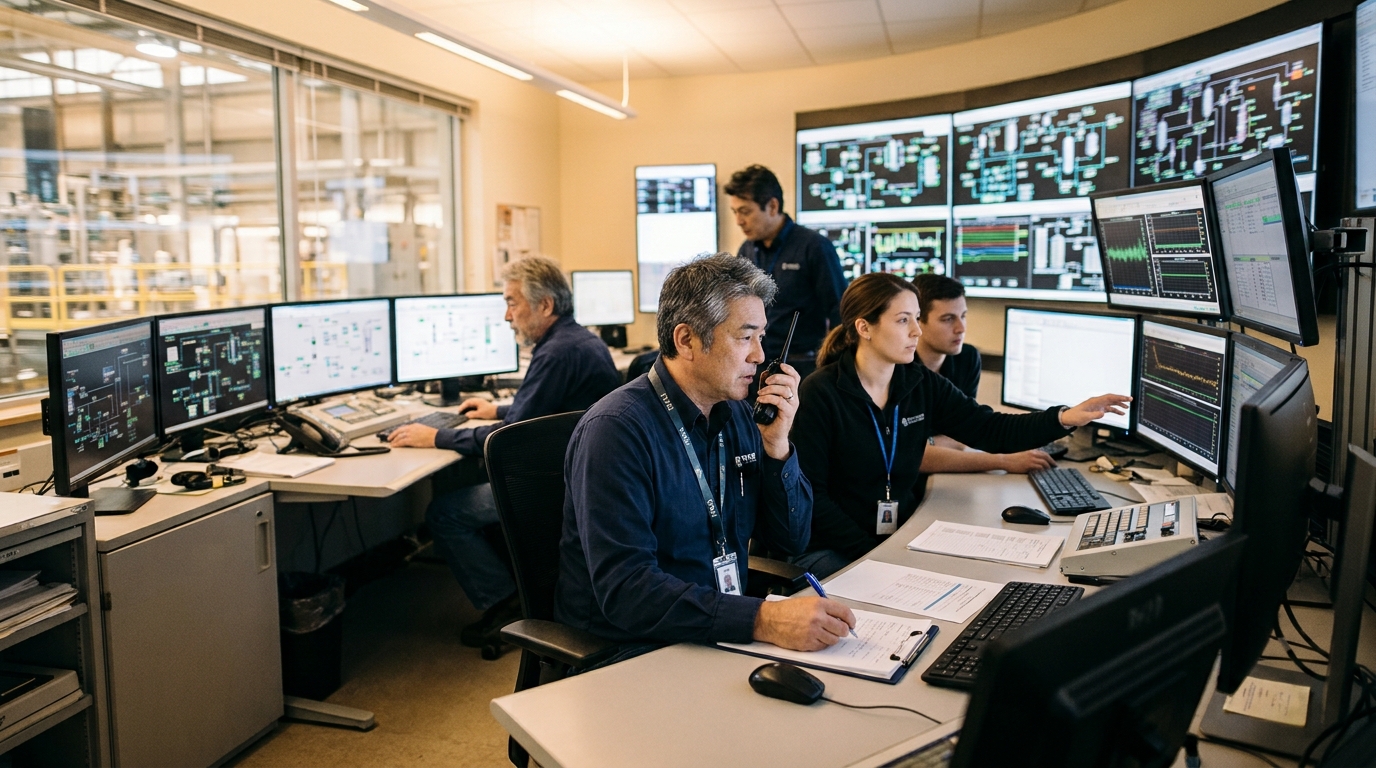
Commissioning is the bridge between construction and operation. It is the process of verifying that every system in the plant works as designed, that safety systems function correctly, and that the plant can operate reliably at its specified performance. A successful commissioning phase means the plant starts up smoothly, meets its performance guarantees, and is ready for handover to the owner’s operations team.
At EPC Partners Inc., commissioning engineering has been a core part of our work across a wide range of plant projects. Our commissioning work has ranged from geothermal steam system cleaning in Kenya and Indonesia, to steam blow and turbine roll for 2×300 MW thermal units in Vietnam and a 400 MW combined cycle plant in Bangladesh, to performance testing of some of the world’s largest desalination plants in the Gulf. We have also supported geothermal work in Iceland and water treatment plants in Vietnam and Kuwait. Each project has presented different challenges, and each has reinforced the same lesson: commissioning is not just a technical exercise. It is the final test of everything the project team has designed and built.
This article covers the key practices in plant commissioning engineering, drawing on our experience supporting projects across Asia, the Middle East, Africa, and Europe.
What Is Commissioning Engineering?
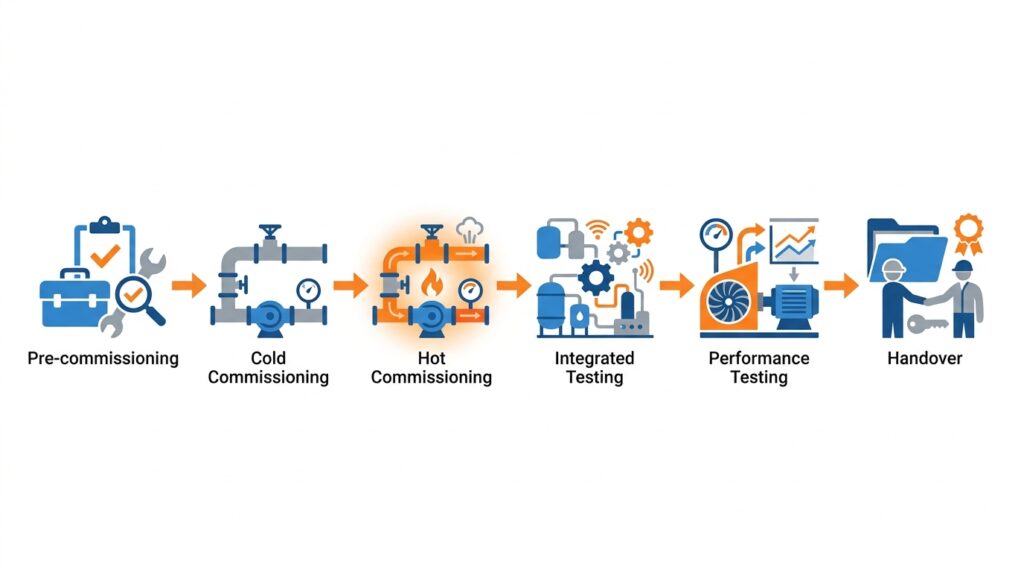
Commissioning engineering is the discipline of planning, executing, and verifying the commissioning of an industrial plant. It includes:
- Commissioning planning: Planning the sequence, resources, and schedule.
- Mechanical completion and system turnover: Formally releasing completed systems from construction to commissioning.
- Pre-commissioning: Static checks, cleaning, and preparation before energization or startup.
- Cold commissioning: Testing without process fluids or at ambient conditions.
- Hot commissioning: Testing with process fluids at operating conditions.
- Integrated testing: Testing interconnected systems under operating conditions.
- Performance testing: Verifying that the plant meets its contractual guarantees.
- Handover: Transferring the plant to the owner’s operations team.
Why Commissioning Engineering Matters
| Factor | Impact of Good Commissioning | Impact of Poor Commissioning |
|---|---|---|
| Safety | Systems verified safe before startup | Safety incidents during startup |
| Performance | Plant meets performance guarantees | Plant underperforms |
| Reliability | Systems function as designed | Early failures and downtime |
| Schedule | Startup on time | Delays from commissioning problems |
| Cost | Rework avoided | Rework and extended commissioning |
| Handover | Smooth transition to operations | Difficult handover |
Whatever the size of the plant, commissioning determines whether it starts up smoothly and meets its performance targets.
Commissioning Planning
Commissioning planning is the foundation of successful commissioning. Key activities:
- Define scope: Which systems will be commissioned?
- Define sequence: In what order? Utilities (power, water, air, cooling) usually come first, because everything else depends on them.
- Define organization: Who is responsible for what?
- Define schedule and resources: When, and with what people, tools, and temporary facilities?
- Define procedures: How will each system be commissioned?
- Define acceptance criteria: What defines success for each system?
Commissioning planning should begin during engineering and contract award, not at the end of construction. Early input lets commissioning needs (temporary connections, flushing points, access, system boundaries) be built into the design and the construction sequence.
Commissioning Organization
| Role | Responsibility |
|---|---|
| Commissioning Manager | Overall responsibility for commissioning |
| Commissioning Engineers | System-specific commissioning |
| Operations Representative | Operations input and readiness |
| Safety Representative | Safety oversight during commissioning |
| Vendor Representatives | Equipment-specific commissioning support |
| Contractor Representatives | Construction support during commissioning |
For small plants, roles may be combined, but the functions must still be covered.
Mechanical Completion and System Turnover
Commissioning works best when the plant is released from construction system by system, not all at once. Mechanical completion confirms that a defined system is built, inspected, and documented in accordance with the design.
Typical elements:
- System boundaries: The plant is divided into clearly defined systems (isolation points marked on P&IDs) so ownership is always clear.
- Inspection and test records: Completed records from construction (e.g., installation checks, welding and NDT, pressure tests, electrical insulation and continuity tests).
- Punch list categories: Items that must be closed before commissioning (Category A) versus items that can be closed later without affecting safety or operability (Category B).
- Formal turnover: A signed certificate transferring care, custody, and control of the system to the commissioning team.
Clear turnover prevents disputes over who is working on what, and keeps construction and commissioning activities from conflicting in the same area.
Pre-Commissioning
Pre-commissioning is the preparation phase before energization or startup. Activities:
- Static checks: Verifying that equipment is installed correctly.
- Cleaning and flushing: Removing debris and contaminants from systems.
- Pressure testing: Testing piping and vessels for strength and leak tightness.
- Instrument calibration and loop checks: Verifying instruments and signals from field device to control system.
- Safety system checks: Verifying that safety systems function correctly.
Pre-commissioning is often the most time-consuming phase. Rushing it leads to problems later.
At our geothermal projects in Kenya (Olkaria I Unit 6, 83 MW) and Indonesia (Muara Laboh, 85.2 MW), pre-commissioning included thorough cleaning of steam piping to remove construction debris and verify that the geothermal steam system was ready for startup. In Iceland (Theistareykir, 2×45 MW), pre-commissioning was adapted to the specific environmental conditions of the site.
Safety During Commissioning
Commissioning is one of the highest-risk periods in a project. New systems are being energized and pressurized while construction work may still be going on nearby.
Key practices:
- Permit-to-work and lock-out/tag-out: Strict control of who may work on which equipment, and when.
- Energization procedures: Formal procedures and clear communication before any high-voltage or medium-voltage energization, with defined exclusion zones.
- Segregation: Clear separation between live commissioned systems and areas still under construction.
- Safe-to-start checks: A documented readiness check before introducing steam, fuel, or other hazardous fluids.
- Emergency preparedness: Emergency response and communication arrangements in place before startup.
Cold Commissioning
Cold commissioning tests systems without process fluids or at ambient conditions. Activities:
- Motor rotation checks: Verifying correct direction.
- Pump and fan testing: Verifying operation without process load.
- Control loop testing: Verifying that loops respond correctly.
- Valve operation: Verifying that valves open, close, and modulate correctly.
- Interlock and trip testing: Verifying that safety interlocks function correctly.
- Electrical energization: Energizing transformers, switchgear, and distribution step by step, and confirming protection settings.
Cold commissioning verifies that systems work mechanically and electrically before introducing process fluids.
Hot Commissioning
Hot commissioning tests systems with process fluids at operating conditions. Activities:
- System startup: Starting individual systems and verifying operation.
- Process parameter verification: Confirming that temperature, pressure, flow, and other parameters meet design values.
- Control loop tuning: Tuning controllers for stable, responsive control.
- Equipment performance: Verifying that equipment operates within design parameters.
- Emissions checks: Confirming that emissions meet regulatory limits.
Hot commissioning is where many problems surface. It requires close coordination between the contractor, owner, and equipment vendors. For thermal power projects in Vietnam (Thai Binh 1, 2×300 MW) and Bangladesh (Bibiyana-III, 400 MW CCGT), hot commissioning included steam blow, turbine roll, and synchronization to the grid, with careful attention to steam chemistry and turbine protection systems. (Steam blow is sometimes treated as pre-commissioning, but it is performed with steam, so we describe it here.)
From the field. At one thermal power project in Vietnam, the steam blow and turbine roll were carefully sequenced to protect the turbine from debris and to verify the steam chemistry before synchronization. At another project in Bangladesh, the combined cycle plant was synchronized to the grid after a thorough commissioning sequence that included performance testing of the gas turbine and steam turbine.
Grid Connection and Grid Code Compliance
For power plants, synchronization is a milestone that depends on the grid operator as much as on the project team. Good practice:
- Agree the energization and synchronization schedule with the grid operator well in advance.
- Complete protection relay settings and coordination studies before first synchronization.
- Plan the grid code compliance tests (e.g., voltage and frequency response, reactive power capability, governor response) as part of the commissioning schedule.
Integrated Testing
Integrated testing verifies that interconnected systems work together under operating conditions. Activities:
- Full plant operation: Running the plant as a whole, not just individual systems.
- Load testing: Operating at various loads across the operating range.
- Transient testing: Testing response to load changes, trips, and other disturbances.
- Safety system verification: Verifying that safety systems work under realistic conditions.
This is where the plant is proven as a complete system, not just a collection of components.
Trial Operation and Reliability Run
Many contracts require a period of continuous operation before performance testing or taking over. The reliability run (or trial operation) shows that the plant can run stably over time, not just meet its numbers for a short test. Typical points to agree in advance: duration, permitted interruptions, operating conditions, who operates the plant, and what counts as a pass.
Performance Testing
Performance testing verifies that the plant meets its contractual performance guarantees. Activities:
- Output testing: Verifying the guaranteed output or capacity.
- Heat rate and efficiency testing: Verifying guaranteed efficiency.
- Emissions and water quality testing: Verifying guaranteed or regulatory limits.
- Availability and reliability: Some contracts require demonstration over a defined period.
Tests must follow the procedures in the contract, including reference conditions, test methods, correction curves, and measurement uncertainty. For power plants, recognized standards such as the ASME PTC series are commonly referenced, with the contract setting out which apply. Test procedures should be agreed with the owner well before the test, not on the day.
For desalination projects in the Gulf (Taweelah, 909,200 m³/day; Jubail 3A, 600,000 m³/day), performance testing included verification of production capacity, water quality, and energy consumption, with careful attention to the specific conditions of Gulf seawater.
Handover
Handover is the formal transfer of the plant from the contractor to the owner. Activities:
- Documentation: As-built drawings, equipment manuals, operating procedures, and maintenance schedules.
- Training: Training the owner’s operations and maintenance team (ideally during commissioning, not just before it).
- Spare parts: Delivering spare parts and consumables.
- Warranty documentation: Confirming warranty terms and procedures.
- Remaining punch items: An agreed list, owners, and dates for closing outstanding items.
- Formal acceptance: Signing off that the plant meets contractual requirements.
Incomplete handover documentation is a common source of problems in the first years of operation.
Commissioning Documentation
Key documents:
- Commissioning procedures: Procedures for each system.
- Commissioning records: Records of tests and results.
- Test certificates: Certificates for equipment and systems.
- Punch lists: Outstanding items.
- As-built drawings: Drawings reflecting actual construction.
- Operating procedures: Procedures for running the plant.
Documentation must be complete, accurate, and accessible.
Commissioning in Small Plants
Small plants face particular challenges: fewer resources, less in-house expertise, less access to vendor support, and competing priorities. Practical approaches:
- Plan early: Start during engineering.
- Use vendor support: Leverage vendors for equipment commissioning.
- Involve operations: Operations staff should take part.
- Document everything: Good records support handover and operations.
- Focus on critical systems: Prioritize safety-critical systems.
- Learn from others: Apply lessons from other plants.
Commissioning does not need to be complex. It needs to be thorough and well-planned.
Common Mistakes in Commissioning
- Insufficient pre-commissioning: Leading to problems during hot commissioning.
- Instrument calibration errors: Causing inaccurate readings and poor control.
- Control loop tuning problems: Causing instability or poor response.
- Equipment failures: Leading to delays and rework.
- Safety system issues: Requiring redesign or modification.
- Unclear system turnover: Construction and commissioning working in the same area.
- Documentation gaps: Making handover difficult.
- Schedule pressure: Leading to rushed testing and missed problems.
- No operator involvement: Operators unprepared for startup.
These mistakes are costly to correct and much cheaper to avoid through disciplined commissioning.
How EPC Partners Inc. Approaches Commissioning Engineering
At EPC Partners Inc., we bring practical experience from projects across Asia, the Middle East, Africa, and Europe. Our approach includes:
- Thorough planning: Clear procedures and acceptance criteria.
- Detailed preparation: Pre-commissioning completed thoroughly before startup.
- Disciplined execution: Commissioning in a controlled sequence.
- Comprehensive documentation: Complete and accurate records.
- Operator involvement: Operations staff involved to build familiarity.
- Safety focus: Safety prioritized throughout.
- Continuous improvement: Lessons captured and applied.
Our experience includes geothermal projects in Kenya, Ethiopia, Indonesia, Iceland, and Japan; desalination projects in the UAE, Saudi Arabia, Oman, and Qatar; thermal power projects in Vietnam, Bangladesh, and Japan; and water treatment projects in Vietnam, Kuwait, and Qatar. We have also supported clients including Marubeni Corporation, Fuji Electric Co., Ltd., and Toyota Tsusho Corporation on commissioning aspects of their projects.
How to Evaluate Commissioning Readiness
| Question | Why It Matters |
|---|---|
| Is there a commissioning plan? | Provides a roadmap |
| Are system boundaries and turnover defined? | Prevents overlap with construction |
| Is pre-commissioning thorough? | Prevents problems during hot commissioning |
| Are procedures prepared? | Defines how systems will be commissioned |
| Is the organization in place? | Ensures clear responsibilities |
| Are permit and safety controls in place? | Protects people and equipment |
| Are operators involved? | Builds familiarity and readiness |
| Are safety systems verified? | Ensures safe operation |
| Is grid or utility connection coordinated? | Avoids delays at synchronization |
| Is documentation complete? | Supports handover and operations |
| Is performance testing planned? | Verifies contractual guarantees |
| Is handover planned? | Ensures smooth transition |
A plant that can answer these questions is ready for successful commissioning.
Conclusion
Commissioning engineering is the bridge between construction and operation. It determines whether a plant starts up smoothly, meets its performance guarantees, and is ready for reliable operation. By focusing on planning, system turnover, pre-commissioning, cold and hot commissioning, integrated testing, performance testing, and handover, owners and project teams can ensure the plant is ready for safe and reliable operation.
EPC Partners Inc. is a Japanese EPC support firm with experience supporting power, water, and industrial plant projects across Asia, the Middle East, Africa, and Europe. If you are planning a plant project and need support with commissioning engineering or EPC project delivery, contact us to discuss how we can help. For more information, visit our project list.