By EPC Partners Inc. Engineering Team
Mechanical engineering is the heart of an industrial plant. It covers the equipment that drives the process (turbines, boilers, pumps, compressors, heat exchangers, and piping) and the systems that connect them. A plant’s mechanical design determines how efficiently it converts fuel or resources into output, how reliably it operates, and how maintainable it is over its life.
At EPC Partners Inc., mechanical engineering has been a core part of our work across a wide range of plant projects. These include geothermal power plants in Kenya, Indonesia, and Iceland; large-scale desalination facilities in the UAE and Saudi Arabia; thermal power plants in Vietnam and Bangladesh; and water treatment plants in Vietnam and Kuwait. Our support on mechanical engineering work has ranged from steam turbines for 83 MW geothermal units to high-pressure pumps for some of the world’s largest desalination plants. Each project has presented different mechanical challenges, and each has reinforced the same lesson: mechanical engineering is not just about selecting equipment. It is about designing systems that work together, reliably and efficiently, for decades.
This article covers the key practices in plant mechanical engineering, drawing on our experience supporting projects across Asia, the Middle East, Africa, and Europe.
What Is Plant Mechanical Engineering?
Plant mechanical engineering is the discipline of designing, specifying, and constructing the mechanical systems and equipment required for an industrial plant.
It includes:
- Rotating equipment: Turbines, compressors, pumps, and fans.
- Static equipment: Boilers, heat exchangers, pressure vessels, and tanks.
- Piping systems: Pipes, valves, fittings, and supports.
- Material handling: Conveyors, cranes, and lifting equipment.
- HVAC and ventilation: Heating, ventilation, and air conditioning systems.
- Fire protection: Pumps, sprinklers, and fire suppression systems.
Mechanical engineering provides the equipment and systems that convert resources into output.
Why Mechanical Engineering Matters
Mechanical engineering directly affects plant performance.
| Factor | Impact of Good Mechanical Engineering | Impact of Poor Mechanical Engineering |
|---|---|---|
| Performance | Equipment operates at design efficiency | Equipment underperforms |
| Reliability | Equipment runs reliably for years | Frequent failures and downtime |
| Cost | Lowest lifecycle cost | Higher capital and operating costs |
| Safety | Mechanical hazards controlled | Safety incidents |
| Maintainability | Equipment accessible for maintenance | Difficult and costly maintenance |
| Compliance | Meets codes and standards | Non-compliance |
For small to medium-scale industrial plants in particular, mechanical engineering often determines whether the plant can achieve its performance targets.
Key Mechanical Systems
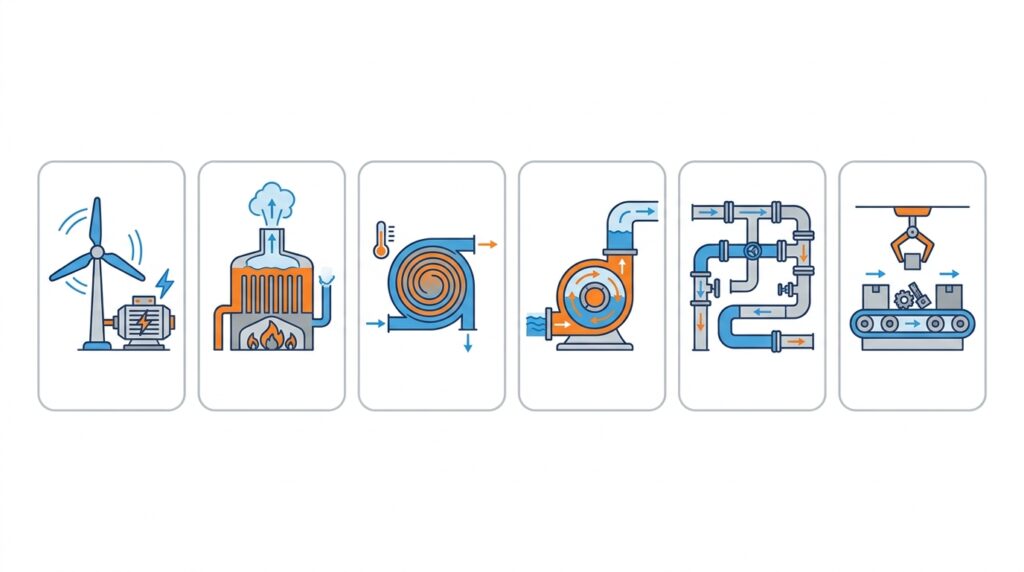
A typical industrial plant has several key mechanical systems.
| System | Description | Examples |
|---|---|---|
| Power generation | Equipment that produces electricity | Steam turbines, gas turbines, generators |
| Steam generation | Equipment that produces steam | Boilers, HRSGs |
| Heat transfer | Equipment that transfers heat | Heat exchangers, condensers, cooling towers |
| Fluid movement | Equipment that moves fluids | Pumps, compressors, fans |
| Piping | Systems that connect equipment | Process piping, utility piping |
| Material handling | Equipment that moves materials | Conveyors, cranes, hoists |
Each system must be designed to work with the others.
Rotating Equipment
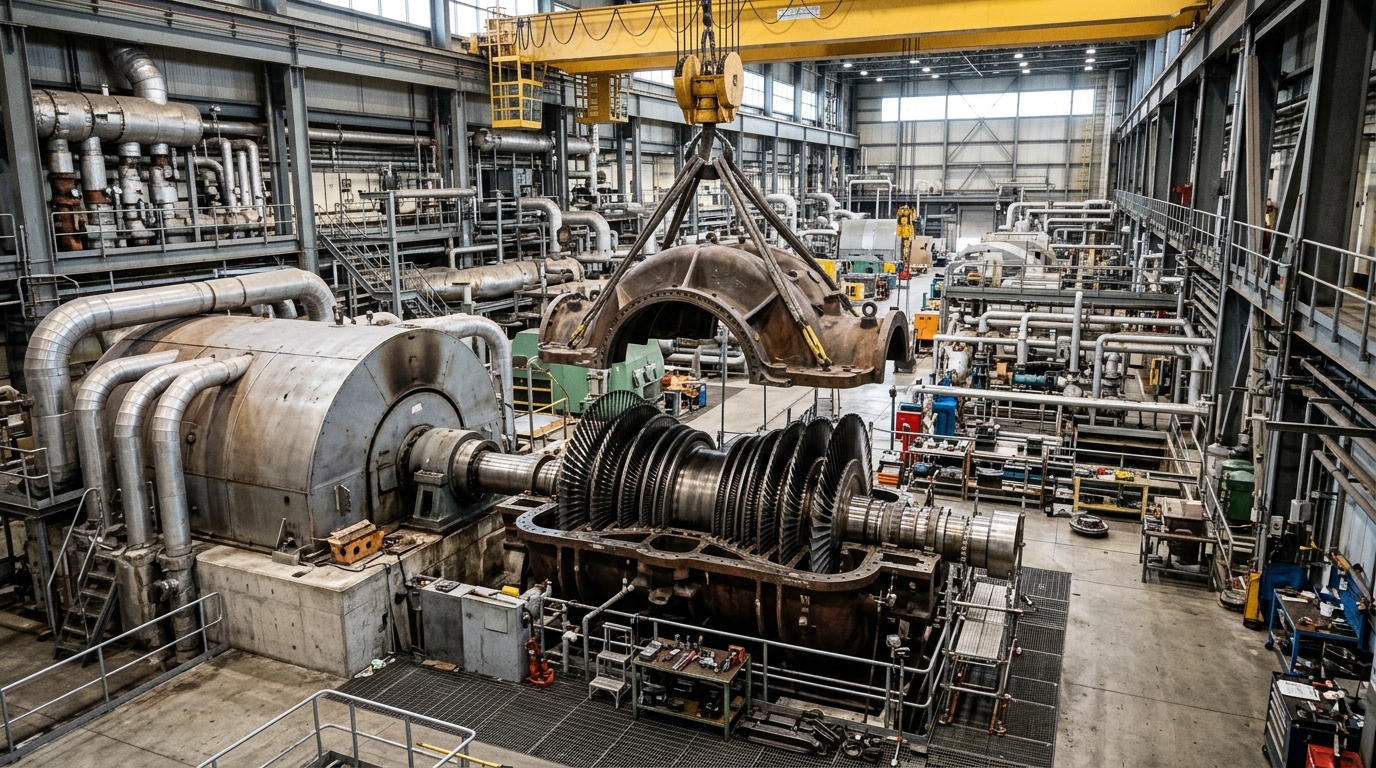
Rotating equipment is the core of many industrial plants.
Types:
- Turbines: Steam turbines, gas turbines, and expanders.
- Compressors: Centrifugal, axial, and reciprocating.
- Pumps: Centrifugal, positive displacement, and reciprocating.
- Fans: Centrifugal and axial.
Key considerations:
- Performance: Does the equipment meet flow, pressure, and efficiency requirements?
- Reliability: Is the equipment proven in similar applications?
- Maintenance: Can the equipment be maintained easily?
- Vibration and dynamics: Have rotor dynamics, foundations, and vibration limits been addressed?
- Vendor support: Is vendor support available?
- Spare parts: Are spare parts available?
At our geothermal projects in Kenya (Olkaria I Unit 6, 83 MW) and Indonesia (Muara Laboh, 85.2 MW), steam turbine selection and integration with the geothermal steam supply were critical to plant performance. In Iceland (Theistareykir, 2×45 MW), the turbines were designed to handle the specific steam conditions of the geothermal resource.
From the field: At one geothermal site in Indonesia, the steam turbine was designed to handle the specific pressure and non-condensable gas content of the resource. At another site in Kenya, the turbine selection considered the long-term degradation of the steam field and the need for flexibility in operation.
The lesson is that rotating equipment cannot be selected from a catalogue alone. The resource or process conditions, today and over the plant’s life, shape the right choice.
Static Equipment
Static equipment includes vessels, heat exchangers, boilers, and tanks.
| Equipment | Description | Examples |
|---|---|---|
| Pressure vessels | Containers for pressurized fluids | Separators, accumulators, reactors |
| Heat exchangers | Equipment for heat transfer | Shell-and-tube, plate, air-cooled |
| Boilers | Equipment for steam generation | Fire-tube, water-tube, HRSG |
| Tanks | Storage vessels for liquids | Atmospheric, pressurized |
Key considerations:
- Design codes: ASME, PED, or local codes.
- Materials: Compatible with process fluids.
- Thermal design: Adequate heat transfer area.
- Mechanical design: Adequate strength and stiffness.
- Corrosion allowance: Adequate allowance for corrosion.
- Nozzle loads and foundations: Loads from connected piping and the supporting structure are accounted for.
Piping Systems
Piping systems connect equipment and transport fluids.
Components:
- Pipe: The main conduit for fluids.
- Fittings: Elbows, tees, reducers, and flanges.
- Valves: Control, isolation, and relief valves.
- Supports: Pipe supports, hangers, and anchors.
- Insulation: Thermal and personnel protection.
Key considerations:
- Material selection: Compatible with fluids and conditions.
- Sizing: Adequate for flow and pressure drop.
- Layout: Efficient routing and accessibility.
- Support and flexibility: Adequate support, with stress analysis for thermal expansion and dynamic loads.
- Testing: Pressure testing and inspection.
For thermal power projects in Vietnam (Thai Binh 1, 2×300 MW) and Bangladesh (Bibiyana-III, 400 MW CCGT), main steam and reheat piping required careful design for high temperature and pressure. Material selection and stress analysis were critical to long-term reliability.
Pumps and Compressors
Pumps and compressors are essential for moving fluids.
| Pump Type | Description | Application |
|---|---|---|
| Centrifugal | Uses rotating impeller | Most common, wide range |
| Positive displacement | Traps and moves fluid | High pressure, viscous fluids |
| Reciprocating | Uses piston or plunger | High pressure, low flow |
| Compressor Type | Description | Application |
|---|---|---|
| Centrifugal | Uses rotating impeller | Large flow, moderate pressure |
| Axial | Uses rotating blades | Very large flow, lower pressure ratio |
| Reciprocating | Uses piston | High pressure, low flow |
Key considerations:
- Performance: Flow, head, and efficiency across the full operating range, not only at the design point.
- Suction conditions: Adequate NPSH for pumps, and surge and control margins for compressors.
- Reliability: Proven in similar applications.
- Maintenance: Accessibility for maintenance.
- Spare parts and vendor support: Availability over the plant’s life.
For desalination projects in the Gulf (Taweelah, 909,200 m³/day; Jubail 3A, 600,000 m³/day), high-pressure pumps and energy recovery devices were critical to plant efficiency and reliability. At this scale, a small efficiency gain in a pump or energy recovery device translates into a large reduction in lifetime energy cost.
Heat Exchangers
Heat exchangers transfer heat between fluids.
| Type | Description | Application |
|---|---|---|
| Shell-and-tube | Most common, wide range | Process heating and cooling |
| Plate | Compact, high efficiency | Clean fluids, moderate pressure |
| Air-cooled | Uses air for cooling | Where water is scarce |
| Condensers | Condense steam | Power plants |
Key considerations:
- Thermal design: Adequate heat transfer area.
- Mechanical design: Adequate pressure and temperature rating.
- Material selection: Compatible with fluids.
- Fouling: Resistance to fouling and ease of cleaning.
- Maintenance: Accessibility for cleaning and repair, including tube pull-out space.
Boilers and Steam Systems
Boilers and steam systems are central to many industrial plants.
Boiler types:
- Fire-tube: Hot gases pass through tubes surrounded by water.
- Water-tube: Water passes through tubes surrounded by hot gases.
- HRSG: Heat recovery steam generator, used in combined cycle plants.
Key considerations:
- Steam conditions: Pressure and temperature.
- Efficiency: Thermal efficiency and heat rate.
- Emissions: NOx, SOx, and particulate matter.
- Water treatment: Boiler feedwater quality.
- Safety: Relief valves and controls.
Material Handling, HVAC, and Fire Protection
These supporting systems are often treated as secondary, but they affect safety, operability, and construction.
- Material handling: Cranes and hoists should be sized for the heaviest maintenance lift, such as a turbine rotor or a large motor. Conveyors need to match throughput and material characteristics.
- HVAC and ventilation: Design must cover equipment heat loads, hazardous or corrosive atmospheres, and control room conditions.
- Fire protection: Pumps, piping, and suppression systems should be coordinated with the overall fire safety design and applicable codes.
Codes, Standards, and Materials
Every mechanical design rests on codes and standards. The right set depends on the project location, owner requirements, and equipment type, and should be agreed early. Typical references include:
- Pressure equipment: ASME Boiler and Pressure Vessel Code, PED (Europe), and local regulations.
- Piping: ASME B31 series.
- Rotating equipment: API standards for pumps, compressors, and turbines, plus relevant ISO and IEC standards.
- Heat exchangers: TEMA and API standards where applicable.
Materials deserve equal attention. Geothermal steam and brine can be corrosive, with chlorides and hydrogen sulfide in the mix. Seawater service in desalination calls for corrosion-resistant alloys. High-temperature steam piping demands creep-resistant steels. A material that is acceptable on a data sheet can fail early if it is not matched to actual service conditions.
The Mechanical Engineering Workflow
Mechanical engineering is not a single step. It runs through the project lifecycle:
| Stage | Key Mechanical Activities |
|---|---|
| Concept and feasibility | Technology options, preliminary sizing, cost estimates |
| Basic design / FEED | Heat and mass balance, equipment lists, data sheets, P&IDs, layout |
| Procurement | Technical bid evaluation, vendor selection, purchase specifications |
| Detailed design | Vendor drawing review, piping design and stress analysis, supports, interfaces |
| Fabrication | Inspection, witnessed factory tests, expediting |
| Construction | Installation, alignment, pressure testing, flushing and cleaning |
| Commissioning | Mechanical completion, run-in, performance verification, punch list |
| Handover | As-built documents, spare parts lists, operating and maintenance manuals |
Strong early work reduces rework later. A decision made at data sheet stage is far cheaper to change than one found during installation.
Vendor Documents, Inspection, and Testing
Selecting a good vendor is only the start. Quality depends on how the vendor’s work is reviewed and verified:
- Document review: Vendor drawings, calculations, and data sheets are checked against the specification and against other disciplines’ requirements.
- Inspection and test plans: Hold and witness points are defined for critical equipment.
- Factory acceptance tests: Performance, mechanical run, and vibration tests are witnessed where justified.
- Traceability: Material certificates and weld records are collected and verified.
- Transport and storage: Preservation and handling requirements are followed, since damage between factory and site is a common source of delay.
Design Reviews and Integration
Mechanical systems interact with civil, electrical, and instrumentation and control (I&C) work. Good integration practices include:
- Interface management: Foundation loads, cable and instrument connections, and utility tie-ins are defined and tracked.
- 3D model reviews and clash checks: Problems are found on screen, not at site.
- HAZOP and safety reviews: Mechanical hazards, relief cases, and failure scenarios are examined.
- Constructability and maintainability reviews: Construction and maintenance teams confirm that equipment can be installed, accessed, and removed.
- Operating mode review: Startup, shutdown, part-load, and upset conditions are considered, not just steady-state operation.
Installation and Mechanical Completion
Good design can be undone by poor installation. Key activities include:
- Alignment and grouting: Rotating equipment aligned to tolerance and properly grouted.
- Piping erection: Verified against stress analysis, with spring supports and temporary restraints correctly set and released.
- Cleanliness: Flushing, chemical cleaning, or steam blowing as required, especially for turbine steam systems.
- Pressure testing: Hydrotests or pneumatic tests per code.
- Mechanical completion: Systematic checks and documented punch lists before handover to commissioning.
Mechanical Engineering in Small Plants
Small plants face particular challenges with mechanical engineering.
Challenges:
- Fewer resources for mechanical engineering.
- Less in-house expertise.
- Less access to vendor information.
- Competing priorities.
Practical approaches:
- Focus on proven equipment: Reduce risk by using proven equipment.
- Use vendor information: Leverage vendor data and references.
- Seek expert advice: Get advice from consultants or experienced colleagues.
- Visit operating plants: See equipment in operation.
- Involve operations and maintenance: Use the experience of the people who will run the plant.
- Document decisions: Record the basis for decisions.
- Consider lifecycle cost: Look beyond capital cost.
Mechanical engineering does not need to be complex. It needs to be thorough and practical.
Common Mistakes in Mechanical Engineering
Even experienced organizations make mistakes. Common ones include:
- Selecting on capital cost alone: Ignoring operating and lifecycle costs.
- Ignoring site conditions: Selecting equipment that does not suit the site, such as ambient temperature, altitude, or water quality.
- Undersizing equipment: Insufficient capacity for actual conditions.
- Oversizing equipment: Unnecessary cost and inefficiency.
- Ignoring maintenance access: Equipment that cannot be maintained.
- Poor material selection: Corrosion or failure.
- No vendor support: Difficulty obtaining spare parts or support.
- Ignoring integration: Equipment that does not work with other systems.
- Weak vendor document review: Errors that surface only at site.
- No documentation: Not recording the basis for decisions.
These mistakes are costly to correct. They are much cheaper to avoid through disciplined mechanical engineering.
How EPC Partners Inc. Approaches Mechanical Engineering
At EPC Partners Inc., we bring practical experience from projects across Asia, the Middle East, Africa, and Europe to mechanical engineering.
Our approach includes:
- Thorough evaluation: Equipment is evaluated carefully against technical, commercial, and lifecycle criteria.
- Proven technology: Proven equipment is preferred over unproven.
- Integration focus: Equipment is evaluated for how well it integrates with other systems.
- Operations and maintenance input: The people who will run the plant are involved in decisions.
- Vendor evaluation: Vendors are evaluated for experience, support, and spare parts availability.
- Rigorous review and inspection: Vendor documents are reviewed and critical equipment is inspected and tested.
- Detailed documentation: The mechanical design and selection process is documented.
- Long-term focus: Equipment is selected for long-term reliability.
Our experience includes supporting geothermal projects in Kenya, Ethiopia, Indonesia, Iceland, and Japan; desalination projects in the UAE, Saudi Arabia, Oman, and Qatar; thermal power projects in Vietnam, Bangladesh, and Japan; and water treatment projects in Vietnam, Kuwait, and Qatar.
We have also supported clients including Marubeni Corporation, Fuji Electric Co., Ltd., and Toyota Tsusho Corporation on mechanical engineering aspects of their projects.
How to Evaluate Mechanical Engineering Readiness
When reviewing mechanical engineering, ask:
| Question | Why It Matters |
|---|---|
| Are requirements clearly defined? | Defines what the equipment must do |
| Have all equipment options been identified? | Ensures no option is overlooked |
| Is equipment evaluated against clear criteria? | Ensures consistent evaluation |
| Is lifecycle cost considered? | Ensures total cost is considered |
| Is reliability assessed? | Accounts for equipment reliability |
| Are codes, standards, and materials defined for the actual service? | Prevents non-compliance and early failure |
| Is maintenance access considered? | Ensures equipment can be maintained |
| Is vendor support evaluated? | Ensures support is available |
| Is integration assessed? | Ensures equipment works with other systems |
| Are vendor documents reviewed and critical equipment inspected? | Catches errors before they reach site |
| Is the design documented? | Ensures transparency |
A plant that addresses these questions is ready for sound mechanical engineering.
Key Takeaways
- Select equipment for lifecycle performance, not capital cost alone.
- Match equipment and materials to actual site and resource conditions, today and over the plant’s life.
- Prefer proven technology, and verify vendor support and spare parts.
- Design for maintenance access from the start.
- Review vendor documents and inspect critical equipment.
- Involve operations and maintenance teams early.
- Document the basis for decisions.
Conclusion
Mechanical engineering is the heart of every industrial plant. For small to medium-scale industrial plants especially, it determines whether the plant can achieve its performance targets, reliably and economically.
By focusing on rotating equipment, static equipment, piping systems, pumps and compressors, heat exchangers, and boilers, and by managing codes, materials, vendors, and installation with discipline, owners and project teams can ensure that the mechanical systems support the plant throughout its life.
If you are planning a plant project and need support with mechanical engineering or EPC project delivery, contact us to discuss how we can help.
EPC Partners Inc. is a Japanese EPC support firm with experience supporting power, water, and industrial plant projects across Asia, the Middle East, Africa, and Europe. For more information, visit our project list.