Tag: Risk Assessment

  • Plant Technology Selection: Key Practices for EPC Projects

    Plant Technology Selection: Key Practices for EPC Projects

    By the EPC Partners Inc. Engineering Team

    Technology selection is one of the most consequential decisions in an industrial plant project. The technology chosen determines how the plant works, how efficient it is, how reliable it is, and how much it costs to build and operate. A good choice can deliver decades of reliable, efficient operation. A poor one can lead to underperformance, high costs, and constant problems.

    At EPC Partners Inc., we have supported technology evaluation and selection across a wide range of plant types: geothermal power plants in Kenya, Ethiopia, Indonesia, Iceland, and Japan; desalination facilities in the UAE, Saudi Arabia, Oman, and Qatar; thermal power plants in Vietnam, Bangladesh, and Japan; and water treatment plants in Vietnam, Kuwait, and Qatar. Each project has presented different options and different constraints, and each has reinforced the same lesson: the best technology is not the most advanced one. It is the one that best fits the plant, the site, and the owner’s long-term needs.

    This matters most for small to medium-scale industrial plants, where there is less margin for error. A technology that is unsuitable for the plant’s scale, fuel, or operating conditions can be difficult and expensive to fix after construction.

    This article explains the key practices in plant technology selection, from defining requirements to evaluating options and confirming the decision, drawing on our experience in Asia, the Middle East, Africa, and Europe.

    What Is Technology Selection?

    Technology selection is the structured process of choosing the technology a plant will use. It has six steps:

    1. Define requirements: what the technology must do.
    2. Identify options: which technologies are available.
    3. Screen options: which options meet the minimum requirements.
    4. Evaluate options: how the remaining options compare in detail.
    5. Select technology: which option is best overall.
    6. Confirm selection: whether the chosen technology is suitable once contract terms, risks, and stakeholder views are considered.

    The process should be transparent and documented, so that anyone can later see why a technology was chosen.

    Why Technology Selection Matters

    Technology selection directly affects plant performance.
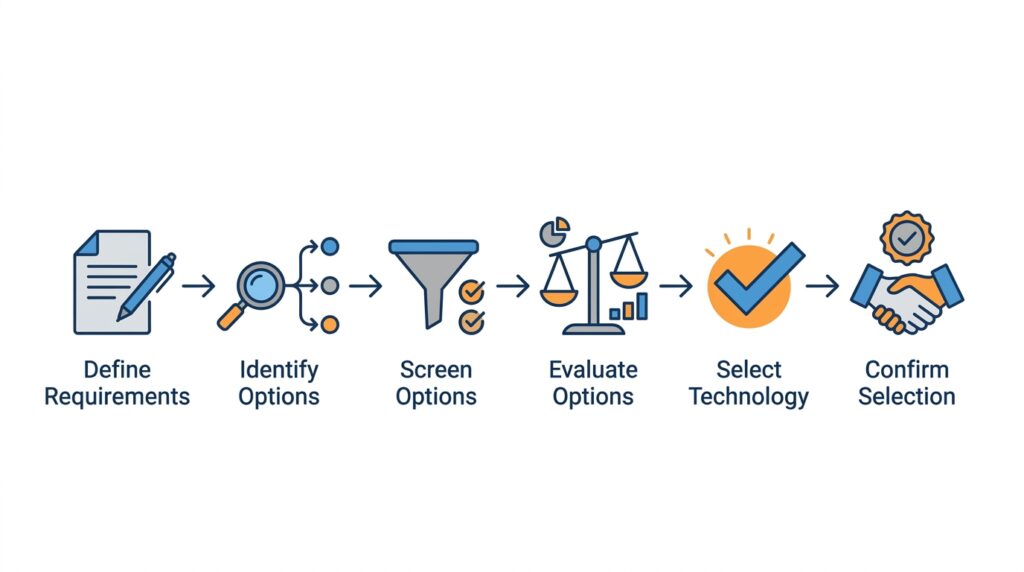
    Technology selection process for industrial plant projects

    Factor Good Technology Selection Poor Technology Selection
    Performance Technology meets requirements Technology underperforms
    Reliability Technology proven and reliable Frequent failures
    Cost Lowest lifecycle cost Higher capital and operating costs
    Schedule Technology available and proven Delays and rework
    Compliance Technology meets regulations Non-compliance
    Safety Hazards understood and controlled Unmanaged process and equipment hazards
    Flexibility Technology adapts to changing needs Technology becomes obsolete

    For small plants, technology selection often decides whether the plant performs as required.

    When Technology Selection Happens

    Technology selection is not a single event. It progresses through project phases, with increasing detail and commitment.

    Phase Technology Selection Activity
    Feasibility study Screen broad technology families; confirm that a viable option exists
    Pre-FEED / FEED Narrow to a preferred technology; define performance and interface basis
    Bidding and contract award Confirm vendor, guarantees, and technical scope
    Detailed engineering Confirm integration, design details, and final equipment data

    The earlier the decision, the greater its influence on cost and performance, and the more expensive it is to reverse. Time spent on selection in the early phases is among the best-value effort in the whole project.

    On geothermal projects such as Olkaria I Unit 6 in Kenya (83 MW) and Muara Laboh in Indonesia (85.2 MW), technology selection begins during feasibility and is refined through FEED. The characteristics of the geothermal resource, namely steam quality, pressure, and non-condensable gas content, drive the choice of turbine and surface equipment.

    Step 1: Define Requirements

    Requirements describe what the plant needs, before any technology is considered. They should be specific, measurable, and achievable.

    Category Examples
    Performance Output, efficiency, emissions
    Fuel or resource Type, quality, availability
    Operating conditions Temperature, pressure, load profile
    Reliability Availability, maintenance requirements
    Compliance Regulatory and permit requirements
    Site Conditions, space, utilities
    Safety and environment Hazard exposure, environmental limits
    Cost Capital and operating cost
    Schedule Delivery and construction time

    It helps to separate mandatory requirements (must be met, or the option is eliminated) from desirable requirements (add value but are not essential). This distinction drives screening and evaluation later.

    Technical Requirements

    Technical requirements define what the technology must achieve: capacity, efficiency, emissions limits, the fuels or resources it must handle, the expected load profile, required turndown, reliability targets, and whether capacity must be expandable later. They should be based on the plant’s actual needs, not aspirational targets. A plant that will run at steady base load has very different needs from one that must follow a variable load.

    Commercial Requirements

    Commercial requirements set the financial and contractual limits: capital budget, acceptable operating cost, target lifecycle cost, available financing (and what lenders will require of the technology), the date the plant must be operating, and the level of risk the owner can accept. They should be realistic and aligned with the project’s objectives.

    Step 2: Identify Technology Options

    Options should be identified broadly before narrowing down. Useful sources include industry knowledge of similar plants, vendor information, technical literature, visits to operating plants, independent consultants, and trade shows. Using several sources reduces the risk of overlooking a good option or relying on a single vendor’s view of the market.

    Step 3: Screen Options

    Screening removes options that fail the mandatory requirements.

    Criterion Question
    Technical suitability Does the technology meet technical requirements?
    Commercial suitability Does it meet commercial requirements?
    Regulatory suitability Does it meet regulatory requirements?
    Availability Can it actually be supplied for this project?
    Maturity Is it proven (see TRL below)?

    Screening should use objective criteria, not preference. Record each eliminated option together with the reason, so the decision can be explained later.

    Technology Readiness Level (TRL)

    Technology readiness level (TRL) is a scale from 1 to 9 that indicates how mature a technology is, from basic research (TRL 1) to proven in operation (TRL 9). For industrial plants, TRL 8 or 9 is generally preferred.

    TRL Description
    1–2 Basic principles observed; concept formulated
    3–4 Proof of concept; laboratory validation
    5–6 Validation and demonstration in a relevant environment (pilot or prototype)
    7 Prototype demonstrated in an operational environment
    8 System complete and qualified
    9 System proven in successful operation

    A technology at TRL 5 or 6 may be promising, but it carries performance, schedule, and cost risks that a small plant is rarely positioned to absorb. TRL should be assessed for the technology at the scale and in the application proposed. A technology proven at large scale is not necessarily proven at small scale, and one proven on one fuel is not necessarily proven on another.

    Reference Plants

    Reference plants (operating plants using the same technology) provide valuable evidence of performance, reliability, and support. Visiting reference plants and speaking with their operators is one of the most effective ways to evaluate technology.

    When assessing a reference plant, consider:

    • Similarity: are the scale, fuel, and operating conditions comparable to the proposed plant?
    • Operating history: how long has it operated, and what are its actual availability and efficiency?
    • Problems and fixes: what issues have occurred, and how were they resolved?
    • Vendor support: how did the vendor respond when problems arose?
    • Independence: where possible, speak with operators without the vendor present.

    Vendor reference lists naturally highlight the best installations. Asking for the complete list, including the oldest and least successful, gives a more balanced picture. In our experience on geothermal projects in Kenya, Indonesia, and Iceland, speaking directly with operators has often revealed practical issues that vendor literature does not mention.

    Step 4: Evaluate Options

    Evaluation compares the remaining options in detail.

    Criterion Key Question
    Technical performance How well does it meet performance requirements?
    Reliability and maturity How proven and reliable is it?
    Capital cost What is the cost to acquire and install?
    Operating cost What are fuel, power, consumable, and labor costs?
    Lifecycle cost What is the total cost over the plant’s life?
    Compliance Does it meet regulations?
    Safety and environment What hazards and environmental impacts does it bring?
    Schedule Can it be delivered on time?
    Integration How well does it fit existing systems?
    Flexibility Can it adapt to changing needs?
    Vendor support Is support available over the plant’s life?

    The relative importance of each criterion depends on the project. Criteria and weights should be defined before evaluation begins and applied consistently. Defining them after seeing vendor proposals invites bias, whether intentional or not.

    Evaluation Methods

    Method Description When to Use
    Scoring matrix Score options against weighted criteria Most evaluations
    Lifecycle costing Compare lifecycle costs When cost is a key criterion
    Risk assessment Assess risks of each option When risk is significant
    Sensitivity analysis Test how results change When uncertainty is high
    Benchmarking Compare against similar plants When data is available

    In practice, methods are combined: a scoring matrix for the overall comparison, lifecycle costing for the cost criterion, and sensitivity analysis to test whether the ranking holds up.

    Scoring Matrix
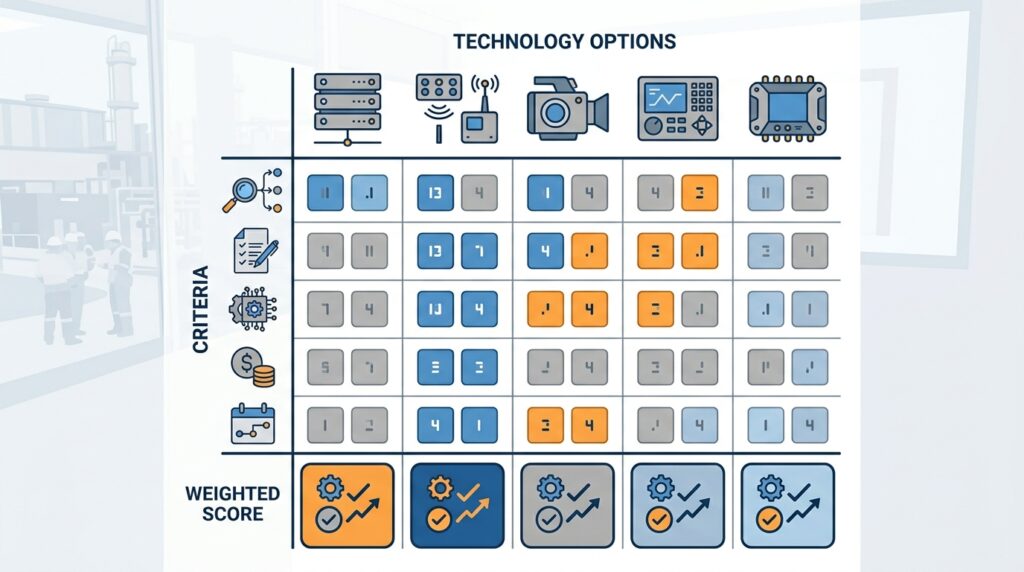
    Technology evaluation scoring matrix for industrial plant projects

    A scoring matrix is the most common evaluation method. The steps are:

    1. Define criteria: decide what will be assessed.
    2. Assign weights: reflect each criterion’s importance. Weights should total 100%.
    3. Score options: rate each option against each criterion (for example, 1 to 5).
    4. Calculate weighted scores: multiply each score by its weight and sum.
    5. Rank options: the highest total is the leading option.
    6. Test the result: check whether the ranking changes if weights or scores change.

    An illustrative example (values are for demonstration only):

    Criterion Weight Option A Option B Option C
    Technical performance 25% 4 5 3
    Reliability / maturity 25% 5 3 4
    Lifecycle cost 25% 3 4 4
    Compliance and safety 10% 4 4 4
    Vendor support 10% 5 3 3
    Schedule 5% 4 3 4
    Weighted score 100% 4.10 3.85 3.65

    For Option A, the calculation is (0.25 × 4) + (0.25 × 5) + (0.25 × 3) + (0.10 × 4) + (0.10 × 5) + (0.05 × 4) = 4.10.

    Scoring matrices make evaluation transparent and consistent. Their weakness is that a good average can hide a critical weakness, so mandatory requirements should be handled in screening (pass or fail), not traded off in the scores.

    Lifecycle Costing

    Lifecycle costing compares the total cost of each option over its life:

    • Capital cost: acquisition and installation.
    • Operating cost: fuel, power, and consumables.
    • Maintenance cost: inspection, repair, and replacement.
    • Downtime cost: lost production.
    • Decommissioning cost: shutdown and disposal.

    Fuel price, plant utilization, and discount rate are often the assumptions with the largest influence on the result. An option with higher capital cost frequently wins on lifecycle cost, which is why selecting on capital cost alone is a common mistake. Lifecycle cost estimates should use realistic assumptions and be tested with sensitivity analysis.

    Sensitivity Analysis

    Sensitivity analysis tests how robust the result is. If the preferred option changes when a key assumption (fuel price, efficiency, availability, or a criterion weight) moves within a realistic range, the decision is fragile and deserves more scrutiny. If the ranking stays the same, confidence in the decision is much higher.

    Technology Risk Assessment

    Risk assessment identifies and evaluates the risks of each technology, including their likelihood and impact, and identifies mitigation measures such as performance guarantees, pilot testing, or vendor support commitments.

    Risk Description
    Technical risk Technology may not perform as expected
    Maturity risk Technology may be unproven
    Scale-up risk Performance proven at one scale may not hold at another
    Vendor risk Vendor may not deliver or support
    Regulatory risk Technology may not meet regulations
    Obsolescence risk Technology may become obsolete
    Integration risk Technology may not integrate with other systems
    Operability risk Technology may be too complex for available staff

    Technology Integration

    Technology integration considers how the new technology will interface with existing systems: control systems, utilities, and infrastructure. Integration risks should be assessed as part of technology selection. Key questions:

    • Control systems: is the technology compatible with the plant control system and communication protocols?
    • Utilities: can existing utilities (power, water, steam, compressed air) supply it?
    • Infrastructure: does the site have the space, foundations, and access it needs?
    • Existing equipment: does it work with existing equipment in brownfield projects?
    • Interfaces: who is responsible for each interface between suppliers?

    A technology that performs well on its own but integrates poorly can still fail to deliver the plant’s required performance.

    Role of Operations and Maintenance

    Operations and maintenance personnel should be involved in technology selection. Their experience with existing equipment can identify practical issues (maintainability, spare parts, and operating complexity) that may not be visible to engineers. They can answer questions such as:

    • Can equipment be accessed and repaired safely and quickly?
    • Are spare parts available locally, and at what lead time and cost?
    • Can the available staff operate the technology reliably?
    • What training is needed, and is the necessary skill base available?
    • What has worked or failed in similar equipment already on site?

    The people who will run the plant for decades should have a voice in choosing it.

    Proven Technology vs. Innovation

    A key decision is whether to use proven or innovative technology.

    Aspect Proven Technology Innovative Technology
    Risk Lower Higher
    Performance Known Potentially better
    Cost Known Uncertain
    Support Widely available Limited
    Schedule Predictable Uncertain
    Financing Easier to finance May require extra guarantees or lender comfort

    For small plants, proven technology is often the safer choice. If innovative technology is considered, risk can be reduced through pilot or demonstration testing, strong performance guarantees, a fallback option, and contingency in cost and schedule.

    An Illustrative Example: Choosing a Geothermal Power Conversion Technology

    The following simplified example shows how requirements drive technology choice. It is illustrative, not a description of a specific project.

    A geothermal developer must choose between a flash steam plant and a binary (organic Rankine cycle) plant. The requirements and resource data point in different directions:

    • Resource temperature: high-temperature reservoirs generally suit flash steam plants, while lower-temperature resources often suit binary plants.
    • Non-condensable gases: a high gas content increases the power needed to remove gas from the condenser in a flash plant, which reduces net output. A binary plant keeps the geothermal fluid in a closed loop, which can reduce emissions and gas-handling issues.
    • Brine chemistry: scaling and corrosion tendencies affect heat exchanger and piping design.
    • Cooling: water availability or ambient temperature affects cooling system choice and output.
    • Reference plants: the team visits operating plants with similar resources to compare real availability and maintenance experience.

    A scoring matrix and lifecycle cost comparison are then tested with sensitivity analysis on resource performance and gas content. The lesson is that resource data, not vendor preference, should lead the decision, and that measured field data should be available before the technology is fixed.

    Vendor Evaluation

    Vendor evaluation is an important part of technology selection. Assess:

    • Experience: has the vendor supplied similar technology at similar scale?
    • References: what do previous customers say?
    • Financial strength: is the vendor stable enough to honor warranties?
    • Support and spare parts: is service and parts supply available locally and over the plant’s life?
    • Training: does the vendor train operators and maintenance staff?
    • Guarantees: what performance guarantees and warranties will the vendor commit to?

    On geothermal and thermal projects, we have seen that strong vendor support, particularly for specialized equipment such as turbines and control systems, can make the difference between a smooth project and a difficult one.

    Performance Guarantees and Contract Terms

    Technology selection should be linked to the contract. Claims made during evaluation (efficiency, availability, emissions, output) should become measurable guarantees with defined test methods and consequences, such as liquidated damages, for shortfalls. A technology advantage that is not backed by a guarantee is only a promise.

    Confirming and Documenting the Decision

    Before final approval, confirm the selection through five reviews:

    • Technical review: does the technology meet all requirements?
    • Commercial review: is the commercial case sound?
    • Risk review: are the risks acceptable?
    • Stakeholder review: do stakeholders agree?
    • Contract review: are the contract terms acceptable?

    Then document the decision in a technology selection report. It should capture the requirements, options considered, screening results, evaluation method and scores, risk assessment, assumptions, and the reasons for the final choice. This record protects the project when questions arise later, helps new team members understand the basis of design, and supports lessons learned on future projects.

    Technology Selection in Small Plants

    Small plants face particular challenges: fewer resources for evaluation, less in-house expertise, less access to vendor information, and competing priorities. Practical approaches include:

    • Focus on proven technology to reduce risk.
    • Use vendor data and references, but verify them independently.
    • Seek expert advice from consultants or experienced colleagues.
    • Visit operating plants to see the technology in service.
    • Involve operations and maintenance early.
    • Document decisions so the basis is on record.
    • Consider lifecycle cost, not just capital cost.

    Technology selection does not need to be complex. It needs to be thorough and honest.

    Common Mistakes in Technology Selection

    Even experienced organizations make mistakes. Common ones include:

    • Selecting on capital cost alone, ignoring operating and lifecycle costs.
    • Choosing unproven technology and taking excessive risk.
    • Ignoring site conditions or fuel quality, so the technology does not suit the plant.
    • Ignoring regulatory requirements, so the technology cannot meet them.
    • Having no evaluation criteria, or setting criteria after seeing proposals.
    • Ignoring scale, assuming performance at one scale applies at another.
    • Ignoring integration with existing systems.
    • Excluding operations and maintenance and missing practical issues.
    • Not documenting the decision.
    • Rushing the selection, leaving insufficient time for thorough evaluation.
    • Ignoring vendor support.

    These mistakes are costly to correct. They are much cheaper to avoid through disciplined technology selection.

    How EPC Partners Inc. Approaches Technology Selection

    Our approach is built on a few principles:

    • Resource and site data first: requirements come from measured conditions, not assumptions.
    • Clear criteria set in advance: weights are agreed before proposals are reviewed.
    • Preference for proven technology where reliability is the priority.
    • Lifecycle focus: operating, maintenance, and downtime costs are considered alongside capital cost.
    • Evidence from operating plants: reference visits and operator interviews.
    • Documented decisions: a selection report that others can review.

    These principles reflect our work supporting power, water, and industrial plant projects across Asia, the Middle East, Africa, and Europe.

    How to Evaluate Technology Selection Readiness

    When reviewing a technology selection, ask:

    Question Why It Matters
    Are requirements clearly defined? Defines what the technology must do
    Have all options been identified? Ensures none is overlooked
    Is technology maturity (TRL) assessed? Avoids unproven technology
    Have reference plants been visited or consulted? Provides evidence of real performance
    Are options evaluated against criteria set in advance? Ensures consistent evaluation
    Is lifecycle cost considered? Ensures total cost is understood
    Is risk assessed, including integration? Accounts for uncertainty
    Have operations and maintenance been involved? Captures practical experience
    Is vendor support evaluated? Ensures support is available
    Are guarantees defined in the contract? Turns claims into commitments
    Is the selection documented and confirmed? Ensures transparency and suitability

    A project that can answer these questions is ready for sound technology selection.

    Frequently Asked Questions

    What is the first step in selecting plant technology? Define the requirements: performance, fuel or resource, operating conditions, reliability, compliance, site, cost, and schedule. Without clear requirements, options cannot be compared fairly.

    What TRL should an industrial plant technology have? TRL 8 or 9 is generally preferred, meaning the system is complete and qualified or proven in operation. Lower TRLs add risk that most plant owners, especially of small plants, are not positioned to absorb.

    Should we choose the cheapest technology? Not on capital cost alone. Operating, maintenance, and downtime costs over the plant’s life often outweigh the initial price difference, so lifecycle cost should be compared.

    How important are reference plants? Very. They show real availability, efficiency, and maintenance experience. Visit them and talk to operators where possible.

    Who should be involved in the decision? Engineers, commercial and project staff, and the operations and maintenance personnel who will run the plant, with input from independent experts where in-house experience is limited.

    Conclusion

    Technology selection is critical to plant success. For small to medium-scale industrial plants, it determines whether the plant performs as required, reliably and economically.

    By focusing on requirements definition, option identification, maturity assessment, evaluation, risk assessment, vendor evaluation, and confirmation, and by involving operations and maintenance along the way, owners and project teams can ensure that the technology selected is the best fit for the plant.

    Key Takeaways

    • Technology selection determines how the plant works, how efficient it is, and how much it costs
    • The process includes requirements definition, option identification, screening, evaluation, selection, and confirmation
    • Requirements cover performance, fuel, operating conditions, reliability, compliance, site, cost, and schedule
    • Technology readiness level (TRL) indicates maturity; TRL 8 or 9 is generally preferred for industrial plants
    • Reference plants provide evidence of performance, reliability, and support
    • Evaluation methods include scoring matrices, lifecycle costing, risk assessment, and sensitivity analysis
    • Integration with existing control systems, utilities, and infrastructure should be assessed as part of selection
    • Operations and maintenance personnel should be involved in the decision
    • Proven technology offers lower risk; innovative technology may offer better performance but higher risk
    • Vendor evaluation and contract guarantees are part of technology selection
    • Small plants should focus on proven technology and lifecycle cost

    References and Further Reading

    • ISO 16290:2013, Space systems — Definition of the Technology Readiness Levels (TRLs) and their criteria of assessment
    • ISO 31000:2018, Risk management — Guidelines
    • IEC 60300-3-3, Dependability management — Application guide — Life cycle costing

    About the Author

    EPC Partners Inc. is a Japanese EPC support firm with experience supporting power, water, and industrial plant projects across Asia, the Middle East, Africa, and Europe. For more information, visit our project list.

    This article provides general information for educational purposes. Technology selection for a specific project should be based on project-specific data and qualified engineering advice.
  • Plant Feasibility Studies: Key Practices for EPC Projects

    Plant Feasibility Studies: Key Practices for EPC Projects

    By EPC Partners Inc. Engineering Team

    Every industrial plant begins with a question: is this project worth doing? Before a single drawing is produced or a single piece of equipment is ordered, someone must decide whether the plant is technically feasible, economically viable, and socially and environmentally acceptable. That decision is the purpose of a feasibility study.

    At EPC Partners Inc., we have supported project development and engineering across a wide range of plant types. These include geothermal power plants in Kenya, Ethiopia, and Indonesia, large-scale desalination facilities in the UAE and Saudi Arabia, thermal power plants in Vietnam and Bangladesh, and water treatment plants in Vietnam and Kuwait. Each project presented different technical, economic, and regulatory challenges, and each reinforced the same lesson: a thorough and honest feasibility study is the foundation of every successful plant.

    For small to medium-scale industrial plants, feasibility studies are especially important because there is less margin for error. A project that looks attractive on paper but proves unviable in practice can waste years of effort and significant capital.

    This article covers the key practices in plant feasibility studies, from scope definition to financial analysis and the final go/no-go decision, drawing on our experience across Asia, the Middle East, Africa, and Europe.

    What Is a Feasibility Study?

    A feasibility study is a structured assessment of a proposed project to determine whether it should proceed. It looks at the project from six angles:

    • Technical feasibility: Can the plant be built and operated as proposed?
    • Economic feasibility: Does the project create value, given market, price, and cost?
    • Financial feasibility: Can the project be funded, and can the debt be repaid?
    • Environmental feasibility: Is the project environmentally acceptable?
    • Regulatory feasibility: Can the project obtain the required approvals?
    • Social feasibility: Is the project socially acceptable?

    The result is the basis for the decision to proceed, modify, or abandon the project.

    Why Feasibility Studies Matter

    Factor Good Feasibility Study Poor Feasibility Study
    Investment Sound investment decision Poor investment decision
    Risk Risks identified and assessed Risks overlooked
    Cost Realistic cost estimates Cost overruns
    Schedule Realistic schedule Delays
    Financing Financing secured Financing problems
    Approvals Approvals obtained Approval problems

    For small plants, where capital is limited, the feasibility study determines whether the project is a good use of resources.

    Feasibility Study Stages

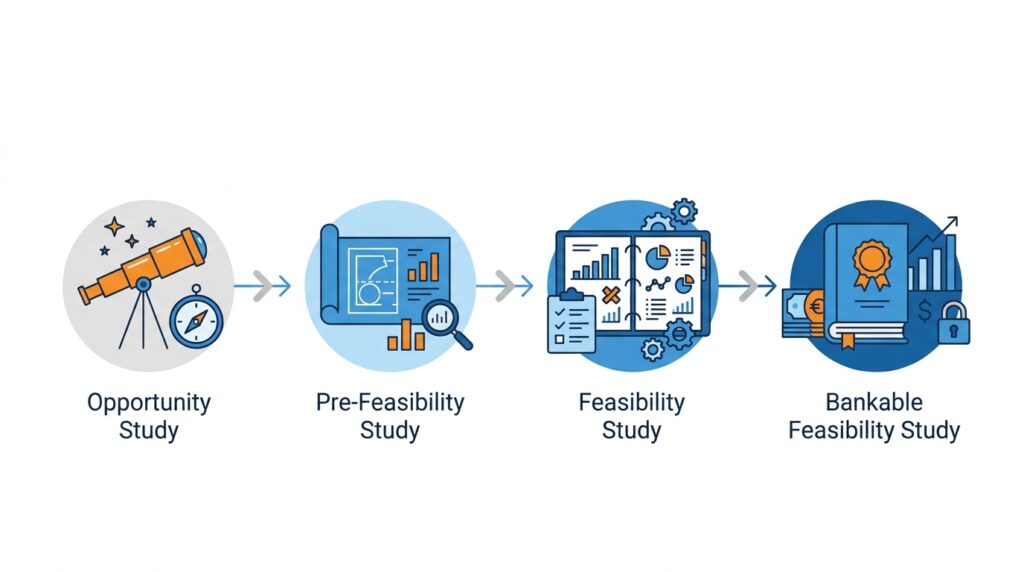
    Feasibility studies are usually conducted in stages, each building on the previous one with more detail and confidence.

    Stages of a feasibility study for industrial plants

    Stage Description Purpose Typical cost estimate accuracy*
    Opportunity study Preliminary assessment of project ideas Identify promising opportunities About -20% to -50% / +30% to +100% (AACE Class 5)
    Pre-feasibility study Preliminary assessment of a specific project Decide whether to proceed to feasibility About -15% to -30% / +20% to +50% (AACE Class 4)
    Feasibility study Detailed assessment of a specific project Support the investment decision About -10% to -20% / +10% to +30% (AACE Class 3)
    Bankable feasibility study Feasibility study suitable for financing Support the financing decision Class 3 or better, often tightened by FEED data

    *Indicative only. Ranges vary by industry and estimating practice. See AACE International Recommended Practice 18R-97.

    Level of detail by stage. The level of detail in a feasibility study should match its stage. An opportunity study may be a few pages, while a bankable feasibility study may be hundreds of pages with detailed engineering, financial models, and environmental assessments. Spending too much on early stages wastes money on ideas that will not proceed. Spending too little on later stages leaves the investment decision poorly supported.

    On geothermal projects such as Olkaria I Unit 6 in Kenya (83 MW) and Muara Laboh in Indonesia (85.2 MW), confirming the resource (steam quality, pressure, and non-condensable gas content) is a decisive step before committing to detailed design and construction.

    Technical Feasibility

    Technical feasibility considerations for industrial plants

    Technical feasibility assesses whether the plant can be built and operated as proposed, and it should rest on engineering assessment rather than assumptions. The study needs to confirm that the technology is proven and available, that the site is suitable, and that the required resources and infrastructure exist. It also has to show that the proposed scale is appropriate and that the plant can be built within the required timeframe. A weakness in any one of these areas can undermine the whole project, however strong the others look.

    Site Selection

    Site selection is a critical part of technical feasibility. Alternatives should be compared against all of the criteria below, because a site that is excellent on one criterion can fail on another.

    Criterion Description
    Land Adequate area, suitable topography, and secure land rights
    Access Roads, rail, ports, and heavy-haul routes
    Utilities Power, water, and other utilities, including grid connection
    Resources Proximity to fuel, raw materials, and markets
    Environment Environmental conditions and constraints (flood, seismic, climate)
    Regulatory Zoning and regulatory requirements
    Social Proximity to communities and social impact

    For large desalination projects in the Gulf, such as Taweelah (909,200 m³/day) and Jubail 3A (600,000 m³/day), the dominant site factors are access to seawater for intake and outfall, grid connection, and proximity to the water distribution network.

    Technology Selection

    Technology selection should rest on both technical and commercial assessment. The technology should be proven in similar applications and meet performance requirements. Its capital and operating costs should be understood, and it should be available from more than one vendor, with vendor support, spare parts, and service. It also has to meet regulatory requirements. A technology that wins on performance but has a single supplier or weak local support can become a long-term operating risk.

    For thermal power projects such as Thai Binh 1 in Vietnam (2×300 MW) and Bibiyana-III in Bangladesh (400 MW CCGT), technology choices depend on fuel availability, grid requirements, and the plant’s operating profile.

    Cost Estimate and Schedule

    Feasibility conclusions are only as good as the capital cost and schedule behind them. The cost estimate needs a clear basis (scope, quantities, vendor quotes, and benchmarks). It also needs an accuracy range appropriate to the stage and explicit allowances for escalation and contingency.

    Owner’s costs are often forgotten. They include development, permitting, land, owner’s engineering, insurance, spares, commissioning, startup, and interest during construction. The schedule should cover permitting, financing, long-lead equipment, construction, and commissioning.

    Optimism bias is most dangerous here. Benchmarking against comparable completed projects is one of the best safeguards.

    Project Delivery and Contracting Strategy

    The feasibility study should consider how the project will be delivered, because this affects cost, risk allocation, and financeability. Options such as EPC (lump-sum turnkey), EPCM, or multi-contract approaches should be compared. Lenders often prefer fixed-price, date-certain EPC contracts with performance guarantees. A feasibility study that assumes a delivery model the market cannot support, or that lenders will not accept, has a weak foundation.

    Economic Feasibility

    Economic feasibility assesses whether the project is economically viable. It asks whether there is a market for the plant’s output, what price that output can command, what it costs to produce, and what margin results. It also asks who the competitors are and what demand is expected. The answers should rest on credible data covering demand, supply, price, competition, customers, and regulation, both now and in the future.

    Offtake and Supply Arrangements

    For many plants, revenue and input costs depend on long-term contracts. Feasibility should test whether offtake agreements (such as power purchase agreements or product sales contracts) and fuel or feedstock supply agreements are obtainable, at what prices, and for what term. Lenders usually look for these agreements to be in place or close to agreement before financial close.

    In our experience supporting geothermal and thermal projects, the availability and terms of power purchase agreements were often as important as the technical feasibility of the plant itself.

    Financial Feasibility

    Financial feasibility assesses whether the project can be funded and the funding repaid. It should include a full financial model that covers:

    • Capital cost: total installed cost and financing costs.
    • Operating cost: annual operating and maintenance costs, including fuel and feedstock.
    • Revenue: expected annual revenue.
    • Cash flow: expected cash flow over the plant’s life.
    • Financing structure: debt and equity mix, loan terms, and cost of capital.
    • Taxes, incentives, currency, and inflation assumptions.
    • End-of-life costs: decommissioning or residual value.

    Financial Analysis

    Method Description
    Net present value (NPV) Present value of future cash flows, discounted at an appropriate rate
    Internal rate of return (IRR) Discount rate at which NPV equals zero
    Payback period Time to recover the investment (ignores time value and later cash flows, so use as a screening measure)
    Debt service coverage ratio (DSCR) Ability of cash flow to service debt
    Levelized cost Lifetime cost per unit of output

    Financial analysis should be based on realistic assumptions and tested with sensitivity analysis.

    Environmental Feasibility

    Environmental feasibility assesses whether the project is environmentally acceptable. The study should examine the overall effect on air, water, land, and ecology, and what the plant will emit, including greenhouse gases. It should also cover how water will be sourced, used, and discharged, how waste will be managed, and which environmental permits are required. An environmental impact assessment should be included where required. Lenders often expect alignment with international standards such as the IFC Performance Standards or the Equator Principles.

    For desalination projects in the Gulf, environmental feasibility includes assessing marine impacts from intake and outfall structures and managing brine discharge.

    Regulatory Feasibility

    Regulatory feasibility assesses whether the project can obtain the required approvals. It should identify which permits and approvals are needed and from whom, how long they will take, and whether the project can comply. It should also consider whether regulations are likely to change during development. This should be assessed early, because approvals can be time-consuming and can determine the critical path.

    For projects in Japan (Asahikasei Mizushima, 29.1 MW) and Qatar (Al Kharsaah, 800 MW solar), regulatory requirements and permitting timelines were significant factors in project planning.

    Social Feasibility

    Social feasibility assesses whether the project is socially acceptable. The study should consider community impact, including noise, traffic, and visual effects, along with the employment the project will create and the infrastructure it will require. It should also address resettlement, if any is involved, and whether the community has been consulted.

    The Role of Stakeholders

    Stakeholder consultation, with regulators, communities, and potential customers, provides valuable input to the feasibility study and helps identify issues early. Issues that surface during feasibility can be addressed by design or planning. The same issues discovered during construction can stop the project.

    Risk Assessment

    Risk assessment identifies and evaluates project risks by assessing their likelihood and impact.

    Risk Description
    Technical Technology does not perform as expected
    Market Market does not develop as expected
    Cost Costs exceed estimates
    Schedule Project is delayed
    Regulatory Approvals are delayed or denied
    Environmental Environmental issues arise
    Social Community opposition
    Financial Financing is unavailable or its terms change
    Contractual Counterparties fail to perform

    Sensitivity Analysis

    Sensitivity analysis tests how results change with different assumptions. It should cover the key variables (capital cost, price, volume, fuel cost, availability, delay, and interest rate). It should also cover the plausible range for each variable and how each affects NPV, IRR, and DSCR. Combined scenarios such as base, downside, and upside cases are also useful. It shows whether the project remains viable when assumptions turn out wrong, which they often do.

    A Simple Sensitivity Example

    Consider a hypothetical plant with a capital cost of 50 million, annual revenue of 20 million, and annual operating cost of 11 million. Net cash flow is 9 million per year over 15 years. Discounted at 10%, the NPV is about +18 million and the IRR about 16%. The figures are simplified and ignore tax, construction period, and working capital.

    Case Annual net cash flow NPV (approx.)
    Base case 9.0 million +18.5 million
    Capital cost +20% (60 million) 9.0 million +8.5 million
    Revenue -15% (17 million) 6.0 million -4.4 million
    Both together 6.0 million -14.4 million

    A 20% capital overrun reduces the margin but leaves the project viable. A 15% revenue shortfall makes it unviable on its own. Many owners focus on capital cost, but conclusions are often more sensitive to price and volume assumptions. This is why market analysis and offtake agreements deserve as much attention as the cost estimate.

    Independent Review and Due Diligence

    Independent review of a feasibility study, by a third party not involved in preparing it, adds credibility and helps identify biases or gaps. Lenders and investors often require independent review (technical, market, environmental, and financial due diligence) before committing funds.

    The Go/No-Go Decision

    The feasibility study should culminate in a clear recommendation: proceed, modify, or abandon. The recommendation should be supported by the analysis and should identify the key risks and conditions. Many owners use stage gates with defined criteria, so the decision is made against agreed thresholds rather than momentum. “No-go” is a legitimate and valuable outcome, since it avoids a much costlier failure later.

    Feasibility Study Report

    The report should be clear, complete, and well-structured. A typical report contains:

    • Executive summary: findings, recommendation, and key conditions.
    • Background: project context and objectives.
    • Technical assessment: site, technology, scale, cost, and schedule.
    • Market and economic assessment: demand, price, and competitiveness.
    • Financial assessment: model results, funding plan, and key metrics.
    • Environmental, regulatory, and social assessments: impacts, approvals, and engagement.
    • Risk and sensitivity analysis: key risks, mitigations, and scenarios.
    • Conclusions and recommendations: go/no-go recommendation, assumptions, and next steps.

    From Feasibility to FEED

    A positive decision leads to the next phase, typically front-end engineering design (FEED), where scope, cost, and schedule are defined in more detail. The feasibility study should hand over its assumptions, design basis, risk register, and open issues so that nothing learned is lost.

    Feasibility Studies in Small Plants

    Small plants face particular challenges: fewer resources, less data, less expertise, and competing priorities. The practical answer is to focus on the most important feasibility questions rather than trying to cover everything at the same depth. Industry data and benchmarks can stand in for detailed studies where data is scarce, and outside experts can be brought in for specific questions. Conservative assumptions protect against optimism, and sensitivity testing shows how much the conclusion depends on each assumption. Documenting the basis for the analysis lets others check it later.

    Feasibility studies do not need to be complex. They need to be thorough and honest.

    Common Mistakes in Feasibility Studies

    • Optimism bias: overestimating benefits and underestimating costs, which is the most common cause of projects that look good on paper and fail in practice.
    • Incomplete analysis or poor data: missing key feasibility aspects or relying on unreliable data, so the conclusions cannot be trusted.
    • No sensitivity analysis, or ignoring risk: not testing how results change with assumptions or accounting for uncertainty, which hides how fragile the case is.
    • Ignoring environmental and social issues: focusing only on technical and economic aspects, then facing permit delays or community opposition later.
    • No stakeholder consultation: missing regulator and community concerns until they become expensive to address.
    • Underestimating owner’s costs and contingency: which leads directly to budget overruns.
    • Rushed study: insufficient time for thorough analysis.
    • No independent review: leaving biases and gaps unchallenged.
    • Predetermined outcome: using the study to justify a decision already made.

    These mistakes are costly to correct. They are much cheaper to avoid through disciplined feasibility studies.

    How EPC Partners Inc. Approaches Feasibility Studies

    At EPC Partners Inc., we bring practical experience from projects across Asia, the Middle East, Africa, and Europe. Our approach is built on a few principles. We assess all feasibility aspects thoroughly and use assumptions that are realistic rather than optimistic. We test results against different assumptions, identify and assess risks, and document the work transparently. We favor independent review and assess feasibility over the plant’s entire life, not just the construction period.

    Our experience includes supporting geothermal projects in Kenya, Ethiopia, Indonesia, Iceland, and Japan; desalination projects in the UAE, Saudi Arabia, Oman, and Qatar; thermal power projects in Vietnam, Bangladesh, and Japan; and water treatment projects in Vietnam, Kuwait, and Qatar. We have also supported clients including Marubeni Corporation, Fuji Electric Co., Ltd., and Toyota Tsusho Corporation on project development aspects of their projects.

    How to Evaluate Feasibility Study Readiness

    Question Why It Matters
    Is the study comprehensive? Covers all key feasibility aspects
    Are assumptions realistic? Ensures results are meaningful
    Is data reliable? Ensures analysis is credible
    Are cost and schedule estimates benchmarked, with contingency? Guards against overruns
    Is sensitivity analysis performed? Tests how results change with assumptions
    Is risk assessed? Accounts for uncertainty
    Are environmental and social issues addressed? Ensures comprehensive assessment
    Have stakeholders been consulted? Ensures social acceptability
    Are offtake and supply arrangements realistic? Underpins revenue and cost assumptions
    Has the study been reviewed independently? Ensures quality and credibility
    Is there a clear go/no-go recommendation with conditions? Supports a decision

    A study that addresses these questions is ready to support a sound investment decision.

    Frequently Asked Questions

    How long does a feasibility study take? It depends on the project’s size and stage. An opportunity study may take weeks, while a bankable feasibility study can take many months because of detailed engineering, environmental baseline work, and financial modeling.

    Who should prepare a feasibility study? Usually a multidisciplinary team of engineering, financial, environmental, and market specialists, with independent review before financing.

    What is the difference between a feasibility study and FEED? A feasibility study decides whether to proceed. FEED defines the scope, cost, and schedule needed to execute the project.

    Is a feasibility study required for financing? Lenders generally require a bankable feasibility study, supported by independent technical, market, and environmental review, before committing funds.

    Conclusion

    Feasibility studies are the foundation of sound investment decisions. For small to medium-scale industrial plants, they determine whether the project is worth doing.

    By focusing on technical, economic, financial, environmental, regulatory, and social feasibility, together with risk assessment, sensitivity analysis, independent review, and a clear go/no-go recommendation, owners and project teams can ensure that investment decisions rest on a thorough and honest assessment of the project.

    Key Takeaways

    • Feasibility studies assess whether a project is technically feasible, economically viable, and socially and environmentally acceptable.
    • Studies are conducted in stages (opportunity, pre-feasibility, feasibility, bankable feasibility), with detail matched to each stage.
    • Technical feasibility covers technology, site, resources, infrastructure, scale, and schedule.
    • Economic and financial feasibility cover market, price, cost, margin, offtake, and financing.
    • Environmental, regulatory, and social feasibility are critical and often overlooked.
    • Risk assessment and sensitivity analysis test how robust the study is. Price and volume assumptions often matter as much as capital cost.
    • Independent review and stakeholder consultation add credibility and surface issues early.
    • The study should end in a clear recommendation: proceed, modify, or abandon.
    • Small plants can focus on key issues and use available data.

    References

    • AACE International, Recommended Practice 18R-97, Cost Estimate Classification System – As Applied in Engineering, Procurement, and Construction for the Process Industries.
    • International Finance Corporation (IFC), Performance Standards on Environmental and Social Sustainability.
    • The Equator Principles Association, The Equator Principles.

    This article is for general information and does not replace project-specific engineering, legal, or financial advice.

    EPC Partners Inc. is a Japanese EPC support firm with experience supporting power, water, and industrial plant projects across Asia, the Middle East, Africa, and Europe. For more information, visit our project list.

  • Failure Modes and Effects Analysis (FMEA): A Practical Guide for Industrial Plants

    Failure Modes and Effects Analysis (FMEA): A Practical Guide for Industrial Plants

    Most plant failures are discovered the hard way, after they happen. Equipment stops working, production is lost, and the maintenance team rushes to repair it. Root Cause Analysis (RCA) helps you learn from these failures. But what if you could identify problems before they occur?

    Failure Modes and Effects Analysis (FMEA) is a structured, proactive method for identifying how equipment, systems, or processes can fail, and what the consequences would be. Instead of reacting to failures, FMEA helps you anticipate them and prevent them or mitigate their effects.

    For small to medium-scale industrial plants, FMEA is especially valuable because it focuses attention on the failures that matter most. It directs limited maintenance and engineering resources toward the equipment and failure modes with the highest risk.

    This article explains what FMEA is, how it works, and how to apply it practically in an industrial plant.

    What Is FMEA?

    FMEA is a systematic method for evaluating a system, design, or process to identify:

    • Functions: What the item is supposed to do.
    • Failure modes: The ways in which it can fail to do so.
    • Failure effects: What happens when each failure mode occurs.
    • Failure causes: What leads to each failure mode.
    • Controls: What is currently in place to prevent or detect each failure mode.

    FMEA was originally developed by the US military in the late 1940s (the procedure MIL-P-1629, issued in 1949) and has since been adopted across many industries, including automotive, aerospace, medical devices, and power generation.

    The purpose of FMEA is to:

    • Identify potential failures before they occur.
    • Assess the risk associated with each failure.
    • Prioritize actions to reduce risk.
    • Document the analysis for future reference.

    Related standards and terms

    Several standards and guidelines govern FMEA practice. Plant teams most often encounter:

    Reference Relevance
    IEC 60812 General international standard for FMEA and FMECA
    MIL-STD-1629A Original US military procedure (now withdrawn, but still widely referenced)
    SAE J1739 and AIAG & VDA FMEA Handbook Automotive practice; source of the Action Priority method
    SAE JA1011 / JA1012 Criteria and guide for Reliability-Centered Maintenance (RCM), where FMEA is a core step

    You may also see the term FMECA (Failure Modes, Effects, and Criticality Analysis). It is FMEA with an added step that ranks the criticality of each failure mode. In practice, most plant FMEAs already include this ranking through severity and RPN, so the two terms are often used interchangeably.

    FMEA vs. RCA

    FMEA and RCA are complementary, but they serve different purposes.

    Aspect FMEA RCA
    Timing Before failure occurs (proactive) After failure occurs (reactive)
    Purpose Identify and prevent potential failures Understand and prevent recurrence of actual failures
    Approach Analyzes what could go wrong Analyzes what did go wrong
    Output Risk-ranked list of failure modes with actions Root cause(s) and corrective actions

    FMEA is proactive; RCA is reactive. Together they form a complete approach to reliability: FMEA prevents failures from happening, and RCA prevents them from happening again.

    The two also feed each other. Failures investigated through RCA reveal failure modes and causes that the FMEA missed, and the FMEA should be updated accordingly. Conversely, an existing FMEA gives an RCA team a head start by listing known failure modes and causes.

    Types of FMEA

    FMEA is used in different forms, depending on the application.

    Type Focus Typical Use
    Design FMEA (DFMEA) Product or equipment design New equipment design, modifications
    Process FMEA (PFMEA) Manufacturing or operational processes Production processes, maintenance procedures
    System FMEA Systems and subsystems Plant systems, control systems
    Equipment FMEA Individual equipment items Critical equipment, rotating machinery

    For plant applications, system FMEA and equipment FMEA are most common. Design FMEA is used when specifying new equipment or modifying existing designs.

    FMEA for new equipment

    FMEA is particularly valuable during design or procurement of new equipment. Identifying failure modes before the equipment is built or purchased allows design changes that are far cheaper than modifications after installation. Typical outcomes include adding redundancy, specifying better materials or seals, requiring condition-monitoring instrumentation from the vendor, or including FMEA deliverables in the supplier’s scope.

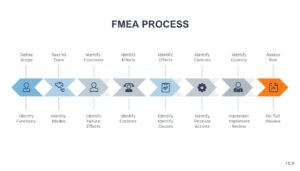
    The FMEA Process

    Ten-step FMEA process diagram for industrial plants

    FMEA follows a structured process, typically performed by a cross-functional team.

    Step Description
    1. Define the scope What system, equipment, or process is being analyzed?
    2. Assemble the team Who has knowledge of the system, its operation, and its failure modes?
    3. Identify functions What is the system or equipment supposed to do?
    4. Identify failure modes How can it fail to perform its function?
    5. Identify effects What happens when each failure mode occurs?
    6. Identify causes What leads to each failure mode?
    7. Identify controls What is currently in place to prevent or detect the failure?
    8. Assess risk How serious is the risk, considering severity, occurrence, and detection?
    9. Prioritize actions Which failure modes need action first?
    10. Implement and review Assign actions, implement them, and review effectiveness.

    FMEA is not a one-time exercise. It should be reviewed when equipment, processes, or operating conditions change.

    Assembling the team

    A good FMEA team typically includes:

    • A facilitator who knows the method and keeps the session focused.
    • Operations personnel, who know how the equipment behaves in practice.
    • Maintenance personnel, who know how it fails and how it is repaired.
    • Engineering staff, who know the design and its limits.
    • Safety or environmental representatives, where consequences may involve people or releases.
    • Vendor or specialist input, where the equipment is unfamiliar or highly specialized.

    Teams of four to seven people generally work best. Larger groups slow down; smaller groups miss perspectives.

    Documenting the analysis: the FMEA worksheet

    FMEA is typically documented on a worksheet with columns for function, failure mode, effects, severity, causes, occurrence, current controls, detection, RPN, recommended actions, and responsibility. Spreadsheets are commonly used, though specialized software is available for larger analyses.

    Whatever the tool, the worksheet should use consistent scales and terminology, and it should be a living document that is stored where the maintenance and engineering teams can find it.

    Identifying Failure Modes

    A failure mode is the way in which a system, equipment, or process fails to perform its intended function.

    Types of failure modes:

    • Complete failure: Equipment stops working entirely.
    • Partial failure: Equipment works, but not at full capacity.
    • Intermittent failure: Equipment alternates unpredictably between working and not working.
    • Degraded performance: Equipment works, but with reduced efficiency, accuracy, or output.
    • Unintended operation: Equipment operates when it should not.
    • Failure to operate on demand: Equipment fails to start or act when needed, as with standby pumps and safety devices.
    • Failure to stop: Equipment continues to run after it should have stopped.

    For each function, the team asks: how could this function fail? The answers are the failure modes.

    It is important to distinguish a failure mode from its cause. “Bearing seizure” describes how the pump stops working (failure mode). “Loss of lubrication” is why the bearing seized (cause). Mixing the two makes the worksheet confusing.

    Identifying Failure Effects

    For each failure mode, the team identifies the effects: what happens when the failure occurs.

    Effects should be considered at multiple levels:

    • Local effects: What happens to the equipment itself?
    • System effects: What happens to the system the equipment is part of?
    • Plant effects: What happens to the plant as a whole?
    • Safety effects: Could the failure cause injury?
    • Environmental effects: Could the failure cause an environmental release?

    Effects should be described specifically. “Pump fails” is not an effect. “Pump fails, causing loss of cooling water flow to the condenser, resulting in turbine trip and 8-hour plant shutdown” is an effect.

    Identifying Failure Causes

    For each failure mode, the team identifies the causes: what leads to the failure.

    Common causes:

    • Design weaknesses: Inadequate material, undersized components, poor layout.
    • Manufacturing defects: Poor workmanship, incorrect assembly.
    • Installation errors: Incorrect alignment, improper torque.
    • Operating errors: Incorrect setpoints, missed procedures.
    • Maintenance errors: Missed tasks, incorrect parts, poor workmanship.
    • Wear and degradation: Normal aging, corrosion, fatigue.
    • External events: Power loss, weather, contamination.

    Causes should be specific enough to allow corrective action. “Operator error” is not a cause. “Operator fails to open valve V-101 before starting pump P-101” is a cause.

    Risk Assessment: Severity, Occurrence, Detection

    Risk priority number calculation in FMEA

    FMEA uses three factors to assess risk:

    Factor What It Measures Scale
    Severity (S) How serious are the effects? 1 (minor) to 10 (catastrophic)
    Occurrence (O) How likely is the cause to occur? 1 (unlikely) to 10 (frequent)
    Detection (D) How likely is the failure to be detected before effects occur? 1 (certain detection) to 10 (no detection)

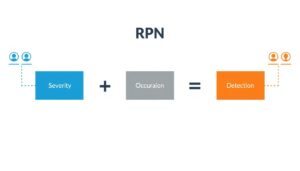
    The Risk Priority Number (RPN) is calculated as:

    RPN = Severity × Occurrence × Detection

    Higher RPN values indicate higher risk and greater priority for action. RPN ranges from 1 to 1,000.

    Defining the scales

    The scales must be defined in advance and applied consistently. Below is an illustrative severity scale for an industrial plant; each plant should adapt it to its own consequences.

    Rating Severity Description (example)
    1-2 No noticeable effect on operation
    3-4 Minor performance loss; repaired during routine maintenance
    5-6 Partial loss of output or short unplanned shutdown
    7-8 Extended shutdown, major equipment damage, or environmental incident
    9-10 Serious injury, fatality, or major environmental or safety event

    Occurrence and detection scales should be defined similarly, for example by expected frequency (once in 10 years vs. monthly) and by the strength of existing controls (continuous online monitoring vs. reliance on an operator noticing).

    A worked example

    Consider a cooling water pump serving a plant condenser:

    Failure Mode Effect Cause S O D RPN
    Bearing seizure Loss of cooling flow; turbine trip; 8-hour shutdown Loss of lubrication 8 5 6 240
    Suction strainer blockage Reduced flow; reduced output Debris ingress 7 4 4 112
    Mechanical seal leak Water leakage; minor repair Seal wear 5 6 3 90

    The bearing seizure ranks highest. The team recommends installing vibration and bearing-temperature monitoring, which improves detection from 6 to 3. The revised RPN is 8 × 5 × 3 = 120. Note that this reduces risk by improving detection, but severity and occurrence are unchanged. If the team can also improve lubrication practices, occurrence falls too, and the risk reduction is more durable.

    Limits of RPN

    RPN is a prioritization tool, not an absolute measure of risk. It has well-known limitations:

    • Different combinations of scores can produce the same RPN. For example, 9 × 2 × 2 = 36 and 3 × 3 × 4 = 36, yet the first involves a far more severe consequence.
    • The rating scales are ordinal, so multiplying them is mathematically questionable.
    • The result is sensitive to small changes in individual scores.

    A failure mode with high severity but low RPN should still be addressed if the consequences are serious. For instance, a relief valve that fails to lift might score 10 × 2 × 3 = 60, which looks modest, yet the consequence is unacceptable.

    Action Priority (AP) as an alternative

    Some industries have adopted Action Priority (AP) as an alternative to RPN. AP uses the same three factors but ranks actions by severity first, then occurrence and detection, avoiding some of the limitations of multiplying scores. In the AIAG & VDA method, for example, a lookup table assigns each combination of ratings a High, Medium, or Low priority, rather than a single number. Plants may use either approach, provided the choice is consistent and severity is never overlooked.

    Prioritizing Actions

    Once risks are ranked, the team prioritizes actions.

    Priority should consider:

    • Severity: Failures with high severity (safety, environmental, major production loss) should be addressed first, regardless of RPN.
    • RPN or AP: Failures with high RPN (or High AP) should be addressed before those with low ratings.
    • Cost-effectiveness: Actions should be proportionate to the risk being reduced.
    • Feasibility: Actions should be practical to implement.

    Types of actions:

    • Eliminate the failure mode: Redesign to remove the possibility of failure.
    • Reduce severity: Add protective systems, reduce consequences.
    • Reduce occurrence: Improve design, materials, or procedures.
    • Improve detection: Add monitoring, alarms, or inspections.

    Actions that eliminate or reduce risk at the source are generally preferred over those that rely on detection. Each action should have a named owner and a due date, and the failure mode should be re-scored once the action is complete to confirm the risk has actually fallen.

    Linking FMEA to maintenance

    FMEA findings should be linked to the maintenance program. Failure modes that require detection or prevention should have corresponding tasks in the preventive or predictive maintenance plan. For example, if the FMEA identifies bearing seizure as a high-priority mode, the maintenance plan should include lubrication checks, oil analysis, and vibration monitoring at defined intervals. Without this link, the FMEA remains a document rather than a driver of reliability.

    FMEA in Practice

    FMEA can be applied at different levels, depending on the scope and resources available.

    Approach Scope When to Use
    Full FMEA Detailed analysis of all failure modes Critical systems, new designs
    Streamlined FMEA Focused analysis using templates and experience Most plant equipment
    Criticality-based FMEA Analysis of critical equipment only Small plants with limited resources
    Process FMEA Analysis of operational or maintenance processes Procedures, work instructions

    For small to medium-scale plants, a criticality-based or streamlined approach is often the most practical. Full FMEA on every piece of equipment is rarely justified.

    Where to start

    A practical starting sequence for a plant new to FMEA:

    1. Rank equipment by criticality, considering safety, environmental impact, production loss, and repair cost.
    2. Select the top few items, such as major rotating machinery, key utilities, and critical control loops.
    3. Use generic failure mode lists from equipment vendors, industry databases, and your own maintenance history as a starting point, and then adapt them to your operating conditions.
    4. Run short, focused workshops, typically half a day per equipment item.
    5. Expand gradually as the team gains experience.

    When to trigger a review

    Beyond scheduled reviews, revisit the FMEA when:

    • A significant failure or near miss occurs (especially if the RCA reveals a failure mode not in the FMEA).
    • Equipment is modified, replaced, or moved to a different duty.
    • Operating conditions or fuel/feed quality change.
    • Maintenance strategies or spare parts policies change.

    FMEA and RCM

    FMEA is closely related to Reliability-Centered Maintenance (RCM). In fact, FMEA is a key tool within the RCM process.

    Aspect FMEA RCM
    Focus Identifying failure modes and their effects Determining maintenance requirements
    Scope Any system, design, or process Physical assets in their operating context
    Output Risk-ranked list of failure modes Maintenance program based on failure modes and consequences
    Relationship FMEA is a tool used within RCM RCM uses FMEA as part of its analysis

    If you have already performed RCM, much of the FMEA analysis is already done. If you have not, FMEA can be a good starting point for improving reliability.

    FMEA and Other Risk Tools

    FMEA is one of several risk-analysis tools, each suited to different questions:

    Tool Best For
    FMEA Equipment- and component-level failure modes and their effects
    HAZOP Process hazards and deviations in process systems
    Fault Tree Analysis (FTA) Tracing a specific top-level event back to its combinations of causes
    Bow-tie / LOPA Evaluating barriers and protection layers for major hazards

    FMEA works from causes toward effects (bottom-up), while fault tree analysis works from a defined event back toward causes (top-down). On critical systems the two are often used together.

    Common Mistakes in FMEA

    Even experienced teams make mistakes. Common ones include:

    • Analyzing too much: Trying to FMEA everything, which exhausts the team and dilutes the value.
    • Analyzing too little: Focusing only on obvious failure modes and missing important ones.
    • Vague failure modes: “Equipment fails” is not useful; “Pump seal leaks” is.
    • Ignoring severity: Prioritizing by RPN alone without considering safety or environmental consequences.
    • Inconsistent scoring: Using different scales or interpretations from one session to the next.
    • No team involvement: Missing knowledge from operations, maintenance, or engineering.
    • Scoring the same failure twice: Rating a control as effective without checking that it is actually performed.
    • No follow-through: Producing a report without implementing actions.
    • Treating FMEA as a one-time project: Failing to update the analysis as conditions change.

    These mistakes reduce the value of FMEA and can lead to its abandonment.

    How Japanese EPC Firms Approach FMEA

    Japanese engineering firms are known for their disciplined approach to reliability and risk analysis. Common characteristics include:

    • Thorough analysis: FMEA is performed carefully, with input from all relevant disciplines.
    • Focus on critical equipment: Resources are directed to equipment where failure matters most.
    • Detailed documentation: Analysis, decisions, and results are carefully recorded.
    • Integration with design: FMEA findings are fed back into design standards and future projects.
    • Continuous improvement: FMEA is reviewed and updated as conditions change.
    • Long-term focus: FMEA is treated as an ongoing practice, not a one-time project.

    For plant owners, this often means fewer unexpected failures, better-targeted maintenance, and a stronger safety record.

    How to Evaluate FMEA Readiness

    When considering FMEA for your plant, ask:

    Question Why It Matters
    Is the scope clearly defined? Focuses the analysis on what matters
    Is there a cross-functional team? Brings together operations, maintenance, and engineering
    Are failure modes specific? Enables meaningful analysis and action
    Are effects assessed at multiple levels? Captures safety, environmental, and production impacts
    Are the rating scales defined and applied consistently? Ensures prioritization is fair and repeatable
    Are actions specific and assigned? Ensures actions are implemented
    Are findings linked to the maintenance program? Turns analysis into practical reliability tasks
    Is the analysis documented and reviewed? Keeps the analysis current and useful

    A plant that addresses these questions is ready to benefit from FMEA.

    Conclusion

    Failure Modes and Effects Analysis is a proactive method for identifying how equipment, systems, or processes can fail, and what the consequences would be. It helps plants anticipate failures rather than react to them.

    For small to medium-scale industrial plants, FMEA, applied pragmatically, can improve reliability, reduce risk, and focus limited resources where they matter most. It is not a quick fix, but it is a proven approach for plants that want to get ahead of failures instead of chasing them.

    Key Takeaways

    • FMEA is a proactive method for identifying failure modes and their effects.
    • FMEA is distinct from RCA: one prevents failures, the other prevents recurrence.
    • The process includes scope definition, team assembly, function identification, failure mode identification, risk assessment, and action.
    • Risk is assessed using severity, occurrence, and detection (RPN), with Action Priority (AP) as an alternative that weights severity first.
    • Actions that eliminate or reduce risk at the source are preferred over those that rely on detection.
    • FMEA findings should be linked to the maintenance program and applied early, during design and procurement of new equipment.
    • FMEA is a key tool within RCM.
    • Japanese EPC firms emphasize thorough analysis and integration with design.