Tag: Project Completion

  • Plant Project Closeout: Key Practices for EPC Projects

    Plant Project Closeout: Key Practices for EPC Projects

    Every project eventually comes to an end. The plant is built, commissioned, handed over, and operating. But the project is not truly complete until it has been formally closed out. Closeout is the final phase of the project lifecycle, where loose ends are tied up, obligations are fulfilled, documents are archived, and the project team is released.

    Closeout is often the least glamorous phase of a project. By the time it happens, the excitement of construction is over, the plant is running, and attention has moved to other things. But a poorly managed closeout leaves unresolved issues, incomplete documentation, and lingering liabilities that can affect the owner for years.

    For small to medium-scale industrial plants, project closeout is especially important because there is less redundancy and fewer resources to absorb the consequences of an incomplete closeout. A clean closeout ensures that the owner has everything needed to operate, maintain, and improve the plant, and that there are no surprises later.

    This article covers the key practices in plant project closeout, from closeout planning to final documentation, financial settlement, warranty management, and lessons learned.

    What Is Project Closeout?

    Project closeout is the process of completing all remaining work and formally closing the project.

    It includes:

    • Scope completion: Ensuring all scope is complete.
    • Punch list closure: Closing out outstanding items.
    • Documentation completion: Completing and archiving documentation.
    • Financial settlement: Settling all financial matters.
    • Contract closure: Closing out contracts, including issuing closeout certificates.
    • Asset handover: Handing over assets to operations.
    • Warranty and post-closeout support: Establishing arrangements that continue after closeout.
    • Lessons learned: Capturing lessons for future projects.
    • Team release: Releasing the project team.

    Closeout is the formal end of the project, but it is also the beginning of the plant’s operating life.

    Why Project Closeout Matters

    Closeout determines whether the project is truly complete.

    Factor Impact of Good Closeout Impact of Poor Closeout
    Completion Project formally closed Project lingers with open items
    Documentation Complete and archived Incomplete or lost
    Financial All accounts settled Disputes and unresolved claims
    Contracts All contracts closed Contracts remain open
    Assets Assets handed over cleanly Assets with unclear ownership
    Warranty Terms and dates clearly tracked Warranty rights lapse unnoticed
    Lessons Lessons captured and applied Lessons lost
    Team Team released cleanly Team members left in limbo

    For small plants, where there is less margin for error, closeout determines whether the project is truly finished.

    Closeout Planning

    Closeout should be planned from the beginning of the project, not left to the end.

    Closeout planning activities:

    • Define closeout criteria: What must be complete before closeout?
    • Define closeout process: What are the steps in the closeout?
    • Define responsibilities: Who is responsible for what?
    • Define documentation requirements: What documents must be completed?
    • Define financial requirements: What must be settled?
    • Define post-closeout arrangements: What warranty, support, and records retention arrangements apply?
    • Schedule closeout activities: When will each activity occur?

    Closeout planning should be integrated into the overall project plan.

    Closeout Criteria

    Closeout criteria define what must be complete before the project can be closed.

    Criterion Description
    Scope complete All scope is complete
    Punch list closed All punch list items are closed
    Documentation complete All documents are complete and archived
    Financial settled All accounts are settled
    Contracts closed All contracts are closed and certificates issued
    Assets handed over Assets are handed over to operations
    Warranty arrangements in place Warranty terms, dates, and contacts are recorded
    Lessons learned Lessons are captured

    Closeout criteria should be defined in the contract and agreed by both parties.

    Punch List Closure

    The punch list is a record of outstanding items that must be completed before closeout.

    Punch list closure activities:

    • Review punch list: Review all open items.
    • Assign responsibility: Assign responsibility for each item.
    • Set deadlines: Set deadlines for completion.
    • Track progress: Track completion of each item.
    • Verify completion: Verify that items are completed correctly.
    • Close items: Close items when complete.

    Punch list items should be closed before final closeout, or formally accepted with a plan for completion, including owner, deadline, and any funds held back to cover the work.

    Documentation Completion

    Documentation must be complete and archived before closeout.

    Document Type Examples
    As-built drawings P&IDs, isometrics, electrical drawings
    Equipment manuals Vendor manuals, operating instructions
    Test records Commissioning records, test certificates
    Quality records Inspection reports, material certificates
    Operating procedures Startup, operation, shutdown procedures
    Maintenance procedures Inspection, maintenance, repair procedures
    Safety procedures Emergency procedures, safety data sheets
    Spare parts lists Recommended spares, supplier information
    Warranty documents Warranty terms, contact information
    Permits and regulatory records Operating permits, inspection certificates

    Documentation should be complete, accurate, and archived in a form that is accessible for future use.

    Financial Settlement

    Financial settlement ensures that all financial matters are resolved.

    Financial settlement activities:

    • Final payment: Make final payment.
    • Retention release: Release any retention, subject to the conditions in the contract.
    • Claims settlement: Settle any outstanding claims.
    • Final accounts: Agree final accounts.
    • Closeout costs: Account for closeout costs.
    • Subcontractor and supplier payments: Confirm that downstream parties have been paid, to avoid liens or claims against the owner.

    Financial settlement should be completed before final closeout.

    Contract Closure

    Contract closure ensures that all contracts are formally closed.

    Contract closure activities:

    • Contract completion: Confirm that all contract obligations are met.
    • Contract closeout certificate: Issue a certificate confirming contract completion.
    • Warranty confirmation: Confirm warranty terms and start date.
    • Contract archive: Archive contract documents.

    Contract closure should be documented and signed by both parties.

    Closeout Certificates

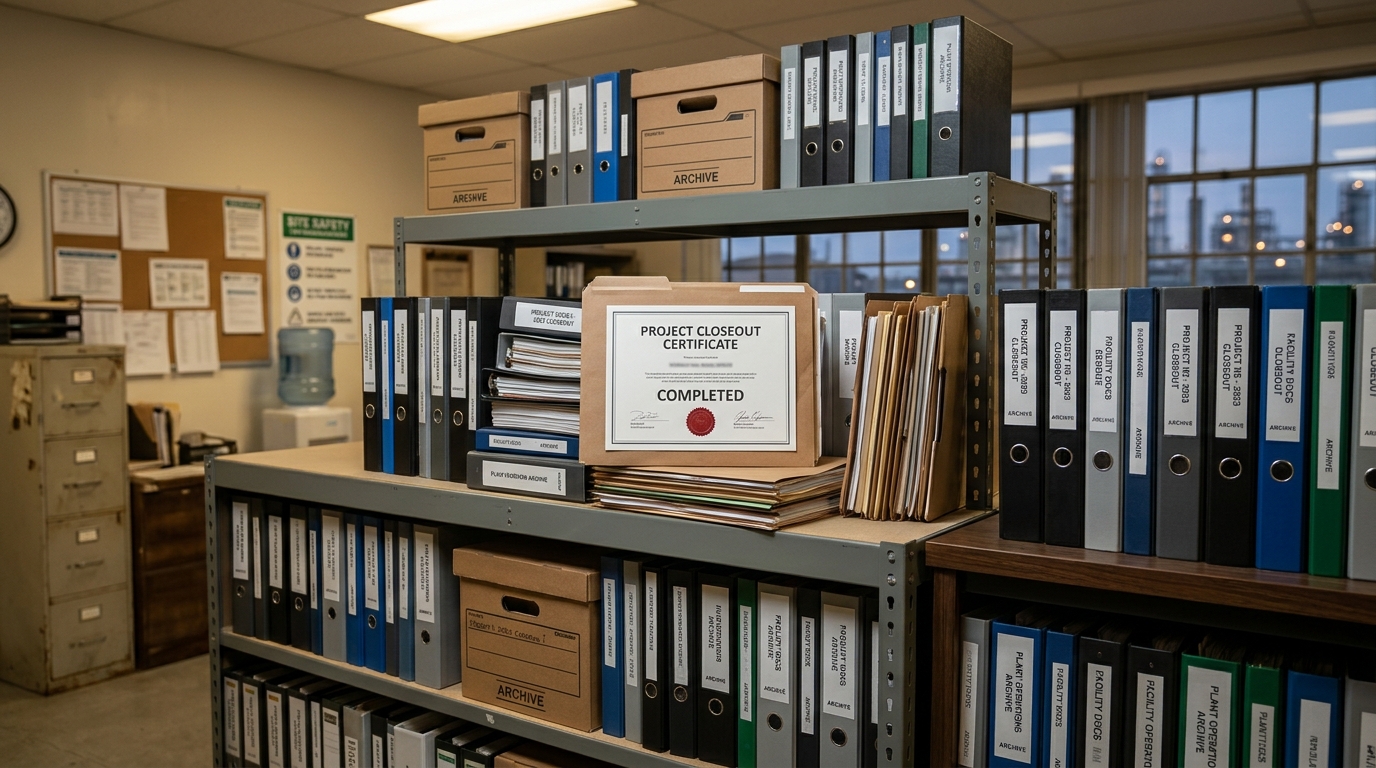
    A closeout certificate is a formal document confirming that the project has been completed and that all contractual obligations have been met. It is typically signed by both the owner and the contractor and marks the formal end of the project.

    Because the certificate often triggers final payment, retention release, and the end of certain liabilities, it should be issued only after closeout criteria have been verified.

    Asset Handover

    Asset handover ensures that assets are formally transferred to operations.

    Asset handover activities:

    • Asset register handover: Hand over the asset register.
    • Documentation handover: Hand over technical documentation.
    • Spare parts handover: Hand over spare parts and inventory.
    • Training completion: Confirm that training is complete.
    • Asset acceptance: Operations accept the assets.

    Asset handover should be documented and signed by both parties.

    Warranty Management After Closeout

    Warranty management does not end with project closeout. Warranties typically continue for a defined period after handover, and the owner must track warranty expiry dates, manage defects, and make claims before the warranty period ends.

    Good warranty management includes:

    • Warranty register: Record each warranty, its start date, expiry date, scope, and supplier contact.
    • Defect logging: Record defects as they appear, with date, description, and evidence.
    • Timely notification: Notify the contractor or supplier within the notice period set by the contract.
    • Pre-expiry inspection: Inspect equipment shortly before warranty expiry to identify defects while they can still be claimed.
    • Responsibility: Assign a named person in operations to own the warranty process.

    Lessons Learned

    Lessons learned capture what was done well and what could be improved.

    Lessons learned activities:

    • Collect lessons: Gather lessons from the project team.
    • Document lessons: Record lessons in a structured format.
    • Share lessons: Share lessons with the organization.
    • Apply lessons: Apply lessons to future projects.

    Lessons learned should be captured throughout the project, not just at the end. Input from the owner, contractor, and key suppliers gives a more balanced picture than any one party alone.

    Project Archive and Records Retention

    The project archive preserves project records for future reference.

    Archive contents:

    • Project documents: All project documents.
    • Correspondence: All project correspondence.
    • Financial records: All financial records.
    • Contract documents: All contract documents.
    • Lessons learned: All lessons learned.

    The archive should be organized, indexed, and accessible.

    Project records should be retained for the period required by contract, regulation, or company policy. Retention periods vary by document type and jurisdiction, and the retention schedule should be established before closeout.

    Some records, such as as-built drawings, safety documentation, and equipment records, are needed for the life of the plant and should be kept in the operating organization’s document system rather than archived away from it.

    Post-Closeout Support

    Some support continues after closeout. Post-closeout support may include warranty support, technical assistance, and access to project team members for questions. Arrangements for post-closeout support should be defined before the team is released.

    Items to define include:

    • Scope of support: What is covered, and what is not.
    • Duration: How long support is available.
    • Contacts: Who to contact at the contractor and key suppliers.
    • Commercial terms: Whether support is included in the contract or charged separately.

    Team Release

    Team release ensures that the project team is formally released.

    Team release activities:

    • Performance reviews: Complete performance reviews.
    • Recognition: Recognize team contributions.
    • Knowledge transfer: Transfer knowledge to operations or other projects.
    • Redeployment: Redeploy team members to other assignments.
    • Closure: Formally release team members.

    Team release should be managed with care and respect, and should happen only after post-closeout support arrangements and knowledge transfer are in place.

    Common Mistakes in Project Closeout

    Even experienced organizations make mistakes. Common ones include:

    • Closeout not planned: Closeout left to the end.
    • Punch list not closed: Outstanding items not resolved.
    • Documentation incomplete: Documents missing or incomplete.
    • Financial matters unresolved: Payments or claims not settled.
    • Contracts not closed: Contracts left open.
    • Assets not handed over: Assets without clear ownership.
    • Warranties not tracked: Claims missed because expiry dates passed.
    • Retention schedule not set: Records discarded too early or kept without purpose.
    • Support not defined: No agreed path for questions after the team disperses.
    • Lessons not captured: Lessons lost.
    • Archive incomplete: Records not preserved.
    • Team not released: Team members left in limbo.

    These mistakes are costly to correct. They are much cheaper to avoid through good planning and disciplined execution.

    How Japanese EPC Firms Approach Project Closeout

    Japanese engineering firms are known for their disciplined approach to project closeout. Common characteristics include:

    • Thorough planning: Closeout is planned from the beginning.
    • Detailed documentation: Documentation is complete and archived.
    • Disciplined financial settlement: All accounts are settled.
    • Systematic contract closure: All contracts are formally closed.
    • Continued after-sales support: Support and warranty follow-up continue after handover.
    • Comprehensive lessons learned: Lessons are captured and applied.
    • Respectful team release: Team members are recognized and released cleanly.

    For plant owners, this often means projects that are truly complete and closed.

    How to Evaluate Project Closeout Readiness

    When reviewing project closeout, ask:

    Question Why It Matters
    Is closeout planned? Provides a roadmap for closeout
    Are closeout criteria defined? Defines what must be complete
    Is the punch list closed? Ensures all items are resolved
    Is documentation complete? Ensures records are available
    Are financial matters settled? Ensures all accounts are resolved
    Are contracts closed and certificates issued? Ensures all obligations are fulfilled
    Are assets handed over? Ensures clear ownership
    Is warranty tracking in place? Protects the owner’s rights after handover
    Is the retention schedule defined? Ensures records are kept as long as required
    Is post-closeout support defined? Ensures help is available after release
    Are lessons captured? Ensures lessons are applied
    Is the archive complete? Ensures records are preserved
    Is the team released? Ensures team members are redeployed

    A plant that addresses these questions is ready for effective closeout.

    Key Takeaways

    • Project closeout is the process of completing all remaining work and formally closing the project
    • Closeout should be planned from the beginning of the project
    • Closeout criteria define what must be complete before the project can be closed
    • Punch list items should be closed before final closeout, or formally accepted with a plan
    • Documentation must be complete and archived
    • Financial settlement and contract closure ensure that all obligations are fulfilled
    • A closeout certificate formally confirms completion and is signed by both parties
    • Asset handover transfers assets and information to operations
    • Warranty management continues after closeout, and expiry dates must be tracked
    • Lessons learned should be captured throughout the project
    • Project records should be archived and retained for the required period
    • Post-closeout support should be defined before the team is released
    • Team release should be managed with care and respect
    • Japanese EPC firms emphasize thorough planning and disciplined execution

    Conclusion

    Project closeout is the final phase of the project lifecycle. For small to medium-scale industrial plants, it determines whether the project is truly complete and whether the owner has everything needed to operate and maintain the plant.

    By focusing on closeout planning, criteria, punch list closure, documentation, financial settlement, contract closure, asset handover, warranty management, lessons learned, records retention, post-closeout support, and team release, owners and project teams can ensure that the project is closed out cleanly and completely.

  • Plant Handover and Turnover: Key Practices for EPC Projects

    Plant Handover and Turnover: Key Practices for EPC Projects

    Handover is the moment when the plant stops being a construction project and becomes an operating asset. The contractor’s job is done. The owner’s team takes over. Operations begin.

    This transition is one of the most critical, and most often rushed, phases of a project. If handover is done well, the owner receives a plant that is complete, documented, and ready to operate. If handover is done poorly, the owner inherits a plant with missing documentation, unresolved defects, and untrained staff, problems that can persist for years.

    For small to medium-scale industrial plants, handover is especially important because there is less redundancy and fewer resources to absorb the consequences of an incomplete handover. The owner’s team must be ready to operate from day one.

    This article covers the key practices in plant handover and turnover, from handover planning to documentation, control systems, permits, training, and final acceptance.

    What Is Handover and Turnover?

    Handover and turnover are the processes of transferring the plant from the contractor to the owner.

    The terms are often used interchangeably, but there is a subtle difference:

    • Turnover typically refers to the transfer of individual systems or areas from construction to commissioning.
    • Handover typically refers to the final transfer of the completed plant from the contractor to the owner.

    Both are part of the same overall process: transferring responsibility, documentation, and knowledge from the project team to the operating team.

    Why Handover Matters

    Handover determines whether the owner can operate the plant effectively.

    Factor Impact of Good Handover Impact of Poor Handover
    Readiness Owner ready to operate from day one Owner struggles to operate
    Documentation Complete, accurate, accessible Missing or incomplete
    Training Staff trained and confident Staff unprepared
    Defects Outstanding items resolved Defects persist for years
    Warranty Claims managed effectively Warranty issues unresolved
    Safety Hazards understood and controlled Hazards unknown

    For small plants, where there is less margin for error, handover determines whether operations start smoothly or struggle.

    Handover Planning

    Handover should be planned from the beginning of the project, not left to the end.

    Handover planning activities:

    • Define handover criteria: What must be complete before handover?
    • Define handover process: What are the steps in the handover?
    • Define responsibilities: Who is responsible for what?
    • Define documentation requirements: What documents must be delivered, in what format, and by when?
    • Define training requirements: What training must be provided?
    • Define acceptance criteria: What defines successful handover?
    • Schedule handover activities: When will each activity occur?

    Handover planning should be integrated into the overall project plan. It is good practice to appoint a handover coordinator on both the contractor and owner sides, and to hold regular handover readiness meetings well before mechanical completion.

    Handover Criteria

    Handover criteria define what must be complete before handover.

    Criterion Description
    Mechanical completion All systems built, installed, and tested
    Commissioning complete All systems commissioned and functional
    Performance testing Plant meets performance guarantees
    Punch list Outstanding items resolved or accepted
    Documentation Complete and accurate documentation delivered
    Control systems Software, licenses, and configuration records delivered
    Permits Regulatory approvals transferred or reissued
    Training Owner’s staff trained and competent
    Spare parts Required spare parts delivered
    Warranty Warranty terms documented and accepted

    Handover criteria should be defined in the contract and agreed by both parties.

    Mechanical Completion

    Mechanical completion is the milestone where all systems are built, installed, and ready for commissioning.

    Mechanical completion activities:

    • Construction complete: All construction work finished.
    • Inspection complete: All inspections completed and accepted.
    • Testing complete: All static tests completed (for example, pressure tests, loop checks, and insulation resistance tests).
    • Punch list: Outstanding items identified.
    • Documentation: As-built documentation prepared.

    Mechanical completion is often a contractual milestone with payment implications.

    Commissioning Completion

    Commissioning completion is the milestone where all systems are commissioned and functional.

    Commissioning completion activities:

    • System testing: All systems tested and functional.
    • Interface testing: Interfaces between systems tested.
    • Performance testing: Performance verified against guarantees.
    • Documentation: Commissioning records complete.
    • Punch list: Outstanding items resolved.

    Commissioning completion confirms that the plant is ready for operation.

    Punch List Management

    The punch list is a record of outstanding items that must be completed before handover.

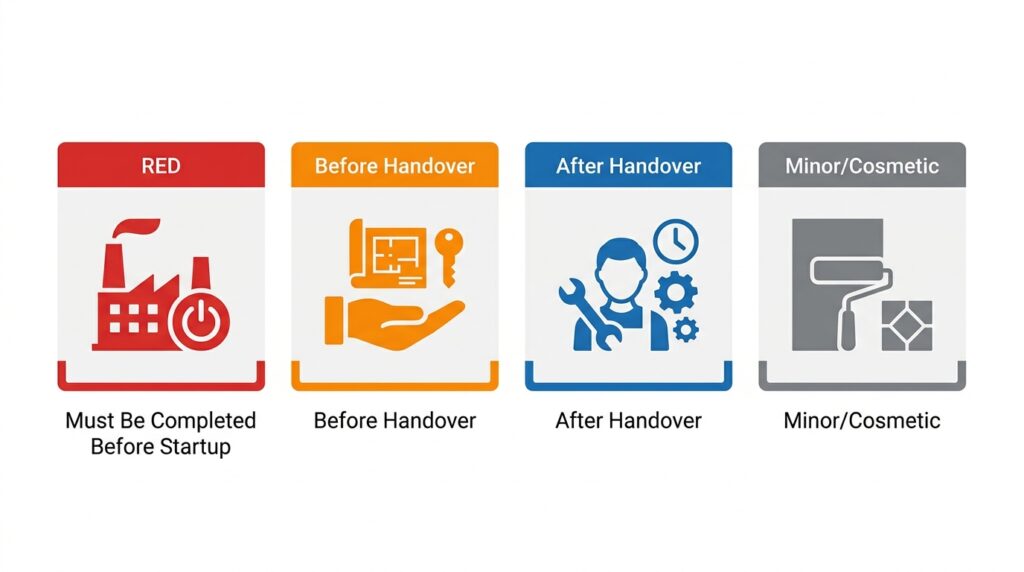
    Category Description Priority
    A Must be completed before startup Highest
    B Must be completed before handover High
    C Can be completed after handover Medium
    D Minor or cosmetic items Low

    Punch list management:

    • Identification: Identify all outstanding items.
    • Categorization: Categorize by priority.
    • Assignment: Assign responsibility for each item.
    • Tracking: Track completion of each item.
    • Verification: Verify that items are completed correctly.
    • Closure: Close items when complete.

    The punch list should be managed actively, not left to the end. Category C and D items that remain open at handover should have an agreed completion date and a clear owner, and the contract should specify any payment retention tied to them. Category A items, especially those with safety implications, must never be carried past startup.

    Documentation Handover

    Types of handover documentation for plant handover

    Documentation is one of the most important, and most often incomplete, aspects of handover.

    Document Type Examples
    As-built drawings P&IDs, isometrics, electrical drawings
    Equipment manuals Vendor manuals, operating instructions
    Test records Commissioning records, test certificates
    Quality records Inspection reports, material certificates
    Operating procedures Startup, operation, shutdown procedures
    Maintenance procedures Inspection, maintenance, repair procedures
    Safety procedures Emergency procedures, safety data sheets
    Spare parts lists Recommended spares, supplier information
    Warranty documents Warranty terms, contact information
    Control system records Software backups, configuration records, control logic documentation
    Permits and approvals Operating permits, licenses, inspection certificates

    Documentation should be complete, accurate, and organized for easy access. Agree on the format (paper, electronic, or both), the indexing and naming convention, and the document register before handover begins. A handover document register, checked item by item against the contract requirements, is the most reliable way to confirm that nothing is missing.

    As-Built Documentation

    As-built documentation reflects the plant as it was actually built, not as it was designed.

    As-built documentation requirements:

    • Updated drawings: Drawings reflect actual construction.
    • Marked changes: Changes from design are clearly marked.
    • Approval: As-built documentation is approved by the contractor.
    • Verification: As-built documentation is verified against the plant, typically through a field walkdown.
    • Delivery: As-built documentation is delivered to the owner.

    As-built documentation is essential for future maintenance, modifications, and safety. Incorrect or outdated P&IDs, for example, can lead to mistakes in isolation, management of change, and hazard reviews.

    Control Systems and Software Handover

    Control systems and software are often overlooked at handover. Control system handover includes software backups, licenses, configuration records, and documentation of control logic, alarm settings, and safety system configurations. Without these, the owner cannot maintain or modify the control system independently.

    Control system handover typically includes:

    • Software backups: Complete, verified backups of DCS, PLC, SCADA, and safety system programs.
    • Licenses: Software licenses transferred to the owner, with registration details and renewal dates.
    • Configuration records: Network configuration, I/O lists, and hardware configuration records.
    • Control logic documentation: Control narratives, logic diagrams, and cause-and-effect matrices.
    • Alarm and setpoint records: Alarm settings, trip setpoints, and the alarm rationalization basis.
    • Safety system configuration: Safety instrumented system settings, bypass records, and proof test requirements.
    • Access and security: Administrator credentials, user accounts, and cybersecurity documentation transferred under a controlled process, with any contractor or vendor default passwords changed.

    The backups should be tested to confirm they can actually be restored, not just stored.

    Permits and Regulatory Approvals

    Regulatory permits, licenses, and approvals should be transferred or reissued in the owner’s name at handover. Operating permits may require inspection or certification before they are issued.

    Both parties should agree early on who is responsible for each permit. Typical items include:

    • Operating permits and licenses
    • Environmental permits and emission or discharge approvals
    • Pressure vessel and boiler certifications
    • Electrical and fire safety inspections and approvals
    • Occupancy or completion certificates

    The permit register should record the issuing authority, validity period, conditions, and renewal dates. Missing a permit can delay startup or place the owner out of compliance on the first day of operation.

    Training and Competency

    The owner’s staff must be trained to operate and maintain the plant.

    Category Description
    Operations training How to operate the plant
    Maintenance training How to maintain equipment
    Safety training How to work safely
    Emergency training How to respond to emergencies
    Vendor training Equipment-specific training from vendors

    Training considerations:

    • Timing: Training should begin before handover, and ideally before commissioning, so that operators can take part in startup.
    • Competency: Training should include competency assessment.
    • Documentation: Training records should be maintained.
    • Refresher: Refresher training should be planned.

    Training is not complete until staff can demonstrate competency.

    Training Records and Competency Assessments

    Training records, including competency assessments and qualifications, should be handed over to the owner. These records demonstrate that staff are qualified to operate and maintain the plant, and they support future audits and regulatory compliance.

    Spare Parts and Consumables

    The owner needs spare parts and consumables to operate and maintain the plant.

    Spare parts handover:

    • Recommended spares: Spares recommended by vendors.
    • Critical spares: Spares essential for operation.
    • Consumables: Filters, lubricants, chemicals, and initial fills.
    • Inventory: Spare parts inventory and location.
    • Supplier information: Supplier contacts and part numbers.

    Spare parts should be delivered, inventoried, and stored properly. Spares used by the contractor during commissioning should be replaced before handover.

    Warranty Management

    Warranty management begins at handover and continues through the warranty period.

    Warranty handover:

    • Warranty terms: What is covered, for how long, and from what date.
    • Warranty contacts: Who to contact for warranty claims.
    • Warranty procedures: How to submit and track claims.
    • Warranty register: Record of all warranties and expiry dates.

    Warranty management should be planned from the beginning of the project. Owners should also keep a clear record of defects found during the warranty period, with dates and evidence, so that claims can be made before the warranty expires. A defects inspection shortly before expiry is good practice.

    Vendor Contacts and Support Arrangements

    Vendor contact information and support arrangements should be documented at handover. This includes warranty contacts, technical support, spare parts suppliers, and service agreements.

    A vendor support register should list, for each major item of equipment, the vendor, local service representative, technical support channel, response time commitments, and any service or maintenance agreements. Ongoing vendor support is especially important for specialized equipment such as turbines, compressors, and control systems.

    Care, Custody, and Control

    Handover is also a transfer of responsibility and risk. The contract should state clearly when care, custody, and control of each system or area passes from the contractor to the owner. This affects:

    • Safety responsibility: Who authorizes work, controls isolations, and responds to incidents in each area.
    • Insurance: When the construction insurance ends and the owner’s operating insurance begins.
    • Site access and security: Who controls access to the plant.
    • Utilities and consumables: Who pays for and manages power, water, and fuel.

    A pre-startup safety review (PSSR) before introducing hazardous materials or energy is the key safety check at this point. Any gap between the contractor’s and owner’s responsibilities should be closed before startup.

    Final Acceptance

    Final acceptance is the formal confirmation that the plant meets requirements.

    Final acceptance activities:

    • Verification: Verify that all requirements are met.
    • Punch list closure: Confirm that all punch list items are closed or accepted.
    • Documentation review: Confirm that documentation is complete.
    • Training confirmation: Confirm that training is complete.
    • Sign-off: Sign the final acceptance certificate.

    Final acceptance is a contractual milestone with payment and warranty implications.

    Many contracts use two acceptance stages. Provisional acceptance (also called taking-over or preliminary acceptance) occurs when the plant has passed performance tests and the owner takes over operation, with the warranty period starting. Final acceptance occurs at the end of the warranty period, once defects have been corrected and the remaining retention is released. Owners should check which terms and milestones their contract uses so that payment, warranty, and responsibility are all clearly tied to the right event.

    Handover Ceremony and Knowledge Transfer

    Handover is not just a formal event. It is a knowledge transfer.

    Knowledge transfer activities:

    • Walkthroughs: Contractor walks the owner through the plant.
    • System explanations: Contractor explains how systems work.
    • Lessons learned: Contractor shares lessons from construction and commissioning.
    • Contacts: Contractor provides contacts for future support.
    • Documentation review: Contractor explains documentation.

    Knowledge transfer ensures that the owner understands the plant, not just owns it. Where possible, owner operations and maintenance staff should be involved during construction and commissioning, so that handover confirms knowledge they already have rather than introducing it for the first time.

    Common Mistakes in Handover and Turnover

    Even experienced organizations make mistakes. Common ones include:

    • Handover not planned: Handover left to the end.
    • Incomplete documentation: Missing or incomplete documents.
    • Control system records missing: No backups, licenses, or configuration records.
    • Permits not transferred: Regulatory approvals not in the owner’s name or not yet issued.
    • Punch list not managed: Outstanding items not tracked.
    • Training incomplete: Staff not trained or competent, or training records not handed over.
    • Spare parts missing: Spares not delivered or inventoried.
    • Warranty not documented: Warranty terms unclear.
    • Vendor support unclear: No record of who to call when equipment fails.
    • Final acceptance rushed: Sign-off without proper verification.
    • Knowledge transfer poor: Owner does not understand the plant.
    • Handover criteria unclear: What must be complete is not defined.

    These mistakes are costly to correct. They are much cheaper to avoid through good planning and disciplined execution.

    How Japanese EPC Firms Approach Handover and Turnover

    Japanese engineering firms are known for their disciplined approach to handover. Common characteristics include:

    • Thorough planning: Handover is planned from the beginning.
    • Detailed documentation: Documentation is complete and accurate.
    • Disciplined punch list management: Outstanding items are tracked and closed.
    • Comprehensive training: Staff are trained and assessed for competency.
    • Systematic knowledge transfer: Contractor ensures the owner understands the plant.
    • Formal acceptance: Final acceptance is not rushed.
    • Long-term support: Contractor provides support after handover.

    For plant owners, this often means a plant that is ready to operate from day one.

    How to Evaluate Handover Readiness

    When reviewing handover readiness, ask:

    Question Why It Matters
    Is handover planned? Provides a roadmap for handover
    Are handover criteria defined? Defines what must be complete
    Is mechanical completion achieved? Confirms construction is complete
    Is commissioning complete? Confirms systems are functional
    Is the punch list managed? Ensures outstanding items are tracked
    Is documentation complete? Ensures owner has needed information
    Are control system backups, licenses, and records delivered? Allows the owner to maintain and modify the control system
    Are permits transferred or reissued? Ensures legal operation from day one
    Is training complete and recorded? Ensures staff can operate the plant and supports audits
    Are spare parts delivered? Ensures owner can maintain the plant
    Are warranty and vendor support documented? Ensures claims and support requests can be made
    Is responsibility for care, custody, and control clear? Avoids gaps in safety and insurance
    Is final acceptance planned? Ensures formal confirmation

    A plant that addresses these questions is ready for successful handover.

    Conclusion

    Handover and turnover are the transition from construction to operation. For small to medium-scale industrial plants, they determine whether the owner can operate the plant effectively from day one.

    By focusing on handover planning, criteria, punch list management, documentation, control systems, permits, training, spare parts, warranty, vendor support, and final acceptance, owners and contractors can ensure that handover is smooth and the plant is ready for reliable operation.

    Key Takeaways

    • Handover is the transition from construction to operation
    • Handover should be planned from the beginning of the project
    • Handover criteria define what must be complete before handover
    • Punch list items should be categorized by priority and managed actively
    • Documentation handover includes as-built drawings, manuals, records, procedures, and warranties
    • Control system handover includes software backups, licenses, and configuration records
    • Permits and regulatory approvals should be transferred or reissued in the owner’s name
    • Training is not complete until staff can demonstrate competency, and training records should be handed over
    • Spare parts, warranty, and vendor support arrangements are part of handover
    • Final acceptance is a formal confirmation with contractual implications
    • Knowledge transfer ensures the owner understands the plant
    • Japanese EPC firms emphasize thorough planning and disciplined documentation