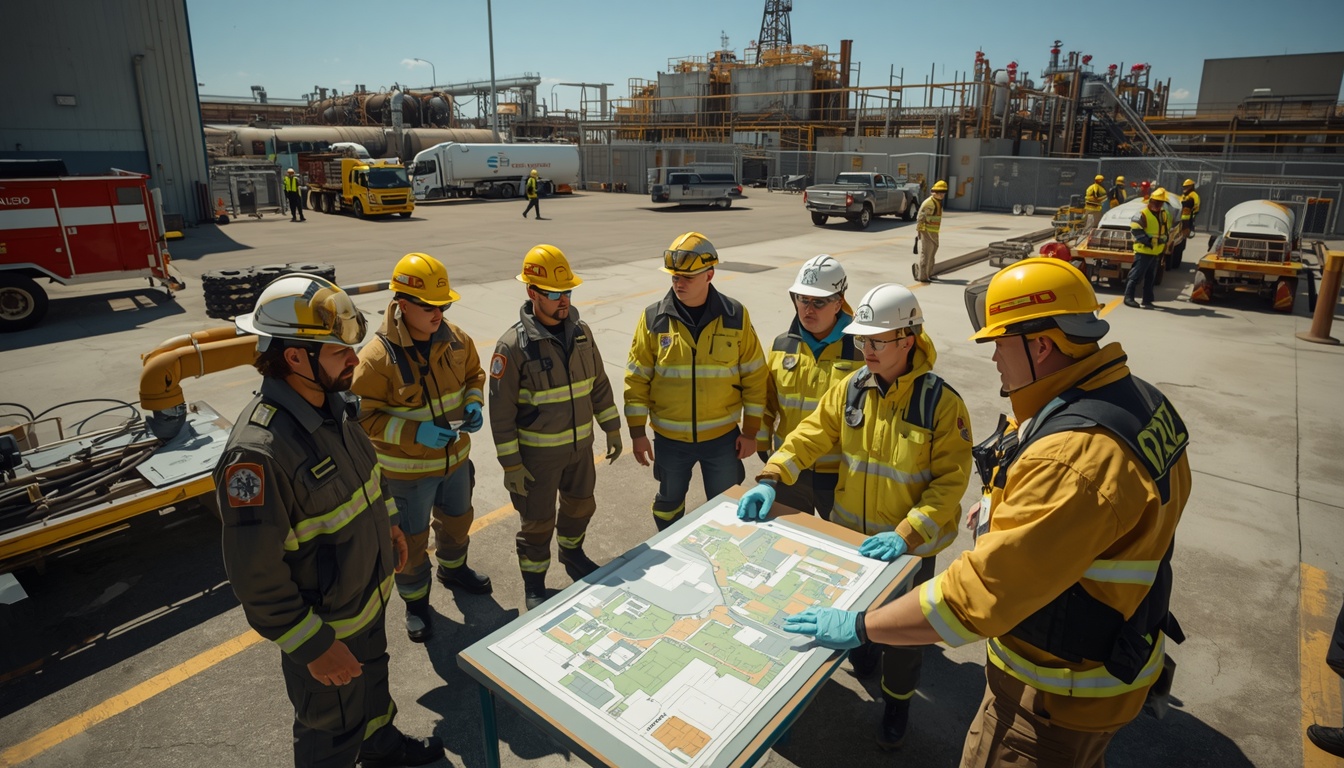
Even the safest plant can experience an emergency. Fires, explosions, toxic releases, and natural disasters can occur despite every precaution. When they do, the difference between a controlled incident and a catastrophe often comes down to how well the plant is prepared.
Emergency response planning is the process of preparing for incidents before they occur. It defines what could go wrong, who does what, how people are alerted, and how the response is coordinated. It connects the plant’s safety systems with the people and procedures that must act when those systems are challenged.
For small to medium-scale industrial plants, emergency response planning is especially critical. These plants have less redundancy and fewer resources to absorb the consequences of a slow or disorganized response. A plan that is clear, practical, and practiced can save lives, protect the environment, and reduce damage.
This article covers the key considerations in emergency response planning for industrial plants, from hazard identification to training, drills, coordination with external services, and recovery after the incident.
What Is Emergency Response Planning?
Emergency response planning is the process of preparing for credible emergency scenarios and defining how the plant will respond. It includes:
- Hazard identification: What emergencies could occur?
- Scenario development: What would each emergency look like?
- Response procedures: What actions are required, and by whom?
- Roles and responsibilities: Who is in charge, and who does what?
- Communication: How are people alerted, and how is information shared?
- Resources: What equipment and supplies are needed?
- Training and drills: How are people prepared to respond?
- Coordination: How does the plant work with external responders?
- Recovery: How does the plant return to normal after the incident?
Emergency response planning is not a document. It is a capability that must be developed, practiced, and maintained.
Why Emergency Response Planning Matters
A well-prepared plant responds quickly and effectively. A poorly prepared plant responds slowly, chaotically, or not at all.
| Factor | Impact of Good Emergency Response | Impact of Poor Emergency Response |
|---|---|---|
| Life safety | People are protected; injuries minimized | Injuries and fatalities more likely |
| Environmental | Releases contained; impact minimized | Releases spread; long-term damage |
| Asset protection | Damage limited | Damage extensive; plant may be destroyed |
| Business continuity | Faster recovery; production restored | Extended outage; business at risk |
| Regulatory | Compliance maintained | Fines, penalties, legal action |
| Reputation | Trust maintained | Reputation damaged |
For small plants, where resources are limited, a focused and practical plan is more valuable than a comprehensive document that no one uses.
Regulatory and Standards Context
Emergency planning requirements vary by country and by the hazards present at the plant. Owners should identify the requirements that apply to their site early. Common reference points include:
- National and local regulations on emergency action plans, fire prevention plans, and hazardous materials response (for example, OSHA 29 CFR 1910.38 and 1910.120 in the United States)
- Process safety regulations for plants handling hazardous chemicals, which often require emergency planning as part of the overall safety management system
- Environmental regulations on spill reporting and release notification
- Consensus standards and guidance, such as NFPA 1600 (continuity, emergency, and crisis management) and ISO 22301 (business continuity management)
- Community awareness programs, such as APELL (Awareness and Preparedness for Emergencies at Local Level), where the plant’s hazards could affect neighbors
The plan should state which requirements apply and where compliance is documented.
Hazard Identification for Emergency Planning
Emergency planning begins with identifying the emergencies that could occur. The plant’s hazard and risk assessments (such as HAZOP, process hazard analysis, and fire risk assessments) are the primary inputs.
Common emergency scenarios:
| Scenario | Examples |
|---|---|
| Fire | Equipment fire, electrical fire, flammable liquid fire |
| Explosion | Dust explosion, gas explosion, pressure vessel rupture |
| Toxic release | Chemical spill, gas leak, toxic vapor release |
| Natural disaster | Earthquake, flood, typhoon or severe weather |
| Utility failure | Power loss, water loss, instrument air loss |
| Security | Intrusion, sabotage, cyberattack |
| Medical | Injury, illness, exposure |
For each scenario, the planning team should consider:
- How likely is it?
- How severe would the consequences be?
- What warning would there be?
- How much time would people have to respond?
- What resources would be needed?
- Could the emergency affect neighbors or the surrounding community?
Developing Emergency Scenarios
For each credible emergency, the planning team develops a scenario that describes what would happen and how the plant would respond.
A good scenario includes:
- Initiating event: What starts the emergency?
- Progression: How does it develop over time, and could it escalate (for example, a small fire spreading to a storage area)?
- Impacts: What are the consequences for people, environment, and assets?
- Response actions: What must be done, and in what order?
- Resources required: What equipment, personnel, and support are needed?
- Decision points: Where are the key decisions, and who makes them?
Scenarios should be based on the plant’s actual hazards and operations, not on generic templates.
Emergency Levels
Many plants classify emergencies by severity so that the response is proportionate and escalation is clear. A typical approach:
| Level | Description | Typical Response |
|---|---|---|
| Level 1 | Minor incident, controlled by the area team | Local response; supervisor informed |
| Level 2 | Significant incident, requires the plant emergency team | Emergency team activated; external services alerted |
| Level 3 | Major emergency, threatens the plant or community | Full activation; external services respond; off-site notification |
The criteria for each level, and who can declare or escalate, should be defined in advance.
Emergency Response Organization
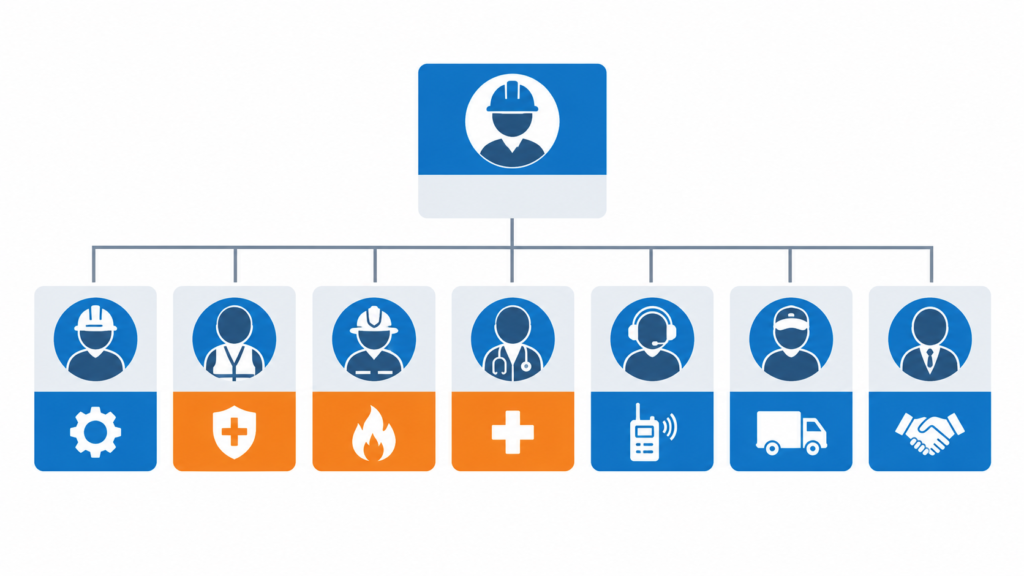
A clear organization is essential for effective response. Many plants adopt an incident command approach, in which one person has overall command and the structure can expand or contract as the incident requires.
Key roles:
| Role | Responsibility |
|---|---|
| Emergency Coordinator (Incident Commander) | Overall command and decision-making |
| Operations Leader | Manages process shutdown and isolation |
| Safety Officer | Monitors safety conditions and advises |
| Fire Team | Firefighting and rescue (if on-site) |
| Medical Team | First aid and medical response |
| Communication Officer | Internal and external communications |
| Logistics Officer | Resources, equipment, and support |
| Liaison Officer | Coordinates with external agencies |
For small plants, roles may be combined, but each function must be assigned. Everyone must know their role before an emergency occurs.
Good practice also includes:
- Deputies for every key role, since the primary person may be absent, off shift, or affected by the incident
- Coverage for all shifts, including nights, weekends, and holidays
- A designated emergency control point, such as a control room or a separate command post, with plant drawings, contact lists, and communication equipment
- Defined authority, including the authority to initiate emergency shutdown without waiting for approval
Emergency Shutdown and Isolation
For many process emergencies, stopping the source is the most effective response. The plan should define:
- When emergency shutdown may or must be initiated
- Who has the authority to initiate it
- Which isolation valves and power disconnects must be operated
- How to keep the plant in a safe state afterward (depressurizing, cooling, inventory control)
These actions should be coordinated with the plant’s safety systems and operating procedures.
Emergency Communication
Communication is critical during an emergency. People must be alerted, information must be shared, and decisions must be communicated.
Communication systems:
- Alarm systems: Audible and visual alarms to alert personnel.
- Public address: Voice communication to direct people.
- Radio systems: For response team coordination.
- Telephone: For internal and external communication.
- Emergency notification: For alerting off-site personnel and management.
Communication considerations:
- Redundancy: What if the primary system fails?
- Coverage: Can everyone hear or see the alarm, including in noisy areas and for people with hearing impairments?
- Clarity: Are messages clear and unambiguous? Are alarm signals for different emergencies (fire, gas release, evacuation) distinguishable?
- Language: Are messages understood by all personnel, including contractors and visitors?
- Power supply: Will critical communication systems work during a power failure?
- Intrinsic safety: Are radios and other devices suitable for classified hazardous areas?
Crisis Communication
Communication with the public, media, and regulators during a major emergency requires careful management. Only authorized personnel should speak on behalf of the plant, and messages should be accurate, timely, and consistent. The plan should identify the spokesperson and a backup, define who must be notified (regulators, neighbors, corporate management, insurers), and set out the time limits for mandatory notifications. Prepared holding statements and contact lists help ensure a fast and consistent initial message. Employees should be reminded not to speak to the media or post information on social media.
Communication with employees’ families is also important. Families will want information about the safety of their relatives, and a clear process for this relieves pressure on the response team.
Evacuation and Muster
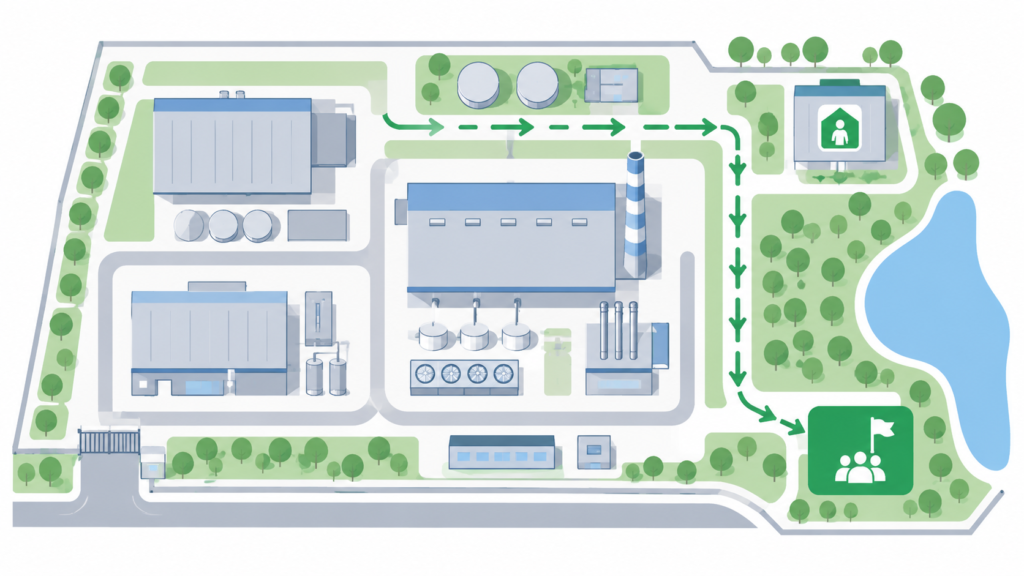
When an emergency occurs, people may need to evacuate. Evacuation planning ensures that people can leave safely and be accounted for.
Key elements:
- Evacuation routes: Clearly marked, unobstructed, lit, and safe. At least two routes from each area where possible.
- Assembly points: Designated locations where people gather, located upwind and at a safe distance from credible hazards, with an alternate point available.
- Headcount: Procedure for accounting for all personnel, contractors, and visitors.
- Muster procedures: What happens at the assembly point?
- Shelter-in-place: Where people go if evacuation is not possible or if staying inside is safer, such as during a toxic release.
- Accountability: Who confirms that everyone is accounted for, and to whom is the result reported?
- Assistance: How are people with disabilities or injuries helped to evacuate?
Wind direction indicators, such as windsocks, help people choose a safe route and assembly point in a release.
Evacuation routes and assembly points must be communicated to everyone, including contractors and visitors. Site inductions, signage, and site maps all support this.
Emergency Resources
Emergency response requires equipment and supplies.
Typical resources:
| Resource | Purpose |
|---|---|
| Firefighting equipment | Extinguishers, hoses, foam, monitors |
| Spill response equipment | Absorbents, booms, containment |
| Personal protective equipment | For response team members, including respiratory protection where needed |
| First aid supplies | For medical response, including defibrillators and eyewash/safety showers where hazards require them |
| Communication equipment | Radios, phones, PA systems |
| Emergency power | For critical systems during power loss |
| Emergency lighting | For evacuation and response |
| Rescue equipment | For confined space, height, or vehicle rescue |
| Gas detection and monitoring | For atmospheric monitoring during response |
Resources must be maintained, inspected, and accessible. Inspection records should be kept, and responders should be trained on the equipment they are expected to use.
Coordination with External Services
Small plants often rely on external services for emergency response.
External services:
- Fire department: For firefighting and rescue.
- Emergency medical services: For medical response.
- Police: For security and traffic control.
- Environmental agencies: For spill response and reporting.
- Utility companies: For power, water, and gas emergencies.
- Mutual aid partners: Neighboring plants that can provide support.
Coordination considerations:
- Pre-incident planning: Meet with external services before an emergency.
- Site familiarization: Invite external services to visit the plant.
- Communication protocols: Agree on how to communicate during an emergency.
- Joint exercises: Practice response together.
- Contact information: Keep current contact information for all external services.
- Information for responders: Provide site maps, hazard information, safety data sheets, and access routes before an incident, and be ready to brief responders on arrival.
- Command interface: Agree on how the plant’s emergency coordinator hands over or shares command with the public fire service.
Mutual Aid Agreements
Mutual aid agreements with neighboring plants can provide additional equipment, personnel, and expertise during a major emergency. These agreements should be documented, and the parties should train together periodically. They should specify what each party will provide, how assistance is requested, who commands the joint response, and how costs and liability are handled.
Remote Plants
Remote plants may face longer response times from external services. These plants may need to maintain greater on-site response capability, including firefighting and medical response, until external help arrives. They may also need to plan for limited road access, weather-related delays, extended self-sufficiency in water and power, and medical evacuation by air or other means. Communication systems that do not depend on local networks, such as satellite phones, may also be warranted.
Training and Drills
Emergency response capabilities must be developed through training and maintained through drills.
Training:
- Initial training: For all personnel on emergency procedures.
- Role-specific training: For response team members.
- Refresher training: Periodic review of procedures.
- New employee training: For new hires and contractors.
Drills:
- Tabletop exercises: Discussion-based walkthrough of scenarios.
- Walkthrough drills: Physical walkthrough of response actions.
- Functional drills: Testing specific response functions.
- Full-scale exercises: Simulating a full emergency response.
Drills should be:
- Realistic: Based on credible scenarios.
- Varied: Different scenarios, times, and conditions, including night shifts and unannounced drills where appropriate.
- Evaluated: Debriefed to identify improvements.
- Documented: Records kept for regulatory and improvement purposes, with corrective actions tracked to completion.
Emergency Response Plan Documentation
The emergency response plan should be documented and accessible.
Plan contents:
- Hazard identification: What emergencies could occur?
- Scenario descriptions: What would each emergency look like?
- Emergency levels and escalation: When and how does the response escalate?
- Response procedures: What actions are required?
- Roles and responsibilities: Who does what?
- Communication procedures: How is information shared, including crisis communication?
- Evacuation and muster: Where do people go?
- Resources: What equipment and supplies are available?
- External coordination: How does the plant work with external services and mutual aid partners?
- Recovery and business continuity: How does the plant return to normal?
- Training and drills: How are people prepared?
- Review and revision: How is the plan kept current?
The plan should be available to all personnel, with key actions summarized on quick-reference cards or checklists that can be used under stress. Copies, including an off-site or electronic copy, should be available even if the plant is inaccessible.
Post-Incident Recovery
After the emergency is controlled, recovery begins. This includes damage assessment, cleanup, investigation, and planning for restart. Recovery should be planned as part of the emergency response process.
Key recovery activities include:
- Securing the site: Preserving evidence and preventing re-ignition, re-release, or unauthorized entry.
- Damage assessment: Evaluating structures, equipment, and systems before they are used again.
- Cleanup and waste management: Handling contaminated materials, firefighting water, and spilled product in line with environmental requirements.
- Investigation: Determining root causes and contributing factors.
- Care for people: Supporting injured employees, affected families, and personnel who experienced a traumatic event.
- Restart planning: Ensuring that repairs are completed, changes are reviewed, and a pre-startup safety review is carried out before operations resume.
- Notifications and reporting: Completing regulatory reports and insurance claims.
Business Continuity
Emergency response focuses on immediate life safety and incident control. Business continuity focuses on restoring operations after the emergency. Both should be planned together, so that recovery begins as soon as the emergency is under control.
Business continuity planning typically considers:
- Which operations are most critical, and how quickly they must be restored
- Availability of critical spare parts, long-lead equipment, and alternate suppliers
- Alternative production or storage arrangements
- Key personnel, records, and data backup
- Insurance coverage and claims procedures
Plan Review and Improvement
Emergency response plans must be reviewed and updated regularly.
Review triggers:
- After an incident: What worked, what didn’t?
- After a drill: What was learned?
- After a change: Does the plan reflect current conditions, such as new processes, new materials, layout changes, or staffing changes?
- On a schedule: At least annually.
- After regulatory changes: Do new requirements apply?
Review should involve personnel who would respond to an emergency. Their input is essential for a practical plan.
Common Mistakes in Emergency Response Planning
Even experienced organizations make mistakes. Common ones include:
- No plan: Assuming an emergency won’t happen.
- Plan not practiced: A document that no one has read or used.
- Unrealistic scenarios: Planning for unlikely events while ignoring credible ones.
- Unclear roles: People not knowing what to do.
- No backups for key roles: The plan fails when the named person is absent.
- Poor communication: People not hearing or understanding alarms.
- Blocked evacuation routes: Routes obstructed or not maintained.
- Insufficient resources: Equipment missing or not maintained.
- No external coordination: External services unfamiliar with the plant.
- No plan for recovery: Response ends when the fire is out, with no plan for what follows.
- Unmanaged public communication: Conflicting or inaccurate statements to the media and regulators.
- No review: Plan outdated after changes.
- No learning: Lessons from drills and incidents not applied.
These mistakes become apparent during an emergency, when it is too late to correct them.
How Japanese EPC Firms Approach Emergency Response Planning
Japanese engineering firms are known for their disciplined approach to safety and emergency preparedness. Common characteristics include:
- Thorough hazard identification: All credible scenarios are identified.
- Detailed planning: Response procedures are clear, practical, and specific.
- Clear roles: Everyone knows their role and responsibility.
- Comprehensive training: All personnel are trained on emergency procedures.
- Regular drills: Drills are conducted regularly and evaluated.
- External coordination: Relationships with external services are developed and maintained.
- Continuous improvement: Lessons from drills and incidents are applied.
- Long-term focus: Emergency preparedness is treated as an ongoing commitment.
For plant owners, this often means a faster, more effective response when an emergency occurs, and a safer workplace every day.
How to Evaluate Emergency Response Planning
When reviewing emergency response planning, ask:
| Question | Why It Matters |
|---|---|
| Have all credible emergencies been identified? | You cannot prepare for unknown scenarios |
| Are scenarios realistic and specific? | Ensures planning is relevant to actual hazards |
| Are emergency levels and escalation criteria defined? | Ensures a proportionate and timely response |
| Are roles and responsibilities clear, with deputies named? | Ensures people know what to do on every shift |
| Is communication reliable and clear? | Ensures people are alerted and informed |
| Is there a crisis communication plan? | Ensures consistent messages to the public, media, and regulators |
| Are evacuation routes clear and unobstructed? | Ensures people can leave safely |
| Are resources available and maintained? | Ensures response equipment works when needed |
| Are external services and mutual aid partners coordinated? | Ensures effective joint response |
| Are response times from external help realistic for the site? | Determines how much on-site capability is needed |
| Are training and drills conducted? | Ensures people are prepared |
| Are recovery and business continuity planned? | Ensures the plant can return to operation |
| Is the plan reviewed and updated? | Keeps the plan current |
| Is there a process for learning from drills and incidents? | Ensures continuous improvement |
A plant that addresses these questions is likely to have an effective emergency response capability.
Key Takeaways
- Emergency response planning prepares the plant for credible emergency scenarios
- Hazard identification and scenario development are the foundation of planning
- Clear roles and responsibilities, with backups for every key role, ensure effective response
- Communication systems must be reliable, clear, and redundant, and crisis communication must be managed by authorized spokespersons
- Evacuation routes and assembly points must be clear and unobstructed
- External services and mutual aid partners should be coordinated before an emergency occurs
- Remote plants may need greater on-site response capability while waiting for external help
- Recovery and business continuity should be planned together with the emergency response
- Training and drills develop and maintain response capability
- Plans must be reviewed and updated regularly
- Japanese EPC firms emphasize thorough planning, clear roles, and regular drills
Conclusion
Emergency response planning is not about expecting the worst. It is about being prepared for it. For small to medium-scale industrial plants, where resources are limited and the consequences of a slow response are severe, effective planning is essential.
By identifying hazards, developing realistic scenarios, defining roles, ensuring communication, maintaining resources, training personnel, coordinating with external services, and planning for recovery, owners and operators can ensure that the plant is ready to respond effectively when an emergency occurs, and ready to return to operation afterward.