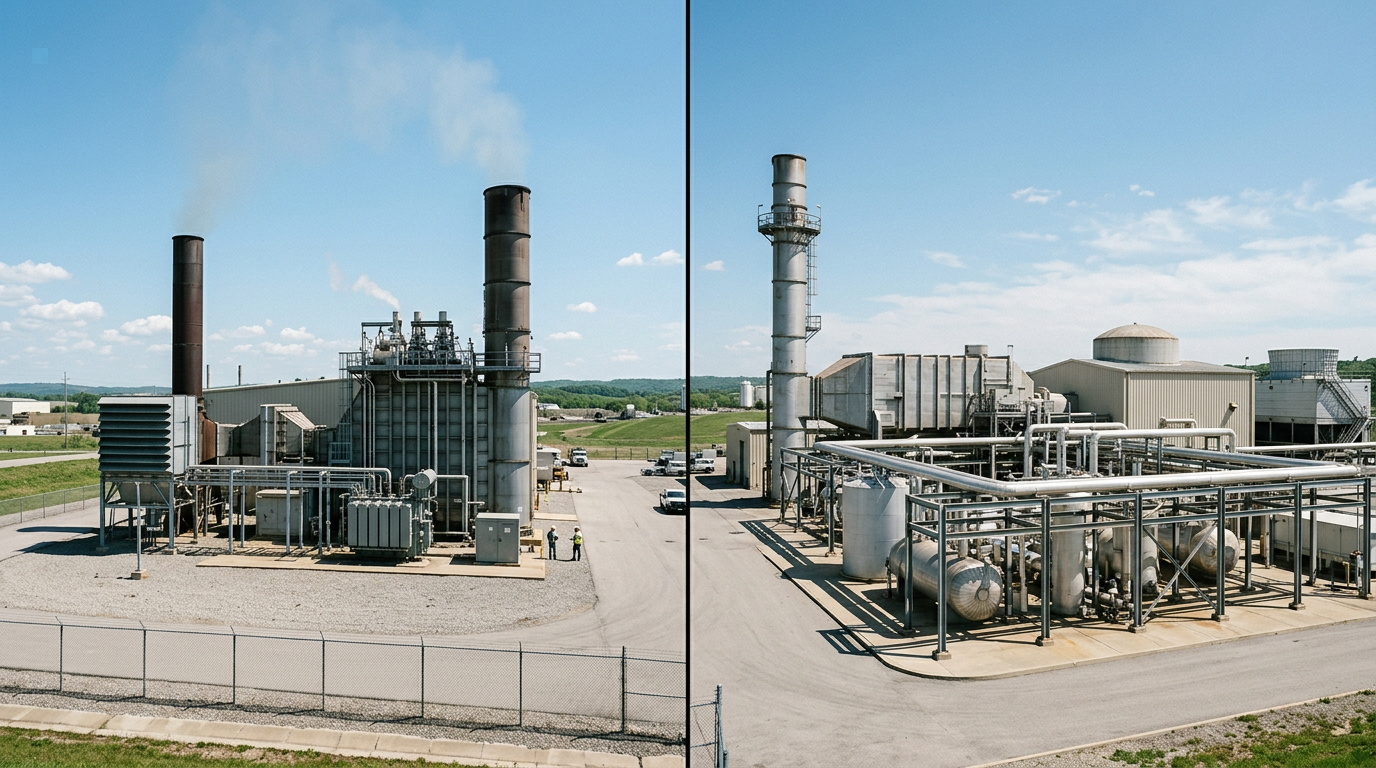
When planning a thermal power plant, one of the first configuration decisions is whether to use a simple cycle or a combined cycle. This choice affects capital cost, efficiency, fuel consumption, emissions, and operational flexibility. For small to medium-scale industrial plants, the right choice depends on your load profile, fuel availability, site constraints, and financial objectives.
This article explains the difference between simple cycle and combined cycle, compares them side by side, and helps you decide which configuration fits your project.
Note on fuel: this article assumes natural gas throughout. Gas turbines can also run on liquid fuels such as distillate and on syngas. Simple cycle plants are generally more fuel-flexible, while combined cycle plants are most often gas-fired, with liquid fuel typically used only as backup.
What Is a Simple Cycle Plant?
A simple cycle plant uses a gas turbine to generate electricity directly. The turbine burns fuel, produces hot exhaust gas, and drives a generator. The exhaust gas is then released to the atmosphere.
Simple cycle plants are:
- Simple to design and build: Fewer components, shorter construction time.
- Lower in capital cost: Less equipment, smaller footprint.
- Fast to start: Can reach full load in minutes.
- Less efficient: Typical efficiency of 30–40%.
- Higher heat rate: More fuel consumed per unit of output.
Simple cycle plants are often used for peaking power, backup generation, and remote locations where simplicity and speed matter more than efficiency.
What Is a Combined Cycle Plant?
A combined cycle plant uses both a gas turbine and a steam turbine to generate electricity. The gas turbine produces electricity, and its hot exhaust gas is directed to a heat recovery steam generator (HRSG). The HRSG produces steam, which drives a steam turbine to generate additional electricity.
Combined cycle plants are:
- More efficient: Typical efficiency of 50–60% or higher.
- Lower heat rate: Less fuel consumed per unit of output.
- Higher capital cost: More equipment, larger footprint.
- Slower to start: Takes longer to reach full load.
- More complex to design and operate.
Combined cycle plants are often used for baseload power, where high efficiency and low fuel cost are priorities.
The Key Difference
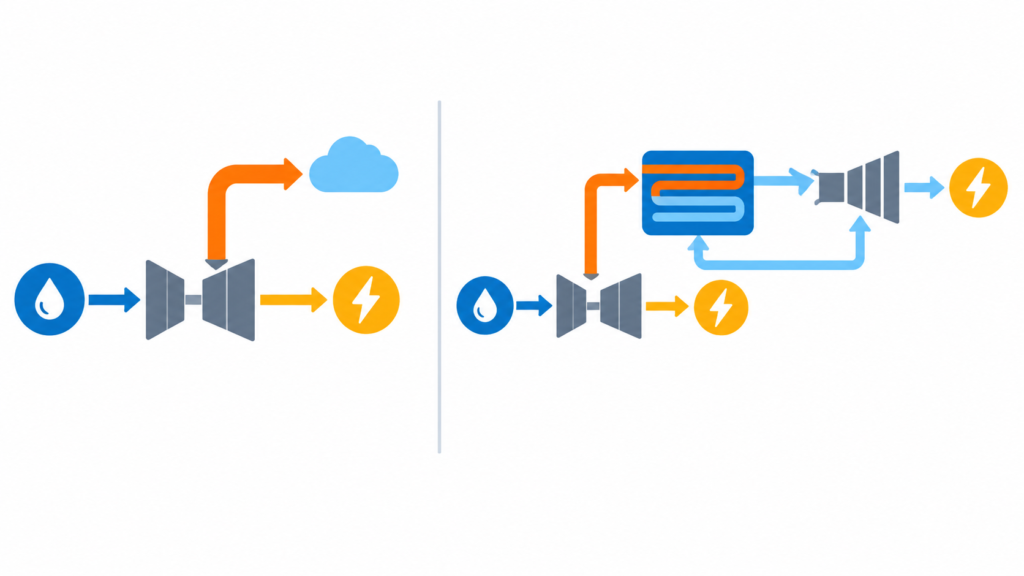
The fundamental difference is waste heat recovery.
In a simple cycle plant, the hot exhaust gas from the gas turbine is wasted. In a combined cycle plant, that heat is captured and used to generate additional electricity.
This is why combined cycle plants achieve much higher efficiency. By recovering waste heat, they extract more useful energy from the same fuel.
Side-by-Side Comparison
| Factor | Simple Cycle | Combined Cycle |
|---|---|---|
| Efficiency | 30–40% | 50–60% or higher |
| Heat rate | Higher (more fuel per kWh) | Lower (less fuel per kWh) |
| Capital cost | Lower | Higher |
| Footprint | Smaller | Larger |
| Construction time | Shorter | Longer |
| Startup time | Fast (minutes) | Slower (30–60 minutes hot start; several hours cold) |
| Operational flexibility | High | Lower |
| Emissions per kWh | Higher | Lower |
| Typical use | Peaking, backup | Baseload, industrial |
| Sensitivity to fuel price | High | Lower |
When Simple Cycle Makes Sense
Simple cycle is often the right choice when:
- Capital cost is the primary constraint. If budget is limited, simple cycle requires less upfront investment.
- The plant operates infrequently. Peaking plants that run only a few hundred hours per year do not benefit much from higher efficiency.
- Fast startup is critical. Simple cycle plants can reach full load in minutes, making them ideal for grid support.
- The site is remote or constrained. Smaller footprint and simpler infrastructure reduce site requirements.
- Fuel is cheap or subsidized. If fuel cost is low, the efficiency penalty of simple cycle matters less.
- The project needs to be built quickly. Shorter construction time can be a decisive advantage.
When Combined Cycle Makes Sense
Combined cycle is often the right choice when:
- The plant operates frequently. Baseload or industrial plants that run thousands of hours per year benefit greatly from higher efficiency.
- Fuel cost is significant. Lower heat rate translates directly into lower operating cost.
- Emissions limits are tight. Combined cycle produces less CO₂ and other emissions per kWh.
- Long-term economics matter more than upfront cost. Higher capital cost is recovered through fuel savings over the plant’s life.
- The site can accommodate a larger plant. Combined cycle requires more space for the HRSG, steam turbine, and cooling systems.
- The load profile is stable. Combined cycle plants perform best when operating at steady, high load.
The Economics of Combined Cycle
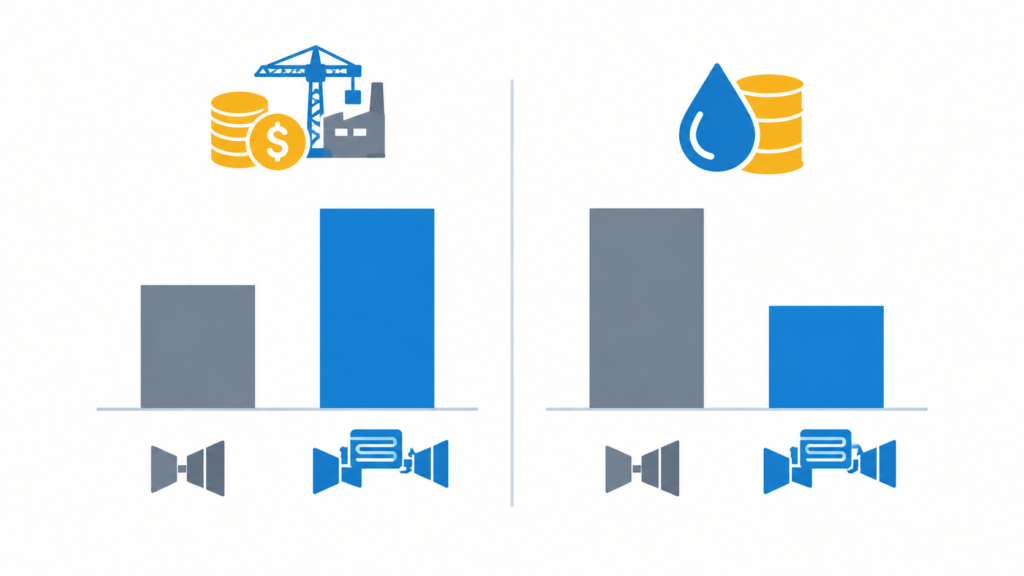
The higher capital cost of combined cycle is justified by fuel savings over the plant’s life. The payback period depends on:
- Fuel cost: Higher fuel cost favors combined cycle.
- Operating hours: More hours per year favor combined cycle.
- Load factor: Higher average load favors combined cycle.
- Capital cost premium: A smaller gap between the two options shortens the payback. (If you evaluate NPV rather than simple payback, a lower discount rate also favors long-term savings.)
A simplified, illustrative comparison for a 50 MW plant operating 8,000 hours per year at a fuel price of about $7.3/MMBtu:
| Parameter | Simple Cycle | Combined Cycle |
|---|---|---|
| Capital cost | $50 million | $75 million |
| Efficiency | 35% | 55% |
| Fuel cost per year (at 8,000 hours) | $28.6 million | $18.2 million |
| Annual fuel savings | — | $10.4 million |
| Simple payback | — | ~2.4 years |
In this example, the additional $25 million capital cost is recovered in about 2.4 years through fuel savings. After that, the combined cycle plant saves over $10 million per year, before accounting for its higher maintenance costs.
Note that 8,000 hours per year is close to baseload operation. At 2,000 hours per year, annual fuel savings fall to roughly $2.6 million and the payback stretches to roughly 10 years, which makes simple cycle considerably more attractive. This simple payback also excludes O&M and financing costs, which would lengthen both figures.
Operational Considerations
Beyond economics, simple cycle and combined cycle differ in operational characteristics.
Startup and shutdown:
- Simple cycle: Fast start, suitable for peaking and grid support.
- Combined cycle: Slower start, less suitable for rapid load changes.
Part-load efficiency:
- Simple cycle: Efficiency drops significantly at part load.
- Combined cycle: Efficiency also drops at part load, but less steeply.
Maintenance:
- Simple cycle: Fewer components, simpler maintenance.
- Combined cycle: More components, including HRSG and steam turbine, requiring more maintenance.
Reliability:
- Simple cycle: Fewer systems, potentially higher reliability.
- Combined cycle: More systems, but redundancy can be built in.
For small plants, operational simplicity may be more valuable than maximum efficiency. This is a key trade-off to consider.
Environmental Considerations
Combined cycle plants produce less CO₂ per kWh because they consume less fuel. NOx emissions per kWh are also lower, mainly because higher efficiency means less exhaust per unit of output, although both configurations need appropriate combustion controls or exhaust treatment to meet permit limits. Combined cycle is also generally better suited to future post-combustion carbon capture, since the HRSG and steam system can supply the heat needed for solvent regeneration and higher operating hours better justify the investment.
For plants subject to strict emissions regulations or carbon pricing, combined cycle is often the more practical option. For plants in regions with lax emissions rules and cheap fuel, simple cycle may be acceptable.
How Japanese EPC Firms Approach This
Japanese engineering firms often favor combined cycle for industrial plants where efficiency and long-term operating cost matter. Common characteristics include:
- Life-cycle cost focus: Combined cycle is evaluated on total cost, not just capital cost.
- Conservative design: Adequate margins for fuel variation and ambient conditions.
- Detailed performance testing: Heat rate and output guarantees are carefully verified.
- Long-term support: Ongoing monitoring and optimization after commissioning.
- Emissions compliance: Designs that meet or exceed environmental standards.
For plant owners, this often means a configuration that delivers low operating cost and reliable performance over decades.
How to Decide
Ask yourself these questions:
| Question | If Yes | If No |
|---|---|---|
| Will the plant operate more than 4,000 hours per year? (rule of thumb; depends on fuel price) | Combined cycle | Simple cycle |
| Is fuel cost a major concern? | Combined cycle | Simple cycle |
| Is capital cost the primary constraint? | Simple cycle | Combined cycle |
| Is fast startup critical? | Simple cycle | Combined cycle |
| Are emissions limits tight? | Combined cycle | Simple cycle |
| Is the site large enough for combined cycle? | Combined cycle | Simple cycle |
| Is long-term economics more important than upfront cost? | Combined cycle | Simple cycle |
For most small to medium-scale industrial plants that operate frequently, combined cycle is the better choice. For peaking plants or sites with tight constraints, simple cycle may be more appropriate.
Conclusion
Simple cycle and combined cycle are both valid configurations for thermal power plants. Simple cycle offers lower capital cost, faster startup, and simpler operation. Combined cycle offers higher efficiency, lower fuel cost, and lower emissions.
The right choice depends on your load profile, fuel cost, site constraints, and financial objectives. By evaluating these factors carefully, you can select the configuration that delivers the best long-term value for your plant.
Key Takeaways
- Simple cycle: lower capital cost, faster start, lower efficiency.
- Combined cycle: higher capital cost, higher efficiency, lower fuel cost per kWh.
- Choose combined cycle for frequent operation and high fuel cost.
- Choose simple cycle for peaking duty, remote sites, or tight budgets.