By EPC Partners Inc. Engineering Team
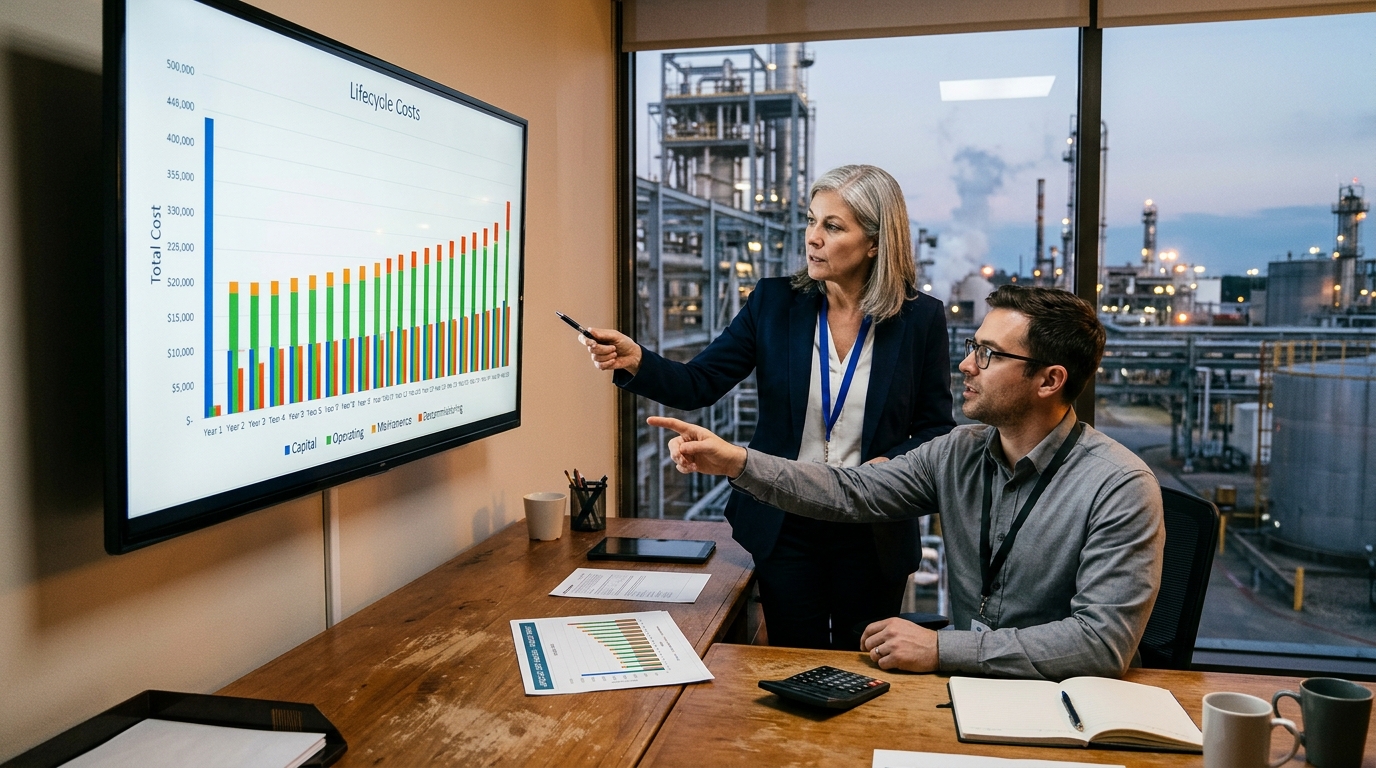
Every industrial plant begins with a question: is this project worth doing? Before a single drawing is produced or a single piece of equipment is ordered, someone must decide whether the plant is technically feasible, economically viable, and socially and environmentally acceptable. That decision is the purpose of a feasibility study.
At EPC Partners Inc., we have supported project development and engineering across a wide range of plant types. These include geothermal power plants in Kenya, Ethiopia, and Indonesia, large-scale desalination facilities in the UAE and Saudi Arabia, thermal power plants in Vietnam and Bangladesh, and water treatment plants in Vietnam and Kuwait. Each project presented different technical, economic, and regulatory challenges, and each reinforced the same lesson: a thorough and honest feasibility study is the foundation of every successful plant.
For small to medium-scale industrial plants, feasibility studies are especially important because there is less margin for error. A project that looks attractive on paper but proves unviable in practice can waste years of effort and significant capital.
This article covers the key practices in plant feasibility studies, from scope definition to financial analysis and the final go/no-go decision, drawing on our experience across Asia, the Middle East, Africa, and Europe.
What Is a Feasibility Study?
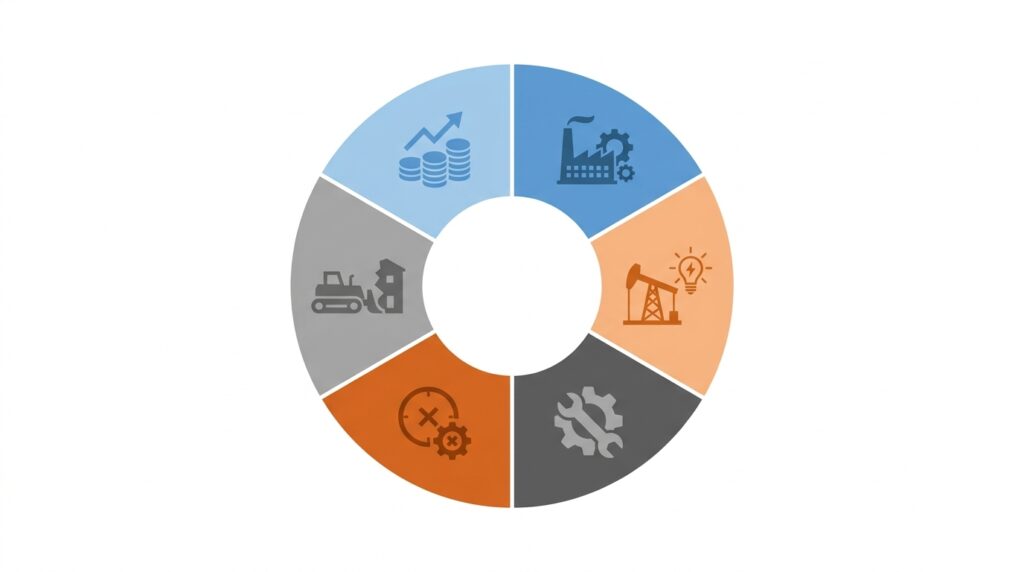
A feasibility study is a structured assessment of a proposed project to determine whether it should proceed. It looks at the project from six angles:
- Technical feasibility: Can the plant be built and operated as proposed?
- Economic feasibility: Does the project create value, given market, price, and cost?
- Financial feasibility: Can the project be funded, and can the debt be repaid?
- Environmental feasibility: Is the project environmentally acceptable?
- Regulatory feasibility: Can the project obtain the required approvals?
- Social feasibility: Is the project socially acceptable?
The result is the basis for the decision to proceed, modify, or abandon the project.
Why Feasibility Studies Matter
| Factor | Good Feasibility Study | Poor Feasibility Study |
|---|---|---|
| Investment | Sound investment decision | Poor investment decision |
| Risk | Risks identified and assessed | Risks overlooked |
| Cost | Realistic cost estimates | Cost overruns |
| Schedule | Realistic schedule | Delays |
| Financing | Financing secured | Financing problems |
| Approvals | Approvals obtained | Approval problems |
For small plants, where capital is limited, the feasibility study determines whether the project is a good use of resources.
Feasibility Study Stages
Feasibility studies are usually conducted in stages, each building on the previous one with more detail and confidence.
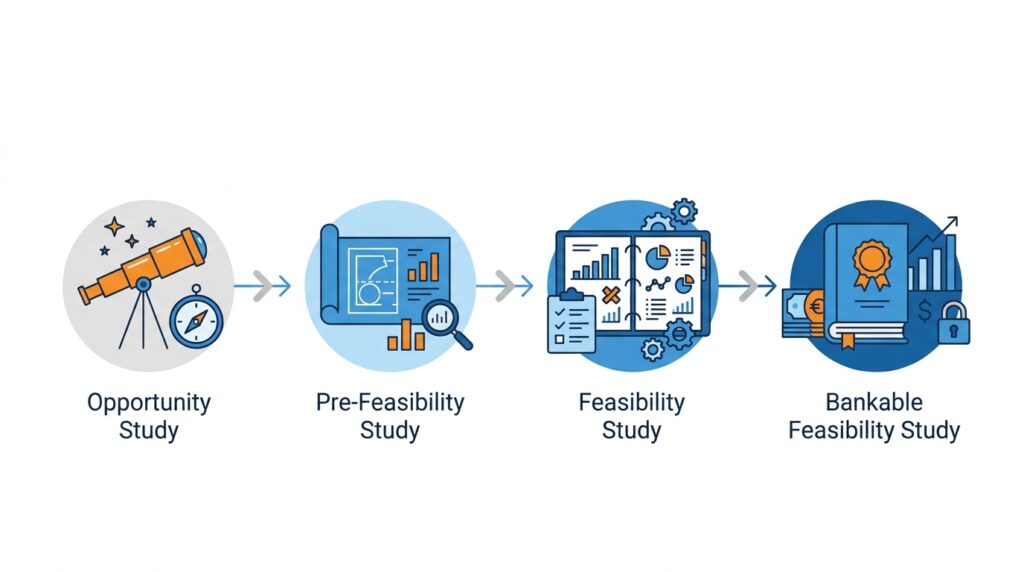
| Stage | Description | Purpose | Typical cost estimate accuracy* |
|---|---|---|---|
| Opportunity study | Preliminary assessment of project ideas | Identify promising opportunities | About -20% to -50% / +30% to +100% (AACE Class 5) |
| Pre-feasibility study | Preliminary assessment of a specific project | Decide whether to proceed to feasibility | About -15% to -30% / +20% to +50% (AACE Class 4) |
| Feasibility study | Detailed assessment of a specific project | Support the investment decision | About -10% to -20% / +10% to +30% (AACE Class 3) |
| Bankable feasibility study | Feasibility study suitable for financing | Support the financing decision | Class 3 or better, often tightened by FEED data |
*Indicative only. Ranges vary by industry and estimating practice. See AACE International Recommended Practice 18R-97.
Level of detail by stage. The level of detail in a feasibility study should match its stage. An opportunity study may be a few pages, while a bankable feasibility study may be hundreds of pages with detailed engineering, financial models, and environmental assessments. Spending too much on early stages wastes money on ideas that will not proceed. Spending too little on later stages leaves the investment decision poorly supported.
On geothermal projects such as Olkaria I Unit 6 in Kenya (83 MW) and Muara Laboh in Indonesia (85.2 MW), confirming the resource (steam quality, pressure, and non-condensable gas content) is a decisive step before committing to detailed design and construction.
Technical Feasibility
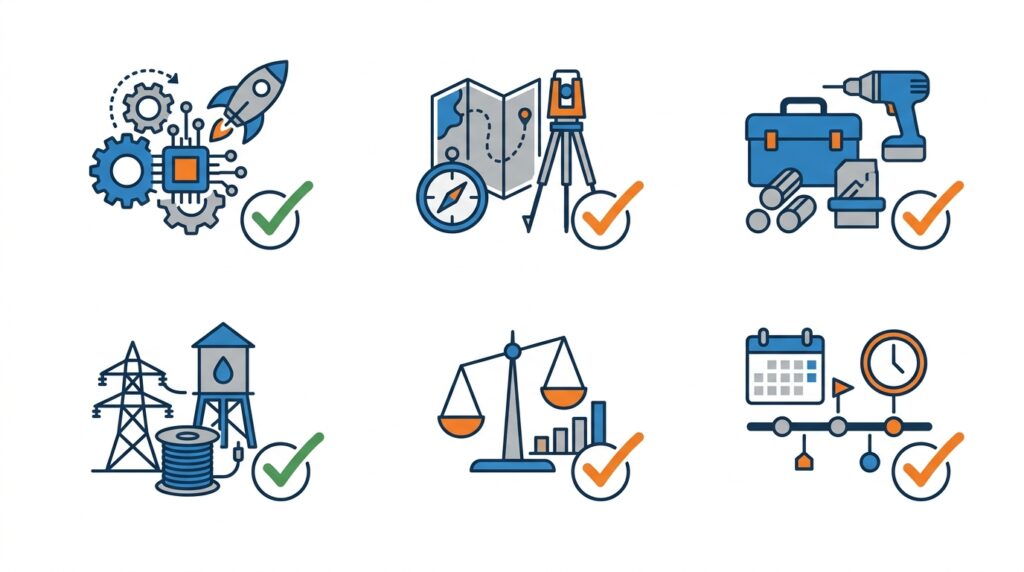
Technical feasibility assesses whether the plant can be built and operated as proposed, and it should rest on engineering assessment rather than assumptions. The study needs to confirm that the technology is proven and available, that the site is suitable, and that the required resources and infrastructure exist. It also has to show that the proposed scale is appropriate and that the plant can be built within the required timeframe. A weakness in any one of these areas can undermine the whole project, however strong the others look.
Site Selection
Site selection is a critical part of technical feasibility. Alternatives should be compared against all of the criteria below, because a site that is excellent on one criterion can fail on another.
| Criterion | Description |
|---|---|
| Land | Adequate area, suitable topography, and secure land rights |
| Access | Roads, rail, ports, and heavy-haul routes |
| Utilities | Power, water, and other utilities, including grid connection |
| Resources | Proximity to fuel, raw materials, and markets |
| Environment | Environmental conditions and constraints (flood, seismic, climate) |
| Regulatory | Zoning and regulatory requirements |
| Social | Proximity to communities and social impact |
For large desalination projects in the Gulf, such as Taweelah (909,200 m³/day) and Jubail 3A (600,000 m³/day), the dominant site factors are access to seawater for intake and outfall, grid connection, and proximity to the water distribution network.
Technology Selection
Technology selection should rest on both technical and commercial assessment. The technology should be proven in similar applications and meet performance requirements. Its capital and operating costs should be understood, and it should be available from more than one vendor, with vendor support, spare parts, and service. It also has to meet regulatory requirements. A technology that wins on performance but has a single supplier or weak local support can become a long-term operating risk.
For thermal power projects such as Thai Binh 1 in Vietnam (2×300 MW) and Bibiyana-III in Bangladesh (400 MW CCGT), technology choices depend on fuel availability, grid requirements, and the plant’s operating profile.
Cost Estimate and Schedule
Feasibility conclusions are only as good as the capital cost and schedule behind them. The cost estimate needs a clear basis (scope, quantities, vendor quotes, and benchmarks). It also needs an accuracy range appropriate to the stage and explicit allowances for escalation and contingency.
Owner’s costs are often forgotten. They include development, permitting, land, owner’s engineering, insurance, spares, commissioning, startup, and interest during construction. The schedule should cover permitting, financing, long-lead equipment, construction, and commissioning.
Optimism bias is most dangerous here. Benchmarking against comparable completed projects is one of the best safeguards.
Project Delivery and Contracting Strategy
The feasibility study should consider how the project will be delivered, because this affects cost, risk allocation, and financeability. Options such as EPC (lump-sum turnkey), EPCM, or multi-contract approaches should be compared. Lenders often prefer fixed-price, date-certain EPC contracts with performance guarantees. A feasibility study that assumes a delivery model the market cannot support, or that lenders will not accept, has a weak foundation.
Economic Feasibility
Economic feasibility assesses whether the project is economically viable. It asks whether there is a market for the plant’s output, what price that output can command, what it costs to produce, and what margin results. It also asks who the competitors are and what demand is expected. The answers should rest on credible data covering demand, supply, price, competition, customers, and regulation, both now and in the future.
Offtake and Supply Arrangements
For many plants, revenue and input costs depend on long-term contracts. Feasibility should test whether offtake agreements (such as power purchase agreements or product sales contracts) and fuel or feedstock supply agreements are obtainable, at what prices, and for what term. Lenders usually look for these agreements to be in place or close to agreement before financial close.
In our experience supporting geothermal and thermal projects, the availability and terms of power purchase agreements were often as important as the technical feasibility of the plant itself.
Financial Feasibility
Financial feasibility assesses whether the project can be funded and the funding repaid. It should include a full financial model that covers:
- Capital cost: total installed cost and financing costs.
- Operating cost: annual operating and maintenance costs, including fuel and feedstock.
- Revenue: expected annual revenue.
- Cash flow: expected cash flow over the plant’s life.
- Financing structure: debt and equity mix, loan terms, and cost of capital.
- Taxes, incentives, currency, and inflation assumptions.
- End-of-life costs: decommissioning or residual value.
Financial Analysis
| Method | Description |
|---|---|
| Net present value (NPV) | Present value of future cash flows, discounted at an appropriate rate |
| Internal rate of return (IRR) | Discount rate at which NPV equals zero |
| Payback period | Time to recover the investment (ignores time value and later cash flows, so use as a screening measure) |
| Debt service coverage ratio (DSCR) | Ability of cash flow to service debt |
| Levelized cost | Lifetime cost per unit of output |
Financial analysis should be based on realistic assumptions and tested with sensitivity analysis.
Environmental Feasibility
Environmental feasibility assesses whether the project is environmentally acceptable. The study should examine the overall effect on air, water, land, and ecology, and what the plant will emit, including greenhouse gases. It should also cover how water will be sourced, used, and discharged, how waste will be managed, and which environmental permits are required. An environmental impact assessment should be included where required. Lenders often expect alignment with international standards such as the IFC Performance Standards or the Equator Principles.
For desalination projects in the Gulf, environmental feasibility includes assessing marine impacts from intake and outfall structures and managing brine discharge.
Regulatory Feasibility
Regulatory feasibility assesses whether the project can obtain the required approvals. It should identify which permits and approvals are needed and from whom, how long they will take, and whether the project can comply. It should also consider whether regulations are likely to change during development. This should be assessed early, because approvals can be time-consuming and can determine the critical path.
For projects in Japan (Asahikasei Mizushima, 29.1 MW) and Qatar (Al Kharsaah, 800 MW solar), regulatory requirements and permitting timelines were significant factors in project planning.
Social Feasibility
Social feasibility assesses whether the project is socially acceptable. The study should consider community impact, including noise, traffic, and visual effects, along with the employment the project will create and the infrastructure it will require. It should also address resettlement, if any is involved, and whether the community has been consulted.
The Role of Stakeholders
Stakeholder consultation, with regulators, communities, and potential customers, provides valuable input to the feasibility study and helps identify issues early. Issues that surface during feasibility can be addressed by design or planning. The same issues discovered during construction can stop the project.
Risk Assessment
Risk assessment identifies and evaluates project risks by assessing their likelihood and impact.
| Risk | Description |
|---|---|
| Technical | Technology does not perform as expected |
| Market | Market does not develop as expected |
| Cost | Costs exceed estimates |
| Schedule | Project is delayed |
| Regulatory | Approvals are delayed or denied |
| Environmental | Environmental issues arise |
| Social | Community opposition |
| Financial | Financing is unavailable or its terms change |
| Contractual | Counterparties fail to perform |
Sensitivity Analysis
Sensitivity analysis tests how results change with different assumptions. It should cover the key variables (capital cost, price, volume, fuel cost, availability, delay, and interest rate). It should also cover the plausible range for each variable and how each affects NPV, IRR, and DSCR. Combined scenarios such as base, downside, and upside cases are also useful. It shows whether the project remains viable when assumptions turn out wrong, which they often do.
A Simple Sensitivity Example
Consider a hypothetical plant with a capital cost of 50 million, annual revenue of 20 million, and annual operating cost of 11 million. Net cash flow is 9 million per year over 15 years. Discounted at 10%, the NPV is about +18 million and the IRR about 16%. The figures are simplified and ignore tax, construction period, and working capital.
| Case | Annual net cash flow | NPV (approx.) |
|---|---|---|
| Base case | 9.0 million | +18.5 million |
| Capital cost +20% (60 million) | 9.0 million | +8.5 million |
| Revenue -15% (17 million) | 6.0 million | -4.4 million |
| Both together | 6.0 million | -14.4 million |
A 20% capital overrun reduces the margin but leaves the project viable. A 15% revenue shortfall makes it unviable on its own. Many owners focus on capital cost, but conclusions are often more sensitive to price and volume assumptions. This is why market analysis and offtake agreements deserve as much attention as the cost estimate.
Independent Review and Due Diligence
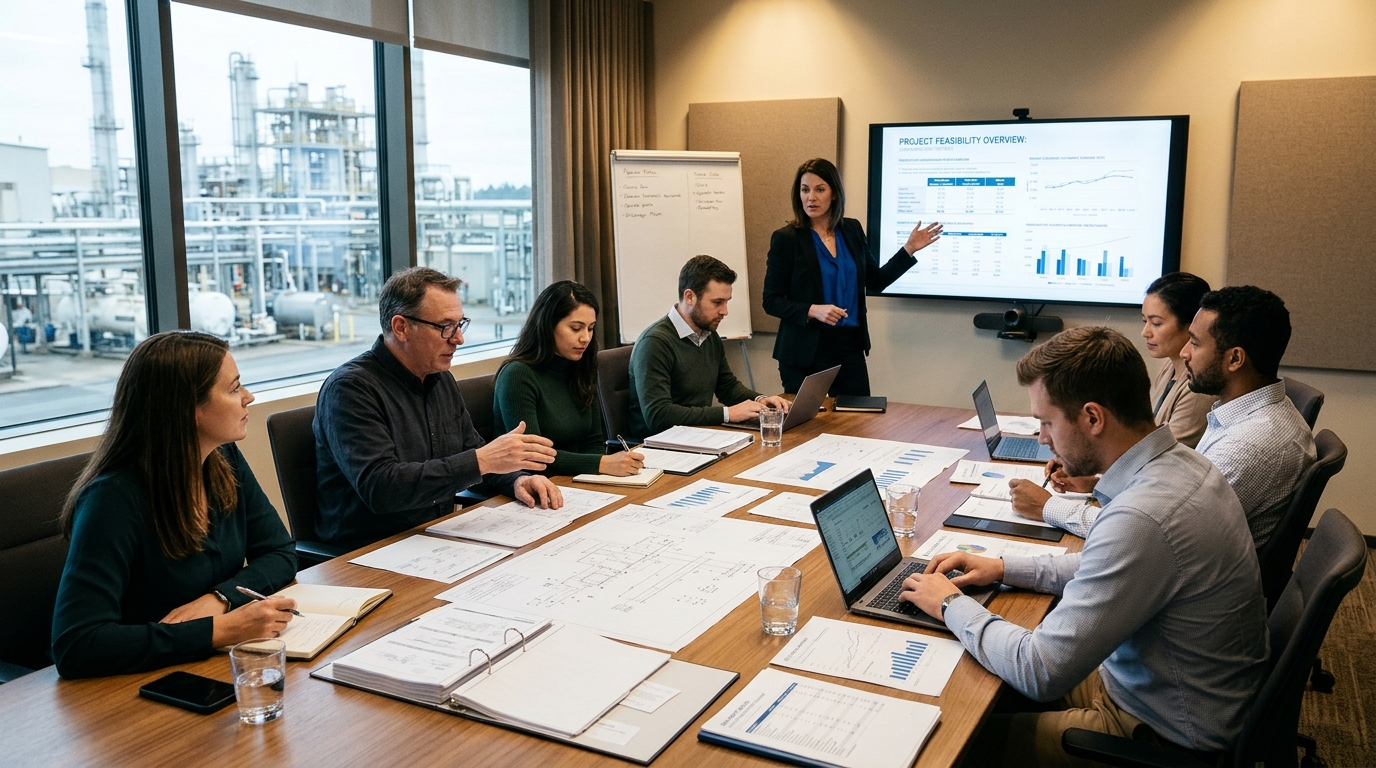
Independent review of a feasibility study, by a third party not involved in preparing it, adds credibility and helps identify biases or gaps. Lenders and investors often require independent review (technical, market, environmental, and financial due diligence) before committing funds.
The Go/No-Go Decision
The feasibility study should culminate in a clear recommendation: proceed, modify, or abandon. The recommendation should be supported by the analysis and should identify the key risks and conditions. Many owners use stage gates with defined criteria, so the decision is made against agreed thresholds rather than momentum. “No-go” is a legitimate and valuable outcome, since it avoids a much costlier failure later.
Feasibility Study Report
The report should be clear, complete, and well-structured. A typical report contains:
- Executive summary: findings, recommendation, and key conditions.
- Background: project context and objectives.
- Technical assessment: site, technology, scale, cost, and schedule.
- Market and economic assessment: demand, price, and competitiveness.
- Financial assessment: model results, funding plan, and key metrics.
- Environmental, regulatory, and social assessments: impacts, approvals, and engagement.
- Risk and sensitivity analysis: key risks, mitigations, and scenarios.
- Conclusions and recommendations: go/no-go recommendation, assumptions, and next steps.
From Feasibility to FEED
A positive decision leads to the next phase, typically front-end engineering design (FEED), where scope, cost, and schedule are defined in more detail. The feasibility study should hand over its assumptions, design basis, risk register, and open issues so that nothing learned is lost.
Feasibility Studies in Small Plants
Small plants face particular challenges: fewer resources, less data, less expertise, and competing priorities. The practical answer is to focus on the most important feasibility questions rather than trying to cover everything at the same depth. Industry data and benchmarks can stand in for detailed studies where data is scarce, and outside experts can be brought in for specific questions. Conservative assumptions protect against optimism, and sensitivity testing shows how much the conclusion depends on each assumption. Documenting the basis for the analysis lets others check it later.
Feasibility studies do not need to be complex. They need to be thorough and honest.
Common Mistakes in Feasibility Studies
- Optimism bias: overestimating benefits and underestimating costs, which is the most common cause of projects that look good on paper and fail in practice.
- Incomplete analysis or poor data: missing key feasibility aspects or relying on unreliable data, so the conclusions cannot be trusted.
- No sensitivity analysis, or ignoring risk: not testing how results change with assumptions or accounting for uncertainty, which hides how fragile the case is.
- Ignoring environmental and social issues: focusing only on technical and economic aspects, then facing permit delays or community opposition later.
- No stakeholder consultation: missing regulator and community concerns until they become expensive to address.
- Underestimating owner’s costs and contingency: which leads directly to budget overruns.
- Rushed study: insufficient time for thorough analysis.
- No independent review: leaving biases and gaps unchallenged.
- Predetermined outcome: using the study to justify a decision already made.
These mistakes are costly to correct. They are much cheaper to avoid through disciplined feasibility studies.
How EPC Partners Inc. Approaches Feasibility Studies
At EPC Partners Inc., we bring practical experience from projects across Asia, the Middle East, Africa, and Europe. Our approach is built on a few principles. We assess all feasibility aspects thoroughly and use assumptions that are realistic rather than optimistic. We test results against different assumptions, identify and assess risks, and document the work transparently. We favor independent review and assess feasibility over the plant’s entire life, not just the construction period.
Our experience includes supporting geothermal projects in Kenya, Ethiopia, Indonesia, Iceland, and Japan; desalination projects in the UAE, Saudi Arabia, Oman, and Qatar; thermal power projects in Vietnam, Bangladesh, and Japan; and water treatment projects in Vietnam, Kuwait, and Qatar. We have also supported clients including Marubeni Corporation, Fuji Electric Co., Ltd., and Toyota Tsusho Corporation on project development aspects of their projects.
How to Evaluate Feasibility Study Readiness
| Question | Why It Matters |
|---|---|
| Is the study comprehensive? | Covers all key feasibility aspects |
| Are assumptions realistic? | Ensures results are meaningful |
| Is data reliable? | Ensures analysis is credible |
| Are cost and schedule estimates benchmarked, with contingency? | Guards against overruns |
| Is sensitivity analysis performed? | Tests how results change with assumptions |
| Is risk assessed? | Accounts for uncertainty |
| Are environmental and social issues addressed? | Ensures comprehensive assessment |
| Have stakeholders been consulted? | Ensures social acceptability |
| Are offtake and supply arrangements realistic? | Underpins revenue and cost assumptions |
| Has the study been reviewed independently? | Ensures quality and credibility |
| Is there a clear go/no-go recommendation with conditions? | Supports a decision |
A study that addresses these questions is ready to support a sound investment decision.
Frequently Asked Questions
How long does a feasibility study take? It depends on the project’s size and stage. An opportunity study may take weeks, while a bankable feasibility study can take many months because of detailed engineering, environmental baseline work, and financial modeling.
Who should prepare a feasibility study? Usually a multidisciplinary team of engineering, financial, environmental, and market specialists, with independent review before financing.
What is the difference between a feasibility study and FEED? A feasibility study decides whether to proceed. FEED defines the scope, cost, and schedule needed to execute the project.
Is a feasibility study required for financing? Lenders generally require a bankable feasibility study, supported by independent technical, market, and environmental review, before committing funds.
Conclusion
Feasibility studies are the foundation of sound investment decisions. For small to medium-scale industrial plants, they determine whether the project is worth doing.
By focusing on technical, economic, financial, environmental, regulatory, and social feasibility, together with risk assessment, sensitivity analysis, independent review, and a clear go/no-go recommendation, owners and project teams can ensure that investment decisions rest on a thorough and honest assessment of the project.
Key Takeaways
- Feasibility studies assess whether a project is technically feasible, economically viable, and socially and environmentally acceptable.
- Studies are conducted in stages (opportunity, pre-feasibility, feasibility, bankable feasibility), with detail matched to each stage.
- Technical feasibility covers technology, site, resources, infrastructure, scale, and schedule.
- Economic and financial feasibility cover market, price, cost, margin, offtake, and financing.
- Environmental, regulatory, and social feasibility are critical and often overlooked.
- Risk assessment and sensitivity analysis test how robust the study is. Price and volume assumptions often matter as much as capital cost.
- Independent review and stakeholder consultation add credibility and surface issues early.
- The study should end in a clear recommendation: proceed, modify, or abandon.
- Small plants can focus on key issues and use available data.
References
- AACE International, Recommended Practice 18R-97, Cost Estimate Classification System – As Applied in Engineering, Procurement, and Construction for the Process Industries.
- International Finance Corporation (IFC), Performance Standards on Environmental and Social Sustainability.
- The Equator Principles Association, The Equator Principles.
This article is for general information and does not replace project-specific engineering, legal, or financial advice.
EPC Partners Inc. is a Japanese EPC support firm with experience supporting power, water, and industrial plant projects across Asia, the Middle East, Africa, and Europe. For more information, visit our project list.