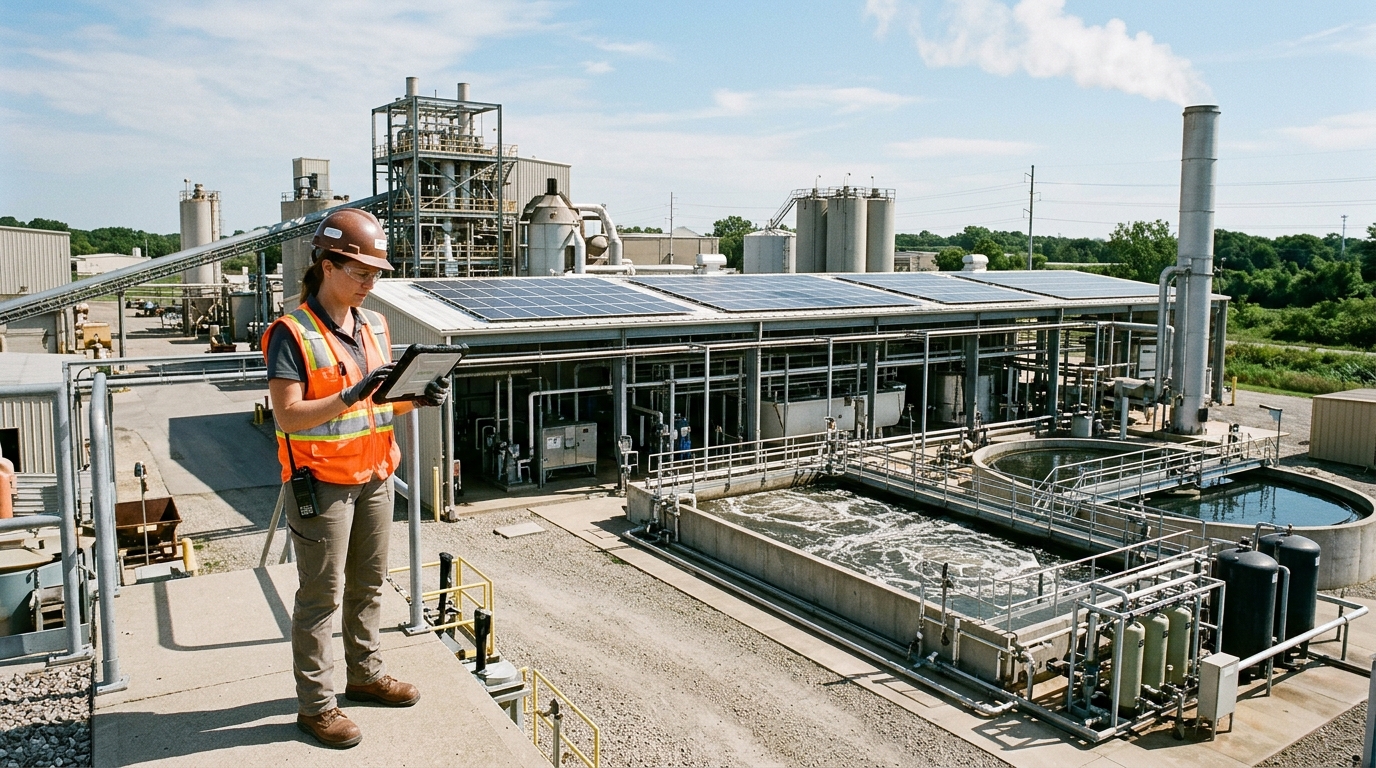
Industrial plants have a significant environmental footprint. They consume energy, water, and raw materials. They generate emissions, wastewater, and waste. They affect the communities around them. How a plant manages these impacts determines whether it is a responsible neighbor and a sustainable business, or a source of environmental damage and regulatory problems.
Sustainability and environmental management is the discipline of minimizing environmental impact while maintaining economic viability. It is not just about compliance with regulations. It is about designing, building, and operating plants that are efficient, responsible, and sustainable over the long term.
For small to medium-scale industrial plants, it is especially important because there is less margin for error and fewer resources to absorb the consequences of environmental problems. A single environmental incident can cause regulatory action, community opposition, and reputational damage.
This article covers the key practices in plant sustainability and environmental management, from environmental impact assessment to emissions control, waste management, climate risk, and sustainability reporting.
What Is Sustainability and Environmental Management?
Sustainability is commonly defined as meeting present needs without compromising the ability of future generations to meet their own needs. Environmental management is the discipline of managing a plant’s interactions with the environment.
Together, they cover:
- Environmental impact assessment: What are the environmental impacts of the plant?
- Environmental risk assessment: What could go wrong, and how serious would it be?
- Emissions control: How are air emissions controlled?
- Water management: How is water used and discharged?
- Waste management: How is waste managed?
- Energy efficiency: How is energy used efficiently?
- Climate risk and adaptation: How will climate change affect the plant?
- Sustainability reporting: How is sustainability performance reported?
Sustainability and environmental management are not just about compliance. They are about responsible operation.
Why Sustainability and Environmental Management Matter
| Factor | Impact of Good Environmental Management | Impact of Poor Environmental Management |
|---|---|---|
| Compliance | Regulatory requirements met | Fines, penalties, shutdowns |
| Community | Community supports the plant | Community opposition |
| Cost | Resources used efficiently | Waste and inefficiency |
| Reputation | Positive reputation | Reputation damaged |
| Financing | Access to financing | Financing restricted |
| Sustainability | Long-term viability | Long-term risk |
For small plants, where there is less margin for error, environmental management determines whether the plant can operate sustainably.
Environmental Management Across the Project Lifecycle
Environmental performance is largely decided early. Design choices on process, fuel, cooling, and layout lock in emissions, water use, and waste for decades. In an EPC project, environmental management applies at every stage:
- Feasibility and design: Environmental screening, site selection, and selection of technology and controls. Applying best available techniques (BAT) at this stage is far cheaper than retrofitting later.
- Engineering: Emission limits, effluent limits, and noise limits are written into design basis documents and performance specifications.
- Procurement: Environmental requirements are included in equipment specifications and vendor guarantees (for example, NOx or noise guarantees).
- Construction: A construction environmental management plan (CEMP) controls dust, noise, erosion, spills, construction waste, and impacts on local communities.
- Commissioning: Emission controls, effluent treatment, and monitoring systems are tested and verified before operation.
- Operation and decommissioning: The EMS, monitoring, reporting, and eventual site closure and restoration.
Environmental obligations should be assigned clearly in the EPC contract, including who holds permits, who is responsible for compliance during construction, and which environmental performance guarantees apply.
Environmental Impact Assessment
Environmental impact assessment (EIA) evaluates the environmental impacts of a proposed plant. Many jurisdictions and lenders also require a social component, called an environmental and social impact assessment (ESIA).
EIA process:
- Screening: Is an EIA required?
- Scoping: What impacts should be assessed?
- Baseline studies: What is the current environmental condition?
- Impact prediction: What impacts will the plant have?
- Mitigation: How can impacts be reduced?
- Reporting: Document the findings in the EIA report.
- Review: Regulatory and public review.
- Decision: Approval or rejection, often with conditions.
- Follow-up: Monitor to confirm that predicted impacts and mitigation measures hold true.
EIA is often a regulatory requirement for new plants and for major modifications. Baseline studies should be done early, because they may need to cover a full seasonal cycle.
Environmental Risk Assessment
Environmental risk assessment evaluates the likelihood and consequence of environmental incidents: spills, releases, and non-compliance. It helps prioritize prevention and response measures.
Typical scenarios include chemical or fuel spills, tank or pipe leaks, uncontrolled releases to air, wastewater treatment failures, contaminated fire-water runoff, and exceedance of permit limits. Results feed directly into secondary containment design, spill response plans, emergency procedures, and monitoring priorities. Risk assessment should be updated when processes, materials, or site conditions change (see Management of Change).
Air Emissions Control
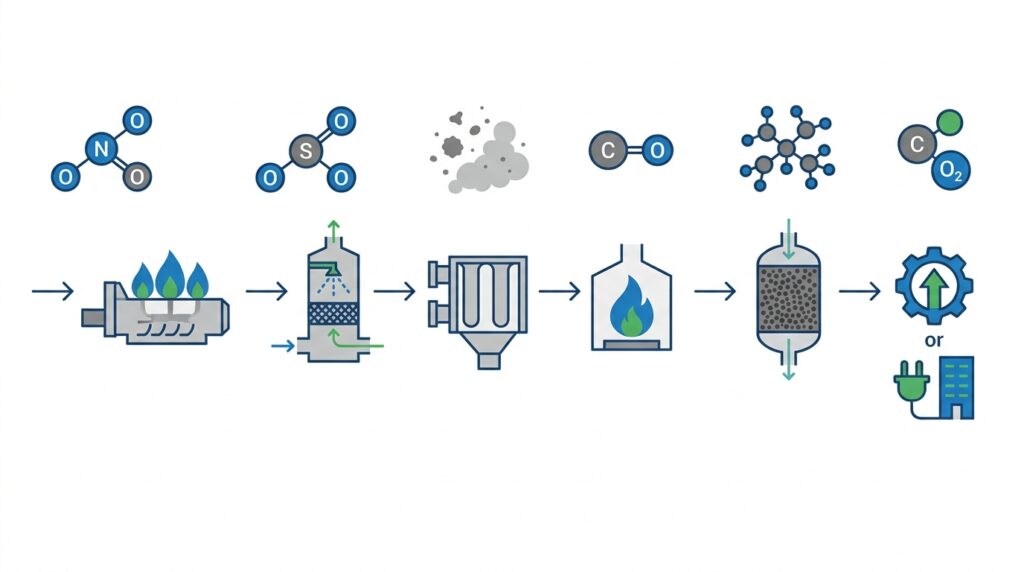
Air emissions are a major environmental concern for industrial plants.
Common air emissions:
| Emission | Source | Control |
|---|---|---|
| NOx | Combustion | Low-NOx burners, SCR, SNCR |
| SOx | Fuel combustion | Low-sulfur fuel, fuel desulfurization, flue gas desulfurization (scrubbers) |
| Particulate matter | Combustion, material handling | Filters, ESPs, baghouses, dust suppression |
| CO | Incomplete combustion | Combustion optimization |
| VOCs | Process emissions, storage | Vapor recovery, incineration, adsorption, leak detection and repair |
| CO₂ | Fuel combustion | Efficiency, fuel switching, CCS |
Emissions must comply with regulatory limits and may be subject to monitoring and reporting requirements. Fugitive emissions and odor should also be considered, especially where the plant is near communities. Where national standards are absent or weaker than lender requirements, owners often follow the World Bank Group’s EHS Guidelines.
Water Management
Water is used in many industrial processes and must be managed carefully.
Water management activities:
- Water sourcing: Where does water come from, and is the source secure?
- Water treatment: How is water treated for use?
- Water use: How is water used efficiently?
- Wastewater treatment: How is wastewater treated?
- Stormwater management: How is runoff from the site managed and kept from contamination?
- Discharge: Where and how is wastewater discharged?
- Water recycling: Can water be recycled or reused?
Water management should minimize water use and minimize the environmental impact of discharge. In water-stressed regions, water availability may be the limiting factor for the whole project.
Waste Management
Industrial plants generate various types of waste.
Waste categories:
| Category | Examples | Management |
|---|---|---|
| Hazardous waste | Chemicals, contaminated materials | Segregation, tracking, licensed transport and disposal |
| Non-hazardous waste | Packaging, general waste | Recycling or landfill |
| Recyclable materials | Metals, plastics, paper | Recycling |
| Process waste | By-products, residues | Reuse, recycling, or disposal |
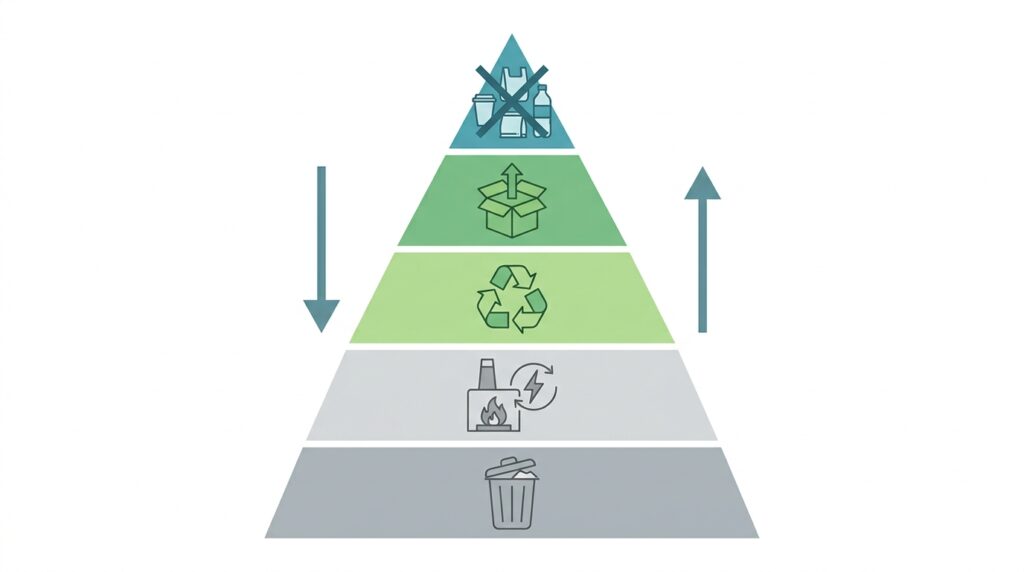
Waste management should follow the waste hierarchy: prevent, reduce, reuse, recycle, recover, and only then dispose. Hazardous waste needs special attention to storage, labeling, manifests, and the licensing of contractors.
Circular Economy
Circular economy principles (designing out waste and pollution, keeping products and materials in use, and regenerating natural systems) are increasingly applied in industrial plants. This includes by-product reuse, material recycling, and industrial symbiosis with neighboring facilities. In practice, one plant’s waste heat, steam, ash, or process residue can become another’s input.
Energy Efficiency
Energy efficiency reduces both costs and environmental impact.
Energy efficiency opportunities:
- Process optimization: Optimizing process conditions.
- Equipment efficiency: Using efficient equipment such as motors, pumps, and drives.
- Heat recovery: Recovering waste heat.
- Cogeneration: Combined heat and power.
- Renewable energy: Solar, wind, biomass.
- Energy management: Metering, targets, and regular review (ISO 50001 provides a framework).
Energy efficiency is often the most cost-effective way to reduce environmental impact.
Greenhouse Gas Management
Greenhouse gas (GHG) emissions contribute to climate change.
GHG management activities:
- GHG inventory: Measuring GHG emissions, typically following the GHG Protocol or ISO 14064. Emissions are categorized as Scope 1 (direct), Scope 2 (purchased energy), and Scope 3 (value chain).
- Reduction targets: Setting reduction targets.
- Reduction measures: Implementing efficiency, fuel switching, electrification, and other measures.
- Reporting: Reporting GHG emissions.
GHG management is increasingly a requirement for financing and regulatory compliance, and carbon pricing or emissions trading may apply in some jurisdictions.
Climate Risk and Adaptation
Climate change poses risks to industrial plants. Climate risk assessment considers how changing climate conditions (temperature, precipitation, extreme weather) may affect the plant. Adaptation measures include flood protection, cooling system upgrades, and water supply resilience.
Climate risk should be considered at the design stage, when site elevation, drainage, cooling capacity, and equipment ratings can be set with future conditions in mind. Physical risks (floods, heat, storms, drought, sea-level rise) and transition risks (carbon pricing, changing regulations, market shifts) should both be assessed.
Environmental Monitoring
Environmental monitoring verifies that the plant is meeting environmental requirements.
Monitoring types:
| Type | Description |
|---|---|
| Emissions monitoring | Continuous (CEMS) or periodic monitoring of air emissions |
| Water monitoring | Monitoring of water quality and discharge |
| Groundwater monitoring | Monitoring of groundwater quality |
| Noise monitoring | Monitoring of noise levels |
| Soil monitoring | Monitoring of soil contamination |
Monitoring data should be recorded, reported, and used to improve performance. Instruments should be calibrated, and sampling and analysis should follow approved methods so that results are accepted by regulators.
Environmental Permits and Compliance
Environmental permits are required for many industrial activities.
Common permits:
- Air permits: For emissions.
- Water permits: For water use and discharge.
- Waste permits: For waste management.
- Operating permits: For plant operation.
Compliance with permits is mandatory. Non-compliance can result in fines, penalties, or shutdown. A compliance register that lists each permit, its conditions, deadlines, and reporting dates helps ensure nothing is missed. Permit lead times can be long, so permitting should be on the project critical path.
Environmental Management Systems
An environmental management system (EMS) provides a structured approach to environmental management.
EMS elements:
- Environmental policy: Commitment to environmental management.
- Planning: Identifying environmental aspects, impacts, and legal requirements.
- Implementation: Implementing environmental management programs, with defined roles, resources, and controls.
- Checking: Monitoring and measuring environmental performance, and auditing.
- Review: Reviewing and improving the EMS.
ISO 14001 is the most widely recognized EMS standard and follows the Plan-Do-Check-Act cycle.
Environmental Training and Awareness
Environmental training and awareness ensure that all staff understand their environmental responsibilities, the environmental aspects of their work, and the procedures for preventing and responding to environmental incidents. Training should cover employees and contractors, including spill response, waste segregation, and permit requirements, and should be recorded and refreshed regularly.
Community Engagement
Community engagement is important for environmental management.
Community engagement activities:
- Information sharing: Informing the community about environmental performance.
- Feedback mechanisms: Providing ways for the community to give feedback.
- Grievance mechanisms: Providing a way to address grievances.
- Community benefits: Considering community benefits programs.
Community engagement builds trust and reduces opposition. It should start during the EIA and continue through construction and operation.
Sustainability Reporting
Sustainability reporting communicates environmental performance to stakeholders.
Reporting frameworks:
| Framework | Description |
|---|---|
| GRI | Global Reporting Initiative: widely used standards for sustainability reporting |
| ISSB (IFRS S1 and S2) | International Sustainability Standards Board: global baseline for sustainability and climate disclosures. It has taken over SASB and the monitoring of TCFD |
| SASB | Sustainability Accounting Standards Board: industry-specific standards, now maintained by the ISSB |
| TCFD | Task Force on Climate-related Financial Disclosures: its recommendations are now incorporated into ISSB standards |
| CDP | Formerly the Carbon Disclosure Project: environmental disclosure system for climate, water, and forests |
| CSRD / ESRS | EU Corporate Sustainability Reporting Directive and its standards, relevant for companies in or tied to the EU |
Sustainability reporting is increasingly expected by investors, lenders, and customers. Reporting requirements differ by jurisdiction, so owners should confirm which apply to them.
Environmental Management in Small Plants
Small plants face particular challenges with environmental management.
Challenges:
- Fewer resources for environmental management.
- Less expertise in environmental issues.
- Competing priorities.
- Limited monitoring capability.
Practical approaches:
- Focus on compliance: Ensure compliance with environmental permits.
- Prioritize significant impacts: Focus on the most significant environmental impacts.
- Use simple tools: A simple environmental register and monitoring program are sufficient.
- Seek advice: Get advice from environmental consultants when needed.
- Build awareness: Train staff on environmental responsibilities.
- Learn from others: Learn from other plants’ experiences.
Environmental management does not need to be complex. It needs to be consistent.
Common Mistakes in Sustainability and Environmental Management
Even experienced organizations make mistakes. Common ones include:
- No environmental assessment: Environmental impacts not assessed.
- Ignoring permits: Operating without required permits.
- Poor monitoring: Environmental performance not monitored.
- No EMS: No structured approach to environmental management.
- Ignoring community: Community concerns not addressed.
- No reporting: Environmental performance not reported.
- Reactive approach: Responding to problems instead of preventing them.
- No training: Staff not trained on environmental responsibilities.
- No continuous improvement: Environmental performance not improved.
- Ignoring climate and spill risk: Flood, heat, and release scenarios not assessed.
- Late environmental input: Environmental requirements added after design is fixed, forcing costly retrofits.
These mistakes are costly to correct. They are much cheaper to avoid through disciplined environmental management.
How Japanese EPC Firms Approach Sustainability and Environmental Management
Japanese engineering firms are known for their disciplined approach to environmental management. Common characteristics include:
- Thorough assessment: Environmental impacts are assessed carefully.
- Detailed planning: Environmental management is planned from the beginning.
- Compliance focus: Regulatory requirements are met.
- Efficiency focus: Resources are used efficiently.
- Community engagement: Communities are engaged constructively.
- Detailed documentation: Environmental records are complete and accurate.
- Continuous improvement: Lessons are captured and applied.
For plant owners, this often means plants that are environmentally responsible and sustainable.
How to Evaluate Sustainability and Environmental Management Readiness
When reviewing sustainability and environmental management, ask:
| Question | Why It Matters |
|---|---|
| Has an environmental impact assessment been performed? | Identifies environmental impacts |
| Has an environmental risk assessment been done? | Prioritizes prevention and response |
| Are environmental permits in place? | Ensures legal operation |
| Are emissions controlled? | Reduces air pollution |
| Is water managed? | Reduces water use and discharge |
| Is waste managed, and are circular options considered? | Reduces waste and environmental impact |
| Is energy used efficiently? | Reduces costs and emissions |
| Has climate risk been assessed? | Protects the plant from future conditions |
| Is there an EMS? | Provides a structured approach |
| Is environmental performance monitored? | Verifies compliance and performance |
| Is staff trained on environmental responsibilities? | Prevents incidents and ensures consistent practice |
| Is the community engaged? | Builds trust and reduces opposition |
| Is sustainability reported? | Communicates performance to stakeholders |
A plant that addresses these questions is ready for effective environmental management.
Conclusion
Sustainability and environmental management are critical to plant success. For small to medium-scale industrial plants, they determine whether the plant can operate responsibly and sustainably.
By focusing on environmental impact and risk assessment, emissions control, water management, waste management and circular economy, energy efficiency, GHG management, climate risk, monitoring, permits, EMS, training, community engagement, and sustainability reporting, owners and project teams can ensure that the plant is environmentally responsible and sustainable.
Key Takeaways
- Sustainability and environmental management minimize impact while maintaining economic viability
- EIA evaluates environmental impacts before construction
- Environmental risk assessment prioritizes prevention and response for spills, releases, and non-compliance
- Air emissions, water, and waste must be managed to reduce environmental impact
- Circular economy principles reduce waste through reuse, recycling, and industrial symbiosis
- Energy efficiency is often the most cost-effective way to reduce environmental impact
- GHG management is increasingly required for financing and compliance
- Climate risk assessment and adaptation protect the plant from changing conditions
- Environmental monitoring verifies compliance and performance
- Permits are required and compliance is mandatory
- An EMS provides a structured approach
- Training ensures staff understand their environmental responsibilities
- Community engagement builds trust
- Sustainability reporting communicates performance to stakeholders
- Japanese EPC firms emphasize thorough assessment and compliance