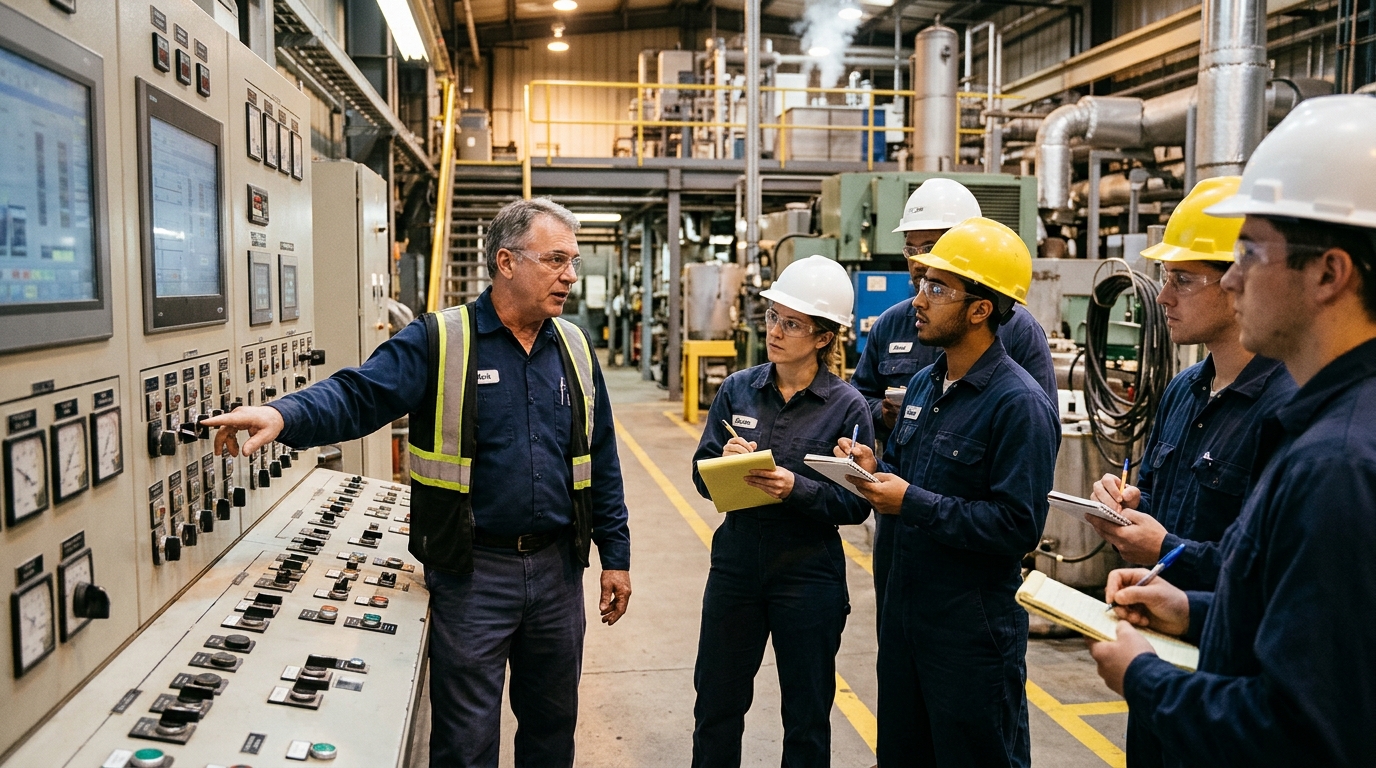
A plant is only as good as the people who operate and maintain it. Equipment can be designed and built to the highest standards, but if the people running it do not understand how it works, how it fails, and how to respond when something goes wrong, the plant will not perform safely or reliably.
Training and competency development is the discipline of ensuring that the owner’s team has the knowledge, skills, and confidence to operate and maintain the plant. It is not just about classroom courses. It is about building real capability through training, on-the-job experience, assessment, and continuous development.
For small to medium-scale industrial plants, training and competency development are especially important because there is less redundancy and fewer resources to absorb the consequences of an unprepared team. A single untrained operator can cause an outage, a safety incident, or equipment damage.
This article covers the key practices in plant training and competency development, from training needs analysis to competency assessment, effectiveness evaluation, and continuous development.
What Is Training and Competency Development?
Training is the process of transferring knowledge and skills to personnel. Competency development is the broader process of building the capability to perform specific tasks to a defined standard.
Training and competency development includes:
- Training needs analysis: What knowledge and skills are required?
- Training design: How will training be delivered?
- Training delivery: Delivering training to personnel.
- On-the-job training: Building skills through practical experience.
- Competency assessment: Verifying that personnel can perform to standard.
- Effectiveness evaluation: Confirming that training delivers the intended outcome.
- Continuous development: Keeping skills current over time.
Training and competency development is not a one-time event. It is an ongoing process throughout the plant’s life.
Management system standards such as ISO 9001 and ISO 45001 (both clause 7.2) require organizations to determine necessary competence, ensure people are competent, and retain evidence. ISO 10015 provides guidelines specifically on competence management and training.
Why Training and Competency Development Matter
Training and competency directly affect plant performance.
| Factor | Impact of Good Training | Impact of Poor Training |
|---|---|---|
| Safety | Personnel understand hazards and controls | Incidents from lack of knowledge |
| Reliability | Equipment operated within limits | Failures from poor operation |
| Efficiency | Plant operated at design performance | Performance below design |
| Cost | Maintenance performed correctly | Rework and premature failures |
| Compliance | Regulatory requirements met | Non-compliance |
| Morale | Team confident and capable | Team overwhelmed |
For small plants, where the team may be small and multi-skilled, training and competency development determine whether the plant can be run safely and effectively.
Training in the EPC Contract
In an EPC project, training is often a contractual deliverable, and it needs to be specified early rather than negotiated at the end.
Items to define in the EPC contract:
- Training scope: Which topics, for which roles, and how many personnel.
- Training plan: Who delivers what, when, and where.
- Training materials: Manuals, presentations, P&ID-based system descriptions, and operating and maintenance procedures.
- Vendor training: Equipment-specific training for major packages such as turbines, boilers, compressors, and control systems.
- Simulator or operator training systems: Where required for complex operations.
- Language and format: Training delivered in a language and format the team can use.
- Timing: Training completed before commissioning and startup, not after.
- Acceptance criteria: How completion of training will be verified.
Contractor and vendor training that is vaguely specified tends to be generic, late, or incomplete. Training should also be linked to operations readiness and handover, so that the owner’s team is competent by the time the plant is turned over.
Training Needs Analysis
Training needs analysis identifies what training is required.
Training needs analysis activities:
- Task analysis: What tasks must be performed?
- Knowledge requirements: What knowledge is required for each task?
- Skill requirements: What skills are required for each task?
- Current competence: What competence do personnel currently have?
- Gap analysis: What gaps exist between required and current competence?
- Training priorities: Which gaps are most important, especially for safety-critical tasks?
Training needs analysis should be based on the actual tasks and equipment in the plant, not on generic training programs.
Training Plan
The results of the needs analysis should be turned into a training plan.
A training plan typically defines:
- Training topics and target personnel.
- Delivery methods and trainers.
- Schedule, sequenced against construction, commissioning, and startup milestones.
- Budget and resources.
- Responsibilities for delivery and tracking.
- Assessment and sign-off requirements.
Sequencing matters. Operators should receive system knowledge before commissioning, so they can take part meaningfully, and procedure training before startup.
Training Categories
Training can be categorized by subject and audience.
| Category | Description |
|---|---|
| Operations training | How to operate the plant |
| Maintenance training | How to maintain equipment |
| Safety training | How to work safely |
| Emergency training | How to respond to emergencies |
| Vendor training | Equipment-specific training from vendors |
| Simulator training | Practice in a simulated environment |
| Soft skills training | Communication, teamwork, problem-solving |
| Regulatory training | Statutory and permit-based competencies |
Each category requires different content, methods, and assessment.
Regulatory and Mandatory Training
Some competencies are required by law, by permit, or by site rules, regardless of the owner’s own training needs analysis.
Typical examples include:
- Electrical work and switching authorization.
- Confined space entry.
- Work at height.
- Lockout/tagout and isolation.
- Permit-to-work systems.
- Hot work.
- Operation of pressure equipment, boilers, and lifting equipment.
- First aid, fire fighting, and emergency response.
- Environmental and hazardous materials handling.
Requirements vary by jurisdiction and site, so owners should confirm what applies locally. Certifications and their expiry dates should be tracked in the training records.
Training Methods
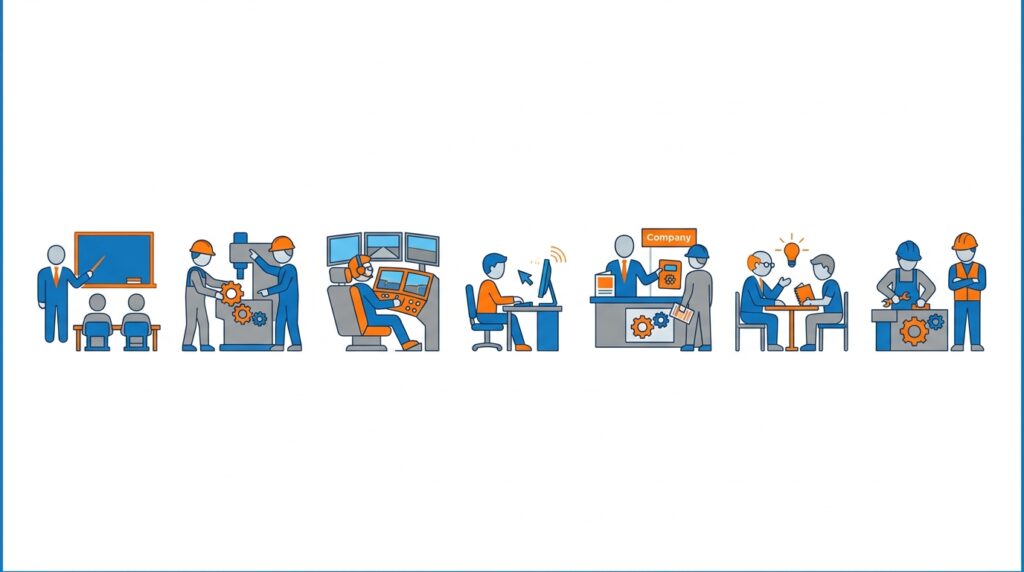
Training can be delivered through various methods.
| Method | Description | Best For |
|---|---|---|
| Classroom training | Instructor-led training in a classroom | Theoretical knowledge |
| On-the-job training | Training while performing actual work | Practical skills |
| Simulator training | Training in a simulated environment | Complex operations |
| E-learning | Online training modules | Flexible, self-paced learning |
| Vendor training | Training from equipment vendors | Equipment-specific knowledge |
| Mentoring | Experienced staff mentor less experienced staff | Knowledge transfer |
| Job shadowing | Junior staff observe experienced staff | Practical experience |
The best training programs combine multiple methods.
Trainers and Training Materials
Training is only as good as the people delivering it and the materials they use.
Considerations:
- Trainer competence: Trainers should know the subject and know how to teach it. Being an expert operator does not automatically make someone an effective trainer.
- Plant-specific materials: Use actual P&IDs, procedures, and equipment photos rather than generic content.
- Up-to-date content: Materials should be updated when the plant or procedures change.
- Accessible format: Materials should be easy to use, in the language of the team, and available after the course for reference.
- Learning objectives: Each session should have clear objectives that link to the competency standards.
On-the-Job Training
On-the-job training builds practical skills through actual work.
On-the-job training considerations:
- Structured approach: Training should be planned, not ad hoc.
- Qualified trainers: Trainers should be competent and trained to train.
- Progressive responsibility: Trainees should take on increasing responsibility as they develop.
- Documentation: Training should be documented.
- Assessment: Competence should be assessed.
On-the-job training is often the most effective way to build practical skills.
Operator Involvement in Commissioning
Commissioning is a valuable training opportunity.
Benefits of operator involvement in commissioning:
- Hands-on experience: Operators gain practical experience with the plant.
- Understanding of systems: Operators learn how systems work.
- Procedure testing: Operators can test draft procedures.
- Early identification of issues: Operators can raise concerns while changes are still easy.
- Confidence building: Operators build confidence before startup.
Operators should be involved in commissioning wherever possible. This requires them to be recruited early enough to take part, which should be reflected in the staffing plan.
Competency Assessment
Competency assessment verifies that personnel can perform to standard.
Competency assessment methods:
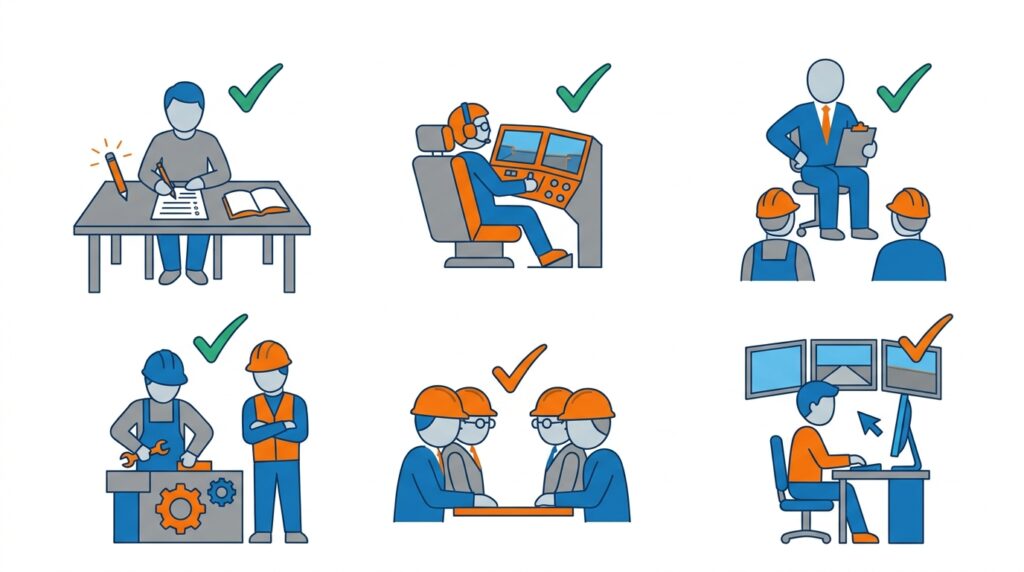
| Method | Description |
|---|---|
| Written tests | Testing knowledge |
| Practical tests | Testing practical skills |
| Observation | Observing performance on the job |
| Simulation | Testing in a simulated environment |
| Peer assessment | Assessment by colleagues |
| Supervisor assessment | Assessment by supervisors |
Competency assessment should be based on clear standards and criteria. Assessors should be competent themselves and, where possible, independent of the trainer.
Competency Standards
Competency standards define what competence looks like.
Competency standards include:
- Task description: What task is being assessed?
- Performance criteria: What defines competent performance?
- Knowledge requirements: What knowledge is required?
- Evidence requirements: What evidence is required to demonstrate competence?
- Assessment methods: How will competence be assessed?
Competency standards should be clear, specific, and relevant to the plant.
Competency Matrices
A competency matrix maps each role against the competencies required, showing who is competent, who is in training, and where gaps exist. It is a practical tool for managing workforce competence.
A competency matrix typically helps to:
- Show at a glance who can perform which tasks.
- Identify single points of failure where only one person is competent.
- Plan shift rosters so that every shift has the required competencies.
- Prioritize training and cross-training.
- Provide evidence for audits and regulators.
The matrix should be kept current and linked to the training records.
Training Records
Training records document training and competency.
Training record contents:
- Personnel details: Who was trained?
- Training details: What training was provided?
- Dates: When was training provided?
- Assessment results: How did the person perform?
- Competency status: Is the person competent?
- Expiry dates: When does refresher training need to happen?
Training records support audits, regulatory compliance, and workforce planning.
Evaluating Training Effectiveness
Training should be evaluated to confirm it works. Delivering training is not the same as achieving competence.
Training effectiveness should be evaluated using models such as Kirkpatrick’s four levels: reaction, learning, behavior, and results. This confirms that training is delivering the intended outcome, not just being delivered.
| Level | Question | Example Evidence |
|---|---|---|
| 1. Reaction | Did participants find the training useful? | Feedback forms |
| 2. Learning | Did participants acquire the knowledge and skills? | Tests, practical assessments |
| 3. Behavior | Are participants applying it on the job? | Observation, supervisor review |
| 4. Results | Did plant performance improve? | Fewer incidents, fewer operator errors, better efficiency |
Findings should feed back into training design. Incident investigations should also be checked for training-related causes.
Refresher Training
Refresher training keeps skills current.
Refresher training considerations:
- Frequency: How often is refresher training needed?
- Content: What should refresher training cover?
- Assessment: Should refresher training include assessment?
- Triggers: What triggers refresher training (e.g., incidents, changes, long absences)?
Refresher training ensures that skills do not degrade over time. Rarely used skills, such as emergency response and infrequent startup and shutdown tasks, are especially at risk.
Training and Change
Training must keep pace with changes to the plant.
- Management of change: Changes to equipment, procedures, or control systems should trigger a check on whether training needs updating, and affected personnel should be trained before the change goes live.
- Incident learning: Lessons from incidents and near-misses should be fed into training content.
- Pre-startup safety review: Verifying that training is complete is a standard element of a pre-startup safety review.
Training for Emergency Response
Emergency response training prepares personnel to respond to emergencies.
Emergency response training includes:
- Emergency procedures: How to respond to emergencies.
- Emergency equipment: How to use emergency equipment.
- Drills: Practice responding to emergencies.
- Coordination: How to coordinate with others, including external responders.
- Communication: How to communicate during emergencies.
Emergency response training should be practical and realistic.
Training for Maintenance
Maintenance training prepares personnel to maintain equipment.
Maintenance training includes:
- Equipment knowledge: How equipment works.
- Maintenance procedures: How to maintain equipment.
- Troubleshooting: How to diagnose problems.
- Safety procedures: How to work safely.
- Tools and techniques: How to use tools and techniques.
Maintenance training should be practical and equipment-specific.
Training for Operations
Operations training prepares personnel to operate the plant.
Operations training includes:
- Plant systems: How the plant works.
- Operating procedures: How to operate the plant.
- Control systems: How to use control systems.
- Abnormal situations: How to respond to abnormal situations.
- Emergency procedures: How to respond to emergencies.
Operations training should include both classroom and practical elements.
Training for Contractors
Contractors working on site require training and competency verification appropriate to their tasks. Site induction, safety training, and task-specific competency checks should be included in contractor management.
Contractor training considerations:
- Site induction: Site rules, hazards, emergency arrangements, and permit-to-work.
- Task-specific competence: Evidence of qualifications and certifications for the work to be done.
- Verification: Checks that competence has been confirmed, not just claimed.
- Records: Contractor training and induction records maintained.
- Ongoing oversight: Supervision and re-verification for long-duration or high-risk work.
This applies both during construction and commissioning and later during turnarounds and maintenance campaigns.
Knowledge Retention and Succession Planning
Training and competency development are closely linked to knowledge retention and succession planning. Documenting critical knowledge and developing successors reduces the risk of losing expertise when experienced staff leave.
Practical measures include:
- Identifying critical roles and the people who hold key knowledge.
- Documenting tacit knowledge such as troubleshooting experience and equipment quirks.
- Pairing experienced staff with successors through mentoring and job shadowing.
- Cross-training so that no critical skill depends on one person.
- Capturing knowledge from the EPC contractor and vendors during commissioning and handover.
This is particularly important in small plants, where one departure can remove a large share of the team’s expertise.
Training in Small Plants
Small plants face particular challenges with training and competency development.
Challenges:
- Fewer resources for training.
- Smaller teams with less redundancy.
- Less access to specialist training.
- Competing priorities.
Practical approaches:
- Focus on critical skills: Prioritize training for critical tasks.
- Use vendor training: Leverage equipment vendor training.
- Use online training: Online training is flexible and cost-effective.
- Learn from others: Share training resources with other plants.
- Build internal capability: Develop internal trainers over time.
- Use a simple competency matrix: Track competence without heavy systems.
- Document training: Good records demonstrate competence.
Training does not need to be expensive. It needs to be focused and practical.
Common Mistakes in Training and Competency Development
Even experienced organizations make mistakes. Common ones include:
- No training needs analysis: Training not based on actual needs.
- Generic training: Training not tailored to the plant.
- Training not specified in the EPC contract: Scope, timing, and acceptance criteria left vague.
- Insufficient training time: Training rushed or inadequate.
- No competency assessment: Training without verification of competence.
- No evaluation of effectiveness: Training delivered but never checked for results.
- No competency matrix: No clear view of who is competent for what.
- Poor training records: Records incomplete or missing.
- No refresher training: Skills degrade over time.
- No on-the-job training: Training not reinforced with practice.
- No operator involvement: Operators not involved in commissioning.
- Contractors overlooked: Site workers not inducted or verified.
- No succession planning: Critical knowledge held by one or two people.
- Training seen as a cost: Training treated as an expense rather than an investment.
These mistakes are costly to correct. They are much cheaper to avoid through disciplined training and competency development.
How Japanese EPC Firms Approach Training and Competency Development
Japanese engineering firms are known for their disciplined approach to training and competency development. Common characteristics include:
- Thorough planning: Training is planned carefully, based on actual needs.
- Detailed content: Training content is specific and relevant.
- Comprehensive assessment: Competence is assessed rigorously.
- Strong records: Training records are complete and accurate.
- Continuous development: Training is an ongoing process.
- Operator involvement: Operators participate in commissioning and training.
- Knowledge transfer: Experienced staff mentor successors, and know-how is passed on deliberately.
- Long-term focus: Training is treated as an investment in the plant’s future.
For plant owners, this often means a team that is confident, competent, and ready to operate.
How to Evaluate Training and Competency Development Readiness
When reviewing training and competency development, ask:
| Question | Why It Matters |
|---|---|
| Is training scope defined in the EPC contract? | Ensures training is delivered on time and to standard |
| Is there a training needs analysis? | Ensures training is based on actual needs |
| Is there a training plan with schedule and budget? | Ensures training is resourced and sequenced |
| Is training tailored to the plant? | Ensures training is relevant |
| Are training methods appropriate? | Ensures training is effective |
| Is on-the-job training provided? | Builds practical skills |
| Are operators involved in commissioning? | Provides hands-on experience |
| Are mandatory certifications in place? | Ensures regulatory compliance |
| Is competency assessed against defined standards? | Verifies that personnel are competent |
| Is there a competency matrix? | Shows gaps and single points of failure |
| Is training effectiveness evaluated? | Confirms training delivers results |
| Are contractors inducted and verified? | Protects safety on site |
| Are training records maintained? | Documents training and competence |
| Is refresher training planned? | Keeps skills current |
| Is there a succession plan for critical roles? | Protects against loss of expertise |
| Is training seen as an investment? | Ensures ongoing commitment |
A plant that addresses these questions is ready for effective training and competency development.
Conclusion
Training and competency development are critical to plant success. For small to medium-scale industrial plants, they determine whether the owner’s team can operate and maintain the plant safely and effectively.
By focusing on training needs analysis, a clear EPC training scope, training design and delivery, on-the-job training, competency assessment, competency matrices, effectiveness evaluation, records, refresher training, contractor competence, and succession planning, owners and project teams can ensure that the plant is operated by a competent and confident team.
Key Takeaways
- Training transfers knowledge and skills; competency development builds capability to perform to standard.
- Training scope, timing, and acceptance criteria should be defined in the EPC contract.
- Training needs analysis identifies what training is required based on actual tasks and equipment.
- Training methods include classroom, on-the-job, simulator, e-learning, vendor, mentoring, and job shadowing.
- On-the-job training and operator involvement in commissioning build practical skills.
- Competency assessment verifies that personnel can perform to standard, and competency standards define what competence looks like.
- Competency matrices show who is competent, who is in training, and where gaps exist.
- Training effectiveness should be evaluated, for example with Kirkpatrick’s four levels.
- Training records document training and competence; refresher training keeps skills current.
- Emergency, maintenance, and operations training are all essential.
- Contractors need site induction and competency verification.
- Training supports knowledge retention and succession planning.
- Small plants can focus on critical skills and use vendor and online training.
- Japanese EPC firms emphasize thorough planning and rigorous assessment.