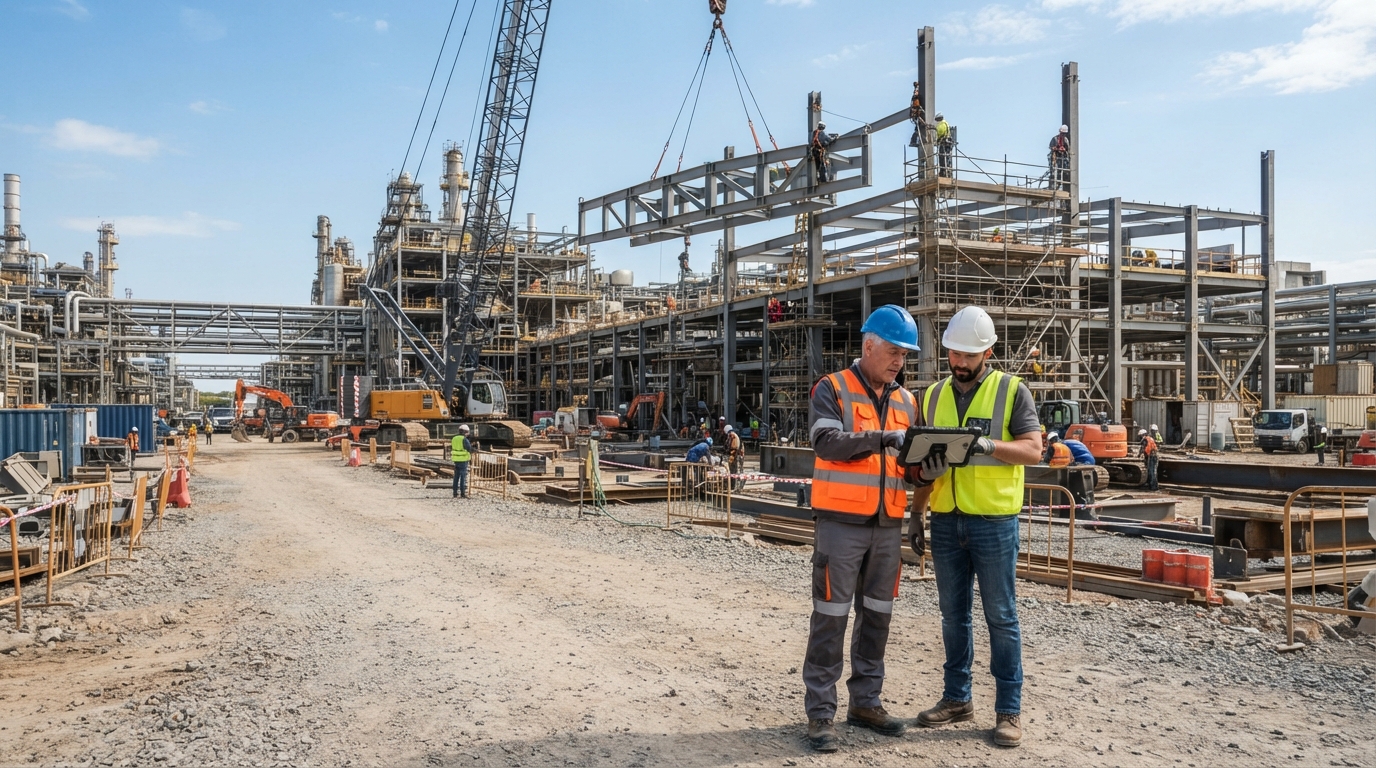
Construction is where a plant moves from drawings to reality. It is the phase where steel is erected, equipment is installed, piping is connected, and systems are tested. It is also the phase where the most visible risks—safety, schedule, cost, and quality—come together.
Construction management is the discipline of planning, coordinating, and controlling construction activities to deliver the plant safely, on schedule, within budget, and to the required quality. For small to medium-scale industrial plants, effective construction management is especially important because there is less redundancy and fewer resources to absorb the consequences of poor planning or execution.
This article covers the key practices in plant construction management, from pre-construction planning to closeout.
What Is Construction Management?
Construction management is the process of managing the construction phase of a project. It includes:
- Planning: Defining scope, schedule, budget, and resources.
- Coordination: Managing contractors, vendors, and interfaces.
- Control: Monitoring progress, cost, quality, and safety.
- Communication: Keeping all parties informed.
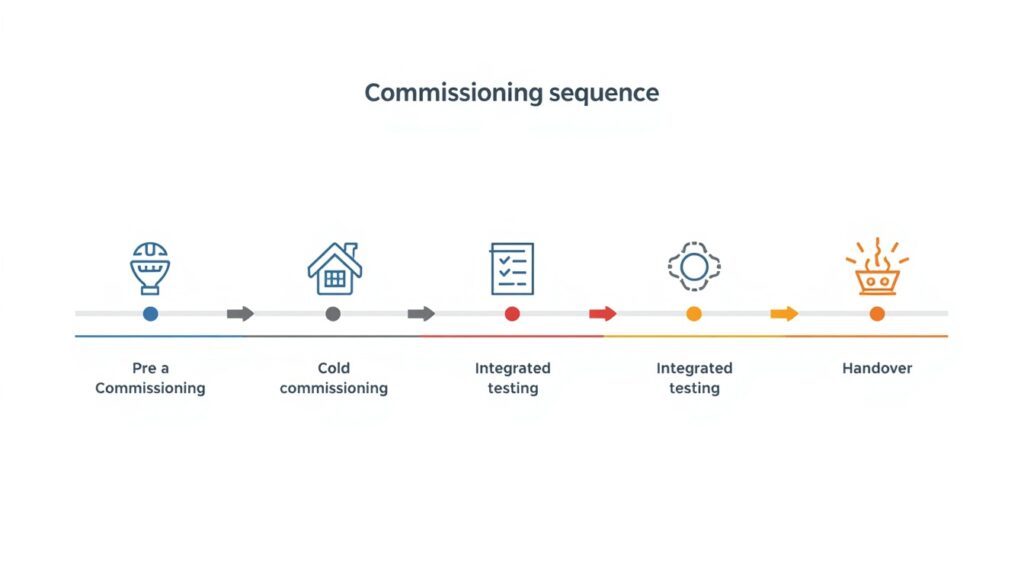
- Closeout: Completing punch lists and handing over to commissioning.
Construction management is distinct from design and commissioning. It focuses on the physical execution of the work, although it must work closely with both: design provides the information to build from, and commissioning receives the finished plant.
Why Construction Management Matters
Construction is where projects succeed or fail.
| Factor | Impact of Good Construction Management | Impact of Poor Construction Management |
|---|---|---|
| Safety | Incidents prevented; workers protected | Incidents, injuries, and regulatory action |
| Schedule | Milestones met; startup on time | Delays cascade; startup postponed |
| Cost | Budget controlled; no surprises | Cost overruns; disputes |
| Quality | Work meets specifications | Rework; premature failures |
| Coordination | Contractors work together | Conflicts; interface problems |
| Documentation | Records complete for handover | Incomplete records; operational problems |
For small plants, where there is less margin for error, construction management determines whether the project is delivered successfully.
The Role of the Construction Manager
The construction manager is responsible for the construction phase of the project.
Key responsibilities:
- Planning and scheduling construction activities.
- Coordinating contractors, vendors, and suppliers.
- Monitoring progress, cost, quality, and safety.
- Managing changes and resolving issues.
- Reporting to the project manager and owner.
- Ensuring documentation is complete.
The construction manager must have both technical knowledge and management skills.
Pre-Construction Planning
Pre-construction planning sets the foundation for successful construction.
Pre-construction activities:
- Scope definition: What work is included in the construction contract?
- Constructability review: Is the design buildable? Are there conflicts or issues?
- Schedule development: What is the construction sequence and timeline?
- Budget development: What is the cost of construction?
- Contractor selection: Who will perform the work?
- Regulatory approvals: Have building permits, environmental approvals, and other statutory requirements been obtained?
- Site preparation: Is the site ready for construction?
- Logistics planning: How will materials and equipment be delivered?
- Safety planning: What are the construction hazards, and how will they be controlled?
- Risk assessment: What could go wrong (weather, ground conditions, late deliveries, labor availability), and what is the response?
Pre-construction planning should begin early—ideally during design—to identify and resolve issues before construction starts.
Constructability Review
A constructability review examines the design to identify construction issues before they become problems.
Constructability review questions:
- Can the design be built safely and efficiently?
- Are there conflicts between disciplines (e.g., piping and structural)?
- Is there adequate access for construction equipment, including cranes?
- Are there adequate laydown areas?
- Are materials and equipment available within the required lead times?
- Are there sequencing issues?
- Is there space and access to maintain the equipment once installed?
- Are there constructability issues that will increase cost or schedule?
Constructability reviews are most valuable when conducted during design, when changes are still inexpensive.
Construction Sequencing
Construction sequencing determines the order in which work is performed. Good sequencing minimizes rework, avoids blocking access, and allows work to proceed in parallel where possible. Sequencing should be planned during pre-construction and adjusted as work progresses.
Typical sequencing considerations for an industrial plant include:
- Installing underground utilities and foundations before structures and equipment are placed above them.
- Setting heavy equipment (turbines, boilers, large vessels) before surrounding structures and piping close off crane access.
- Completing large-bore piping and structural steel before small-bore piping, cable trays, and instrumentation.
- Prioritizing work by system, so that areas and systems can be completed and turned over to commissioning in the order commissioning needs them.
Sequencing should be aligned with equipment delivery dates, so that work is not delayed waiting for materials and equipment is not stored longer than necessary.
Construction Organization
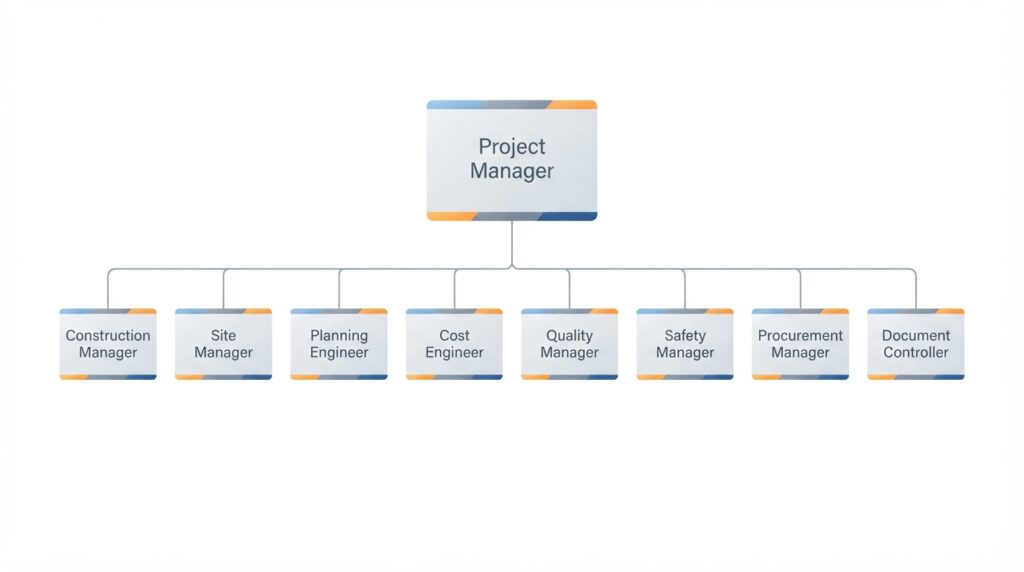
A clear organization is essential for construction management.
Key roles:
| Role | Responsibility |
|---|---|
| Project Manager | Overall responsibility for the project |
| Construction Manager | Construction planning, coordination, and control |
| Site Manager | Day-to-day management of the site |
| Planning Engineer | Schedule development and progress tracking |
| Cost Engineer | Budget tracking and cost control |
| Quality Manager | Quality control and inspection |
| Safety Manager | Safety oversight and compliance |
| Procurement Manager | Materials and equipment |
| Document Controller | Document management |
For small plants, roles may be combined, but the functions must be covered. Clear lines of authority and reporting should be established before mobilization, so that everyone on site knows who makes decisions.
Temporary Facilities
Construction sites require temporary facilities. Temporary facilities—site offices, warehouses, rest areas, first aid stations, and utilities—must be planned and provided. These facilities support the construction workforce and are demobilized during closeout.
Other temporary facilities to plan for include:
- Laydown and fabrication yards.
- Temporary power, water, and sanitation.
- Site access roads, gates, and security.
- Waste collection and storage.
- Parking, worker transport, and, for remote sites, accommodation.
These facilities should be located so that they do not interfere with permanent works, and their cost and schedule impact should be included in the construction plan.
Contractor Management
Construction is typically performed by contractors. Managing them effectively is critical.
Contractor management activities:
- Pre-qualification: Assessing contractor capability, safety record, and financial strength.
- Contracting: Defining scope, schedule, quality, and safety requirements.
- Mobilization: Ensuring contractors are ready to start work, with qualified personnel, equipment, and approved procedures.
- Supervision: Monitoring contractor performance.
- Coordination: Managing interfaces between contractors.
- Performance evaluation: Assessing contractor performance against requirements.
Good contractor management requires clear expectations, consistent enforcement, and open communication. Contractors should also be required to submit method statements for critical or high-risk activities, such as heavy lifts, so that the approach is reviewed before work begins.
Interface Management
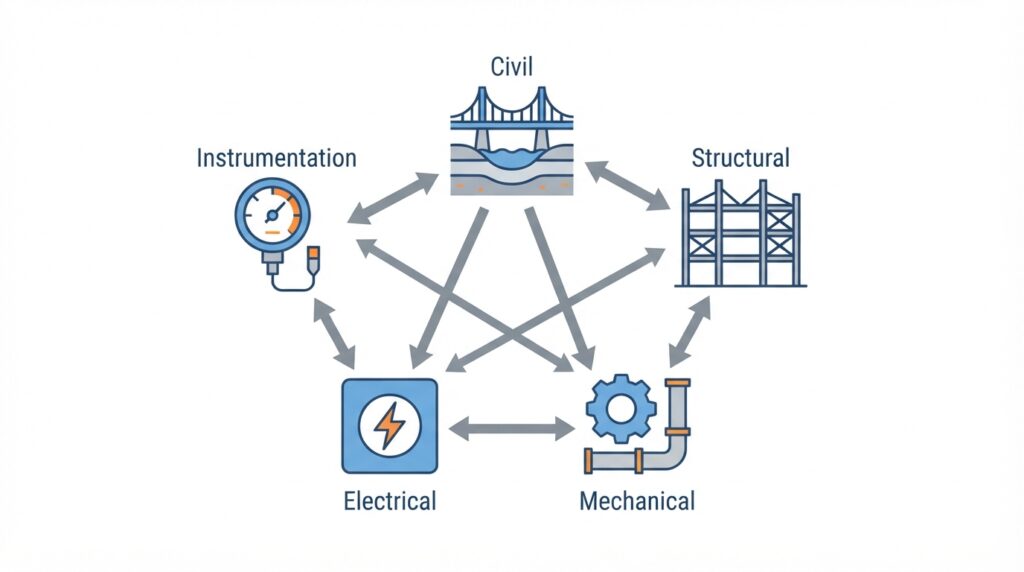
Construction involves many interfaces—between disciplines, contractors, and systems.
Common interfaces:
- Between civil and structural works.
- Between structural and mechanical works.
- Between mechanical and electrical works.
- Between electrical and instrumentation works.
- Between contractors working in the same area.
- Between construction and commissioning.
- Between new construction and existing operating facilities, where applicable.
Interface management ensures that work is coordinated and conflicts are resolved. Practical tools include an interface register, regular coordination meetings, and area-based work planning.
Schedule Management
Schedule management ensures that construction is completed on time.
Schedule management activities:
- Baseline schedule: The approved schedule for the project.
- Progress tracking: Measuring actual progress against the baseline, using agreed progress measurement rules (for example, weighted quantities installed rather than subjective estimates).
- Critical path analysis: Identifying activities that determine the project duration.
- Schedule updates: Updating the schedule as work progresses.
- Look-ahead planning: Short-term (for example, three-week) schedules that translate the baseline into detailed work plans.
- Delay analysis: Identifying causes of delay and corrective actions.
- Recovery planning: Developing plans to recover schedule slippage.
Schedule management requires accurate progress data and timely decision-making.
Cost Management
Cost management ensures that construction is completed within budget.
Cost management activities:
- Budget development: The approved budget for construction.
- Commitment tracking: Tracking contracts and purchase orders.
- Cost tracking: Tracking actual costs against budget.
- Forecasting: Predicting final costs based on current trends.
- Change management: Managing scope changes and their cost impact.
- Contingency management: Managing contingency for unknowns.
Cost management requires accurate cost data and disciplined change control. Cost and schedule performance are best evaluated together—for example, by comparing the value of work completed with both planned progress and actual spending—so that problems are visible early.
Quality Management
Quality management ensures that construction meets specifications.
Quality management activities:
- Quality plan: Defining quality requirements and responsibilities.
- Inspection and test plans: Defining which activities are inspected, by whom, and at which hold or witness points.
- Inspection and testing: Verifying that work meets specifications.
- Documentation: Recording inspections and test results.
- Non-conformance management: Identifying and resolving quality issues.
- Final acceptance: Confirming that work meets requirements.
Quality issues discovered during construction are cheaper to fix than those discovered during commissioning or operation. Inspecting work as it is completed, rather than at the end, prevents defects from being buried by later work.
Safety Management
Safety is the highest priority in construction.
Safety management activities:
- Hazard identification: Identifying construction hazards.
- Risk assessment: Assessing and prioritizing risks.
- Safety procedures: Permit-to-work, lockout/tagout, confined space, hot work, work at height, excavation, and lifting operations.
- Training: Ensuring workers are trained for their tasks and receive a site induction.
- PPE: Providing and enforcing use of protective equipment.
- Inspections: Regular site inspections to identify hazards.
- Incident reporting: Reporting and investigating incidents and near-misses.
- Emergency response: Planning for emergencies.
Safety must be integrated into every construction activity, not added as an afterthought.
Permit-to-Work Systems
Permit-to-work is a key safety control during construction. A permit-to-work system controls high-risk activities such as hot work, confined space entry, and work at height. Permits define the precautions required and must be issued by authorized personnel before work begins.
An effective permit-to-work system also:
- Specifies the location, scope, duration, and the people covered by each permit.
- Requires the area to be checked and isolated as needed before work starts.
- Coordinates simultaneous operations, so that one activity does not endanger another.
- Requires permits to be closed out when work is complete or suspended.
Environmental Management
Construction can affect the environment through dust, noise, spills, waste, and runoff. An environmental plan should address permit conditions, waste management, spill prevention, and erosion and sediment control. Environmental requirements should be communicated to contractors and monitored like any other contract requirement.
Materials and Equipment Management
Construction requires timely delivery of materials and equipment.
Materials management activities:
- Procurement: Ordering materials and equipment.
- Expediting: Monitoring supplier progress.
- Inspection: Verifying materials meet specifications.
- Logistics: Managing shipping, customs, and delivery.
- Receiving: Inspecting and accepting deliveries.
- Storage: Storing and preserving materials.
- Issue: Delivering materials to the work site.
Materials management ensures that materials are available when needed and in good condition. Rotating equipment, electrical gear, and instruments often require special preservation (for example, climate-controlled storage or periodic rotation), and failing to maintain it can invalidate warranties.
Construction Documentation
Construction generates vast amounts of documentation.
Key documents:
- Drawings: As-built drawings reflecting actual construction.
- Specifications: Technical requirements.
- Inspection records: Results of inspections and tests.
- Test records: Results of system tests.
- Non-conformance reports: Records of quality issues.
- Change orders: Documentation of scope changes.
- Progress reports: Records of progress and issues.
- Safety records: Incident reports and safety inspections.
- Vendor documents: Manuals, certificates, and warranty information.
Documentation must be complete and accurate for handover to commissioning and operations. It is far easier to collect records as the work is completed than to reconstruct them afterward.
Communication and Reporting
Regular communication keeps everyone aligned. Typical practices include daily toolbox or coordination meetings, weekly progress meetings with contractors, and monthly reports to the owner covering progress, cost, quality, safety statistics, risks, and upcoming milestones. Decisions and actions should be recorded and followed up.
Managing Changes During Construction
Changes during construction are common. Managing them is critical.
Change management activities:
- Change identification: Recognizing when a change is required.
- Change assessment: Evaluating the impact on scope, schedule, cost, quality, and safety.
- Change approval: Approving or rejecting the change.
- Change implementation: Implementing the change.
- Documentation: Recording the change and its impact, including updates to drawings.
Uncontrolled changes lead to scope creep, schedule delays, and cost overruns.
Construction Closeout
Closeout is the phase where construction is completed and handed over to commissioning.
Closeout activities:
- Punch list: Outstanding items to be completed, typically categorized by whether they must be finished before commissioning or can be completed afterward.
- Inspection: Verification that work meets requirements.
- Mechanical completion: Confirmation that systems are built, inspected, and ready for pre-commissioning and commissioning.
- Documentation: Completion of as-built drawings and records.
- Handover: Formal transfer to commissioning, typically system by system.
- Demobilization: Removal of contractors, equipment, and temporary facilities.
- Housekeeping: Cleaning the site.
Closeout should be planned as part of construction, not left to the end. Handing over completed systems progressively allows commissioning to start earlier and reduces the end-of-project crunch.
Lessons Learned
Lessons learned during construction should be captured and applied. Regular reviews and a lessons-learned database help ensure that problems are not repeated on future projects.
Lessons should be captured throughout the project, not only at the end—for example, at milestone reviews and after significant incidents or non-conformances—and shared with the people who will plan the next project.
Common Mistakes in Construction Management
Even experienced organizations make mistakes. Common ones include:
- Inadequate pre-construction planning: Starting construction before planning is complete.
- Poor constructability review: Missing design issues that cause problems during construction.
- Unclear scope: Leading to disputes and changes.
- Poor contractor selection: Choosing on price alone.
- Inadequate interface management: Conflicts between disciplines and contractors.
- Poor sequencing: Work performed in an order that causes rework or blocks access.
- Poor schedule management: Delays not identified or addressed.
- Weak cost control: Cost overruns not detected until too late.
- Quality issues: Rework and premature failures.
- Safety shortcuts: Leading to incidents.
- Incomplete documentation: Problems during handover.
- Failing to capture lessons: Repeating the same mistakes on later projects.
These mistakes are costly to correct. They are much cheaper to avoid through good planning and disciplined execution.
How Japanese EPC Firms Approach Construction Management
Japanese engineering firms are known for their disciplined approach to construction management. Common characteristics include:
- Thorough planning: Construction is planned carefully, with detailed schedules and work packages.
- Disciplined execution: Work is performed as planned, with tight control.
- Safety focus: Safety is prioritized throughout, with daily toolbox meetings and hazard prediction activities.
- Quality control: Work is inspected as it is completed.
- Detailed documentation: Records are complete and accurate.
- Interface management: Interfaces between disciplines and contractors are carefully managed.
- Continuous improvement: Lessons are captured and applied.
- Long-term focus: Construction is treated as the foundation for reliable operation.
For plant owners, this often means construction that is completed safely, on schedule, within budget, and to the required quality.
How to Evaluate Construction Management Readiness
When reviewing construction management, ask:
| Question | Why It Matters |
|---|---|
| Is pre-construction planning complete? | Sets the foundation for success |
| Has a constructability review been performed? | Identifies issues before construction |
| Is the scope clearly defined? | Prevents disputes and changes |
| Are contractors pre-qualified? | Ensures capable contractors |
| Is the construction sequence defined? | Minimizes rework and access conflicts |
| Is the schedule realistic? | Ensures work can be completed |
| Is the budget adequate? | Ensures funding is available |
| Are temporary facilities planned? | Supports the workforce and logistics |
| Is there a quality plan? | Ensures work meets specifications |
| Is there a safety plan and permit-to-work system? | Protects workers |
| Are interfaces managed? | Prevents conflicts |
| Is documentation complete? | Supports handover and operations |
| Is there a process for capturing lessons learned? | Improves future projects |
A plant that addresses these questions is ready for successful construction.
Conclusion
Construction management is the discipline of delivering the plant safely, on schedule, within budget, and to the required quality. For small to medium-scale industrial plants, it is especially important because there is less margin for error.
By focusing on pre-construction planning, constructability review, sequencing, contractor management, interface management, schedule, cost, quality, and safety, owners and construction managers can ensure that construction is completed successfully and the plant is ready for commissioning and operation.
Key Takeaways
- Construction management delivers the plant safely, on schedule, within budget, and to quality.
- Pre-construction planning sets the foundation for success.
- Constructability reviews identify issues before construction begins.
- Good sequencing minimizes rework and avoids blocking access.
- Contractor, interface, schedule, cost, quality, and safety management are all essential.
- Permit-to-work systems control high-risk activities.
- Materials management ensures materials are available when needed.
- Documentation must be complete and accurate for handover.
- Change management prevents scope creep and cost overruns.
- Closeout should be planned as part of construction.
- Lessons learned should be captured and applied to future projects.
- Japanese EPC firms emphasize thorough planning and disciplined execution.