Starting up a plant, or restarting it after a significant change, is one of the highest-risk activities in its life. Equipment is energized, process fluids are introduced, and systems are operated together for the first time. Mistakes during startup can cause equipment damage, environmental releases, injuries, or worse.
The Pre-Startup Safety Review (PSSR) is the final formal check before hazardous materials or energy are introduced or reintroduced. It confirms that construction is complete, safety systems are functional, procedures are in place, and personnel are trained. It is one of the last barriers before startup, and one of the few that looks at the whole plant rather than a single system.
For small to medium-scale industrial plants, PSSR is especially important because there is less redundancy and fewer resources to absorb the consequences of a startup problem. A missed item can turn a smooth startup into an incident.
This article explains what PSSR is, when it applies, and how to conduct one practically in an industrial plant.
What Is a Pre-Startup Safety Review?
A Pre-Startup Safety Review is a formal, documented review conducted before introducing hazardous materials or energy into a process, or before restarting after a significant change.
The purpose of PSSR is to confirm that:
- Construction and equipment conform to the design specification.
- Safety, operating, maintenance, and emergency procedures are in place and adequate.
- A hazard analysis has been completed, and its recommendations are resolved or scheduled.
- Management of Change (MOC) requirements have been met for modifications.
- Training of affected personnel is complete.
- Open items are either closed or formally accepted with a due date.
- The plant is ready to be started safely.
PSSR and Commissioning
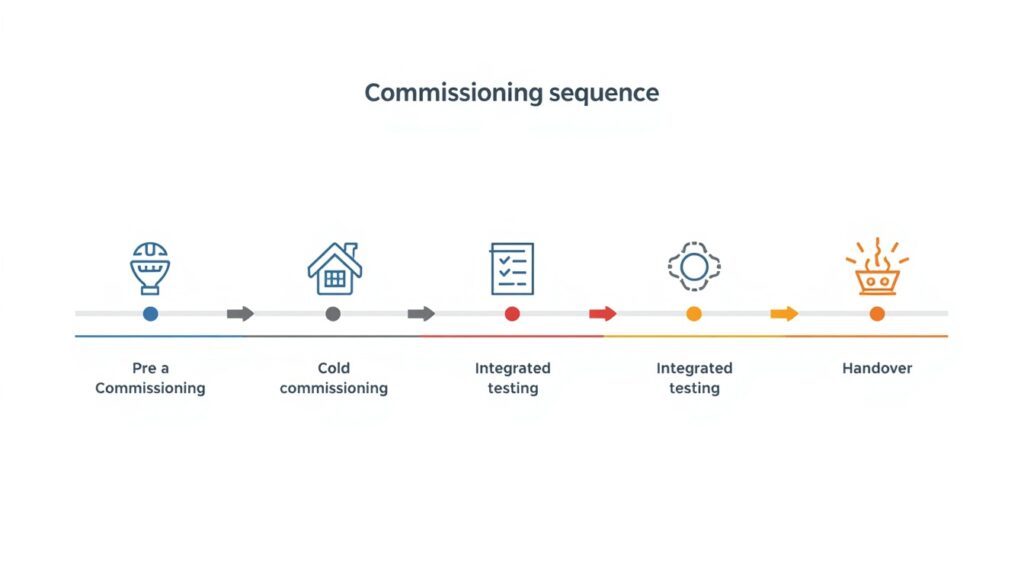
PSSR is not a substitute for commissioning. Commissioning verifies that equipment and systems function as designed. PSSR verifies that the plant is ready to be started safely.
The two overlap in sequence. Construction, mechanical completion, and non-hazardous (“cold”) commissioning, such as loop checks, motor run tests, and water or air tests, are normally finished before the PSSR. The PSSR is then completed before hazardous materials or energy are introduced, which is when “hot” commissioning and startup begin. In other words, PSSR is the gate between preparation and the introduction of hazards.
Regulatory and Standards Background
In many jurisdictions PSSR is a legal requirement for facilities handling hazardous chemicals. For example, the US OSHA Process Safety Management standard (29 CFR 1910.119) and the EPA Risk Management Program rule (40 CFR Part 68) both require a PSSR for new facilities and for modified facilities where the modification changes process safety information. Industry guidance, such as the CCPS Risk Based Process Safety framework, also treats PSSR as a core element.
Requirements differ by country and industry, so plant owners should confirm what applies to them. Even where PSSR is not legally required, it is good practice for any plant with significant hazards.
When Is PSSR Required?
PSSR is required before startup in specific situations.
| Trigger | Description |
|---|---|
| New plant or unit | First startup of a new facility |
| Significant modification | Changes that alter process safety information or design basis |
| Change requiring MOC | Changes classified as moderate or major under Management of Change |
| Restart after extended shutdown | Restart after a long outage or turnaround |
| Restart after an incident | Restart after an incident that affected safety systems |
The first three triggers are generally regulatory. The last two are good practice, and many organizations adopt them as policy.
Not every change requires a PSSR. Minor changes handled under MOC may not need one, such as a like-for-like replacement within the design basis. The decision should be made as part of the MOC process and recorded.
PSSR for Turnarounds
Turnarounds (planned shutdowns for maintenance and modifications) often require PSSR before restart. Turnarounds often involve multiple changes that individually may not require PSSR, but collectively may. The cumulative effect of changes should be considered when deciding whether a PSSR is needed.
A practical approach is to review the full turnaround scope list against MOC records before restart, and to decide up front whether a unit-level or plant-level PSSR is required. Even when a full PSSR is not needed, a restart readiness check covering isolations removed, blinds and spades pulled, temporary bypasses restored, and equipment boxed up is essential.
PSSR and Other Processes
PSSR is closely related to other plant processes.
| Process | Relationship to PSSR |
|---|---|
| Commissioning | Cold commissioning is completed before PSSR; hot commissioning follows it |
| Management of Change (MOC) | Determines whether a PSSR is required for a change |
| Hazard analysis (HAZOP, LOPA) | Identifies hazards; PSSR confirms recommendations are addressed |
| Mechanical integrity | Confirms equipment is inspected and tested |
| Training | Confirms personnel are trained on new or modified systems |
| Operating procedures | Confirms procedures are updated and available |
| Permit-to-work and isolation | Confirms all work permits are closed and isolations are removed |
PSSR is the integration point for all these activities. It confirms that everything is ready before startup.
The PSSR Process
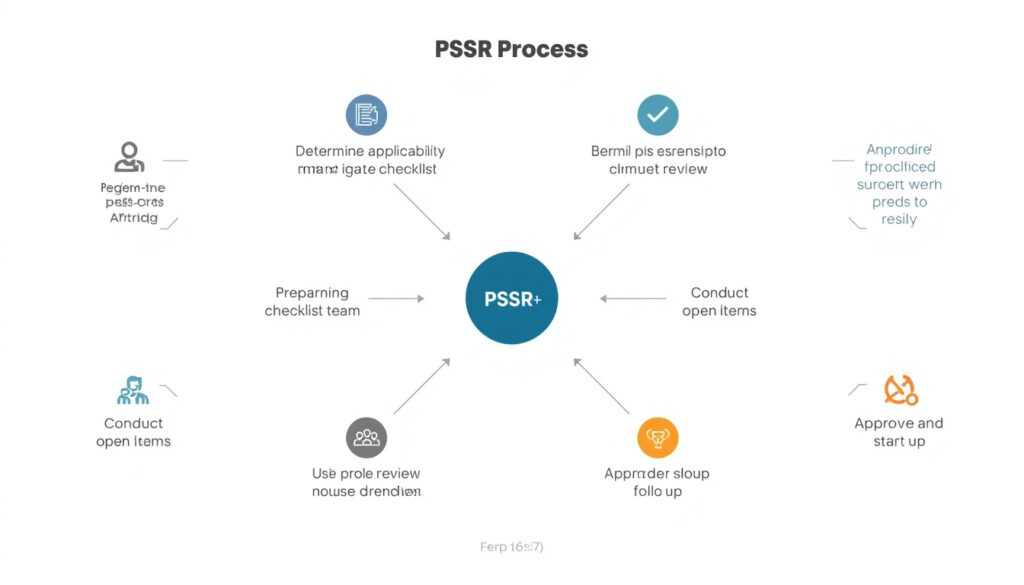
While PSSR processes vary by organization, most follow a similar structure.
| Step | Description |
|---|---|
| 1. Determine applicability | Is a PSSR required for this startup? |
| 2. Assemble the team | Who will conduct the review? |
| 3. Prepare the checklist | What items must be verified? |
| 4. Conduct the review | Verify each item, including a field walkdown, and document findings. |
| 5. Resolve open items | Close or formally accept outstanding items. |
| 6. Approve and sign off | Authorized personnel approve startup. |
| 7. Start up | Proceed with startup. |
| 8. Follow up | Confirm open items are completed and capture lessons learned. |
The PSSR must be completed before startup, not after.
Timing the PSSR
PSSR should be scheduled so that there is enough time to resolve any findings before startup. If the PSSR is conducted at the last minute, there may not be time to address issues, and the temptation to proceed anyway increases.
A practical approach is to build the PSSR into the project or turnaround schedule as a defined milestone:
- Start preparing the checklist early, during construction or turnaround planning.
- Begin progressive reviews of documents, training, and procedures well before mechanical completion.
- Hold the final walkdown and sign-off with enough float in the schedule to fix findings.
- Make clear to everyone, including senior management and the client, that startup dates depend on PSSR completion and not the other way around.
PSSR Team
The PSSR team should include people with knowledge of the systems being reviewed.
Typical team members:
- Operations representative: Knows how the plant is operated.
- Maintenance representative: Knows equipment condition and maintenance status.
- Engineering representative: Knows the design and any modifications.
- Safety representative: Knows safety systems and requirements.
- Project representative: Knows what was constructed or modified.
- Commissioning representative: Knows what has been tested and verified.
For small plants, the team may be smaller, but the functions must still be covered, and one person may cover more than one function. The team should include someone independent of the project or modification, to provide objective review. This might be an engineer or supervisor from another unit, a corporate or sister-plant resource, or a third-party reviewer.
The team leader should have the authority and the standing to recommend that startup be delayed.
PSSR Checklist
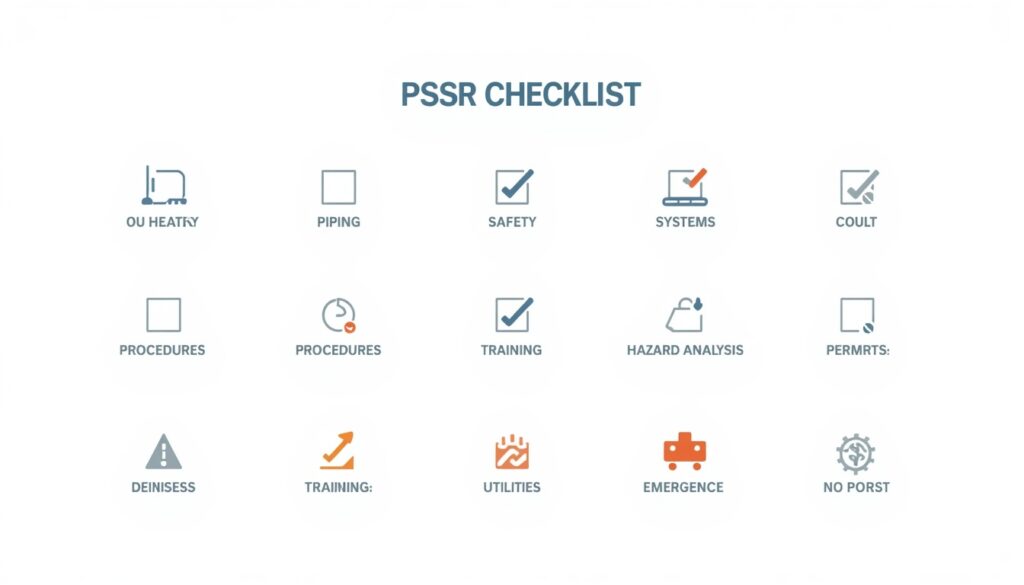
The PSSR checklist covers the items that must be verified before startup.
Typical checklist categories:
| Category | Items to Verify |
|---|---|
| Construction and equipment | Equipment installed per design, materials correct, supports and foundations complete |
| Piping and instrumentation | P&IDs updated, instruments installed and calibrated, valves in correct position |
| Safety systems | SIS tested, relief devices installed and tested, fire and gas detection functional |
| Procedures | Operating, maintenance, and emergency procedures updated and available |
| Training | Personnel trained on new or modified systems |
| Hazard analysis | Recommendations resolved or scheduled |
| Permits and compliance | Required permits obtained, regulatory requirements met |
| Utilities | Power, water, air, steam, and other utilities available and reliable |
| Spare parts and consumables | Critical spares and consumables available |
| Emergency response | Emergency equipment available, response plans updated |
| Documentation | Process safety information, as-built drawings, and equipment records updated |
Checklists should be tailored to the specific plant and the specific startup. A generic template is a useful starting point, but it should be reviewed and adapted. The checklist should also state who is responsible for each item and what evidence (test record, certificate, signed procedure) demonstrates that it is complete.
Construction and Equipment Verification
The PSSR verifies that construction and equipment conform to the design specification.
Items to verify:
- Equipment installed in the correct location and orientation.
- Materials of construction match the specification.
- Supports, foundations, and anchor bolts complete.
- Insulation and refractory installed correctly.
- Electrical connections complete and tested.
- Instruments installed, calibrated, and connected.
- Valves installed in the correct orientation and position.
- Piping systems tested (pressure/leak tested) and flushed or cleaned.
- Temporary items removed, including blinds, spades, temporary supports, strainers, and construction debris.
- Equipment preservation maintained during construction.
Any deviations from the design should be documented, assessed through MOC where necessary, and resolved before startup.
Safety System Verification
The PSSR verifies that safety systems are functional.
Items to verify:
- Safety instrumented functions (SIFs) functionally tested and validated, with SIL verification documented for the as-built design.
- Relief devices installed, sized correctly, set at the correct pressure, and tested or certified.
- Fire and gas detection systems functional and tested.
- Fire protection systems, such as water, foam, and extinguishers, available and operational.
- Emergency shutdown systems tested.
- Alarms and trips tested at their set points.
- Interlocks tested.
- Temporary bypasses, overrides, and jumpers removed and protection restored.
Safety systems must be verified before startup, not after.
Procedure Verification
The PSSR verifies that procedures are in place and adequate.
Procedures to verify:
- Operating procedures, including startup, normal operation, and shutdown.
- Emergency procedures, including response to upsets and emergency shutdown.
- Maintenance procedures for new or modified equipment.
- Safety procedures, including permit-to-work and lockout/tagout.
- Alarm response procedures.
Procedures must reflect the current design, be reviewed by operators, and be available at the point of use. Startup procedures in particular should be walked through in the field before use, since errors often show up when the procedure is compared with the real plant.
Training Verification
The PSSR verifies that personnel are trained on new or modified systems.
Training to verify:
- Operators trained on new equipment, procedures, and alarms.
- Maintenance personnel trained on new equipment and procedures.
- Emergency response personnel trained on updated plans.
- Contractors briefed on site hazards and procedures.
Training records should be available and complete. Where possible, operators should be assessed for competence, for example through a walkthrough or simulator exercise, and not just recorded as having attended.
Hazard Analysis Verification
The PSSR verifies that hazard analysis recommendations are resolved or scheduled.
Items to verify:
- HAZOP or other hazard analysis completed.
- Recommendations resolved, or formally accepted with a due date where they do not affect safe startup.
- Management of Change (MOC) completed for modifications.
- Risks assessed and acceptable.
Open recommendations must be tracked to completion.
Utilities Verification
Utilities (power, water, air, steam) are essential for startup. Utilities must be available and reliable before startup. If a utility is interrupted during startup, the plant may not be able to shut down safely or maintain critical systems.
Items to verify:
- Electrical power available, including emergency power and UPS for control and safety systems.
- Instrument air available, dry, and at the right pressure, with failure positions of control valves confirmed.
- Cooling water, boiler feedwater, and steam available at the required quality and capacity.
- Fuel, nitrogen, and other process utilities available where required.
- Emergency utilities, such as fire water and emergency lighting, available.
- Utility failure scenarios considered, and the plant’s response to each understood by operators.
Where startup depends on temporary utilities, such as rental compressors or temporary power, these should be reviewed with the same rigor as permanent systems.
Field Walkdown
A PSSR is not just a paper review. The team should physically walk down the plant to confirm that what is installed matches the drawings and the checklist. Typical walkdown checks include:
- Valve positions, blinds, and spades match the startup line-up.
- Access, egress, lighting, and housekeeping are acceptable.
- Labeling and signage are in place.
- Emergency equipment is in place and accessible.
- Nothing visible conflicts with the P&IDs.
Many serious startup problems, such as a missing blind, a reversed check valve, or an unprotected opening, are found by walking the plant, not by reading documents.
Managing Open Items
Not every item can be closed before startup. Some items may be acceptable to leave open, provided they are formally accepted with a due date.
Open items should be:
- Documented with a clear description.
- Assessed for risk if left open.
- Formally accepted by authorized personnel.
- Assigned to a responsible person.
- Given a due date for completion.
- Tracked to completion.
Many organizations sort open items into two categories:
| Category | Description | Timing |
|---|---|---|
| Category A (must close) | Items that affect safe startup or operation | Closed before startup |
| Category B (may be deferred) | Items that do not affect safe startup, such as minor documentation, painting, or non-critical spares | Closed by an agreed date after startup |
Open items that affect safety must be closed before startup. Open items that do not affect safety may be accepted with a due date. If there is doubt about which category an item belongs in, treat it as Category A.
If the PSSR finds that the plant is not ready, the correct answer is to delay startup. The team and the approvers need to know that a delay is an acceptable outcome, and that nobody will be penalized for stopping a startup that is not ready.
Approval and Sign-Off
The PSSR must be approved by authorized personnel before startup.
Typical approvals:
- Operations manager
- Engineering manager
- Safety manager
- Plant manager (for major startups)
Approval should be documented, with the approver’s name, date, and any conditions. The sign-off confirms that the approver has seen the evidence (not just the summary), that Category A items are closed, and that Category B items are accepted with owners and due dates.
Documentation and Record Retention
PSSR records should be retained and made available to operations, maintenance, and future project teams. They provide a record of what was verified, what was accepted as open, and who approved startup.
Records to retain typically include:
- The completed PSSR checklist and supporting evidence.
- The team list and the independent reviewer’s findings.
- The open items register, with closure evidence.
- The sign-off page, with names, dates, and conditions.
- Updated process safety information and as-built drawings.
Retention periods should follow regulatory requirements and company policy. For hazardous facilities, keeping records for the life of the process or unit is common. Where a regulator or auditor may ask for them, records should be easy to retrieve, not buried in project archives.
Common Mistakes in PSSR
Even experienced teams make mistakes. Common ones include:
- Skipping PSSR: Starting up without a formal review.
- Late PSSR: Doing the review at the last minute, with no time to fix findings.
- Incomplete checklist: Missing items that later cause problems.
- No independent review: Team too close to the project to be objective.
- Paper-only review: No field walkdown to confirm the as-built plant.
- Open items not tracked: Recommendations forgotten after startup.
- Safety systems not verified: Assuming systems work without testing.
- Utilities overlooked: Assuming power, air, and cooling will be reliable.
- Procedures not updated: Operators working from outdated documents.
- Training not complete: Personnel unfamiliar with new systems.
- Cumulative changes missed: Turnaround changes reviewed one by one instead of together.
- Approval rushed: Signing off under schedule pressure.
These mistakes can turn a smooth startup into an incident.
After Startup: Follow-Up
The PSSR does not end when the plant starts. After startup:
- Track Category B items to closure and report progress to management.
- Confirm that as-built drawings, P&IDs, and procedures are updated.
- Review startup experience with the team, including what went well, what surprised people, and what the checklist missed.
- Feed lessons learned into the checklist template for the next PSSR.
How Japanese EPC Firms Approach PSSR
Japanese engineering firms are known for their disciplined approach to startup and safety. Common characteristics include:
- Thorough preparation: PSSR checklists are detailed and tailored to the plant.
- Comprehensive verification: All items are verified, not assumed.
- Independent review: Team includes people independent of the project.
- Field confirmation: Walkdowns are used to verify the installed plant against the drawings.
- Detailed documentation: PSSR records, findings, and open items are carefully maintained.
- Disciplined approval: Sign-off is not rushed; open items are resolved or formally accepted.
- Follow-through: Open items are tracked to completion.
- Long-term focus: PSSR is treated as the foundation for safe operation, not a bureaucratic hurdle.
For plant owners, this often means smoother startups, fewer surprises, and a plant that is ready for safe operation from day one.
How to Evaluate PSSR Readiness
When considering PSSR for your plant, ask:
| Question | Why It Matters |
|---|---|
| Is PSSR required for this startup? | Determines whether a formal review is needed |
| Is there a defined PSSR process? | Ensures reviews are conducted consistently |
| Is the PSSR scheduled early enough? | Leaves time to fix findings before startup |
| Is there a tailored checklist? | Covers the specific items for this startup |
| Is the team independent? | Provides objective review |
| Has the plant been walked down? | Confirms the installed plant matches the documents |
| Are safety systems verified? | Ensures protection is functional |
| Are utilities available and reliable? | Ensures the plant can run and shut down safely |
| Are procedures updated? | Ensures operators have current information |
| Is training complete? | Ensures personnel know the systems |
| Are open items tracked? | Ensures recommendations are completed |
| Is approval documented and retained? | Confirms authorized sign-off and preserves the record |
A plant that addresses these questions is likely to have an effective PSSR.
Conclusion
The Pre-Startup Safety Review is the final formal check before hazardous materials or energy are introduced into a process. It confirms that construction is complete, safety systems are functional, procedures are in place, and personnel are trained.
For small to medium-scale industrial plants, PSSR is especially important because there is less redundancy and fewer resources to absorb the consequences of a startup problem. Scheduled early, conducted independently, verified in the field, and signed off without schedule pressure, PSSR ensures that startup happens safely and that the plant is ready for reliable operation.
Key Takeaways
- PSSR is the final check before introducing hazardous materials or energy.
- PSSR is required for new plants and significant modifications, and is good practice after extended shutdowns, turnarounds, and incidents.
- PSSR verifies construction, safety systems, utilities, procedures, training, and hazard analysis.
- PSSR is not a substitute for commissioning. It follows cold commissioning and comes before hazardous startup.
- Schedule PSSR early enough to fix findings, and consider the cumulative effect of turnaround changes.
- Open items affecting safety must be closed; others may be accepted only with an owner and a due date.
- PSSR must be completed and signed off before startup, not after, and the records retained.
- Japanese EPC firms emphasize thorough preparation, field verification, and independent review.