
Quality is one of the three pillars of project success, alongside cost and schedule. A plant that is built quickly and cheaply but does not perform as designed, or fails prematurely, is not a success. Quality management is the discipline of ensuring that the plant is designed, built, and commissioned to meet its specifications.
Quality is not just about inspection at the end. It is about building quality into every phase of the project, from design through procurement, construction, and commissioning. Quality problems discovered late are expensive to fix; quality problems prevented from the start cost far less.
For small to medium-scale industrial plants, quality management is especially important because there is less redundancy and fewer resources to absorb the consequences of quality failures. A defective component or a poorly executed installation can cause outages, safety incidents, and costly rework.
This article covers the key practices in plant quality management, from quality planning to inspection, testing, and continuous improvement.
What Is Quality Management?
Quality management is the process of planning, controlling, and improving quality to meet project requirements. It includes:
- Quality planning: Defining what quality means and how it will be achieved.
- Quality assurance: Ensuring that processes are capable of producing quality.
- Quality control: Inspecting and testing to verify that quality is achieved.
- Quality improvement: Continuously improving processes and outcomes.
▲ On EPC projects these activities are usually organized within a quality management system (QMS), often based on ISO 9001, and documented in a project quality plan (see ISO 10005 for guidance) that explains how the system applies to the specific project.
Why Quality Management Matters
| Factor | Impact of Good Quality Management | Impact of Poor Quality Management |
|---|---|---|
| Performance | Plant meets design specifications | Plant underperforms |
| Reliability | Equipment performs as expected | Premature failures |
| Safety | Quality issues identified and corrected | Safety incidents |
| Cost | Rework avoided | Rework and warranty costs |
| Schedule | Work accepted first time | Delays from rework |
| Reputation | Owner and contractor credibility | Reputation damaged |
For small plants, where there is less margin for error, quality management determines whether the plant performs as designed.
▲ The Cost of Quality
The cost of quality includes prevention costs (training, planning), appraisal costs (inspection, testing), and failure costs (rework, scrap, warranty). Failure costs can be internal (found before handover) or external (found after handover, including warranty claims and lost production). Investing in prevention and appraisal reduces failure costs. Quality is cheaper when built in than when corrected.
Quality Planning
Quality planning defines what quality means and how it will be achieved. Key activities:
- Quality objectives: What level of quality is required?
- Quality standards: What standards and specifications apply?
- Quality responsibilities: Who is responsible for quality?
- Quality procedures: How will quality be achieved and verified?
- Inspection and test plans: What inspections and tests are required?
- Acceptance criteria: What defines acceptable quality?
- Quality records: What records will be maintained?
Quality planning should begin early, ideally during design, so that quality requirements are built into the project.
▲ Quality in Design
Design quality determines whether the plant can meet its performance requirements. Design reviews, verification, and validation ensure that the design is correct before construction begins. Typical controls include design review meetings at defined stages, independent checking of calculations and drawings, constructability and operability reviews, and formal management of design changes. Design errors found in the field are among the most expensive quality problems to correct.
▲ Quality Gates
Many projects define quality gates, formal checkpoints at the end of each phase (design, procurement, construction, pre-commissioning) where quality status is reviewed before the project proceeds. A phase is not considered complete until its quality requirements are met and documented.
Quality Standards and Specifications
Quality standards and specifications define what quality means. Sources of quality requirements:
- Design specifications: Technical requirements for equipment and systems.
- Industry standards: ASME, ASTM, API, AWS, IEC, ISO, JIS, and others.
- Regulatory requirements: Codes, permits, and regulations.
- Contract requirements: Quality requirements in contracts.
- Owner requirements: Specific requirements from the owner.
Quality requirements should be clear, specific, and achievable. Ambiguous requirements lead to disputes. ▲ Where standards conflict, the order of precedence should be stated in the contract.
Quality Assurance vs. Quality Control
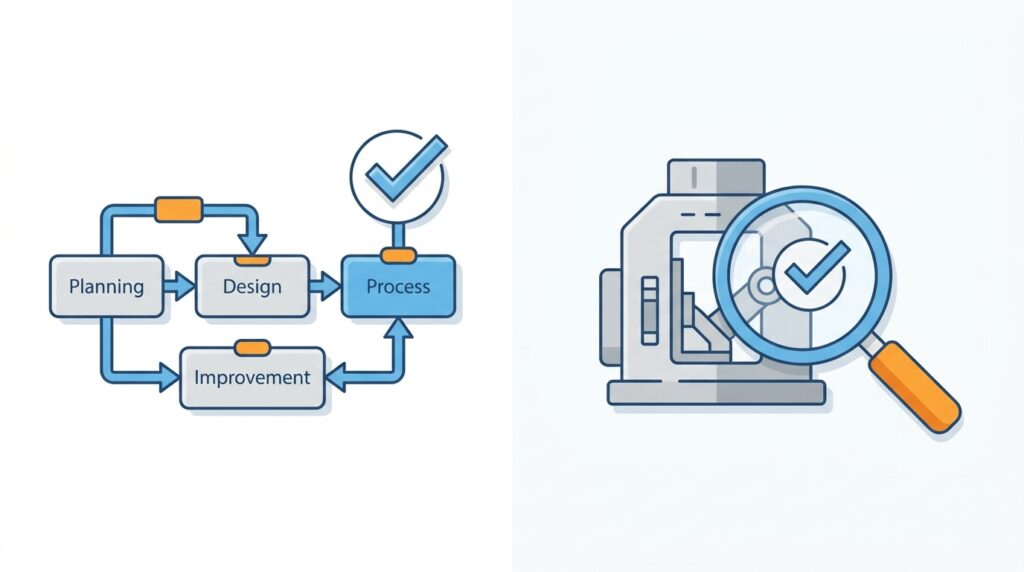
Quality assurance and quality control are related but distinct.
| Aspect | Quality Assurance (QA) | Quality Control (QC) |
|---|---|---|
| Focus | Processes | Products |
| Approach | Proactive | Reactive |
| Question | Are we doing things right? | Are the results right? |
| Activities | Process audits, procedure reviews | Inspection, testing |
| Responsibility | Management | Inspection and test personnel |
Quality assurance ensures that processes are capable of producing quality. Quality control verifies that quality is achieved.
Inspection and Test Plans (ITPs)
Inspection and test plans define what inspections and tests are required, when, and by whom.
| Element | Description |
|---|---|
| Activity | What work is being inspected |
| Inspection/test | What inspection or test is required |
| Reference | What standard or specification applies |
| Acceptance criteria | What defines acceptable quality |
| Responsibility | Who performs and witnesses the inspection |
| Hold points | Points where work cannot proceed without inspection |
| Witness points | Points where inspection is witnessed but work can proceed |
| Records | What records are produced |
ITPs should be prepared before work begins and agreed with all parties, including the owner and, where applicable, third-party inspectors.
Hold Points and Witness Points
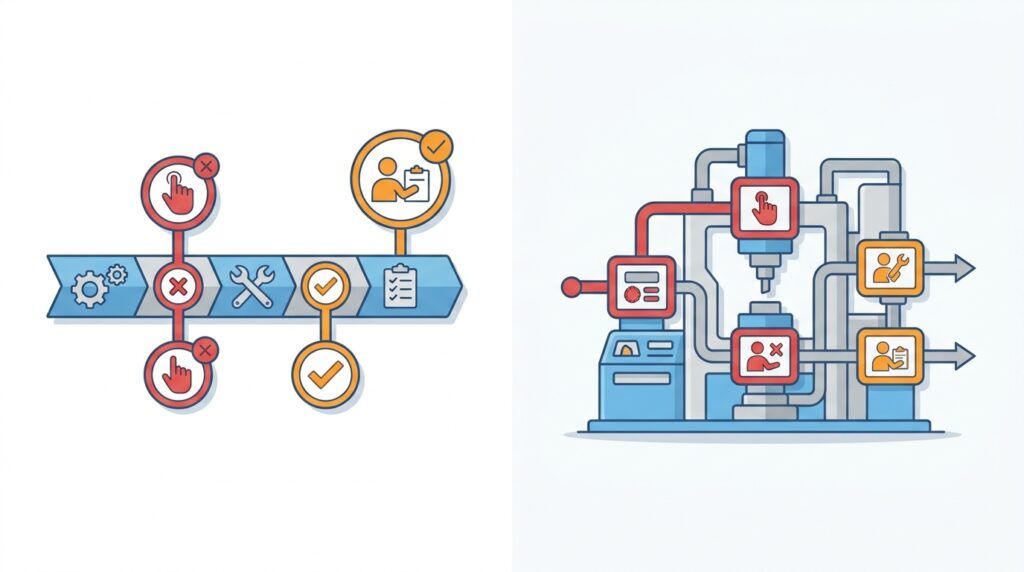
Hold points:
- Definition: Points where work cannot proceed until inspection is complete and accepted.
- Purpose: Ensure that critical quality steps are verified before work continues.
- Examples: Pressure test acceptance, weld inspection, equipment alignment.
Witness points:
- Definition: Points where inspection is witnessed but work can proceed.
- Purpose: Allow verification without stopping work.
- Examples: Material identification, coating inspection, final assembly.
▲ For both, the ITP should state how much advance notice the inspector must receive. If a witness point is not attended after proper notice, work may proceed, whereas a hold point is released only by signed acceptance.
Inspection
Inspection verifies that work meets requirements.
| Type | Description | When to Use |
|---|---|---|
| Receiving inspection | Inspecting materials and equipment on arrival | All deliveries |
| In-process inspection | Inspecting work during construction | Critical activities |
| Final inspection | Inspecting completed work | Before acceptance |
| Surveillance | Ongoing monitoring of work | Throughout construction |
Inspection should be planned, documented, and performed by qualified personnel. ▲ For critical equipment, owners often appoint independent third-party inspectors to provide additional assurance.
Testing
Testing verifies that equipment and systems function as designed.
| Test Type | Description | Examples |
|---|---|---|
| Factory acceptance test (FAT) | Testing at vendor’s facility | Equipment performance testing |
| Site acceptance test (SAT) | Testing at site | Equipment installation verification |
| Pressure test | Testing pressure systems | Piping and vessel pressure testing |
| Functional test | Testing system function | Control system testing |
| Performance test | Testing system performance | Output, efficiency, emissions |
Testing should be planned, documented, and witnessed as required.
▲ Statistical Quality Control
Statistical quality control uses sampling and control charts to monitor quality and detect trends before defects occur. It is particularly useful for repetitive work such as welding, coating, and fabrication.
Non-Conformance Management
Non-conformances are deviations from requirements. Managing them is critical.
- Identify: Identify the non-conformance.
- Document: Record it in a non-conformance report (NCR).
- Assess: Assess the impact and severity.
- ▲ Determine root cause: Understand why it happened, not just what happened.
- Disposition: Determine disposition (repair, rework, replace, accept as-is).
- Approve: Approve the disposition. ▲ Accept-as-is and repair dispositions typically require approval from the designer and the owner.
- Implement: Implement the disposition.
- Verify: Verify that the disposition was effective.
- Close: Close the non-conformance.
- ▲ Prevent recurrence: Apply corrective and preventive action.
Non-conformances should be tracked and analyzed to identify trends and prevent recurrence.
Quality Records
Quality records document that quality requirements were met. Key records:
- Inspection reports: Results of inspections.
- Test certificates: Results of tests.
- Material certificates: Certification of materials.
- Calibration records: Instrument calibration.
- Non-conformance reports: Records of non-conformances.
- Audit reports: Records of quality audits.
- As-built drawings: Drawings reflecting actual construction.
Quality records must be complete, accurate, and accessible. ▲ They are normally compiled into a handover quality dossier (often called a data book or manufacturing data record) delivered to the owner, and they remain valuable throughout the plant’s operating life.
Quality Audits
Quality audits verify that the quality system is working.
| Type | Description | When to Use |
|---|---|---|
| Internal audit | Audit by the organization itself | Regularly |
| External audit | Audit by an external party | As required by contract |
| Supplier audit | Audit of suppliers | Before and during supply |
| Process audit | Audit of specific processes | When problems occur |
Audits should be planned, performed by qualified auditors, and followed up with corrective actions.
Supplier Quality Management
Suppliers are a critical part of quality management. Key activities:
- Supplier qualification: Assessing supplier quality capability.
- Supplier audits: Auditing supplier quality systems.
- Inspection at source: Inspecting at the supplier’s facility.
- Supplier performance monitoring: Tracking supplier quality performance.
- Supplier development: Helping suppliers improve quality.
Supplier quality problems can cause significant project delays and cost overruns.
Construction Quality
Construction quality is where design becomes reality.
- Workmanship standards: Defining acceptable workmanship.
- Method statements: Defining how work will be performed.
- Inspection and testing: Verifying construction quality.
- Weld quality: Welding procedures, welder qualification, inspection.
- Coating quality: Surface preparation, application, inspection.
- Alignment and tolerance: Verifying equipment alignment.
▲ Weld quality deserves particular attention. It relies on qualified welding procedure specifications, qualified welders, and appropriate non-destructive examination (NDE) such as radiographic, ultrasonic, magnetic particle, or liquid penetrant testing, with the extent of NDE defined by the applicable code. Positive material identification (PMI) is also commonly used to confirm that alloy materials match the specification.
Construction quality problems are expensive to correct after installation.
Commissioning Quality
Commissioning quality ensures that systems function as designed.
- Commissioning procedures: Defining how systems will be commissioned.
- Functional testing: Testing that systems function as designed.
- Performance testing: Testing that systems meet performance requirements.
- Documentation: Documenting commissioning and test results.
- Handover: Confirming that systems meet requirements before handover.
▲ Pre-commissioning checks (such as loop checks, flushing, and cleaning) and a managed punch list of outstanding items support a controlled handover.
Commissioning quality problems can delay startup or cause operational problems.
▲ Measuring Quality Performance
What is not measured is hard to improve. Common quality indicators include the number and age of open NCRs, rework rate, first-time inspection pass rate, supplier delivery quality, audit findings closed on time, and punch list closure rate. Trends in these indicators give early warning of problems.
Quality Culture
Quality is not just a system. It is a culture.
- Leadership commitment: Quality is a priority, not just a slogan.
- Employee engagement: Everyone is responsible for quality.
- Right first time: Doing it right the first time.
- Continuous improvement: Always looking for ways to improve.
- Open communication: Reporting problems without fear.
- Training: Ensuring everyone has the skills to do quality work.
- Accountability: Taking responsibility for quality.
A quality culture is what sustains quality over the long term.
▲ Lessons Learned and Quality Improvement
Lessons learned from quality problems (root causes, corrective actions, and prevention measures) should be captured and applied to future projects. A quality lessons-learned database helps prevent repeat problems. Lessons should be reviewed at project milestones, not only at closeout, so that they can benefit the current project as well.
Common Mistakes in Quality Management
- No quality plan: Quality not planned.
- Inadequate specifications: Unclear or incomplete requirements.
- Skipping inspection: Not verifying quality.
- Poor ITPs: Inspection and test plans incomplete or not followed.
- Ignoring non-conformances: Not addressing deviations.
- Incomplete records: Quality records missing or incomplete.
- No audits: Not verifying that the quality system works.
- Poor supplier quality: Not managing supplier quality.
- Weak quality culture: Quality not taken seriously.
- No continuous improvement: Not learning from quality problems.
- ▲ Weak design quality control: Errors carried from design into construction.
- ▲ Treating quality as a cost to minimize: Cutting prevention and appraisal only increases failure costs.
These mistakes are costly to correct. They are much cheaper to avoid through disciplined quality management.
How Japanese EPC Firms Approach Quality Management
Japanese engineering firms are known for their disciplined approach to quality management. Common characteristics include:
- Thorough planning: Quality is planned carefully, with clear requirements and procedures.
- Detailed ITPs: Inspection and test plans are comprehensive and followed.
- Disciplined inspection: Work is inspected as it is completed.
- Rigorous non-conformance management: Non-conformances are addressed promptly and thoroughly.
- Detailed documentation: Records are complete and accurate.
- Supplier quality focus: Suppliers are managed for quality.
- Continuous improvement: Lessons are captured and applied.
- Quality culture: Quality is embedded in how people work.
- ▲ Process discipline: The plan-do-check-act (PDCA) cycle, kaizen, and error-proofing (poka-yoke) are part of everyday practice, and problems are investigated at the source.
For plant owners, this often means plants that perform as designed and avoid costly rework.
How to Evaluate Quality Management Readiness
| Question | Why It Matters |
|---|---|
| Is there a quality plan? | Provides a roadmap for quality |
| Are specifications clear and complete? | Defines what quality means |
| ▲ Are design reviews performed? | Prevents design errors reaching site |
| Are ITPs prepared and followed? | Defines inspections and tests |
| Are hold and witness points defined? | Ensures critical steps are verified |
| Is inspection performed? | Verifies that work meets requirements |
| Is testing performed? | Verifies that equipment functions |
| Are non-conformances managed? | Addresses deviations |
| Are quality records complete? | Documents that quality was achieved |
| Are audits performed? | Verifies that the quality system works |
| ▲ Are lessons learned captured? | Prevents repeat problems |
| Is there a quality culture? | Sustains quality over time |
A plant that addresses these questions is ready for effective quality management.
Conclusion
Quality management is critical to project success. For small to medium-scale industrial plants, it determines whether the plant performs as designed and avoids costly rework.
By focusing on quality planning, design quality, standards, ITPs, inspection, testing, non-conformance management, records, audits, supplier quality, and quality culture, owners and project teams can ensure that the plant is built to specification and performs reliably.
Key Takeaways
- Quality management ensures the plant is designed, built, and commissioned to specifications
- Quality is built in, not inspected in
- Quality planning defines objectives, standards, responsibilities, and procedures
- Design quality must be verified before construction begins
- QA focuses on processes; QC focuses on products
- ITPs define inspections and tests, with hold and witness points
- Non-conformances must be managed through a structured process, including root cause and corrective action
- Quality records document that requirements were met
- Quality audits verify that the quality system works
- Supplier quality is a critical part of overall quality
- Prevention and appraisal cost less than failure
- Quality culture sustains quality over the long term
- Japanese EPC firms emphasize thorough planning and disciplined inspection