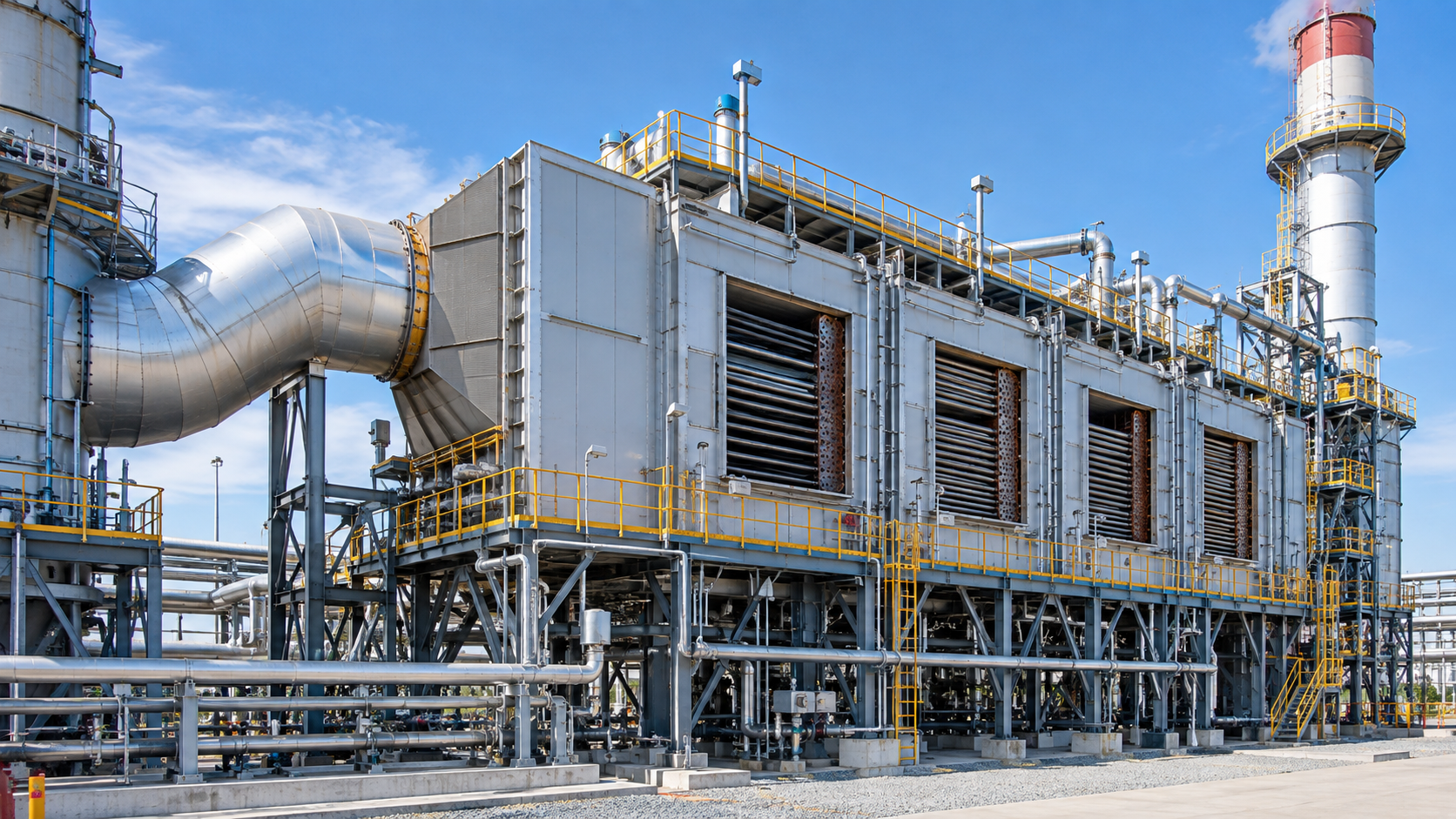
The heat recovery steam generator (HRSG) is the component that makes combined cycle power generation possible. Without it, the hot exhaust gas from the gas turbine would be wasted, and the plant would operate as a simple cycle with much lower efficiency.
For plant owners and engineers working with combined cycle plants, understanding HRSG design and operation is essential. The HRSG determines how much additional electricity the plant can produce, how quickly it can respond to load changes, and how reliably it operates over its life.
This article covers the fundamentals of HRSG design, the key configuration options, operational considerations, and common issues that plant owners should be aware of.
What Is an HRSG?
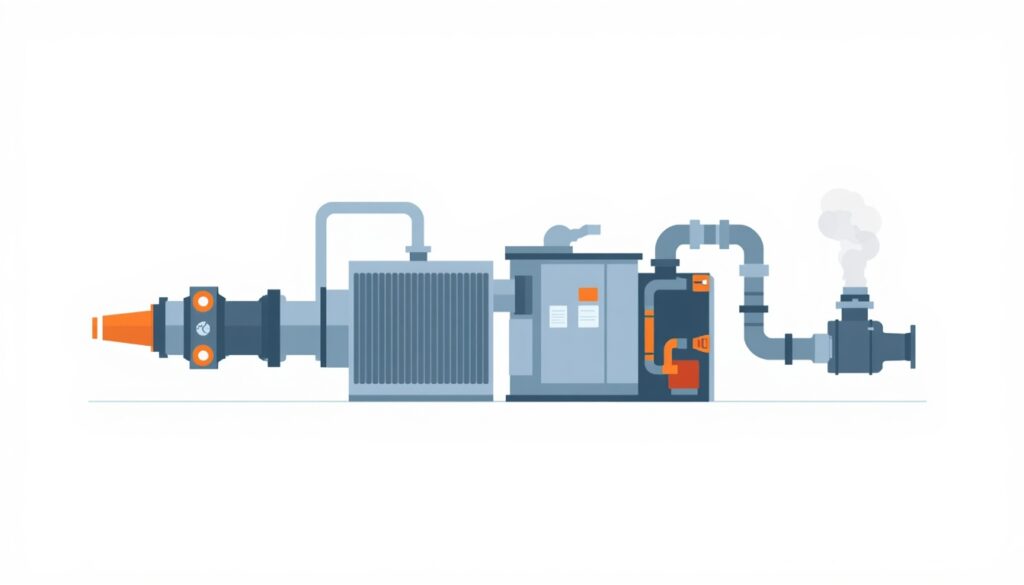
An HRSG is a heat exchanger that recovers heat from the gas turbine exhaust and uses it to produce steam. That steam then drives a steam turbine to generate additional electricity.
The basic flow is:
- Gas turbine exhaust enters the HRSG
- Heat is transferred to water and steam in tubes
- Steam is produced at one or more pressure levels
- Steam drives the steam turbine
- Exhaust gas exits the HRSG at a much lower temperature
The HRSG is essentially a boiler that has no burner of its own. All its heat comes from the gas turbine exhaust.
Why the HRSG Matters
The HRSG is the key to combined cycle efficiency. In a simple cycle plant, exhaust gas leaves the gas turbine at 500–600°C and is released to the atmosphere. In a combined cycle plant, that same exhaust gas passes through the HRSG, where its heat is used to generate steam.
The result is that the plant produces significantly more electricity from the same fuel. This is why combined cycle plants achieve 50–60% efficiency, while simple cycle plants achieve only 30–40%.
The HRSG also affects:
- Plant output: More steam production means more electricity from the steam turbine.
- Plant flexibility: HRSG design influences how quickly the plant can start and change load.
- Plant reliability: HRSG failures can shut down the entire combined cycle plant.
- Maintenance cost: HRSG components are subject to corrosion, fouling, and thermal fatigue.
HRSG Configurations
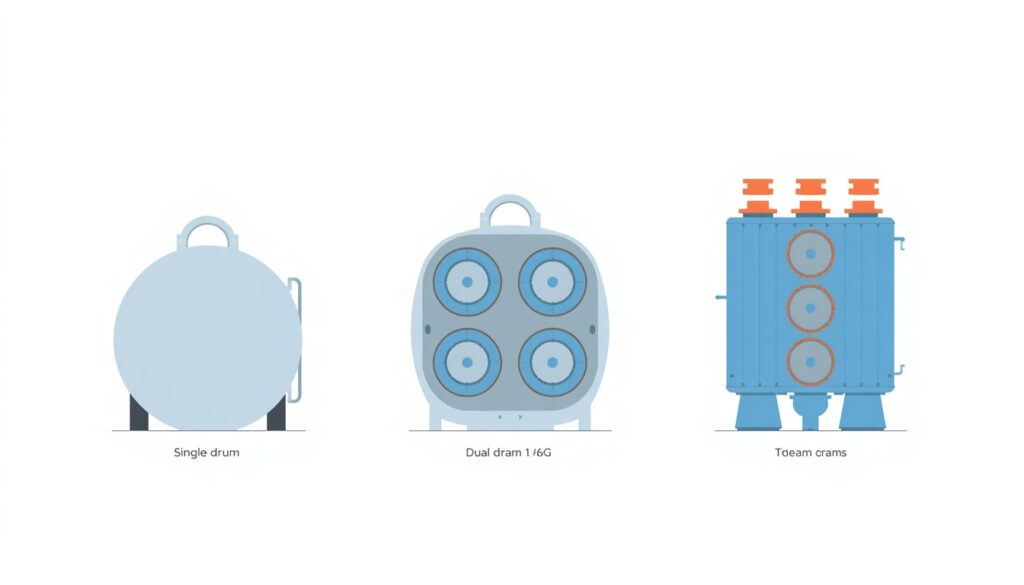
HRSGs come in several configurations, each suited to different applications.
Horizontal vs. Vertical
| Configuration | Characteristics | Typical Use |
|---|---|---|
| Horizontal | Exhaust gas flows horizontally through the HRSG | Large combined cycle plants |
| Vertical | Exhaust gas flows vertically upward | Smaller plants, limited footprint |
Horizontal HRSGs are more common in large plants because they are easier to maintain and can accommodate larger tube bundles. Vertical HRSGs are more compact and are sometimes used in smaller installations.
Number of Pressure Levels
HRSGs can produce steam at one, two, or three pressure levels.
| Configuration | Characteristics | Efficiency Impact |
|---|---|---|
| Single pressure | Simplest design, one steam drum | Lower efficiency, lower cost |
| Dual pressure | Two steam drums, two pressure levels | Moderate efficiency, moderate cost |
| Triple pressure | Three steam drums, three pressure levels | Highest efficiency, highest cost |
Triple pressure HRSGs extract more heat from the exhaust gas and produce more steam, improving overall plant efficiency. However, they are more complex and more expensive.
For small to medium-scale plants, dual pressure is often a practical compromise between efficiency and cost. Triple pressure adds cost and complexity that may not be justified at smaller scales, while single pressure leaves efficiency on the table.
Duct Firing
Some HRSGs include supplementary firing (duct firing) to increase steam production. This increases plant output but reduces efficiency because it adds fuel without recovering additional waste heat. Duct firing also increases NOx emissions, which is a relevant consideration for plants in regulated jurisdictions.
Duct firing is useful for meeting peak demand but is not typically used for baseload operation.
Bypass Stacks
Some HRSGs include a bypass stack that allows the gas turbine to operate independently when the steam cycle is unavailable, which adds flexibility during startup and when the steam side is out of service.
Key Design Considerations
1. Pinch Point and Approach Temperature
The pinch point is the temperature difference between the exhaust gas leaving the evaporator and the saturated steam temperature. The approach temperature is the difference between the saturated steam temperature and the feedwater temperature entering the evaporator.
Smaller pinch and approach temperatures mean more heat is recovered, improving efficiency. However, they also require larger heat transfer surfaces, increasing cost and footprint.
Typical values:
- Pinch point: 8–15°C
- Approach temperature: 5–10°C
2. Gas Side Pressure Drop
The HRSG adds pressure drop to the exhaust gas path. Higher pressure drop reduces gas turbine output. Designers aim to minimize pressure drop while still achieving the required heat transfer.
3. Tube Material Selection
HRSG tubes are exposed to high temperatures and corrosive gases. Material selection depends on:
- Exhaust gas temperature
- Fuel composition (especially sulfur content)
- Steam pressure and temperature
- Expected operating hours
Common materials include carbon steel for lower-temperature sections and alloy steels for higher-temperature sections.
4. Drum Design and Sizing
The steam drum separates steam from water and provides a buffer for load changes. Drum size affects the HRSG’s ability to handle rapid load changes and startup.
5. Thermal Cycling
HRSGs in cycling plants experience frequent thermal cycling, which causes fatigue in tubes, headers, and drums. Design must account for the expected number of cycles over the plant’s life.
Operational Considerations

Startup and Shutdown
HRSG startup must be carefully controlled to avoid thermal stress. Key parameters include:
- Drum heat-up rate
- Tube metal temperature gradients
- Steam temperature matching between HRSG and steam turbine
Rapid startups increase thermal stress and can shorten component life.
Water Chemistry
Water quality is critical for HRSG reliability. Poor water chemistry leads to:
- Scale formation on tubes
- Corrosion of tube surfaces
- Carryover of impurities into the steam turbine
Water chemistry must be monitored continuously and controlled within strict limits.
Fouling and Corrosion
HRSG tubes can foul with deposits from exhaust gas, especially if the fuel contains sulfur or other impurities. Fouling reduces heat transfer and increases pressure drop, reducing plant efficiency.
Corrosion can occur on the gas side (from acidic gases) or the water side (from poor water chemistry). Both must be managed through design, operation, and maintenance.
Load Changes
HRSGs respond to load changes more slowly than gas turbines. When the gas turbine load changes, the HRSG takes time to reach a new steady state. This affects the plant’s ability to respond to grid demand.
Common HRSG Problems
Even well-designed HRSGs can experience problems. Common issues include:
- Tube failures: Caused by corrosion, fatigue, or overheating
- Drum level instability: Caused by rapid load changes or poor control
- Steam temperature excursions: Caused by changes in gas turbine load or exhaust temperature
- Fouling and plugging: Caused by deposits from exhaust gas
- Corrosion: Caused by acidic gases or poor water chemistry
These problems can lead to reduced output, increased maintenance, and in severe cases, plant shutdown.
How Japanese EPC Firms Approach HRSG Design
Japanese engineering firms are known for their disciplined approach to HRSG design and operation. Common characteristics include:
- Conservative design margins: Adequate pinch and approach temperatures, generous tube surface area
- Careful material selection: Materials matched to fuel and operating conditions
- Detailed thermal analysis: Startup and shutdown procedures designed to minimize thermal stress
- Strict water chemistry control: Comprehensive monitoring and treatment programs
- Long-term performance monitoring: Heat transfer and pressure drop tracked over the plant’s life
For plant owners, this often means an HRSG that performs reliably for decades, even under cycling operation.
How to Evaluate HRSG Design
When reviewing an HRSG design, ask:
| Question | Why It Matters |
|---|---|
| What pinch and approach temperatures are specified? | Determines efficiency and surface area |
| How many pressure levels? | Affects efficiency and complexity |
| What materials are used for tubes? | Determines resistance to corrosion and fatigue |
| How is thermal cycling addressed? | Affects component life in cycling plants |
| What water chemistry limits apply? | Determines reliability and maintenance needs |
| How is fouling managed? | Affects long-term performance |
| What is the expected pressure drop? | Affects gas turbine output |
A design that addresses these questions is likely to perform well over the plant’s life.
Conclusion
The HRSG is the heart of a combined cycle plant. It determines how much additional electricity the plant can produce and how efficiently it uses fuel. Understanding HRSG design and operation helps plant owners evaluate proposals, plan maintenance, and optimize performance.
For small to medium-scale combined cycle plants, the HRSG is often the most technically complex component. Careful attention to design, materials, water chemistry, and operational procedures is essential for reliable, efficient operation over the plant’s life.
Key Takeaways
- The HRSG recovers gas turbine exhaust heat to produce steam, which is what lifts combined cycle efficiency well above simple cycle.
- Configuration (horizontal or vertical, number of pressure levels) affects efficiency, cost, and complexity.
- Pinch point and approach temperature are key design parameters, trading heat recovery against surface area and cost.
- Water chemistry control and thermal cycling management are critical for long-term reliability.