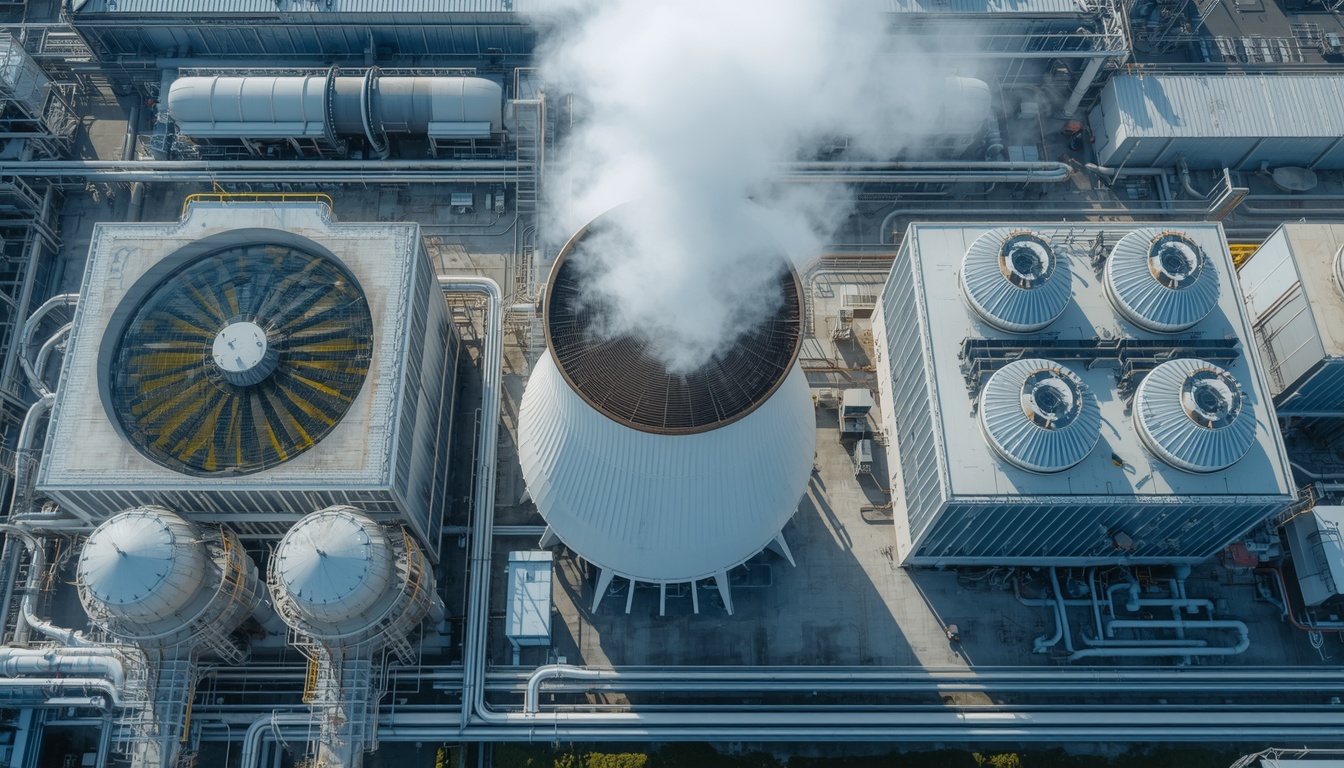
Cooling is one of the most overlooked yet consequential decisions in industrial plant design. Every thermal plant—whether it burns coal, gas, biomass, or waste heat—must reject heat to the environment. How that heat is rejected affects efficiency, water consumption, environmental impact, capital cost, and site selection.
For small to medium-scale industrial plants, cooling system selection is especially critical because there is less margin for error and fewer resources to manage complex systems. The wrong choice can limit plant output, increase operating cost, or create regulatory problems.
This article covers the main cooling system options, compares them side by side, and helps you decide which one fits your project.
Why Cooling Matters
Thermal plants convert heat into electricity, but not all heat can be converted. A significant portion must be rejected to the environment. This is a fundamental thermodynamic limit—no plant can convert all its heat input into useful work.
The cooling system’s job is to reject this waste heat efficiently and reliably. The main functions are:
- Condensing steam: In steam cycles, cooling condenses the exhaust steam from the turbine back into water so it can be reused.
- Cooling auxiliary equipment: Lubricating oil, generators, and other equipment require cooling.
- Maintaining vacuum: Efficient condensing requires low pressure, which depends on effective cooling.
If the cooling system underperforms, the turbine back pressure rises, reducing output and efficiency. In severe cases, the plant must reduce load or shut down.
The Main Cooling System Options
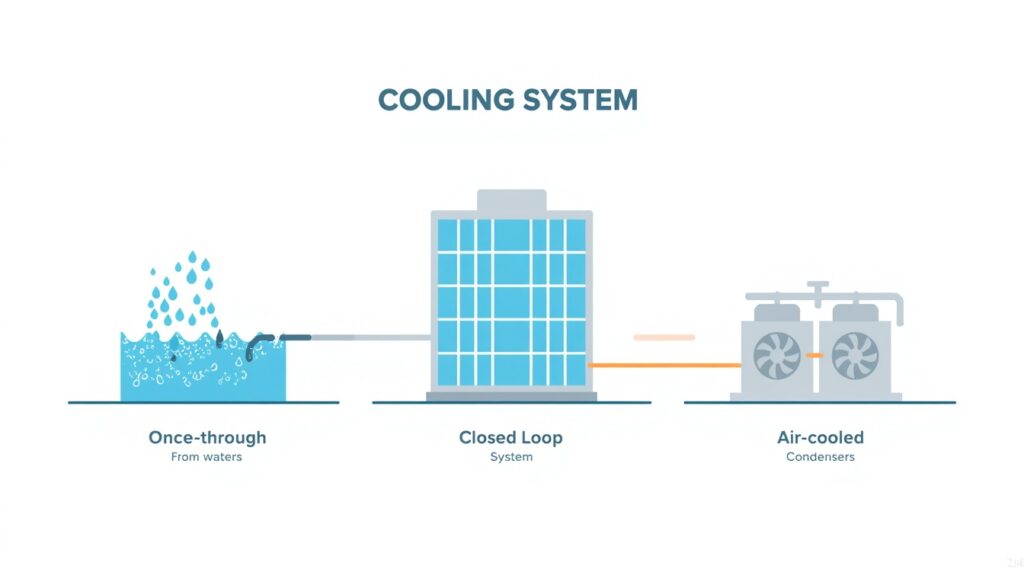
Comparison of once-through, closed-loop, and air-cooled cooling system types
There are three main types of cooling systems for industrial plants:
- Once-through cooling
- Closed-loop (recirculating) cooling with cooling towers
- Air-cooled (dry) cooling
Each has distinct characteristics, advantages, and drawbacks.
Once-Through Cooling
In a once-through system, water is drawn from a nearby source (river, lake, sea), passed through the condenser, and returned to the source at a higher temperature.
Characteristics:
- High efficiency: Once-through cooling provides the best cooling performance because water temperature is typically low.
- Low capital cost: Fewer components, simpler system.
- High water consumption: Large volumes of water are drawn and returned.
- Environmental impact: Thermal discharge can affect aquatic ecosystems.
- Site constraint: Requires a large, reliable water source.
When it makes sense:
- Sites with access to abundant cooling water (coastal or large river locations)
- Regions with lenient thermal discharge regulations
- Plants where efficiency is the top priority
Once-through cooling is increasingly restricted in many jurisdictions due to environmental concerns. In the United States, for example, the Clean Water Act Section 316(b) requires that cooling water intake structures minimize environmental impact.
Closed-Loop Cooling with Cooling Towers
In a closed-loop system, cooling water is recirculated between the condenser and a cooling tower. The cooling tower rejects heat to the atmosphere, primarily through evaporation.
Characteristics:
- Moderate efficiency: Performance depends on ambient wet-bulb temperature. Efficiency is lower than once-through but higher than air-cooled.
- Moderate capital cost: Cooling towers and circulating water systems add cost.
- Lower water consumption: Water is lost primarily through evaporation and blowdown, but consumption is much lower than once-through.
- Visible plume: Cooling towers produce a visible plume of water vapor, which can be a concern in some locations.
- Chemical treatment: Recirculated water requires treatment to control corrosion, scaling, and biological growth. Closed-loop systems require continuous water treatment to manage these effects; treatment programs typically include corrosion inhibitors, scale inhibitors, and biocides.
When it makes sense:
- Sites with limited water availability
- Regions with strict thermal discharge regulations
- Plants where a balance between efficiency and water use is needed
Closed-loop cooling is the most common choice for new industrial plants in many regions. It offers a reasonable compromise between efficiency, water use, and environmental impact.
Air-Cooled (Dry) Cooling
In an air-cooled system, heat is rejected directly to the atmosphere using air-cooled condensers or fin-fan coolers. No cooling water is used.
Characteristics:
- Lower efficiency: Performance depends on ambient dry-bulb temperature, which is typically higher than wet-bulb temperature. This reduces plant efficiency compared to wet cooling.
- Higher capital cost: Air-cooled condensers are large and expensive.
- Zero water consumption: No cooling water is required for heat rejection.
- Large footprint: Air-cooled systems require significant space.
- Higher auxiliary power: Fans consume more power than cooling tower fans.
When it makes sense:
- Sites with no reliable water source
- Regions with strict water use restrictions
- Plants where water availability is uncertain or expensive
Air-cooled cooling is common in arid regions and in plants where water is scarce or expensive. It eliminates water consumption but at the cost of efficiency and capital cost.
Side-by-Side Comparison
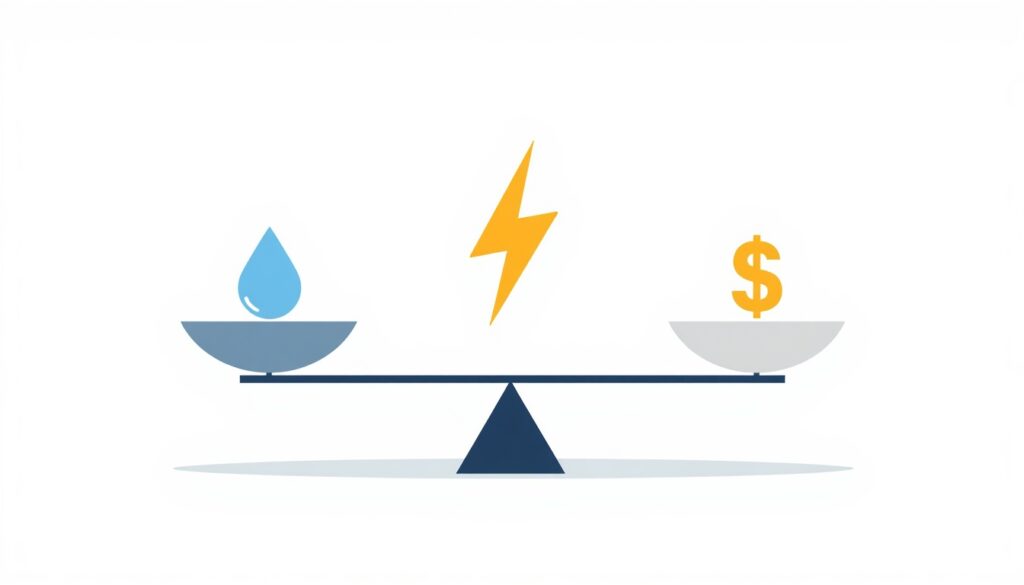
Trade-offs between water consumption, efficiency, and capital cost in cooling systems
| Factor | Once-Through | Closed-Loop (Wet) | Air-Cooled (Dry) |
|---|---|---|---|
| Cooling efficiency | Highest | Moderate | Lowest |
| Capital cost | Lowest | Moderate | Highest |
| Water consumption | Highest | Moderate | None |
| Footprint | Small | Moderate | Large |
| Auxiliary power | Lowest | Moderate | Highest |
| Environmental impact | Thermal discharge | Water consumption, plume | Land use, noise |
| Site requirement | Large water source | Moderate water source | No water source |
| Typical use | Coastal, large rivers | Most inland plants | Arid regions |
Hybrid Cooling Systems
Some plants use hybrid cooling, which combines wet and dry cooling. In a hybrid system, cooling towers operate during cooler periods, while air-cooled condensers take over during peak heat or when water is scarce.
Advantages:
- Reduces water consumption compared to pure wet cooling
- Improves efficiency compared to pure dry cooling
- Provides flexibility to respond to water availability and ambient conditions
Disadvantages:
- Higher capital cost than either pure wet or pure dry
- More complex operation and maintenance
Hybrid cooling is often used in regions with seasonal water constraints or where a balance between efficiency and water use is required.
Key Design Considerations
1. Ambient Conditions
Wet-bulb temperature drives wet cooling performance. Dry-bulb temperature drives air-cooled performance. Both vary by location and season. Design must account for the worst-case conditions the plant will face.
2. Water Availability and Quality
Water quantity, quality, and cost all affect cooling system selection. Poor water quality may require treatment, which adds cost and complexity.
3. Environmental Regulations
Thermal discharge limits, water intake rules, and plume restrictions can all constrain cooling system options. These must be identified early in design.
4. Plant Size and Load Profile
Small plants may have different constraints than large ones. A plant that operates only during peak hours may not justify the cost of a complex cooling system.
5. Parasitic Power
Cooling system auxiliaries (pumps, fans) consume power, reducing net plant output. This must be accounted for in performance calculations.
6. Corrosion and Materials
Cooling water chemistry affects material selection. Once-through systems using seawater require corrosion-resistant materials. Closed-loop systems require water treatment to control scaling and corrosion.
7. Availability and Redundancy
For critical plants, consider whether redundancy in cooling system components (pumps, fans, cells) is justified. A single cooling tower cell failure can limit plant output.
8. Noise Regulations
Noise from cooling towers and air-cooled condensers can be a constraint in populated areas. Local noise regulations may limit fan speed or require acoustic treatment.
9. Control and Optimization
Modern cooling systems use variable frequency drives and advanced controls to match cooling output to plant load and ambient conditions. This reduces auxiliary power consumption at part load.
Common Mistakes in Cooling System Selection
Even experienced designers make mistakes. Common ones include:
- Underestimating water consumption: Especially for wet cooling in water-scarce regions
- Ignoring ambient extremes: Designing for average conditions rather than worst-case
- Overlooking regulations: Discovering too late that thermal discharge or intake rules prohibit the chosen system
- Undersizing cooling towers: Leading to higher back pressure and reduced output
- Neglecting auxiliary power: Forgetting that fans and pumps reduce net output
- Poor water treatment: Leading to scaling, corrosion, and reduced performance
These mistakes are costly to fix after construction. They are much cheaper to avoid during design.
How Japanese EPC Firms Approach Cooling System Selection
Japanese engineering firms are known for their disciplined approach to cooling system design. Common characteristics include:
- Thorough site assessment: Water availability, ambient conditions, and regulations are studied carefully before selection.
- Conservative design margins: Cooling systems are sized with adequate margin for worst-case conditions.
- Life-cycle cost focus: Capital cost is evaluated alongside operating cost, water cost, and environmental compliance.
- Detailed water treatment design: Water chemistry is managed carefully to ensure long-term reliability.
- Long-term performance monitoring: Cooling system performance is tracked over the plant’s life.
For plant owners, this often means a cooling system that performs reliably for decades, even under challenging conditions.
How to Evaluate Cooling System Options
When reviewing cooling system options, ask:
| Question | Why It Matters |
|---|---|
| What is the ambient design condition? | Determines cooling performance and system size |
| Is water available, and at what cost? | Affects selection and operating cost |
| What are the environmental regulations? | Constrains system options |
| What is the auxiliary power consumption? | Reduces net plant output |
| What is the life-cycle cost? | Captures total cost, not just capital |
| How reliable is the system? | Affects plant availability |
| How complex is operation and maintenance? | Affects staffing and long-term cost |
A cooling system that satisfies all these questions is likely to perform well over the plant’s life.
Key Takeaways
- Cooling system selection affects efficiency, water use, cost, and environmental impact
- Once-through: highest efficiency, highest water use
- Closed-loop: moderate efficiency, moderate water use
- Air-cooled: lowest efficiency, zero water use
- Hybrid systems balance wet and dry cooling
- Japanese EPC firms emphasize thorough site assessment and conservative design margins
Conclusion
Cooling system selection is a strategic decision that affects efficiency, water consumption, environmental impact, and cost. Once-through, closed-loop, and air-cooled systems each have distinct advantages and drawbacks. For small to medium-scale industrial plants, the right choice depends on site conditions, water availability, regulations, and financial objectives.
By evaluating these factors carefully and considering life-cycle cost, owners and designers can select a cooling system that performs reliably and economically for decades.