
Most plant failures are discovered the hard way, after they happen. Equipment stops working, production is lost, and the maintenance team rushes to repair it. Root Cause Analysis (RCA) helps you learn from these failures. But what if you could identify problems before they occur?
Failure Modes and Effects Analysis (FMEA) is a structured, proactive method for identifying how equipment, systems, or processes can fail, and what the consequences would be. Instead of reacting to failures, FMEA helps you anticipate them and prevent them or mitigate their effects.
For small to medium-scale industrial plants, FMEA is especially valuable because it focuses attention on the failures that matter most. It directs limited maintenance and engineering resources toward the equipment and failure modes with the highest risk.
This article explains what FMEA is, how it works, and how to apply it practically in an industrial plant.
What Is FMEA?
FMEA is a systematic method for evaluating a system, design, or process to identify:
- Functions: What the item is supposed to do.
- Failure modes: The ways in which it can fail to do so.
- Failure effects: What happens when each failure mode occurs.
- Failure causes: What leads to each failure mode.
- Controls: What is currently in place to prevent or detect each failure mode.
FMEA was originally developed by the US military in the late 1940s (the procedure MIL-P-1629, issued in 1949) and has since been adopted across many industries, including automotive, aerospace, medical devices, and power generation.
The purpose of FMEA is to:
- Identify potential failures before they occur.
- Assess the risk associated with each failure.
- Prioritize actions to reduce risk.
- Document the analysis for future reference.
Related standards and terms
Several standards and guidelines govern FMEA practice. Plant teams most often encounter:
| Reference | Relevance |
|---|---|
| IEC 60812 | General international standard for FMEA and FMECA |
| MIL-STD-1629A | Original US military procedure (now withdrawn, but still widely referenced) |
| SAE J1739 and AIAG & VDA FMEA Handbook | Automotive practice; source of the Action Priority method |
| SAE JA1011 / JA1012 | Criteria and guide for Reliability-Centered Maintenance (RCM), where FMEA is a core step |
You may also see the term FMECA (Failure Modes, Effects, and Criticality Analysis). It is FMEA with an added step that ranks the criticality of each failure mode. In practice, most plant FMEAs already include this ranking through severity and RPN, so the two terms are often used interchangeably.
FMEA vs. RCA
FMEA and RCA are complementary, but they serve different purposes.
| Aspect | FMEA | RCA |
|---|---|---|
| Timing | Before failure occurs (proactive) | After failure occurs (reactive) |
| Purpose | Identify and prevent potential failures | Understand and prevent recurrence of actual failures |
| Approach | Analyzes what could go wrong | Analyzes what did go wrong |
| Output | Risk-ranked list of failure modes with actions | Root cause(s) and corrective actions |
FMEA is proactive; RCA is reactive. Together they form a complete approach to reliability: FMEA prevents failures from happening, and RCA prevents them from happening again.
The two also feed each other. Failures investigated through RCA reveal failure modes and causes that the FMEA missed, and the FMEA should be updated accordingly. Conversely, an existing FMEA gives an RCA team a head start by listing known failure modes and causes.
Types of FMEA
FMEA is used in different forms, depending on the application.
| Type | Focus | Typical Use |
|---|---|---|
| Design FMEA (DFMEA) | Product or equipment design | New equipment design, modifications |
| Process FMEA (PFMEA) | Manufacturing or operational processes | Production processes, maintenance procedures |
| System FMEA | Systems and subsystems | Plant systems, control systems |
| Equipment FMEA | Individual equipment items | Critical equipment, rotating machinery |
For plant applications, system FMEA and equipment FMEA are most common. Design FMEA is used when specifying new equipment or modifying existing designs.
FMEA for new equipment
FMEA is particularly valuable during design or procurement of new equipment. Identifying failure modes before the equipment is built or purchased allows design changes that are far cheaper than modifications after installation. Typical outcomes include adding redundancy, specifying better materials or seals, requiring condition-monitoring instrumentation from the vendor, or including FMEA deliverables in the supplier’s scope.
The FMEA Process
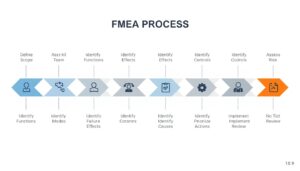
FMEA follows a structured process, typically performed by a cross-functional team.
| Step | Description |
|---|---|
| 1. Define the scope | What system, equipment, or process is being analyzed? |
| 2. Assemble the team | Who has knowledge of the system, its operation, and its failure modes? |
| 3. Identify functions | What is the system or equipment supposed to do? |
| 4. Identify failure modes | How can it fail to perform its function? |
| 5. Identify effects | What happens when each failure mode occurs? |
| 6. Identify causes | What leads to each failure mode? |
| 7. Identify controls | What is currently in place to prevent or detect the failure? |
| 8. Assess risk | How serious is the risk, considering severity, occurrence, and detection? |
| 9. Prioritize actions | Which failure modes need action first? |
| 10. Implement and review | Assign actions, implement them, and review effectiveness. |
FMEA is not a one-time exercise. It should be reviewed when equipment, processes, or operating conditions change.
Assembling the team
A good FMEA team typically includes:
- A facilitator who knows the method and keeps the session focused.
- Operations personnel, who know how the equipment behaves in practice.
- Maintenance personnel, who know how it fails and how it is repaired.
- Engineering staff, who know the design and its limits.
- Safety or environmental representatives, where consequences may involve people or releases.
- Vendor or specialist input, where the equipment is unfamiliar or highly specialized.
Teams of four to seven people generally work best. Larger groups slow down; smaller groups miss perspectives.
Documenting the analysis: the FMEA worksheet
FMEA is typically documented on a worksheet with columns for function, failure mode, effects, severity, causes, occurrence, current controls, detection, RPN, recommended actions, and responsibility. Spreadsheets are commonly used, though specialized software is available for larger analyses.
Whatever the tool, the worksheet should use consistent scales and terminology, and it should be a living document that is stored where the maintenance and engineering teams can find it.
Identifying Failure Modes
A failure mode is the way in which a system, equipment, or process fails to perform its intended function.
Types of failure modes:
- Complete failure: Equipment stops working entirely.
- Partial failure: Equipment works, but not at full capacity.
- Intermittent failure: Equipment alternates unpredictably between working and not working.
- Degraded performance: Equipment works, but with reduced efficiency, accuracy, or output.
- Unintended operation: Equipment operates when it should not.
- Failure to operate on demand: Equipment fails to start or act when needed, as with standby pumps and safety devices.
- Failure to stop: Equipment continues to run after it should have stopped.
For each function, the team asks: how could this function fail? The answers are the failure modes.
It is important to distinguish a failure mode from its cause. “Bearing seizure” describes how the pump stops working (failure mode). “Loss of lubrication” is why the bearing seized (cause). Mixing the two makes the worksheet confusing.
Identifying Failure Effects
For each failure mode, the team identifies the effects: what happens when the failure occurs.
Effects should be considered at multiple levels:
- Local effects: What happens to the equipment itself?
- System effects: What happens to the system the equipment is part of?
- Plant effects: What happens to the plant as a whole?
- Safety effects: Could the failure cause injury?
- Environmental effects: Could the failure cause an environmental release?
Effects should be described specifically. “Pump fails” is not an effect. “Pump fails, causing loss of cooling water flow to the condenser, resulting in turbine trip and 8-hour plant shutdown” is an effect.
Identifying Failure Causes
For each failure mode, the team identifies the causes: what leads to the failure.
Common causes:
- Design weaknesses: Inadequate material, undersized components, poor layout.
- Manufacturing defects: Poor workmanship, incorrect assembly.
- Installation errors: Incorrect alignment, improper torque.
- Operating errors: Incorrect setpoints, missed procedures.
- Maintenance errors: Missed tasks, incorrect parts, poor workmanship.
- Wear and degradation: Normal aging, corrosion, fatigue.
- External events: Power loss, weather, contamination.
Causes should be specific enough to allow corrective action. “Operator error” is not a cause. “Operator fails to open valve V-101 before starting pump P-101” is a cause.
Risk Assessment: Severity, Occurrence, Detection
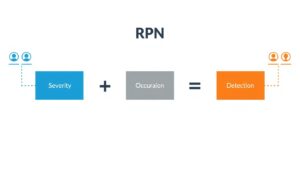
FMEA uses three factors to assess risk:
| Factor | What It Measures | Scale |
|---|---|---|
| Severity (S) | How serious are the effects? | 1 (minor) to 10 (catastrophic) |
| Occurrence (O) | How likely is the cause to occur? | 1 (unlikely) to 10 (frequent) |
| Detection (D) | How likely is the failure to be detected before effects occur? | 1 (certain detection) to 10 (no detection) |
The Risk Priority Number (RPN) is calculated as:
RPN = Severity × Occurrence × Detection
Higher RPN values indicate higher risk and greater priority for action. RPN ranges from 1 to 1,000.
Defining the scales
The scales must be defined in advance and applied consistently. Below is an illustrative severity scale for an industrial plant; each plant should adapt it to its own consequences.
| Rating | Severity Description (example) |
|---|---|
| 1-2 | No noticeable effect on operation |
| 3-4 | Minor performance loss; repaired during routine maintenance |
| 5-6 | Partial loss of output or short unplanned shutdown |
| 7-8 | Extended shutdown, major equipment damage, or environmental incident |
| 9-10 | Serious injury, fatality, or major environmental or safety event |
Occurrence and detection scales should be defined similarly, for example by expected frequency (once in 10 years vs. monthly) and by the strength of existing controls (continuous online monitoring vs. reliance on an operator noticing).
A worked example
Consider a cooling water pump serving a plant condenser:
| Failure Mode | Effect | Cause | S | O | D | RPN |
|---|---|---|---|---|---|---|
| Bearing seizure | Loss of cooling flow; turbine trip; 8-hour shutdown | Loss of lubrication | 8 | 5 | 6 | 240 |
| Suction strainer blockage | Reduced flow; reduced output | Debris ingress | 7 | 4 | 4 | 112 |
| Mechanical seal leak | Water leakage; minor repair | Seal wear | 5 | 6 | 3 | 90 |
The bearing seizure ranks highest. The team recommends installing vibration and bearing-temperature monitoring, which improves detection from 6 to 3. The revised RPN is 8 × 5 × 3 = 120. Note that this reduces risk by improving detection, but severity and occurrence are unchanged. If the team can also improve lubrication practices, occurrence falls too, and the risk reduction is more durable.
Limits of RPN
RPN is a prioritization tool, not an absolute measure of risk. It has well-known limitations:
- Different combinations of scores can produce the same RPN. For example, 9 × 2 × 2 = 36 and 3 × 3 × 4 = 36, yet the first involves a far more severe consequence.
- The rating scales are ordinal, so multiplying them is mathematically questionable.
- The result is sensitive to small changes in individual scores.
A failure mode with high severity but low RPN should still be addressed if the consequences are serious. For instance, a relief valve that fails to lift might score 10 × 2 × 3 = 60, which looks modest, yet the consequence is unacceptable.
Action Priority (AP) as an alternative
Some industries have adopted Action Priority (AP) as an alternative to RPN. AP uses the same three factors but ranks actions by severity first, then occurrence and detection, avoiding some of the limitations of multiplying scores. In the AIAG & VDA method, for example, a lookup table assigns each combination of ratings a High, Medium, or Low priority, rather than a single number. Plants may use either approach, provided the choice is consistent and severity is never overlooked.
Prioritizing Actions
Once risks are ranked, the team prioritizes actions.
Priority should consider:
- Severity: Failures with high severity (safety, environmental, major production loss) should be addressed first, regardless of RPN.
- RPN or AP: Failures with high RPN (or High AP) should be addressed before those with low ratings.
- Cost-effectiveness: Actions should be proportionate to the risk being reduced.
- Feasibility: Actions should be practical to implement.
Types of actions:
- Eliminate the failure mode: Redesign to remove the possibility of failure.
- Reduce severity: Add protective systems, reduce consequences.
- Reduce occurrence: Improve design, materials, or procedures.
- Improve detection: Add monitoring, alarms, or inspections.
Actions that eliminate or reduce risk at the source are generally preferred over those that rely on detection. Each action should have a named owner and a due date, and the failure mode should be re-scored once the action is complete to confirm the risk has actually fallen.
Linking FMEA to maintenance
FMEA findings should be linked to the maintenance program. Failure modes that require detection or prevention should have corresponding tasks in the preventive or predictive maintenance plan. For example, if the FMEA identifies bearing seizure as a high-priority mode, the maintenance plan should include lubrication checks, oil analysis, and vibration monitoring at defined intervals. Without this link, the FMEA remains a document rather than a driver of reliability.
FMEA in Practice
FMEA can be applied at different levels, depending on the scope and resources available.
| Approach | Scope | When to Use |
|---|---|---|
| Full FMEA | Detailed analysis of all failure modes | Critical systems, new designs |
| Streamlined FMEA | Focused analysis using templates and experience | Most plant equipment |
| Criticality-based FMEA | Analysis of critical equipment only | Small plants with limited resources |
| Process FMEA | Analysis of operational or maintenance processes | Procedures, work instructions |
For small to medium-scale plants, a criticality-based or streamlined approach is often the most practical. Full FMEA on every piece of equipment is rarely justified.
Where to start
A practical starting sequence for a plant new to FMEA:
- Rank equipment by criticality, considering safety, environmental impact, production loss, and repair cost.
- Select the top few items, such as major rotating machinery, key utilities, and critical control loops.
- Use generic failure mode lists from equipment vendors, industry databases, and your own maintenance history as a starting point, and then adapt them to your operating conditions.
- Run short, focused workshops, typically half a day per equipment item.
- Expand gradually as the team gains experience.
When to trigger a review
Beyond scheduled reviews, revisit the FMEA when:
- A significant failure or near miss occurs (especially if the RCA reveals a failure mode not in the FMEA).
- Equipment is modified, replaced, or moved to a different duty.
- Operating conditions or fuel/feed quality change.
- Maintenance strategies or spare parts policies change.
FMEA and RCM
FMEA is closely related to Reliability-Centered Maintenance (RCM). In fact, FMEA is a key tool within the RCM process.
| Aspect | FMEA | RCM |
|---|---|---|
| Focus | Identifying failure modes and their effects | Determining maintenance requirements |
| Scope | Any system, design, or process | Physical assets in their operating context |
| Output | Risk-ranked list of failure modes | Maintenance program based on failure modes and consequences |
| Relationship | FMEA is a tool used within RCM | RCM uses FMEA as part of its analysis |
If you have already performed RCM, much of the FMEA analysis is already done. If you have not, FMEA can be a good starting point for improving reliability.
FMEA and Other Risk Tools
FMEA is one of several risk-analysis tools, each suited to different questions:
| Tool | Best For |
|---|---|
| FMEA | Equipment- and component-level failure modes and their effects |
| HAZOP | Process hazards and deviations in process systems |
| Fault Tree Analysis (FTA) | Tracing a specific top-level event back to its combinations of causes |
| Bow-tie / LOPA | Evaluating barriers and protection layers for major hazards |
FMEA works from causes toward effects (bottom-up), while fault tree analysis works from a defined event back toward causes (top-down). On critical systems the two are often used together.
Common Mistakes in FMEA
Even experienced teams make mistakes. Common ones include:
- Analyzing too much: Trying to FMEA everything, which exhausts the team and dilutes the value.
- Analyzing too little: Focusing only on obvious failure modes and missing important ones.
- Vague failure modes: “Equipment fails” is not useful; “Pump seal leaks” is.
- Ignoring severity: Prioritizing by RPN alone without considering safety or environmental consequences.
- Inconsistent scoring: Using different scales or interpretations from one session to the next.
- No team involvement: Missing knowledge from operations, maintenance, or engineering.
- Scoring the same failure twice: Rating a control as effective without checking that it is actually performed.
- No follow-through: Producing a report without implementing actions.
- Treating FMEA as a one-time project: Failing to update the analysis as conditions change.
These mistakes reduce the value of FMEA and can lead to its abandonment.
How Japanese EPC Firms Approach FMEA
Japanese engineering firms are known for their disciplined approach to reliability and risk analysis. Common characteristics include:
- Thorough analysis: FMEA is performed carefully, with input from all relevant disciplines.
- Focus on critical equipment: Resources are directed to equipment where failure matters most.
- Detailed documentation: Analysis, decisions, and results are carefully recorded.
- Integration with design: FMEA findings are fed back into design standards and future projects.
- Continuous improvement: FMEA is reviewed and updated as conditions change.
- Long-term focus: FMEA is treated as an ongoing practice, not a one-time project.
For plant owners, this often means fewer unexpected failures, better-targeted maintenance, and a stronger safety record.
How to Evaluate FMEA Readiness
When considering FMEA for your plant, ask:
| Question | Why It Matters |
|---|---|
| Is the scope clearly defined? | Focuses the analysis on what matters |
| Is there a cross-functional team? | Brings together operations, maintenance, and engineering |
| Are failure modes specific? | Enables meaningful analysis and action |
| Are effects assessed at multiple levels? | Captures safety, environmental, and production impacts |
| Are the rating scales defined and applied consistently? | Ensures prioritization is fair and repeatable |
| Are actions specific and assigned? | Ensures actions are implemented |
| Are findings linked to the maintenance program? | Turns analysis into practical reliability tasks |
| Is the analysis documented and reviewed? | Keeps the analysis current and useful |
A plant that addresses these questions is ready to benefit from FMEA.
Conclusion
Failure Modes and Effects Analysis is a proactive method for identifying how equipment, systems, or processes can fail, and what the consequences would be. It helps plants anticipate failures rather than react to them.
For small to medium-scale industrial plants, FMEA, applied pragmatically, can improve reliability, reduce risk, and focus limited resources where they matter most. It is not a quick fix, but it is a proven approach for plants that want to get ahead of failures instead of chasing them.
Key Takeaways
- FMEA is a proactive method for identifying failure modes and their effects.
- FMEA is distinct from RCA: one prevents failures, the other prevents recurrence.
- The process includes scope definition, team assembly, function identification, failure mode identification, risk assessment, and action.
- Risk is assessed using severity, occurrence, and detection (RPN), with Action Priority (AP) as an alternative that weights severity first.
- Actions that eliminate or reduce risk at the source are preferred over those that rely on detection.
- FMEA findings should be linked to the maintenance program and applied early, during design and procurement of new equipment.
- FMEA is a key tool within RCM.
- Japanese EPC firms emphasize thorough analysis and integration with design.