
Cost is one of the three pillars of project success, alongside schedule and quality. A project that is delivered on time and to specification but costs far more than planned is not a success. Cost estimation and budget control are the disciplines that ensure a project is affordable, funded, and delivered within the money available.
Cost estimation is the process of predicting what a project will cost. Budget control is the process of ensuring that actual costs stay within the approved budget. Together, they determine whether the project is financially viable, and whether the owner gets what they paid for.
For small to medium-scale industrial plants, cost estimation and budget control are especially important because there is less margin for error and fewer resources to absorb cost overruns. An accurate estimate supports good decisions; a poor one leads to underfunding, delays, and disputes.
This article covers the key practices in plant cost estimation and budget control, from estimating methods to change management and cost reporting.
What Is Cost Estimation and Budget Control?
Cost estimation is the process of predicting the cost of a project or a component of a project. Budget control is the process of managing actual costs against the approved budget.
Together, they cover:
- Estimating: Predicting costs for each element of the project.
- Budgeting: Allocating the approved budget to work packages.
- Commitment tracking: Tracking contracts and purchase orders.
- Cost tracking: Tracking actual costs against budget.
- Forecasting: Predicting final costs based on current trends.
- Change management: Managing changes and their cost impact.
- Reporting: Reporting cost performance to management.
Cost estimation and budget control are not just financial functions. They are project management functions that require technical knowledge as well as financial discipline.
Why Cost Estimation and Budget Control Matter
Cost performance has significant consequences.
| Factor | Impact of Good Cost Management | Impact of Poor Cost Management |
|---|---|---|
| Viability | Project remains financially viable | Project becomes unaffordable |
| Funding | Funding secured and sufficient | Funding shortfalls and delays |
| Decisions | Decisions based on accurate data | Decisions based on guesswork |
| Disputes | Fewer disputes with contractors | More disputes and claims |
| Reputation | Owner and contractor credibility | Reputation damaged |
| Completion | Project completed as planned | Project delayed or abandoned |
For small plants, where there is less margin for error, cost management determines whether the project can be completed.
Cost Estimation Methods
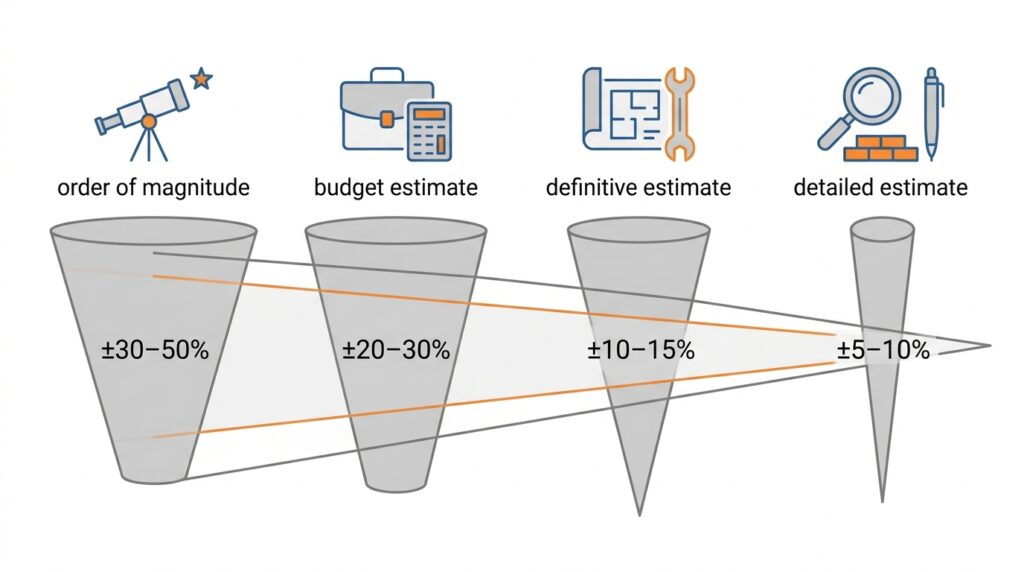
Different estimating methods are used at different stages of a project. Estimate accuracy improves as the design matures.
| Method | Description | Typical Accuracy | When to Use |
|---|---|---|---|
| Order of magnitude | Based on capacity or similar projects | ±30% to ±50% | Concept stage |
| Budget estimate | Based on preliminary design | ±20% to ±30% | Feasibility stage |
| Definitive estimate | Based on detailed design | ±10% to ±15% | Basic engineering stage |
| Detailed estimate | Based on completed design and quotes | ±5% to ±10% | Detailed design stage |
Early estimates are used for feasibility decisions; later estimates support budget approval and contract awards.
A note on accuracy ranges: The ranges above are simplified, typical values. Industry practice, such as the AACE International estimate classification system, defines five estimate classes (Class 5 for concept screening through Class 1 for check estimates) and recognizes that early estimates are skewed toward overruns, so the range is usually wider on the high side than on the low side. Accuracy also depends on project complexity, the quality of the scope definition, and the estimator’s experience. Every estimate should state its class and expected accuracy range.
Cost Categories
Project costs are typically divided into categories.
| Category | Description | Examples |
|---|---|---|
| Equipment | Major equipment items | Turbines, boilers, compressors |
| Bulk materials | Commodity materials | Pipe, fittings, valves, cable |
| Construction | Construction labor and services | Civil, mechanical, electrical |
| Engineering | Design and engineering services | Process, mechanical, electrical |
| Project management | Project management and administration | Salaries, offices, travel |
| Owner’s costs | Costs borne by the owner | Land, permits, insurance, financing |
| Contingency | Reserve for unknowns | Scope, price, schedule |
Each category should be estimated separately and tracked separately.
Work Breakdown Structure (WBS)
A work breakdown structure (WBS) divides the project into manageable components.
WBS principles:
- Hierarchical: Each level breaks the level above into smaller components.
- Complete: All project scope is included.
- Unique: Each component has a unique identifier.
- Manageable: Components are small enough to plan, estimate, and control.
Typical WBS levels:
| Level | Description | Example |
|---|---|---|
| 1 | Project | Power plant |
| 2 | Major systems | Boiler, turbine, electrical |
| 3 | Subsystems | Feedwater, fuel, control |
| 4 | Work packages | Pumps, valves, instruments |
| 5 | Activities | Installation tasks |
The WBS provides the framework for estimating, budgeting, and cost control. It is usually linked to a cost code structure, so that estimates, commitments, and actual costs are all recorded against the same codes and can be compared directly.
Estimating Techniques
Several techniques are used to estimate costs.
| Technique | Description | When to Use |
|---|---|---|
| Parametric | Based on historical relationships (e.g., cost per MW) | Early stages |
| Analogous | Based on similar past projects | When data is limited |
| Bottom-up | Built from detailed quantities and rates | Detailed stages |
| Vendor quotes | Based on actual vendor pricing | For equipment and services |
| Expert judgment | Based on experience | For unusual items |
Most estimates use a combination of techniques. Equipment is often priced by vendor quotes; construction is often priced bottom-up from quantities.
Basis of Estimate
Every estimate should be accompanied by a basis of estimate (BOE): a document that records the scope included and excluded, the design information used, the estimating methods, key assumptions, pricing date, productivity assumptions, allowances, exclusions, and the expected accuracy. A clear BOE allows the estimate to be reviewed, defended, and updated, and it prevents disputes later about what the estimate was meant to cover.
Cost Escalation
Costs can escalate over the life of a project. Cost escalation, the increase in costs over time due to inflation, market conditions, and other factors, should be considered in estimates, especially for projects with long durations. Escalation can be applied as a percentage per year or based on specific indices.
Escalation should be estimated separately from contingency. Escalation covers expected price changes between the pricing date and the date when the item will be bought or the work performed; contingency covers uncertainty in scope and quantities. For long-lead equipment and commodity-driven items such as steel, copper, and pipe, the timing of purchase has a significant effect on escalation exposure.
Currency and Exchange Rate Risk
International projects face currency risk. For international projects, costs may be incurred in multiple currencies. Exchange rate fluctuations can significantly affect the final cost. Currency risk should be identified and managed through hedging, currency clauses in contracts, or by matching costs and revenue in the same currency.
For example, a plant owner funded in local currency may buy major equipment in US dollars, euros, or yen. A weakening local currency increases the local-currency cost of that equipment even though the contract price has not changed. The estimate should show the currency of each major cost item, so that exposure can be quantified and managed.
Contingency
Contingency is a reserve for unknowns. It covers costs that are likely to occur but cannot be specifically identified at the time of estimating.
Types of contingency and reserves:
| Type | Description | Examples |
|---|---|---|
| Scope contingency | For scope growth and definition gaps | Additional work identified during design |
| Price contingency | For price variation not covered by escalation | Material price increases above allowance |
| Schedule contingency | For cost impact of delays | Delays due to weather or labor |
| Management reserve | For unidentified risks, held by management outside the baseline | Major unforeseen events |
Contingency sizing:
- Early stages: Higher contingency (e.g., 15–25%) due to uncertainty.
- Later stages: Lower contingency (e.g., 5–10%) as uncertainty reduces.
- Risk-based: Contingency based on quantitative risk analysis, such as Monte Carlo simulation, which gives a confidence level (for example P50 or P80) for the estimate.
Contingency should be managed, not treated as free money. Drawing it down should be controlled, with each use approved, recorded, and reported. The percentages above are typical examples; actual values depend on project type, scope definition, and risk.
Budget Development
The budget is the approved spending plan for the project.
Budget development steps:
- Estimate: Estimate the cost of each WBS element.
- Review: Review the estimate for completeness and accuracy.
- Approve: Obtain approval from management or the owner.
- Allocate: Allocate the budget to work packages and cost accounts.
- Baseline: Establish the baseline budget for control.
The baseline budget is the reference against which actual costs are compared. It should also be time-phased into a cash flow forecast (often shown as an S-curve), so that funding, financing, and payments can be planned in line with the schedule.
Budget Control
Budget control ensures that actual costs stay within budget.
Budget control activities:
| Activity | Description |
|---|---|
| Commitment tracking | Tracking contracts, purchase orders, and commitments |
| Cost tracking | Tracking actual costs against budget |
| Accruals | Recording costs incurred but not yet invoiced |
| Forecasting | Predicting final costs based on current trends |
| Variance analysis | Comparing actual and forecast costs against budget |
| Corrective action | Taking action when variances are significant |
Budget control requires accurate data and timely reporting. Tracking commitments, not just invoices, is essential: by the time an invoice arrives, the money has already been committed, and the opportunity to act has often passed.
Earned Value Management
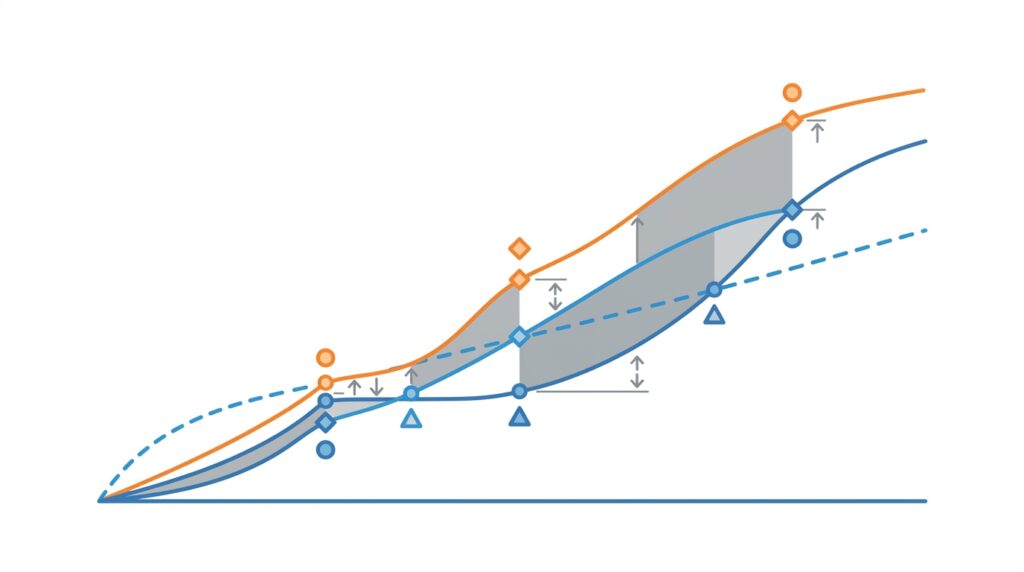
Earned value management (EVM) integrates cost, schedule, and scope to measure project performance.
Key EVM metrics:
| Metric | Description | Formula |
|---|---|---|
| Planned Value (PV) | Budgeted cost of work scheduled | — |
| Earned Value (EV) | Budgeted cost of work performed | — |
| Actual Cost (AC) | Actual cost of work performed | — |
| Cost Variance (CV) | Cost performance | EV − AC (positive = under budget) |
| Schedule Variance (SV) | Schedule performance | EV − PV (positive = ahead of schedule) |
| Cost Performance Index (CPI) | Cost efficiency | EV ÷ AC (>1 = efficient) |
| Schedule Performance Index (SPI) | Schedule efficiency | EV ÷ PV (>1 = ahead) |
| Budget at Completion (BAC) | Total approved budget | — |
| Estimate at Completion (EAC) | Forecast final cost | AC + (BAC − EV) ÷ CPI, if current cost performance continues |
| Estimate to Complete (ETC) | Forecast cost of remaining work | EAC − AC |
EVM provides early warning of cost and schedule problems, allowing corrective action before it is too late. Its reliability depends on a well-defined WBS and objective measurement of progress, since earned value is only as good as the progress data behind it.
Forecasting
Forecasting predicts the final cost of the project based on current performance.
Forecasting methods:
| Method | Description | When to Use |
|---|---|---|
| Budget-based | Actual cost plus remaining budget for remaining work | When performance is on track |
| CPI-based | Remaining budget adjusted by CPI | When performance is off track |
| Bottom-up | Re-estimate remaining work | For significant variances |
| Management judgment | Based on experience | For unusual situations |
Forecasting should be updated regularly as the project progresses. A good forecast also includes known risks and pending changes, not only the work already measured.
Change Management
Changes during a project affect cost. Managing them is critical.
Change management activities:
- Change identification: Recognizing when a change is required.
- Change assessment: Evaluating the impact on cost, schedule, and scope.
- Change approval: Approving or rejecting the change.
- Change implementation: Implementing the change.
- Documentation: Recording the change and its cost impact.
Uncontrolled changes lead to cost overruns and disputes. Approved changes should update the budget and forecast, with any contingency draw-down clearly recorded. Pending and unapproved changes should be tracked so that their potential cost impact is visible to management.
Cost Reporting
Cost reporting keeps management informed of cost performance.
Cost report contents:
- Budget: The approved budget.
- Commitments: Contracts and purchase orders.
- Actual costs: Costs incurred to date.
- Accruals: Costs incurred but not invoiced.
- Forecast: Predicted final cost.
- Variance: Actual and forecast vs. budget.
- Trends: Cost performance over time.
- Contingency status: Contingency used and remaining.
Reports should be accurate, timely, and clear.
Cost Control in EPC Projects
EPC projects have specific cost control challenges.
EPC cost control considerations:
- Lump-sum contracts: The contractor bears cost risk, but changes may still affect the owner.
- Shared risk: Some contracts share cost risk between owner and contractor, for example target-price or cost-plus arrangements.
- Owner’s costs: The owner bears costs not included in the EPC contract.
- Interface costs: Costs at the interface between EPC and owner scope.
- Payment milestones: Payments linked to measurable progress help align contractor cash flow with actual work.
- Liquidated damages and guarantees: These protect the owner but do not remove the need for owner-side cost control.
Cost control in EPC projects requires clear contract terms and disciplined change management.
The Role of the Cost Engineer
A cost engineer, or cost controller, is responsible for estimating, budgeting, and controlling project costs. In smaller projects, this role may be combined with other project management functions, but the discipline of cost control should not be neglected.
Typical responsibilities include preparing and updating estimates, setting up the cost code structure, tracking commitments and actuals, preparing forecasts and reports, and evaluating the cost impact of changes. Independence matters: the person reporting cost performance should be able to report bad news without pressure.
Lessons Learned and Benchmarking
Historical data from previous projects, including actual costs, productivity rates, and lessons learned, improves estimating accuracy. Maintaining a cost database and benchmarking against completed projects helps calibrate estimates and identify trends.
Benchmarks such as cost per installed MW, cost per tonne of equipment, or labor hours per unit of quantity can be used to test whether a new estimate is reasonable. Capturing lessons learned at project closeout, including where the estimate was wrong and why, is one of the most valuable inputs for the next project.
Common Mistakes in Cost Estimation and Budget Control
Even experienced organizations make mistakes. Common ones include:
- Optimistic estimates: Underestimating costs.
- Incomplete scope: Missing elements that later add cost.
- Inadequate contingency: Not enough reserve for unknowns.
- Ignoring escalation and currency effects: Pricing as if costs will not change.
- Poor change control: Changes not tracked or approved.
- Delayed reporting: Discovering cost overruns too late.
- Inaccurate data: Costs not recorded accurately.
- No forecasting: Not predicting final costs.
- Ignoring trends: Missing early warning signs.
- Weak commitment tracking: Not tracking contracts and purchase orders.
- No historical data: Not learning from previous projects.
These mistakes are costly to correct. They are much cheaper to avoid through disciplined estimating and control.
How Japanese EPC Firms Approach Cost Estimation and Budget Control
Japanese engineering firms are known for their disciplined approach to cost management. Common characteristics include:
- Thorough estimating: Estimates are prepared carefully, with detailed quantities and rates.
- Conservative assumptions: Estimates are based on realistic, not optimistic, assumptions.
- Adequate contingency: Contingency is sized to cover real uncertainty.
- Disciplined control: Costs are tracked and reported regularly.
- Early warning: Variances are identified and addressed early.
- Detailed documentation: Records are complete and accurate.
- Continuous improvement: Lessons are captured and applied.
For plant owners, this often means projects that are delivered within budget and without surprises.
How to Evaluate Cost Estimation and Budget Control Readiness
When reviewing cost estimation and budget control, ask:
| Question | Why It Matters |
|---|---|
| Is there a cost estimate with a documented basis? | Provides the basis for budgeting |
| Is the estimate based on adequate design information? | Determines estimate accuracy |
| Are escalation and currency risk addressed? | Prevents hidden price exposure |
| Is contingency adequate? | Covers unknowns |
| Is there a baseline budget and cash flow forecast? | Provides the reference for control and funding |
| Are commitments tracked? | Ensures all costs are captured |
| Is cost tracked against budget? | Identifies variances |
| Is forecasting performed? | Predicts final costs |
| Is change management disciplined? | Prevents uncontrolled cost growth |
| Is someone responsible for cost control? | Ensures accountability |
| Is reporting timely? | Enables early corrective action |
A plant that addresses these questions is ready for effective cost management.
Conclusion
Cost estimation and budget control are critical to project success. For small to medium-scale industrial plants, they determine whether the project is affordable, funded, and delivered within the money available.
By focusing on estimating methods, WBS, escalation and currency risk, contingency, budget development, budget control, earned value, forecasting, and change management, owners and project teams can ensure that costs are managed effectively and the project is delivered within budget.
Key Takeaways
- Cost estimation and budget control determine whether the project is affordable, funded, and delivered within budget
- Estimate accuracy improves as design progresses
- Cost categories should be estimated and tracked separately
- The WBS provides the framework for estimating, budgeting, and cost control
- Escalation and currency risk should be estimated and managed explicitly
- Contingency covers unknowns and should be sized to match uncertainty
- Earned value management integrates cost, schedule, and scope
- Forecasting predicts final costs based on current performance
- Change management prevents uncontrolled cost growth
- Cost reporting keeps management informed and enables early corrective action
- Historical data and benchmarking improve future estimates
- Japanese EPC firms emphasize thorough estimating and disciplined control