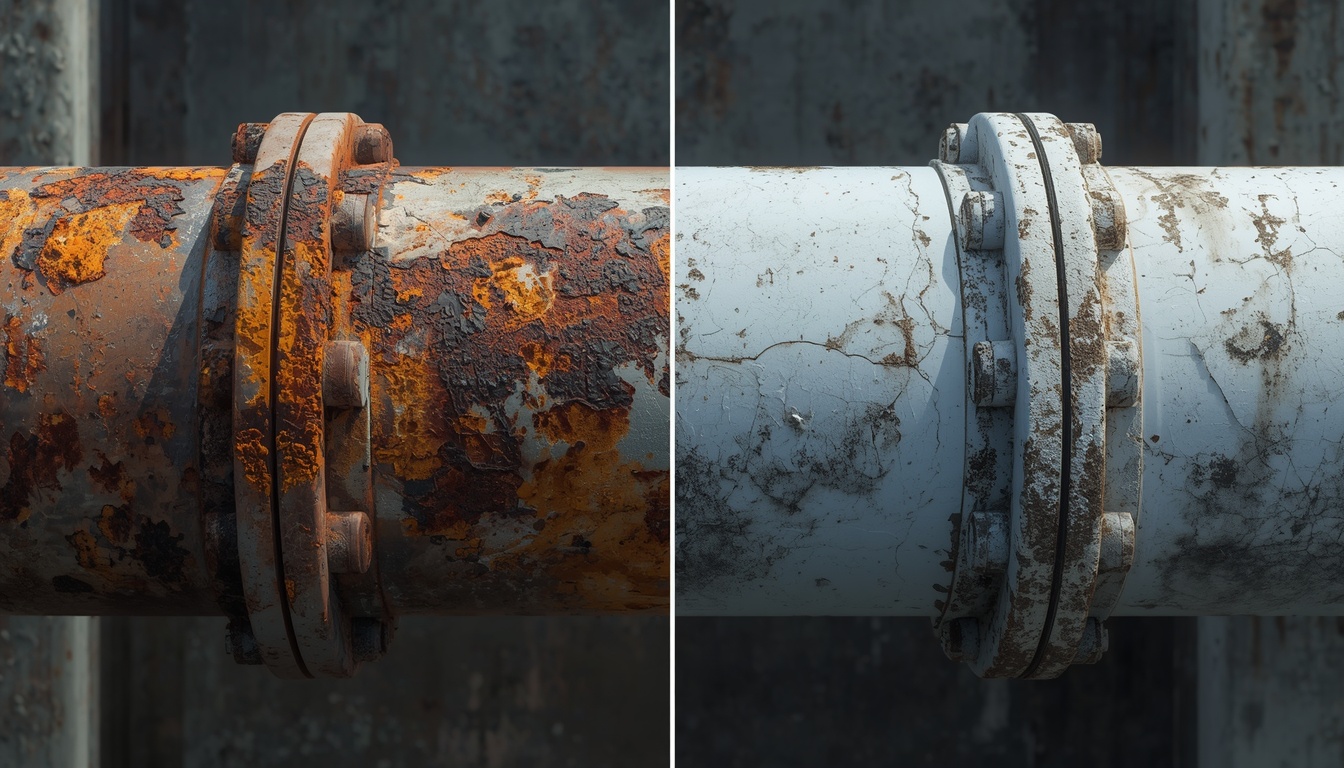
Corrosion is one of the most persistent and costly problems in industrial plants. It attacks pipes, tanks, structures, and equipment, reducing their strength, causing leaks, and eventually leading to failure. According to industry studies, corrosion costs industrial plants billions of dollars annually in maintenance, repair, and lost production.
For small to medium-scale industrial plants, corrosion control is especially critical because there is less redundancy and fewer resources to manage unexpected failures. A corroded pipe that leaks or bursts can shut down the plant, create safety hazards, and require costly repairs.
This article covers the fundamentals of corrosion control in industrial plants, including the mechanisms of corrosion, material selection, coatings, cathodic protection, and monitoring.
What Is Corrosion?
Corrosion is the deterioration of a material—usually a metal—due to chemical or electrochemical reaction with its environment. For iron and steel, corrosion typically takes the form of rust, which is iron oxide.
Corrosion occurs when three conditions are present:
- An anode: The site where metal dissolves.
- A cathode: The site where reduction occurs.
- An electrolyte: A conductive medium (water, soil, or humid air) that connects the anode and cathode.
If any of these three is eliminated, corrosion stops. Corrosion control strategies work by interrupting one or more of these conditions.
Common Types of Corrosion
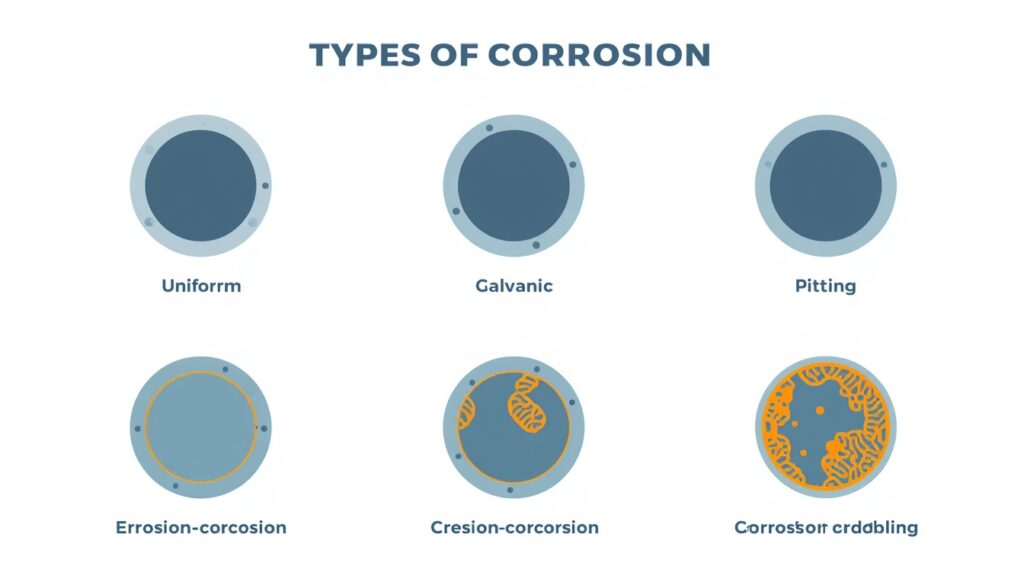
Corrosion takes many forms. Understanding the type helps in selecting the right control method.
| Type | Description | Typical Locations |
|---|---|---|
| Uniform corrosion | Even attack over the entire surface | Carbon steel in general service |
| Galvanic corrosion | Attack at the junction of dissimilar metals | Flanges, fittings, transitions |
| Pitting corrosion | Localized attack creating deep pits | Stainless steels in chloride environments |
| Crevice corrosion | Attack in stagnant crevices | Gaskets, bolt holes, under deposits |
| Erosion-corrosion | Accelerated attack due to flow | Pumps, bends, tees |
| Stress corrosion cracking | Cracking under combined stress and corrosive environment | High-temperature, chloride environments |
| Microbiologically influenced corrosion (MIC) | Corrosion caused by microorganisms | Cooling water, stagnant areas |
Different types of corrosion require different control strategies. A single approach is rarely sufficient.
One form worth calling out on its own is corrosion under insulation (CUI). It is a particularly insidious form of corrosion because it is hidden from view. Insulation can trap moisture against the metal surface, causing corrosion that goes undetected until failure. Proper insulation design, including vapor barriers and drainage, is essential. (This topic is covered in more detail in the piping systems article.)
Material Selection
The first line of defense against corrosion is selecting the right material.
Common materials and their corrosion resistance:
| Material | Corrosion Resistance | Typical Use |
|---|---|---|
| Carbon steel | Low to moderate | General service with protective measures |
| Stainless steel | High (with limitations) | Corrosive fluids, food and pharmaceutical |
| Duplex stainless steel | Very high | Chloride environments, seawater |
| Nickel alloys | Excellent | Highly corrosive environments |
| Titanium | Excellent | Seawater, oxidizing chemicals |
| Copper alloys | Moderate to high | Heat exchangers, potable water |
| Plastics (PVC, CPVC, HDPE) | High | Chemicals, water |
| FRP (fiberglass reinforced plastic) | High | Corrosive chemicals |
Material selection depends on:
- Fluid composition: What chemicals are present, and at what concentration?
- Temperature: Higher temperatures usually accelerate corrosion.
- Pressure: Higher pressures require stronger materials.
- Environment: External corrosion from salt air, chemicals, or soil.
- Cost: Material cost and life-cycle cost both matter.
In piping and vessel design, a corrosion allowance is often added to wall thickness to account for expected metal loss over the plant’s life. This is extra wall thickness added to piping and vessels to account for expected metal loss over the design life. The allowance depends on the corrosion rate, the design life, and the required safety margin.
Protective Coatings
Coatings provide a barrier between the metal and the corrosive environment. They are one of the most common and cost-effective corrosion control methods.
Common coating types:
| Coating Type | Characteristics | Typical Use |
|---|---|---|
| Epoxy | Excellent adhesion, chemical resistance | Tanks, pipes, structures |
| Polyurethane | Good weather resistance | External surfaces |
| Zinc-rich primers | Sacrificial protection | Steel structures, tanks |
| Fusion-bonded epoxy (FBE) | Excellent for buried pipelines | Buried pipe |
| Concrete | Mechanical protection, alkaline | Buried pipe, marine structures |
Key considerations for coatings:
- Surface preparation: The surface must be clean, dry, and properly profiled.
- Application: Coating must be applied at the correct thickness and under the right conditions.
- Inspection: Coating defects must be detected and repaired.
- Maintenance: Coatings degrade over time and require repair or replacement.
Coating failures are often due to poor surface preparation, not the coating itself.
Cathodic Protection
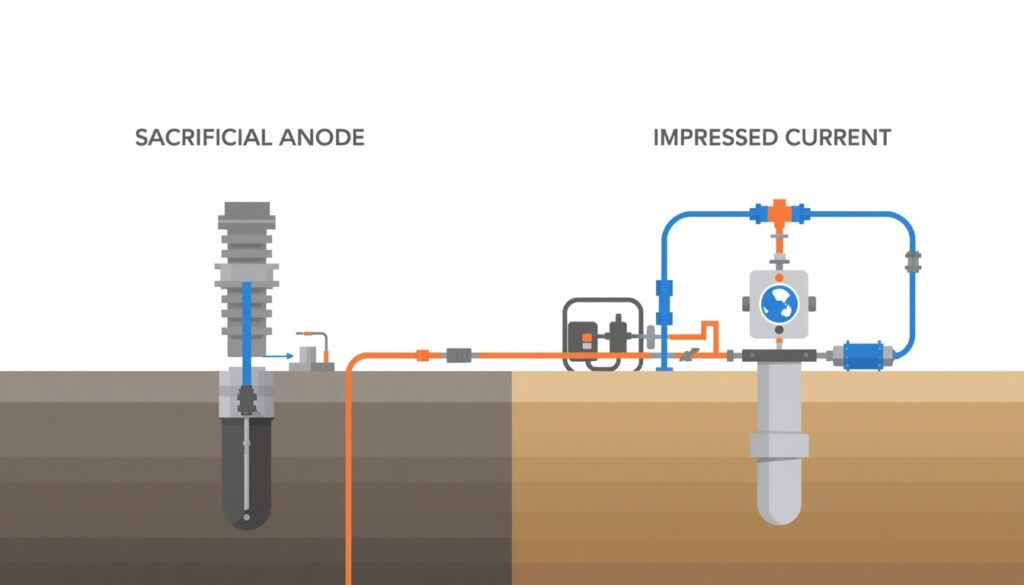
Cathodic protection (CP) is an electrochemical method of corrosion control. It works by making the metal to be protected the cathode of an electrochemical cell, so that it does not corrode.
There are two main types:
1. Sacrificial anode systems: A more active metal (such as zinc, aluminum, or magnesium) is connected to the protected structure. The anode corrodes instead of the structure.
- Simple, no external power required.
- Suitable for small structures and low-resistivity environments.
- Anodes must be replaced periodically.
2. Impressed current systems: An external DC power source supplies current to the structure through an inert anode.
- Suitable for large structures and high-resistivity environments.
- Requires external power and regular maintenance.
- Can be adjusted to meet changing conditions.
Cathodic protection is commonly used for:
- Buried pipelines
- Storage tank bottoms
- Marine structures
- Underground tanks
Corrosion Inhibitors
Corrosion inhibitors are chemicals that reduce corrosion rates by forming protective films on metal surfaces or by altering the environment. Common types include anodic inhibitors, cathodic inhibitors, and mixed inhibitors. Selection depends on the fluid, material, and operating conditions.
Corrosion Monitoring
Monitoring helps detect corrosion before it causes failure.
Common monitoring methods:
| Method | What It Measures | Typical Use |
|---|---|---|
| Visual inspection | Visible corrosion | Accessible surfaces |
| Ultrasonic thickness | Wall thickness | Pipes, tanks, vessels |
| Coupons | Corrosion rate | Process streams |
| Electrical resistance probes | Corrosion rate | Process streams |
| Linear polarization resistance (LPR) | Corrosion rate | Cooling water, process water |
| Hydrogen probes | Hydrogen permeation | High-temperature, sour service |
Monitoring data helps schedule maintenance, adjust treatment programs, and verify that corrosion control measures are working.
Corrosion Control in Specific Systems
Different plant systems require different corrosion control strategies.
Cooling water systems:
- Chemical inhibitors (corrosion inhibitors, scale inhibitors, biocides)
- Material selection (stainless steel, copper alloys)
- Cathodic protection for critical components
Boiler systems:
- Water treatment (oxygen removal, pH control)
- Chemical treatment (oxygen scavengers, pH adjusters)
- Material selection
Piping systems:
- Material selection
- Coatings (internal and external)
- Cathodic protection for buried pipes
- Corrosion monitoring (ultrasonic thickness)
- Insulation design that avoids trapping moisture, to prevent corrosion under insulation (CUI)
Storage tanks:
- Coatings (internal and external)
- Cathodic protection (tank bottoms)
- Corrosion monitoring
Structures:
- Coatings (external)
- Cathodic protection (buried or submerged)
- Material selection
Key Design Considerations
1. Corrosion Risk Assessment Identify where corrosion is likely to occur and what type is expected. This determines the control strategy.
2. Material Selection Select materials compatible with the fluid, temperature, pressure, and environment.
3. Protective Measures Combine coatings, cathodic protection, and chemical treatment as needed. No single method is sufficient for all situations.
4. Monitoring Implement monitoring to detect corrosion before it causes failure.
5. Maintenance Inspect, repair, and replace coatings and anodes as needed.
6. Documentation Record material selection, coating specifications, cathodic protection design, and monitoring data.
Corrosion Management Programs
Corrosion control is not just a design issue. It requires an ongoing program. An effective corrosion management program includes regular inspection, monitoring, maintenance, and documentation. It assigns responsibility for corrosion control and ensures that issues are identified and addressed before they cause failure.
Common Mistakes in Corrosion Control
Even experienced designers make mistakes. Common ones include:
- Selecting the wrong material: Incompatible with the fluid or environment.
- Poor surface preparation: Causing coating failure.
- Inadequate cathodic protection design: Failing to protect the entire structure.
- Ignoring monitoring: Discovering corrosion only after failure.
- Skipping maintenance: Letting coatings and anodes degrade.
- Incomplete documentation: Making it difficult to troubleshoot and maintain.
These mistakes are costly to fix after construction. They are much cheaper to avoid during design.
How Japanese EPC Firms Approach Corrosion Control
Japanese engineering firms are known for their disciplined approach to corrosion control. Common characteristics include:
- Thorough risk assessment: Corrosion risks are identified early in design.
- Conservative material selection: Materials are selected with adequate margin for the expected environment.
- Detailed coating specifications: Surface preparation, application, and inspection are carefully specified.
- Comprehensive monitoring: Corrosion is monitored throughout the plant’s life.
- Long-term maintenance focus: Corrosion control is treated as an ongoing responsibility, not a one-time design decision.
For plant owners, this often means lower maintenance costs and fewer unexpected failures over the plant’s life.
How to Evaluate Corrosion Control Design
When reviewing corrosion control design, ask:
| Question | Why It Matters |
|---|---|
| Has a corrosion risk assessment been performed? | Identifies where corrosion is likely |
| Are materials compatible with the fluid and environment? | Prevents corrosion from the start |
| Are coatings properly specified? | Ensures effective barrier protection |
| Is cathodic protection designed correctly? | Ensures complete protection |
| Is monitoring in place? | Detects corrosion before failure |
| Is maintenance planned? | Ensures long-term effectiveness |
| Is documentation complete? | Supports troubleshooting and maintenance |
A design that addresses these questions is likely to perform well over the plant’s life.
Key Takeaways
- Corrosion requires an anode, a cathode, and an electrolyte
- Common types include uniform, galvanic, pitting, crevice, erosion-corrosion, and MIC
- Material selection is the first line of defense
- Coatings provide a barrier between metal and environment
- Cathodic protection uses sacrificial anodes or impressed current
- Monitoring detects corrosion before failure
- Japanese EPC firms emphasize thorough risk assessment and conservative material selection
Conclusion
Corrosion is a persistent and costly problem in industrial plants, but it can be controlled. By combining material selection, coatings, cathodic protection, and monitoring, owners and designers can protect equipment and structures from corrosion and extend their service life.
For small to medium-scale industrial plants, where margins are tight, corrosion control deserves careful attention from the earliest stages of design.