
Contracts are the foundation of every EPC project. They define what is to be built, how much it will cost, when it will be delivered, and who bears which risks. But signing a contract is only the beginning. Contract management is the discipline of administering the contract throughout the project: ensuring obligations are met, changes are managed, payments are made correctly, disputes are resolved, and the relationship between owner and contractor remains constructive.
For small to medium-scale industrial plants, contract management is especially important because there is less margin for error and fewer resources to absorb the consequences of contractual disputes. A poorly managed contract can lead to cost overruns, schedule delays, litigation, and damaged relationships.
This article covers the key practices in plant contract management, from contract formation to closeout.
What Is Contract Management?
Contract management is the process of administering a contract from award to closeout.
It includes:
- Contract formation: Negotiating and awarding the contract.
- Contract administration: Managing the contract during execution.
- Change management: Managing changes to the contract.
- Payment management: Ensuring payments are made correctly.
- Claims management: Managing claims and disputes.
- Contract closeout: Closing out the contract at completion.
Contract management is not just a legal function. It is a project management function that requires technical, commercial, and legal knowledge.
Why Contract Management Matters
Contract management directly affects project success.
| Factor | Impact of Good Contract Management | Impact of Poor Contract Management |
|---|---|---|
| Cost | Costs controlled; disputes avoided | Cost overruns; claims |
| Schedule | Schedule protected; delays managed | Delays; disputes over time |
| Quality | Quality requirements met | Quality disputes |
| Risk | Risks allocated clearly | Risks disputed |
| Relationship | Constructive relationship | Adversarial relationship |
| Closeout | Smooth closeout | Litigation |
For small plants, where there is less margin for error, contract management determines whether the project is delivered without disputes.
Contract Formation
Contract formation is the process of negotiating and awarding the contract.
Contract formation activities:
- Scope definition: What is included in the contract, and what is excluded?
- Pricing: What is the contract price, and how is it structured?
- Terms and conditions: What are the legal terms, including governing law?
- Risk allocation: Who bears which risks?
- Payment terms: When and how will payment be made?
- Schedule: What are the key dates and milestones?
- Security and insurance: What bonds, guarantees, and insurance are required?
- Dispute resolution: How will disputes be resolved?
Contract formation should result in a clear, complete, and fair contract.
Many owners use a recognized standard form (for example, the FIDIC Silver Book for EPC/turnkey projects, or an industry or national model form) as the starting point. Standard forms are well understood by the market and reduce drafting risk, but they still need to be tailored through special conditions to fit the specific project.
Handover from Negotiation to Administration
A common weakness is that the people who negotiated the contract are not the people who administer it. Key commitments, assumptions, and negotiated clarifications can be lost. A short kickoff session that walks the project team through the contract, its key obligations, deadlines, and risk areas helps ensure that what was agreed is what gets managed.
Contract Interpretation and Order of Precedence
Contract documents frequently contain provisions that appear to conflict. Contracts should specify the order of precedence among documents—typically the contract agreement, then the conditions of contract, then the specification, then the drawings. This order determines which document prevails in a dispute.
The actual order varies by contract form, so it should always be confirmed in the contract itself. Ambiguities should be raised and clarified in writing as soon as they are noticed, rather than being left to surface in a dispute.
Contract Types
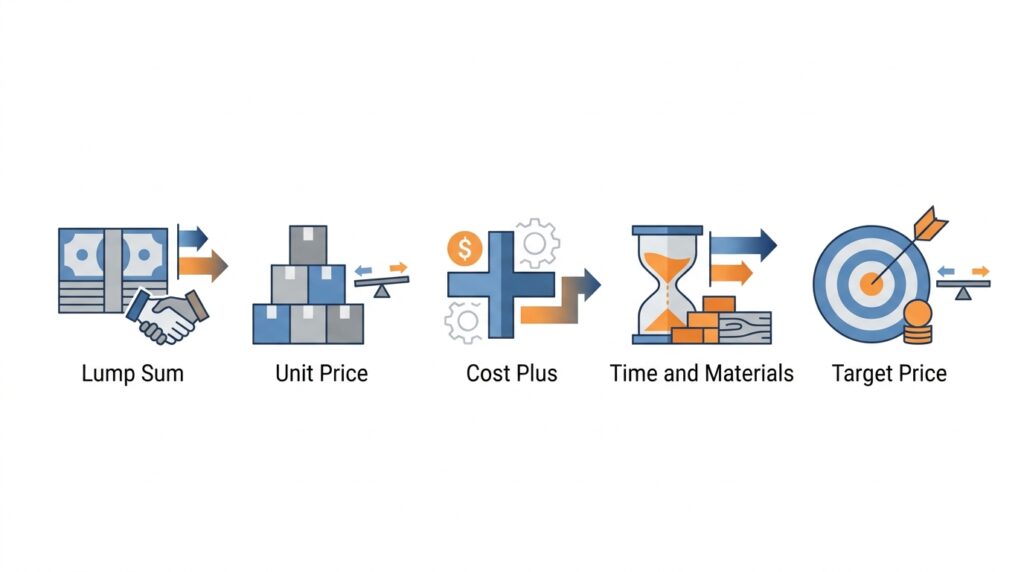
Different contract types allocate risk differently.
| Contract Type | Description | Risk Allocation |
|---|---|---|
| Lump sum | Fixed price for defined scope | Contractor bears cost risk for defined scope; owner bears risk of scope changes |
| Unit price | Price per unit of work, with quantities remeasured | Risk shared based on quantities |
| Cost plus | Actual cost plus fee | Owner bears cost risk |
| Time and materials | Hourly rate plus materials | Owner bears cost risk |
| Target price | Target with shared savings/overruns | Risk shared |
The choice of contract type depends on how well the scope is defined and how much risk each party can bear. EPC projects are most often lump sum, which gives the owner cost certainty but only if the scope and the owner’s requirements are well defined at award.
Key Contract Terms
Contracts contain many terms that affect project execution.
| Term | Description |
|---|---|
| Scope | What is included and excluded |
| Price | Contract price and pricing structure |
| Payment terms | When and how payment is made |
| Schedule | Key dates and milestones |
| Performance guarantees | What performance must be achieved |
| Liquidated damages | Pre-agreed compensation for delay or performance shortfall, usually subject to a cap |
| Warranty | Warranty period (defects liability) and terms |
| Security | Performance bonds, advance payment guarantees, parent company guarantees |
| Insurance | Required coverage, such as construction all-risk and third-party liability |
| Indemnity | Who bears liability for specific risks |
| Limitation of liability | Caps on each party’s total liability |
| Force majeure | What happens if events beyond control occur |
| Suspension and termination | Under what conditions the contract can be suspended or terminated |
| Governing law | Which law applies to the contract |
| Dispute resolution | How disputes are resolved |
Key terms should be clearly understood by both parties.
Contract Administration
Contract administration is the ongoing management of the contract during execution.
Contract administration activities:
- Correspondence management: Managing letters, emails, and notices.
- Meeting management: Managing project meetings and minutes.
- Document management: Managing contract documents and their revisions.
- Obligation tracking: Tracking contractual obligations of both parties.
- Compliance monitoring: Monitoring compliance with contract terms.
- Subcontractor oversight: Confirming that the contractor’s subcontractor arrangements comply with contract requirements.
- Reporting: Reporting contract status to management.
Contract administration ensures that the contract is managed professionally.
Obligations run in both directions. Owners often overlook their own duties, such as providing site access, owner-supplied information or equipment, approvals within agreed review periods, and timely payment. Failure to meet these can give the contractor grounds for a time or cost claim.
Contract Management Software
Contract management software can help track obligations, manage correspondence, monitor milestones, and provide alerts for upcoming deadlines. For small plants, even a structured spreadsheet can provide significant benefit.
A simple obligations register, listing each obligation, who owns it, the due date, and its status, is often the most valuable single tool.
Correspondence and Notices
Correspondence and notices are the formal communication between parties.
Correspondence considerations:
- Formal notices: Notices required by the contract (e.g., delay notices, change notices, claim notices).
- Time limits: Many notices have strict time limits, and some contracts bar claims that are not notified in time.
- Format and delivery: Contracts often specify how notices must be given (in writing, to a named person or address).
- Written record: Verbal instructions should be confirmed in writing.
- Record keeping: Correspondence should be filed and accessible.
- Tone: Correspondence should be professional and constructive.
Failure to provide required notices can result in loss of rights.
Early Warning and Risk Sharing
Some contracts require parties to notify each other of emerging risks or problems at an early stage. Early warning allows issues to be addressed collaboratively before they escalate into claims.
Even where the contract does not require it, raising concerns early is good practice. Regular joint risk reviews help make this routine.
Change Management
Changes are common in EPC projects. Managing them is critical.
Change management activities:
- Change identification: Recognizing when a change is required.
- Change assessment: Evaluating the impact on scope, cost, schedule, and quality.
- Change approval: Approving or rejecting the change before work proceeds.
- Change implementation: Implementing the change.
- Documentation: Recording the change and its impact, and issuing a formal change order or variation.
Types of changes:
| Type | Description |
|---|---|
| Scope change | Addition or deletion of work |
| Design change | Modification to design |
| Schedule change | Change to schedule |
| Price change | Change to price |
| Procedure change | Change to procedures |
Changes should be managed formally, with clear documentation and approval. Work carried out on verbal instruction without a formal change order is a frequent source of later disputes over entitlement and valuation.
A change that affects price or schedule should be agreed, or at least have its basis of valuation agreed, before the work is done. Disputed changes should still be recorded so the dispute does not grow unnoticed.
Payment Management
Payment management ensures that payments are made correctly and on time.
Payment management activities:
- Payment schedule: What payments are due, and when?
- Milestone verification: Confirming that milestones are met.
- Invoice review: Reviewing invoices for accuracy.
- Payment approval: Approving payments.
- Payment processing: Processing payments.
- Payment records: Recording payments.
Payment considerations:
- Retention: Some contracts include retention (a percentage held back until completion or the end of the warranty).
- Advance payments: Some contracts include advance payments, usually secured by a bank guarantee.
- Currency and exchange rates: What currency is used, and is there any adjustment mechanism?
- Price adjustment: Whether the price adjusts for inflation or escalation.
- Taxes: What taxes apply, including withholding tax.
- Set-off: Whether the owner may deduct amounts, such as liquidated damages, from payments.
Payment should be made according to the contract terms.
Claims Management
Claims are requests for additional time or money.
Common claims:
| Claim Type | Description |
|---|---|
| Extension of time | Additional time required |
| Additional cost | Additional cost incurred |
| Disruption | Disruption to planned work |
| Acceleration | Cost of accelerating work |
| Change | Cost of change |
Claims management activities:
- Claim identification: Identifying potential claims.
- Claim notification: Notifying the other party of claims within contract time limits.
- Claim preparation: Preparing claim documentation.
- Claim evaluation: Evaluating claims.
- Claim resolution: Resolving claims.
Claims should be managed proactively, not left to accumulate.
Record Keeping for Claims
Claims are usually decided on the basis of contemporaneous records: site diaries, daily reports, correspondence, and progress data. Records created at the time of the event carry far more weight than those reconstructed later.
Useful records include updated schedules, photographs, resource and manpower records, meeting minutes, and inspection reports. Both owners and contractors benefit from keeping them consistently, because they are equally important when defending against a claim.
Delay Analysis
Time claims need to show not just that a delay occurred, but that it affected the critical path. Where delays by both parties overlap (concurrent delay), the contract and governing law determine how time and cost are treated. A current, agreed baseline schedule and regular schedule updates make delay analysis far more reliable.
Dispute Resolution
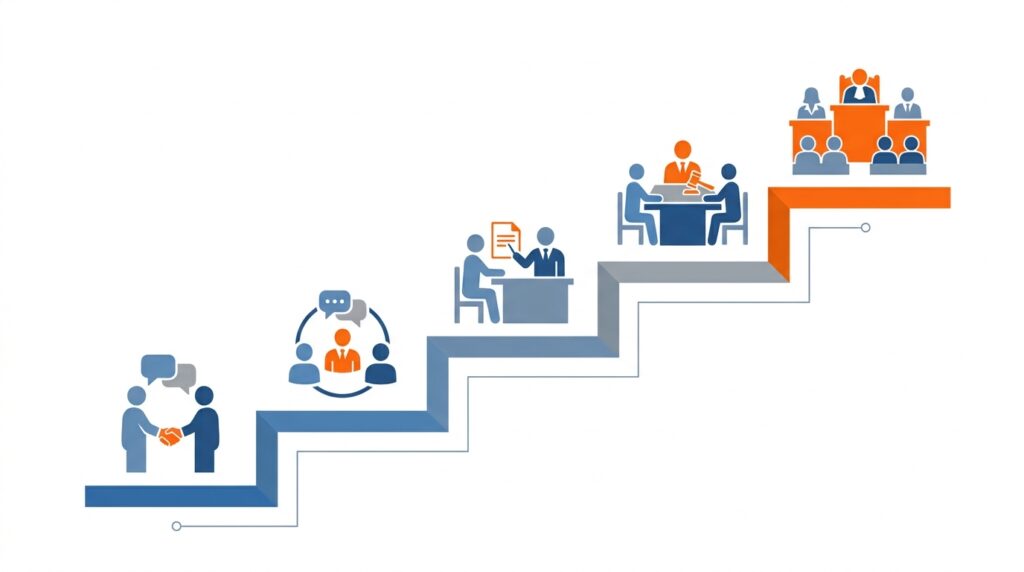
Disputes can arise when parties disagree.
Dispute resolution methods:
| Method | Description |
|---|---|
| Negotiation | Parties negotiate directly |
| Mediation | Neutral third party helps the parties reach agreement; not binding unless agreed |
| Adjudication / dispute board | Neutral third party issues a decision, often binding in the short term but open to later challenge |
| Arbitration | Arbitrator issues a binding award |
| Litigation | Court decides |
Many contracts use a tiered approach, escalating from project-level discussion to senior management, then to mediation or a dispute board, and finally to arbitration or litigation. Dispute resolution should be planned in the contract, with clear procedures and time limits. Disputes should be raised and addressed early, while the facts are fresh and the relationship is intact.
Contract Closeout
Contract closeout is the final phase of contract management.
Closeout activities:
- Final acceptance: Confirming that all work is complete, including performance tests and handover.
- Final payment: Making final payment.
- Warranty documentation: Confirming warranty terms and periods.
- Release of retention and securities: Releasing any retention and returning bonds and guarantees when due.
- Final accounts: Agreeing final accounts, including all changes and claims.
- Resolution of open claims: Settling or formally recording any outstanding claims.
- Records archive: Retaining contract records for the required period.
- Lessons learned: Capturing lessons for future projects.
Closeout should be planned from the beginning, not left to the end.
Contract Management in Small Plants
Small plants face particular challenges with contract management.
Challenges:
- Fewer resources for contract management.
- Less legal and commercial expertise.
- More informal communication.
- Competing priorities.
Practical approaches:
- Define clear contracts: Clear contracts reduce disputes.
- Assign responsibility: Someone should be responsible for contract management.
- Use templates: Standard templates for notices, change orders, and claim registers save time.
- Keep records: Good records support claims and disputes.
- Seek advice: Get legal or commercial advice when needed, especially before sending a notice with significant consequences.
- Learn from others: Learn from other plants’ experiences.
Contract management does not need to be complex. It needs to be consistent.
Common Mistakes in Contract Management
Even experienced organizations make mistakes. Common ones include:
- Unclear contracts: Ambiguous terms or conflicting documents lead to disputes.
- No contract management: Contract not actively managed.
- Missing notices: Failing to provide required notices.
- Poor records: Inadequate documentation.
- Uncontrolled changes: Changes not managed formally.
- Delayed payments: Payments not made on time.
- Unresolved claims: Claims left to accumulate.
- Escalating disputes: Disputes not resolved early.
- Ignoring owner obligations: Owner-side duties not tracked.
- Poor closeout: Closeout left to the end.
These mistakes are costly to correct. They are much cheaper to avoid through disciplined contract management.
How Japanese EPC Firms Approach Contract Management
Japanese engineering firms are known for their disciplined approach to contract management. Common characteristics include:
- Clear contracts: Contracts are clear and complete.
- Disciplined administration: Contract obligations are tracked and managed.
- Thorough records: Documentation is complete and accessible.
- Proactive communication: Issues are raised early.
- Constructive relationships: Parties work together to resolve issues.
- Systematic closeout: Closeout is planned and executed.
- Continuous improvement: Lessons are captured and applied.
For plant owners, this often means projects that are delivered without disputes.
How to Evaluate Contract Management Readiness
When reviewing contract management, ask:
| Question | Why It Matters |
|---|---|
| Is the contract clear and complete? | Reduces disputes |
| Is the order of precedence defined? | Resolves conflicts between documents |
| Is someone responsible for contract management? | Ensures accountability |
| Are contract obligations tracked, for both parties? | Ensures compliance |
| Is correspondence managed and are notice deadlines known? | Preserves rights |
| Are changes managed formally? | Prevents disputes |
| Are payments made on time? | Maintains relationship |
| Are contemporaneous records kept? | Supports claims and defense |
| Are claims managed proactively? | Prevents escalation |
| Are disputes resolved early? | Prevents litigation |
| Is closeout planned? | Ensures smooth completion |
A plant that addresses these questions is ready for effective contract management.
Conclusion
Contract management is critical to project success. For small to medium-scale industrial plants, it determines whether the project is delivered without disputes.
By focusing on contract formation, administration, change management, payment, claims, dispute resolution, and closeout, owners and project teams can ensure that the contract supports the project rather than hindering it.
Key Takeaways
- Contract management administers the contract from award to closeout
- Contract formation establishes clear scope, price, terms, and risk allocation
- Contract documents should state an order of precedence to resolve conflicts
- Contract types allocate risk differently: lump sum, unit price, cost plus, time and materials, target price
- Key contract terms include scope, price, payment, schedule, guarantees, liquidated damages, warranty, security, indemnity, force majeure, termination, and dispute resolution
- Correspondence and notices are formal communication with time limits
- Early warning lets parties address emerging problems before they become claims
- Changes must be managed formally
- Claims should be managed proactively and supported by contemporaneous records
- Contract management software, or even a structured spreadsheet, helps track obligations and deadlines
- Disputes should be resolved early through negotiation, mediation, adjudication, arbitration, or litigation
- Closeout should be planned from the beginning
- Japanese EPC firms emphasize clear contracts and disciplined administration