
Every project has stakeholders: people and organizations who affect, or are affected by, the project. The owner, the contractors, the vendors, the regulators, the local community, the lenders, the insurers, and the plant’s future operators are all stakeholders. Each has different interests, different concerns, and different levels of influence.
Stakeholder management is the discipline of identifying these parties, understanding their interests and influence, and engaging them effectively throughout the project. It is not about pleasing everyone, which is impossible. It is about understanding who matters, what they need, and how to work with them constructively.
For small to medium-scale industrial plants, stakeholder management is especially important because there is less margin for error and fewer resources to absorb the consequences of stakeholder conflicts. A single unhappy regulator, community group, or lender can delay or derail a project.
This article covers the key practices in plant stakeholder management, from identification and analysis to engagement, communication, and monitoring.
What Is Stakeholder Management?
Stakeholder management is the process of identifying, analyzing, and engaging stakeholders to achieve project objectives.
It includes:
- Stakeholder identification: Who are the stakeholders?
- Stakeholder analysis: What are their interests, influence, and expectations?
- Engagement planning: How will we engage each stakeholder?
- Communication: How will we communicate with each stakeholder?
- Monitoring: How are stakeholder relationships developing?
Stakeholder management is not just about communication. It is about understanding and managing relationships.
Why Stakeholder Management Matters
| Factor | Good Stakeholder Management | Poor Stakeholder Management |
|---|---|---|
| Approvals | Permits and approvals obtained smoothly | Delays and rejections |
| Community | Community supports the project | Community opposition |
| Financing | Lenders confident in the project | Financing delayed or withdrawn |
| Construction | Contractors work together | Contractor disputes |
| Operations | Operations team ready and engaged | Operations unprepared |
| Reputation | Positive reputation | Reputation damaged |
For small plants, where there is less margin for error, stakeholder management determines whether the project proceeds smoothly.
Stakeholder Identification
Stakeholder identification is the first step.
| Category | Examples |
|---|---|
| Internal | Owner, project team, operations, maintenance |
| Contractors | EPC contractor, subcontractors, vendors |
| Regulators | Environmental agencies, safety authorities, local government |
| Financial | Lenders, investors, insurers |
| Community | Local residents, landowners, community groups, NGOs |
| Workforce | Construction workers, local labor, unions or worker representatives |
| Media | Local and industry media |
| Other | Utilities, emergency services, industry associations |
Identification should be comprehensive, because a missed stakeholder can cause problems later. It should also be repeated: new stakeholders appear as the project moves from design to construction to operation.
The Stakeholder Register
A stakeholder register lists each stakeholder, their interests, influence, engagement approach, and status. It is the central document for stakeholder management and should be reviewed regularly.
A practical register also records the responsible owner for each stakeholder, the date and outcome of the last contact, and any open issues or commitments. For small plants, a simple spreadsheet is enough, provided it is kept current.
Stakeholder Analysis
Stakeholder analysis evaluates each stakeholder’s interests, influence, and expectations.
| Dimension | Description |
|---|---|
| Interest | How interested is the stakeholder in the project? |
| Influence | How much influence does the stakeholder have? |
| Impact | How much will the project affect the stakeholder? |
| Expectations | What does the stakeholder expect? |
| Concerns | What are the stakeholder’s concerns? |
Power-interest grid:
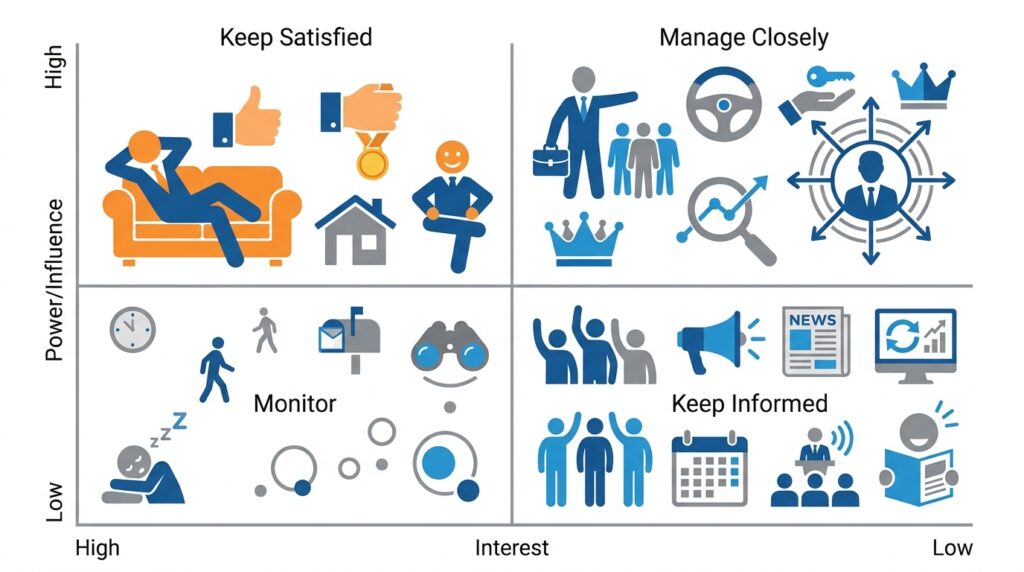
| Low Influence | High Influence | |
|---|---|---|
| High Interest | Keep informed | Manage closely |
| Low Interest | Monitor | Keep satisfied |
The grid helps prioritize engagement effort. Note that influence and interest change over time. A quiet stakeholder can become highly active when the project begins to affect them directly, so the grid should be revisited as the project moves between phases.
Managing Conflicting Stakeholder Interests
Stakeholders often have conflicting interests: what satisfies one may concern another. Managing these conflicts requires understanding each stakeholder’s priorities, finding common ground where possible, and making transparent decisions where conflicts cannot be resolved.
Typical conflicts on plant projects include:
- Schedule vs. community impact: Lenders want fast completion, while residents want limited construction noise and traffic.
- Cost vs. environmental performance: Owners want low capital cost, while regulators and lenders require stricter controls.
- Contractor profit vs. owner scope: Each party reads the same contract differently.
- Construction convenience vs. operability: Designs that are easy to build may be harder to operate.
Where a conflict cannot be resolved, the decision, its rationale, and the trade-offs should be recorded and communicated openly. Stakeholders can accept an outcome they dislike more readily than one reached without explanation.
Stakeholder Engagement in Different Project Phases
Stakeholder engagement needs change as the project progresses.
- Design phase: Engagement focuses on technical and regulatory stakeholders, including permitting authorities, lenders’ technical advisors, and operations.
- Procurement phase: Engagement focuses on vendors, logistics providers, and local suppliers.
- Construction phase: Engagement focuses on contractors and the community, covering noise, traffic, safety, and local employment.
- Commissioning and handover: Engagement focuses on the operations team, regulators (for start-up approvals), and emergency services.
- Operations phase: Engagement focuses on the operations team and ongoing regulatory compliance, along with continued community relations.
The engagement plan should be updated at each phase transition.
Stakeholder Engagement Planning
Engagement planning determines how each stakeholder will be engaged:
- Define objectives: What do we want to achieve with each stakeholder?
- Define approach: How will we engage each stakeholder?
- Define frequency: How often will we engage?
- Define responsibilities: Who is responsible for each stakeholder?
- Define resources: What resources are needed?
- Define metrics: How will we measure engagement success?
Stakeholder Engagement Plan
| Element | Description |
|---|---|
| Stakeholder list | Who are the stakeholders? |
| Analysis | What are their interests, influence, and expectations? |
| Objectives | What do we want to achieve with each stakeholder? |
| Engagement approach | How will we engage each stakeholder? |
| Communication methods | How will we communicate? |
| Frequency | How often will we engage? |
| Responsibilities | Who is responsible? |
| Escalation | Who is involved when an issue cannot be resolved at working level? |
| Metrics | How will we measure success? |
The plan should be reviewed and updated regularly.
Communication

Communication considerations:
- Message: What do we want to communicate?
- Audience: Who are we communicating with?
- Method: What communication method is appropriate?
- Timing: When should we communicate?
- Frequency: How often should we communicate?
- Feedback: How will we receive feedback?
| Method | When to Use |
|---|---|
| Meetings | Detailed discussions and decisions |
| Reports | Regular status updates |
| Presentations | Larger audiences |
| Routine communication | |
| Website and notices | Public information |
| Site visits | Showing progress |
| Public meetings | Community consultation |
Communication should be tailored to the audience. A lender wants financial and schedule data; a resident wants to know about noise, traffic, and safety. Keep messages consistent across audiences, since stakeholders compare notes.
Regulator Engagement
Regulators are often the most important stakeholders for industrial plants. Good practice includes:
- Early engagement: Engage regulators early in the project.
- Clear submissions: Prepare clear, complete submissions.
- Regular updates: Keep regulators informed of progress.
- Compliance: Ensure compliance with all requirements.
- Relationship building: Build constructive relationships.
Regulator engagement should be proactive, not reactive.
Community Engagement
Community engagement is critical for projects that affect local residents. Good practice includes:
- Early engagement: Engage the community early.
- Transparent communication: Be open about project impacts.
- Feedback mechanisms: Provide ways for the community to give feedback.
- Community benefits: Consider local employment, local procurement, and community programs.
- Grievance mechanisms: Provide a way to address grievances.
Community opposition can delay or derail a project. Early, transparent engagement reduces this risk.
Grievance Mechanisms
A grievance mechanism provides a formal way for stakeholders to raise concerns and have them addressed. It should be accessible, transparent, and responsive, with clear timelines for resolution.
Grievance mechanisms are especially important for community and labor stakeholders. Practical features include:
- Multiple ways to submit a grievance (phone, email, in person, written)
- A grievance log with an owner for each case
- Clear response and resolution timelines
- An escalation route if the complainant is not satisfied
- Feedback to the complainant on the outcome
- Periodic review of grievance trends to spot recurring problems
Lender and Investor Engagement
Lenders and investors have significant influence over projects. Good practice includes:
- Regular reporting: Provide regular progress and financial reports.
- Compliance: Ensure compliance with financing conditions, including any environmental and social requirements.
- Transparency: Be transparent about risks and issues.
- Relationship building: Build constructive relationships.
Lenders and investors need confidence that the project is on track. Bad news delivered late damages that confidence far more than bad news delivered early with a recovery plan.
Contractor and Vendor Engagement
- Clear contracts: Define scope and responsibilities clearly.
- Regular communication: Hold regular progress meetings.
- Issue resolution: Address issues promptly.
- Performance management: Monitor and manage performance.
- Relationship building: Build constructive relationships.
Good contractor relationships reduce disputes and improve performance.
Workforce and Labor Engagement
Workers are stakeholders too. Good practice includes:
- Clear communication on site rules, safety, and working conditions
- Fair and timely payment, including for subcontractor workers
- A grievance channel open to all workers, including subcontractor staff
- Respect for local labor laws and worker representation
Media Engagement
Media can shape public perception of the project. Designate a single spokesperson, prepare a short project statement, and provide factual updates, especially if an incident occurs. Silence leaves the story to others.
Operations and Maintenance Engagement
The operations and maintenance team will run the plant after handover. Their engagement during the project is critical:
- Early involvement: Involve operations in design reviews.
- Training: Provide training during construction and commissioning.
- Procedure development: Involve operations in developing procedures.
- Feedback: Seek operations feedback on design and construction.
Operations engagement ensures that the plant is designed and built for operability.
Monitoring Stakeholder Relationships
Stakeholder relationships should be tracked, not assumed. Monitoring includes:
- Updating the stakeholder register after each significant contact
- Reviewing the power-interest grid when circumstances change
- Tracking open issues, commitments, and grievances
- Measuring engagement against the metrics in the plan (for example, response times, meeting attendance, number of unresolved grievances)
- Reporting stakeholder status to project management alongside cost and schedule
- Feeding stakeholder risks into the project risk register
Monitoring turns stakeholder management from a one-time exercise into a continuing process.
Stakeholder Management in Small Plants
Small plants face particular challenges: fewer resources, less experience with complex stakeholder environments, competing priorities, and limited communication channels.
Practical approaches:
- Prioritize stakeholders: Focus on the most important ones.
- Assign responsibility: Someone should be responsible for stakeholder management.
- Use simple tools: A stakeholder register and engagement plan are sufficient.
- Communicate regularly: Regular communication builds trust.
- Seek advice: Get advice from experienced colleagues or consultants.
Stakeholder management does not need to be complex. It needs to be consistent.
Common Mistakes in Stakeholder Management
- No stakeholder identification: Stakeholders not identified.
- Incomplete analysis: Interests and influence not understood.
- No engagement plan: Engagement left to chance.
- Late engagement: Stakeholders engaged too late.
- Poor communication: Communication not tailored or timely.
- Ignoring concerns: Concerns not addressed.
- No feedback or grievance mechanisms: Stakeholders cannot raise issues.
- Reactive approach: Responding to problems instead of preventing them.
- Static analysis: The register and grid never updated as phases change.
- No monitoring: Relationships not tracked.
These mistakes are costly to correct and much cheaper to avoid through disciplined stakeholder management.
How Japanese EPC Firms Approach Stakeholder Management
Japanese engineering firms are known for their disciplined approach. Common characteristics include:
- Thorough identification: Stakeholders are identified systematically.
- Detailed analysis: Interests and influence are analyzed carefully.
- Proactive engagement: Stakeholders are engaged early and regularly, with issues discussed before formal decisions or submissions.
- Clear communication: Communication is clear, timely, and tailored.
- Constructive relationships: Relationships are built on trust and respect.
- Systematic monitoring: Stakeholder relationships are tracked.
- Continuous improvement: Lessons are captured and applied.
For plant owners, this often means projects that proceed smoothly, with stakeholder support.
How to Evaluate Stakeholder Management Readiness
| Question | Why It Matters |
|---|---|
| Are stakeholders identified and recorded in a register? | Missing stakeholders cause problems |
| Is stakeholder analysis performed? | Understanding interests and influence |
| Is there an engagement plan, updated for each phase? | Provides a roadmap for engagement |
| Is responsibility assigned? | Ensures accountability |
| Is communication planned? | Ensures effective communication |
| Are regulators engaged early? | Prevents approval delays |
| Is the community engaged, with a grievance mechanism? | Prevents opposition |
| Are lenders and investors engaged? | Maintains financing confidence |
| Are contractors, vendors, and workers engaged? | Improves performance |
| Is operations engaged? | Ensures operability |
| Are conflicts between stakeholders identified and managed? | Prevents surprises |
| Is stakeholder status monitored and reported? | Keeps the plan current |
A plant that addresses these questions is ready for effective stakeholder management.
Conclusion
Stakeholder management is critical to project success. For small to medium-scale industrial plants, it determines whether the project proceeds smoothly, with stakeholder support.
By focusing on stakeholder identification, the register, analysis, engagement planning, communication, grievance handling, phase-based engagement, and monitoring, owners and project teams can ensure that stakeholders support the project rather than hinder it.
Key Takeaways
- Stakeholder management identifies, analyzes, and engages stakeholders to achieve project objectives.
- Stakeholders include internal, contractors, regulators, financial, community, workforce, media, and other parties.
- A stakeholder register is the central tracking document and should be reviewed regularly.
- Stakeholder analysis evaluates interest, influence, impact, expectations, and concerns.
- The power-interest grid helps prioritize engagement.
- Stakeholder interests often conflict; manage them through understanding, common ground, and transparent decisions.
- Engagement needs change by project phase: design, construction, and operations each have different priorities.
- A stakeholder engagement plan defines how each stakeholder will be engaged.
- Communication should be tailored to the audience.
- Regulator, community, lender, contractor, and operations engagement are all critical.
- A grievance mechanism should be accessible, transparent, and responsive, with clear resolution timelines.
- Small plants can manage stakeholders with a register, an engagement plan, and consistent communication.
- Japanese EPC firms emphasize proactive engagement and constructive relationships.