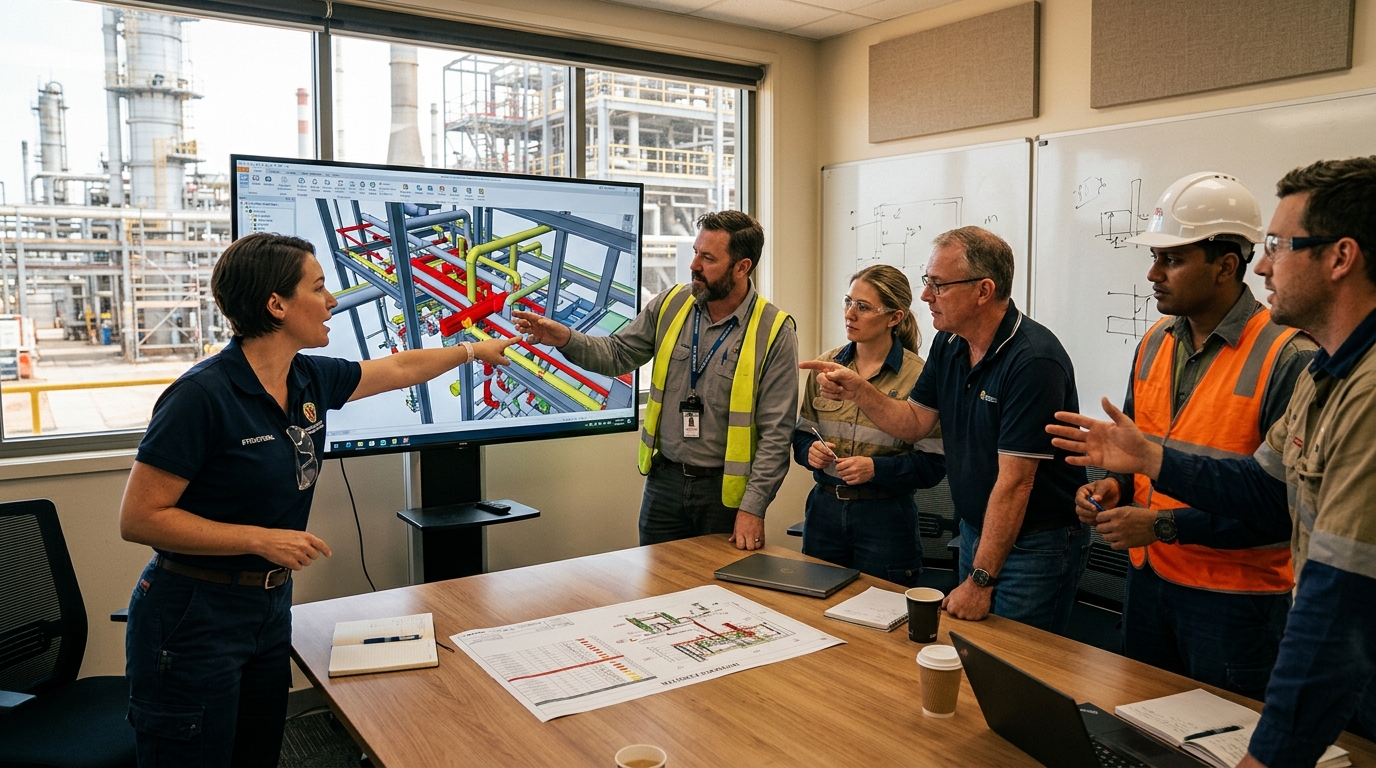
Most project problems do not come from any single discipline doing its job badly. They come from the gaps between disciplines. Piping is designed correctly. Structural steel is designed correctly. But the pipe does not fit through the opening in the steel. The electrical cable tray clashes with the ductwork. The vendor’s equipment arrives with connections that do not match the site’s utilities.
Interface management is the discipline of identifying, defining, and controlling the points where different scopes, disciplines, contractors, or systems meet. It is one of the most commonly underestimated aspects of EPC projects, and one of the most common sources of delay, rework, and dispute.
For small to medium-scale industrial plants, interface management is especially important because there is less redundancy and fewer resources to absorb the consequences of interface failures. A missed interface can stop work in multiple areas at once.
This article covers the key practices in plant interface management, from identifying interfaces to managing them through design, construction, commissioning, and closeout.
What Is Interface Management?
Interface management is the process of identifying, defining, and controlling the points of interaction between different parts of a project.
An interface is any point where:
- Two disciplines meet (e.g., mechanical and electrical).
- Two contractors meet (e.g., civil contractor and mechanical contractor).
- Two systems meet (e.g., process and control systems).
- Two organizations meet (e.g., owner and EPC contractor).
- Two phases meet (e.g., construction and commissioning).
- New works meet existing facilities.
Interface management ensures that these points are defined, documented, and controlled.
Why Interface Management Matters
Interface failures are a leading cause of project problems.
| Factor | Impact of Good Interface Management | Impact of Poor Interface Management |
|---|---|---|
| Schedule | Work proceeds without clashes | Work stops at interfaces |
| Cost | Rework avoided | Rework and added cost |
| Quality | Interfaces correctly designed and built | Misalignment, leaks, failures |
| Safety | Interfaces assessed for safety | Safety hazards at interfaces |
| Coordination | Contractors work together | Contractors blame each other |
| Disputes | Responsibilities clear | Disputes over responsibility |
For small plants, where there is less margin for error, interface management determines whether the project runs smoothly or gets bogged down in conflicts.
Types of Interfaces
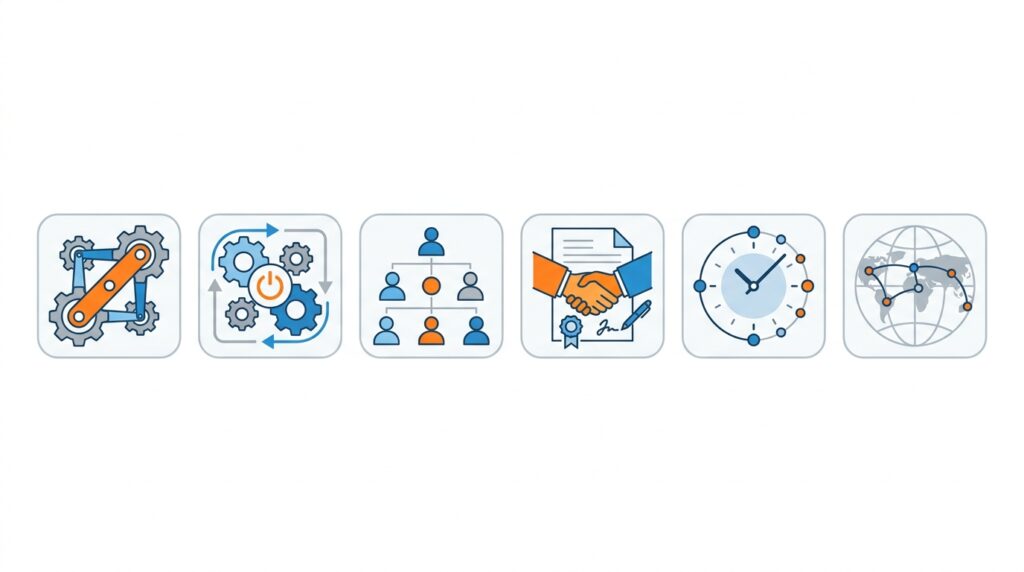
| Type | Description | Examples |
|---|---|---|
| Physical | Where equipment or structures meet | Pipe connections, foundation interfaces, cable entries |
| Functional | Where systems interact | Control signals, utility supplies, process flows |
| Organizational | Where organizations meet | Owner-contractor, contractor-contractor |
| Contractual | Where contracts meet | Scope boundaries, responsibility splits |
| Temporal | Where phases meet | Design-construction, construction-commissioning |
| Geographic | Where areas meet | Site boundaries, tie-in points |
Each type requires a different approach to management.
Interface Management Plan and Coordinator
Interface management works best when it is organized as a defined process rather than left to individual disciplines.
An interface management plan, prepared early in the project, typically defines:
- Scope and objectives: Which interfaces are covered and what the process aims to achieve.
- Roles and responsibilities: Who owns the process and who owns each interface.
- Procedures: How interfaces are identified, documented, tracked, changed, and closed.
- Meeting schedule: How often interface coordination meetings are held.
- Escalation route: How unresolved issues move up the organization.
- Reporting: What status information is reported and to whom.
An interface coordinator (or interface manager) should be named to run the process, maintain the register, chair interface meetings, and chase open items. On small projects this may be a part-time role, but it should still have a named owner.
Interface Identification
Interface identification is the first step in interface management.
Identification methods:
- Review project scope: What scopes are involved, and where do they meet?
- Review contracts: What are the scope boundaries and responsibilities?
- Review drawings: Where do disciplines and systems connect?
- Review the WBS: Where do work packages interface?
- Workshops: Bring together disciplines and contractors to identify interfaces.
- Interface register: Document identified interfaces.
Identification should be comprehensive. Missing an interface is worse than identifying too many. It should also be repeated as the design develops, since new interfaces appear as scope is refined.
The Interface Register
The interface register is the central document for interface management.
| Field | Description |
|---|---|
| Interface ID | Unique identifier |
| Description | What the interface is |
| Parties involved | Who is on each side of the interface |
| Type | Physical, functional, organizational, etc. |
| Status | Open, agreed, closed |
| Responsible party | Who owns the interface |
| Due date | When the interface must be resolved |
| Documents | Relevant drawings, specifications, agreements |
| Issues | Open issues or disagreements |
The interface register should be reviewed regularly and updated as the project progresses.
Interface Responsibility Matrix
An interface responsibility matrix maps each interface to the party responsible for defining, providing, or resolving it. It complements the interface register by making responsibilities explicit and reducing disputes.
A simple matrix lists interfaces down one axis and parties (disciplines, contractors, vendors, the owner) across the other. Each cell shows the role of that party, such as defines, provides, installs, verifies, or approves. Gaps (no one responsible) and overlaps (two parties both responsible) become visible immediately and can be corrected before they become disputes.
Interface Agreements
An interface agreement documents how an interface will be managed.
Interface agreement contents:
- Scope: What is included on each side of the interface.
- Responsibilities: Who is responsible for what.
- Technical requirements: What each party must provide.
- Schedule: When each party must deliver.
- Documentation: What documents are exchanged.
- Change process: How changes are managed.
- Dispute resolution: How disputes are resolved.
Interface agreements should be signed by both parties and treated as contractual documents.
Interface Change Control
Interfaces change as designs develop, and an uncontrolled change on one side of an interface can invalidate the other side. Changes affecting an interface should:
- Be recorded against the interface in the register.
- Be reviewed for impact on all parties to that interface.
- Be approved by the parties before implementation.
- Be communicated to affected disciplines, contractors, and vendors.
- Update the relevant drawings, models, and agreements.
Linking interface change control to the project’s formal change management process prevents changes from bypassing the people who are affected.
Interface Management in Design
Many interface issues originate in design.
Design interface management activities:
- Discipline coordination: Ensuring that disciplines coordinate their designs.
- 3D modeling and clash detection: Detecting physical clashes before construction.
- Design reviews: Reviewing designs at discipline interfaces.
- Interface control documents: Documenting design interfaces.
- Vendor data integration: Ensuring vendor data is integrated into the design.
Design interface management prevents problems before they reach the field.
3D Modeling and Clash Detection
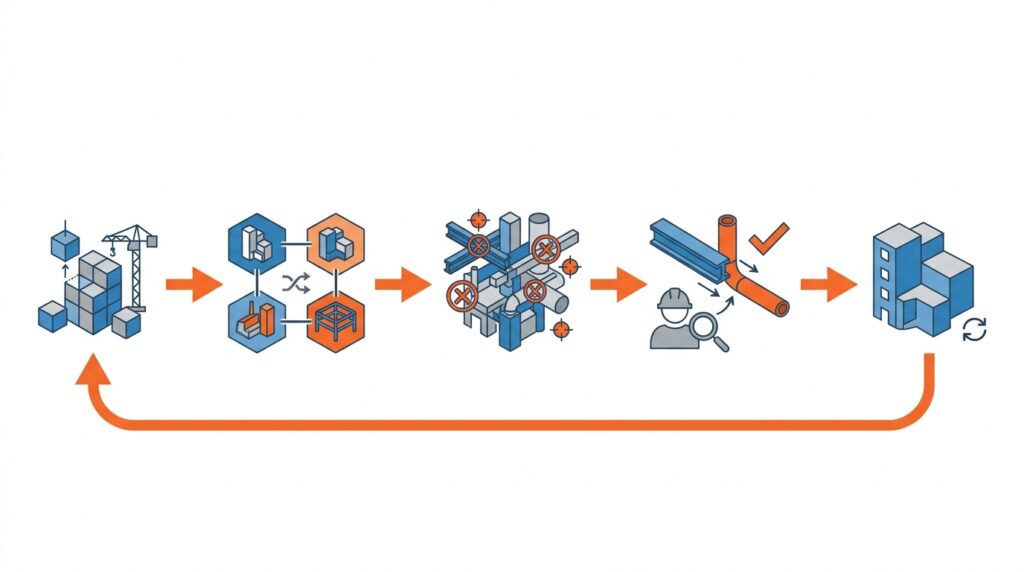
3D modeling and clash detection are key tools for interface management.
Benefits:
- Detect clashes: Identify physical clashes before construction.
- Verify clearances: Confirm that equipment and piping have adequate clearance, including access for operation and maintenance.
- Plan construction: Visualize construction sequence and access.
- Coordinate disciplines: Allow disciplines to see each other’s designs.
Clash detection process:
- Build the model: Each discipline builds its portion of the 3D model.
- Integrate the model: The models are combined into a single model.
- Run clash detection: Software identifies clashes between disciplines.
- Resolve clashes: Clashes are reviewed and resolved.
- Update the model: The model is updated as clashes are resolved.
- Repeat: Clash detection is repeated as the design progresses.
Clash detection catches problems that would otherwise be found in the field, where they are far more expensive to fix. Not every clash is a real problem, so results should be filtered and prioritized, with hard clashes (physical interference) and clearance clashes (insufficient access or space) addressed first.
Digital Tools for Interface Management
Digital tools can support interface management beyond 3D modeling. Digital tools for interface management include BIM (building information modeling) platforms, clash detection software, and project management systems with interface tracking. These tools centralize interface data and improve coordination across disciplines and contractors.
In practice, a shared environment where the interface register, models, drawings, and agreements are all linked allows each party to see the current status of any interface. Automated notifications for overdue items and dashboards for open interfaces further reduce reliance on manual follow-up.
Interface Management in Procurement
Interfaces between equipment vendors and the rest of the plant are often overlooked.
Procurement interface activities:
- Vendor data requirements: Defining what data vendors must provide.
- Interface schedules: Ensuring vendor data is delivered in time for design.
- Connection details: Confirming how vendor equipment connects to the plant.
- Utility requirements: Confirming power, water, air, and other utilities.
- Control interfaces: Confirming control signals and protocols.
- Documentation: Ensuring vendor documentation is complete.
Vendor interfaces should be defined in the purchase order and managed through the project.
Interface Management in Construction
Construction is where interface problems become visible.
Construction interface activities:
- Interface register: Maintaining the register as construction progresses.
- Coordination meetings: Regular meetings between contractors.
- Area-based planning: Planning work by area to manage interfaces.
- Handover procedures: Defining how areas are handed over between contractors.
- Inspection: Inspecting interfaces as work is completed.
- Punch lists: Addressing interface issues before handover.
Construction interface management prevents clashes, rework, and disputes.
Interface Management in Commissioning
Commissioning involves interfaces between construction and operations.
Commissioning interface activities:
- System handover: Defining how systems are handed over from construction to commissioning.
- Commissioning procedures: Defining how systems are commissioned.
- Interface testing: Testing interfaces between systems.
- Operations involvement: Involving operations in commissioning.
- Documentation: Documenting commissioning and handover.
Commissioning interfaces should be planned well before commissioning begins.
Interface Management in Brownfield Projects
Brownfield projects, meaning modifications to existing operating plants, have unique interface challenges. Tie-ins to existing systems, as-built accuracy, and coordination with ongoing operations all require careful management. Existing documentation may be inaccurate, and interfaces with operating systems must be planned around production schedules.
Practical measures include:
- Field verification: Walking down and surveying (for example, by laser scanning) to confirm as-built conditions before design is finalized.
- Tie-in planning: Identifying every tie-in early, defining its isolation requirements, and scheduling it for an available shutdown window.
- Operations coordination: Involving plant operations in planning, permits, and work scheduling.
- Safety at the interface: Assessing hazards where new work meets live systems, including isolation, energy control, and management of change.
- Documentation update: Updating existing drawings and records to reflect the modified plant.
Tie-ins missed in planning often cannot be done outside a shutdown, so they can delay the entire project.
Organizational and Contractual Interfaces
Organizational and contractual interfaces are often the most challenging.
Common organizational interfaces:
- Owner and EPC contractor: Scope, responsibilities, approvals.
- EPC contractor and subcontractors: Scope, schedule, quality.
- Multiple contractors: Coordination, handover, interfaces.
- Owner and vendors: Direct contracts, warranties, support.
Managing organizational interfaces:
- Clear scope definition: Define what each party is responsible for.
- Clear contract terms: Define interfaces in contracts.
- Regular communication: Hold regular coordination meetings.
- Escalation process: Define how issues are escalated.
- Interface agreements: Document interface agreements.
Organizational interfaces require active management, not assumptions.
Interface Closeout
Interfaces should be formally closed when both parties confirm that the interface has been defined, documented, and resolved. Closing interfaces without confirmation leaves open issues that can resurface later.
A formal closeout typically includes:
- Written confirmation from both parties that the interface requirements are met.
- Supporting evidence, such as as-built drawings, test results, or inspection records.
- Resolution or documented transfer of any open issues or punch items.
- Updating the register status to closed, with date and sign-off.
Closeout should be completed before area handover, system handover, and project completion, so that no interface is carried into operations unresolved.
Interface Management Tools
| Tool | Purpose |
|---|---|
| Interface management plan | Defines the process, roles, and procedures |
| Interface register | Central document for tracking interfaces |
| Interface responsibility matrix | Maps interfaces to responsible parties |
| Interface agreements | Document how interfaces are managed |
| 3D models | Detect physical clashes |
| Clash detection software | Identify and resolve clashes |
| Coordination meetings | Regular communication between parties |
| Interface control documents | Define design interfaces |
| Area-based planning | Manage interfaces by area |
The right tools depend on the project’s size and complexity.
Monitoring Interface Performance
Interface management should be monitored like any other project process. Useful indicators include:
- Number of interfaces open, agreed, and closed.
- Number of overdue interfaces and how long they have been open.
- Number of clashes detected and resolved, and how many remain open.
- Number of interface-related changes, RFIs, and rework events.
- Status of vendor data and interface information against schedule.
Rising counts of overdue interfaces or late clashes are early warnings that should be raised in project reviews.
Common Interface Problems
| Problem | Description | Prevention |
|---|---|---|
| Physical clashes | Equipment or piping clashes | 3D modeling; clash detection |
| Missing connections | Interfaces not defined | Interface register; reviews |
| Utility mismatches | Utilities do not match requirements | Early utility definition |
| Control incompatibilities | Control signals do not match | Control interface definition |
| Scope gaps | Work not assigned to any party | Clear scope definition; responsibility matrix |
| Scope overlaps | Work assigned to multiple parties | Clear scope definition; responsibility matrix |
| Handover problems | Areas not handed over cleanly | Handover procedures; formal closeout |
| Documentation gaps | Interface documentation missing | Interface agreements |
| Inaccurate as-builts (brownfield) | Existing conditions differ from records | Field verification; scanning |
Prevention is far cheaper than correction.
Common Mistakes in Interface Management
Even experienced organizations make mistakes. Common ones include:
- No interface management process: Interfaces not identified or managed.
- Incomplete interface identification: Missing interfaces.
- No interface register: Interfaces not documented.
- No interface agreements: Responsibilities not defined.
- No responsibility matrix: Gaps and overlaps go unnoticed.
- Poor discipline coordination: Disciplines work in isolation.
- Skipping clash detection: Physical clashes found in the field.
- Ignoring vendor interfaces: Vendor connections not defined.
- Trusting existing drawings in brownfield work: Tie-ins designed from inaccurate records.
- Poor contractor coordination: Contractors do not communicate.
- No escalation process: Issues not escalated when needed.
- Closing interfaces without confirmation: Open issues resurface later.
- Interface issues discovered late: Problems found during construction or commissioning.
These mistakes are costly to correct. They are much cheaper to avoid through disciplined interface management.
How Japanese EPC Firms Approach Interface Management
Japanese engineering firms are known for their disciplined approach to interface management. Common characteristics include:
- Thorough identification: Interfaces are identified systematically, with input from all disciplines.
- Detailed documentation: Interface registers and agreements are complete and accurate.
- Disciplined coordination: Regular meetings and coordination between disciplines and contractors.
- 3D modeling: Extensive use of 3D modeling and clash detection.
- Clear responsibilities: Scope and responsibilities are clearly defined.
- Early resolution: Interface issues are resolved early, before they affect construction.
- Formal confirmation: Interfaces are closed only after both sides confirm.
- Continuous improvement: Lessons are captured and applied.
For plant owners, this often means projects that proceed smoothly, without the clashes and disputes that plague poorly managed projects.
Capturing Lessons Learned
Interface problems tend to repeat across projects. At key milestones and at project closeout, record which interfaces caused delay or rework, why they were missed, and what would have prevented them. Feed these lessons into standard interface checklists, templates, and registers for future projects.
How to Evaluate Interface Management Readiness
| Question | Why It Matters |
|---|---|
| Is there an interface management process and plan? | Provides a structured approach |
| Is an interface coordinator named? | Gives the process an owner |
| Are interfaces identified comprehensively? | Missing interfaces cause problems |
| Is there an interface register? | Documents and tracks interfaces |
| Is there an interface responsibility matrix? | Removes gaps and overlaps |
| Are interface agreements in place? | Defines responsibilities |
| Are disciplines coordinated? | Prevents design clashes |
| Is 3D modeling and clash detection used? | Catches physical clashes before construction |
| Are vendor interfaces defined? | Prevents connection problems |
| Are brownfield tie-ins and as-built conditions verified? | Prevents surprises on operating plants |
| Are contractors coordinated? | Prevents construction conflicts |
| Is there an escalation process? | Resolves issues before they escalate |
| Are interfaces formally closed? | Prevents unresolved issues carrying forward |
| Are interfaces managed through commissioning? | Ensures smooth handover |
A plant that addresses these questions is ready for effective interface management.
Conclusion
Interface management is one of the most commonly underestimated aspects of EPC projects, and one of the most common sources of problems. For small to medium-scale industrial plants, it determines whether the project runs smoothly or gets bogged down in clashes, rework, and disputes.
By focusing on interface identification, registers, responsibility matrices, agreements, discipline coordination, 3D modeling and digital tools, vendor interfaces, brownfield tie-ins, contractor coordination, and formal closeout, owners and project teams can ensure that interfaces are managed proactively rather than discovered in the field.
Key Takeaways
- Interface management identifies, defines, and controls the points where scopes, disciplines, contractors, or systems meet.
- Interface failures are a leading cause of project problems.
- Types of interfaces include physical, functional, organizational, contractual, temporal, and geographic.
- The interface register is the central document for interface management.
- An interface responsibility matrix makes responsibilities explicit and reduces disputes.
- Interface agreements document how interfaces will be managed.
- 3D modeling, clash detection, and digital tools catch physical clashes before construction and centralize interface data.
- Vendor interfaces should be defined in the purchase order.
- Brownfield projects need field verification, tie-in planning, and coordination with operations.
- Organizational interfaces require active management.
- Interfaces should be formally closed only when both parties confirm resolution.
- Japanese EPC firms emphasize thorough identification and detailed documentation.