
When a company decides to build an industrial plant—whether it’s a biomass facility, a small thermal power plant, or a process plant—one of the first major decisions is how to structure the contract with the engineering firm. For many plant owners, the term “EPC” appears early in discussions, but its full implications are not always clear.
This guide explains what an EPC contract is, how it differs from other delivery models, and what owners of small to medium-scale plants should consider before signing.
What Does EPC Stand For?
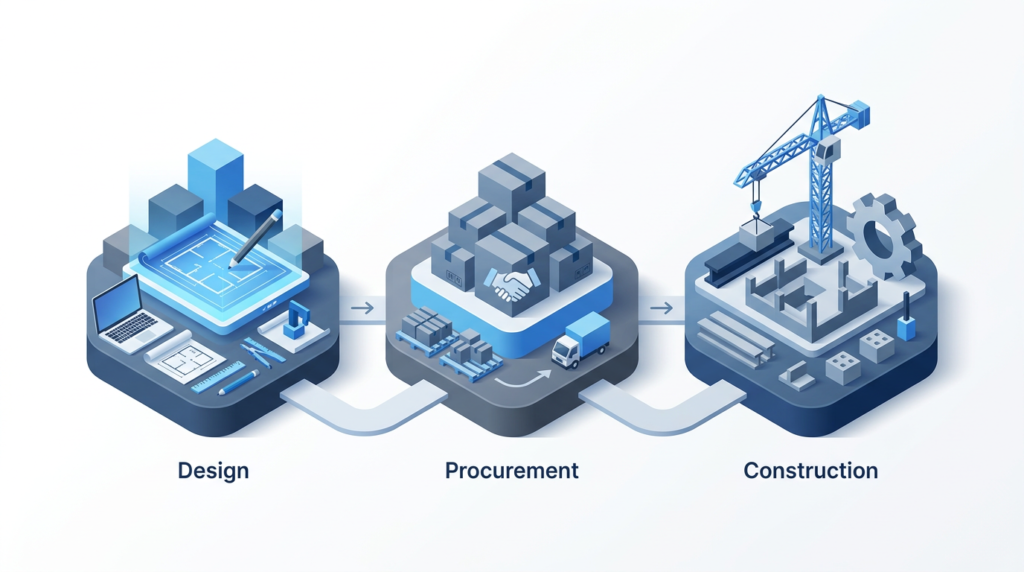
EPC stands for Engineering, Procurement, and Construction. It is a contract model in which a single contractor takes responsibility for the entire project delivery, from detailed design through to commissioning.
Under a traditional EPC arrangement, the contractor is responsible for:
-
Engineering: Detailed design, technical specifications, drawings, and engineering calculations.
-
Procurement: Sourcing and purchasing all equipment, materials, and components.
-
Construction: Civil works, erection, installation, testing, and commissioning.
The owner receives a facility that is ready to operate, often referred to as a “turnkey” delivery. In many cases, the EPC contractor also carries responsibility for performance guarantees, such as output capacity or efficiency targets.
How EPC Differs From Other Delivery Models
EPC is not the only way to deliver a plant. Understanding the alternatives helps clarify why EPC is often chosen for industrial projects.
| Delivery Model | Contractor Responsibility | Owner Risk |
|---|---|---|
| EPC / Turnkey | Design, procurement, construction | Low (single point of responsibility) |
| EPCM | Design and procurement management only; owner holds construction contracts | Medium |
| Design-Bid-Build | Separate contracts for design and construction | High (coordination risk) |
| Design-Build | Design and construction combined | Medium |
For small to medium-scale plants, EPC is often attractive because the owner does not need to manage multiple contractors or coordinate interfaces between design and construction. This reduces administrative burden and transfers much of the risk to the contractor.
Why EPC Is Common for Small to Medium-Scale Plants
Large utility-scale projects sometimes use EPCM or multi-contract models because owners have in-house engineering teams. For smaller plants, however, the owner may not have the technical staff to manage multiple contractors.
EPC offers several practical advantages:
-
Single point of responsibility: If something goes wrong, there is one party accountable.
-
Predictable cost and schedule: Most EPC contracts are lump-sum, fixed-price arrangements.
-
Reduced owner staffing needs: The contractor manages day-to-day coordination.
-
Performance guarantees: The contractor is often contractually bound to meet output or efficiency targets.
Key Elements of an EPC Contract
While every contract is negotiated, most EPC agreements share common elements. These include:
-
Scope of Work: A detailed definition of what is included—and excluded—from the contract.
-
Price and Payment Terms: Typically milestone-based payments tied to progress.
-
Schedule and Milestones: Key dates for design completion, equipment delivery, and commissioning.
-
Performance Guarantees: Targets for capacity, heat rate, emissions, or other metrics.
-
Liquidated Damages: Pre-agreed compensation if the contractor misses deadlines or performance targets.
-
Warranty and Defect Liability: The period during which the contractor must fix defects at no cost.
-
Force Majeure: Provisions for events beyond either party’s control.
For owners, the most important sections are often the scope definition and the performance guarantees, because these determine what the contractor is actually obligated to deliver.

Common Pitfalls for Plant Owners
Even with a well-drafted contract, problems can arise. Some common issues include:
-
Incomplete scope definition: Leading to disputes over what is included.
-
Unrealistic schedules: Causing pressure to cut corners during commissioning.
-
Weak performance guarantees: Allowing the contractor to avoid accountability.
-
Insufficient owner review: Failing to verify design assumptions before construction begins.
-
Poor interface management: Especially when the owner supplies certain equipment or services.
These issues are not unique to EPC contracts, but they are more consequential because the owner has less direct involvement in day-to-day execution.
How Japanese EPC Practices Differ
Japanese engineering firms are known for their emphasis on quality, safety, and long-term reliability. In EPC delivery, this often translates into:
-
Detailed front-end engineering: More time spent on design before construction begins.
-
Strong documentation: Comprehensive records for operation and maintenance.
-
Conservative design margins: Equipment sized with more margin for reliability.
-
Long-term client relationships: A focus on repeat business rather than one-off transactions.
For plant owners, working with a Japanese EPC firm or EPC support partner can mean a slower start but fewer surprises during commissioning and operation.

What to Look For in an EPC Partner
When evaluating EPC contractors or support firms, consider:
-
Experience with similar plant types and scales
-
Track record in your region or country
-
Depth of engineering staff, not just project managers
-
Willingness to share references and past project data
-
Understanding of local regulations and standards
-
Ability to provide long-term support after handover
For small to medium-scale plants, a specialized EPC support firm may offer more flexibility than a large contractor focused on utility-scale projects.
Conclusion
EPC contracts are a proven delivery model for industrial plants, particularly when the owner wants a single point of responsibility and predictable outcomes. Understanding the structure, risks, and key contract terms helps owners make better decisions and avoid common pitfalls.
If you are planning a small to medium-scale plant and considering an EPC approach, the most important step is to define your requirements clearly and select a partner with relevant experience and a commitment to quality.